REVIEW 3 major objections 6 minor 46 references
YOLO-CCA: A Context-Based Approach for Traffic Sign Detection
T0 review · 3 major / 6 minor · reviewed 2026-08-11 · deepseek-v4-flash
Pith's one-line read The paper claims that a context-collection module added to YOLOv7 raises traffic sign detection mAP from 88.2% to 92.1% on TT100K while cutting parameters by 2.7 million.
desk verdict A decent incremental YOLOv7 context-condensation adaptation whose accuracy gain is plausible but whose parameter-reduction headline is undercut by arithmetic errors in Table II. read the letter →
The pith
A machine-rendered reading of the paper's core claim, the machinery that carries it, and where it could break.
The reading
What carries the argument
The CCA module is the central mechanism: a transformer-based context collection augmentation that replaces the four ELAN sections in YOLOv7's neck. It first reduces channel count with two 3x3 stride-2 convolutions; one branch passes through LCFE, which applies dilated convolutions (rates 1, 2, 3) and adaptive spatial weighting to gather local context, and through GCFC, which predicts n key locations via a 1x1 convolution and global max pooling and collects the features there as global context. The local and global context features are concatenated into a synthesized context, processed by a transformer encoder (queries, keys, values all from the synthesized context), and the transformer output is added to the second branch and passed through a 3x3 convolution to produce the final fusion result. This design is what carries the paper's accuracy gain and parameter reduction.
What would settle it
Retrain YOLOv7 and YOLO-CCA from the same seeds with identical hyperparameters and compare the mAP distribution over several runs on TT100K; if the 3.9-point margin falls inside run-to-run variance, the claimed architectural improvement collapses.
Extended reading notes
Core claim
The central claim is that decomposing rich context into local and global parts, then fusing those parts through a transformer, improves the multi-level feature fusion of YOLOv7 enough to raise traffic sign detection accuracy while reducing cost. The local part, LCFE, runs dilated convolutions at rates 1, 2, and 3 and adaptively weights them to capture relationships between an object and its surroundings. The global part, GCFC, uses a small network to predict a fixed number of key locations in the feature map and collects and scores the features at those locations as global context. The two contexts are concatenated into a synthesized context, refined by a transformer encoder, and added back to a strided-convolution path to produce the refined fusion output. The paper presents ablations in which each module contributes a measurable mAP gain, and comparisons on TT100K and CCTSDB2021 where YOLO-CCA outperforms YOLOv7 with fewer parameters.
Load-bearing premise
The load-bearing premise is that the reported mAP gains come from the CCA modules themselves rather than from hidden differences in training conditions, random seeds, or hyperparameter tuning between YOLOv7 and YOLO-CCA.
Editorial extensions
If this is right
- A detector with 92.1% mAP@.5 on TT100K and 33.8 million parameters can run more cheaply than YOLOv7 while detecting small signs more reliably.
- Replacing ELAN blocks with context modules may lower deployment cost for traffic sign systems without sacrificing accuracy.
- The local-plus-global context decomposition gives a recipe for adding scene understanding to other one-stage detectors.
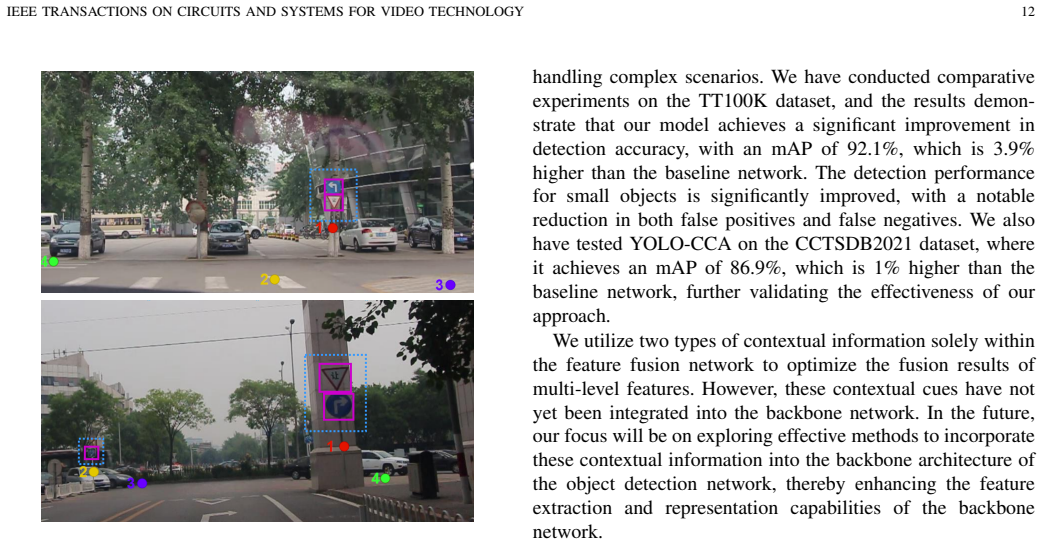
- The visualization of key global locations (roadsides, zebra crossings, turns) indicates where the network looks, offering a built-in explanation channel for detection decisions.
Reading between the lines
- The paper does not isolate whether the mAP gain comes from the transformer fusion or from the context features themselves; a version of CCA with the transformer but random key locations would distinguish these.
- The four global key locations are a very compact scene summary; if the method transfers, it would suggest that a few scene anchors are enough to inform small-object detection in structured road environments.
- The paper reports parameter counts and FLOPs; measuring wall-clock inference latency on the same GPU would determine whether the 'no additional complexity' claim holds for real-time deployment.
- If the context cues prove transferable, the same CCA modules could apply to other small-object tasks such as drone imagery or remote sensing, where scene layout also predicts object locations.
Signed reviews
Editorial analysis
A structured set of objections, weighed in public.
Referee Report
Summary. The manuscript proposes YOLO-CCA, a traffic-sign detector built on the YOLOv7 baseline. It introduces three modules: an adaptive Local Context Feature Enhancement (LCFE) module based on multi-scale dilated convolutions, a Global Context Feature Collection (GCFC) module that predicts and collects key locations in the image, and a Transformer-based Context Collection Augmentation (CCA) module that fuses the collected local and global context. The CCA module replaces the four ELAN sections of the YOLOv7 neck. On the TT100K dataset the paper reports 92.1% mAP@.5, a 3.9-point improvement over YOLOv7, with a claimed parameter reduction from 36.5M to 33.8M; on CCTSDB2021 it reports a smaller improvement of about one mAP@.5 point. The paper includes ablations separating the contributions of the Transformer, LCFE, and GCFC, and it releases source code.
Significance. Traffic-sign detection is a practical and active application area, and the core idea of replacing the computationally heavy ELAN neck blocks with a compact context-collecting Transformer is plausible and potentially useful. The ablation structure is a strength: it decomposes the contributions of the local and global context modules and the Transformer. The public code release is also a substantial plus and should allow independent verification of the reported numbers. However, the numerical support for the central efficiency claim is internally inconsistent, and the training-protocol documentation is insufficient to establish that the reported margins are due to the proposed modules rather than to uncontrolled training differences. The significance of the contribution is therefore conditional on correction of the tables and additional experimental detail.
major comments (3)
- [Section III-D, Table II, and Abstract] The parameter arithmetic in Table II is internally inconsistent. Configuration B (YOLOv7+Trans) is 32.0M, C (B+LCFE) is 33.8M, and D (B+GCFC) is 32.9M, implying that LCFE adds 1.8M and GCFC adds 0.9M over B. Configuration E (Ours, B+LCFE+GCFC) is then reported as 33.8M, the same as C, whereas additivity would give approximately 34.7M. If the modules share parameters or replace existing layers in a way that makes the additions non-additive, this must be explained explicitly; as printed, the table supports no such explanation. The 33.8M value is reused in Table III and in the Abstract to claim a 2.7M parameter reduction from the 36.5M YOLOv7 baseline; under the additive reading the reduction would be 1.8M. This directly affects a headline claim of the paper, so the parameter counts in Table II, Table III, and the Abstract need to be corrected and verified.
- [Table IV] The YOLOv5l row in Table IV lists exactly the same Precision, Recall, mAP@.5, and mAP@.5:.95 as the YOLOv5s row, while giving different parameter and FLOP values. Identical detection metrics for two models of very different sizes are not credible and indicate a copy-paste error. As printed, this row undermines the comparative table on CCTSDB2021. Please provide the correct YOLOv5l results or remove the row.
- [Section IV-B and Section IV-D] The training-protocol description is too sparse to support the comparative claims. Only the initial learning rate (0.01), cosine annealing, 300 epochs, batch size 2, and 640x640 input size are given; no random seeds, data augmentation choices, optimizer settings, warm-up schedule, EMA settings, or evaluation-time settings are reported. The ablation section states that experiments use 'the same parameters' but does not specify what those parameters are, nor does it report variance across runs. Since every conclusion in the paper rests on differences between models trained under this protocol, the authors should report the full pipeline, run the main comparisons and ablations with at least three seeds, and state whether all baseline models were trained with exactly the same procedure. Without this, the 3.9-point and 1.0-point margins could be due to uncontrolled training conditions rather than to the proposed modules.
minor comments (6)
- [Section III-A, Eqs. (1)-(3)] The notation in the LCFE equations needs cleanup: Eq. (1) says 'DialatedConv' and refers to 'LCM' while the module is called LCFE; Eq. (2) writes the fused output as a weighted sum of F1, F2, and F3, but Eq. (3) uses Fi inside the softmax in a way that is not fully defined. Please align the symbols and define F1, F2, F3, and the fusion weights clearly.
- [Table I] There are typos in the hardware/software table: 'Configuratio Inforemation' should be 'Configuration Information' and 'Operating ystem' should be 'Operating System'.
- [Fig. 8 caption] The caption says 'TT00K' but should be 'TT100K'.
- [Section IV-A.2] The description of CCTSDB2021 contains a typo ('lables') and, more importantly, no citation or URL is provided for the dataset. Please add a reference.
- [Abstract and Section V] The Abstract reports a 0.9% mAP improvement on CCTSDB2021, while Section V and Table IV report a 1.0 percentage-point improvement (85.9% to 86.9%). Please make these consistent and explain the rounding.
- [Section V] The phrase 'potential revenue for future work' should read 'potential avenues for future work'.
Circularity Check
No circularity found: the reported mAP gains are empirical outcomes against external baselines, not derived by construction from the module definitions.
full rationale
The paper's central claims (mAP 92.1% vs 88.2% for YOLOv7; 33.8M vs 36.5M parameters) are empirical measurements made on the TT100K validation set and CCTSDB2021 test set after end-to-end training, not conclusions forced by the module definitions. Equations (1)-(11) define the LCFE, GCFC, and CCA computation graphs (dilated convolutions, learned location picking, and transformer self-attention); none of these equations encode the target mAP values, and no parameter is fitted to the reported metric. The ablation in Table II and comparisons in Tables III-IV are against external baselines and standard datasets, and the claimed gains are attributable to the proposed modules only through controlled comparison. There are no self-citations to prior work by these authors, no uniqueness theorem, and no imported ansatz: the closest external source, [26], is explicitly cited as inspiration rather than as a justification that the result must hold. The only notable numerical issue is that Table II's parameter counts are internally inconsistent (B=32.0M, C=33.8M, D=32.9M imply E should be 34.7M if LCFE and GCFC add additively, not 33.8M); this is a reporting/arithmetic concern about the efficiency claim, but it is not a circularity because the mAP numbers do not depend on that arithmetic. Accordingly, the circularity score is 0.
Assumptions & free parameters
free parameters (4)
- n_key_features =
4
- dilation_rates =
[1, 2, 3]
- GCFC_proposal_conv_output_channels =
4
- CCA_conv_and_transformer_configuration =
not reported
assumptions (6)
- domain assumption Global context can be summarized by a small number (n=4) of key locations selected via global max pooling, and these locations are semantically meaningful for detecting traffic signs.
- domain assumption Multi-scale dilated convolutions with rates 1, 2, 3 capture useful local context without grid artifacts for small traffic signs.
- domain assumption YOLOv7 with the four ELAN blocks replaced by CCA preserves feature alignment, so the CCA modules receive compatible multi-level features.
- domain assumption The TT100K and CCTSDB2021 labels and the standard 45-class / 3-class protocols are correct and comparable to published results.
- ad hoc to paper Training hyperparameters (lr=0.01, cosine, 300 epochs, batch 2, input 640) are adequate for all compared models.
- standard math Standard transformer self-attention can model relationships among synthesized context features.
Cite this review
Pith. "Pith review of YOLO-CCA: A Context-Based Approach for Traffic Sign Detection." pith.science (2026). https://pith.science/paper/VK2NWIAI
@misc{pith2026241204289,
  author       = {Pith},
  title        = {Pith review of: YOLO-CCA: A Context-Based Approach for Traffic Sign Detection},
  year         = {2026},
  howpublished = {\url{https://pith.science/paper/VK2NWIAI}},
  note         = {Machine review of arXiv:2412.04289}
}
read the original abstract
Traffic sign detection is crucial for improving road safety and advancing autonomous driving technologies. Due to the complexity of driving environments, traffic sign detection frequently encounters a range of challenges, including low resolution, limited feature information, and small object sizes. These challenges significantly hinder the effective extraction of features from traffic signs, resulting in false positives and false negatives in object detection. To address these challenges, it is essential to explore more efficient and accurate approaches for traffic sign detection. This paper proposes a context-based algorithm for traffic sign detection, which utilizes YOLOv7 as the baseline model. Firstly, we propose an adaptive local context feature enhancement (LCFE) module using multi-scale dilation convolution to capture potential relationships between the object and surrounding areas. This module supplements the network with additional local context information. Secondly, we propose a global context feature collection (GCFC) module to extract key location features from the entire image scene as global context information. Finally, we build a Transformer-based context collection augmentation (CCA) module to process the collected local context and global context, which achieves superior multi-level feature fusion results for YOLOv7 without bringing in additional complexity. Extensive experimental studies performed on the Tsinghua-Tencent 100K dataset show that the mAP of our method is 92.1\%. Compared with YOLOv7, our approach improves 3.9\% in mAP, while the amount of parameters is reduced by 2.7M. On the CCTSDB2021 dataset the mAP is improved by 0.9\%. These results show that our approach achieves higher detection accuracy with fewer parameters. The source code is available at \url{https://github.com/zippiest/yolo-cca}.
Figures


Figures from the paper (7 more)


Reference graph
Works this paper leans on
-
[26]
Transformer-based context condensation for boosting feature pyramids in object detection,
Z. Chen, J. Zhang, Y . Xu, and D. Tao, “Transformer-based context condensation for boosting feature pyramids in object detection,” Inter- national Journal of Computer Vision , pp. 1–19, 2023
work page 2023
-
[1]
X. Chang, B. Y . Chen, Q. Li, X. Cui, L. Tang, and C. Liu, “Esti- mating real-time traffic carbon dioxide emissions based on intelligent transportation system technologies,” IEEE Transactions on Intelligent Transportation Systems, vol. 14, no. 1, pp. 469–479, 2012
work page 2012
-
[2]
Towards real-time traffic sign detection and classification,
Y . Yang, H. Luo, H. Xu, and F. Wu, “Towards real-time traffic sign detection and classification,” IEEE Transactions on Intelligent Trans- portation systems, vol. 17, no. 7, pp. 2022–2031, 2015
work page 2022
-
[3]
Road-sign detection and recognition based on support vector machines,
S. Maldonado-Basc ´on, S. Lafuente-Arroyo, P. Gil-Jimenez, H. G ´omez- Moreno, and F. L ´opez-Ferreras, “Road-sign detection and recognition based on support vector machines,” IEEE Transactions on Intelligent Transportation Systems, vol. 8, no. 2, pp. 264–278, 2007
work page 2007
-
[4]
Traffic sign segmentation and classification using statistical learning methods,
J. Lillo-Castellano, I. Mora-Jim ´enez, C. Figuera-Pozuelo, and J. L. Rojo- ´Alvarez, “Traffic sign segmentation and classification using statistical learning methods,” Neurocomputing, vol. 153, pp. 286–299, 2015
work page 2015
-
[5]
Color exploitation in hog-based traffic sign detection,
I. M. Creusen, R. G. Wijnhoven, E. Herbschleb, and P. de With, “Color exploitation in hog-based traffic sign detection,” in 2010 IEEE International Conference on Image Processing. IEEE, 2010, pp. 2669– 2672
work page 2010
-
[6]
D. Nandi, A. S. Saif, P. Prottoy, K. M. Zubair, and S. A. Shubho, “Traffic sign detection based on color segmentation of obscure image candidates: a comprehensive study,”International Journal of Modern Education and Computer Science, vol. 10, no. 6, p. 35, 2018
work page 2018
-
[7]
Fast traffic sign recognition with a rotation invariant binary pattern based feature,
S. Yin, P. Ouyang, L. Liu, Y . Guo, and S. Wei, “Fast traffic sign recognition with a rotation invariant binary pattern based feature,” Sensors, vol. 15, no. 1, pp. 2161–2180, 2015
work page 2015
Show all 46 references
-
[8]
Rich feature hierarchies for accurate object detection and semantic segmentation,
R. Girshick, J. Donahue, T. Darrell, and J. Malik, “Rich feature hierarchies for accurate object detection and semantic segmentation,” in IEEE Conference on Computer Vision and Pattern Recognition , 2014, pp. 580–587
2014
-
[9]
Faster R-CNN: Towards real-time object detection with region proposal networks,
S. Ren, K. He, R. Girshick, and J. Sun, “Faster R-CNN: Towards real-time object detection with region proposal networks,” Advances in Neural Information Processing Systems , vol. 28, 2015
2015
-
[10]
Cascade R-CNN: High quality object detection and instance segmentation,
Z. Cai and N. Vasconcelos, “Cascade R-CNN: High quality object detection and instance segmentation,” IEEE Transactions on Pattern Analysis and Machine Intelligence, vol. 43, no. 5, pp. 1483–1498, 2019
2019
-
[11]
Mask R-CNN,
K. He, G. Gkioxari, P. Doll ´ar, and R. Girshick, “Mask R-CNN,” in IEEE International Conference on Computer Vision , 2017, pp. 2961–2969
2017
-
[12]
SSD: Single shot multibox detector,
W. Liu, D. E. Dragomir Anguelov, C. Szegedy, S. Reed, C.-Y . Fu, and A. C. Berg, “SSD: Single shot multibox detector,” arXiv preprint arXiv:1512.02325, 2015
2015 arXiv
-
[13]
DSSD: Deconvolutional single shot detector,
C.-Y . Fu, W. Liu, A. Ranga, A. Tyagi, and A. C. Berg, “DSSD: Deconvolutional single shot detector,” arXiv preprint arXiv:1701.06659, 2017
2017 arXiv
-
[14]
You only look once: Unified, real-time object detection,
J. Redmon, S. Divvala, R. Girshick, and A. Farhadi, “You only look once: Unified, real-time object detection,” in IEEE Conference on Computer Vision and Pattern Recognition , 2016, pp. 779–788. IEEE TRANSACTIONS ON CIRCUITS AND SYSTEMS FOR VIDEO TECHNOLOGY 13
2016
-
[15]
Yolo9000: better, faster, stronger,
J. Redmon and A. Farhadi, “Yolo9000: better, faster, stronger,” in IEEE Conference on Computer Vision and Pattern Recognition , 2017, pp. 7263–7271
2017
-
[16]
Yolov3: An incremental improvement,
F. Redmon, Joseph and Ali, “Yolov3: An incremental improvement,” arXiv preprint arXiv:1804.02767 , 2018
2018 arXiv
-
[17]
Ultralytics yolov5,
G. Jocher, A. Chaurasia, A. Stoken, J. Borovec, Y . Kwon, J. Fang, K. Michael, D. Montes, J. Nadar, P. Skalski et al., “Ultralytics yolov5,” Available: https://github.com/ultralytics/yolov5., 2020
2020
-
[18]
Yolov6: A single-stage object detection framework for industrial applications,
C. Li, L. Li, H. Jiang, K. Weng, Y . Geng, L. Li, Z. Ke, Li et al., “Yolov6: A single-stage object detection framework for industrial applications,” arXiv preprint arXiv:2209.02976 , 2022
2022 arXiv
-
[19]
Yolov7: Trainable bag-of-freebies sets new state-of-the-art for real-time object detectors,
C.-Y . Wang, A. Bochkovskiy, and H.-Y . M. Liao, “Yolov7: Trainable bag-of-freebies sets new state-of-the-art for real-time object detectors,” in IEEE/CVF Conference on Computer Vision and Pattern Recognition , 2023, pp. 7464–7475
2023
-
[20]
Feature pyramid networks for object detection,
T.-Y . Lin, P. Doll´ar, R. Girshick, K. He, B. Hariharan, and S. Belongie, “Feature pyramid networks for object detection,” in IEEE Conference on Computer Vision and Pattern Recognition , 2017, pp. 2117–2125
2017
-
[21]
Multi-level feature fusion pyramid network for object detection,
Z. Guo, H. Shuai, G. Liu, Y . Zhu, and W. Wang, “Multi-level feature fusion pyramid network for object detection,” The Visual Computer , vol. 39, no. 9, pp. 4267–4277, 2023
2023
-
[22]
Realize your surroundings: Exploiting context information for small object detection,
J. Leng, Y . Ren, W. Jiang, X. Sun, and Y . Wang, “Realize your surroundings: Exploiting context information for small object detection,” Neurocomputing, vol. 433, pp. 287–299, 2021
2021
-
[23]
Hybrid task cascade for instance segmentation,
K. Chen, J. Pang, J. Wang, Y . Xiong, X. Li, S. Sun, W. Feng, Z. Liu, J. Shi, W. Ouyang et al. , “Hybrid task cascade for instance segmentation,” in IEEE Conference on Computer Vision and Pattern Recognition, 2019, pp. 4974–4983
2019
-
[24]
Efficient context-guided stacked refinement network for rgb-t salient object detection,
F. Huo, X. Zhu, L. Zhang, Q. Liu, and Y . Shu, “Efficient context-guided stacked refinement network for rgb-t salient object detection,” IEEE Transactions on Circuits and Systems for Video Technology , vol. 32, no. 5, pp. 3111–3124, 2022
2022
-
[25]
Cam- ouflaged object detection via context-aware cross-level fusion,
G. Chen, S.-J. Liu, Y .-J. Sun, G.-P. Ji, Y .-F. Wu, and T. Zhou, “Cam- ouflaged object detection via context-aware cross-level fusion,” IEEE Transactions on Circuits and Systems for Video Technology , vol. 32, no. 10, pp. 6981–6993, 2022
2022
-
[27]
Cbam: Convolutional block attention module,
S. Woo, J. Park, J.-Y . Lee, and I. S. Kweon, “Cbam: Convolutional block attention module,” in Proceedings of the European Conference on Computer Vision, September 2018
2018
-
[28]
Attentional feature fusion,
Y . Dai, F. Gieseke, S. Oehmcke, Y . Wu, and K. Barnard, “Attentional feature fusion,” in Proceedings of the IEEE/CVF Winter Conference on Applications of Computer Vision (WACV), January 2021, pp. 3560–3569
2021
-
[29]
Gather-excite: Exploiting feature context in convolutional neural networks,
J. Hu, L. Shen, S. Albanie, G. Sun, and A. Vedaldi, “Gather-excite: Exploiting feature context in convolutional neural networks,” Neural Information Processing Systems , Jan 2018
2018
-
[30]
Hierarchical multi-scale attention for semantic segmentation,
A. Tao, K. Sapra, and B. Catanzaro, “Hierarchical multi-scale attention for semantic segmentation,” Computer Vision and Pattern Recognition , May 2020
2020
-
[31]
A real-time chinese traffic sign detection algorithm based on modified yolov2,
J. Zhang, M. Huang, X. Jin, and X. Li, “A real-time chinese traffic sign detection algorithm based on modified yolov2,” Algorithms, vol. 10, no. 4, p. 127, 2017
2017
-
[32]
Traffic object detection and recognition based on the attentional visual field of drivers,
M. Shirpour, N. Khairdoost, M. A. Bauer, and S. S. Beauchemin, “Traffic object detection and recognition based on the attentional visual field of drivers,” IEEE Transactions on Intelligent Vehicles , vol. 8, no. 1, pp. 594–604, 2021
2021
-
[33]
Traffic sign detection and recognition in multiimages using a fusion model with yolo and vgg network,
J. Yu, X. Ye, and Q. Tu, “Traffic sign detection and recognition in multiimages using a fusion model with yolo and vgg network,” IEEE Transactions on Intelligent Transportation Systems , vol. 23, no. 9, pp. 16 632–16 642, 2022
2022
-
[34]
Mfl-yolo: An object detection model for damaged traffic signs,
T. Chen and J. Ren, “Mfl-yolo: An object detection model for damaged traffic signs,” arXiv preprint arXiv:2309.06750 , 2023
2023 arXiv
-
[35]
Vehicle- mounted adaptive traffic sign detector for small-sized signs in multiple working conditions,
J. Wang, Y . Chen, X. Ji, Z. Dong, M. Gao, and C. S. Lai, “Vehicle- mounted adaptive traffic sign detector for small-sized signs in multiple working conditions,” IEEE Transactions on Intelligent Transportation Systems, vol. 25, no. 1, pp. 710–724, 2024
2024
-
[36]
Automatic traffic sign detection and recognition using segu-net and a modified tversky loss function with l1-constraint,
U. Kamal, T. I. Tonmoy, S. Das, and M. K. Hasan, “Automatic traffic sign detection and recognition using segu-net and a modified tversky loss function with l1-constraint,” IEEE Transactions on Intelligent Transportation Systems, vol. 21, no. 4, pp. 1467–1479, 2020
2020
-
[37]
Rs-lane: A robust lane detection method based on resnest and self-attention distillation for challenging traffic situations,
R. Zhang, Y . Wu, W. Gou, and J. Chen, “Rs-lane: A robust lane detection method based on resnest and self-attention distillation for challenging traffic situations,” Journal of Advanced Transportation , vol. 2021, pp. 1–12, 2021
2021
-
[38]
Attention-based neural network for traffic sign detection,
J. Zhang, L. Hui, J. Lu, and Y . Zhu, “Attention-based neural network for traffic sign detection,” in 2018 24th International Conference on Pattern Recognition (ICPR). IEEE, 2018, pp. 1839–1844
2018
-
[39]
Traffic sign recognition with lightweight two-stage model in complex scenes,
Z. Wang, J. Wang, Y . Li, and S. Wang, “Traffic sign recognition with lightweight two-stage model in complex scenes,” IEEE Transactions on Intelligent Transportation Systems, vol. 23, no. 2, pp. 1121–1131, 2020
2020
-
[40]
Long- tailed traffic sign detection using attentive fusion and hierarchical group softmax,
E. Gao, W. Huang, J. Shi, X. Wang, J. Zheng, G. Du, and Y . Tao, “Long- tailed traffic sign detection using attentive fusion and hierarchical group softmax,” IEEE Transactions on Intelligent Transportation Systems , vol. 23, no. 12, pp. 24 105–24 115, 2022
2022
-
[41]
Ultralytics yolov8,
G. Jocher, “Ultralytics yolov8,” https://github.com/ultralytics/ultralytics, 2023
2023
-
[42]
Yolov10: Real-time end-to-end object detection,
A. Wang, H. Chen, L. Liu, K. Chen, Z. Lin, J. Han, and G. Ding, “Yolov10: Real-time end-to-end object detection,” arXiv preprint arXiv:2405.14458, 2024
2024 arXiv
-
[43]
Context-aware convolutional neural network for object detection in vhr remote sensing imagery,
Y . Gong, Z. Xiao, X. Tan, H. Sui, C. Xu, H. Duan, and D. Li, “Context-aware convolutional neural network for object detection in vhr remote sensing imagery,” IEEE Transactions on Geoscience and Remote Sensing, vol. 58, no. 1, pp. 34–44, 2020
2020
-
[44]
Recursive context routing for object detection,
Z. Chen, J. Zhang, and D. Tao, “Recursive context routing for object detection,” International Journal of Computer Vision , vol. 129, no. 1, pp. 142–160, 2021
2021
-
[45]
V ote-based 3d object detection with context modeling and sob-3dnms,
Q. Xie, Y .-K. Lai, J. Wu, Z. Wang, Y . Zhang, K. Xu, and J. Wang, “V ote-based 3d object detection with context modeling and sob-3dnms,” International Journal of Computer Vision , vol. 129, pp. 1857–1874, 2021
2021
-
[46]
Crnet: Context-guided reasoning network for detecting hard objects,
J. Leng, Y . Liu, X. Gao, and Z. Wang, “Crnet: Context-guided reasoning network for detecting hard objects,” IEEE Transactions on Multimedia , vol. 26, pp. 3765–3777, 2024
2024
Reviewed August 11, 2026 · model on record in the stance chip above.
Discussion (0). Continue with ORCID to comment.