REVIEW 4 minor 2 cited by
Search for heavy neutral resonances decaying to tau lepton pairs in proton-proton collisions at $\sqrt{s}$ = 13 TeV
T0 review · 0 major / 4 minor · reviewed 2026-08-11 · deepseek-v4-flash
Pith's one-line read This paper reports a search for heavy neutral $Z'$ bosons decaying to tau lepton pairs in 138 fb$^{-1}$ of 13 TeV proton-proton collisions, finds the data consistent with standard model predictions, and excludes a sequential standard…
desk verdict A solid, incremental Run-2 search: no signal, and the tau-pair Z' exclusion improves from about 2.4 to 3.5 TeV in the SSM, based on a careful three-channel combination of the full 138 fb^-1 dataset. read the letter →
The pith
A machine-rendered reading of the paper's core claim, the machinery that carries it, and where it could break.
The reading
What carries the argument
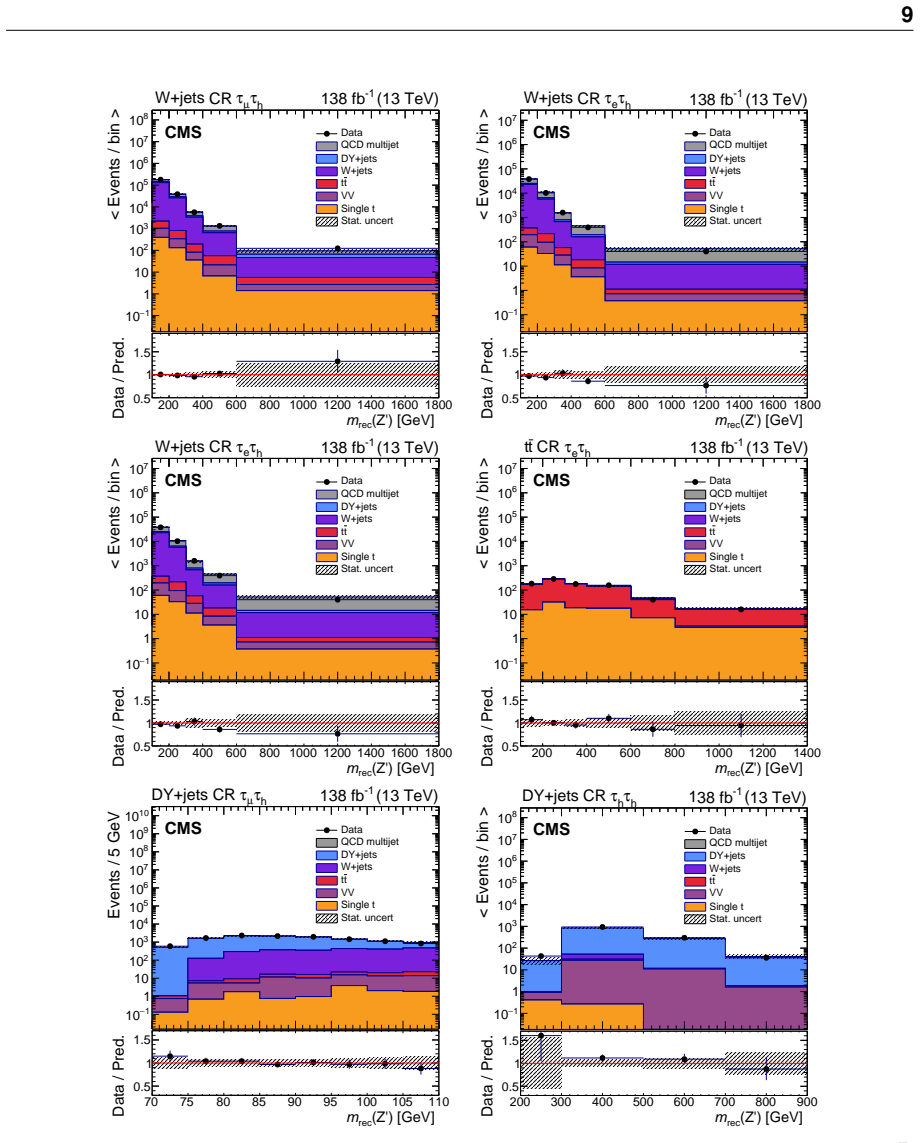
The discriminating variable is the reconstructed $Z'$ mass estimator $m_{\mathrm{rec}}(Z') = \sqrt{ (E^{\tau\mathrm{vis}}_1 + E^{\tau\mathrm{vis}}_2 + |\mathbf{p}^{Z'\mathrm{miss}}_T|)^2 - |\mathbf{p}^{\tau\mathrm{vis}}_1 + \mathbf{p}^{\tau\mathrm{vis}}_2 + \mathbf{p}^{Z'\mathrm{miss}}|^2 }$, built from the visible products of the two tau decays plus an assumed neutrino momentum that balances the visible transverse momentum. This estimator is used as the fit discriminant in a profile maximum-likelihood fit to extract the signal yield. Standard model backgrounds come from simulation rescaled by data-measured scale factors, while the QCD multijet background is estimated with an ABCD method whose transfer factors are fitted as first-order polynomials in $m_{\mathrm{rec}}(Z')$ to assign the shape uncertainty.
What would settle it
Measure the QCD transfer factor $N_C/N_D$ in finely binned $m_{\mathrm{rec}}(Z')$ intervals using a high-statistics validation region with low missing transverse momentum; if the measured transfer factor deviates from the first-order polynomial by more than the quoted shape uncertainty in the signal region, the background prediction and the derived limit would need to be revised.
Extended reading notes
Core claim
The central result is a null observation: after a maximum-likelihood fit to the reconstructed mass estimator $m_{\mathrm{rec}}(Z')$ in the $\tau_\mu\tau_h$, $\tau_e\tau_h$, and $\tau_h\tau_h$ channels, the data are consistent with standard model expectation. The resulting 95% confidence level upper limits on $\sigma(pp\to Z')\,\mathcal{B}(Z'\to\tau^+\tau^-)$ exclude a sequential standard model $Z'$ with mass below 3.5 TeV; for tau-pair branching fractions of 1% and 10%, the excluded masses are 3.0 TeV and 4.1 TeV, respectively. The $\tau_h\tau_h$ channel dominates the sensitivity over most of the mass range, while the mixed $\tau_\mu\tau_h$ and $\tau_e\tau_h$ channels become competitive at $Z'$ masses of 4–5 TeV because the hadronic tau identification efficiency degrades for highly boosted decays.
Load-bearing premise
The load-bearing premise is that the QCD multijet background in the signal region can be extrapolated from an ABCD sideband using transfer factors that are fitted as first-order polynomials in the reconstructed mass; if those transfer factors curve nonlinearly with mass, the background shape and the derived 95% confidence level limit would be biased.
Editorial extensions
If this is right
- Any sequential standard model $Z'$ boson with $Z$-like couplings and mass below 3.5 TeV is excluded at 95% confidence level, improving the previous tau-pair bound.
- The published limits on $\sigma\mathcal{B}(Z'\to\tau^+\tau^-)$ as a function of $m_{Z'}$ let any model prediction be tested against the data directly.
- Models predicting a tau-pair branching fraction of 1% are excluded below 3.0 TeV, and those predicting 10% are excluded below 4.1 TeV.
- The $\tau_h\tau_h$ channel gives the dominant sensitivity across most of the mass range, while at 4–5 TeV the mixed channels take over because of tau identification efficiency at high boost.
- No channel shows a significant excess, so the observations are consistent with the standard model background prediction in every mass bin.
Reading between the lines
- Indirectly, the null result tightens constraints on models with nonuniversal couplings to third-generation fermions, since those predict an enhanced tau-pair rate relative to the standard model $Z$.
- A testable extension is to reinterpret the HEPData tables in models with $Z$-$Z'$ interference or with mass-dependent couplings; the paper notes interference effects are small for the benchmark range.
- With the higher luminosity of the high-luminosity LHC, the same reconstructed-mass estimator and background strategy should push the tau-pair exclusion toward higher masses, assuming the QCD transfer-factor systematics do not grow with reach.
- The estimator's reliance on transverse-momentum balance could be reused in searches for similar resonances in final states with only one visible tau and missing energy, where the neutrino momentum is even less constrained.
Editorial analysis
A structured set of objections, weighed in public.
Referee Report
Summary. This paper reports a search for narrow heavy neutral resonances (Z') decaying to tau lepton pairs using 138 fb^-1 of proton-proton collision data at sqrt(s)=13 TeV recorded by CMS. Three final states are analyzed: tau_mu tau_h, tau_e tau_h, and tau_h tau_h. The discriminating variable is an approximated reconstructed mass m_rec(Z') built from the visible tau decay products and the inferred neutrino transverse momentum. Backgrounds are estimated from simulation normalized with data control regions, with a data-driven ABCD method for QCD multijet production. A binned maximum-likelihood fit to the m_rec(Z') distributions finds the observed yields consistent with the standard-model expectation. Upper limits at 95% CL are set on sigma B(Z' -> tau tau) as a function of m_Z', and in the sequential standard model scenario a Z' with mass below 3.5 TeV is excluded, the most stringent limit to date from this type of search.
Significance. If the result holds, it provides the strongest direct constraint on heavy neutral resonances decaying to tau lepton pairs, extending previous ditau bounds by roughly 1 TeV. The analysis has clear strengths: three decay channels are combined with per-year scale factors, the systematic uncertainties are documented and correlated appropriately, the limit-setting procedure uses the standard CLs method implemented in the CMS combine tool, and tabulated results are provided in HEPData. The background model is data-driven for the dominant QCD component in the tau_h tau_h channel and simulation-based with control-region scale factors for the electroweak backgrounds. The principal methodological caveat, the extrapolation of ABCD transfer factors from low to high pTmiss and from low to high m_rec, is explicitly quantified and is shown to have only small impact on the central exclusion because the QCD multijet fraction is small in the high-m_rec region that governs the 3.5 TeV bound.
minor comments (4)
- [Section 7.1 and Section 8] The QCD ABCD method is validated only in a low-pTmiss sideband (pTmiss < 30 GeV), and the lack-of-correlation check is documented for the hadronic di-tau channel, while the signal-region transfer factors are used for the lepton+tau channels and for pTmiss > 30 GeV; a sentence explaining why the low-pTmiss validation is sufficient, or a cross-check in a high-pTmiss sideband, would increase confidence in the QCD background model.
- [Section 2, Eq. (1)] The symbols pZ'miss and p tau_vis_i are used both as three-vectors and as magnitudes in the same expression; adding explicit vector notation and defining E_tau_vis_i as the visible energy of each tau daughter would remove ambiguity.
- [Section 5] The sentence stating that the theoretical decay width increases with g_tau but remains smaller than the experimental resolution (<30%) should specify that this is the width relative to the Z' mass, since Section 2 quotes a <3% relative width for the SSM scenario; otherwise the two statements appear inconsistent.
- [Section 8] The description of the QCD transfer-factor shape uncertainty would be clearer if it stated explicitly that the uncertainty is taken as the full deviation of the fitted first-order polynomial from unity, rather than the statistical uncertainty of the fit, given that the quoted shape uncertainties (up to 150%) are much larger than the transfer-factor statistical uncertainties quoted in the same section.
Circularity Check
No significant circularity: the null observation and exclusion limits follow from a direct comparison of data to a background-only prediction with Monte Carlo signal templates.
full rationale
The paper's central result is an observed agreement with the standard model background and an exclusion limit on sigma times branching fraction for a Z' boson. The derivation chain is self-contained: signal templates are generated from Monte Carlo at fixed mass points with stated coupling assumptions; background estimates come from simulation normalized with data-derived scale factors from dedicated control regions, plus an ABCD method for QCD multijet backgrounds. No parameter is fitted to the signal region and then renamed as a prediction: the signal strength is a free parameter in a maximum likelihood fit to the m_rec(Z') distributions, and the observed limits follow from the absence of an excess. The only near-candidate concerns are the ABCD transfer factors fitted as first-order polynomials in m_rec and extrapolated to high mass, but the paper explicitly quantifies the resulting shape uncertainties (up to 150% at high m_rec) and argues that the QCD fraction is small there; this is a systematic-uncertainty limitation, not circularity. The self-citations to previous CMS searches are contextual and not load-bearing: the exclusion limit is derived from data in this paper, not imported from prior work. No equation in the paper defines the output in terms of the input, and no fitted input is relabeled as a prediction. Accordingly, the circularity score is 0.
Assumptions & free parameters
free parameters (2)
- Background scale factors (DY, W+jets, tt) per channel and year =
e.g., DY tau_mu tau_h: 0.98, 0.91, 0.90
- QCD multijet transfer factors =
fitted to first-order polynomial; values not given in text
assumptions (3)
- domain assumption Standard model backgrounds are correctly described by simulation after applying data-derived scale factors
- domain assumption The sequential standard model with fermion couplings equal to the Z boson and B(Z' to tau tau) = 3% is used for the exclusion claim
- domain assumption The reconstructed mass m_rec discriminates between signal and background
Cite this review
Pith. "Pith review of Search for heavy neutral resonances decaying to tau lepton pairs in proton-proton collisions at $\sqrt{s}$ = 13 TeV." pith.science (2026). https://pith.science/paper/E5YYSYYL
@misc{pith2026241204357,
  author       = {Pith},
  title        = {Pith review of: Search for heavy neutral resonances decaying to tau lepton pairs in proton-proton collisions at $\sqrts$ = 13 TeV},
  year         = {2026},
  howpublished = {\url{https://pith.science/paper/E5YYSYYL}},
  note         = {Machine review of arXiv:2412.04357}
}
abstract
A search for heavy neutral gauge bosons (Z') decaying into a pair of tau leptons is performed in proton-proton collisions at $\sqrt{s}$ = 13 TeV at the CERN LHC. The data were collected with the CMS detector and correspond to an integrated luminosity of 138 fb$^{-1}$. The observations are found to be in agreement with the expectation from standard model processes. Limits at 95% confidence level are set on the product of the Z' production cross section and its branching fraction to tau lepton pairs for a range of Z' boson masses. For a narrow resonance in the sequential standard model scenario, a Z' boson with a mass below 3.5 TeV is excluded. This is the most stringent limit to date from this type of search.
Figures


Figures from the paper (1 more)

Forward citations
Cited by 2 Pith papers
-
Combination of searches for heavy vector boson resonances in proton-proton collisions at $\sqrt{s}$ = 13 TeV
A CMS combination of searches finds no heavy vector boson resonance and excludes HVT W′/Z′ bosons below 5.5 TeV (weak coupling), 4.8 TeV (strong coupling), and 2.0 TeV for VBF production at 95% CL.
-
Search for a new neutral gauge boson produced in association with one or two b jets and decaying into a pair of muons in proton-proton collisions at $\sqrt{s}$ = 13 TeV
No Z' boson decaying to muon pairs and produced with b jets appears in 138 fb⁻¹ of CMS data, yielding first 95% CL limits of 0.2–2 fb on σ×B×A×ε across 125–350 GeV.
Reference graph
Works this paper leans on
-
[1]
CMS Collaboration, “Search for resonant and nonresonant new phenomena in high-mass References 15 dilepton final states at √s= 13 TeV”,JHEP07(2021) 208, doi:10.1007/JHEP07(2021)208,arXiv:2103.02708
arXiv 2021
-
[2]
Implications of E6 grand unification
P . K. Mohapatra, R. N. Mohapatra, and P . B. Pal, “Implications of E6 grand unification”, Phys. Rev. D33(1986) 2010,doi:10.1103/PhysRevD.33.2010
-
[3]
D. London and J. L. Rosner, “Extra gauge bosons in E 6”,Phys. Rev. D34(1986) 1530, doi:10.1103/PhysRevD.34.1530
-
[4]
Large mass hierarchy from a small extra dimension
L. Randall and R. Sundrum, “Large mass hierarchy from a small extra dimension”,Phys. Rev. Lett.83(1999) 3370,doi:10.1103/PhysRevLett.83.3370
-
[5]
ATLAS Collaboration, “Search for high-mass dilepton resonances using 139 fb −1 of pp collision data collected at √s=13 TeV with the ATLAS detector”,Phys. Lett. B796(2019) 68,doi:10.1016/j.physletb.2019.07.016,arXiv:1903.06248
arXiv 2019
-
[6]
The physics of heavyZ ′ gauge bosons
P . Langacker, “The physics of heavyZ ′ gauge bosons”,Rev. Mod. Phys.81(2009) 1199, doi:10.1103/RevModPhys.81.1199,arXiv:0801.1345
arXiv 2009
-
[7]
FindingZ ′ bosons coupled preferentially to the third family at LEP and the Tevatron
K. R. Lynch, E. H. Simmons, M. Narain, and S. Mrenna, “FindingZ ′ bosons coupled preferentially to the third family at LEP and the Tevatron”,Phys. Rev. D63(2001) 035006,doi:10.1103/PhysRevD.63.035006,arXiv:hep-ph/0007286
arXiv 2001
-
[8]
ATLAS Collaboration, “Search for additional heavy neutral Higgs and gauge bosons in the ditau final state produced in 36 fb−1 of pp collisions at √s=13 TeV with the ATLAS detector”,JHEP01(2018) 055,doi:10.1007/JHEP01(2018)055, arXiv:1709.07242
arXiv 2018
Show all 80 references
-
[9]
Search for heavy resonances decaying to tau lepton pairs in proton-proton collisions at √s=13 TeV
CMS Collaboration, “Search for heavy resonances decaying to tau lepton pairs in proton-proton collisions at √s=13 TeV”,JHEP02(2017) 048, doi:10.1007/JHEP02(2017)048,arXiv:1611.06594
2017 arXiv
-
[10]
Search for new resonances in mass distributions of jet pairs using 139 fb−1 ofppcollisions at √s=13 TeV with the ATLAS detector
ATLAS Collaboration, “Search for new resonances in mass distributions of jet pairs using 139 fb−1 ofppcollisions at √s=13 TeV with the ATLAS detector”,JHEP03(2020) 145, doi:10.1007/JHEP03(2020)145,arXiv:1910.08447
2020 arXiv
-
[11]
Search for narrow resonances in the b-tagged dijet mass spectrum in proton-proton collisions at s=13 TeV
CMS Collaboration, “Search for narrow resonances in the b-tagged dijet mass spectrum in proton-proton collisions at s=13 TeV”,Phys. Rev. D108(2023) 012009, doi:10.1103/PhysRevD.108.012009,arXiv:2205.01835
2023 arXiv
-
[12]
Evidence for an excess of ¯B→D (∗) τ− ¯ντ decays
BaBar Collaboration, “Evidence for an excess of ¯B→D (∗) τ− ¯ντ decays”,Phys. Rev. Lett. 109(2012) 101802,doi:10.1103/PhysRevLett.109.101802,arXiv:1205.5442
2012 arXiv
-
[13]
Measurement of an excess of ¯B→D (∗) τ− ¯ντ decays and implications for charged Higgs bosons
BaBar Collaboration, “Measurement of an excess of ¯B→D (∗) τ− ¯ντ decays and implications for charged Higgs bosons”,Phys. Rev. D88(2013) 072012, doi:10.1103/PhysRevD.88.072012,arXiv:1303.0571
2013 arXiv
-
[14]
Measurement of the branching ratio of ¯B→D (∗) τ− ¯ντ relative to ¯B→D (∗)ℓ− ¯νℓ decays with hadronic tagging at Belle
Belle Collaboration, “Measurement of the branching ratio of ¯B→D (∗) τ− ¯ντ relative to ¯B→D (∗)ℓ− ¯νℓ decays with hadronic tagging at Belle”,Phys. Rev. D92(2015) 072014, doi:10.1103/PhysRevD.92.072014,arXiv:1507.03233
2015 arXiv
-
[15]
Measurement of the ratio of branching fractions B( ¯B0 →D ∗+τ− ¯ντ)/B( ¯B0 →D ∗+µ− ¯νµ)
LHCb Collaboration, “Measurement of the ratio of branching fractions B( ¯B0 →D ∗+τ− ¯ντ)/B( ¯B0 →D ∗+µ− ¯νµ)”,Phys. Rev. Lett.115(2015) 111803, doi:10.1103/PhysRevLett.115.111803,arXiv:1506.08614. [Erratum: doi:10.1103/PhysRevLett.115.159901]. 16
2015
-
[16]
Measurement of the branching ratio of ¯B0 →D ∗+τ− ¯ντ relative to ¯B0 →D ∗+ℓ− ¯νℓ decays with a semileptonic tagging method
Belle Collaboration, “Measurement of the branching ratio of ¯B0 →D ∗+τ− ¯ντ relative to ¯B0 →D ∗+ℓ− ¯νℓ decays with a semileptonic tagging method”,Phys. Rev. D94(2016) 072007,doi:10.1103/PhysRevD.94.072007,arXiv:1607.07923
2016 arXiv
-
[17]
Measurement of theτlepton polarization andR(D ∗)in the decay ¯B→D ∗τ− ¯ντ
Belle Collaboration, “Measurement of theτlepton polarization andR(D ∗)in the decay ¯B→D ∗τ− ¯ντ”,Phys. Rev. Lett.118(2017) 211801, doi:10.1103/PhysRevLett.118.211801,arXiv:1612.00529
2017 arXiv
-
[18]
Measurement of theτlepton polarization andR(D ∗)in the decay ¯B→D ∗τ− ¯ντ with one-prong hadronicτdecays at Belle
Belle Collaboration, “Measurement of theτlepton polarization andR(D ∗)in the decay ¯B→D ∗τ− ¯ντ with one-prong hadronicτdecays at Belle”,Phys. Rev. D97(2018) 012004, doi:10.1103/PhysRevD.97.012004,arXiv:1709.00129
2018 arXiv
-
[19]
Measurement of the ratio of theB 0 →D ∗−τ+ντ and B0 →D ∗−µ+νµ branching fractions using three-prongτ-lepton decays
LHCb Collaboration, “Measurement of the ratio of theB 0 →D ∗−τ+ντ and B0 →D ∗−µ+νµ branching fractions using three-prongτ-lepton decays”,Phys. Rev. Lett. 120(2018) 171802,doi:10.1103/PhysRevLett.120.171802,arXiv:1708.08856
2018 arXiv
-
[20]
Test of lepton flavor universality by the measurement of the B0 →D ∗−τ+ντ branching fraction using three-prongτdecays
LHCb Collaboration, “Test of lepton flavor universality by the measurement of the B0 →D ∗−τ+ντ branching fraction using three-prongτdecays”,Phys. Rev. D97(2018) 072013,doi:10.1103/PhysRevD.97.072013,arXiv:1711.02505
2018 arXiv
-
[21]
Measurement of the ratios of branching fractionsR(D ∗)and R(D 0)
LHCb Collaboration, “Measurement of the ratios of branching fractionsR(D ∗)and R(D 0)”,Phys. Rev. Lett.131(2023) 111802, doi:10.1103/PhysRevLett.131.111802,arXiv:2302.02886
2023 arXiv
-
[22]
Measurement of the branching fraction ratiosR(D+)and R(D∗+)using muonicτdecays
LHCb Collaboration, “Measurement of the branching fraction ratiosR(D+)and R(D∗+)using muonicτdecays”,Phys. Rev. Lett.134(2025) 061801, doi:10.1103/PhysRevLett.134.061801,arXiv:2406.03387
2025
-
[23]
Unravelling an extra neutral gauge boson at the LHC using third generation fermions
R. Diener, S. Godfrey, and T. A. W. Martin, “Unravelling an extra neutral gauge boson at the LHC using third generation fermions”,Phys. Rev. D83(2011) 115008, doi:10.1103/PhysRevD.83.115008,arXiv:1006.2845
2011 arXiv
-
[24]
Collider constraints on Z ′ models for neutral current B anomalies
B. C. Allanach, J. M. Butterworth, and T. Corbett, “Collider constraints on Z ′ models for neutral current B anomalies”,JHEP08(2019) 106,doi:10.1007/JHEP08(2019)106, arXiv:1904.10954
2019 arXiv
-
[25]
Searching for new heavy neutral gauge bosons using vector boson fusion processes at the LHC
A. Fl ´orez et al., “Searching for new heavy neutral gauge bosons using vector boson fusion processes at the LHC”,Phys. Lett. B767(2017) 126, doi:10.1016/j.physletb.2017.01.062,arXiv:1609.09765
2017 arXiv
-
[26]
HEPData record for this analysis, 2024.doi:10.17182/hepdata.155459
2024 doi
-
[27]
The CMS Experiment at the CERN LHC
CMS Collaboration, “The CMS Experiment at the CERN LHC”,JINST3(2008) S08004, doi:10.1088/1748-0221/3/08/S08004
2008 doi
-
[28]
Development of the CMS detector for the CERN LHC Run 3
CMS Collaboration, “Development of the CMS detector for the CERN LHC Run 3”, JINST19(2024) P05064,doi:10.1088/1748-0221/19/05/P05064, arXiv:2309.05466
2024 arXiv
-
[29]
Performance of the CMS Level-1 trigger in proton-proton collisions at √s=13 TeV
CMS Collaboration, “Performance of the CMS Level-1 trigger in proton-proton collisions at √s=13 TeV”,JINST15(2020) P10017, doi:10.1088/1748-0221/15/10/P10017,arXiv:2006.10165
2020 arXiv
-
[30]
The CMS trigger system
CMS Collaboration, “The CMS trigger system”,JINST12(2017) P01020, doi:10.1088/1748-0221/12/01/P01020,arXiv:1609.02366. References 17
2017 arXiv
-
[31]
Particle-flow reconstruction and global event description with the CMS detector
CMS Collaboration, “Particle-flow reconstruction and global event description with the CMS detector”,JINST12(2017) P10003,doi:10.1088/1748-0221/12/10/P10003, arXiv:1706.04965
2017 arXiv
-
[32]
Technical proposal for the Phase-II upgrade of the Compact Muon Solenoid
CMS Collaboration, “Technical proposal for the Phase-II upgrade of the Compact Muon Solenoid”, CMS Technical Proposal CERN-LHCC-2015-010, CMS-TDR-15-02, 2015
2015
-
[33]
The anti-kT jet clustering algorithm
M. Cacciari, G. P . Salam, and G. Soyez, “The anti-kT jet clustering algorithm”,JHEP04 (2008) 063,doi:10.1088/1126-6708/2008/04/063,arXiv:0802.1189
2008 arXiv
-
[34]
FastJet user manual
M. Cacciari, G. P . Salam, and G. Soyez, “FastJet user manual”,Eur. Phys. J. C72(2012) 1896,doi:10.1140/epjc/s10052-012-1896-2,arXiv:1111.6097
2012 arXiv
-
[35]
Pileup mitigation at CMS in 13 TeV data
CMS Collaboration, “Pileup mitigation at CMS in 13 TeV data”,JINST15(2020) P09018, doi:10.1088/1748-0221/15/09/P09018,arXiv:2003.00503
2020 arXiv
-
[36]
Jet energy scale and resolution in the CMS experiment in pp collisions at 8 TeV
CMS Collaboration, “Jet energy scale and resolution in the CMS experiment in pp collisions at 8 TeV”,JINST12(2017) P02014, doi:10.1088/1748-0221/12/02/P02014,arXiv:1607.03663
2017 arXiv
-
[37]
Performance of missing transverse momentum reconstruction in proton-proton collisions at √s=13 TeV using the CMS detector
CMS Collaboration, “Performance of missing transverse momentum reconstruction in proton-proton collisions at √s=13 TeV using the CMS detector”,JINST14(2019) P07004,doi:10.1088/1748-0221/14/07/P07004,arXiv:1903.06078
2019 arXiv
-
[38]
Performance of the CMS muon detector and muon reconstruction with proton-proton collisions at √s=13 TeV
CMS Collaboration, “Performance of the CMS muon detector and muon reconstruction with proton-proton collisions at √s=13 TeV”,JINST13(2018) P06015, doi:10.1088/1748-0221/13/06/P06015,arXiv:1804.04528
2018 arXiv
-
[39]
Reconstruction of signal amplitudes in the CMS electromagnetic calorimeter in the presence of overlapping proton-proton interactions
CMS Collaboration, “Reconstruction of signal amplitudes in the CMS electromagnetic calorimeter in the presence of overlapping proton-proton interactions”,JINST15(2020) P10002,doi:10.1088/1748-0221/15/10/P10002,arXiv:2006.14359
2020 arXiv
-
[40]
Electron and photon reconstruction and identification with the CMS experiment at the CERN LHC
CMS Collaboration, “Electron and photon reconstruction and identification with the CMS experiment at the CERN LHC”,JINST16(2021) P05014, doi:10.1088/1748-0221/16/05/P05014,arXiv:2012.06888
2021 arXiv
-
[41]
Performance of reconstruction and identification ofτleptons decaying to hadrons andν τ in pp collisions at √s=13 TeV
CMS Collaboration, “Performance of reconstruction and identification ofτleptons decaying to hadrons andν τ in pp collisions at √s=13 TeV”,JINST13(2018) P10005, doi:10.1088/1748-0221/13/10/P10005,arXiv:1809.02816
2018 arXiv
-
[42]
Identification of hadronic tau lepton decays using a deep neural network
CMS Collaboration, “Identification of hadronic tau lepton decays using a deep neural network”,JINST17(2022) P07023,doi:10.1088/1748-0221/17/07/P07023, arXiv:2201.08458
2022 arXiv
-
[43]
Identification of heavy-flavour jets with the CMS detector in pp collisions at 13 TeV
CMS Collaboration, “Identification of heavy-flavour jets with the CMS detector in pp collisions at 13 TeV”,JINST13(2018) P05011, doi:10.1088/1748-0221/13/05/P05011,arXiv:1712.07158
2018 arXiv
-
[44]
The automated computation of tree-level and next-to-leading order differential cross sections, and their matching to parton shower simulations
J. Alwall et al., “The automated computation of tree-level and next-to-leading order differential cross sections, and their matching to parton shower simulations”,JHEP07 (2014) 079,doi:10.1007/JHEP07(2014)079,arXiv:1405.0301
2014 arXiv
-
[45]
A new method for combining NLO QCD with shower Monte Carlo algorithms
P . Nason, “A new method for combining NLO QCD with shower Monte Carlo algorithms”,JHEP11(2004) 040,doi:10.1088/1126-6708/2004/11/040, arXiv:hep-ph/0409146. 18
2004 arXiv
-
[46]
Matching NLO QCD computations with parton shower simulations: the POWHEG method
S. Frixione, P . Nason, and C. Oleari, “Matching NLO QCD computations with parton shower simulations: the POWHEG method”,JHEP11(2007) 070, doi:10.1088/1126-6708/2007/11/070,arXiv:0709.2092
2007 arXiv
-
[47]
A general framework for implementing NLO calculations in shower Monte Carlo programs: the POWHEG BOX
S. Alioli, P . Nason, C. Oleari, and E. Re, “A general framework for implementing NLO calculations in shower Monte Carlo programs: the POWHEG BOX”,JHEP06(2010) 043, doi:10.1007/JHEP06(2010)043,arXiv:1002.2581
2010 arXiv
-
[48]
An introduction to PYTHIA 8.2
T. Sj ¨ostrand et al., “An introduction to PYTHIA 8.2”,Comput. Phys. Commun.191(2015) 159,doi:10.1016/j.cpc.2015.01.024,arXiv:1410.3012
2015 arXiv
-
[49]
A comprehensive framework for studyingW ′ andZ ′ bosons at hadron colliders with automated jet veto resummation
B. Fuks and R. Ruiz, “A comprehensive framework for studyingW ′ andZ ′ bosons at hadron colliders with automated jet veto resummation”,JHEP05(2017) 032, doi:10.1007/JHEP05(2017)032,arXiv:1701.05263
2017 arXiv
-
[50]
Event generator tunes obtained from underlying event and multiparton scattering measurements
CMS Collaboration, “Event generator tunes obtained from underlying event and multiparton scattering measurements”,Eur. Phys. J. C76(2016) 155, doi:10.1140/epjc/s10052-016-3988-x,arXiv:1512.00815
2016 arXiv
-
[51]
Extraction and validation of a new set of CMS PYTHIA8 tunes from underlying-event measurements
CMS Collaboration, “Extraction and validation of a new set of CMS PYTHIA8 tunes from underlying-event measurements”,Eur. Phys. J. C80(2020) 4, doi:10.1140/epjc/s10052-019-7499-4,arXiv:1903.12179
2020 arXiv
-
[52]
Parton distributions for the LHC run II
NNPDF Collaboration, “Parton distributions for the LHC run II”,JHEP04(2015) 040, doi:10.1007/JHEP04(2015)040,arXiv:1410.8849
2015 arXiv
-
[53]
NLO single-top production matched with shower in POWHEG:s- andt-channel contributions
S. Alioli, P . Nason, C. Oleari, and E. Re, “NLO single-top production matched with shower in POWHEG:s- andt-channel contributions”,JHEP09(2009) 111, doi:10.1088/1126-6708/2009/09/111,arXiv:0907.4076. [Erratum: doi:10.1007/JHEP02(2010)011]
2009 arXiv
-
[54]
Single-top Wt-channel production matched with parton showers using the POWHEG method
E. Re, “Single-top Wt-channel production matched with parton showers using the POWHEG method”,Eur. Phys. J. C71(2011) 1547, doi:10.1140/epjc/s10052-011-1547-z,arXiv:1009.2450
2011 arXiv
-
[55]
FEWZ 2.0: A code for hadronic Z production at next-to-next-to-leading order
R. Gavin, Y. Li, F. Petriello, and S. Quackenbush, “FEWZ 2.0: A code for hadronic Z production at next-to-next-to-leading order”,Comput. Phys. Commun.182(2011) 2388, doi:10.1016/j.cpc.2011.06.008,arXiv:1011.3540
2011 arXiv
-
[56]
W+W−, WZ and ZZ production in the POWHEG BOX
T. Melia, P . Nason, R. Rontsch, and G. Zanderighi, “W+W−, WZ and ZZ production in the POWHEG BOX”,JHEP11(2011) 078,doi:10.1007/JHEP11(2011)078, arXiv:1107.5051
2011 arXiv
-
[57]
Hadronic top-quark pair production with NNLL threshold resummation
M. Beneke, P . Falgari, S. Klein, and C. Schwinn, “Hadronic top-quark pair production with NNLL threshold resummation”,Nucl. Phys. B855(2012) 695, doi:10.1016/j.nuclphysb.2011.10.021,arXiv:1109.1536
2012 arXiv
-
[58]
Top-pair production at hadron colliders with next-to-next-to-leading logarithmic soft-gluon resummation
M. Cacciari et al., “Top-pair production at hadron colliders with next-to-next-to-leading logarithmic soft-gluon resummation”,Phys. Lett. B710(2012) 612, doi:10.1016/j.physletb.2012.03.013,arXiv:1111.5869
2012 arXiv
-
[59]
Percent level precision physics at the Tevatron: first genuine NNLO QCD corrections to qq→t t+X
P . B¨arnreuther, M. Czakon, and A. Mitov, “Percent level precision physics at the Tevatron: first genuine NNLO QCD corrections to qq→t t+X”,Phys. Rev. Lett.109(2012) 132001,doi:10.1103/PhysRevLett.109.132001,arXiv:1204.5201. References 19
2012 arXiv
-
[60]
NNLO corrections to top-pair production at hadron colliders: the all-fermionic scattering channels
M. Czakon and A. Mitov, “NNLO corrections to top-pair production at hadron colliders: the all-fermionic scattering channels”,JHEP12(2012) 054, doi:10.1007/JHEP12(2012)054,arXiv:1207.0236
2012 arXiv
-
[61]
NNLO corrections to top pair production at hadron colliders: the quark-gluon reaction
M. Czakon and A. Mitov, “NNLO corrections to top pair production at hadron colliders: the quark-gluon reaction”,JHEP01(2013) 080,doi:10.1007/JHEP01(2013)080, arXiv:1210.6832
2013 arXiv
-
[62]
W physics at the LHC with FEWZ 2.1
R. Gavin, Y. Li, F. Petriello, and S. Quackenbush, “W physics at the LHC with FEWZ 2.1”, Comput. Phys. Commun.184(2013) 208,doi:10.1016/j.cpc.2012.09.005, arXiv:1201.5896
2013 arXiv
-
[63]
Total top-quark pair-production cross section at hadron colliders throughO(α 4 S)
M. Czakon, P . Fiedler, and A. Mitov, “Total top-quark pair-production cross section at hadron colliders throughO(α 4 S)”,Phys. Rev. Lett.110(2013) 252004, doi:10.1103/PhysRevLett.110.252004,arXiv:1303.6254
2013 arXiv
-
[64]
GEANT4—a simulation toolkit
GEANT4 Collaboration, “GEANT4—a simulation toolkit”,Nucl. Instrum. Meth. A506 (2003) 250,doi:10.1016/S0168-9002(03)01368-8
2003 doi
-
[65]
Precision luminosity measurement in proton-proton collisions at√s=13 TeV in 2015 and 2016 at CMS
CMS Collaboration, “Precision luminosity measurement in proton-proton collisions at√s=13 TeV in 2015 and 2016 at CMS”,Eur. Phys. J. C81(2021) 800, doi:10.1140/epjc/s10052-021-09538-2,arXiv:2104.01927
2021 arXiv
-
[66]
CMS luminosity measurement for the 2017 data-taking period at√s= 13 TeV
CMS Collaboration, “CMS luminosity measurement for the 2017 data-taking period at√s= 13 TeV”, CMS Physics Analysis Summary CMS-PAS-LUM-17-004, 2018
2017
-
[67]
CMS luminosity measurement for the 2018 data-taking period at√s= 13 TeV
CMS Collaboration, “CMS luminosity measurement for the 2018 data-taking period at√s= 13 TeV”, CMS Physics Analysis Summary CMS-PAS-LUM-18-002, 2019
2018
-
[68]
Measurement of the inelastic proton-proton cross section at√s=13 TeV
CMS Collaboration, “Measurement of the inelastic proton-proton cross section at√s=13 TeV”,JHEP07(2018) 161,doi:10.1007/JHEP07(2018)161, arXiv:1802.02613
2018 arXiv
-
[69]
Measurement of the inelastic proton-proton cross section at√s=13 TeV with the ATLAS detector at the LHC
ATLAS Collaboration, “Measurement of the inelastic proton-proton cross section at√s=13 TeV with the ATLAS detector at the LHC”,Phys. Rev. Lett.117(2016) 182002, doi:10.1103/PhysRevLett.117.182002,arXiv:1606.02625
2016 arXiv
-
[70]
ECAL 2016 refined calibration and Run2 summary plots
CMS Collaboration, “ECAL 2016 refined calibration and Run2 summary plots”, CMS Detector Performance Summary CMS-DP-2020-021, 2020
2016
-
[71]
PDF4LHC recommendations for LHC Run II
J. Butterworth et al., “PDF4LHC recommendations for LHC Run II”,J. Phys. G43(2016) 023001,doi:10.1088/0954-3899/43/2/023001,arXiv:1510.03865
2016 arXiv
-
[72]
The t t cross-section at 1.8 and 1.96 TeV: a study of the systematics due to parton densities and scale dependence
M. Cacciari et al., “The t t cross-section at 1.8 and 1.96 TeV: a study of the systematics due to parton densities and scale dependence”,JHEP04(2004) 068, doi:10.1088/1126-6708/2004/04/068,arXiv:hep-ph/0303085
2004 arXiv
-
[73]
The CMS statistical analysis and combination tool: COMBINE
CMS Collaboration, “The CMS statistical analysis and combination tool: COMBINE”, Comput. Softw. Big Sci.8(2024) 19,doi:10.1007/s41781-024-00121-4, arXiv:2404.06614
2024 arXiv
-
[74]
Confidence level computation for combining searches with small statistics
T. Junk, “Confidence level computation for combining searches with small statistics”, Nucl. Instrum. Meth. A434(1999) 435,doi:10.1016/S0168-9002(99)00498-2, arXiv:hep-ex/9902006. 20
1999 arXiv
-
[75]
Presentation of search results: the CL s technique
A. L. Read, “Presentation of search results: the CL s technique”,J. Phys. G28(2002) 2693, doi:10.1088/0954-3899/28/10/313
2002 doi
-
[76]
Asymptotic formulae for likelihood-based tests of new physics
G. Cowan, K. Cranmer, E. Gross, and O. Vitells, “Asymptotic formulae for likelihood-based tests of new physics”,Eur. Phys. J. C71(2011) 1554, doi:10.1140/epjc/s10052-011-1554-0,arXiv:1007.1727. [Erratum: doi:10.1140/epjc/s10052-013-2501-z]. References 21 1000 2000 3000 4000 50...
2011 arXiv
-
[77]
deviation ± 2 std
[pb] τ τ → (Z' Β σ 95% CL limits on Z' models Expected Observed 1 std. deviation ± 2 std. deviation ± = 1% Β = 3% Β = 10% ΒCMS h τμ τ (13 TeV) -1138 fb 1000 2000 3000 4000 5000 [GeV] Z'm4 −103 −102 −101 −101 10 2 103 104
2000
-
[78]
deviation ± 2 std
[pb] τ τ → (Z' Β σ 95% CL limits on Z' models Expected Observed 1 std. deviation ± 2 std. deviation ± = 1% Β = 3% Β = 10% ΒCMS hτe τ (13 TeV) -1138 fb 1000 2000 3000 4000 5000 [GeV] Z'm4 −103 −102 −101 −101 10 2 103 104
2000
-
[79]
deviation ± 2 std
[pb] τ τ → (Z' Β σ 95% CL limits on Z' models Expected Observed 1 std. deviation ± 2 std. deviation ± = 1% Β = 3% Β = 10% ΒCMS hτh τ (13 TeV) -1138 fb Figure 3: Upper limits at 95% CL onσB(Z ′ →τ +τ −)for the (upper)τ µ τh, (middle)τ e τh, and (lower)τ hτh channel. In each plo...
2000
-
[80]
deviation ± 2 std
[pb] τ τ → (Z' Β σ 95% CL limits on Z' models Expected Observed 1 std. deviation ± 2 std. deviation ± = 1% Β = 3% Β = 10% ΒCMS ττ (13 TeV) -1138 fb Figure 4: Upper limits at 95% CL onσB(Z ′ →τ +τ −)for the combination of all channels. The solid black line represents the observ...
Reviewed August 11, 2026 · model on record in the stance chip above.
Discussion (0). Continue with ORCID to comment.