REVIEW 3 major objections 5 minor 1 cited by
Robust Quickest Change Detection in Multi-Stream Non-Stationary Processes
T0 review · 3 major / 5 minor · reviewed 2026-08-12 · deepseek-v4-flash
Pith's one-line read By designing a multi-stream CUSUM statistic from least favorable laws, the paper proves exact or asymptotic robust optimality for quickest change detection in non-stationary processes with unknown pre- and post-change distributions.
desk verdict A mostly sound single-stream robust QCD story wrapping a multi-stream result that, as printed, has an internal inconsistency in the key sufficient condition; likely fixable, but the theorem needs revision. read the letter →
The pith
A machine-rendered reading of the paper's core claim, the machinery that carries it, and where it could break.
The reading
What carries the argument
The carrying mechanism is the least favorable law (LFL) pair with stochastic boundedness: a pre-change law $\bar{f}_n$ is least favorable if it stochastically dominates every member of the pre-change family, and a post-change law $\bar{g}_{n,\nu}$ is least favorable if every member of the post-change family stochastically dominates it. Because the post-change family depends on the change point $\nu$, this LFL notion is stronger than the classical one. The proof chains a stochastic-dominance comparison lemma through the CUSUM statistic's maximum-and-sum structure: the stopping-time event is a continuous, coordinatewise increasing function of the observations, so replacing true laws by the LFLs only increases the relevant tail probabilities. That yields both the false-alarm guarantee under every pre-change law and the worst-case delay identity that makes the rule minimax optimal.
What would settle it
Run the LFL-based CUSUM on a Gaussian family from Example 1 with several post-change means inside the allowed interval, compare the observed worst-case delay to the delay when the data are exactly at the LFLs; the theorem predicts no interior law is worse, so observing any law whose conditional delay exceeds the LFL delay would disprove the core identity (57) or (69).
Extended reading notes
Core claim
The central claim is Theorem IV.2: for the robust multi-stream minimax problem (29), if each stream's uncertainty families admit a pair of least favorable laws — pre-LFL $\bar{f}_{\theta,n}$ stochastically dominating every pre-change law and every post-change law $g_{\theta,n,\nu}$ stochastically dominating the post-LFL $\bar{g}_{\theta,n,\nu}$ — and if all likelihood ratios used by the test are continuous and monotone increasing, then the LFL-based CUSUM stopping rule $\tau_{\mathrm{ms}}$ in (33) is exactly or asymptotically robust optimal. The optimality is uniform over every possible changed subset $B \in \mathcal{B}$. Equivalently, the worst-case detection delay over all unknown non-stationary laws is attained when the data actually follow the least favorable pair, and the algorithm designed for that pair cannot be beaten by any other stopping time that meets the same false-alarm constraint. The paper also gives the single-stream version (Theorem III.4) as a special case and identifies least favorable pairs for Gaussian location and Poisson rate families.
Load-bearing premise
The load-bearing premise is that for every stream and time a least-favorable pair exists — a known pre-change law stochastically larger than every pre-change law and a known post-change law stochastically smaller than every post-change law — and that all likelihood ratios in the CUSUM statistic are continuous and monotone increasing; the paper verifies these conditions only for Gaussian and Poisson families.
Editorial extensions
If this is right
- Under the LFL conditions, the multi-stream stopping rule $\tau_{\mathrm{ms}}$ in (33) is exactly or asymptotically optimal for the robust minimax problem (29), uniformly over the unknown changed subset $B$.
- The robust rule is a recursive CUSUM statistic, so it avoids the computational cost of generalized-likelihood-ratio or mixture detectors in non-stationary multi-stream settings.
- With threshold $\log(|\mathcal{B}|/\alpha)$, the mean time to a false alarm is at least $1/\alpha$ under every pre-change law in the family, and the worst-case delay is asymptotically $|\log \alpha|/I_B$, where $I_B$ is the sum of per-stream information numbers.
- The single-stream result in Theorem III.4 is the $M=1$ special case, and the case where at most one stream changes yields the simpler rule (34)-(35) that also identifies the affected stream.
- The LFL construction is explicit for Gaussian location families and Poisson rate families, which covers the COVID-19 and aircraft-approach demonstrations reported in Section V.
Reading between the lines
- Inference: the same LFL construction should transfer to any exponential-family location or rate family whose likelihood ratios are monotone in the observation, so the Gaussian and Poisson examples are instances of a broader template rather than the whole scope.
- Inference: the proof uses independence across streams and across time; whether robust optimality survives short-range dependence, such as Markov or autoregressive streams, remains an open question not addressed by the paper.
- Inference: the worst-case-delay identity suggests a conservative design rule — choose LFL parameters at the boundary of the uncertainty class and keep the threshold $\log(|\mathcal{B}|/\alpha)$ — but a misspecified LFL would void the guarantee, which can be checked by simulation before deployment.
- Inference: the change-set estimator $\hat{B}$ in (45) is a natural by-product of the stopping rule, yet the paper provides no probabilistic guarantee on correct identification; combining this detector with a misidentification-controlled diagnosis scheme would be a testable next step.
Editorial analysis
A structured set of objections, weighed in public.
Referee Report
Summary. The paper studies robust quickest change detection (QCD) for multi-stream non-stationary processes in which both pre-change and post-change distributions are unknown and time-varying. It defines least favorable laws (LFLs) through stochastic boundedness conditions adapted to change-point-dependent post-change models, proposes CUSUM-type statistics based on these LFLs, and proves (in Theorems III.4 and IV.2) that if the proposed rule is optimal or asymptotically optimal under the LFLs, then it is robustly optimal for the original minimax problem. The paper gives Gaussian and Poisson examples where LFLs can be identified and illustrates the tests on simulated data, COVID-19 case counts, and airport flight data. The single-stream treatment is carefully argued, and the stochastic dominance arguments are the right tool for the false-alarm and delay comparisons. However, the multi-stream optimality theorem relies on a sufficient condition in Theorem IV.3 whose printed form is internally inconsistent: Eq. (39) averages log-likelihood ratios over all streams, while the post-change drift is confined to the true subset B. This invalidates the stated verification of the LFL-optimality premise for the multi-stream algorithm.
Significance. If the multi-stream robust optimality claim were established, the paper would be a useful contribution to robust QCD in a practically relevant non-stationary multi-stream setting. The single-stream result and the LFL identification for Gaussian and Poisson families are plausible and potentially transferable. The paper also provides real-data demonstrations, which are valuable for conveying the intended application. That said, the advertised multi-stream contribution is currently not supported because the main sufficient condition (Theorem IV.3, Eq. (39)) fails under the paper's own model, and the exact-optimality branch of Theorem IV.2 requires a threshold construction that is never provided. The strengths of the paper are the clear stochastic-dominance proof technique for the single-stream case and the concrete LFL examples; the weakness is the load-bearing error in the multi-stream asymptotic optimality condition.
major comments (3)
- [Theorem IV.3, Eq. (39)] Condition (39) is internally inconsistent with the stated LFL model. Under the LFL post-change law for the true subset B, streams in B have per-unit-time drift I_theta, while streams outside B remain at bar f_theta and contribute negative drift -D(bar f_theta || bar g_theta) (where D(p||q) >= 0 denotes KL divergence). The average in (39) therefore converges almost surely to I_B - sum_{theta notin B} D(bar f_theta || bar g_theta), which is strictly less than I_B whenever M > |B|. For any delta smaller than that gap, the event in (39) has probability tending to 1, not 0, contradicting the required limit. This is not a minor wording issue: it removes the only general sufficient condition that Theorem IV.2 uses to establish the LFL-optimality premise, so the multi-stream asymptotic robust optimality claim is left without a verified instance. The condition should be corrected, presumably by averaging only over theta in B (or by requiring the condition uniformly over B in B), and the Gaussian and Poisson examples in Section V-B should then be checked against the corrected condition.
- [Theorem IV.2(b) and Theorem IV.3(2)] Theorem IV.2 part 1 requires thresholds {A_{n,alpha}} with E^{bar F}_infty[tau_ms] = 1/alpha, but Theorem IV.3(2) proposes the threshold log(|B|/alpha) and proves only E^{bar F}_infty[tau_ms] >= 1/alpha. No construction of thresholds attaining equality is given, so the exact-optimality branch of Theorem IV.2 is not realized by the paper's algorithm. The asymptotic branch may not require equality, but the text should separate these two cases explicitly and state which threshold choice supports which claim.
- [Section IV-E after Theorem IV.3] The sentence 'All the examples given in Section III-E will work for the multi-stream case as well' is asserted without proof. In particular, the paper does not verify condition (39) (or any corrected version) for the Gaussian and Poisson multi-stream examples used in Section V-B. Since condition (39) is false as printed, the current text does not connect the LFL examples to the multi-stream optimality theorem, and the numerical simulations in Section V-B cannot substitute for that verification.
minor comments (5)
- [Definition IV.1] The word 'Defintion' in Definition IV.1 should be 'Definition'.
- [Figure 2 caption] The caption contains the typo 'Pittsburgh-Butler Reginal Airport'; it should be 'Regional'.
- [Section V-B, Eq. (50)] In the Gaussian multi-stream model of Eq. (50), the parameter condition is written as 'lambda_{theta,n,nu} >= 1.5'; this should be mu_{theta,n,nu} >= 1.5, since lambda is used elsewhere for Poisson rates.
- [Section V-A-1 and V-B-2] There are several malformed expressions such as 'Pois(lambda_{1,n}, 1)' and 'g_{theta,n,nu} = Pois(lambda_{theta,n,nu})' in the Poisson multi-stream experiments; the extra '1' and the use of N(.,.) notation for Poisson distributions should be cleaned up.
- [Section V-B-3] The threshold is written as log(|B|/alpha) = log(7175 x 10); the notation for alpha in the simulations is not defined consistently with the theoretical alpha in Section IV, and a brief explanation of how alpha=0.1 is chosen would improve reproducibility.
Circularity Check
No significant circularity: the robust optimality proof reduces to optimality under externally defined least favorable laws; self-citations are present but not load-bearing. A separate internal inconsistency in Theorem IV.3 condition (39) is flagged as a correctness gap, not circularity.
full rationale
The derivation chain is not circular. The central theorem (Theorem IV.2) takes as its premise that the multi-stream CUSUM rule tau_ms is optimal under the least favorable laws (bar-F, bar-G), and proves via stochastic dominance (Lemma III.3, from Unnikrishnan et al. [26]) and monotone continuous likelihood ratios that the LFL pair is the worst-case law: WADD^{bar-F,bar-G,B}(tau_ms) >= sup_{F in F, G in G} WADD^{F,G,B}(tau_ms). The LFLs are defined externally by stochastic boundedness (Definition IV.1, Eqs. (30)-(31)), not in terms of tau_ms, and their existence is verified independently for Gaussian and Poisson families by monotone likelihood ratio calculations. No fitted parameter is renamed as a prediction; numerical LFL choices in Section V (e.g., Pois(mu+2sigma) for the COVID second-wave analysis) calibrate thresholds from pre-change baseline data rather than predicting the quantity being detected. Self-citations ([16], [24]) appear in the literature review and as citations for sufficient conditions for LFL-optimality, but the robust-optimality proof itself is self-contained and cites external works (Lai [14]; Unnikrishnan et al. [26]); the self-citations are therefore not load-bearing. I separately flag an internal correctness gap, not a circularity: Theorem IV.3(3), condition (39), requires P((1/n) sum_{i=k}^{k+n} sum_{theta in Theta} Zbar_{theta,i,k} <= I_B - delta) -> 0, but under the LFL post-change law only streams in B have positive drift I_theta; streams outside B remain at fbar and contribute negative mean -D(fbar || gbar). Hence the average over all Theta converges almost surely to I_B - sum_{theta not in B} D(fbar_{theta} || gbar_{theta}) < I_B for M > |B|, so the probability in (39) tends to 1, not 0. This makes the printed sufficient condition fail in the paper's own multi-stream examples (Section V-B, M=3 with unaffected streams), so Theorem IV.3 does not establish the LFL-optimality premise of Theorem IV.2 as stated. That is missing support for the theorem, but it is not a self-referential reduction.
Assumptions & free parameters
free parameters (4)
- COVID second-wave pre-LFL parameters Pois(70) and Pois(138) =
70, 138
- COVID second-wave post-LFL parameters Pois(93) and Pois(171) =
93, 171
- Flight-data LFL means =
0 and 0.5 for N(0,1) and N(0.5,1)
- Simulation thresholds =
log(150), log(1000), log(10|Theta|), log(10|B|), log(7175 times 10)
assumptions (6)
- domain assumption Observations are independent across time and streams, conditioned on the change point (Eqs. (9) and (24)).
- domain assumption The uncertainty classes {P^{F,theta}_n} and {P^{G,theta}_{n,nu}} are known to the decision maker.
- domain assumption All densities in the uncertainty classes are mutually absolutely continuous.
- ad hoc to paper A least favorable pair exists with stochastic boundedness and monotone increasing continuous likelihood ratios.
- standard math Stochastic dominance lemma (Lemma III.3) from [26] holds.
- standard math The asymptotic optimality conditions in Theorems III.5 and IV.3, imported from [14], [16], and [2], hold for the least favorable laws.
Cite this review
Pith. "Pith review of Robust Quickest Change Detection in Multi-Stream Non-Stationary Processes." pith.science (2026). https://pith.science/paper/TB6WYIJS
@misc{pith2026241204493,
  author       = {Pith},
  title        = {Pith review of: Robust Quickest Change Detection in Multi-Stream Non-Stationary Processes},
  year         = {2026},
  howpublished = {\url{https://pith.science/paper/TB6WYIJS}},
  note         = {Machine review of arXiv:2412.04493}
}
read the original abstract
The problem of robust quickest change detection (QCD) in non-stationary processes under a multi-stream setting is studied. In classical QCD theory, optimal solutions are developed to detect a sudden change in the distribution of stationary data. Most studies have focused on single-stream data. In non-stationary processes, the data distribution both before and after change varies with time and is not precisely known. The multi-dimension data even complicates such issues. It is shown that if the non-stationary family for each dimension or stream has a least favorable law (LFL) or distribution in a well-defined sense, then the algorithm designed using the LFLs is robust optimal. The notion of LFL defined in this work differs from the classical definitions due to the dependence of the post-change model on the change point. Examples of multi-stream non-stationary processes encountered in public health monitoring and aviation applications are provided. Our robust algorithm is applied to simulated and real data to show its effectiveness.
Figures


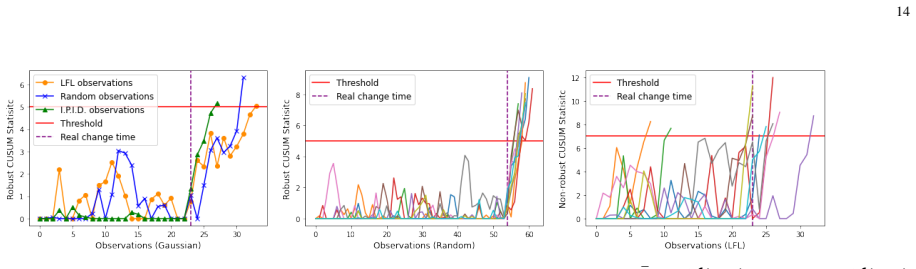
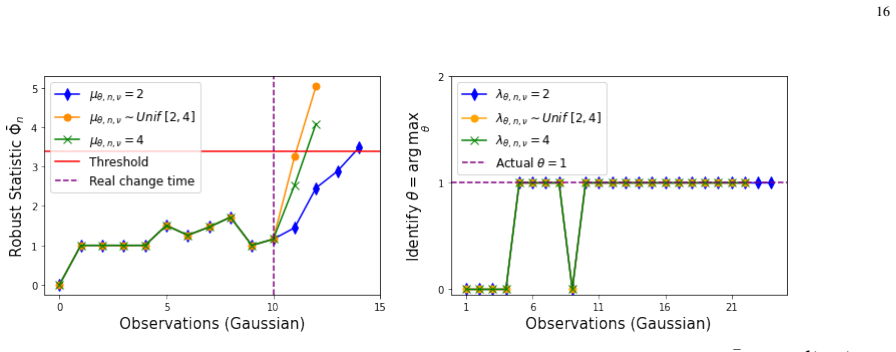
Figures from the paper (11 more)




Forward citations
Cited by 1 Pith paper
-
Robust Quickest Change Detection with Sampling Control
RDE-CUSUM combines robust CUSUM with on-off sampling control to detect distribution changes with unknown post-change laws while skipping a controlled fraction of observations, and is claimed asymptotically robust optimal.
Reference graph
Works this paper leans on
-
[24]
Robust quickest change detection in nonstationary processes,
Y . Hou, Y . Oleyaeimotlagh, R. Mishra, H. Bidkhori, and T. Banerjee, “Robust quickest change detection in nonstationary processes,” Sequential Analysis, vol. 43, no. 3, pp. 275–300, 2024
work page 2024
-
[14]
Information bounds and quick detection of parameter changes in stochastic systems,
T. L. Lai, “Information bounds and quick detection of parameter changes in stochastic systems,” IEEE Transactions on Information Theory, vol. 44, no. 7, pp. 2917 –2929, Nov. 1998
work page 1998
-
[1]
V . V . Veeravalli and T. Banerjee, Quickest Change Detection . Academic Press Library in Signal Processing: V olume 3 – Array and Statistical Signal Processing, 2014
work page 2014
-
[2]
A. G. Tartakovsky, I. V . Nikiforov, and M. Basseville, Sequential Analysis: Hypothesis Testing and Change-Point Detection , ser. Statistics. CRC Press, 2014
work page 2014
-
[3]
H. V . Poor and O. Hadjiliadis, Quickest detection. Cambridge University Press, 2009
work page 2009
-
[4]
On optimum methods in quickest detection problems,
A. N. Shiryaev, “On optimum methods in quickest detection problems,” Theory of Probability and Its Applications , vol. 8, pp. 22–46, 1963
work page 1963
-
[5]
General asymptotic Bayesian theory of quickest change detection,
A. G. Tartakovsky and V . V . Veeravalli, “General asymptotic Bayesian theory of quickest change detection,” Theory of Probability and its Applications, vol. 49, no. 3, pp. 458–497, Sep. 2005
work page 2005
-
[6]
A. Tartakovsky, Sequential change detection and hypothesis testing: general non-iid stochastic models and asymptotically optimal rules . CRC Press, 2019
work page 2019
Show all 33 references
-
[7]
A Bayesian theory of change detection in statistically periodic random processes,
T. Banerjee, P. Gurram, and G. T. Whipps, “A Bayesian theory of change detection in statistically periodic random processes,” IEEE Transactions on Information Theory , vol. 67, no. 4, pp. 2562–2580, 2021
2021
-
[8]
A bayesian partially observable online change detection approach with thompson sampling,
J. Guo, H. Yan, and C. Zhang, “A bayesian partially observable online change detection approach with thompson sampling,” Technometrics, vol. 65, no. 2, pp. 179–191, 2023
2023
-
[9]
Bayesian quickest change-point detection with an energy harvesting sensor and asymptotic analysis,
A. Naha and S. Dey, “Bayesian quickest change-point detection with an energy harvesting sensor and asymptotic analysis,” IEEE Transactions on Signal Processing, 2024
2024
-
[10]
Optimal detection of a change in distribution,
M. Pollak, “Optimal detection of a change in distribution,” Annals of Statistics , vol. 13, no. 1, pp. 206–227, Mar. 1985
1985
-
[11]
Procedures for reacting to a change in distribution,
G. Lorden, “Procedures for reacting to a change in distribution,” Annals of Mathematical Statistics , vol. 42, no. 6, pp. 1897–1908, Dec. 1971
1908
-
[12]
Continuous inspection schemes,
E. S. Page, “Continuous inspection schemes,” Biometrika, vol. 41, no. 1/2, pp. 100–115, Jun. 1954
1954
-
[13]
Optimal stopping times for detecting changes in distributions,
G. V . Moustakides, “Optimal stopping times for detecting changes in distributions,” Annals of Statistics, vol. 14, no. 4, pp. 1379–1387, Dec. 1986
1986
-
[15]
Quickest change detection with non-stationary post-change observations,
Y . Liang, A. G. Tartakovsky, and V . V . Veeravalli, “Quickest change detection with non-stationary post-change observations,” IEEE Transactions on Information Theory , vol. 69, no. 5, pp. 3400–3414, 2022
2022
-
[16]
Modeling and quickest detection of a rapidly approaching object,
T. Brucks, T. Banerjee, and R. Mishra, “Modeling and quickest detection of a rapidly approaching object,” Sequential Analysis, vol. 42, no. 4, pp. 387–403, 2023
2023
-
[17]
Sequential multi-sensor change-point detection,
Y . Xie and D. Siegmund, “Sequential multi-sensor change-point detection,” THE ANNALS of STATISTICS , pp. 670–692, 2013
2013
-
[18]
Large-scale multi-stream quickest change detection via shrinkage post-change estimation,
Y . Wang and Y . Mei, “Large-scale multi-stream quickest change detection via shrinkage post-change estimation,”IEEE Transactions on Information Theory, vol. 61, no. 12, pp. 6926–6938, 2015. 25
2015
-
[19]
Multistream quickest change detection: Asymptotic optimality under a sparse signal,
G. Fellouris, G. V . Moustakides, and V . V . Veeravalli, “Multistream quickest change detection: Asymptotic optimality under a sparse signal,” in 2017 IEEE International Conference on Acoustics, Speech and Signal Processing (ICASSP) . IEEE, 2017, pp. 6444–6447
2017
-
[20]
Optimum multi-stream sequential change-point detection with sampling control,
Q. Xu, Y . Mei, and G. V . Moustakides, “Optimum multi-stream sequential change-point detection with sampling control,” IEEE Transactions on Information Theory, vol. 67, no. 11, pp. 7627–7636, 2021
2021
-
[21]
Multi-stream quickest detection with unknown post-change parameters under sampling control,
Q. Xu and Y . Mei, “Multi-stream quickest detection with unknown post-change parameters under sampling control,” in 2021 IEEE International Symposium on Information Theory (ISIT) . IEEE, 2021, pp. 112–117
2021
-
[22]
Active quickest detection when monitoring multi-streams with two affected streams,
——, “Active quickest detection when monitoring multi-streams with two affected streams,” in 2022 IEEE International Symposium on Information Theory (ISIT). IEEE, 2022, pp. 1915–1920
2022
-
[23]
Quickest change detection in statistically periodic processes with unknown post-change distribution,
Y . Oleyaeimotlagh, T. Banerjee, A. Taha, and E. John, “Quickest change detection in statistically periodic processes with unknown post-change distribution,” Sequential Analysis, vol. 42, no. 4, p. 404–437, 2023
2023
-
[25]
TrajAir: A General Aviation Trajectory Dataset,
J. Patrikar, B. Moon, S. Ghosh, J. Oh, and S. Scherer, “TrajAir: A General Aviation Trajectory Dataset,” 6 2021. [Online]. Available: https://kilthub.cmu.edu/articles/dataset/TrajAir A General Aviation Trajectory Dataset/14866251
2021
-
[26]
Minimax robust quickest change detection,
J. Unnikrishnan, V . V . Veeravalli, and S. P. Meyn, “Minimax robust quickest change detection,” IEEE Transactions on Information Theory , vol. 57, no. 3, pp. 1604 –1614, Mar. 2011
2011
-
[27]
A binning approach to quickest change detection with unknown post-change distribution,
T. S. Lau, W. P. Tay, and V . V . Veeravalli, “A binning approach to quickest change detection with unknown post-change distribution,” IEEE Transactions on Signal Processing , vol. 67, no. 3, pp. 609–621, 2018
2018
-
[28]
Average run lengths of an optimal method of detecting a change in distribution,
M. Pollak, “Average run lengths of an optimal method of detecting a change in distribution,” Annals of Statistics , vol. 15, no. 2, pp. 749–779, Jun. 1987
1987
-
[29]
Algorithms for change detection with sparse signals,
A. Jain, P. Sarvepalli, S. Bhashyam, and A. P. Kannu, “Algorithms for change detection with sparse signals,” IEEE Transactions on Signal Processing, vol. 68, pp. 1331–1345, 2020
2020
-
[30]
Minimax robust quickest change detection in systems and signals with unknown transients,
T. L. Molloy and J. J. Ford, “Minimax robust quickest change detection in systems and signals with unknown transients,” IEEE Transactions on Automatic Control, vol. 64, no. 7, pp. 2976–2982, 2018
2018
-
[31]
Minimax asymptotically optimal quickest change detection for statistically periodic data,
T. Banerjee, P. Gurram, and G. Whipps, “Minimax asymptotically optimal quickest change detection for statistically periodic data,” Signal Processing, vol. 215, p. 109290, 2024
2024
-
[32]
Krishnamurthy, Partially Observed Markov Decision Processes
V . Krishnamurthy, Partially Observed Markov Decision Processes . Cambridge University Press, 2016
2016
-
[33]
Worst-case misidentification control in sequential change diagnosis using the min-cusum,
A. Warner and G. Fellouris, “Worst-case misidentification control in sequential change diagnosis using the min-cusum,” IEEE Transactions on Information Theory, 2024
2024
Reviewed August 12, 2026 · model on record in the stance chip above.
Discussion (0). Continue with ORCID to comment.