CMSO-transducing tree-like graph decompositions
Pith reviewed 2026-05-23 08:18 UTC · model grok-4.3
The pith
CMSO-transductions output a graph's modular decomposition, split decomposition and bi-join decomposition.
A machine-rendered reading of the paper's core claim, the machinery that carries it, and where it could break.
Core claim
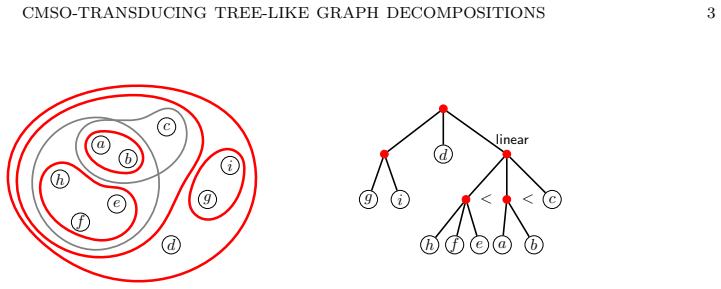
We give CMSO-transductions that, given a graph G, output its modular decomposition, its split decomposition and its bi-join decomposition. This improves results by Courcelle who gave such transductions using order-invariant MSO, a strictly more expressive logic than CMSO. Our methods more generally yield C2MSO-transductions that output the canonical decompositions of weakly-partitive set systems and weakly-bipartitive systems of bipartitions.
What carries the argument
CMSO-transductions that construct the decomposition structures from the input graph or set system.
If this is right
- These decompositions become definable without linear orders on the vertices.
- Algorithms relying on CMSO model-checking can now target the decompositions directly.
- The same transduction technique applies to decompositions of set systems beyond graphs.
- Results extend from graphs to weakly-partitive and weakly-bipartitive systems.
Where Pith is reading between the lines
- Other canonical decompositions studied in graph theory may also admit CMSO definitions.
- Fixed-parameter algorithms for problems on these decompositions could be obtained via existing CMSO machinery.
- The approach might transfer to related structures such as treewidth or rank-width decompositions.
Load-bearing premise
The canonical decompositions admit definitions inside CMSO or C2MSO that require no ordering of the underlying elements.
What would settle it
Exhibiting one graph whose modular decomposition cannot be produced by any CMSO-transduction from the graph itself.
Figures


read the original abstract
We give $\operatorname{CMSO}$-transductions that, given a graph $G$, output its modular decomposition, its split decomposition and its bi-join decomposition. This improves results by Courcelle [Logical Methods in Computer Science, 2006] who gave such transductions using order-invariant $\operatorname{MSO}$, a strictly more expressive logic than $\operatorname{CMSO}$. Our methods more generally yield $\operatorname{C}_2 \operatorname{MSO}$-transductions that output the canonical decompositions of weakly-partitive set systems and weakly-bipartitive systems of bipartitions.
Editorial analysis
A structured set of objections, weighed in public.
Referee Report
Summary. The paper constructs explicit CMSO-transductions that, on input a graph G, produce its modular decomposition, split decomposition, and bi-join decomposition. It further gives C₂MSO-transductions realizing the canonical decompositions of weakly-partitive set systems and weakly-bipartitive systems of bipartitions. These constructions are claimed to operate directly inside the stated logics without order-invariance or external structure, improving on Courcelle (LMCS 2006) who required order-invariant MSO.
Significance. If the explicit constructions hold, the result demonstrates that several canonical graph decompositions are definable by CMSO (respectively C₂MSO) transductions, removing the need for order-invariance. This strengthens the known expressive power of counting monadic second-order logic for structural graph theory and supplies concrete logical characterizations that may be useful for algorithmic meta-theorems and decomposition-based algorithms.
major comments (2)
- [§3] §3 (modular decomposition transduction): the construction appears to rely on identifying strong modules via a fixed-point iteration expressed in CMSO; it is not immediately clear from the text whether the iteration is bounded by a CMSO-definable parameter or whether an auxiliary ordering is implicitly used to break ties among equivalent modules.
- [§5] §5 (general weakly-partitive case): the reduction from the graph decompositions to the set-system case is stated to be CMSO-expressible, but the proof sketch does not exhibit the precise transduction that maps a graph to its associated set system while preserving the canonical decomposition property.
minor comments (2)
- [Introduction] Notation for the output structures (e.g., how the decomposition tree is encoded as a relational structure) is introduced only informally in the introduction and should be formalized once in a dedicated preliminary subsection.
- [§4] Several lemmas in §4 are stated without proof sketches; while the overall argument is clear, adding one-sentence justifications would improve readability.
Simulated Author's Rebuttal
We thank the referee for the careful reading and the recommendation of minor revision. We address the two major comments point by point below.
read point-by-point responses
-
Referee: [§3] §3 (modular decomposition transduction): the construction appears to rely on identifying strong modules via a fixed-point iteration expressed in CMSO; it is not immediately clear from the text whether the iteration is bounded by a CMSO-definable parameter or whether an auxiliary ordering is implicitly used to break ties among equivalent modules.
Authors: The fixed-point iteration is expressed directly as the least fixed point of a CMSO-definable monotone operator on the power set of vertices; the operator itself is given by a CMSO formula that, for any pair of vertices, selects the unique minimal strong module containing them. Because this module is canonically determined, no auxiliary ordering is required to resolve ties. The number of iterations is bounded by |V|, which is CMSO-definable via counting quantifiers, so the entire construction stays inside CMSO. We will insert a short clarifying paragraph after the definition of the operator to make the absence of ordering explicit. revision: partial
-
Referee: [§5] §5 (general weakly-partitive case): the reduction from the graph decompositions to the set-system case is stated to be CMSO-expressible, but the proof sketch does not exhibit the precise transduction that maps a graph to its associated set system while preserving the canonical decomposition property.
Authors: The reduction is realized by the CMSO transduction whose universe is V(G) and whose set predicate is interpreted by the CMSO formula defining the modules (respectively splits or bi-joins) already constructed in §§3–4. Because the canonical decomposition of a weakly-partitive set system is uniquely determined by the inclusion-minimal members of the family, the same formulas that define the graph decomposition also define the set-system decomposition. We agree that the sketch would benefit from an explicit listing of the two-sorted interpretation; this will be added as a short subsection in the revised §5. revision: yes
Circularity Check
No significant circularity; explicit constructions over external reference
full rationale
The paper's central contribution consists of explicit CMSO (and C₂MSO) transduction constructions that directly output the canonical modular, split, bi-join, and weakly-partitive decompositions. These are presented as improvements on Courcelle's 2006 result (an external citation using a strictly stronger logic), with no equations, fitted parameters, self-definitional loops, or load-bearing self-citations appearing in the derivation. The constructions are self-contained within the stated logics and do not reduce to renaming or importing uniqueness from the authors' prior work.
Axiom & Free-Parameter Ledger
axioms (1)
- standard math Standard definitions of CMSO, C₂MSO, transductions, modular decomposition, split decomposition, bi-join decomposition, weakly-partitive set systems and weakly-bipartitive systems of bipartitions.
Reference graph
Works this paper leans on
-
[1]
Linear rank-width of distance-hereditary graphs I
Isolde Adler, Mamadou Moustapha Kant \' e , and O - joung Kwon. Linear rank-width of distance-hereditary graphs I . A polynomial-time algorithm. Algorithmica , 78(1):342--377, 2017
work page 2017
-
[2]
Dragan, Ho \` a ng - Oanh Le, and Raffaele Mosca
Andreas Brandst \" a dt, Feodor F. Dragan, Ho \` a ng - Oanh Le, and Raffaele Mosca. New graph classes of bounded clique-width. Theory Comput. Syst. , 38(5):623--645, 2005. URL: https://doi.org/10.1007/s00224-004-1154-6, https://doi.org/10.1007/S00224-004-1154-6 doi:10.1007/S00224-004-1154-6
-
[3]
Definable decompositions for graphs of bounded linear cliquewidth
Mikołaj Bojańczyk, Martin Grohe, and Michał Pilipczuk. Definable decompositions for graphs of bounded linear cliquewidth. Log. Methods Comput. Sci. , 17(1), 2021
work page 2021
-
[4]
A linear time algorithm for finding tree-decompositions of small treewidth
Hans L Bodlaender. A linear time algorithm for finding tree-decompositions of small treewidth. In Proceedings of the twenty-fifth annual ACM symposium on Theory of computing , pages 226--234, 1993
work page 1993
-
[5]
The category of mso transductions
Mikołaj Bojańczyk. The category of mso transductions. may 2023. URL: http://arxiv.org/abs/2305.18039v1, http://arxiv.org/abs/2305.18039v1 arXiv:2305.18039v1
-
[6]
Definability equals recognizability for graphs of bounded treewidth
Mikołaj Bojańczyk and Michał Pilipczuk. Definability equals recognizability for graphs of bounded treewidth. In Martin Grohe, Eric Koskinen, and Natarajan Shankar, editors, Proceedings of the 31st Annual ACM/IEEE Symposium on Logic in Computer Science, LICS '16, New York, NY, USA, July 5-8, 2016 , pages 407--416. ACM , 2016. https://doi.org/10.1145/293357...
-
[7]
Bruno Courcelle and Joost Engelfriet. Graph Structure and Monadic Second-Order Logic . Cambridge University Press, 2012. URL: https://doi.org/10.1017 https://doi.org/10.1017/cbo9780511977619 doi:10.1017/cbo9780511977619
-
[8]
Cmso-transducing tree-like graph decompositions
Rutger Campbell, Bruno Guillon, Mamadou Moustapha Kant \' e , Eun Jung Kim, and Noleen K \" o hler. Cmso-transducing tree-like graph decompositions. In Olaf Beyersdorff, Michal Pilipczuk, Elaine Pimentel, and Kim Thang Nguyen, editors, 42nd International Symposium on Theoretical Aspects of Computer Science, STACS 2025, March 4-7, 2025, Jena, Germany , vol...
-
[9]
Recognisability equals definability for finitely representable matroids of bounded path-width
Rutger Campbell, Bruno Guillon, Mamadou Moustapha Kant \' e , Eun Jung Kim, and Sang-il Oum. Recognisability equals definability for finitely representable matroids of bounded path-width. In Lars Birkedal and Barbara König, editors, Proceedings of the Fortieth Annual ACM/IEEE Symposium on Logic in Computer Science, LICS '16, Singapour, Singapour, USA, Jun...
work page 2025
-
[10]
Michel Chein, Michel Habib, and Marie-Catherine Maurer. Partitive hypergraphs. Discrete mathematics , 37(1):35--50, 1981
work page 1981
-
[11]
The monadic second-order logic of graphs
Bruno Courcelle. The monadic second-order logic of graphs. I . recognizable sets of finite graphs. Information and computation , 85(1):12--75, 1990
work page 1990
-
[12]
Bruno Courcelle. The monadic second-order logic of graphs V : On closing the gap between definability and recognizability. Theoretical Computer Science , 80(2):153--202, 1991
work page 1991
-
[13]
The monadic second-order logic of graphs X: linear orderings
Bruno Courcelle. The monadic second-order logic of graphs X: linear orderings. Theor. Comput. Sci. , 160(1 & 2):87--143, 1996. https://doi.org/10.1016/0304-3975(95)00083-6 doi:10.1016/0304-3975(95)00083-6
-
[14]
The monadic second-order logic of graphs XI: hierarchical decompositions of connected graphs
Bruno Courcelle. The monadic second-order logic of graphs XI: hierarchical decompositions of connected graphs. Theor. Comput. Sci. , 224(1-2):35--58, 1999. https://doi.org/10.1016/S0304-3975(98)00306-5 doi:10.1016/S0304-3975(98)00306-5
-
[15]
The monadic second-order logic of graphs XVI : Canonical graph decompositions
Bruno Courcelle. The monadic second-order logic of graphs XVI : Canonical graph decompositions. Logical Methods in Computer Science , 2, 2006
work page 2006
-
[16]
Canonical graph decompositions
Bruno Courcelle. Canonical graph decompositions. Talk, 2012. Available at https://www.labri.fr/perso/courcell/Conferences/ExpoCanDecsJuin2012.pdf
work page 2012
-
[17]
The atomic decomposition of strongly connected graphs
Bruno Courcelle. The atomic decomposition of strongly connected graphs. Technical report, Université de Bordeaux, 2013. Available at https://www.labri.fr/perso/courcell/ArticlesEnCours/AtomicDecSubmitted.pdf
work page 2013
-
[18]
Fully dynamic recognition algorithm and certificate for directed cographs
Christophe Crespelle and Christophe Paul. Fully dynamic recognition algorithm and certificate for directed cographs. Discret. Appl. Math. , 154(12):1722--1741, 2006. URL: https://doi.org/10.1016/j.dam.2006.03.005, https://doi.org/10.1016/J.DAM.2006.03.005 doi:10.1016/J.DAM.2006.03.005
-
[19]
Decomposition of directed graphs
William H Cunningham. Decomposition of directed graphs. SIAM Journal on Algebraic Discrete Methods , 3(2):214--228, 1982
work page 1982
-
[20]
Décomposition modulaire des graphes
Fabien de Montgolfier. Décomposition modulaire des graphes. Théorie, extension et algorithmes . Phd thesis, Université Montpellier II, LIRMM, 2003
work page 2003
-
[21]
Fabien de Montgolfier and Micha \" e l Rao. The bi-join decomposition. Electron. Notes Discret. Math. , 22:173--177, 2005. URL: https://doi.org/10.1016/j.endm.2005.06.039, https://doi.org/10.1016/J.ENDM.2005.06.039 doi:10.1016/J.ENDM.2005.06.039
-
[22]
The Theory of 2-Structures - A Framework for Decomposition and Transformation of Graphs
Andrzej Ehrenfeucht, Tero Harju, and Grzegorz Rozenberg. The Theory of 2-Structures - A Framework for Decomposition and Transformation of Graphs . World Scientific, 1999. URL: http://www.worldscibooks.com/mathematics/4197.html
work page 1999
-
[23]
Tree automata and pigeonhole classes of matroids: I
Daryl Funk, Dillon Mayhew, and Mike Newman. Tree automata and pigeonhole classes of matroids: I . Algorithmica , 84(7):1795--1834, 2022. URL: https://doi.org/10.1007/s00453-022-00939-7, https://doi.org/10.1007/S00453-022-00939-7 doi:10.1007/S00453-022-00939-7
-
[24]
Order-invariant MSO is stronger than counting MSO in the finite
Tobias Ganzow and Sasha Rubin. Order-invariant MSO is stronger than counting MSO in the finite. In Susanne Albers and Pascal Weil, editors, STACS 2008, 25th Annual Symposium on Theoretical Aspects of Computer Science, Bordeaux, France, February 21-23, 2008, Proceedings , volume 1 of LIPIcs , pages 313--324. Schloss Dagstuhl - Leibniz-Zentrum f \" u r Info...
-
[25]
Michel Habib, Fabien de Montgolfier, Lalla Mouatadid, and Mengchuan Zou. A general algorithmic scheme for combinatorial decompositions with application to modular decompositions of hypergraphs. Theor. Comput. Sci. , 923:56--73, 2022. URL: https://doi.org/10.1016/j.tcs.2022.04.052, https://doi.org/10.1016/J.TCS.2022.04.052 doi:10.1016/J.TCS.2022.04.052
-
[26]
Branch-width, parse trees, and monadic second-order logic for matroids
Petr Hlinen \' y . Branch-width, parse trees, and monadic second-order logic for matroids. J. Comb. Theory B , 96(3):325--351, 2006. URL: https://doi.org/10.1016/j.jctb.2005.08.005, https://doi.org/10.1016/J.JCTB.2005.08.005 doi:10.1016/J.JCTB.2005.08.005
-
[27]
e l Rao. NLC-2 graph recognition and isomorphism. In Andreas Brandst \
Vincent Limouzy, Fabien de Montgolfier, and Micha \" e l Rao. NLC-2 graph recognition and isomorphism. In Andreas Brandst \" a dt, Dieter Kratsch, and Haiko M \" u ller, editors, Graph-Theoretic Concepts in Computer Science, 33rd International Workshop, WG 2007, Dornburg, Germany, June 21-23, 2007. Revised Papers , volume 4769 of Lecture Notes in Computer...
work page 2007
-
[28]
Décompositions de graphes et algorithmes efficaces
Michaël Rao. Décompositions de graphes et algorithmes efficaces . Phd thesis, Université Paul Verlaine - Metz, 2006
work page 2006
-
[29]
MSOL partitioning problems on graphs of bounded treewidth and clique-width
Micha \" e l Rao. MSOL partitioning problems on graphs of bounded treewidth and clique-width. Theor. Comput. Sci. , 377(1-3):260--267, 2007. URL: https://doi.org/10.1016/j.tcs.2007.03.043, https://doi.org/10.1016/J.TCS.2007.03.043 doi:10.1016/J.TCS.2007.03.043
-
[30]
Monadic second-order model-checking on decomposable matroids
Yann Strozecki. Monadic second-order model-checking on decomposable matroids. Discret. Appl. Math. , 159(10):1022--1039, 2011. URL: https://doi.org/10.1016/j.dam.2011.02.005, https://doi.org/10.1016/J.DAM.2011.02.005 doi:10.1016/J.DAM.2011.02.005
discussion (0)
Sign in with ORCID, Apple, or X to comment. Anyone can read and Pith papers without signing in.