REVIEW 3 minor 76 references
Improving data sharing and knowledge transfer via the Neuroelectrophysiology Analysis Ontology (NEAO)
T0 review · 0 major / 3 minor · reviewed 2026-08-11 · deepseek-v4-flash
Pith's one-line read This paper introduces the Neuroelectrophysiology Analysis Ontology (NEAO), a vocabulary for describing the atomic steps of neuroelectrophysiology data analysis, and shows that annotating captured provenance with NEAO classes lets…
desk verdict A solid, reproducible ontology paper for electrophysiology analysis provenance; the mapping from provenance to NEAO is hand-crafted and limits the interoperability claim to instrumented pipelines. read the letter →
The pith
A machine-rendered reading of the paper's core claim, the machinery that carries it, and where it could break.
The reading
What carries the argument
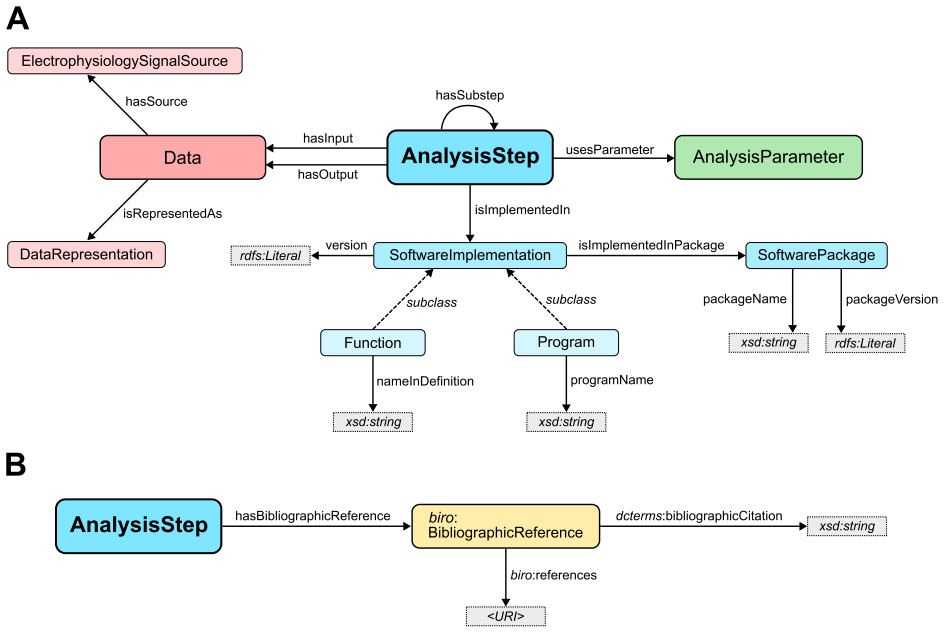
The central object is the NEAO ontology model, a set of OWL classes built around AnalysisStep, Data, and AnalysisParameter, with object properties hasInput, hasOutput, and usesParameter to wire steps to their data and controls, and isImplementedIn and isImplementedInPackage to attach software function and package details. Name ambiguity is handled by controlled skos:prefLabel and skos:altLabel annotations and by bibliographic references via BiRO. The grouping of semantically similar methods is carried by two mechanisms: a primary subclass taxonomy (e.g., PowerSpectralDensityAnalysis above the Welch and multitaper step classes) and the Rector normalization technique, which uses restrictions on properties like hasPurpose to infer additional grouping classes such as FunctionalConnectivityAnalysis. The operational bridge from code to semantics is a set of SPARQL update rules that convert provenance triples (prov:used, prov:generated, alpaca:hasParameter, alpaca:usedFunction) into NEAO properties, plus a container-membership rule for outputs that are collections.
What would settle it
Run the three example analyses with the provenance captured by a second, non-PROV-O tool, or by a script that passes parameters through a wrapper so that alpaca:hasParameter does not point directly to the annotated parameter, then apply the transformation rules in Listings 1–3 and check whether the knowledge graph still answers the queries in Tables 7–10 without adding new rules. If it does not, the demonstrated interoperability depends on the hand-crafted mapping.
Extended reading notes
Core claim
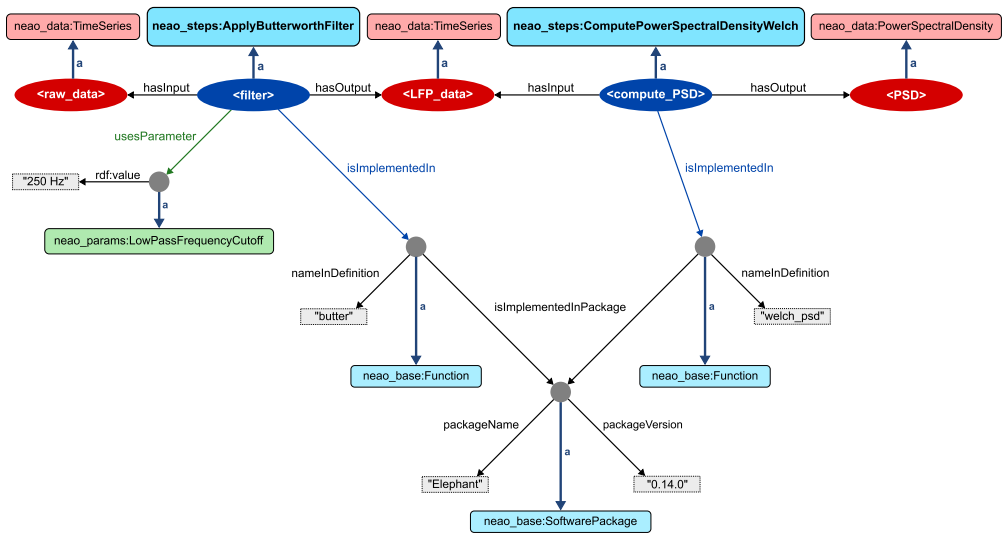
NEAO models an analysis as a sequence of atomic AnalysisStep instances, each linked by hasInput and hasOutput to Data entities and by usesParameter to AnalysisParameter entities, and each tied to a SoftwareImplementation (Function or Program) and SoftwarePackage through isImplementedIn and isImplementedInPackage. Semantic groupings are asserted in a primary taxonomy and extended by inferred groupings built with the Rector normalization technique, so that, for instance, coherence and cross-correlation steps can both be recognized as functional connectivity analyses. The decisive demonstration is a mapping (Table 11 and Listings 1–3) from the PROV-O-based provenance graph emitted by the Alpaca tool into NEAO classes, followed by SPARQL queries over a knowledge graph built from three real analysis scripts. The queries recover, per result file, the full chain of analysis steps, the specific methods, the software packages and versions, and the parameter values used, without any knowledge of the underlying Python functions.
Load-bearing premise
The query demonstrations rely on a hand-written mapping from the provenance graph produced by one specific Python tool (Alpaca) to NEAO semantics; if that mapping cannot be generalized to other provenance capture tools or code structures without bespoke rules, the interoperability benefit is limited to instrumented workflows.
Editorial extensions
If this is right
- Researchers can query a collection of result files by conceptual content, for example all files containing a power spectral density estimate, without enumerating every algorithm that produces such an estimate.
- Provenance captured during script execution, once annotated with NEAO classes, yields method-, parameter-, and software-level answers that currently require inspecting the code or trusting a README.
- The ability to infer that two analyses used the same method in different toolboxes, or used equivalent parameters, supports comparisons of analysis results across researchers and laboratories.
- The modular structure of the ontology permits future toolbox-specific modules that could carry restrictions describing valid inputs, outputs, and parameters for a given tool.
Reading between the lines
- If the NEAO-to-provenance mapping were standardized rather than hand-crafted per script, the same query layer could be attached to any Python analysis that captures provenance, turning the approach into a general reproducibility layer.
- The hasPurpose grouping mechanism is a template for cross-method comparisons in other domains; for example, grouping diverse statistical tests by inferential purpose would let users query all significance tests without naming each one.
- Because NEAO attaches bibliographic references to method classes, a knowledge graph of annotated results could be mined to ask whether parameter choices differ systematically across toolboxes for the same method.
- The paper's stated limitation that AnalysisStep has no OWL restrictions on inputs and outputs suggests that toolbox-specific NEAO modules could add such restrictions without breaking cases where a method returns either an array or a plot.
Signed reviews
Editorial analysis
A structured set of objections, weighed in public.
Referee Report
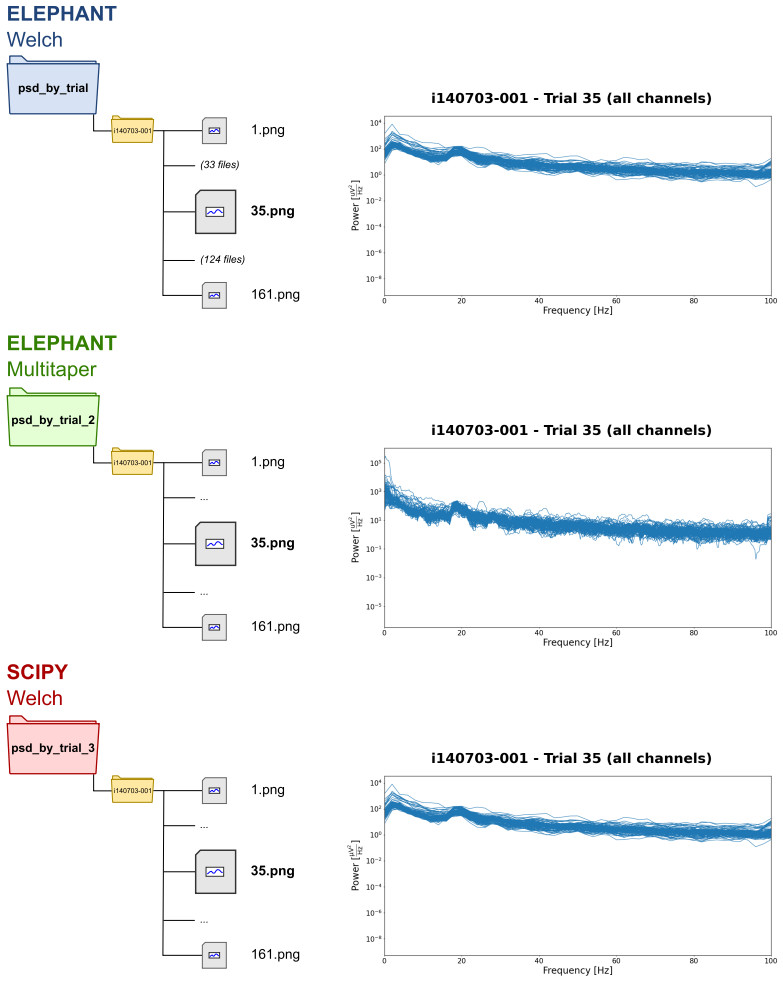
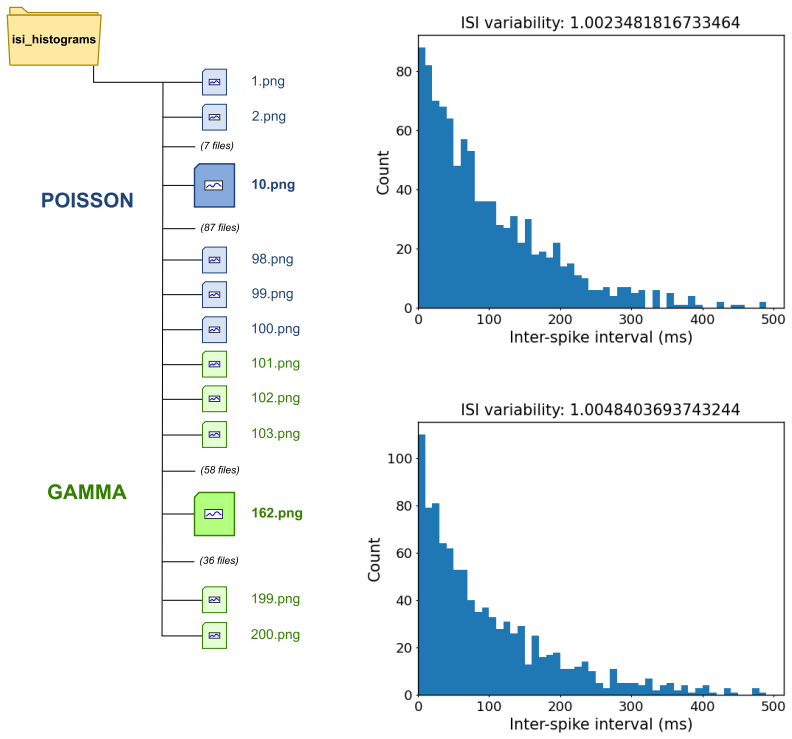
Summary. The paper introduces the Neuroelectrophysiology Analysis Ontology (NEAO), an OWL ontology that provides a unified vocabulary for describing the atomic steps, data entities, parameters, software implementations, and bibliographic references involved in neuroelectrophysiology data analysis. The ontology was designed from a review of existing electrophysiology toolboxes and literature rather than from the example analyses, and it uses taxonomic grouping and Rector normalization to represent both specific methods and semantic categories such as power spectral density analysis or functional connectivity analysis. The authors then demonstrate the ontology on three real-world analysis scenarios: PSD computation with different methods and toolboxes, ISIH computation from spike-train surrogates, and ISIH computation from artificially generated spike trains. The scripts were instrumented with the Alpaca provenance tool, NEAO annotations were added via Python decorators, and SPARQL update queries mapped the PROV-O/Alpaca provenance to NEAO relations. The resulting knowledge graph is queried to recover which analysis steps, methods, software packages, and parameters produced each output file, supporting the paper's claim that NEAO improves findability, interoperability, and reusability of analysis results.
Significance. If accepted, NEAO addresses a genuine gap: existing biomedical and neuroscience ontologies generally lack the specificity needed to connect electrophysiology analysis methods to their software implementations and parameters. The paper's main contribution is a concrete, reproducible proof of concept. The ontology files, analysis scripts, Alpaca provenance files, SPARQL update queries, and raw query-result CSVs are all provided, and the reported query outputs match the ground truth of the constructed analyses. The ontology was built from an independent toolbox and literature survey rather than fitted to the example analyses, which substantially reduces circularity concerns. A notable strength is that the queries recover distinctions that are genuinely hard to obtain from code inspection alone, such as Welch versus multitaper PSD estimation, Elephant versus SciPy implementations, and uniform spike dithering versus trial shifting.
minor comments (3)
- [Results, 'Which spike train surrogate generation method was used?'] The text states that Analysis 2.1 used a dithering time of 15 ms, but the Methods section ('Use case analyses', Analysis 2) and Table 9C both report 25 ms for the uniform spike dithering condition. This numerical inconsistency in a displayed query result must be corrected and reconciled across the three locations.
- [Methods, 'Knowledge graph and SPARQL queries' and Listings 2-3] The demonstrated interoperability pipeline is tied to Alpaca and to the three instrumented scripts: Listing 2 hard-codes package-name mappings for only neo, elephant, and scipy, and Listing 3 maps container outputs only when their members already carry NEAO Data annotations. The discussion already acknowledges that annotation must be performed by the collecting tool, but the paper should add an explicit sentence in the results or discussion clarifying that the software-implementation mapping is a proof-of-concept for the demonstrated tool stack and that generalization to other provenance tools or unmodified third-party code is future work.
- [Discussion, limitations paragraph] The statement that NEAO 'cannot be directly integrated into the OBO Foundry' is appropriate, but the subsequent discussion of future alignment is brief. Since alignment to BFO/RO is a common expectation for biomedical ontologies, the authors should briefly mention whether the lack of alignment affects the practical use of NEAO with existing OBO Foundry tools or reasoners, or whether it only affects formal interoperability with OBO-aligned ontologies.
Circularity Check
No significant circularity: NEAO's vocabulary is derived from independent toolbox/literature surveys, and the query examples are transparent proof-of-concept demonstrations of annotation and retrieval, not fitted predictions.
full rationale
The paper's central contribution is a new OWL ontology whose class vocabulary was built from published tool reviews and API documentation, not from the example scripts (Methods: "We then used a recent review [15]... complemented by manually searching the API"). The three analyses are used to demonstrate annotation and SPARQL querying rather than to fit or validate the ontology's content. The query outputs in Tables 5-10 do recover NEAO class annotations that were manually attached via the __ontology__ decorator and mapped through the hand-written SPARQL updates of Listings 1-3; however, the paper explicitly states that this association "must be performed by the tool collecting the provenance information" and acknowledges that in the examples it was done by "adding special attributes to the Python functions." This is an openly disclosed limitation about automation and generalizability, not a circular derivation of the central claim. Self-citations to Elephant, Alpaca, and SPADE point to separate, publicly available artifacts and are not used as the sole justification for NEAO's semantics. No fitted parameters, equation-level reductions, or author-imported uniqueness theorems appear. The main weakness is that the demonstrated mapping is bespoke and may not generalize to third-party toolboxes, which is a scope/generality risk rather than circularity. Verdict: no significant circularity, score 0.
Assumptions & free parameters
assumptions (4)
- domain assumption Neuroelectrophysiology analyses can be decomposed into atomic AnalysisStep entities, each with data inputs/outputs and parameters.
- domain assumption The class set derived from toolbox reviews and API documentation is a sufficient representation of the domain.
- ad hoc to paper The hand-written SPARQL UPDATE rules (Listings 1-3) map PROV-O/Alpaca provenance to NEAO semantics without loss of meaning.
- standard math Description-logic reasoning (OWL2-RL in GraphDB) computes the intended inferred class memberships (e.g., FunctionalConnectivityAnalysis).
invented entities (2)
-
NEAO ontology (AnalysisStep, Data, AnalysisParameter, SoftwareImplementation classes and properties)
independent evidence
-
Inferred grouping classes via Rector normalization (e.g., PowerSpectralDensityAnalysis, FunctionalConnectivityAnalysis)
independent evidence
Cite this review
Pith. "Pith review of Improving data sharing and knowledge transfer via the Neuroelectrophysiology Analysis Ontology (NEAO)." pith.science (2026). https://pith.science/paper/MZDPYOTH
@misc{pith2026241205021,
  author       = {Pith},
  title        = {Pith review of: Improving data sharing and knowledge transfer via the Neuroelectrophysiology Analysis Ontology (NEAO)},
  year         = {2026},
  howpublished = {\url{https://pith.science/paper/MZDPYOTH}},
  note         = {Machine review of arXiv:2412.05021}
}
read the original abstract
Describing the processes involved in analyzing data from electrophysiology experiments to investigate the function of neural systems is inherently challenging. On the one hand, data can be analyzed by distinct methods that serve a similar purpose, such as different algorithms to estimate the spectral power content of a measured time series. On the other hand, different software codes can implement the same algorithm for the analysis while adopting different names to identify functions and parameters. Having reproducibility in mind, with these ambiguities the outcomes of the analysis are difficult to report, e.g., in the methods section of a manuscript or on a platform for scientific findings. Here, we illustrate how using an ontology to describe the analysis process can assist in improving clarity, rigour and comprehensibility by complementing, simplifying and classifying the details of the implementation. We implemented the Neuroelectrophysiology Analysis Ontology (NEAO) to define a unified vocabulary and to standardize the descriptions of the processes involved in analyzing data from neuroelectrophysiology experiments. Real-world examples demonstrate how the NEAO can be employed to annotate provenance information describing an analysis process. Based on such provenance, we detail how it can be used to query various types of information (e.g., using knowledge graphs) that enable researchers to find, understand and reuse prior analysis results.
Figures


Figures from the paper (4 more)

Reference graph
Works this paper leans on
-
[1]
Brief History and Development of Electrophysiological Recording Techniques in Neuroscience
Huang, Z. Brief History and Development of Electrophysiological Recording Techniques in Neuroscience. In Li, X. (ed.) Signal Processing in Neuroscience, 1–10, 10.1007/978-981-10-1822-0_1 (Springer, Singapore, 2016)
-
[2]
Buzsáki, G., Anastassiou, C. A. & Koch, C. The origin of extracellular fields and currents–EEG, ECoG, LFP and spikes. Nat Rev Neurosci 13, 407–420, 10.1038/nrn3241 (2012)
doi:10.1038/nrn3241 2012
-
[3]
Lalley, P. M. Intracellular recording. In Binder, M. D., Hirokawa, N. & Windhorst, U. (eds.)Encyclopedia of Neuroscience, 2019–2026, 10.1007/978-3-540-29678-2_2554 (Springer Berlin Heidelberg, Berlin, Heidelberg, 2009)
-
[4]
Subash, P. et al. A comparison of neuroelectrophysiology databases. Sci. Data 10, 719, 10.1038/s41597-023-02614-0 (2023)
-
[5]
Hodgkin, A. L. & Huxley, A. F. Action Potentials Recorded from Inside a Nerve Fibre. Nature 144, 710–711, 10.1038/ 144710a0 (1939)
work page 1939
-
[6]
Large-scale recording of neuronal ensembles
Buzsáki, G. Large-scale recording of neuronal ensembles. Nat Neurosci 7, 446–451, 10.1038/nn1233 (2004)
doi:10.1038/nn1233 2004
-
[7]
Siegle, J. H. et al. Survey of spiking in the mouse visual system reveals functional hierarchy. Nature 592, 86–92, 10.1038/s41586-020-03171-x (2021)
-
[8]
Bastos, A. M. & Schoffelen, J.-M. A tutorial review of functional connectivity analysis methods and their interpretational pitfalls. Front. Syst. Neurosci.9, 175, 10.3389/fnsys.2015.00175 (2016)
arXiv 2016
Show all 76 references
-
[9]
& Torre, E
Grün, S., Quaglio, P., Stella, A. & Torre, E. Statistical evaluation of spatio-temporal spike patterns. In Jaeger, D. & Jung, R. (eds.) Encyclopedia of Computational Neuroscience, 1–4, 10.1007/978-1-4614-7320-6_100702-1 (Springer New York, New York, NY , 2020)
-
[10]
The use of fast Fourier transform for the estimation of power spectra: A method based on time averaging over short, modified periodograms
Welch, P. The use of fast Fourier transform for the estimation of power spectra: A method based on time averaging over short, modified periodograms. IEEE Transactions on Audio Electroacoustics 15, 70–73, 10.1109/TAU.1967.1161901 (1967)
1967
-
[11]
Spectrum estimation and harmonic analysis
Thomson, D. Spectrum estimation and harmonic analysis. Proc. IEEE 70, 1055–1096, 10.1109/PROC.1982.12433 (1982)
1982
-
[12]
Percival, D. B. & Walden, A. T. Spectral Analysis for Physical Applications (Cambridge University Press, Cambridge, 1993)
1993
-
[13]
& Grün, S
Denker, M., Yegenoglu, A. & Grün, S. Collaborative HPC-enabled workflows on the HBP Collaboratory using the Elephant framework. In Neuroinformatics 2018, P19, 10.12751/incf.ni2018.0019 (2018)
2018
-
[14]
Gramfort, A. et al. MEG and EEG data analysis with MNE-Python. Front. Neurosci.7, 267, 10.3389/fnins.2013.00267 (2013)
2013
-
[15]
Unakafova, V . A. & Gail, A. Comparing open-source toolboxes for processing and analysis of spike and local field potentials data. Front. Neuroinformatics13, 57, 10.3389/fninf.2019.00057 (2019)
2019
-
[16]
Bernabé, C. H. et al. The use of foundational ontologies in biomedical research. J. Biomed. Semant. 14, 21, 10.1186/ s13326-023-00300-z (2023)
2023
-
[17]
Kaplan, R. M. & Beatty, A. S. (eds.) Ontologies in the Behavioral Sciences: Accelerating Research and the Spread of Knowledge (National Academies Press, Washington, D.C., 2022)
2022
-
[18]
Hoehndorf, R., Schofield, P. N. & Gkoutos, G. V . The role of ontologies in biological and biomedical research: a functional perspective. Briefings Bioinforma. 16, 1069–1080, 10.1093/bib/bbv011 (2015)
2015 doi
-
[19]
& Martone, M
Larson, S. & Martone, M. Ontologies for neuroscience: What are they and what are they good for? Front. Neurosci.3, 60–67, 10.3389/neuro.01.007.2009 (2009)
2009 doi
-
[20]
Studer, R., Benjamins, V . R. & Fensel, D. Knowledge engineering: Principles and methods. Data & Knowl. Eng. 25, 161–197, 10.1016/S0169-023X(97)00056-6 (1998)
1998 doi
-
[21]
Wilkinson, M. D. et al. The FAIR Guiding Principles for scientific data management and stewardship. Sci. Data 3, 160018, 10.1038/sdata.2016.18 (2016). 16/37
2016 doi
-
[22]
Bandrowski, A. et al. The Ontology for Biomedical Investigations. PLOS ONE 11, e0154556, 10.1371/journal.pone. 0154556 (2016)
2016 doi
-
[23]
Zheng, J. et al. The Ontology of Biological and Clinical Statistics (OBCS) for standardized and reproducible statistical analysis. J. Biomed. Semant. 7, 53, 10.1186/s13326-016-0100-2 (2016)
2016 doi
-
[24]
Tenenbaum, J. D. et al. The Biomedical Resource Ontology (BRO) to Enable Resource Discovery in Clinical and Translational Research. J. biomedical informatics 44, 137–145, 10.1016/j.jbi.2010.10.003 (2011)
2011 doi
-
[25]
Ison, J. et al. EDAM: An ontology of bioinformatics operations, types of data and identifiers, topics and formats. Bioinformatics 29, 1325–1332, 10.1093/bioinformatics/btt113 (2013)
2013 doi
-
[26]
Bug, W. J. et al. The NIFSTD and BIRNLex V ocabularies: Building Comprehensive Ontologies for Neuroscience. Neuroinformatics 6, 175–194, 10.1007/s12021-008-9032-z (2008)
2008 doi
-
[27]
Computational Neuroscience Ontology: A new tool to provide semantic meaning to your models
Le Franc, Y .et al. Computational Neuroscience Ontology: A new tool to provide semantic meaning to your models. BMC Neurosci. 13, P149, 10.1186/1471-2202-13-S1-P149 (2012)
2012 doi
-
[28]
& Dou, D
Frishkoff, G., LePendu, P., Frank, R., Liu, H. & Dou, D. Development of Neural Electromagnetic Ontologies (NEMO): Ontology-based Tools for Representation and Integration of Event-related Brain Potentials. Nat. Preced. 1–1, 10.1038/ npre.2009.3458.1 (2009)
2009
-
[29]
Describing Neurophysiology Data and Metadata with OEN, the Ontology for Experimental Neurophysi- ology
Le Franc, Y .et al. Describing Neurophysiology Data and Metadata with OEN, the Ontology for Experimental Neurophysi- ology. In Front. Neuroinform. Conference Abstract: Neuroinformatics 2014, 10.3389/conf.fninf.2014.18.00044 (Frontiers, 2014)
2014 doi
-
[30]
ICEPO: The ion channel electrophysiology ontology
Hinard, V .et al. ICEPO: The ion channel electrophysiology ontology. Database 2016, baw017, 10.1093/database/baw017 (2016)
2016 doi
-
[31]
& Bengtson, J
Farrell, B. & Bengtson, J. Scientist and data architect collaborate to curate and archive an inner ear electrophysiology data collection. PLOS ONE 14, e0223984, 10.1371/journal.pone.0223984 (2019)
2019 doi
-
[32]
& Moucek., R
Štebeták., J. & Moucek., R. Ontology based Description of Analytic Methods for Electrophysiology. In Proceedings of the 9th International Joint Conference on Biomedical Engineering Systems and Technologies (BIOSTEC 2016) - HEALTHINF, 420–425, 10.5220/0005814004200425. INSTICC ...
2016 doi
-
[33]
Arndt, S. et al. Metadata4Ing: An ontology for describing the generation of research data within a scientific activity., 10.5281/zenodo.5957103 (2024)
2024 doi
-
[34]
& König-Ries, B
Samuel, S. & König-Ries, B. End-to-End provenance representation for the understandability and reproducibility of scientific experiments using a semantic approach. J. Biomed. Semant. 13, 1, 10.1186/s13326-021-00253-1 (2022)
2022 doi
-
[35]
FAIRsharing record for: QUDT; Quantities, Units, Dimensions and Types, 10.25504/FAIRsharing
FAIRsharing Team. FAIRsharing record for: QUDT; Quantities, Units, Dimensions and Types, 10.25504/FAIRsharing. d3pqw7
-
[36]
& Bechhofer, S
Miles, A. & Bechhofer, S. SKOS Simple Knowledge Organization System Reference. W3C Recommendation http: //www.w3.org/TR/2009/REC-skos-reference-20090818 (2009)
2009
-
[37]
Gorgolewski, K. et al. Nipype: A Flexible, Lightweight and Extensible Neuroimaging Data Processing Framework in Python. Front. Neuroinformatics5, 13, 10.3389/fninf.2011.00013 (2011)
2011 arXiv
-
[38]
& Schoffelen, J.-M
Oostenveld, R., Fries, P., Maris, E. & Schoffelen, J.-M. FieldTrip: Open Source Software for Advanced Analysis of MEG, EEG, and Invasive Electrophysiological Data. Comput. Intell. Neurosci. 2011, 156869, 10.1155/2011/156869 (2011)
2011 doi
-
[39]
C., Pantazis, D
Tadel, F., Baillet, S., Mosher, J. C., Pantazis, D. & Leahy, R. M. Brainstorm: A User-Friendly Application for MEG/EEG Analysis. Comput. Intell. Neurosci. 2011, 879716, 10.1155/2011/879716 (2011)
2011 doi
-
[40]
E., Mehta, S
Bokil, H., Andrews, P., Kulkarni, J. E., Mehta, S. & Mitra, P. Chronux: A Platform for Analyzing Neural Signals. J. neuroscience methods 192, 146–151, 10.1016/j.jneumeth.2010.06.020 (2010)
2010 doi
-
[41]
SciPy 1.0: Fundamental Algorithms for Scientific Computing in Python
Virtanen, P.et al. SciPy 1.0: Fundamental Algorithms for Scientific Computing in Python. Nat. Methods 17, 261–272, 10.1038/s41592-019-0686-2 (2020)
2020 doi
-
[42]
& Grün, S
Torre, E., Picado-Muiño, D., Denker, M., Borgelt, C. & Grün, S. Statistical evaluation of synchronous spike patterns extracted by frequent item set mining. Front. computational neuroscience7, 132, 10.3389/fncom.2013.00132 (2013)
2013
-
[43]
Quaglio, P., Yegenoglu, A., Torre, E., Endres, D. M. & Grün, S. Detection and evaluation of spatio-temporal spike patterns in massively parallel spike train data with spade. Front. computational neuroscience11, 41, 10.3389/fncom.2017.00041 (2017). 17/37
2017
-
[44]
& Grün, S
Stella, A., Quaglio, P., Torre, E. & Grün, S. 3d-SPADE: Significance evaluation of spatio-temporal patterns of various temporal extents. Biosystems 185, 104022, 10.1016/j.biosystems.2019.104022 (2019)
2019
-
[45]
FAIRsharing record for: Bibliographic Reference Ontology, 10.25504/FAIRSHARING.99DA5F
FAIRsharing Team. FAIRsharing record for: Bibliographic Reference Ontology, 10.25504/FAIRSHARING.99DA5F
-
[46]
DCMI Metadata Terms
DCMI Usage Board. DCMI Metadata Terms. Dublin Core Metadata Initiative http://dublincore.org/specifications/ dublin-core/dcmi-terms/2020-01-20 (2020)
2020
-
[47]
& Durstewitz, D
Russo, E. & Durstewitz, D. Cell assemblies at multiple time scales with arbitrary lag constellations. Elife 6, e19428, 10.7554/eLife.19428 (2017)
2017 doi
-
[48]
Torre, E. et al. Asset: analysis of sequences of synchronous events in massively parallel spike trains. PLoS Comp. Biol. 12, e1004939, 10.1371/journal.pcbi.1004939 (2016)
2016 doi
-
[49]
Rector, A. L. Modularisation of domain ontologies implemented in description logics and related formalisms including owl. In Proceedings of the 2nd International Conference on Knowledge Capture, K-CAP ’03, 121–128, 10.1145/945645.945664 (Association for Computing Machinery, Ne...
-
[50]
Data-Driven Significance Estimation for Precise Spike Correlation
Grün, Sonja. Data-Driven Significance Estimation for Precise Spike Correlation. J. Neurophysiol. 101, 1126–1140, 10.1152/jn.00093.2008 (2009)
2009
-
[51]
A., Ulianych, D., Grün, S., Decker, S
Köhler, C. A., Ulianych, D., Grün, S., Decker, S. & Denker, M. Facilitating the sharing of electrophysiology data analysis results through in-depth provenance capture. eNeuro 11, ENEURO.0476–23.2024, 10.1523/ENEURO.0476-23.2024 (2024)
2024 doi
-
[52]
& Seaborne, A
Harris, S. & Seaborne, A. SPARQL 1.1 Query Language. W3C Recommendation https://www.w3.org/TR/sparql11-query/ (2013)
2013
-
[53]
& Grün, S
Stella, A., Bouss, P., Palm, G. & Grün, S. Comparing surrogates to evaluate precisely timed higher-order spike correlations. eNeuro 9, ENEURO.0505–21.2022, 10.1523/ENEURO.0505-21.2022 (2022)
2022 doi
-
[54]
Shinomoto, S. et al. Relating neuronal firing patterns to functional differentiation of cerebral cortex. PLoS Comput. Biol 5, e1000433, 10.1371/journal.pcbi.1000433 (2009)
2009 doi
-
[55]
R., Softky, W
Holt, G. R., Softky, W. R., Koch, C. & Douglas, R. J. Comparison of discharge variability in vitro and in vivo in cat visual cortex neurons. J. neurophysiology 75, 1806–1814, 10.1152/jn.1996.75.5.1806 (1996)
1996 doi
-
[56]
Cox, D. R. & Lewis, P. A. W. The Statistical Analysis of Series of Events. Methuen’s Monographs on Applied Probability and Statistics (Methuen, London, 1966)
1966
-
[57]
Jordan, J. et al. Extremely Scalable Spiking Neuronal Network Simulation Code: From Laptops to Exascale Computers. Front. Neuroinformatics12, 2, 10.3389/fninf.2018.00002 (2018)
2018
-
[58]
Smith, B. et al. The OBO Foundry: Coordinated evolution of ontologies to support biomedical data integration. Nat. Biotechnol. 25, 1251–1255, 10.1038/nbt1346 (2007)
2007 doi
-
[59]
Jackson, R. et al. OBO Foundry in 2021: Operationalizing open data principles to evaluate ontologies. Database 2021, baab069, 10.1093/database/baab069 (2021)
2021 doi
-
[60]
& Spear, A
Arp, R., Smith, B. & Spear, A. D. Building Ontologies with Basic Formal Ontology(Massachusetts Institute of Technology, Cambridge, Massachusetts, 2015)
2015
-
[61]
Mungall, C. et al. Oborel/obo-relations: February 2023 release 2 (Major Pipeline Change). Zenodo, 10.5281/zenodo. 7665156 (2023)
2023 doi
-
[62]
Smith, B. et al. Relations in biomedical ontologies. Genome Biol. 6, R46, 10.1186/gb-2005-6-5-r46 (2005)
2005 doi
-
[63]
Malone, J. et al. The Software Ontology (SWO): A resource for reproducibility in biomedical data analysis, curation and digital preservation. J. Biomed. Semant. 5, 25, 10.1186/2041-1480-5-25 (2014)
2014 doi
-
[64]
Larson, S. D. & Martone, M. NeuroLex.org: An online framework for neuroscience knowledge. Front. Neuroinformatics 7, 18, 10.3389/fninf.2013.00018 (2013)
2013
-
[65]
Musen, M. A. The protégé project: A look back and a look forward. AI Matters 1, 4–12, 10.1145/2757001.2757003 (2015)
2015
-
[66]
Gramm: Grammar of graphics plotting in Matlab
Morel, P. Gramm: Grammar of graphics plotting in Matlab. J. Open Source Softw. 3, 568, 10.21105/joss.00568 (2018)
2018 doi
-
[67]
& Obermayer, K
Pröpper, R. & Obermayer, K. Spyke Viewer: A flexible and extensible platform for electrophysiological data analysis. Front. Neuroinformatics7, 26, 10.3389/fninf.2013.00026 (2013). 18/37
2013
-
[68]
& Bozanic, N
Kreuz, T., Mulansky, M. & Bozanic, N. SPIKY: A graphical user interface for monitoring spike train synchrony. J. Neurophysiol. 113, 3432–3445, 10.1152/jn.00848.2014 (2015)
2015
-
[69]
Brochier, T. et al. Massively parallel recordings in macaque motor cortex during an instructed delayed reach-to-grasp task. Sci. Data 5, 180055, 10.1038/sdata.2018.55 (2018)
2018 doi
-
[70]
Zehl, L. et al. Handling Metadata in a Neurophysiology Laboratory. Front. Neuroinformatics10, 26, 10.3389/fninf.2016. 00026 (2016)
2016 doi
-
[71]
& Scherberger, H
Denker, M., Grün, S., Wachtler, T. & Scherberger, H. Reproducibility and efficiency in handling complex neurophysiological data. Neuroforum 27, 27–34, 10.1515/nf-2020-0041 (2021)
2021 doi
-
[72]
& Benda, J
Grewe, J., Wachtler, T. & Benda, J. A bottom-up approach to data annotation in neurophysiology. Front. Neuroinformatics 5, 16, 10.3389/fninf.2011.00016 (2011)
2011 arXiv
-
[73]
Garcia, S. et al. Neo: an object model for handling electrophysiology data in multiple formats. Front. Neuroinformatics8, 10, 10.3389/fninf.2014.00010 (2014)
2014
-
[74]
J., Benda, J., Wachtler, T
Stoewer, A., Kellner, C. J., Benda, J., Wachtler, T. & Grewe, J. File format and library for neuroscience data and metadata. In Front. Neuroinform. Conference Abstract: Neuroinformatics 2014, 10.3389/conf.fninf.2014.18.00027 (Frontiers, 2014)
2014 doi
-
[75]
& Kleinjohann, A
Denker, M., Köhler, C., Kern, M. & Kleinjohann, A. Elephant 0.14.0. Zenodo https://doi.org/10.5281/zenodo.10075775, 10.5281/zenodo.10075775 (2023)
2023 doi
-
[76]
iBehave", grant number: NW21-049), and the Joint Lab
Köhler, C. A. Alpaca 0.2.0. Zenodo, 10.5281/zenodo.10277861 (2023). Acknowledgements This work was performed as part of the Helmholtz School for Data Science in Life, Earth and Energy (HDS-LEE) and received funding from the Helmholtz Association of German Research Centres. Thi...
2023 arXiv
Reviewed August 11, 2026 · model on record in the stance chip above.
Discussion (0). Continue with ORCID to comment.