REVIEW 2 major objections 5 minor 10 references
Spatially modulated plasma profile for turbulence and instabilities mitigation in fusion plasma
T0 review · 2 major / 5 minor · reviewed 2026-08-12 · deepseek-v4-flash
Pith's one-line read A harmonic spatial modulation of the drift-wave phase velocity creates a wavenumber band around beta = 2 k0 where drift waves are attenuated, which the paper argues can mitigate turbulence in fusion plasmas.
desk verdict A clearly-written concept sketch whose central claim—that a Mathieu bandgap from a toy wave equation applies to drift-wave turbulence—rests on an unproven and likely wrong equation, with no nonlinear step to transport suppression. read the letter →
The pith
A machine-rendered reading of the paper's core claim, the machinery that carries it, and where it could break.
The reading
What carries the argument
The central object is the Mathieu equation—a linear second-order differential equation with periodic coefficients—in the form $\frac{d^2 n_\omega}{dx^2} = -k_0^2(1+\epsilon\cos((2k_0+\delta)x))n_\omega$, obtained by time-Fourier transforming the wave equation and expanding the modulated phase velocity to first order in $\epsilon$. The mechanism is parametric resonance: the periodic 'pump' with wavenumber $\beta\approx2k_0$ couples the forward- and backward-propagating components of the drift wave, producing the spatial eigenvalue $\lambda = \tfrac{1}{2}\sqrt{(\epsilon k_0/2)^2-\delta^2}$. The band condition $|\delta|<\epsilon k_0/2$, where $\delta=\beta-2k_0$, is what the paper calls the attenuation window; its width is set directly by the modulation amplitude.
What would settle it
Solve the Hasegawa-Wakatani or a gyrokinetic model on a slab with a sinusoidal density modulation whose wavenumber $\beta$ is scanned through $2k_0$, and check whether a monochromatic drift wave at wavenumber $k_0$ decays with the predicted rate $\lambda=\tfrac{1}{2}\sqrt{(\epsilon k_0/2)^2-\delta^2}$ inside the band and propagates without decay outside it; if no attenuation window appears, the simple wave equation is the point of failure. A complementary experiment would impose a periodic magnetic perturbation in a linear plasma device and directly measure drift-wave amplitude versus distance.
Extended reading notes
Core claim
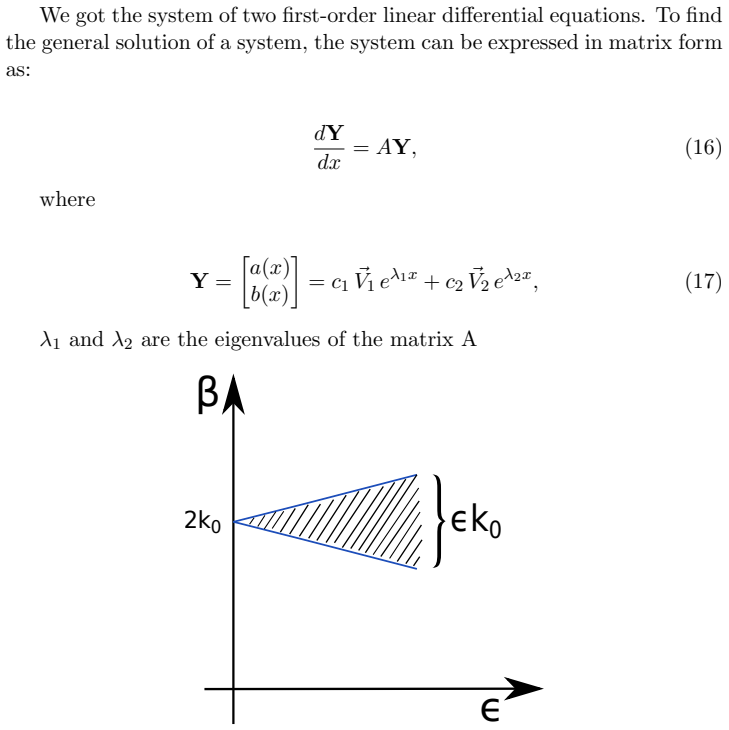
The central claim is that a small sinusoidal modulation of the drift-wave phase velocity, $u_p(x)=u_p^0(1-\epsilon\cos\beta x)$ with $\epsilon\ll1$, creates a stop band for drift waves when the modulation wavenumber $\beta$ is close to twice the unperturbed wave wavenumber $k_0=\omega/u_p^0$. Substituting this profile into the wave equation yields the Mathieu equation, and a slowly varying amplitude analysis gives the spatial growth/decay rate $\lambda=\pm\tfrac{1}{2}\sqrt{(\epsilon k_0/2)^2-(\beta-2k_0)^2}$. When $|\beta-2k_0|<\epsilon k_0/2$, the rate is real and the wave amplitude has components $e^{\pm\lambda x}$, meaning exponential spatial growth or decay; the paper argues that a static ripple gives damping while launched waves can do either. Outside that band the amplitudes oscillate without net growth or decay. The paper concludes that externally creating a modulation within the resonant band should suppress drift-wave turbulence and similar wave-like instabilities, in direct analogy with photonic bandgaps.
Load-bearing premise
The load-bearing premise is that a drift wave obeys the simple non-dispersive wave equation $d^2n/dt^2 = u_p^2\,d^2n/dx^2$ with $u_p$ equal to the electron diamagnetic drift velocity; if real drift waves instead have a frequency that depends on wavenumber in a more complicated way, the Mathieu analysis and the predicted suppression band do not apply.
Editorial extensions
If this is right
- Drift waves whose wavenumbers satisfy $|\beta-2k_0|<\epsilon k_0/2$ will be exponentially attenuated in space rather than propagating freely.
- The same bandgap mechanism should transfer to other wave-like instabilities—interchange turbulence, MHD waves—provided their phase velocity can be modulated.
- Tuning the modulation amplitude $\epsilon$ and wavenumber $\beta$ controls the width and location of the suppression band, giving an external dial for turbulence control.
- Because the resonance can amplify as well as damp, the choice of implementation (static ripple versus launched wave) determines whether the net effect is stabilizing or destabilizing.
- The proposed concept offers a route to turbulence suppression that does not depend on self-organized transport barriers, so it could work in devices where such barriers cannot form.
Reading between the lines
- Editorial extension: a direct numerical test would be to run Hasegawa-Wakatani or gyrokinetic simulations with a sinusoidal density modulation at $\beta\approx2k_0$; those models include the dispersion the paper's wave equation omits, so they would show whether the band survives.
- Editorial extension: the scale-free form of the band condition implies concrete design numbers—for a drift-wave wavelength of 1–2 cm, the required modulation wavelength is roughly 0.5–1 cm, which is in the range of localized RF or current perturbations.
- Editorial extension: in a self-consistent plasma the damped wave feeds back on the mean profile, so the predicted exponential attenuation may be modified by profile relaxation; nonlinear simulations or experiments would reveal whether the band persists.
- Editorial extension: the paper treats a prescribed static modulation; using a launched wave as the pump introduces its own dispersion, so the effective phase-velocity profile would not be a fixed cosine and the band structure could differ.
Editorial analysis
A structured set of objections, weighed in public.
Referee Report
Summary. The paper proposes that introducing a harmonic spatial modulation of the drift-wave phase velocity, u_p(x) = u0_p(1 - ε cos βx), creates a stop band for drift waves when the modulation wavenumber β is close to 2k0, with a spatial attenuation rate λ = (1/2) sqrt((εk0/2)^2 - δ^2) (Eq. 19). The author starts from a second-order wave equation for the density perturbation (Eq. 1), performs a Mathieu/Floquet analysis in Section 1, and concludes in Sections 2 and 3 that this effect can mitigate turbulence and instabilities in fusion plasmas. Several qualitative implementation schemes are listed, including RF waves, microwave ponderomotive density modulation, and static magnetic perturbations.
Significance. If the starting equation were the correct drift-wave equation and if linear evanescence implied turbulence suppression, the idea of using periodic modulation to create bandgaps would be an interesting and potentially controllable alternative to existing transport-barrier methods. The Mathieu calculation is transparent and the bandgap condition is standard for that toy equation, which is a strength in terms of internal consistency. However, the physical premise is not established: Eq. (1) is not the drift-wave equation used in plasma physics, and the paper provides no nonlinear, transport, simulation, or experimental evidence connecting the linear Floquet exponent to turbulence mitigation. As it stands, the paper is a mathematical exercise on a generic wave equation with an asserted application to fusion plasmas.
major comments (2)
- [Section 1, Eq. (1)] The starting point Eq. (1), d^2 n/dt^2 = u_p^2 d^2 n/dx^2, is asserted 'without delving into details' and is not the drift-wave equation used in plasma physics. The standard linear drift wave is a single dispersive branch with dispersion ω = ω_*e/(1 + k⊥^2 ρ_s^2), propagating in the electron diamagnetic direction; it is not described by a second-order wave equation with counter-propagating solutions. In addition, u_p = ∇p × B/(ne B^2) is the electron diamagnetic drift velocity, not the phase velocity of the drift wave, and substituting a modulated density profile into this expression changes ∇n/n and introduces first-order derivative terms that are absent from Eq. (1). Since the Mathieu analysis in Eqs. (4)–(20) is built entirely on Eq. (1), the predicted attenuation band does not apply to drift waves.
- [Section 3; Section 2.1] Even if Eq. (1) were an acceptable toy model, the paper does not establish the central conclusion that the linear evanescence described by the Floquet exponent λ in Eq. (19) leads to mitigation of turbulence and instabilities in fusion plasmas. Turbulent transport is a nonlinear, driven, multi-scale process; attenuation of a monochromatic linear mode in a narrow band does not imply reduced fluctuation amplitudes or transport in the turbulent state. No nonlinear analysis, reduced transport model, simulation, or experimental evidence is provided to connect the bandgap to confinement, so the conclusion in Section 3 that spatial modulation 'attenuates wave propagation' and mitigates turbulence is unsupported.
minor comments (5)
- [Section 1, Eq. (18)] The matrix A in Eq. (18) does not follow from the system in Eq. (15); the off-diagonal signs are inconsistent. The eigenvalues in Eq. (19) are nevertheless correct for the standard Mathieu equation, so this appears to be a typographical error rather than a change of result.
- [Appendix, Eq. (22)] The appendix contains unexplained cancellations (the overstruck terms) and several incomplete sentences; the derivation should be rewritten for clarity.
- [Section 2.2] The term 'dumping' is used where 'damping' is intended, and the discussion of amplification versus damping is qualitative, giving no physical criterion for the sign of λ.
- [Figure 1] Figure 1 is a schematic without axis labels or units; as a chart of the bandgap it would benefit from plotting the real part of λ from Eq. (19) as a function of β.
- [Introduction] The paper cites only general textbooks for the analogies; it would benefit from references to the drift-wave turbulence literature (e.g., Hasegawa-Wakatani models, gyrokinetic simulations) and to prior work on zonal-flow or periodic-profile effects in plasmas, to place the proposal in context.
Circularity Check
No significant circularity: the bandgap result is a transparent Mathieu-eigenvalue derivation from an asserted model equation, with no fitted parameters or load-bearing self-citations.
full rationale
The claimed result, the spatial attenuation band centered at beta = 2 k0 with rate lambda = (1/2) sqrt((epsilon k0/2)^2 - delta^2), is obtained by substituting the assumed modulation u_p(x) = u0_p(1 - epsilon cos(beta x)) into the model equation d^2 n/dt^2 = u_p^2 d^2 n/dx^2, Fourier-transforming, expanding to first order in epsilon, and solving the resulting coupled amplitude equations. Every step is algebraic and explicit in Eqs. (4)-(20); no parameter is fitted to data, no external benchmark is used, and no self-citation supplies any load-bearing premise. The main weaknesses are physical rather than circular: Eq. (1) is asserted 'without delving into details' and is not a standard drift-wave model, and the extension from single-mode linear evanescence to turbulence suppression in Sec. 3 is an inference rather than a derived consequence. These are modeling and validity concerns, not cases where the prediction is equivalent to its input by construction. The paper also openly acknowledges the approximate nature of the solution ('Such a solution, of course, is not exact') and that the attenuation result is 'well-known in many areas of physics', which further shows no circular re-labeling is occurring. Therefore the circularity score is 0.
Assumptions & free parameters
free parameters (2)
- modulation depth epsilon =
epsilon << 1, not specified
- modulation wavenumber beta =
beta approximately 2 k0
assumptions (4)
- ad hoc to paper Drift wave propagation is described by d^2 n/dt^2 = u_p^2 d^2 n/dx^2, with u_p = grad p x B / (n e B^2).
- domain assumption The time Fourier transform of this equation yields a Helmholtz equation with a spatially varying coefficient, and the resulting Mathieu analysis describes the wave behavior.
- domain assumption Spatial evanescence of a linear monochromatic wave implies suppression of turbulent transport.
- standard math The amplitudes a(x) and b(x) are slowly varying, so their second derivatives can be dropped.
Cite this review
Pith. "Pith review of Spatially modulated plasma profile for turbulence and instabilities mitigation in fusion plasma." pith.science (2026). https://pith.science/paper/Y3AWFLE5
@misc{pith2026241205310,
  author       = {Pith},
  title        = {Pith review of: Spatially modulated plasma profile for turbulence and instabilities mitigation in fusion plasma},
  year         = {2026},
  howpublished = {\url{https://pith.science/paper/Y3AWFLE5}},
  note         = {Machine review of arXiv:2412.05310}
}
read the original abstract
This work explores a novel approach to mitigating turbulence in fusion plasmas through spatially modulated plasma profiles. By imposing a harmonic modulation on plasma parameters, we introduce conditions that alter the propagation characteristics of turbulent and MHD waves, a primary source of transport and instabilities in fusion devices. This modulation approach resembles bandgap formation in solid-state and photonic crystals, where spatial periodicity suppresses wave propagation within specific frequency bands. The mathematical framework developed here essentially resembles the parametric resonance of the harmonic oscillator. It reveals how a controlled spatial variation of turbulent wave phase velocity can effectively attenuate turbulence and instabilities. Several methods for implementing this modulation in plasma, including RF waves, static magnetic field perturbations, and modulated density profiles, are proposed as potential paths for achieving stable confinement. This concept could provide a versatile and potentially more controllable alternative to existing turbulence suppression techniques, with the goal of improving stability and confinement across a variety of magnetized fusion configurations.
Figures
Reference graph
Works this paper leans on
-
[1]
Kittel, C. (2005). Introduction to Solid State Physics. Wiley, Hobo- ken, NJ, 8th edition
work page 2005
-
[2]
Joannopoulos, J. D., Johnson, S. G., Winn, J. N., & Meade, R. D. (2008). Photonic Crystals: Molding the Flow of Light. Princeton University Press, Princeton, NJ, 2nd edition
work page 2008
-
[3]
Sakoda, K. (2001). Optical Properties of Photonic Crystals. Springer, Berlin, Heidelberg
work page 2001
-
[4]
Haus, J. W. (2016). Fundamentals and Applications of Nanophotonics. Woodhead Publishing, Cambridge
work page 2016
-
[5]
Strogatz, S. H. (2000). Nonlinear Dynamics and Chaos: With Ap- plications to Physics, Biology, Chemistry, and Engineering. Westview Press
work page 2000
-
[6]
Timoshenko, S., Young, D. H., & Weaver, W. (1974). Vibration Prob- lems in Engineering. Wiley
work page 1974
-
[7]
Den Hartog, J. P. (1947). Mechanical Vibrations. McGraw-Hill
work page 1947
-
[8]
Guckenheimer, J., & Holmes, P. (1983). Nonlinear Oscillations, Dy- namical Systems, and Bifurcations of Vector Fields. Springer-Verlag
work page 1983
Show all 10 references
-
[9]
T., & Dahleh, M
Thomson, W. T., & Dahleh, M. D. (1998). Theory of Vibration with Applications. Prentice Hall
1998
-
[10]
Svelto, O. (1998). Principles of Lasers. Springer. Appendix substituting this form of the solution (13) into the differential equation (12) and considering that both the coefficients in front of cos(( k0 + δ 2 )x) and sin((k0 + δ 2 )x) must be zero to satisfy the differential ...
1998
Reviewed August 12, 2026 · model on record in the stance chip above.
Discussion (0). Continue with ORCID to comment.