REVIEW 3 major objections 4 minor 60 references
Isochronous and period-doubling diagrams for symplectic maps of the plane
T0 review · 3 major / 4 minor · reviewed 2026-08-11 · deepseek-v4-flash
Pith's one-line read Adding a second symmetry-line scan completes Hénon's bifurcation diagram.
desk verdict A useful, visually rich extension of Hénon's stability diagrams with a genuinely new period-doubling diagram, but the two-line completeness claim is overstated and needs tightening. read the letter →
The pith
A machine-rendered reading of the paper's core claim, the machinery that carries it, and where it could break.
The reading
What carries the argument
The central object is the pair of symmetry lines $L_1 = \mathrm{Fix}\,R_1$ and $L_2 = \mathrm{Fix}\,R_2$ coming from the reversible decomposition $T = R_2\circ R_1$ into two involutions. The load-bearing identity is $(T^m\circ R)\circ(T^n\circ R)\zeta = T^{m-n}\zeta = \zeta$, which forces every doubly symmetric point to be periodic and every symmetric periodic point to be doubly symmetric; hence all symmetric orbits and their bifurcations sit on the intersection of the two symmetry lines. These lines turn a two-dimensional phase-space search into two one-dimensional scans, with the first line capturing isochronous bifurcations and the second capturing period-doubling.
What would settle it
Find a reversible symplectic plane map with an isolated stable asymmetric n-cycle (n≥3) whose stability region is wide enough to shift the rotation number along $L_1$ or $L_2$; if the two-line diagrams show no signature of this orbit, the claim that the diagrams represent the system's bifurcations is falsified. Alternatively, construct a symmetric even periodic orbit that, like case (c) in Fig. 4, crosses neither symmetry line; if such an orbit is created in a bifurcation and is invisible in both scans, the completeness claim collapses.
Extended reading notes
Core claim
By adding a period-doubling diagram along the second symmetry line $L_2$ to Hénon's original isochronous diagram along $L_1$, the paper claims to obtain a complete two-plot inventory of the typical bifurcations of the fixed point of a reversible symplectic plane map: transcritical, saddle-node, pitchfork, period-doubling, and the symmetric periodic orbit groups they produce—including even island chains that evade the single-line scan. This completeness follows from the reversibility identity that every symmetric periodic point is doubly symmetric and therefore lies at an intersection of two symmetry lines, so a one-dimensional scan along those lines encounters every such orbit. The authors demonstrate the scheme on the quadratic Hénon map, on higher-order homogeneous maps, on the Chirikov map, and on maps with multiple reversibilities, and use the reversibility-error and alignment-index indicators to color the resulting diagrams.
Load-bearing premise
The load-bearing premise is that every symmetric periodic orbit appears on one of the first two symmetry lines, so a one-dimensional scan along those lines encounters all of them—an assumption the authors themselves note fails for asymmetric orbits such as some 3-cycles, which evade both lines and are detected only indirectly.
Editorial extensions
If this is right
- The two diagrams together locate every fixed-point bifurcation of a reversible plane map, including the transcritical, saddle-node, pitchfork, and period-doubling cases the authors enumerate.
- Even island chains, which Hénon's original single-line diagram missed because no island center lies on $L_1$, become visible on the period-doubling diagram along $L_2$.
- For maps with multiple reversibilities, additional symmetry lines $l_3, l_4, \ldots$ extend the same scheme, so the method is not limited to the quadratic map.
- The reversibility-error and alignment-index colorings turn the diagrams into practical control plots that separate regular, chaotic, and twistless dynamics, useful for visualizing dynamic aperture in accelerators.
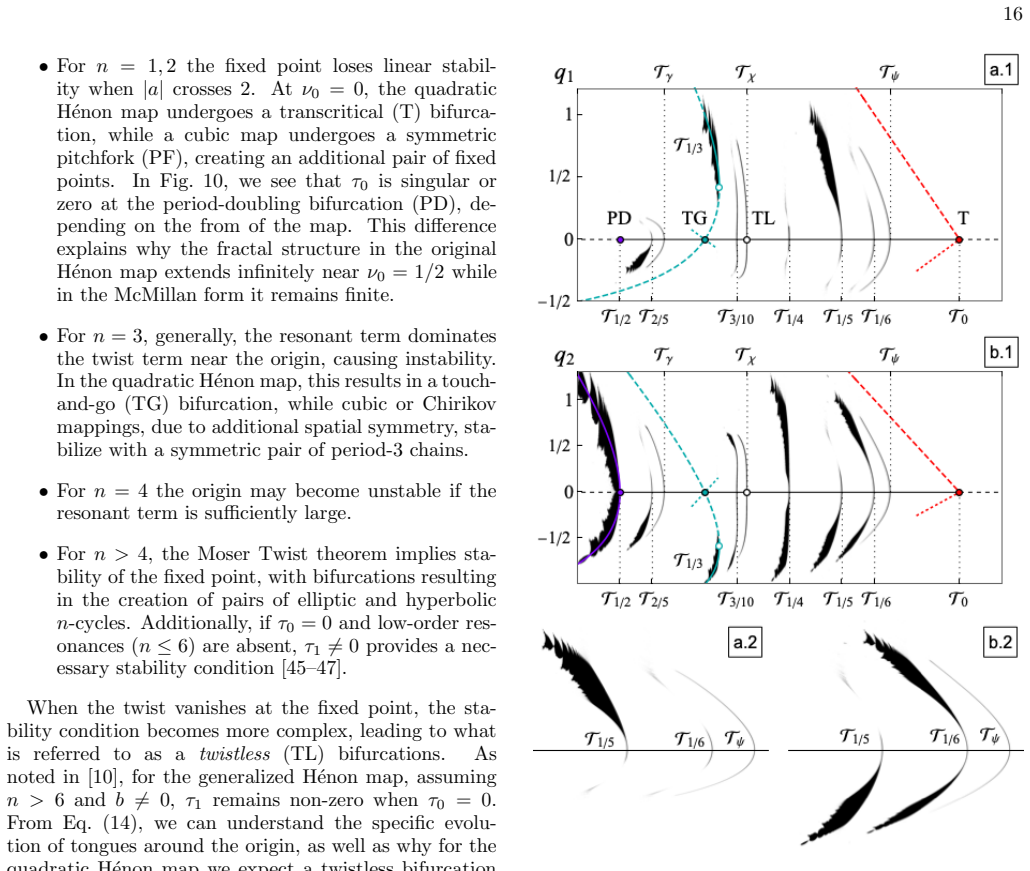
- In the bounded-motion region, rational tongues, cuts, seams, and the twistless 'ribcage' structure provide a quantitative explanation of the shapes of the stability domains.
Reading between the lines
- Going beyond the paper: the same completeness argument should hold for higher-dimensional reversible symplectic maps if the two symmetry lines are replaced by symmetry manifolds, but a scan of a fixed line would then be a codimension-one slice whose completeness is not guaranteed; this is testable with standard four-dimensional symplectic maps.
- Going beyond the paper: the two-line diagrams could serve as a diagnostic for asymmetric dynamics: any stability shift seen in both scans without a symmetric orbit appearing on either line is a signature of an asymmetric periodic orbit population, turning the method's admitted blind spot into a detection tool.
- Going beyond the paper: the twistless-orbit 'ribcage' seen in the quadratic map suggests that the zero-twist curve, not the last invariant circle, may set the practical dynamic aperture in weakly nonlinear lattices; this is a speculative extension the paper does not claim.
Signed reviews
Editorial analysis
A structured set of objections, weighed in public.
Referee Report
Summary. The paper revisits Hénon's isochronous diagram for the area-preserving quadratic Hénon map and proposes extending it by adding a period-doubling diagram along the second symmetry line, together with additional symmetry-line scans for multiply reversible maps. The authors develop the reversibility/symmetry-line framework in Sections III.B–III.E, introduce REM and GALI based coloring of stability diagrams, describe Arnold tongue structures such as feathers, cuts, tears, frays, and twistless tori, and offer a quantitative interpretation through integrable McMillan approximations (SX-1 and SX-2) whose first twist coefficient is matched to the quadratic Hénon map. Applications to homogeneous Hénon maps (sextupole through duodecapole models) and to the Chirikov map are presented.
Significance. If the completeness claim were established, the proposed two-line diagrams would provide a practical and valuable control plot for reversible symplectic maps of the plane, recovering even island chains that Hénon's original L1-only diagram missed and giving a direct visualization of fixed-point bifurcations. The reversibility framework used in Sections III.B–III.D is classical and sound, and the numerical diagrams are rich, internally coherent, and supported by referenced code and animations. The main weakness is that the central completeness claim is asserted rather than proved and is in tension with the paper's own classification in Fig. 4(c). The quantitative approximation via SX-2 is suggestive but not rigorously controlled. These issues affect the strength of the advertised conclusions, though they do not destroy the value of the diagrams as exploratory tools.
major comments (3)
- [Section III.D–III.E, Fig. 4(c)] The central completeness claim is not supported by the paper's own classification. Equations (11)–(12) show that each symmetric periodic point lies at an intersection of some pair of symmetry lines in the infinite family Fix(T^n R1); they do not imply that one of the two principal lines L1 or L2 is always involved. Figure 4(c) explicitly depicts a symmetric even group with Γ∩L1=∅ and Γ∩L2=∅, i.e., a symmetric periodic orbit invisible to both one-dimensional scans. The assertion in Section III.E that for even n "cycles appear on both sides of two different symmetry lines" and that each crossing occurs on a symmetry line therefore needs a proof that such orbits do not arise in the bifurcations under study. Without that proof, the abstract's claim that the diagrams "represent the system's bifurcations and the groups of symmetric periodic orbits that emerge in typical bifurcations of the fixed point" is too strong. I recommend either supplying the missing argument or explicitly restricting the claim to the classes covered by cases (a), (b), and (d) of Fig. 4 and noting that case (c) is not detected directly.
- [Section V.E, Eq. (16), Fig. 18] The quantitative explanation of the Hénon set's bulbs rests on the SX-2 McMillan approximation, which matches the quadratic Hénon map's first twist coefficient τ0. The paper does not quantify the error of this approximation away from the origin, and it concedes that higher orders do not yield an integrable map and that convergence "becomes increasingly challenging" near ripped boundaries. As it stands, the agreement in Fig. 18(c) is suggestive but not a demonstrated quantitative explanation. Please state explicitly what is matched, what is uncontrolled, and which qualitative features of the Hénon set are guaranteed by the matching. In particular, the claim in the introduction and Section VII of a "quantitative description" needs a precise statement of the approximation's validity region.
- [Section III.E and Section VII] The treatment of asymmetric orbits narrows the representational claim more than the summary acknowledges. The paper concedes in Section III.E that asymmetric 3-cycles "fully evade symmetry lines" and are only detected indirectly through stability shifts, and it concedes for multiply reversible maps that additional lines l3, l4, ... are required. Section VII states that groups arising from typical bifurcations "can be identified along at least one of the two principal symmetry lines" without restating these caveats. The summary and abstract should be rephrased so that the direct-detection claim is limited to symmetric orbits intersecting a scanned symmetry line, while asymmetric orbits and case-(c) symmetric orbits are described as detected only indirectly or not at all.
minor comments (4)
- [Abstract] There are several grammatical errors, e.g., "which allows to represents the system's bifurcations" and "a comprehensive description ... remain lacking." These should be corrected.
- [Section III.E] The parenthetical "(see Section oct)" should be a proper cross-reference, presumably to Section VI.B.1 on the cubic map.
- [Section VI.B.2] The text contains typos such as "ca be seen" and "wit chaotic trajectories"; please proofread this subsection.
- [Section V.C and Fig. 13] The terms "seam," "cut," "tear," and "fray" are introduced with an analogy to tailoring; the analogy is helpful, but a concise formal definition of each term in terms of rotation-number level sets and manifold intersections would improve reproducibility.
Circularity Check
Central diagram method is self-contained; partial circularity only in the SX-2 twistless 'revelation' (fitted tau0) and its self-cited derivation, while the two-line completeness claim is an unproven, in-text-contradicted assertion (correctness risk) rather than a circular reduction.
-
fitted input called prediction
[Section V.E (Approximate domains of the Hénon set), paragraph after Eq. (16), SX-2 approximation]
"fSX-2(q) = a (a + 1) + q (a + 1) - q + 1/a q2 q = a q + q2 + O(q4). ... In the SX-2 order, τ0 is exactly matched [25]. This approximation reveals a twistless orbit and additionally, it captures the formation of a bulb for a ∈ (−1, 0), corresponding to ν0 ∈ (1/4, 1/3)."
The SX-2 model is an integrable approximation explicitly fitted to the quadratic Hénon map: its force function is a q + q² + O(q⁴) and 'τ0 is exactly matched.' The twistless bifurcation at the origin (a = −1/2, ν0 = χ ≈ 0.290) is defined precisely by the vanishing of the first twist coefficient τ0 at the fixed point. Because the approximant was constructed to reproduce τ0 exactly, its 'revelation' of the twistless orbit and of the ν0 ∈ (1/4, 1/3) bulb is a consequence of the fit condition, not an independent prediction. The paper discloses the match explicitly, so this is a transparent model-validation statement, but as worded ('this approximation reveals...') the revealed structure is forced by construction.
-
self citation load bearing
[Section V.E, perturbation-theory paragraph (Eqs. (15)-(16)); Section I(iii)]
"Interestingly, the first two orders of this theory yield a general result ... that matches the integrable symmetric McMillan map. ... For now, the first two orders are covered in [25, 44], with a summary of the essential points provided here. ... Thorough discussion of this perturbation theory, along with higher-order analyses, will be provided in a subsequent publication."
The quantitative perturbation apparatus (Eq. (16), SX-1/SX-2 maps) that underpins the explanation of the Hénon set's bulb structure is not derived in this paper; the derivation is cited to the same authors' companion works, [25] (arXiv:2410.10380) and [44] (arXiv:2405.05652), with the full treatment deferred to a later publication. The cited result is itself an approximation explicitly fitted to τ0 (see the preceding step), so the chain 'SX-2 matches τ0 ⇒ reveals twistless structure' rests on a self-citation chain. Mitigating factors: Eq. (14) is stated in-paper with multiple independent derivations listed, and the SX-2 series is written explicitly, so the claimed match is directly verifiable by the reader. This is load-bearing but shallow self-citation, not a closed circle.
full rationale
The paper's central contribution — the isochronous and period-doubling diagrams built from scans of the two principal symmetry lines — is not a circular construction. The symmetry-line machinery (Eqs. (6)-(12)) restates classical reversibility theory (Birkhoff, deVogelaere, Roberts-Quispel), properly cited externally, and the diagrams are produced by direct numerical indicators (REM, GALI, mode-locking) along the defined lines; the analytic 1-, 2-, 3-, 4-cycle branches are computed from the map's equations. The twistless bifurcation at a = −1/2 is an independent consequence of the stated twist formula Eq. (14) and is consistent with the external literature (Dullin-Meiss [10]). What prevents a clean non-finding is one quasi-circular element: the SX-2 integrable approximation is deliberately constructed to match the quadratic Hénon map's first twist coefficient exactly, and the paper then states that this approximation 'reveals' the twistless orbit and the ν0 ∈ (1/4, 1/3) bulb. Since the twistless bifurcation of the origin is defined by τ0 = 0, the revelation is forced by the fit; the disclosure is explicit, making this a transparent validation rather than a disguised prediction. The source of the SX-2 perturbation theory is also self-referential ([25, 44], same authors), with the full derivation deferred, though the in-paper explicit formulas keep the claim externally checkable. Separately, and flagged per the review rule rather than as circularity: Section III.E asserts that for even n, island-chain cycles 'cross a symmetry line,' but the paper's own symbolic classification (Fig. 4(c)) includes even symmetric groups with Γ ∩ L1 = ∅ and Γ ∩ L2 = ∅, and the doubled 3-island chain is explicitly described as 'absent on both symmetry lines,' requiring extra lines l3, l4. The completeness of the two-line scan is therefore asserted, not derived, and is partially contradicted in-text; this is an over-claim (correctness risk), not a reduction of the result to its inputs.
Assumptions & free parameters
assumptions (5)
- standard math KAM theorem and Moser twist theorem: invariant tori persist near stable fixed points under small perturbations and stability holds for generic resonances with period larger than 4.
- standard math Reversibility theory: for an orientation-reversing C^1 involution R of the plane, Fix(R) is a one-dimensional analytic line, and symmetric periodic points are doubly symmetric and lie at intersections of symmetry lines.
- standard math Birkhoff normal form expansion of the rotation number, nu(J) = nu0 + tau0 J + ..., and the expression (14) for the first twist coefficient tau0.
- ad hoc to paper The SX-1 and SX-2 rational McMillan maps are valid integrable approximations of the chaotic quadratic Hénon map in the regions where stability boundaries are matched, with convergence not analyzed beyond second order.
- domain assumption Finite-horizon chaos indicators (REM, GALI, FMA) with the chosen thresholds correctly classify regular versus chaotic orbits and detect bifurcations in the scanned parameter-variable slices.
Cite this review
Pith. "Pith review of Isochronous and period-doubling diagrams for symplectic maps of the plane." pith.science (2026). https://pith.science/paper/VZ2BFLQB
@misc{pith2026241205541,
  author       = {Pith},
  title        = {Pith review of: Isochronous and period-doubling diagrams for symplectic maps of the plane},
  year         = {2026},
  howpublished = {\url{https://pith.science/paper/VZ2BFLQB}},
  note         = {Machine review of arXiv:2412.05541}
}
read the original abstract
Symplectic mappings of the plane serve as key models for exploring the fundamental nature of complex behavior in nonlinear systems. Central to this exploration is the effective visualization of stability regimes, which enables the interpretation of how systems evolve under varying conditions. While the area-preserving quadratic H\'enon map has received significant theoretical attention, a comprehensive description of its mixed parameter-space dynamics remain lacking. This limitation arises from early attempts to reduce the full two-dimensional phase space to a one-dimensional projection, a simplification that resulted in the loss of important dynamical features. Consequently, there is a clear need for a more thorough understanding of the underlying qualitative aspects. This paper aims to address this gap by revisiting the foundational concepts of reversibility and associated symmetries, first explored in the early works of G.D. Birkhoff. We extend the original framework proposed by H\'enon by adding a period-doubling diagram to his isochronous diagram, which allows to represents the system's bifurcations and the groups of symmetric periodic orbits that emerge in typical bifurcations of the fixed point. A qualitative and quantitative explanation of the main features of the region of parameters with bounded motion is provided, along with the application of this technique to other symplectic mappings, including cases of multiple reversibility. Modern chaos indicators, such as the Reversibility Error Method and the Generalized Alignment Index, are employed to distinguish between various dynamical regimes in the mixed space of variables and parameters. These tools prove effective in differentiating regular and chaotic dynamics, as well as in identifying twistless orbits and their associated bifurcations.
Figures


Figures from the paper (25 more)




Reference graph
Works this paper leans on
-
[1]
For mappings in McMillan form that satisfy f (p) = −f (−p), an additional spatial symmetry arises
Cubic H´ enon map As a specific example, we analyze the cubic transfor- mations with f±(p) = a p± p3, representing a typical odd force function. For mappings in McMillan form that satisfy f (p) = −f (−p), an additional spatial symmetry arises. Specifically, these mappings commute with the area-preserving involution: T = Rot(π) ◦ T ◦ Rot−1(π). This propert...
-
[2]
Stable (rational and irrational) trajectories appear in white, while black regions indicate some mode-locked areas, and gold shows unstable initial conditions. These differences can be understood through founda- tional works in dynamical systems and chaos theory, es- pecially in the context of the H´ enon map. We refer read- ers to relevant articles [9–11...
-
[3]
P. J. L. Fatou, Comptes Rendus de l’Acad´ emie des Sci- ences de Paris 165, 992 (1917)
work page 1917
-
[4]
Fourth and fifth power functions Next, we present results for two additional mappings, characterized by the force functions f (p) = a p+ p4 and f (p) = a p+ p5 as shown in Figs. 24 and 25, respectively. These systems exhibit an atypical behavior, as they lack both lower- order terms q2 and q3. Consequently, the usual integrable approximation cannot be app...
work page 2024
-
[5]
G. M. Julia, Journal de Math´ ematiques Pures et Ap- pliqu´ ees8, 47 (1918), [8 e S´ erie, Tome 1]
work page 1918
-
[6]
P. J. L. Fatou, Comptes Rendus de l’Acad´ emie des Sci- ences de Paris 164, 806 (1917)
work page 1917
-
[7]
H´ enon, Quarterly of Applied Mathematics 27, 291 (1969)
M. H´ enon, Quarterly of Applied Mathematics 27, 291 (1969)
work page 1969
-
[8]
The dynamics of 2- generator subgroups of PSL(2, C),
R. Brooks and J. P. Matelski, “The dynamics of 2- generator subgroups of PSL(2, C),” in Riemann Surfaces And Related Topics: Proceedings of the 1978 Stony Brook Conference. (AM-97), Volume 97 , edited by I. Kra and B. Maskit (Princeton University Press, Princeton, 1981) pp. 65–72
work page 1978
Show all 60 references
-
[9]
B. B. Mandelbrot, Annals of the New York Academy of Sciences 357, 249 (1980)
1980
-
[10]
H´ enon, Communications in Mathematical Physics50, 69 (1976)
M. H´ enon, Communications in Mathematical Physics50, 69 (1976)
1976
-
[11]
Dullin, J
H. Dullin, J. Meiss, and D. Sterling, Nonlinearity 13, 203 (2000)
2000
-
[12]
J. A. C. Gallas, Phys. Rev. Lett. 70, 2714 (1993)
1993
-
[13]
Sterling, H
D. Sterling, H. Dullin, and J. Meiss, Physica D: Nonlin- ear Phenomena 134, 153 (1999)
1999
-
[14]
Dullin and J
H. Dullin and J. Meiss, Physica D: Nonlinear Phenomena 143, 262 (2000)
2000
-
[15]
E. M. McMillan, in Topics in modern physics. A Trib- ute to Edward U. Condon , edited by W. E. Brittin and H. Odabasi (Colorado Associated University Press, Boul- der, CO, 1971) pp. 219–244
1971
-
[16]
hop across
that “ ...re- versible dynamical systems have received far less atten- tion and the treatment that they have received has tended to be less systematic. This has led to the situation where the literature on the subject is quite scattered, with some authors not being aware of th...
-
[17]
Mathematica, version 10.0,
W. R. Inc., “Mathematica, version 10.0,” (2013), cham- paign, IL, 2013
2013
-
[18]
D. C. Lewis Jr., Pacific Journal of Mathematics 11, 1077 (1961)
1961
-
[19]
IV. On the structure of symmetric pe- riodic solutions of conservative systems, with applica- tions,
R. DeVogelaere, “IV. On the structure of symmetric pe- riodic solutions of conservative systems, with applica- tions,” in Contributions to the Theory of Nonlinear Os- cillations (AM-41), Volume IV , edited by S. Lefschetz (Princeton University Press, 1958) pp. 53–84
1958
-
[20]
Roberts and G
J. Roberts and G. Quispel, Physics Reports 216, 63 (1992)
1992
-
[21]
Bazzani, M
A. Bazzani, M. Giovannozzi, C. E. Montanari, and G. Turchetti, Phys. Rev. E 107, 064209 (2023)
2023
-
[22]
S. Das, Y. Saiki, E. Sander, and J. A. Yorke, Nonlinearity 30, 4111 (2017)
2017
-
[23]
Introduction to Frequency Map Analysis,
J. Laskar, “Introduction to Frequency Map Analysis,” in Hamiltonian Systems with Three or More Degrees of Freedom, edited by C. Sim´ o (Springer Netherlands, Dor- drecht, 1999) pp. 134–150
1999
-
[24]
Frequency map analysis and quasiperiodic de- compositions,
J. Laskar, “Frequency map analysis and quasiperiodic de- compositions,” (2003), arXiv:math/0305364 [math.DS]
2003 arXiv
-
[25]
Panichi, L
F. Panichi, L. Ciotti, and G. Turchetti, Communications in Nonlinear Science and Numerical Simulation 35, 53 (2016)
2016
-
[26]
Panichi, K
F. Panichi, K. Go´ zdziewski, and G. Turchetti, Monthly Notices of the Royal Astronomical Society 468, 469 (2017), https://academic.oup.com/mnras/article- pdf/468/1/469/11066230/stx374.pdf
2017
-
[27]
Skokos, T
C. Skokos, T. Bountis, and C. Antonopoulos, Physica D: Nonlinear Phenomena 231, 30 (2007)
2007
-
[28]
The Smaller (SALI) and the Generalized (GALI) Alignment Indices: Efficient Meth- ods of Chaos Detection,
C. H. Skokos and T. Manos, “The Smaller (SALI) and the Generalized (GALI) Alignment Indices: Efficient Meth- ods of Chaos Detection,” in Chaos Detection and Pre- dictability, edited by C. H. Skokos, G. A. Gottwald, and J. Laskar (Springer Berlin Heidelberg, Berlin, Heidelberg,
-
[29]
Dynamics of McMillan mappings III. Symmetric map with mixed nonlinearity,
T. Zolkin, S. Nagaitsev, I. Morozov, S. Kladov, and Y.-K. Kim, “Dynamics of McMillan mappings III. Symmetric map with mixed nonlinearity,” (2024), arXiv:2410.10380 [nlin.SI]
2024 arXiv
-
[30]
Research conserning the theory of non- linear resonance and stochasticity,
B. V. Chirikov, “Research conserning the theory of non- linear resonance and stochasticity,” (1971), translated at CERN by A. T. Sanders from the Russian [CERN- Trans-71-40]. Nuclear Physics Institute of the Siberian Section of the USSR Academy of Science, Report 267, Novosibi...
1971
-
[31]
B. V. Chirikov, Physics Reports 52, 263 (1979)
1979
-
[32]
Turaev, Nonlinearity 16, 123 (2002)
D. Turaev, Nonlinearity 16, 123 (2002)
2002
-
[33]
Zolkin, Y
T. Zolkin, Y. Kharkov, and S. Nagaitsev, Phys. Rev. Res. 5, 043241 (2023)
2023
-
[34]
Zolkin, Y
T. Zolkin, Y. Kharkov, and S. Nagaitsev, Phys. Rev. Res. 6, 023324 (2024)
2024
-
[35]
Barrio and F
R. Barrio and F. Blesa, Chaos, Solitons & Fractals 41, 560 (2009)
2009
-
[36]
Abraham and J
R. Abraham and J. E. Marsden, Foundations of Me- chanics, 2nd ed., MSC: Primary 70; Secondary 37, Vol. 364 (Addison-Wesley Publishing Company, Inc., 1978) p. 826
1978
-
[37]
Froeschl´ e, R
C. Froeschl´ e, R. Gonczi, and E. Lega, Planetary and Space Science 45, 881 (1997), asteroids, Comets, Meteors 1996 - II
1997
-
[38]
Small denominators. I. Mapping of the circumference onto itself,
A. B. Givental, B. A. Khesin, J. E. Marsden, A. N. Varchenko, V. A. Vassiliev, O. Y. Viro, and V. M. Za- kalyukin, eds., “Small denominators. I. Mapping of the circumference onto itself,” in Collected Works: Repre- sentations of Functions, Celestial Mechanics and KAM Theory, 1...
1957
-
[39]
P. L. Boyland, Communications in Mathematical Physics 106, 353 (1986)
1986
-
[40]
N. Y. Ivankov and S. P. Kuznetsov, Phys. Rev. E 63, 046210 (2001)
2001
-
[41]
A. N. Kolmogorov (1954) pp. 527–530
1954
-
[42]
Moser, Matematika 6, 51 (1962)
J. Moser, Matematika 6, 51 (1962)
1962
-
[43]
V. I. Arnold, Russian Mathematical Surveys 18, 9 (1963)
1963
-
[44]
Bengtsson, The sextupole scheme for the Swiss Light Source (SLS): an analytic approach , Tech
J. Bengtsson, The sextupole scheme for the Swiss Light Source (SLS): an analytic approach , Tech. Rep. SLS- TME-TA-1997-0009 (Paul Scherrer Institut, Villigen, Switzerland, 1997)
1997
-
[45]
Morozov and E
I. Morozov and E. Levichev, in Proceedings of the CERN- BINP Workshop for Young Scientists in e+e− Collid- ers, Geneva, Switzerland, 22 – 25 August 2016 , CERN Proceedings, Vol. 1/2017, edited by V. Brancolini and L. Linssen (CERN, Geneva, 2017) pp. 195–206, CERN- Proceedings-2017-001
2016
-
[46]
L. H. Yu, Phys. Rev. Accel. Beams 20, 034001 (2017)
2017
-
[47]
L. P. Michelotti, Intermediate Classical Dynamics with Applications to Beam Physics , Wiley Series in Beam Physics and Accelerator Technology (Wiley, 1995)
1995
-
[48]
Dynamics of McMillan mappings I. McMillan multipoles,
T. Zolkin, S. Nagaitsev, and I. Morozov, “Dynamics of McMillan mappings I. McMillan multipoles,” (2024), arXiv:2405.05652 [nlin.SI]. 34
2024 arXiv
-
[49]
C. L. Siegel and J. K. Moser, Lectures on Celestial Mechanics, 1st ed., Classics in Mathematics (Springer Berlin, Heidelberg, 1971)
1971
-
[50]
V. I. Arnold, Dynamical Systems III , 1st ed., Encyclopae- dia of Mathematical Sciences (Springer Berlin, Heidel- berg, 1988)
1988
-
[51]
V. I. Arnold, V. V. Kozlov, and A. I. Neishtadt, Mathe- matical Aspects of Classical and Celestial Mechanics, 3rd ed., Encyclopaedia of Mathematical Sciences (Springer Berlin, Heidelberg, 2006)
2006
-
[52]
Dolotin and A
V. Dolotin and A. Morozov, International Jour- nal of Modern Physics A 23, 3613 (2008), https://doi.org/10.1142/S0217751X08040330
2008 doi
-
[53]
Lee, Accelerator Physics, 4th ed
S.-Y. Lee, Accelerator Physics, 4th ed. (World Scientific Publishing Company, 2018)
2018
-
[54]
Gareyte, J.-P
J. Gareyte, J.-P. Koutchouk, and F. Ruggiero, Landau damping dynamic aperture and octupole in LHC , Tech. Rep. (CERN, Geneva, 1997) revised version number 1 submitted on 2003-08-21 14:12:02
1997
-
[55]
S. C. Leemann and A. Streun, Phys. Rev. ST Accel. Beams 14, 030701 (2011)
2011
-
[56]
Plassard, G
F. Plassard, G. Wang, T. Shaftan, V. Smaluk, Y. Li, and Y. Hidaka, Phys. Rev. Accel. Beams 24, 114801 (2021)
2021
-
[57]
Ohuchi, Y
N. Ohuchi, Y. Arimoto, K. Akai, K. Aoki, N. Hi- gashi, K. Kanazawa, M. Kawai, T. Kawamoto, H. Koiso, Y. Kondou, M. Masuzawa, A. Morita, S. Nakamura, Y. Ohnishi, Y. Ohsawa, K. Oide, N. Okada, T. Oki, H. Sugimoto, M. Tawada, K. Tsuchiya, R. Ueki, X. Wang, H. Yamaoka, Z. Zong, B....
2022
-
[58]
Nagaitsev and T
S. Nagaitsev and T. Zolkin, Phys. Rev. Accel. Beams 23, 054001 (2020)
2020
-
[59]
Chang, S
C. Chang, S. Ku, R. Hager, J. Choi, D. Pugmire, S. Klasky, A. Loarte, and R. Pitts, Nuclear Fusion 64, 056041 (2024)
2024
-
[60]
Barrio and D
R. Barrio and D. Wilczak, Nonlinear Dynamics 102, 403 (2020)
2020
Reviewed August 11, 2026 · model on record in the stance chip above.
Discussion (0). Continue with ORCID to comment.