REVIEW 5 major objections 7 minor 139 references
Classification and physical characteristics analysis of Fermi-GBM Gamma-ray bursts based on Deep-learning
T0 review · 5 major / 7 minor · reviewed 2026-08-11 · deepseek-v4-flash
Pith's one-line read A convolutional network trained on Fermi-GBM time–energy images assigns every overlapping gamma-ray burst to one of two classes, ruling out an intermediate GRB category.
desk verdict A useful count-map CNN classifier, but the claim that it refutes an intermediate GRB class is not supported by the design: a binary softmax cannot test for a third class. read the letter →
The pith
A machine-rendered reading of the paper's core claim, the machinery that carries it, and where it could break.
The reading
What carries the argument
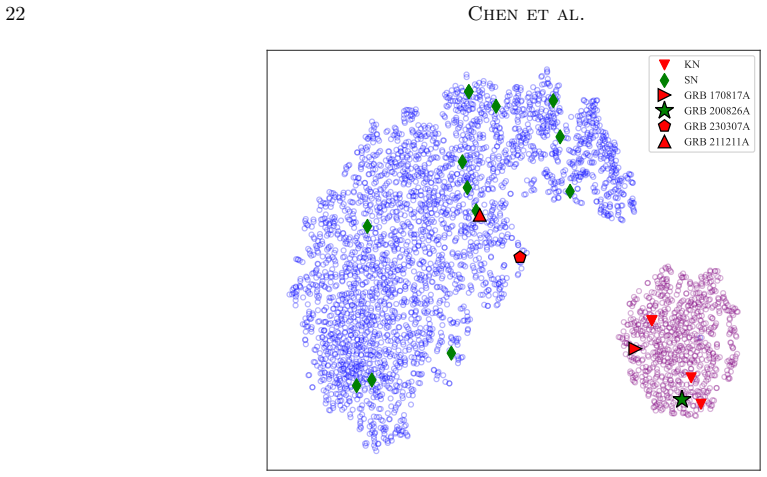
The load-bearing input is the GRB count map: a $512 \times 128$ image whose horizontal axis is time (512 bins over the first 15 s and last 30 s of each burst), vertical axis is 128 energy channels, and pixel value is normalized photon count. These maps preserve both the temporal profile and spectral shape, so the network can use more than duration. The classifier is a ResNet-CBAM convolutional network—residual blocks with channel and spatial attention modules—trained on 3,177 non-overlapping bursts labeled SGRB or LGRB from the two peaks of the $T_{90}$ distribution, augmented by using four detectors per burst and settled by majority vote for each event. t-SNE, a nonlinear dimensionality-reduction algorithm, is then applied to the average-pooling features; the appearance of two separated clusters in this projection, rather than the softmax output alone, is what carries the refutation of an intermediate class.
What would settle it
One decisive check would be to retrain the same architecture on the same labels with the spectral axis of the count maps destroyed, for example by scrambling the energy channels in every time bin, and ask whether the network still splits the overlapping bursts into two clean clusters; if it does, the claimed physical dichotomy rests on duration alone rather than on the spectral information the paper says carries the signal. A second, progenitor-anchored check would be to require that confirmed supernova bursts land in L-type and confirmed kilonova bursts in S-type, with only the documented outliers allowed.
Extended reading notes
Core claim
The paper's central discovery is that the $T_{90}$ overlap region does not contain a third type of burst. Using a ResNet-CBAM convolutional network and count maps built from Fermi-GBM time-tagged events, the authors classify 593 overlapping bursts into two categories, S-type and L-type, and find two well-separated clusters when the learned features are projected with t-SNE. The same network, applied to 3,726 bursts, puts 756 (20.3%) in the S-type cluster and 2,970 (79.7%) in the L-type cluster, with no absolute $T_{90}$ boundary: S-type events can last up to about 8 s and L-type events can be as short as 0.4 s. Time-integrated spectral fitting shows significant differences between the two classes in low-energy index, peak energy, flux, and hardness ratio, and known kilonova bursts land mostly in S-type while supernova bursts land mostly in L-type. The paper therefore concludes that duration-based overlap and 'intermediate' candidates reflect the inadequacy of $T_{90}$ as a classifier, not a real intermediate population.
Load-bearing premise
The whole argument leans on the assumption that the labels taken from the two non-overlapping tails of the duration distribution mark the true physical types, so the network learns intrinsic differences and not just a clever reconstruction of the 2-second $T_{90}$ rule.
Editorial extensions
If this is right
- Overlapping-$T_{90}$ bursts can each be assigned a class, so the proposed intermediate GRB population is not needed to explain the overlap.
- The two classes differ significantly in time-integrated spectral parameters ($\alpha$, $E_p$, flux, and hardness ratio), so the classification has observable physical content beyond duration.
- Most kilonova-associated bursts are S-type and most supernova-associated bursts are L-type, so the learned classes align with the two standard progenitor channels, with GRB 211211A and GRB 230307A as long-duration kilonova outliers and GRB 200826A as a short-duration supernova outlier.
- Short GRBs with extended emission appear in both classes depending on their duration, so extended emission does not define a separate category.
- Because the method needs only count maps and not redshifts, it can be applied immediately to newly detected Fermi-GBM bursts and to archival samples where distance is unknown.
Reading between the lines
- A testable extension of the paper's logic would be to run the same trained network on bursts observed by instruments with different energy passbands; if the S/L split is physical it should survive the bandpass change, whereas a duration artifact would not.
- The 32 overlapping events that failed the four-detector vote are a natural place to look for a continuum rather than a clean dichotomy; their spectra and light curves could be compared with confidently classified bursts to see whether they sit between the two clusters.
- If the L-type class really contains merger-origin bursts such as GRB 211211A and GRB 230307A, then the low-redshift L-type fraction should track the short-burst formation rate; redshift-complete catalogs could test this without waiting for new associations.
- The claim that no intermediate class exists should be read as conditional on the training labels coming from the $T_{90}$ peaks; a fully label-free version of the same feature extraction, clustering the count-map features without using duration at all, would be the cleanest independent check.
Editorial analysis
A structured set of objections, weighed in public.
Referee Report
Summary. The paper trains a ResNet-CBAM convolutional neural network on Fermi-GBM count maps to classify gamma-ray bursts as short (S) or long (L). Training labels are derived from a BGMM fit to log10(T90) after removing the overlap region (roughly T90 between 1.792 and 8.256 s), using the non-overlapping tails as ground truth. The model is then applied to the overlap bursts, and the authors claim that assigning these events to two classes refutes the existence of an intermediate GRB class. The paper further extracts features from the network's average-pooling layer, applies t-SNE, reports two clusters, and compares spectral properties, kilonova/supernova associations, and traditional classification schemes.
Significance. If the central claim were valid, the paper would offer a notable contribution: a deep-learning classifier that uses full temporal-spectral count maps rather than a single duration value, plus a large spectral parameter catalog. Strengths include the use of public Fermi-GBM data, multi-detector sample augmentation, careful reporting of test-set metrics, and broad comparisons with previous classification schemes. However, the headline inference, that binary classification of overlap events refutes an intermediate GRB class, is not logically supported by the experimental design. The two-neuron softmax output and the T90-derived training labels force the very structure the paper claims to discover. Consequently, the physical conclusions about S/L spectral differences and kilonova/supernova associations inherit this circularity.
major comments (5)
- [Section 3.1] The model's final layer is a two-neuron softmax (Eq. 1 with C=2), so every input is necessarily assigned to one of two classes. A classifier with no third output, no abstention option, and no out-of-distribution rejection rule cannot provide evidence about whether a third class exists. The statement in the Abstract and Section 4.2.1 that classifying the overlapping GRBs into two categories 'refutes the existence of an intermediate GRB class' is therefore not a valid inference from this architecture. To support the claim, the authors would need an independent test such as an unsupervised clustering or density estimate on the overlap sample, a model with an explicit third class whose predicted probability can be examined, or a calibrated reject-option analysis showing that no subpopulation of overlap events resists confident assignment to the two known classes.
- [Section 2 / Figure 7] Figure 7 is not independent evidence of two clusters. The t-SNE features are extracted from the average-pooling layer of a network trained with binary labels derived from the non-overlapping T90 tails (Section 2). Because the count-map input contains a 512-bin time axis, the network can learn features that are essentially a nonlinear re-encoding of T90; in that case the two separated clusters in the supervised feature space are the expected outcome even if the underlying population is continuous or trimodal. The statement in Section 4.2.1 that Figure 7 'indirectly disproves' a third class is thus circular. An unsupervised dimensionality reduction applied directly to the count maps, or to features from a model trained without labels, is required to probe the intrinsic cluster structure of the overlap events.
- [Section 4.1 / Section 4.2.1] The model's reported test accuracy of 99.40% is measured on a test split drawn from the non-overlapping tails of the T90 distribution, while Section 4.2.1 applies the model to 594 overlap events whose T90 lies between 1.792 and 8.256 s, a region excluded from training. The high tail-accuracy therefore does not validate the classification of the overlap events, for which no ground-truth labels exist. The authors should provide overlap-specific evidence, for example by varying the BGMM overlap threshold and showing the class assignments are stable, by demonstrating that confidence scores are calibrated on overlap inputs, or by withholding bursts with independent physical classifications (e.g., kilonova/supernova associations) from training and showing they are predicted correctly.
- [Section 4.2.1 vs Section 6] The number of successfully classified overlap events is inconsistent across the manuscript: Section 4.2.1 states that 562 of 594 events are classified and 32 fail, Section 6 states that 594 overlapping GRBs were successfully classified, and the Abstract says 593. This discrepancy affects the central quantitative result and must be resolved, with the exact definitions of 'classification sample' and 'successfully classified' stated explicitly.
- [Section 2 / Section 5] The training labels are assigned by splitting the non-overlapping tails of the log10(T90) distribution, yet the Introduction itself argues that T90 alone cannot determine the progenitor type of a GRB. The model is therefore trained to reproduce a T90-based dichotomy, and applying it to the overlap region extrapolates the same duration rule rather than discovering a physical dichotomy. Unless the T90 tails are justified as a valid proxy for physical class, the downstream comparisons of spectral parameters and kilonova/supernova associations in Section 5 rest on labels whose physical meaning has not been established.
minor comments (7)
- [Section 1] The statement that 'Deep learning (DL) is a subset of unsupervised machine learning' is incorrect; DL includes supervised, unsupervised, and self-supervised methods, and the classifier used in this paper is supervised.
- [Section 2] The sentence 'we selected the first 15 s and the last 30 s of its duration as the time range for sampling' is ambiguous; please specify the time window relative to the trigger time and to T90.
- [Section 4.1] The text states 'Figure 2 shows the variations in loss and accuracy,' but Figure 2 shows the count-map example; the training curves appear in Figure 4.
- [Section 4.2.2] The text says 'The statistical results of the two types of bursts are shown in Table 3,' but Table 3 in the appendix lists the sGRB-EE sample; the referenced table appears to be misnumbered or missing.
- [Section 5.1] The kilonova sample is said to include five events, but the list contains four (GRB 150101B, GRB 170817A, GRB 211211A, GRB 230307A); GRB 160821B, discussed later in the same paragraph, should be added to the list.
- [Section 6] The sentence 'extract features from count maps of 3376 GRBs' conflicts with the number 3726 used in Section 4.2.2; please reconcile the total count.
- [Section 5.1] The name 'GRB 200826Ac' appears to be a typo for 'GRB 200826A'.
Circularity Check
Binary softmax and T90-derived labels make the claimed refutation of an intermediate GRB class circular.
-
self definitional
[Abstract; Sec. 3.1 (Eq. 1); Sec. 4.2.1]
"By using count maps that incorporate both temporal and spectral features as inputs, we successfully classify 593 overlapping events into two distinct categories, thereby refuting the existence of an intermediate GRB class. ... This layer contains 2 neurons, used to output the probability of each classification category. ... After inputting these count maps into the optimal model, we can determine whether these GRB events are GRB-L or GRB-S."
With C=2 in Eq. (1), the softmax layer has exactly two output neurons, so no third class can be expressed. Every non-tie event is therefore assigned to either GRB-S or GRB-L by construction. The 'successful classification into two distinct categories' is guaranteed by the architecture, and the 'refutation' of an intermediate class is a property of the output layer, not an empirical finding. The 32 unclassified events are vote ties among four binary detector outputs, not detections of an intermediate class.
-
fitted input called prediction
[Sec. 2; Sec. 4.2.2 and Fig. 8]
"We label the short-duration and long-duration components as SGRB and LGRB, respectively, serving as our training samples. ... We apply the optimal model to feature extraction of GRB count maps. ... The features of GRBs form two distinct groups after dimensionality reduction. The smaller cluster mainly consists of short-duration GRBs, while the larger cluster consists of long-duration GRBs."
Training labels are the non-overlapping T90 tails, and the count-map inputs contain duration information, so the supervised loss can be minimized by learning features that effectively re-encode T90. Extracting features from this binary-trained network and projecting them with t-SNE will separate the two label groups by construction. The 'two distinct clusters' are therefore a restatement of the T90-derived labels, not an unsupervised discovery of bimodality in the overlap region.
full rationale
The central claim that classifying the overlap events into two categories refutes an intermediate GRB class is forced by the experimental design rather than demonstrated by the data. Section 2 defines the training labels from a BGMM fit to log10 T90, using only the non-overlapping tails as SGRB and LGRB samples. Section 3.1 fixes C=2 in the softmax, so the model cannot output any third category; the 594 (or 562, or 593, depending on the section) overlap events are necessarily assigned to one of two classes whenever the detector votes are not tied. The t-SNE visualizations are computed from features of this binary-trained network, so their two-cluster appearance reflects the supervised separation objective and the duration content of the count maps, not an independent measurement of the overlap population. The stated refutation of an intermediate class is thus tautological with respect to the label construction and the output architecture. The spectral comparisons and KN/SN associations are independent empirical checks, but they cannot validate the existence claim because the labels assigned to the overlap events already encode the two-class assumption being tested.
Assumptions & free parameters
free parameters (4)
- BGMM overlap threshold =
0.12
- Count map time window =
512 time bins over first 15 s and last 30 s around trigger
- t-SNE perplexity =
20
- CNN hyperparameters =
learning rate 1e-4, batch size 64, epochs 100, dropout 0.5
assumptions (5)
- domain assumption Two Gaussian components adequately model the log T90 distribution, and the non-overlap region labels bursts by component (short/long).
- ad hoc to paper Count maps from different detectors of the same burst are independent samples of the burst class.
- ad hoc to paper A two-neuron softmax classifier can test for the existence of a third GRB class.
- domain assumption t-SNE embeddings of features from a supervised network preserve true cluster structure.
- domain assumption Band function fits describe the time-integrated spectra well enough for the spectral comparisons.
Cite this review
Pith. "Pith review of Classification and physical characteristics analysis of Fermi-GBM Gamma-ray bursts based on Deep-learning." pith.science (2026). https://pith.science/paper/5WX3BHLX
@misc{pith2026241205564,
  author       = {Pith},
  title        = {Pith review of: Classification and physical characteristics analysis of Fermi-GBM Gamma-ray bursts based on Deep-learning},
  year         = {2026},
  howpublished = {\url{https://pith.science/paper/5WX3BHLX}},
  note         = {Machine review of arXiv:2412.05564}
}
abstract
The classification of Gamma-Ray Bursts has long been an unresolved problem. Early long and short burst classification based on duration is not convincing due to the significant overlap in duration plot, which leads to different views on the classification results. We propose a new classification method based on Convolutional Neural Networks and adopt a sample including 3774 GRBs observed by Fermi-GBM to address the $T_\text{90}$ overlap problem. By using count maps that incorporate both temporal and spectral features as inputs, we successfully classify 593 overlapping events into two distinct categories, thereby refuting the existence of an intermediate GRB class. Additionally, we apply the optimal model to extract features from the count maps and visualized the extracted GRB features using the t-SNE algorithm, discovering two distinct clusters corresponding to S-type and L-type GRBs. To further investigate the physical properties of these two types of bursts, we conduct a time-integrated spectral analysis and discovered significant differences in their spectral characteristics. The analysis also show that most GRBs associated with kilonovae belong to the S-type, while those associated with supernovae are predominantly L-type, with few exceptions. Additionally, the duration characteristics of short bursts with extended emission suggest that they may manifest as either L-type or S-type GRBs. Compared to traditional classification methods (Amati and EHD methods), the new approach demonstrates significant advantages in classification accuracy and robustness without relying on redshift observations. The deep learning classification strategy proposed in this paper provides a more reliable tool for future GRB research.
Figures


Figures from the paper (14 more)




Reference graph
Works this paper leans on
-
[1]
thebibliography [1] 20pt to REFERENCES 6pt =0pt -12pt 10pt plus 3pt =0pt =0pt =1pt plus 1pt =0pt =0pt -12pt =13pt plus 1pt =20pt =13pt plus 1pt \@M =10000 =-1.0em =0pt =0pt 0pt =0pt =1.0em @enumiv\@empty 10000 10000 `\.\@m \@noitemerr \@latex@warning Empty `thebibliography' environment \@ifnextchar \@reference \@latexerr Missing key on reference command E...
arXiv 2021
-
[2]
Abbott , B. P., Abbott , R., Abbott , T. D., et al. 2017, , 848, L12, 10.3847/2041-8213/aa91c9
-
[3]
Ahumada , T., Singer , L. P., Anand , S., et al. 2021, Nature Astronomy, 5, 917, 10.1038/s41550-021-01428-7
-
[4]
Aimuratov , Y., Becerra , L. M., Bianco , C. L., et al. 2023, , 955, 93, 10.3847/1538-4357/ace721
-
[5]
2002, , 390, 81, 10.1051/0004-6361:20020722
Amati , L., Frontera , F., Tavani , M., et al. 2002, , 390, 81, 10.1051/0004-6361:20020722
-
[6]
A., D'Avanzo , P., Perna , R., et al
Antonelli , L. A., D'Avanzo , P., Perna , R., et al. 2009, , 507, L45, 10.1051/0004-6361/200913062
-
[7]
1993, , 413, 281, 10.1086/172995
Band , D., Matteson , J., Ford , L., et al. 1993, , 413, 281, 10.1086/172995
doi:10.1086/172995 1993
-
[8]
Barnes , J., & Metzger , B. D. 2023, , 947, 55, 10.3847/1538-4357/acc384
Show all 139 references
-
[9]
L., Troja , E., Watson , A
Becerra , R. L., Troja , E., Watson , A. M., et al. 2023, , 522, 5204, 10.1093/mnras/stad1372
2023 doi
-
[10]
R., et al
Berger , E., Chornock , R., Holmes , T. R., et al. 2011, , 743, 204, 10.1088/0004-637X/743/2/204
2011 doi
-
[11]
G., Bianco , C
Bernardini , M. G., Bianco , C. L., Caito , L., et al. 2007, , 474, L13, 10.1051/0004-6361:20078300
2007 doi
-
[12]
G., Venkatesh , S., et al
Bhardwaj , S., Dainotti , M. G., Venkatesh , S., et al. 2023, , 525, 5204, 10.1093/mnras/stad2593
2023 doi
-
[13]
Bhave , A., Kulkarni , S., Desai , S., & Srijith , P. K. 2022, , 367, 39, 10.1007/s10509-022-04068-z
2022 doi
- [14]
-
[15]
D., & Stefanski, L
Boos, D. D., & Stefanski, L. A. 2011, The American Statistician, 65, 213
2011
-
[16]
2013, , 764, 179, 10.1088/0004-637X/764/2/179
Bromberg , O., Nakar , E., Piran , T., & Sari , R. 2013, , 764, 179, 10.1088/0004-637X/764/2/179
2013 doi
-
[17]
2014, , 568, A19, 10.1051/0004-6361/201423920
Cano , Z., de Ugarte Postigo , A., Pozanenko , A., et al. 2014, , 568, A19, 10.1051/0004-6361/201423920
2014 doi
-
[18]
2015, , 452, 1535, 10.1093/mnras/stv1327
Cano , Z., de Ugarte Postigo , A., Perley , D., et al. 2015, , 452, 1535, 10.1093/mnras/stv1327
2015 doi
-
[19]
2017, , 605, A107, 10.1051/0004-6361/201731005
Cano , Z., Izzo , L., de Ugarte Postigo , A., et al. 2017, , 605, A107, 10.1051/0004-6361/201731005
2017 doi
-
[20]
2022, , 512, 439, 10.1093/mnras/stac517
Cao , S., Dainotti , M., & Ratra , B. 2022, , 512, 439, 10.1093/mnras/stac517
2022 doi
-
[21]
B., Gal-Yam , A., Kasliwal , M
Cenko , S. B., Gal-Yam , A., Kasliwal , M. M., et al. 2013, GRB Coordinates Network, 14998, 1
2013
-
[22]
2024, , 964, 45, 10.3847/1538-4357/ad26fc
Chen , J.-M., & Peng , Z.-Y. 2024, , 964, 45, 10.3847/1538-4357/ad26fc
2024 doi
-
[23]
2021, , 920, 53, 10.3847/1538-4357/ac14b8
Chen , J.-M., Peng , Z.-Y., Du , T.-T., Yin , Y., & Wu , H. 2021, , 920, 53, 10.3847/1538-4357/ac14b8
2021 doi
-
[24]
2024, , 527, 4272, 10.1093/mnras/stad3407
Chen , J.-M., Zhu , K.-R., Peng , Z.-Y., & Zhang , L. 2024, , 527, 4272, 10.1093/mnras/stad3407
2024 doi
-
[25]
E., Bloom , J
Cobb , B. E., Bloom , J. S., Cenko , S. B., & Perley , D. A. 2010, GRB Coordinates Network, 10400, 1
2010
-
[26]
G., Cardone , V
Dainotti , M. G., Cardone , V. F., & Capozziello , S. 2008, , 391, L79, 10.1111/j.1745-3933.2008.00560.x
2008
-
[27]
G., Fabrizio Cardone , V., Capozziello , S., Ostrowski , M., & Willingale , R
Dainotti , M. G., Fabrizio Cardone , V., Capozziello , S., Ostrowski , M., & Willingale , R. 2011, , 730, 135, 10.1088/0004-637X/730/2/135
2011 doi
-
[28]
G., Levine , D., Fraija , N., Warren , D., & Sourav , S
Dainotti , M. G., Levine , D., Fraija , N., Warren , D., & Sourav , S. 2022 a , , 940, 169, 10.3847/1538-4357/ac9b11
2022 doi
-
[29]
G., Nagataki , S., Maeda , K., Postnikov , S., & Pian , E
Dainotti , M. G., Nagataki , S., Maeda , K., Postnikov , S., & Pian , E. 2017, , 600, A98, 10.1051/0004-6361/201628384
2017 doi
-
[30]
G., Postnikov , S., Hernandez , X., & Ostrowski , M
Dainotti , M. G., Postnikov , S., Hernandez , X., & Ostrowski , M. 2016, , 825, L20, 10.3847/2041-8205/825/2/L20
2016 doi
-
[31]
G., Sharma , R., Narendra , A., et al
Dainotti , M. G., Sharma , R., Narendra , A., et al. 2023, , 267, 42, 10.3847/1538-4365/acdd07
2023 doi
-
[32]
G., Willingale , R., Capozziello , S., Fabrizio Cardone , V., & Ostrowski , M
Dainotti , M. G., Willingale , R., Capozziello , S., Fabrizio Cardone , V., & Ostrowski , M. 2010, , 722, L215, 10.1088/2041-8205/722/2/L215
2010 doi
-
[33]
G., Livermore , S., Kann , D
Dainotti , M. G., Livermore , S., Kann , D. A., et al. 2020, , 905, L26, 10.3847/2041-8213/abcda9
2020 doi
-
[34]
G., Young , S., Li , L., et al
Dainotti , M. G., Young , S., Li , L., et al. 2022 b , , 261, 25, 10.3847/1538-4365/ac7c64
2022 doi
-
[35]
2006, , 444, 1050, 10.1038/nature05374
Della Valle , M., Chincarini , G., Panagia , N., et al. 2006, , 444, 1050, 10.1038/nature05374
2006 doi
-
[36]
2024, TensorFlow, v2.17.0, Zenodo, 10.5281/zenodo.12726004
Developers, T. 2024, TensorFlow, v2.17.0, Zenodo, 10.5281/zenodo.12726004
2024 doi
- [37]
-
[38]
2022, Journal of Astrophysics and Astronomy, 43, 39, 10.1007/s12036-022-09822-x
Dimple , Misra , K., Ghosh , A., et al. 2022, Journal of Astrophysics and Astronomy, 43, 39, 10.1007/s12036-022-09822-x
2022 doi
-
[39]
2024, , 962, L27, 10.3847/2041-8213/ad22e2
Du , Z., L \"u , H., Yuan , Y., Yang , X., & Liang , E. 2024, , 962, L27, 10.3847/2041-8213/ad22e2
2024 doi
-
[40]
Eichler , D., Livio , M., Piran , T., & Schramm , D. N. 1989, , 340, 126, 10.1038/340126a0
1989 doi
-
[41]
Fynbo , J. P. U., Watson , D., Th \"o ne , C. C., et al. 2006, , 444, 1047, 10.1038/nature05375
2006 doi
-
[42]
B., Price , P
Gal-Yam , A., Fox , D. B., Price , P. A., et al. 2006, , 444, 1053, 10.1038/nature05373
2006 doi
-
[43]
J., Vreeswijk , P
Galama , T. J., Vreeswijk , P. M., van Paradijs , J., et al. 1998, , 395, 670, 10.1038/27150
1998 doi
-
[44]
L., De Colle , F., Cabrera , J
Garcia-Cifuentes , K., Becerra , R. L., De Colle , F., Cabrera , J. I., & Del Burgo , C. 2023, , 951, 4, 10.3847/1538-4357/acd176
2023 doi
-
[45]
P., Barthelmy , S
Gehrels , N., Norris , J. P., Barthelmy , S. D., et al. 2006, , 444, 1044, 10.1038/nature05376
2006 doi
-
[46]
H., & Kocevski, D
Goldstein, A., Cleveland, W. H., & Kocevski, D. 2022, Fermi GBM Data Tools: v1.1.1. https://fermi.gsfc.nasa.gov/ssc/data/analysis/gbm
2022
-
[47]
2017, , 848, L14, 10.3847/2041-8213/aa8f41
Goldstein , A., Veres , P., Burns , E., et al. 2017, , 848, L14, 10.3847/2041-8213/aa8f41
2017 doi
-
[48]
P., Ravasio , M
Gompertz , B. P., Ravasio , M. E., Nicholl , M., et al. 2023, Nature Astronomy, 7, 67, 10.1038/s41550-022-01819-4
2023 doi
-
[49]
2023, , 954, L21, 10.3847/2041-8213/aceeff
Gottlieb , O., Issa , D., Jacquemin-Ide , J., et al. 2023, , 954, L21, 10.3847/2041-8213/aceeff
2023 doi
-
[50]
W., Roiger , R
Hakkila , J., Giblin , T. W., Roiger , R. J., et al. 2003, , 582, 320, 10.1086/344568
2003 doi
-
[51]
R., Millman , K
Harris , C. R., Millman , K. J., van der Walt , S. J., et al. 2020, , 585, 357, 10.1038/s41586-020-2649-2
2020 doi
-
[52]
2016, in 2016 IEEE Conference on Computer Vision and Pattern Recognition (CVPR, 1, 10.1109/CVPR.2016.90
He , K., Zhang , X., Ren , S., & Sun , J. 2016, in 2016 IEEE Conference on Computer Vision and Pattern Recognition (CVPR, 1, 10.1109/CVPR.2016.90
2016 doi
- [53]
-
[54]
2002, , 392, 791, 10.1051/0004-6361:20020808
---. 2002, , 392, 791, 10.1051/0004-6361:20020808
2002 doi
-
[55]
G., Bagoly , Z., & Veres , P
Horv \'a th , I., Bal \'a zs , L. G., Bagoly , Z., & Veres , P. 2008, , 489, L1, 10.1051/0004-6361:200810269
2008 doi
-
[56]
2019, , 364, 105, 10.1007/s10509-019-3585-1
Horv \'a th , I., Hakkila , J., Bagoly , Z., et al. 2019, , 364, 105, 10.1007/s10509-019-3585-1
2019 doi
-
[57]
Horv \'a th , I., & T \'o th , B. G. 2016, , 361, 155, 10.1007/s10509-016-2748-6
2016 doi
-
[58]
Hunter , J. D. 2007, Computing in Science and Engineering, 9, 90, 10.1109/MCSE.2007.55
2007 doi
-
[59]
K., Severin , J
Jespersen , C. K., Severin , J. B., Steinhardt , C. L., et al. 2020, , 896, L20, 10.3847/2041-8213/ab964d
2020 doi
-
[60]
F., G \"o g \"u s , E., & Lin , L
Kaneko , Y., Bostanc , Z. F., G \"o g \"u s , E., & Lin , L. 2015, , 452, 824, 10.1093/mnras/stv1286
2015 doi
-
[61]
2022, Journal of Astrophysics and Astronomy, 43, 76, 10.1007/s12036-022-09871-2
Kembhavi , A., & Pattnaik , R. 2022, Journal of Astrophysics and Astronomy, 43, 76, 10.1007/s12036-022-09871-2
2022 doi
- [62]
-
[63]
A., Fishman , G
Kouveliotou , C., Meegan , C. A., Fishman , G. J., et al. 1993, , 413, L101, 10.1086/186969
1993 doi
-
[64]
2017, , 362, 70, 10.1007/s10509-017-3047-6
Kulkarni , S., & Desai , S. 2017, , 362, 70, 10.1007/s10509-017-3047-6
2017 doi
-
[65]
R., Frail , D
Kulkarni , S. R., Frail , D. A., Wieringa , M. H., et al. 1998, , 395, 663, 10.1038/27139
1998 doi
-
[66]
2020, , 492, 3622, 10.1093/mnras/staa044
Lan , L., Lu , R.-J., L \"u , H.-J., et al. 2020, , 492, 3622, 10.1093/mnras/staa044
2020 doi
-
[67]
2014, Molecular psychiatry, 19, 1336
Lazzeroni, L., Lu, Y., & Belitskaya-Levy, I. 2014, Molecular psychiatry, 19, 1336
2014
-
[68]
J., Gompertz , B
Levan , A. J., Gompertz , B. P., Salafia , O. S., et al. 2024, , 626, 737, 10.1038/s41586-023-06759-1
2024 doi
- [69]
-
[70]
2016, , 227, 7, 10.3847/0067-0049/227/1/7
Li , Y., Zhang , B., & L \"u , H.-J. 2016, , 227, 7, 10.3847/0067-0049/227/1/7
2016 doi
-
[71]
Lin , L., Liang , E.-W., Zhang , B.-B., & Zhang , S. N. 2008, in American Institute of Physics Conference Series, Vol. 1065, 2008 Nanjing Gamma-ray Burst Conference, ed. Y.-F. Huang , Z.-G. Dai , & B. Zhang (AIP), 39--42, 10.1063/1.3027953
2008 doi
-
[72]
2022, Research in Astronomy and Astrophysics, 22, 105007, 10.1088/1674-4527/ac833a
Liu , Y.-L., Li , J., Liu , Z.-Y., et al. 2022, Research in Astronomy and Astrophysics, 22, 105007, 10.1088/1674-4527/ac833a
2022 doi
-
[73]
2023, , 959, 44, 10.3847/1538-4357/ad03ec
Luo , J.-W., Wang , F.-F., Zhu-Ge , J.-M., et al. 2023, , 959, 44, 10.3847/1538-4357/ad03ec
2023 doi
-
[74]
P., Golenetskii , S
Mazets , E. P., Golenetskii , S. V., Ilinskii , V. N., et al. 1981, , 80, 3, 10.1007/BF00649140
1981 doi
-
[75]
2008, , 677, L85, 10.1086/588189
McBreen , S., Foley , S., Watson , D., et al. 2008, , 677, L85, 10.1086/588189
2008 doi
-
[76]
2024, , 969, 88, 10.3847/1538-4357/ad43e7
Mehta , N., & Iyyani , S. 2024, , 969, 88, 10.3847/1538-4357/ad43e7
2024 doi
-
[77]
B., Izzo , L., et al
Melandri , A., Malesani , D. B., Izzo , L., et al. 2019, , 490, 5366, 10.1093/mnras/stz2900
2019 doi
-
[78]
2022, , 659, A39, 10.1051/0004-6361/202141788
Melandri , A., Izzo , L., Pian , E., et al. 2022, , 659, A39, 10.1051/0004-6361/202141788
2022 doi
-
[79]
2006, Reports on Progress in Physics, 69, 2259, 10.1088/0034-4885/69/8/R01
M \'e sz \'a ros , P. 2006, Reports on Progress in Physics, 69, 2259, 10.1088/0034-4885/69/8/R01
2006 doi
-
[80]
Meszaros , P., & Rees , M. J. 1992, , 397, 570, 10.1086/171813
1992 doi
-
[81]
Y., & Pozanenko , A
Minaev , P. Y., & Pozanenko , A. S. 2020, , 492, 1919, 10.1093/mnras/stz3611
2020 doi
-
[82]
2021, Astronomy and Computing, 34, 100441, 10.1016/j.ascom.2020.100441
Modak , S. 2021, Astronomy and Computing, 34, 100441, 10.1016/j.ascom.2020.100441
2021
-
[83]
Nair, V., & Hinton, G. E. 2010, in Proceedings of the 27th International Conference on International Conference on Machine Learning, ICML'10 (Madison, WI, USA: Omnipress), 807–814
2010
-
[84]
2011, , 531, L6, 10.1051/0004-6361/201116657
Nicuesa Guelbenzu , A., Klose , S., Rossi , A., et al. 2011, , 531, L6, 10.1051/0004-6361/201116657
2011 doi
- [85]
-
[86]
P., Cline , T
Norris , J. P., Cline , T. L., Desai , U. D., & Teegarden , B. J. 1984, , 308, 434, 10.1038/308434a0
1984 doi
-
[87]
P., Gehrels , N., & Scargle , J
Norris , J. P., Gehrels , N., & Scargle , J. D. 2010, , 717, 411, 10.1088/0004-637X/717/1/411
2010 doi
-
[88]
O., Cenko , S
Ofek , E. O., Cenko , S. B., Gal-Yam , A., et al. 2007, , 662, 1129, 10.1086/518082
2007 doi
- [89]
- [90]
-
[91]
2023, , 945, 106, 10.3847/1538-4357/acba0a
Parmiggiani , N., Bulgarelli , A., Ursi , A., et al. 2023, , 945, 106, 10.3847/1538-4357/acba0a
2023 doi
-
[92]
2011, Journal of Machine Learning Research, 12, 2825
Pedregosa, F., Varoquaux, G., Gramfort, A., et al. 2011, Journal of Machine Learning Research, 12, 2825
2011
-
[93]
2024, , 969, 26, 10.3847/1538-4357/ad45fc
Peng , Z.-Y., Chen , J.-M., & Mao , J. 2024, , 969, 26, 10.3847/1538-4357/ad45fc
2024 doi
-
[94]
Petrosian , V., & Dainotti , M. G. 2024, , 963, L12, 10.3847/2041-8213/ad2763
2024 doi
-
[95]
2013, , 430, 163, 10.1093/mnras/sts547
Qin , Y.-P., & Chen , Z.-F. 2013, , 430, 163, 10.1093/mnras/sts547
2013 doi
-
[96]
C., Gompertz , B
Rastinejad , J. C., Gompertz , B. P., Levan , A. J., et al. 2022, , 612, 223, 10.1038/s41586-022-05390-w
2022 doi
-
[97]
2022 a , , 932, 1, 10.3847/1538-4357/ac60a2
Rossi , A., Rothberg , B., Palazzi , E., et al. 2022 a , , 932, 1, 10.3847/1538-4357/ac60a2
2022 doi
-
[98]
2022 b , GRB Coordinates Network, 31596, 1
Rossi , A., Pian , E., Palazzi , E., et al. 2022 b , GRB Coordinates Network, 31596, 1
2022
-
[99]
2022, Galaxies, 10, 77, 10.3390/galaxies10040077
Salmon , L., Hanlon , L., & Martin-Carrillo , A. 2022, Galaxies, 10, 77, 10.3390/galaxies10040077
2022 doi
-
[100]
2009, , 461, 1258, 10.1038/nature08445
Salvaterra , R., Della Valle , M., Campana , S., et al. 2009, , 461, 1258, 10.1038/nature08445
2009 doi
-
[101]
Sen , S., Agarwal , S., Chakraborty , P., & Singh , K. P. 2022, Experimental Astronomy, 53, 1, 10.1007/s10686-021-09827-4
2022 doi
-
[102]
P., Cenko , S
Singer , L. P., Cenko , S. B., Kasliwal , M. M., et al. 2013, , 776, L34, 10.1088/2041-8205/776/2/L34
2013 doi
-
[103]
2024, in Proceedings of SPAICE2024: The First Joint European Space Agency / IAA Conference on AI in and for Space, ed
Sourav , S., Shukla , A., Dwivedi , R., & Singh , K. 2024, in Proceedings of SPAICE2024: The First Joint European Space Agency / IAA Conference on AI in and for Space, ed. D. Dold , A. Hadjiivanov , & D. Izzo , 543--547, 10.5281/zenodo.13885689
2024 doi
-
[104]
Sparre , M., Sollerman , J., Fynbo , J. P. U., et al. 2011, , 735, L24, 10.1088/2041-8205/735/1/L24
2011 doi
-
[105]
P., Dainotti , M
Srinivasaragavan , G. P., Dainotti , M. G., Fraija , N., et al. 2020, , 903, 18, 10.3847/1538-4357/abb702
2020 doi
-
[106]
P., Swain , V., O'Connor , B., et al
Srinivasaragavan , G. P., Swain , V., O'Connor , B., et al. 2024, , 960, L18, 10.3847/2041-8213/ad16e7
2024 doi
-
[107]
Z., Matheson , T., Garnavich , P
Stanek , K. Z., Matheson , T., Garnavich , P. M., et al. 2003, , 591, L17, 10.1086/376976
2003 doi
-
[108]
L., Mann , W
Steinhardt , C. L., Mann , W. J., Rusakov , V., & Jespersen , C. K. 2023, , 945, 67, 10.3847/1538-4357/acb999
2023 doi
-
[109]
R., Fox , D
Tanvir , N. R., Fox , D. B., Levan , A. J., et al. 2009, , 461, 1254, 10.1038/nature08459
2009 doi
-
[110]
2015, , 581, A29, 10.1051/0004-6361/201526415
Tarnopolski , M. 2015, , 581, A29, 10.1051/0004-6361/201526415
2015 doi
- [111]
-
[112]
2022, , 657, A13, 10.1051/0004-6361/202038645
---. 2022, , 657, A13, 10.1051/0004-6361/202038645
2022 doi
-
[113]
2024, pandas-dev/pandas: Pandas , v2.2.2, Zenodo, 10.5281/zenodo.3509134
The pandas development Team . 2024, pandas-dev/pandas: Pandas , v2.2.2, Zenodo, 10.5281/zenodo.3509134
2024 doi
-
[114]
2017, , 551, 71, 10.1038/nature24290
Troja , E., Piro , L., van Eerten , H., et al. 2017, , 551, 71, 10.1038/nature24290
2017 doi
-
[115]
2018, Nature Communications, 9, 4089, 10.1038/s41467-018-06558-7
Troja , E., Ryan , G., Piro , L., et al. 2018, Nature Communications, 9, 4089, 10.1038/s41467-018-06558-7
2018 doi
-
[116]
J., Becerra Gonz \'a lez , J., et al
Troja , E., Castro-Tirado , A. J., Becerra Gonz \'a lez , J., et al. 2019, , 489, 2104, 10.1093/mnras/stz2255
2019 doi
-
[117]
L., O'Connor , B., et al
Troja , E., Fryer , C. L., O'Connor , B., et al. 2022, , 612, 228, 10.1038/s41586-022-05327-3
2022 doi
- [118]
-
[119]
2008, Journal of Machine Learning Research, 9, 2579
van der Maaten, L., & Hinton, G. 2008, Journal of Machine Learning Research, 9, 2579. http://jmlr.org/papers/v9/vandermaaten08a.html
2008
-
[120]
Veres , P., Bagoly , Z., Horv \'a th , I., M \'e sz \'a ros , A., & Bal \'a zs , L. G. 2010, , 725, 1955, 10.1088/0004-637X/725/2/1955
2010 doi
-
[121]
N., Burns , E., et al
Veres , P., Bhat , P. N., Burns , E., et al. 2023, , 954, L5, 10.3847/2041-8213/ace82d
2023 doi
- [122]
-
[123]
E., et al
Virtanen , P., Gommers , R., Oliphant , T. E., et al. 2020, Nature Methods, 17, 261, 10.1038/s41592-019-0686-2
2020 doi
-
[124]
I., Yu , Y.-W., Ren , J., et al
Wang , X. I., Yu , Y.-W., Ren , J., et al. 2024, , 964, L9, 10.3847/2041-8213/ad2df6
2024 doi
-
[125]
A., Ruffini , R., et al
Wang , Y., Rueda , J. A., Ruffini , R., et al. 2019, , 874, 39, 10.3847/1538-4357/ab04f8
2019 doi
- [126]
-
[127]
Woosley , S. E. 1993, , 405, 273, 10.1086/172359
1993 doi
-
[128]
E., & Bloom , J
Woosley , S. E., & Bloom , J. S. 2006, , 44, 507, 10.1146/annurev.astro.43.072103.150558
2006 arXiv
-
[129]
2013, , 776, 98, 10.1088/0004-637X/776/2/98
Xu , D., de Ugarte Postigo , A., Leloudas , G., et al. 2013, , 776, 98, 10.1088/0004-637X/776/2/98
2013 doi
-
[130]
2022, , 612, 232, 10.1038/s41586-022-05403-8
Yang , J., Ai , S., Zhang , B.-B., et al. 2022, , 612, 232, 10.1038/s41586-022-05403-8
2022 doi
-
[131]
2024, , 626, 742, 10.1038/s41586-023-06979-5
Yang , Y.-H., Troja , E., O'Connor , B., et al. 2024, , 626, 742, 10.1038/s41586-023-06979-5
2024 doi
-
[132]
2019, , 886, 20, 10.3847/1538-4357/ab488a
Yu , H.-F., Dereli-B \'e gu \'e , H., & Ryde , F. 2019, , 886, 20, 10.3847/1538-4357/ab488a
2019 doi
-
[133]
2016 a , , 202, 3, 10.1007/s11214-016-0305-9
Zhang , B., L \"u , H.-J., & Liang , E.-W. 2016 a , , 202, 3, 10.1007/s11214-016-0305-9
2016 doi
-
[134]
2007, , 655, L25, 10.1086/511781
Zhang , B., Zhang , B.-B., Liang , E.-W., et al. 2007, , 655, L25, 10.1086/511781
2007 doi
-
[135]
J., et al
Zhang , B., Zhang , B.-B., Virgili , F. J., et al. 2009, , 703, 1696, 10.1088/0004-637X/703/2/1696
2009 doi
-
[136]
B., Liu , Z
Zhang , B. B., Liu , Z. K., Peng , Z. K., et al. 2021, Nature Astronomy, 5, 911, 10.1038/s41550-021-01395-z
2021 doi
-
[137]
2022, , 517, 5770, 10.1093/mnras/stac3131
Zhang , L., Luo , J.-J., Huang , Y.-F., Gong , Y.-J., & Wu , S. 2022, , 517, 5770, 10.1093/mnras/stac3131
2022 doi
-
[138]
2024, , 272, 4, 10.3847/1538-4365/ad2de5
Zhang , P., Li , B., Gui , R., et al. 2024, , 272, 4, 10.3847/1538-4365/ad2de5
2024 doi
-
[139]
2016 b , , 462, 3243, 10.1093/mnras/stw1835
Zhang , Z.-B., Yang , E.-B., Choi , C.-S., & Chang , H.-Y. 2016 b , , 462, 3243, 10.1093/mnras/stw1835
2016 doi
Reviewed August 11, 2026 · model on record in the stance chip above.
Discussion (0). Continue with ORCID to comment.