REVIEW 3 major objections 7 minor 70 references
Efficient Joint Precoding Design for Wideband Intelligent Reflecting Surface-Assisted Cell-Free Network
T0 review · 3 major / 7 minor · reviewed 2026-08-11 · deepseek-v4-flash
Pith's one-line read The paper claims that weighted sum-rate in wideband IRS-assisted cell-free networks can be maximized by a CADMM-APG-FRCG algorithm that outperforms the PDS baseline with about one-third the computational complexity.
desk verdict Plausible algorithm, but the PDS comparison is not apples-to-apples and Lorentzian feasibility is never enforced; the reported gains are not established. read the letter →
The pith
A machine-rendered reading of the paper's core claim, the machinery that carries it, and where it could break.
The reading
What carries the argument
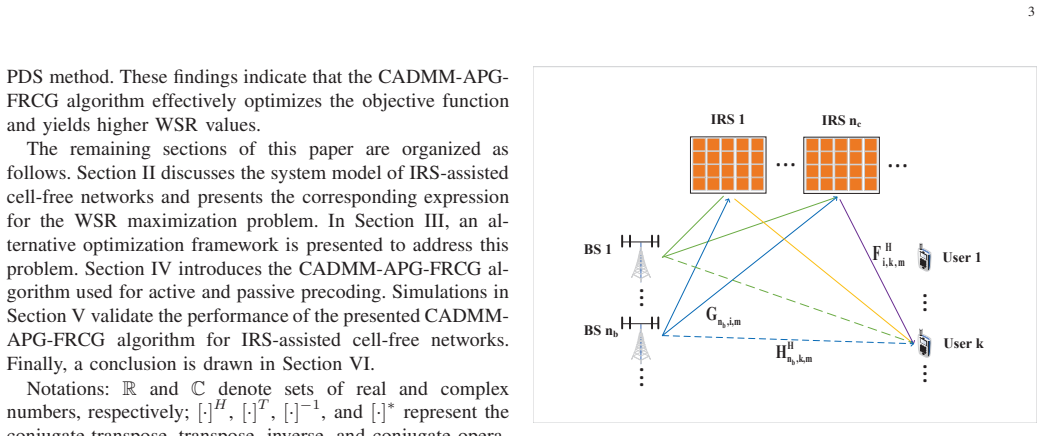
The key machinery is a decoupling-and-closed-form-update chain. The Lagrangian dual transform introduces auxiliary variables η to pull the logarithm out of the SINR ratio, and the multidimensional complex quadratic transform introduces δ and ρ to convert the fractional objective into a quadratic form, separating W from Φ. The active subproblem is then a QCQP solved by consensus ADMM: a linearized update for W, per-base-station projections of the form $V = \sqrt{P_{\max}} e^{j\angle(\cdot)}$, and dual-variable updates, all in closed form. The passive subproblem is solved by APG with a projection of $\varphi$ onto the unit disk, followed by FRCG, a conjugate-gradient method that fits the Lorentzian parameters $(\phi,\psi,\kappa)$ to the current reflection vector.
What would settle it
Take the optimized $(\phi,\psi,\kappa)$ returned by Algorithm 3 and evaluate $|\varphi_{i,r,m}|$ via (4) across all subcarriers and elements; if any value exceeds 1, constraint (9d) is violated and the reported WSR is not achievable by a passive IRS. The paper's own initialization ($\phi=1$, $\psi=3\times10^9$, $\kappa=6\times10^7$) gives $|\varphi|=\phi\psi/\kappa=50$ at resonance, so checking whether the final parameters keep $|\varphi|\le 1$ over the whole band is decisive.
Extended reading notes
Core claim
The paper's central claim is that the non-convex weighted sum-rate problem P(0), which jointly optimizes active beamforming W and passive reflection Φ under a Lorentzian frequency-selective response, can be solved by the CADMM-APG-FRCG algorithm, which the authors describe as optimally solving W and Φ in P(0). The decoupling is done by the Lagrangian dual transform and the multidimensional complex quadratic transform; the active subproblem becomes a QCQP that is decomposed into single-constraint QCQP-1 subproblems with closed-form solutions, and the passive subproblem is handled by projected gradient updates for the reflection coefficients and a conjugate-gradient fit for the Lorentzian parameters. The reported result is a weighted sum-rate about 62.8% higher than PDS at convergence, with about 31.44% of PDS's computational complexity.
Load-bearing premise
The load-bearing premise is that the Lorentzian reflection formula (4) can be realized by passive IRS elements while keeping $|\varphi|\le 1$ on every subcarrier; the optimization only penalizes how far the chosen reflection vector is from that formula, so if no parameter set satisfies the bound across the band, the optimized solution is physically unrealizable.
Editorial extensions
If this is right
- If the central claim holds, the proposed CADMM-APG-FRCG algorithm gives a lower-complexity alternative to PDS for wideband IRS cell-free networks, with the reported complexity ratio of 31.44% making it attractive for dense deployments.
- The closed-form per-base-station updates in the active subproblem can be computed in parallel, so the algorithm scales more gracefully with the number of base stations than PDS.
- Because the passive subproblem explicitly fits a Lorentzian frequency response, the performance gains carry over to wideband OFDM systems where an ideal phase-shifter model would be inaccurate.
- Under imperfect CSI, the algorithm's WSR degradation (about 14% at $\omega=0.2$) is comparable to PDS while maintaining a roughly 66.6% higher WSR, so the advantage persists in non-ideal channel estimation.
- Energy efficiency peaks at finite BS and IRS counts (the paper reports a maximum at $N_b=7$, $N_c=10$), meaning the method can inform deployment sizing rather than assuming more IRS elements always helps.
Reading between the lines
- A decisive physical check the paper leaves implicit: the Lorentzian fitting in P(7) does not constrain $b(\phi,\psi,\kappa)$ to lie within the unit disk, so one should verify that the final parameters yield $|\varphi|\le 1$ over all subcarriers before accepting the WSR numbers; the initialization already violates the bound at resonance.
- The 62.8%-over-PDS comparison may be partly explained by PDS converging to a suboptimal point rather than the new method reaching a global optimum; a stronger test would be to compare against a global-optimality bound or exhaustive search on a small instance.
- The complexity ratio 31.44% is computed from one simulation setting's iteration counts; a useful extension would be to map the crossover problem sizes where the new method's advantage erodes.
- As bandwidth shrinks toward narrowband, the Lorentzian model should reduce to a phase-shifter model; testing the algorithm in that limit would connect the wideband results to the existing narrowband literature.
Editorial analysis
A structured set of objections, weighed in public.
Referee Report
Summary. The paper studies joint active and passive precoding for weighted sum-rate (WSR) maximization in a wideband IRS-assisted cell-free MIMO-OFDM network, where each IRS element is modeled by a Lorentzian frequency response. The proposed CADMM-APG-FRCG algorithm uses Lagrangian dual transform and multidimensional complex quadratic transform to decouple the problem, CADMM with linearized updates for the active beamforming subproblem, and APG with FRCG for the passive Lorentzian parameter subproblem. Simulations compare the proposed algorithm with a primal-dual subgradient (PDS) baseline and report consistent WSR gains plus about 31% of the baseline computational complexity. The paper claims that the algorithm optimally solves the active and passive variables in P(0).
Significance. If the claims were valid, the paper would make a useful contribution: it addresses a realistic frequency-selective IRS model, provides a low-complexity algorithmic pipeline, and gives a concrete complexity comparison. The paper is clearly organized and includes pseudocode for all three algorithms, a full complexity table, and extensive numerical experiments, which are commendable. However, the central numerical claims are not established: the optimized Lorentzian reflection coefficients are not certified to satisfy the passive constraint, and the PDS baseline is not solving the same wideband problem. These issues affect the main conclusion that the proposed algorithm outperforms existing methods, so the contribution cannot be accepted in its current form.
major comments (3)
- [§IV-A and P(7), Eqs. (48)–(53)] The passive beamforming update does not enforce the physical feasibility constraint (9d) on the Lorentzian reflection coefficient. With the simulation initialization ϕ=1, ψ=3×10^9, κ=6×10^7 (Section IV-A), Eq. (4) gives |b|=ψ/κ=50 at the resonance frequency f_m=ψ, already violating (9d). P(7) replaces the equality constraint (48a) by a soft penalty, and the APG projection (52) is applied only to the auxiliary variable φ; the FRCG update (53) minimizes ||φ−b||² without any constraint on b. A converged point can therefore have |φ_{i,r,m}|≤1 while b(ϕ,ψ,κ) violates (9d), or can leave a nonzero penalty, in which case no feasible point of P(6) is recovered. Since the WSR values in Figs. 2–6 are computed from φ, the reported gains may correspond to reflection coefficients that a passive IRS cannot realize. The statement in Section IV-B that the algorithm "optimally solves W and Φ in P(0)" is therefore unsupported; a feasibility certificate for b (or an explicit projection onto the set {b: |b_{i,r,m}|≤1}) is required.
- [§IV-B, Figs. 2–6, Remark 2] The comparison with the PDS baseline is not apples-to-apples. The abstract and Section II state that PDS uses an ideal reflection matrix, and Remark 2 explicitly says that PDS cannot address passive precoding in wideband systems. Thus the PDS baseline is restricted to a narrowband/frequency-flat unit-modulus model, while the proposed method optimizes per-tone Lorentzian coefficients. Under these unequal feasible sets, the consistent WSR advantage claimed in Section IV-B may reflect the larger number of optimization variables or the relaxed soft-constraint formulation rather than the CADMM-APG-FRCG updates. A valid baseline should solve the same P(0) with constraints (9c)–(9d), for example an SCA or alternating optimization method over the Lorentzian parameters (ϕ,ψ,κ) with a feasibility guarantee. Without such a baseline, the paper's central claim of algorithmic superiority over PDS is not established.
- [§III-D, Eqs. (49)–(53), §IV-B] The optimality and convergence claims are not supported by the presented material. The passive subproblem P(7) is nonconvex, and APG with the extrapolation (50)–(51) and a constant step size ω=1/8 (Section IV-A) has no convergence proof for this problem; FRCG applied to the unconstrained, nonconvex P(8) also lacks a guarantee. Moreover, the W-subproblem P(3) is described as "generally known to be NP-hard" (Section III-C), yet the text later says CADMM "optimally solves" the QCQP; since the objective and constraints in P(3) are convex quadratic, the NP-hard statement is misleading, and in any case no convergence or optimality theorem for Algorithm 1 or 3 is stated. The authors should either provide formal convergence and stationarity results, or replace claims of solving P(0) optimally with statements about the heuristic performance of the proposed iterations.
minor comments (7)
- [§II-B, Eq. (10)] The definition Φ = diag(Φ_1, · · ·, Φ_2, · · ·, Φ_M) contains an obvious typo; it should read diag(Φ_1, · · ·, Φ_M).
- [§III-B, Algorithm 3] The line "Update η by (15)" should refer to Eq. (14), where the closed-form optimal η is given.
- [Throughout] The name "Flecher-Reeves" should be spelled "Fletcher-Reeves."
- [§IV-A] The quality factor Qn is used without a definition in the parameter list; its relation to ψ and κ should be stated explicitly.
- [§III-C, Eq. (25)] The displayed expression is not an equality ("then WH DW = ..."); it is a first-order approximation plus a proximal term and should be written with ≈.
- [Table II] The table heading uses "CADMM-APG" while the algorithm is called "CADMM-APG-FRCG"; the notation should be made consistent.
- [§I and References] Reference [38] is described in the Introduction as a narrowband work, but its title refers to a wideband framework; please clarify whether PDS is restricted to frequency-flat reflection or to narrowband signaling.
Circularity Check
No significant circularity: the algorithm derivation is self-contained, with Lorentzian parameters as optimization variables rather than fitted inputs.
full rationale
The paper's derivation chain is self-contained rather than circular. The WSR-maximization problem P(0) is transformed via Lagrangian dual transform and multidimensional complex quadratic transform, both cited to external fractional-programming references [64], [65]. The active-beamforming subproblem is solved with consensus ADMM, cited to the external CADMM literature [66], and the passive-beamforming subproblem uses APG and FRCG, cited to external optimization references [67], [68]. No parameter is fitted to the WSR values that are later reported as predictions; the Lorentzian parameters ϕ, ψ, and κ are optimization variables updated by the algorithm, not constants calibrated to reproduce a target weighted sum-rate. The comparison baseline PDS is taken from the external reference [38], not from the authors' own prior work, and the complexity ratio in Table II is computed from the paper's own stated iteration counts rather than from a fitted model. Several cited references share authors with the present paper, but none is load-bearing in the sense of invoking a uniqueness theorem or an ansatz that itself contains the conclusion; the update equations (17), (27), (35), (41), (49)-(52), and (53) are derived in the text from the stated objective and constraints. The claim that CADMM-APG-FRCG 'optimally solves W and Φ in P(0)' may overstate what the penalty-based P(7) guarantees, and the Lorentzian realizability under |φ|≤1 is a legitimate feasibility concern, but that is an internal correctness or modeling-validity issue, not circular reasoning: the reported WSR is not equivalent by construction to any fitted input or to a self-citation chain. Hence no circular step is present.
Assumptions & free parameters
free parameters (5)
- APG step size omega =
1/8
- CADMM linearization penalty beta =
W^H D W / W^H W
- Penalty weight mu =
formula garbled in text, appears as 12 N_b^2 / (phi^H Q phi)
- CADMM penalty alpha =
N_b
- Initial Lorentzian parameters phi, psi, kappa =
1, 3x10^9, 6x10^7
assumptions (3)
- domain assumption Perfect CSI is available at all base stations, IRSs, and users.
- domain assumption The IRS reflection coefficient follows the Lorentzian model of equation (4) as a function of frequency.
- ad hoc to paper The linearized CADMM update (27) and APG with constant step size omega converge to a stationary point of the corresponding subproblems.
Cite this review
Pith. "Pith review of Efficient Joint Precoding Design for Wideband Intelligent Reflecting Surface-Assisted Cell-Free Network." pith.science (2026). https://pith.science/paper/ITRWHKRN
@misc{pith2026241205623,
  author       = {Pith},
  title        = {Pith review of: Efficient Joint Precoding Design for Wideband Intelligent Reflecting Surface-Assisted Cell-Free Network},
  year         = {2026},
  howpublished = {\url{https://pith.science/paper/ITRWHKRN}},
  note         = {Machine review of arXiv:2412.05623}
}
read the original abstract
In this paper, we propose an efficient joint precoding design method to maximize the weighted sum-rate in wideband intelligent reflecting surface (IRS)-assisted cell-free networks by jointly optimizing the active beamforming of base stations and the passive beamforming of IRS. Due to employing wideband transmissions, the frequency selectivity of IRSs has to been taken into account, whose response usually follows a Lorentzian-like profile. To address the high-dimensional non-convex optimization problem, we employ a fractional programming approach to decouple the non-convex problem into subproblems for alternating optimization between active and passive beamforming. The active beamforming subproblem is addressed using the consensus alternating direction method of multipliers (CADMM) algorithm, while the passive beamforming subproblem is tackled using the accelerated projection gradient (APG) method and Flecher-Reeves conjugate gradient method (FRCG). Simulation results demonstrate that our proposed approach achieves significant improvements in weighted sum-rate under various performance metrics compared to primal-dual subgradient (PDS) with ideal reflection matrix. This study provides valuable insights for computational complexity reduction and network capacity enhancement.
Figures


Figures from the paper (1 more)

Reference graph
Works this paper leans on
-
[38]
Z. Zhang and L. Dai, “A joint precoding framework for wid eband reconfigurable intelligent surface-aided cell-free netwo rk,” IEEE Trans. Signal Process. , vol. 69, pp. 4085-4101, 2021
work page 2021
-
[1]
Ultra-dense netwo rks: A survey,
M. Kamel, W. Hamouda, and A. Y oussef, “Ultra-dense netwo rks: A survey,” IEEE Commun. Surveys Tuts. , vol. 18, no. 4, pp. 2522- 2545,Oct.-Dec. 2016
work page 2016
-
[2]
R. Borralho, A. Mohamed, A. U. Quddus, P . Vieira and R. Taf azolli, “A survey on coverage enhancement in cellular networks: chall enges and solutions for future deployments,” IEEE Commun. Surveys Tuts. , vol. 23, no. 2, pp. 1302-1341, Secondquarter 2021
work page 2021
-
[3]
Cel l-free massive MIMO systems,
E. Nayebi, A. Ashikhmin, T. L. Marzetta, and H. Y ang, “Cel l-free massive MIMO systems,” in Proc. 49th Asilomar Conf. Signals Syst. Comput., 2015, pp. 695-699
work page 2015
-
[4]
Ubiquitous cell-free massive MIMO communications,
G. Interdonato, E. Bj¨ ornson, H. Q. Ngo, P . Frenger, and E . G. Larsson, “Ubiquitous cell-free massive MIMO communications,” EURASIPJ. Wireless Commun. Netw. , pp. 197-206, 2019
work page 2019
-
[5]
Downlink re source allocation in cell-free massive MIMO systems,
S. Mosleh, H. Almosa, E. Perrins, and L. Liu, “Downlink re source allocation in cell-free massive MIMO systems,” in Proc. Int. Conf. Comput. Netw. Commun. , 2019, pp. 883-887. 4The maximum energy efficiency of the PDS method is 0.138 bit/s/Hz/W in [38], the corresponding decrease in energy efficiency is 34.7%
work page 2019
-
[6]
Modified conju gate beam- forming for cell-free massive MIMO,
M. Attarifar, A. Abbasfar, and A. Lozano, “Modified conju gate beam- forming for cell-free massive MIMO,” IEEE Commun. Lett. , vol. 8, no. 2,pp. 616-619, Apr. 2019
work page 2019
-
[7]
Channel estimation fo r cell-free mmwave massive MIMO through deep learning,
Y . Jin, J. Zhang, S. Jin, and B. Ai, “Channel estimation fo r cell-free mmwave massive MIMO through deep learning,” IEEE Trans. V eh. Technol., vol. 68, no. 10, pp. 10325-10329, Oct. 2019
work page 2019
Show all 70 references
-
[8]
Are we approaching the fundamental limits of wireless network den sification?,
J. G. Andrews, X. Zhang, G. D. Durgin, and A. K. Gupta, “Are we approaching the fundamental limits of wireless network den sification?,” IEEE Commun. Mag. , vol. 54, no. 10, pp. 1558-1896, Oct. 2016
2016
-
[9]
Cell-free massive MIMO versus small cells,
H. Q. Ngo, A. Ashikhmin, H. Y ang, E. G. Larsson, and T. L. Ma rzetta, “Cell-free massive MIMO versus small cells,” IEEE Trans. Wireless Commun., vol. 16, no. 3, pp. 1834-1850, Mar. 2017
2017
-
[10]
Towards smart and reconfigurable env ironment: Intelligent reflecting surface aided wireless network,
Q. Wu and R. Zhang, “Towards smart and reconfigurable env ironment: Intelligent reflecting surface aided wireless network,” IEEE Commun. Mag., vol. 58, no. 1, pp. 106-112, Jan. 2020
2020
-
[11]
Intellige nt reflecting surface-aided wireless communications: a tutorial,
Q. Wu, S. Zhang, B. Zheng, C. Y ou and R. Zhang, “Intellige nt reflecting surface-aided wireless communications: a tutorial,” IEEE Trans. Com- mun., vol. 69, no. 5, pp. 3313-3351, May 2021
2021
-
[12]
Reconfigurable intelligent surface-based wireless comm u- nication: Antenna design, prototyping and experimental re sults,
L. Dai, et al., “Reconfigurable intelligent surface-based wireless comm u- nication: Antenna design, prototyping and experimental re sults,” IEEE Access., vol. 8, pp. 45913-45923, Mar. 2020
2020
-
[13]
IRS-aided WPC Ns: a new optimization framework for dynamic IRS beamforming,
Q. Wu, X. Zhou, W. Chen, J. Li and X. Zhang, “IRS-aided WPC Ns: a new optimization framework for dynamic IRS beamforming,” IEEE Trans. Wireless Commun. , vol. 21, no. 7, pp. 4725-4739, July. 2022
2022
-
[14]
IRS aided MEC systems with binary offloading: a unified framework for dynam ic IRS beamforming,
G. Chen, Q. Wu, R. Liu, J. Wu and C. Fang, “IRS aided MEC systems with binary offloading: a unified framework for dynam ic IRS beamforming,” IEEE J. Sel. Areas Commun. , vol. 41, no. 2, pp. 349-365, Feb. 2023
2023
-
[15]
On the performance of multi-antenna IRS-assisted NOMA networks with continuous and discrete IRS phase shifti ng,
Z. Sun and Y . Jing, “On the performance of multi-antenna IRS-assisted NOMA networks with continuous and discrete IRS phase shifti ng,” IEEE Trans. Wireless Commun. , vol. 21, no. 5, pp. 3012-3023, May. 2022
2022
-
[16]
A new wireless communication paradigm through software-controlled metasurfaces,
C. Liaskos, et al. , “A new wireless communication paradigm through software-controlled metasurfaces,” IEEE Commun. Mag. , vol. 56, no. 9,pp. 162-169, Sep. 2018
2018
-
[17]
Joint beamformin g design and power splitting optimization in IRS-assisted SW IPT NOMA networks,
Z. Li, W. Chen, Q. Wu, K. Wang and J. Li, “Joint beamformin g design and power splitting optimization in IRS-assisted SW IPT NOMA networks,” IEEE Trans. Wireless Commun. , vol. 21, no. 3, pp. 2019- 2033, Mar. 2022
2019
-
[18]
Smart radio environments empowered by recon- figurable AI meta-surfaces: An idea whose time has come,
M. Di Renzo et al. , “Smart radio environments empowered by recon- figurable AI meta-surfaces: An idea whose time has come,” EURASIPJ. Wireless Commun. Netw. , vol. 2019, no. 1, pp. 129, 2019
2019
-
[19]
Exploring s um rate maximization in UA V -based multi-IRS networks: IRS association, UA V altitude, and phase shift design,
Y . Li, H. Zhang, K. Long and A. Nallanathan, “Exploring s um rate maximization in UA V -based multi-IRS networks: IRS association, UA V altitude, and phase shift design,” IEEE Trans. Commun., vol. 70, no. 11, pp. 7764-7774, Nov. 2022
2022
-
[20]
Reconfigurable intelligent surfaces vs. relaying: differences, similarities, and performance comparison,
K. Ntontin, et al. , “Reconfigurable intelligent surfaces vs. relaying: differences, similarities, and performance comparison,” IEEE Open Access J. Commun. Soc. , vol. 1, pp. 798-807, 2020
2020
-
[21]
One-bit symbol-level precod ing for MU-MISO downlink with intelligent reflecting surface,
S. Wang, Q. Li and M. Shao, “One-bit symbol-level precod ing for MU-MISO downlink with intelligent reflecting surface,” IEEE Signal Process. Lett., vol. 27, pp. 1784-1788, 2020
2020
-
[22]
Reconfigurable intelligent surfaces for energy efficiency in wireless communication,
C. Huang, A. Zappone, G. C. Alexandropoulos, M. Debbah a nd C. Y uen, “Reconfigurable intelligent surfaces for energy efficiency in wireless communication,” IEEE Trans. Wireless Commun. , vol. 18, no. 8, pp. 4157-4170, Aug. 2019
2019
-
[23]
Channel estimat ion and user localization for IRS-assisted MIMO-OFDM systems,
Y . Lin, S. Jin, M. Matthaiou and X. Y ou, “Channel estimat ion and user localization for IRS-assisted MIMO-OFDM systems,” IEEE Trans. Wireless Commun., vol. 21, no. 4, pp. 2320-2335, Apr. 2022
2022
-
[24]
Conformal IRS-e mpowered MIMO-OFDM: channel estimation and environment mapping,
Y . Lin, S. Jin, M. Matthaiou and X. Y ou, “Conformal IRS-e mpowered MIMO-OFDM: channel estimation and environment mapping,” IEEE Trans. Commun., vol. 70, no. 7, pp. 4884-4899, Jul. 2022
2022
-
[25]
Intelligent reflecting surface enha nced wireless network via joint active and passive beamforming,
Q. Wu and R. Zhang, “Intelligent reflecting surface enha nced wireless network via joint active and passive beamforming,” IEEE Trans. Wireless Commun., vol. 18, no. 11, pp. 5394-5409, Nov. 2019
2019
-
[26]
RIS-assisted communicat ion radar coexistence: joint beamforming design and analysis,
Y . He, Y . Cai, H. Mao and G. Y u, “RIS-assisted communicat ion radar coexistence: joint beamforming design and analysis,” IEEE J. Sel. Areas Commun., vol. 40, no. 7, pp. 2131-2145, 2022. 13
2022
-
[27]
Asymptotic max-min SINR analysis of reconfigur able intelligent surface assisted MISO systems,
Q.-U.-A. Nadeem, A. Kammoun, A. Chaaban, M. Debbah and M .- S. Alouini, “Asymptotic max-min SINR analysis of reconfigur able intelligent surface assisted MISO systems,” IEEE Trans. Commun. , vol. 19, no. 12, pp. 7748-7764, Dec. 2020
2020
-
[28]
Physics- based mod- eling and scalable optimization of large intelligent reflec ting surfaces,
M. Najafi, V . Jamali, R. Schober and H. V . Poor, “Physics- based mod- eling and scalable optimization of large intelligent reflec ting surfaces,” IEEE Trans. Commun. , vol. 69, no. 4, pp. 2673-2691, Apr. 2021
2021
-
[29]
Multicell MIMO communications relying on intelligent reflecting surfaces,
C. Pan, et al. , “Multicell MIMO communications relying on intelligent reflecting surfaces,” IEEE Trans. Wireless Commun. , vol. 19, no. 8, pp. 5218-5233, Aug. 2020
2020
-
[30]
Intellige nt reflecting surface: practical phase shift model and beamforming optim ization,
S. Abeywickrama, R. Zhang, Q. Wu and C. Y uen, “Intellige nt reflecting surface: practical phase shift model and beamforming optim ization,” IEEE Trans. Commun. , vol. 68, no. 9, pp. 5849-5863, Sep. 2020
2020
-
[31]
Passive beamformi ng and information transfer design for reconfigurable intelligen t surfaces aided multiuser MIMO systems,
W. Y an, X. Y uan, Z. -Q. He and X. Kuai, “Passive beamformi ng and information transfer design for reconfigurable intelligen t surfaces aided multiuser MIMO systems,” IEEE J. Sel. Areas Commun. , vol. 38, no. 8, pp. 1793-1808, Aug. 2020
2020
-
[32]
Achie vable rate maximization for underlay spectrum sharing MIMO syste m with intelligent reflecting surface,
V . Kumar, M. F. Flanagan, R. Zhang and L. -N. Tran, “Achie vable rate maximization for underlay spectrum sharing MIMO syste m with intelligent reflecting surface,” IEEE Wireless Commun. Lett. , vol. 11, no. 8, pp. 1758-1762, Aug. 2022
2022
-
[33]
Energy efficiency and spectral efficiency tradeoff in RIS-aided multiuser MIMO uplink transmission,
L. Y ou, et al. , “Energy efficiency and spectral efficiency tradeoff in RIS-aided multiuser MIMO uplink transmission,” IEEE Trans. Signal Process., vol. 69, pp. 1407-1421, 2021
2021
-
[34]
Spe ctrum and energy efficiency optimization in IRS-assisted UA V networks,
Y . Su, X. Pang, S. Chen, X. Jiang, N. Zhao and F. R. Y u, “Spe ctrum and energy efficiency optimization in IRS-assisted UA V networks,” IEEE Trans. Commun., vol. 70, no. 10, pp. 6489-6502, Oct. 2022,
2022
-
[35]
IRS- assisted secure UA V transmission via joint trajectory and b eamforming design,
X. Pang, N. Zhao, J. Tang, C. Wu, D. Niyato and K. -K. Wong, “IRS- assisted secure UA V transmission via joint trajectory and b eamforming design,” IEEE Trans. Commun., vol. 70, no. 2, pp. 1140-1152, Feb. 2022
2022
-
[36]
Max-Min fairness in IRS-aid ed multi-cell MISO systems with joint transmit and reflective beamforming ,
H. Xie, J. Xu and Y . -F. Liu, “Max-Min fairness in IRS-aid ed multi-cell MISO systems with joint transmit and reflective beamforming ,” IEEE Trans. Wireless Commun. , vol. 20, no. 2, pp. 1379-1393, Feb. 2021
2021
-
[37]
Achievabl e rate analysis and Max-Min SINR optimization in intelligent refle cting surface assisted cell-free MIMO uplink,
Q. -U. -A. Nadeem, A. Zappone and A. Chaaban, “Achievabl e rate analysis and Max-Min SINR optimization in intelligent refle cting surface assisted cell-free MIMO uplink,” IEEE Open Access J. Commun. Soc. , vol. 3, pp. 1295-1322, 2022
2022
-
[39]
Intelligen t reflecting surface-assisted millimeter wave communications: joint a ctive and pas- sive precoding design,
P . Wang, J. Fang, X. Y uan, Z. Chen, and H. Li, “Intelligen t reflecting surface-assisted millimeter wave communications: joint a ctive and pas- sive precoding design,” IEEE Trans. V eh. Technol., vol. 69, no. 12, pp. 14960-14973, Dec. 2020
2020
-
[40]
Hybrid beamforming for reconfigurable intelligent surfa ce based multi-user communications: achievable rates with li mited discrete phase shifts,
B. Di, et al., “Hybrid beamforming for reconfigurable intelligent surfa ce based multi-user communications: achievable rates with li mited discrete phase shifts,” IEEE J. Sel. Areas Commun. , vol. 38, no. 8, pp. 1809- 1822, Aug. 2020
2020
-
[41]
IRS-enhanced OFDM: pow er allo- cation and passive array optimization,
Y . Y ang, S. Zhang, and R. Zhang, “IRS-enhanced OFDM: pow er allo- cation and passive array optimization,” in Proc. IEEE Global Commun. Conf., 2019, pp. 1-6
2019
-
[42]
Joint active and p assive beamforming design for IRS-aided radar-communication,
M. Hua, Q. Wu, C. He, S. Ma, and W. Chen, “Joint active and p assive beamforming design for IRS-aided radar-communication,” IEEE Trans. Wireless Commun., vol. 22, no. 4, pp. 2278-2294, Apr. 2023
2023
-
[43]
Hybrid active- passive IRS assisted energy-efficient wireless communicat ion,
Q. Peng, Q. Wu, G. Chen, R. Liu, S. Ma, and W. Chen, “Hybrid active- passive IRS assisted energy-efficient wireless communicat ion,” IEEE Commun. Lett. , vol. 27, no. 8, pp. 2202-2206, Aug. 2023
2023
-
[44]
Cooperative dou ble-IRS aided communication: beamforming design and power scaling ,
Y . Han, S. Zhang, L. Duan, and R. Zhang, “Cooperative dou ble-IRS aided communication: beamforming design and power scaling ,” IEEE Wireless Commun. Lett. , vol. 9, no. 8, pp. 1206-1210, Aug. 2020
2020
-
[45]
Double-IRS assisted mul ti-user MIMO: cooperative passive beamforming design,
B. Zheng, C. Y ou, and R. Zhang, “Double-IRS assisted mul ti-user MIMO: cooperative passive beamforming design,” IEEE Trans. Wireless Commun., vol. 20, no. 7, pp. 4513-4526, Jul. 2021
2021
-
[46]
Doubl e-IRS Auxiliary Communications: Models and Performance Predict ion,
E. Dong, Z. Lian, Y . Wang, Z. Ma, L. Ling and C. Luo, “Doubl e-IRS Auxiliary Communications: Models and Performance Predict ion,” IEEE Wireless Commun. Lett. , vol. 13, no. 9, pp. 2571-2575, Sep. 2024
2024
-
[47]
RIS-aided cell-free massive MIMO system s for 6G: fundamentals, system design, and applications,
E. Shi et al., “RIS-aided cell-free massive MIMO system s for 6G: fundamentals, system design, and applications,” Proc. IEEE. , vol. 112, no. 4, pp. 331-364, Apr. 2024
2024
-
[48]
N ovel beamforming design for IRS-assisted cell-free massive MIM O systems,
X. Qiao, Y . Zhang, J. Zhang, H. Fang, L. Y ang and H. Zhu, “N ovel beamforming design for IRS-assisted cell-free massive MIM O systems,” IEEE Wireless Commun. Lett. , vol. 13, no. 4, pp. 1068-1072, Apr. 2024
2024
-
[49]
A distributed mach ine learning- based approach for IRS-enhanced cell-free MIMO networks,
C. Chen, S. Xu, J. Zhang and J. Zhang, “A distributed mach ine learning- based approach for IRS-enhanced cell-free MIMO networks,” IEEE Trans. Wireless Commun. , vol. 23, no. 5, pp. 5287-5298, May. 2024
2024
-
[50]
Rate analys is and optimization of IRS-aided hardware-impaired cell-free ma ssive MIMO systems under correlated Ricean fading channels,
Y . Zhang, H. Zhao, W. Xia, L. Y ang and H. Zhu, “Rate analys is and optimization of IRS-aided hardware-impaired cell-free ma ssive MIMO systems under correlated Ricean fading channels,” IEEE Trans. V eh. Technol., vol. 73, no. 8, pp. 12126-12131, Aug. 2024
2024
-
[51]
Intelligent reflecting surface enhanced w ideband MIMO- OFDM communications: From practical model to reflection opt imiza- tion,
H. Li et al., “Intelligent reflecting surface enhanced w ideband MIMO- OFDM communications: From practical model to reflection opt imiza- tion,” IEEE Trans. Commun. ,vol. 69, no. 7, pp. 4807-4820, Jul. 2021
2021
-
[52]
Joint downlink and uplink optimization for RIS-aided FDD M IMO communication systems,
G. Lee, H. Lee, D. Kim, J. Chung, A. L. Swindlehurst and J. Choi, “Joint downlink and uplink optimization for RIS-aided FDD M IMO communication systems,” IEEE Trans. Wireless Commun. , vol. 23, no. 8, pp. 9059-9071, Aug. 2024
2024
-
[53]
Polarizability extraction of complementary metamaterial elements in waveguides for aperture modeling ,
L. Pulido-Mancera et al., “Polarizability extraction of complementary metamaterial elements in waveguides for aperture modeling ,” Phys. Rev. B., vol. 96, no. 23, p. 235402, 2017
2017
-
[54]
Dynamic metasurface antennas fo r 6G extreme massive MIMO communications,
N. Shlezinger et al., “Dynamic metasurface antennas fo r 6G extreme massive MIMO communications,” IEEE Wireless Commun., vol. 28, no. 2, pp. 106-113, Jan. 2021
2021
-
[55]
Dynamic metasurface antennas for MIMO- OFDM receivers with bit-limited ADCs,
H. Wang et al., “Dynamic metasurface antennas for MIMO- OFDM receivers with bit-limited ADCs,” IEEE Trans. Commun. , vol. 69, no. 4, pp. 2643-2659, Apr. 2021
2021
-
[56]
Dynamic metasurface antennas fo r uplink massive MIMO systems,
N. Shlezinger et al., “Dynamic metasurface antennas fo r uplink massive MIMO systems,” IEEE Trans. Commun., vol. 67, no. 10, pp. 6829-6843, Oct. 2019
2019
-
[57]
Wideband multi-user MIMO communications with freque ncy se- lective RISs: element response modeling and sum-rate maxim ization,
K. D. Katsanos1, N. Shlezinger, M. F. Imani, and G. C. Ale xandropou- los, “Wideband multi-user MIMO communications with freque ncy se- lective RISs: element response modeling and sum-rate maxim ization,” arXiv:2202.02169v2 [cs.IT] 25 Mar 2022
2022 arXiv
-
[58]
Weighted sum-rate maximization for reconfigurable intelligent surface aided wireless netw orks,
H. Guo, Y . -C. Liang, J. Chen, et al. , “Weighted sum-rate maximization for reconfigurable intelligent surface aided wireless netw orks,” IEEE Trans. Wireless Commun. , vol. 19, no. 5, pp. 3064-3076, May. 2020
2020
-
[59]
Weighted sum-rate optimization for intelligent reflecting surface enhanced wireless netwo rks,
H. Guo, Y . -C. Liang, J. Chen, et al. , “Weighted sum-rate optimization for intelligent reflecting surface enhanced wireless netwo rks,” in Proc. IEEE Global Commun. Conf. , Waikoloa, HI, USA, 2019, pp. 1-6
2019
-
[60]
Weighted sum-rate and energy efficiency maximization for joint ITS and IRS assisted multiuser MIMO networks,
W. Du, et al. , “Weighted sum-rate and energy efficiency maximization for joint ITS and IRS assisted multiuser MIMO networks,” IEEE Trans. Commun., vol. 70, no. 11, pp. 7351-7364, Nov. 2022
2022
-
[61]
Joint beamforming de sign for IRS aided multiuser MIMO with imperfect CSI,
P . Zeng, D. Qiao, H. Qian and Q. Wu, “Joint beamforming de sign for IRS aided multiuser MIMO with imperfect CSI,” IEEE Trans. V eh Technol., vol. 71, no. 10, pp. 10729-10743, Oct. 2022
2022
-
[62]
Wei ghted sum-rate of intelligent reflecting surface aided multiuser downlink transmission with statistical CSI,
Q. Tao, S. Zhang, C. Zhong, W. Xu, H. Lin and Z. Zhang, “Wei ghted sum-rate of intelligent reflecting surface aided multiuser downlink transmission with statistical CSI,” IEEE Trans. Wireless Commun. , vol. 21, no. 7, pp. 4925-4937, Jul. 2022
2022
-
[63]
Low-c omplexity algorithm for maximizing the weighted sum-rate of intellig ent reflecting surface assisted wireless networks,
Y . Wang, L. Fang, S. Cai, Z. Lian, Y . Su, and Z. Xie, “Low-c omplexity algorithm for maximizing the weighted sum-rate of intellig ent reflecting surface assisted wireless networks,” IEEE Internet Things J. , vol. 11, no. 6, pp. 10490-10499, Mar. 2024
2024
-
[64]
Fractional programming for communic ation systems Part I: Power control and beamforming,
K. Shen and W. Y u, “Fractional programming for communic ation systems Part I: Power control and beamforming,” IEEE Trans. Signal Process., vol. 66, no. 10, pp. 2616-2630, May. 2018
2018
-
[65]
Fractional programming for communic ation systems¡ªPart II: Uplink scheduling via matching,
K. Shen and W. Y u, “Fractional programming for communic ation systems¡ªPart II: Uplink scheduling via matching,” IEEE Trans. Signal Process., vol. 66, no. 10, pp. 2631-2644, 2018
2018
-
[66]
Consensus-ADMM for Ge neral Quadratically Constrained Quadratic Programming,
K. Huang and N. D. Sidiropoulos, “Consensus-ADMM for Ge neral Quadratically Constrained Quadratic Programming,” IEEE Trans. Signal Process., vol. 64, no. 20, pp. 5297-5310, 15 Oct.15, 2016
2016
-
[67]
Accelerated proximal gradient method s for nonconvex programming,
H. Li and Z. Lin, “Accelerated proximal gradient method s for nonconvex programming,” in Proc. Adv. Neural Inf. Process. Syst. , 2015, pp. 379- 387
2015
-
[68]
Accelerated gradient methods for nonconvex nonlinear and stochastic programming,
S. Ghadimi and G. H. Lan, “Accelerated gradient methods for nonconvex nonlinear and stochastic programming,” Mathematical Programming. , vol. 156, no. 1-2, pp. 59-99. 2016
2016
-
[69]
Distributed optimization and statistical learning via the alternative direction method of multipliers,
S. Boyd, N. Parikh, E. Chu, et al ., “Distributed optimization and statistical learning via the alternative direction method of multipliers,” F ound. Trends Math. Learn., vol. 3, no. 1, pp. 1-122, 2011
2011
-
[70]
Proximal algorithms,
N. Parikh and S. Boyd, “Proximal algorithms,” F ound. Trends Optim., vol. 1, no. 3, pp. 123-231, 2013
2013
Reviewed August 11, 2026 · model on record in the stance chip above.
Discussion (0). Continue with ORCID to comment.