REVIEW 5 major objections 6 minor 47 references
Deciphering Galactic Halos: A Detailed Review of Star Formation in NGC 5128 (Cen A)
T0 review · 5 major / 6 minor · reviewed 2026-08-11 · deepseek-v4-flash
Pith's one-line read Synchronized star-forming bursts in the halo of NGC 5128 reveal galaxy-wide triggers.
desk verdict A plausible but under-supported LPV-based SFH for two Cen A halo fields; the synchronized-peak claim is real but needs error bars and a quantified dust correction before I'd trust it. read the letter →
The pith
A machine-rendered reading of the paper's core claim, the machinery that carries it, and where it could break.
The reading
What carries the argument
The load-bearing method is the statistical LPV-based SFH reconstruction. Long-period variable stars reach peak luminosity in a phase that ties their observed near-infrared magnitude to the birth mass of the star; combining the birth-mass-luminosity relation, an age-mass relation, a pulsation-duration relation, and the Kroupa initial mass function gives the star formation rate at each epoch. The paper's innovation is to fold an age-metallicity relation into these relations, producing a single unified mass-luminosity and age-mass relation and thereby reducing the metallicity degeneracy. An ad hoc dust correction shifts stars scattered redward back onto the theoretical isochrone peaks before their magnitudes are used.
What would settle it
Rebuild the star formation history of the same two fields from independent tracers, such as deep color-magnitude diagrams reaching the main-sequence turnoff or red-clump stars, and check whether the same peaks appear at roughly 800 Myr and 3.8 Gyr; if the independent method shows no such synchronized episodes, or places them at different ages, the LPV-based claim is refuted.
Extended reading notes
Core claim
The central claim is that the halo of NGC 5128 has a synchronized, galaxy-wide star formation history: both observed regions, located about 28 kpc apart on opposite sides of the galaxy, show elevated star formation rates at approximately 800 Myr and 3.8 Gyr ago, and one region exhibits a further rise at roughly 6.3 Gyr ago. The shared peaks are interpreted as evidence for a major merger around 1 Gyr ago and for AGN-triggered, episodic star formation connected to the active nucleus of the galaxy. Because the two fields are so widely separated, the similar peaks argue against purely local fluctuations and in favor of large-scale processes shaping the halo's stellar populations.
Load-bearing premise
The reconstruction assumes that the Ks-band magnitudes and periods of the selected long-period variable stars, after an ad hoc dust correction, map without systematic bias to unique birth masses and ages through the stellar models; if the dust correction or the model mapping is biased, the derived peaks at 800 Myr and 3.6 Gyr could be artifacts.
Editorial extensions
If this is right
- If the LPV-derived SFH is correct, the halo of NGC 5128 underwent synchronized bursts of star formation at about 800 Myr and 3.8 Gyr ago, indicating a galaxy-wide trigger rather than local random fluctuations.
- The approximately 800 Myr peak adds support to a major merger with a gas-rich companion roughly 1 Gyr ago, a scenario previously suggested from optical shells and the galaxy's unusual structure.
- The similar SFH in regions 28 kpc apart implies that AGN-driven jets or related nuclear activity can enhance star formation over large volumes of a galaxy's halo.
- The age-metallicity-based extension of the LPV method can be applied to other nearby galaxies with LPV catalogs, providing a way to reconstruct SFH without assuming a single metallicity.
- The additional peak at about 6.3 Gyr in one field but not the other suggests earlier, possibly more localized accretion events in the galaxy's history.
Reading between the lines
- A testable extension the paper leaves open: apply the same age-metallicity-based LPV method to the galaxy's inner regions once an LPV catalog exists there, to see whether the approximately 800 Myr burst is tied directly to the jets.
- If the synchronized peaks are real, one would expect similar large-scale coherence in other post-merger ellipticals; a survey of LPVs in multiple halo fields of such galaxies could check that prediction.
- The dust-correction step could be tested independently: if the shifted stars are genuinely dusty LPVs, their near-infrared colors and period-luminosity positions should follow a dust-extinction locus rather than random scatter.
Signed reviews
Editorial analysis
A structured set of objections, weighed in public.
Referee Report
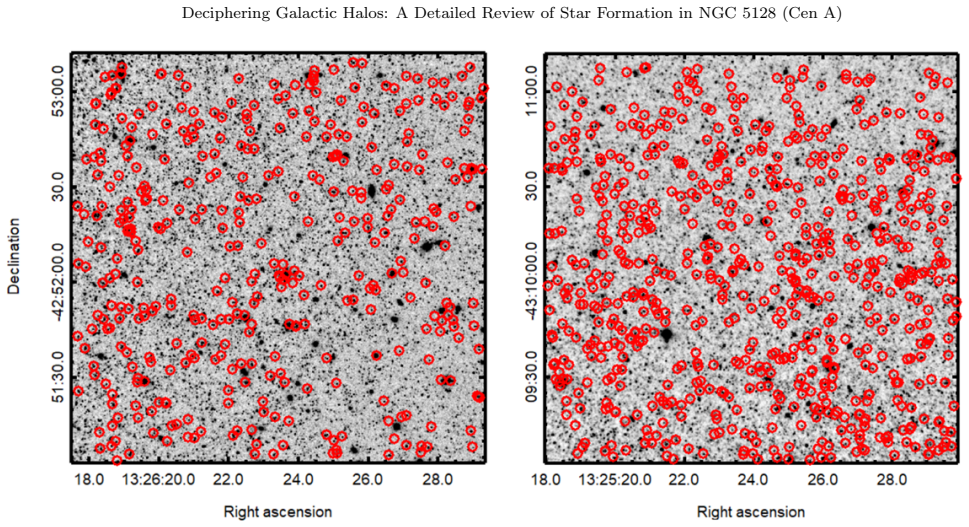
Summary. The paper reconstructs the star formation history (SFH) of two halo fields of NGC 5128, located on opposite sides of the galaxy and separated by about 28 kpc, using 395 and 671 long-period variable (LPV) stars from the ISAAC catalog of Rejkuba et al. (2003). The method follows Javadi et al. (2011a), converting LPV Ks-band magnitudes and periods into birth masses and ages via Padova models (Marigo et al. 2017), with an added age-metallicity relation (AMR) taken from Woodley et al. (2009) and Yi et al. (2004). The derived SFHs show peaks at roughly 0.8 and 3.6 Gyr in both fields, plus a ~6.3 Gyr peak in Field 2, which the authors interpret as evidence of a major merger ~1 Gyr ago and of AGN-triggered, jet-induced star formation.
Significance. If the synchronized SFH peaks at ~0.8 and ~3.6 Gyr across two fields 28 kpc apart are robust, they would constitute an interesting constraint on the merger and star-formation history of the nearest giant elliptical galaxy, NGC 5128. The introduction of an AMR into the LPV-based SFH method is a potentially useful extension that could reduce the metallicity degeneracy. However, the central claim is not yet demonstrated: the SFHs are reported without uncertainties, the dust correction is described only qualitatively, and the inferred AGN–star formation causality goes beyond what the data can show. The paper would be strengthened substantially by adding error bars, quantifying the dust correction, and testing the sensitivity of the peaks to the adopted AMR.
major comments (5)
- [Section 3, Figure 2] The dust correction is described only as shifting stars that appear "spread into redder regions due to surrounding dust" back to the isochrone peaks. No quantitative criterion for identifying affected stars, no extinction law, and no count of how many of the 395 Field 1 and 671 Field 2 LPVs were shifted are provided. Because the same shifting rule is applied to both fields, any systematic bias in the rule will move derived ages in the same direction in both fields, so the apparent synchronization at ~0.8 and ~3.6 Gyr could be produced by the common calibration rather than by a real shared star-formation episode. Please quantify the correction, show its effect on the derived SFH, and test robustness by, for example, recomputing the SFH without the corrected stars or with a different extinction law.
- [Section 4, Figure 4] The SFHs are presented without any uncertainties or significance estimates. The central claim that the two fields are "remarkably similar" requires a quantitative comparison showing that the peaks agree within the expected noise. Given the relatively small LPV samples (395 and 671 stars), the apparent peaks could be statistical fluctuations. Please provide bootstrap or Poisson error bars on the SFH bins and a formal test of the similarity between the two fields' SFHs.
- [Abstract and Section 4] The reported peak ages are inconsistent: the abstract states that Field 1 shows increases at approximately 800 Myr and 3.8 Gyr ago, while Section 4 states that the peak is at about 3.6 Gyr. This discrepancy matters because the coincidence of peak ages between the two fields is the basis of the synchronization claim. Please standardize the reported peak ages and quote an uncertainty for each peak.
- [Equation 1] In Equation (1), the quantity dn'(t) (or n'(t)) and the time interval δt are not explicitly defined, and the text does not state how the LPV pulsation-duration relation enters the conversion from observed magnitudes and periods into a star formation rate. Without these definitions, the method cannot be reproduced or validated. Please define all symbols and specify the role of the pulsation-duration relation explicitly.
- [Section 4, Conclusion] The conclusion that "AGN activity can enhance the star formation rate in galaxies" is not supported by the data presented. The derived SFH peaks at ~0.8 and ~3.6 Gyr are not spatially correlated with the jet axis, and the AGN activity timescales quoted in the text (~150 Myr and ~30 Myr) are much younger than the 0.8 Gyr peak. Please either provide a quantitative argument linking the SFHs to the AGN history or restrict the conclusions to what the data show.
minor comments (6)
- [Abstract] The statement that the two regions reveal "remarkably similar SFHs" is qualified by the fact that Field 2 has an additional, prominent peak at ~6.3 Gyr; please acknowledge this difference explicitly.
- [Introduction] In the first paragraph, "in details" should be "in detail".
- [Section 4] "Evidences" should be "Evidence" in the sentence beginning "Evidences such as the galaxy's unusual structure...".
- [Table 1] The two AMRs differ substantially at old ages (for example, Z = 0.001 versus Z = 0.0003 at ages ≥ 10 Gyr); please discuss whether this affects the derived ~6.3 Gyr peak in Field 2.
- [Figure 2 caption] The caption does not specify which dotted line is the RGB tip and which is the completeness limit; please clarify the legend.
- [Section 3] The text invokes a "pulsation duration relation" but Figure 3 shows only the mass-luminosity and age-luminosity relations; please state where the pulsation-duration relation is used and, if possible, illustrate it.
Circularity Check
No constructional circularity: the SFH peaks are obtained by inverting LPV magnitudes with external stellar models and AMRs, not by fitting the claimed epochs.
full rationale
The derivation chain is a direct inversion rather than a fit to the target SFH. LPV Ks magnitudes are mapped to birth masses and ages through published Padova models (Marigo et al. 2017), the Kroupa IMF, and two external age-metallicity relations (Yi et al. 2004; Woodley et al. 2009), and the observed counts enter Equation 1 without any parameter tuned to reproduce the 0.8 or 3.6 Gyr peaks. The method is imported from a self-citation (Javadi et al. 2011a), but that is a published, externally applicable inversion procedure with stated assumptions; the cited work is not itself derived from the present claim, and the present paper adds only the AMR step rather than fitting its own output. The ad hoc dust correction that shifts stars 'back to the isochrone peaks' (Section 3, Figure 2) and the common AMR used for both fields could plausibly bias both reconstructions in the same direction, making the apparent synchronization a systematic-error and significance concern rather than a constructional equivalence. No equation in the paper reduces to its own input, and the prediction is not a renamed fit. The paper would be improved by error bars, a quantitative dust-correction criterion, and explicit definitions of dn'(t) and delta-t, but these are correctness risks, not circularity.
Assumptions & free parameters
free parameters (1)
- LPV period selection threshold =
P > 70 days
assumptions (4)
- domain assumption Padova stellar models (Marigo et al. 2017) accurately predict Ks-band luminosities, ages, and pulsation durations for LPV stars at the relevant metallicities.
- domain assumption LPV stars trace the star formation history proportionally to the IMF and their pulsation lifetime, with no strong bias from metallicity or dust beyond the ad hoc correction.
- domain assumption The age-metallicity relations of Woodley et al. (2009) and Yi et al. (2004) correctly describe the metallicity of the stellar populations in these halo fields.
- domain assumption The distance modulus (mu=27.87) and reddening (E(B-V)=0.15) are accurate.
Cite this review
Pith. "Pith review of Deciphering Galactic Halos: A Detailed Review of Star Formation in NGC 5128 (Cen A)." pith.science (2026). https://pith.science/paper/4XEICWMO
@misc{pith2026241205642,
  author       = {Pith},
  title        = {Pith review of: Deciphering Galactic Halos: A Detailed Review of Star Formation in NGC 5128 (Cen A)},
  year         = {2026},
  howpublished = {\url{https://pith.science/paper/4XEICWMO}},
  note         = {Machine review of arXiv:2412.05642}
}
read the original abstract
NGC 5128 (Centaurus A), the closest giant elliptical galaxy outside the Local Group to the Milky Way, is one of the brightest extragalactic radio sources. It is distinguished by a prominent dust lane and powerful jets, driven by a supermassive black hole at its core. Using previously identified long-period variable (LPV) stars from the literature, this study aims to reconstruct the star formation history (SFH) of two distinct regions in the halo of NGC 5128. These regions reveal remarkably similar SFHs, despite being located about 28 kpc apart on opposite sides of the galaxy's center. In Field 1, star formation rates (SFRs) show notable increases at approximately 800 Myr and 3.8 Gyr ago. Field 2 exhibits similar peaks at these times, along with an additional rise around 6.3 Gyr ago. The increase in SFR around 800 Myr ago is consistent with earlier research suggesting a merger event. Since no LPV catalog exists for the central region of NGC 5128, we focused our investigation on its outer regions, which has provided new insights into the complex evolutionary history of this cornerstone galaxy. The SFH traced by LPVs supports a scenario in which multiple events of nuclear activity have triggered episodic, jet-induced star formation.
Figures


Figures from the paper (1 more)

Reference graph
Works this paper leans on
-
[1]
write newline
" write newline "" before.all 'output.state := FUNCTION fin.entry write newline FUNCTION new.block output.state before.all = 'skip after.block 'output.state := if FUNCTION new.sentence output.state after.block = 'skip output.state before.all = 'skip after.sentence 'output.state := if if FUNCTION not #0 #1 if FUNCTION and 'skip pop #0 if FUNCTION or pop #1...
-
[2]
Abdollahi H., et al., 2023, @doi [ ] 10.3847/1538-4357/acbbc9 , https://ui.adsabs.harvard.edu/abs/2023ApJ...948...63A 948, 63
-
[3]
Aghdam S. T., et al., 2024, @doi [ ] 10.3847/1538-4357/ad57c0 , https://ui.adsabs.harvard.edu/abs/2024ApJ...972...47A 972, 47
-
[4]
Binney J., 2004, MNRAS, 347, 1093
work page 2004
-
[5]
First Detection of Molecular Gas in the Shells of CenA
Charmandaris V., Combes F., van der Hulst J. M., 2000, @doi [ ] 10.48550/arXiv.astro-ph/0003175 , https://ui.adsabs.harvard.edu/abs/2000A&A...356L...1C 356, L1
work page Pith review arXiv doi:10.48550/arxiv.astro-ph/0003175 2000
-
[6]
P., 1997, @doi [ ] 10.1086/310902 , https://ui.adsabs.harvard.edu/abs/1997ApJ...487L.105C 487, L105
Ciotti L., Ostriker J. P., 1997, @doi [ ] 10.1086/310902 , https://ui.adsabs.harvard.edu/abs/1997ApJ...487L.105C 487, L105
doi:10.1086/310902 1997
- [7]
- [8]
Show all 47 references
-
[9]
A., 1979, @doi [ ] 10.1086/157265 , https://ui.adsabs.harvard.edu/abs/1979ApJ...232...60G 232, 60
Graham J. A., 1979, @doi [ ] 10.1086/157265 , https://ui.adsabs.harvard.edu/abs/1979ApJ...232...60G 232, 60
1979 doi
-
[10]
T., Khosroshahi H., Saremi E., 2017, @doi [ ] 10.1093/mnras/stw3174 , https://ui.adsabs.harvard.edu/abs/2017MNRAS.466.1764H 466, 1764
Hamedani Golshan R., Javadi A., van Loon J. T., Khosroshahi H., Saremi E., 2017, @doi [ ] 10.1093/mnras/stw3174 , https://ui.adsabs.harvard.edu/abs/2017MNRAS.466.1764H 466, 1764
2017 doi
-
[11]
J., Evans D
Hardcastle M. J., Evans D. A., Croston J. H., 2009, @doi [ ] 10.1111/j.1365-2966.2009.14887.x , https://ui.adsabs.harvard.edu/abs/2009MNRAS.396.1929H 396, 1929
2009
-
[12]
Harris G. L. H., Harris W. E., Poole G. B., 1999, @doi [ ] 10.1086/300749 , https://ui.adsabs.harvard.edu/abs/1999AJ....117..855H 117, 855
1999 doi
-
[13]
A., Javadi A., van Loon J
Hashemi S. A., Javadi A., van Loon J. T., 2018, @doi [MNRAS] 10.1093/mnras/sty3450 , 483, 4751
2018 doi
-
[14]
A., et al., 1999, The Astronomical Journal, 118, 2262
Holtzman J. A., et al., 1999, The Astronomical Journal, 118, 2262
1999
-
[15]
T., Mirtorabi M
Javadi A., van Loon J. T., Mirtorabi M. T., 2011a, @doi [MNRAS] 10.1111/j.1365-2966.2010.17678.x , 411, 263
2010
-
[16]
T., Mirtorabi M
Javadi A., van Loon J. T., Mirtorabi M. T., 2011b, @doi [MNRAS] 10.1111/j.1365-2966.2011.18638.x , 414, 3394
2011
-
[17]
T., Khosroshahi H
Javadi A., van Loon J. T., Khosroshahi H. G., Tabatabaei F., Hamedani Golshan R., Rashidi M., 2017, @doi [ ] 10.1093/mnras/stw2463 , https://ui.adsabs.harvard.edu/abs/2017MNRAS.464.2103J 464, 2103
2017 doi
-
[18]
D., 2005, @doi [ ] 10.1086/426368 , https://ui.adsabs.harvard.edu/abs/2005AJ....129..178K 129, 178
Karachentsev I. D., 2005, @doi [ ] 10.1086/426368 , https://ui.adsabs.harvard.edu/abs/2005AJ....129..178K 129, 178
2005 doi
-
[19]
Khatamsaz F., Abdollahi M., Abdollahi H., Javadi A., Van Loon J., 2024, in IAU General Assembly. p. 648
2024
-
[20]
Kroupa P., 2001, @doi [ ] 10.1046/j.1365-8711.2001.04022.x , https://ui.adsabs.harvard.edu/abs/2001MNRAS.322..231K 322, 231
2001
-
[21]
Lamers, H. J. G. L. M. Kruijssen, J. M. D. Bastian, N. Rejkuba, M. Hilker, M. Kissler-Patig, M. 2017, @doi [A&A] 10.1051/0004-6361/201731062 , 606, A85
2017 doi
-
[22]
Ma C., et al., 1998, The Astronomical Journal, 116, 516
1998
-
[23]
Malin D., Quinn P., Graham J., 1983, , 272, L5
1983
-
[24]
Marigo P., et al., 2017, @doi [ ] 10.3847/1538-4357/835/1/77 , https://ui.adsabs.harvard.edu/abs/2017ApJ...835...77M 835, 77
2017 doi
-
[25]
Morganti R., Killeen N. E. B., Ekers R. D., Oosterloo T. A., 1999, @doi [MNRAS] 10.1046/j.1365-8711.1999.02622.x , 307, 750
1999
-
[26]
Navabi M., et al., 2021, @doi [ ] 10.3847/1538-4357/abdec1 , https://ui.adsabs.harvard.edu/abs/2021ApJ...910..127N 910, 127
2021 doi
-
[27]
A., 1999, The Astronomical Journal, 117, 2244
Olsen K. A., 1999, The Astronomical Journal, 117, 2244
1999
-
[28]
Parto T., et al., 2023, @doi [ ] 10.3847/1538-4357/aca471 , https://ui.adsabs.harvard.edu/abs/2023ApJ...942...33P 942, 33
2023 doi
-
[29]
W., Ford H
Peng E. W., Ford H. C., Freeman K. C., White R. L., 2002, @doi [ ] 10.1086/344308 , https://ui.adsabs.harvard.edu/abs/2002AJ....124.3144P 124, 3144
2002 doi
-
[31]
2004b, @doi [A&A] 10.1051/0004-6361:20034031 , 413, 903
Rejkuba, M. 2004b, @doi [A&A] 10.1051/0004-6361:20034031 , 413, 903
-
[32]
R., 2003, @doi [ ] 10.1051/0004-6361:20030683 , https://ui.adsabs.harvard.edu/abs/2003A&A...406...75R 406, 75
Rejkuba M., Minniti D., Silva D. R., 2003, @doi [ ] 10.1051/0004-6361:20030683 , https://ui.adsabs.harvard.edu/abs/2003A&A...406...75R 406, 75
2003 doi
-
[33]
Rejkuba M., Greggio L., Zoccali M., 2004, @doi [ ] 10.1051/0004-6361:20034200 , https://ui.adsabs.harvard.edu/abs/2004A&A...415..915R 415, 915
2004 doi
-
[34]
E., Harris G
Rejkuba M., Greggio L., Harris W. E., Harris G. L. H., Peng E. W., 2005, @doi [ ] 10.1086/432462 , https://ui.adsabs.harvard.edu/abs/2005ApJ...631..262R 631, 262
2005 doi
-
[35]
E., Greggio L., Harris G
Rejkuba M., Harris W. E., Greggio L., Harris G. L. H., 2011, @doi [ ] 10.1051/0004-6361/201015640 , https://ui.adsabs.harvard.edu/abs/2011A&A...526A.123R 526, A123
2011 doi
-
[36]
S., Javadi A., Khosroshahi H., van Loon J
Rezaei kh. S., Javadi A., Khosroshahi H., van Loon J. T., 2014, @doi [MNRAS] 10.1093/mnras/stu1807 , 445, 2214
2014 doi
-
[37]
Saremi E., et al., 2020, @doi [ ] 10.3847/1538-4357/ab88a2 , https://ui.adsabs.harvard.edu/abs/2020ApJ...894..135S 894, 135
2020 doi
-
[38]
J., Sutherland R
Saxton C. J., Sutherland R. S., Bicknell G. V., 2001, @doi [ ] 10.1086/323836 , https://ui.adsabs.harvard.edu/abs/2001ApJ...563..103S 563, 103
2001 doi
-
[39]
K., Silk J., 2007, MNRAS, 382, 1415
Schawinski K., Thomas D., Sarzi M., Maraston C., Kaviraj S., Joo S.-J., Yi S. K., Silk J., 2007, MNRAS, 382, 1415
2007
-
[40]
H., van der Hulst J
Schiminovich D., van Gorkom J. H., van der Hulst J. M., Kasow S., 1994, @doi [ ] 10.1086/187246 , https://ui.adsabs.harvard.edu/abs/1994ApJ...423L.101S 423, L101
1994 doi
-
[41]
Sijacki D., Springel V., Di Matteo T., Hernquist L., 2007, MNRAS, 380, 877
2007
-
[42]
Silk J., 2005, MNRAS, 364, 1337
2005
- [43]
-
[44]
S., 1996, @doi [ ] 10.1086/178193 , https://ui.adsabs.harvard.edu/abs/1996ApJ...473..810S 473, 810
Sparke L. S., 1996, @doi [ ] 10.1086/178193 , https://ui.adsabs.harvard.edu/abs/1996ApJ...473..810S 473, 810
1996 doi
-
[45]
Springel V., Di Matteo T., Hernquist L., 2005, The Astrophysical Journal, 620, L79
2005
-
[46]
Tolstoy E., Saha A., 1996, @doi [ ] 10.1086/177181 , https://ui.adsabs.harvard.edu/abs/1996ApJ...462..672T 462, 672
1996 doi
-
[47]
A., Harris W
Woodley K. A., Harris W. E., Puzia T. H., G \'o mez M., Harris G. L., Geisler D., 2009, The Astrophysical Journal, 708, 1335
2009
-
[48]
Yi S., Peng E., Ford H., Kaviraj S., Yoon S.-J., 2004, MNRAS, 349, 1493
2004
Reviewed August 11, 2026 · model on record in the stance chip above.
Discussion (0). Continue with ORCID to comment.