REVIEW 4 major objections 5 minor 24 references
Update of kaon semileptonic form factor using $N_f=2+1$ PACS10 configurations
T0 review · 4 major / 5 minor · reviewed 2026-08-11 · deepseek-v4-flash
Pith's one-line read Using near-physical, huge-volume ensembles at three lattice spacings, this paper produces a preliminary continuum-limit value of the kaon semileptonic form factor $f_+(0)$ and a $|V_{us}|$ that is consistent with other kaon routes but…
desk verdict Straightforward, honest update of a mature lattice program; the new third lattice spacing is real but the result is explicitly preliminary and the continuum limit still rests on three points. read the letter →
The pith
A machine-rendered reading of the paper's core claim, the machinery that carries it, and where it could break.
The reading
What carries the argument
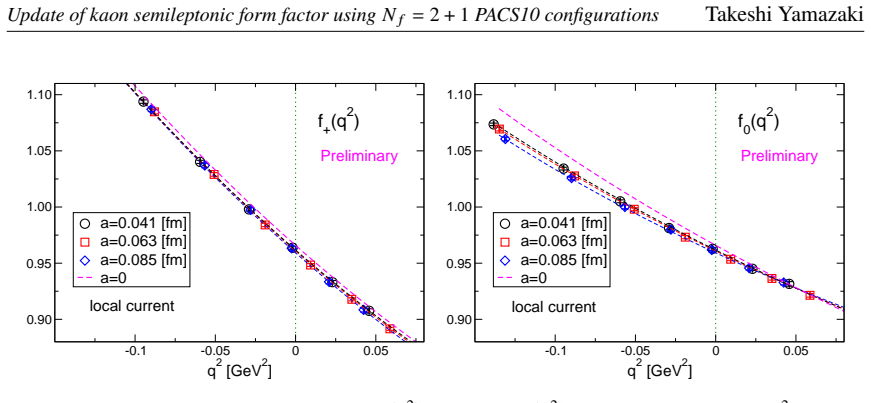
The load-bearing object is the simultaneous fit of $f_+(q^2)$ and $f_0(q^2)$ at all three lattice spacings. Its fit form is anchored by the next-to-leading-order chiral perturbation theory expressions of Gasser and Leutwyler, supplemented by $(m_K^2-m_\pi^2)^2$, $q^2$, and discretization terms; the continuum extrapolation uses a quadratic-in-$a$ ansatz with a linear-in-$a$ variant as a consistency check. The fit interpolates the data to $q^2=0$, extrapolates to $a=0$, and tunes the simulated meson masses to the physical point in one step, which is what lets the paper separate the chiral correction, largest at the finest spacing, from the continuum extrapolation. The systematic error on $f_+(0)$ is built by repeating the fit under different analysis choices and taking the maximum deviation.
What would settle it
A fourth lattice spacing below $0.041$ fm, or a full-statistics reanalysis of the current finest ensemble, that moves the continuum-extrapolated $f_+(0)$ outside the quoted total error would show the systematic error estimate to be too small.
Extended reading notes
Core claim
Using $N_f=2+1$ PACS10 configurations at three lattice spacings ($a=0.085$, $0.063$, and $0.041$ fm) with physical volumes above $(10\,\mathrm{fm})^4$, the paper performs a simultaneous fit that interpolates the form factors in $q^2$, extrapolates to the continuum limit, and makes a short chiral extrapolation to physical $m_\pi$ and $m_K$. The fit is based on next-to-leading-order chiral perturbation theory formulas with added corrections in $(m_K^2-m_\pi^2)^2$, $q^2$, and lattice-spacing effects, and it uses both the local and conserved vector currents. The central output is a preliminary continuum-limit $f_+(0)$ with a systematic error estimated from alternative analyses, such as linear versus quadratic dependence on $a$ and different renormalization choices for the local current. Combining this $f_+(0)$ with the experimental product $|V_{us}|f_+(0)=0.21635(39)$ yields a $K_{\ell3}$ determination of $|V_{us}|$ that is consistent with other lattice results and with the $K_{\ell2}$ determination, while differing by about $2\sigma$ from CKM unitarity.
Load-bearing premise
The continuum extrapolation to $a=0$ rests on fitting $f_+(0)$ as a quadratic function of the lattice spacing, with a linear-in-$a$ check, using only three spacings, the finest of which is still preliminary with 20 configurations; if residual $O(a^3)$ discretization effects exceed the spread between the two fit forms, the central value shifts.
Editorial extensions
If this is right
- The $K_{\ell3}$ route to $|V_{us}|$ gains an independent, near-physical-mass lattice value with an explicit continuum extrapolation and a systematic error estimate.
- The $|V_{us}|$ from this $f_+(0)$ agrees with the $K_{\ell2}$ determination from $F_K/F_\pi$, supporting the current kaon-decay picture of first-row CKM elements.
- A phase-space-integral determination of $|V_{us}|$ using the same $q^2$-dependent form factors agrees with the $f_+(0)$ route, making the $K_{\ell3}$ result internally consistent.
- The about-$2\sigma$ gap between this $K_{\ell3}$ result and the CKM-unitarity value persists, keeping open the possibility of beyond-Standard-Model physics or underestimated errors in the inputs.
Reading between the lines
- A natural next test is to repeat the analysis on the already-started $N_f=2+1+1$ PACS10$c$ ensembles at the two smaller spacings; if the dynamical-charm result shifts $f_+(0)$ by more than the current systematic error, the charm-quark effect is bigger than the present error budget assumes.
- The same simultaneous-fit machinery could be applied to other semileptonic decays, such as $D\to K\ell\nu$, where near-physical, huge-volume ensembles would give similarly controlled continuum extrapolations.
- The boundary-condition averaging used to suppress wrapping-around effects near $q^2=0$ is a transferable technique for any large-volume lattice calculation that needs small momentum transfers.
- If the central value is confirmed, the combined lattice $K_{\ell3}$ determinations may eventually drive the world-average $|V_{us}|$ down, sharpening the first-row unitarity deficit into a more definitive tension.
Editorial analysis
A structured set of objections, weighed in public.
Referee Report
Summary. The paper reports an updated lattice QCD calculation of the kaon semileptonic decay form factors f_+(q^2) and f_0(q^2) using N_f=2+1 PACS10 configurations at three lattice spacings (a=0.085, 0.063, 0.041 fm) with volumes larger than (10 fm)^4 near the physical point. A simultaneous fit is used for the q^2 interpolation, the continuum extrapolation, and a short chiral extrapolation based on next-to-leading-order chiral perturbation theory with additional polynomial corrections. The systematic error on f_+(0) is estimated from the spread of alternative analyses using different vector-current renormalizations and different continuum fit forms, and |V_us| is derived from the experimental product |V_us| f_+(0). All results at the finest lattice spacing are explicitly labeled preliminary, and no numerical value for f_+(0) is quoted in the text.
Significance. If the result holds, it provides an independent continuum-limit lattice determination of f_+(0) from ensembles with physical volumes and near-physical quark masses, and a |V_us| that can be compared with other K_l3 determinations, with the K_l2 route, and with CKM unitarity. The main strengths are the physical-volume setup, the use of both local and conserved vector currents, the check with different Z_V choices, and the honest labeling of the results as preliminary. The weakness is that the central quantitative result is not actually given as a number, and the systematic error estimate rests on a family of fits that share the same chiral and continuum ans"atze, so a common model error may be missed. The manuscript is a proceedings-style contribution, and its preliminary status is appropriate, but as a published paper the central claim needs to be stated numerically and the continuum-limit systematics need more support.
major comments (4)
- [Section 3.2, Fig. 2 (left)] The continuum extrapolation is the main quantitative assumption of the paper, but it uses only three lattice spacings and the systematic error is estimated as the maximum difference between analyses that all share the same NLO ChPT form and polynomial-in-a ansatz. An O(a^3) discretization error or an NNLO chiral effect common to all fits would not appear in this spread. Please add an explicit estimate of such a common model error, for example by including an O(a^3) term, varying the chiral fit form, or demonstrating stability when the coarsest or finest spacing is dropped. The fact that all three ensembles have only 20 configurations (Table 1) makes this check particularly important.
- [Abstract and Sections 3.2, 3.3] The central result of the paper, namely the preliminary value of f_+(0) and the resulting |V_us|, is never quoted numerically in the text; both appear only in figures. Since the paper's purpose is to present an updated value with an estimated systematic error, please give the numbers explicitly, with statistical and systematic errors separated, and state the resulting |V_us| with the lattice and experimental errors. Without these numbers it is not possible for the reader to compare with previous determinations or to assess the error budget.
- [Section 3.2, left panel of Fig. 2] The largest chiral extrapolation occurs at the finest lattice spacing, where m_K=514 MeV differs from the physical m_K0=497.6 MeV by about 3% (Table 1), and this same ensemble also anchors the a=0 continuum limit. The text states this fact but does not quantify how the simultaneous fit separates the chiral and continuum effects. Please add a sensitivity check, such as repeating the fit without the a=0.041 fm data, or using an alternative chiral ansatz, to show that the central value is stable under this correlation.
- [Section 3.2] The systematic error is defined as the maximum difference of the central value of the black cross result from those in the different analyses, but the paper does not tabulate the central values and errors of the individual analyses, and it is unclear whether this is intended as a one-sided or two-sided error. Please provide a table of the analyses (local with Z_V^pi, local with Z_V^K, local with sqrt(Z_V^pi Z_V^K), conserved current, linear and quadratic a fits) with their central values and statistical errors, and explain how the quoted total systematic error is constructed from them.
minor comments (5)
- [Section 2, Eq. (3)] The definition Z_V = sqrt(Z_V^pi Z_V^K) should be justified or referenced more explicitly, and the statistical correlation between the two factors should be discussed if it contributes to the error budget.
- [Section 3.1] The explicit form of the simultaneous fit function is not given in this paper. Since the manuscript refers to Refs. [12,13] for method details, at least write the fit form used here, including the q^2 dependence, the chiral correction terms, and the treatment of the local and conserved current data in the continuum limit.
- [Fig. 2 caption] The text refers to a "black cross symbol" that is not described in the figure caption; please clarify which symbol represents the central result in each panel and what its error bars denote.
- [Table 1] The column labeled t_sep gives values in fm, but the header says "the range of the timeslice separation"; please state that the values are converted from lattice units.
- [Abstract] The phrase "short chiral extrapolation" is slightly unusual; consider "small" or "mild" chiral extrapolation for clarity.
Circularity Check
No significant circularity: f_+(0) is measured from lattice correlation functions, with self-citations only to methodology; remaining concerns are continuum-extrapolation systematics, not circularity.
full rationale
The paper's derivation of f_+(0) is self-contained: the form factors are extracted from two- and three-point correlation functions via Eq. (1), with the renormalized local current calibrated through Z_V from the bare electromagnetic form factor at q^2=0. The central simultaneous fit combines q^2 interpolation, continuum extrapolation, and a short chiral extrapolation using an NLO ChPT-based ansatz with correction terms in (m_K^2 - m_pi^2)^2, q^2, and lattice-spacing effects; this is a theory-motivated fit form, not a fitted restatement of the target. The systematic error is estimated from the spread of alternative analyses (different renormalization factors, local versus conserved currents, linear versus quadratic in a), which is an uncertainty estimate rather than a construction of the result. Self-citations to Refs. [12,13] provide method details and previous PACS results, but the new data at a=0.041 fm are new measurements, and no load-bearing claim rests solely on an unverified self-citation. Finally, |V_us| is obtained by dividing the external experimental product |V_us| f_+(0)=0.21635(39) by the lattice value, so the only circularity risk would be if f_+(0) itself were tuned; it is not. Possible concerns about continuum-limit control with three lattice spacings and a preliminary finest-spacing ensemble are genuine systematic-error risks but are not circularity.
Assumptions & free parameters
free parameters (2)
- Simultaneous-fit coefficients for q^2 interpolation and chiral corrections =
not tabulated
- Continuum extrapolation coefficients (linear and quadratic in a) =
not tabulated
assumptions (5)
- domain assumption Lattice QCD with the Iwasaki gauge action and N_f=2+1 nonperturbatively O(a)-improved Wilson quarks has a well-defined continuum limit.
- domain assumption The NLO ChPT fit form, supplemented by polynomial correction terms, is a valid approximant for the q^2 and quark-mass dependence over the fitted ranges.
- domain assumption Finite-volume effects are negligible at physical volumes larger than (10 fm)^4.
- domain assumption Excited-state contamination in the three-point functions is controlled by the combined analysis of multiple source operators and multiple t_sep values.
- domain assumption The local vector current renormalization factor Z_V = sqrt(Z_pi^V Z_K^V), computed from bare electromagnetic form factors at q^2=0, is correct.
Cite this review
Pith. "Pith review of Update of kaon semileptonic form factor using $N_f=2+1$ PACS10 configurations." pith.science (2026). https://pith.science/paper/BX442JZG
@misc{pith2026241205778,
  author       = {Pith},
  title        = {Pith review of: Update of kaon semileptonic form factor using $N_f=2+1$ PACS10 configurations},
  year         = {2026},
  howpublished = {\url{https://pith.science/paper/BX442JZG}},
  note         = {Machine review of arXiv:2412.05778}
}
abstract
We calculate the form factors for the kaon semileptonic decay process using the PACS10 configurations, whose physical volume is more than (10 fm)$^4$ very close to the physical point. The configurations were generated with the Iwasaki gauge action and $N_f=2+1$ stout-smeared nonperturbatively $O(a)$-improved Wilson quark action at the three lattice spacings, 0.085, 0.063, and 0.041 fm. We present updated results for the form factors, and discuss their continuum extrapolations, momentum transfer interpolation, and short chiral extrapolation to tune the simulated pion and kaon masses to the physical ones. From the results with various analyses, the systematic error of the form factor at the zero momentum transfer is estimated. The value of $|V_{us}|$ is determined using our result, and is compared with those using the previous calculations and also those determined through the kaon leptonic decay process.
Figures


Figures from the paper (2 more)


Reference graph
Works this paper leans on
-
[1]
Particle Data Groupcollaboration, Review of Particle Physics,PTEP 2022 (2022) 083C01
2022
-
[2]
Vector form factor in K_l3 semileptonic decay with two flavors of dynamical domain-wall quarks
C. Dawson, T. Izubuchi, T. Kaneko, S. Sasaki and A. Soni,Vector form factor in K(l3) semileptonic decay with two flavors of dynamical domain-wall quarks, Phys. Rev.D74 (2006) 114502 [hep-ph/0607162]
work page Pith review arXiv 2006
-
[3]
RBC-UKQCD collaboration, K(l3) semileptonic form-factor from 2+1 flavour lattice QCD, Phys. Rev. Lett.100 (2008) 141601 [0710.5136]
work page Pith review arXiv 2008
-
[4]
Rev.D80 (2009) 111502 [0906.4728]
ETM collaboration,𝐾→𝜋𝑙𝜈 Semileptonic Form Factors from Two-Flavor Lattice QCD, Phys. Rev.D80 (2009) 111502 [0906.4728]
arXiv 2009
-
[5]
Rev.D87 (2013) 073012 [1212.4993]
Fermilab Lattice, MILC collaboration, Kaon semileptonic vector form factor and determination of|𝑉𝑢𝑠| using staggered fermions,Phys. Rev.D87 (2013) 073012 [1212.4993]
arXiv 2013
-
[6]
The kaon semileptonic form factor with near physical domain wall quarks
RBC-UKQCD collaboration, The kaon semileptonic form factor with near physical domain wall quarks,JHEP 08 (2013) 132 [1305.7217]. 1http://luscher.web.cern.ch/luscher/openQCD/ 8 Update of kaon semileptonic form factor using𝑁𝑓 = 2+ 1 PACS10 configurations Takeshi Yamazaki
work page Pith review arXiv 2013
-
[7]
Fermilab Lattice, MILC collaboration, Determination of|𝑉𝑢𝑠| from a lattice-QCD calculation of the𝐾→𝜋ℓ𝜈 semileptonic form factor with physical quark masses,Phys. Rev. Lett. 112 (2014) 112001 [1312.1228]
work page Pith review arXiv 2014
-
[8]
RBC-UKQCD collaboration, The kaon semileptonic form factor in N𝑓 = 2 + 1 domain wall lattice QCD with physical light quark masses, JHEP 06(2015) 164 [1504.01692]
arXiv 2015
Show all 24 references
-
[9]
Rev.D93(2016) 114512 [1602.04113]
ETM collaboration,𝐾→𝜋 semileptonic form factors with𝑁𝑓 = 2+ 1+ 1 twisted mass fermions, Phys. Rev.D93(2016) 114512 [1602.04113]
2016 arXiv
-
[10]
Rev.D96 (2017) 034501 [1705.00884]
JLQCD collaboration,Chiral behavior of𝐾→𝜋𝑙𝜈 decay form factors in lattice QCD with exact chiral symmetry,Phys. Rev.D96 (2017) 034501 [1705.00884]
2017 arXiv
-
[11]
Rev.D99 (2019) 114509 [1809.02827]
Fermilab Lattice, MILC collaboration,|𝑉𝑢𝑠| from𝐾ℓ3 decay and four-flavor lattice QCD, Phys. Rev.D99 (2019) 114509 [1809.02827]
2019 arXiv
-
[12]
PACScollaboration,𝐾𝑙3 form factors at the physical point on a(10.9𝑓𝑚)3 volume,Phys. Rev. D101 (2020) 094504 [1912.13127]
2020 arXiv
-
[13]
PACScollaboration,𝐾ℓ3 form factors at the physical point: Toward the continuum limit, Phys. Rev. D106(2022) 094501 [2206.08654]
2022 arXiv
-
[14]
PACScollaboration,|𝑉𝑢𝑠| from kaon semileptonic form factor in𝑁𝑓 = 2+ 1 QCD at the physical point on (10 fm)4,PoS LATTICE2023(2024) 276 [2311.16755]
2024 arXiv
-
[15]
Iwasaki,Renormalization Group Analysis of Lattice Theories and Improved Lattice Action
Y. Iwasaki,Renormalization Group Analysis of Lattice Theories and Improved Lattice Action. II – four-dimensional non-abelian SU(N) gauge model, 1111.7054
-
[16]
Morningstar and M.J
C. Morningstar and M.J. Peardon,Analytic smearing of SU(3) link variables in lattice QCD, Phys. Rev.D69 (2004) 054501 [hep-lat/0311018]
2004 arXiv
-
[17]
RBC-UKQCD collaboration, The Pion’s electromagnetic form-factor at small momentum transfer in full lattice QCD,JHEP 07(2008) 112 [0804.3971]
2008 arXiv
-
[18]
PACScollaboration, Electromagnetic pion form factor near physical point in𝑁𝑓 = 2+ 1 lattice QCD, PoS LATTICE2016(2017) 160
2017
-
[19]
Gasser and H
J. Gasser and H. Leutwyler,Low-Energy Expansion of Meson Form-Factors,Nucl. Phys. B250(1985) 517
1985
-
[20]
Gasser and H
J. Gasser and H. Leutwyler,Chiral Perturbation Theory: Expansions in the Mass of the Strange Quark, Nucl. Phys.B250 (1985) 465
1985
-
[21]
C.-Y. Seng, D. Galviz, W.J. Marciano and U.-G. Meißner,Update on |Vus| and |Vus/Vud| from semileptonic kaon and pion decays, Phys. Rev. D105 (2022) 013005 [2107.14708]
2022 arXiv
-
[22]
Di Carlo, D
M. Di Carlo, D. Giusti, V. Lubicz, G. Martinelli, C.T. Sachrajda, F. Sanfilippo et al., Light-meson leptonic decay rates in lattice QCD+QED,Phys. Rev.D100(2019) 034514 [1904.08731]. 9 Update of kaon semileptonic form factor using𝑁𝑓 = 2+ 1 PACS10 configurations Takeshi Yamazaki
2019 arXiv
-
[23]
Leutwyler and M
H. Leutwyler and M. Roos,Determination of the Elements V(us) and V(ud) of the Kobayashi-Maskawa Matrix,Z. Phys.C25(1984) 91
1984
-
[24]
Hardy and I.S
J.C. Hardy and I.S. Towner,Superallowed 0+→ 0+ nuclear𝛽 decays: 2020 critical survey, with implications for V𝑢𝑑 and CKM unitarity,Phys. Rev. C102(2020) 045501. 10
2020
Reviewed August 11, 2026 · model on record in the stance chip above.
Discussion (0). Continue with ORCID to comment.