REVIEW 3 major objections 4 minor 45 references
Quenching and recovery of persistent X-ray emission during a superburst in 4U 1820$-$30
T0 review · 3 major / 4 minor · reviewed 2026-08-11 · deepseek-v4-flash
Pith's one-line read A superburst in 4U 1820–30 nearly quenched the neutron star's persistent X-ray emission, which then recovered as the inner disk refilled on a ~1.8-hour viscous timescale.
desk verdict Solid observational core with a headline claim that over-extrapolates the data; the persistent-flux recovery and absorption-line drift are real, but 'near-complete quenching' is a model-dependent lower limit. read the letter →
The pith
A machine-rendered reading of the paper's core claim, the machinery that carries it, and where it could break.
The reading
What carries the argument
The argument is carried by two quantitative tools. The first is the sigmoid fit to the Comptonization flux, $f(t)=F/(1+e^{-k(t-t_0)})$, whose parameters give the 10–90% rise time $t_{\rm rise}=2\ln 9/k\approx1.8$ hr; this curve connects the observed recovery of persistent emission to the viscous refill timescale of the inner disk, and the disk potential-energy and viscous-timescale formulas from Ballantyne & Everett (2005) are used to show that the superburst energy can remove the inner disk and that refill from roughly 1000 gravitational radii takes about 2.3 hr. The second is the Gaussian absorption component (gabs) added to the burst spectral model; its line energy drifts from 4.15 to 3.62 keV, which the paper interprets as the gravitational redshift of the Ar XVIII rest energy, converting the drift into a radius estimate of about 17 km for a $1.4\,M_\odot$ neutron star.
What would settle it
High-cadence X-ray coverage of a future superburst from 4U 1820–30 that includes the burst peak would settle the quenching claim: if the measured persistent (Comptonization) flux at peak exceeds $2.2\times10^{-13}$ erg s$^{-1}$ cm$^{-2}$ by orders of magnitude, the near-complete quenching conclusion collapses.
Extended reading notes
Core claim
The central discovery is that the persistent X-ray emission of 4U 1820–30 was almost completely quenched during the 2021 superburst. Time-resolved NICER and MAXI spectra show the Comptonization flux climbing from $8.9\times10^{-10}$ erg s$^{-1}$ cm$^{-2}$ to the preburst level of $7.3\times10^{-9}$ erg s$^{-1}$ cm$^{-2}$ over 6.89 hr along a sigmoid curve with a 10–90% rise time $t_{\rm rise}\approx1.8$ hr; extrapolating that curve to the burst peak yields a lower limit of $2.2\times10^{-13}$ erg s$^{-1}$ cm$^{-2}$ for the persistent flux, which the authors take as evidence of near-complete quenching. They interpret the recovery as the viscous refill of the inner accretion disk, noting that the observed rise time matches the viscous timescale when the Shakura–Sunyaev viscosity parameter is $\alpha\approx0.135$. In the same data an absorption line drifts from 4.15 keV to 3.62 keV while the persistent emission recovers; the paper attributes the line to Ar XVIII in the inner disk and interprets the drift as gravitational redshift, implying the inner disk approached to roughly 17 km from the neutron star. The authors explicitly note that no NICER data cover the superburst peak, so the minimum flux is an extrapolated lower limit rather than a direct measurement.
Load-bearing premise
The claim of near-complete quenching rests on a sigmoid curve extrapolated below the observed flux range, because no NICER data cover the superburst peak; if that extrapolation is wrong, the true persistent flux at peak could be orders of magnitude higher.
Editorial extensions
If this is right
- A superburst can reduce the persistent X-ray flux of an accreting neutron star by a factor of thousands, implying that the burst radiation removes or pushes back the inner accretion disk.
- The rise time of the persistent flux, about 1.8 hr, provides a direct observational estimate of the viscous refill timescale for the inner disk, favoring $\alpha\approx0.135$ under the adopted disk model.
- The gravitationally redshifted Ar XVIII line gives an inner-disk radius of about 17 km, which can be combined with an independent neutron star mass to constrain the mass–radius relation if the line identification is secure.
- The inferred ignition column depth $y_{12}\sim0.29$ and recurrence time near 0.25–0.31 yr are consistent with carbon-powered superbursts in hydrogen-poor ultracompact binaries.
- Because the superburst peak was not covered by NICER, the near-complete quenching scenario makes a specific prediction: future observations that catch a superburst peak should find the persistent emission at or below the extrapolated lower limit.
Reading between the lines
- A direct extension of this work would be a systematic search of archival NICER and MAXI superburst light curves for the same S-shaped persistent-flux recovery; finding similar factor-of-ten rises in other sources would show that disk emptying is a generic superburst effect rather than a peculiarity of 4U 1820–30.
- The 17 km radius, if confirmed, turns superburst absorption lines into a ruler for the inner disk location; applying the same redshift technique to other neutron star low-mass X-ray binaries could probe compactness across a range of masses.
- The match between $t_{\rm rise}$ and the viscous timescale assumes a fixed $\alpha$ and ignores radiation feedback during refill; self-consistent simulations of disk evolution under burst irradiation could test whether the recovery time really equals the viscous time or is set by a different process.
- The absorption line appears only in a narrow window of the recovery phase, suggesting that the line traces a limited range of disk radius and ionization; tracking similar lines through future bursts could map the radial migration of the inner disk in real time.
Editorial analysis
A structured set of objections, weighed in public.
Referee Report
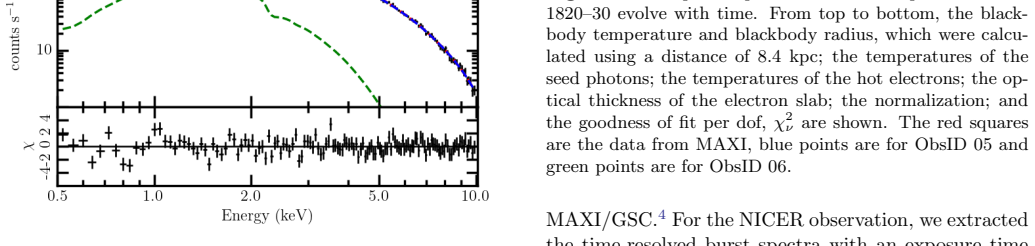
Summary. The paper reports NICER and MAXI observations of a superburst from the ultracompact X-ray binary 4U 1820-30 in 2021 August. From time-resolved spectroscopy, the authors derive burst parameters: a blackbody decay time of about 2.5 hr, an ignition column depth of about 0.3e12 g/cm2, an energy release per unit mass of about 2.4e17 erg/g, a fluence of about 4.1e-4 erg/cm2, and a total energy release of about 3.5e42 erg. During the burst tail, the Comptonization (persistent) flux is observed to rise from 8.95e-10 to 7.29e-9 erg/s/cm2. The authors interpret this as recovery of persistent emission after a near-complete quenching caused by the superburst radiation depleting the inner accretion disk. They also detect an absorption line that drifts from 4.15 to 3.62 keV and attribute it to gravitationally redshifted Ar XVIII from the inner accretion disk, implying that the disk approached to about 17 km from the neutron star.
Significance. The paper provides a detailed, time-resolved spectral study of a superburst with joint NICER and MAXI coverage, which is rare and valuable. The observed increase of the Comptonization flux and the drifting absorption line are novel spectral findings that could open a new window on superburst-disk interactions. If the near-total quenching interpretation is correct, this would be strong evidence that superburst radiation can empty the inner disk and that the recovery occurs on the viscous timescale. However, the amplitude of the quenching is not directly measured: the 2.2e-13 erg/s/cm2 value is an extrapolation from a sigmoid fit to data that start 3.28 hr after the MAXI trigger, with no NICER coverage at the superburst peak. The observed data alone support strong suppression (first measured flux about 12% of the baseline) but not the factor-of-3e-5 reduction that the abstract implies. The paper is transparent about this limitation in Sect. 4.2, but the abstract and summary overstate the result. The absorption-line interpretation is also not unique. Overall, the paper is a useful observational contribution whose central interpretive claims need to be qualified and made more robust.
major comments (3)
- [Sect. 3.2 and Abstract] The 'near-complete quenching' claim is based on an extrapolation. The value 2.2e-13 erg/s/cm2 is the zero-time asymptote of a sigmoid fitted to data beginning 3.28 hr after the MAXI trigger; no NICER data cover the superburst peak. The first measured Comptonization flux is 8.95e-10 erg/s/cm2, about 12% of the adopted preburst level of 7.29e-9 erg/s/cm2. This demonstrates strong suppression but not the factor-of-3e-5 quenching implied by 2.2e-13. The paper itself acknowledges in Sect. 4.2 that 'the actual flux could be orders of magnitude higher,' yet the abstract and Summary present near-complete quenching as an established result. The abstract and summary should be revised to state that the data show a strong suppression and that the lower limit is a model-dependent extrapolation.
- [Sects. 2 and 3.2] The preburst baseline is not contemporaneous. ObsID 02, observed 64.5 days before the burst, has a count rate of about 2935 counts/s, while ObsID 06, used as the recovered persistent level, has a count rate of about 1977 counts/s. The Comptonization flux of 7.29e-9 erg/s/cm2, labeled the 'preburst level,' is taken from ObsID 06, i.e., after the burst. 'Recovery to the preburst level' is therefore not anchored to the same source state. The authors should explicitly discuss the factor-of-1.5 difference in count rate between the two epochs and whether the persistent flux level was the same before and after the burst.
- [Sect. 4.3] The attribution of the drifting absorption line to gravitationally redshifted Ar XVIII is not unique. The line energy could vary because of changes in ionization balance, column density, or bulk Doppler motion in a wind or accretion stream. The authors do not test these alternatives; for example, they do not examine whether the observed decrease in line width (0.38 to 0.09 keV) and depth (0.13 to 0.03 keV) is consistent with a purely gravitational redshift at constant rest energy. The inferred inner-disk radius of about 17 km depends on the assumed rest energy of 4.15 keV and a neutron star mass of 1.4 solar masses. This claim should be framed as a plausible interpretation rather than a secure measurement.
minor comments (4)
- [Throughout] The text repeatedly uses the spelling 'Componization' instead of 'Comptonization' (e.g., in the Abstract, Sect. 3.2, and Fig. 6/7 captions). This should be corrected.
- [Sect. 4.2] The comparison of the observed rise time (1.8 hr) with the viscous timescale uses alpha = 0.135, which is chosen a posteriori to match the observation. The authors should state clearly that alpha is not independently constrained in this study and that the agreement is therefore not a strong test of the model.
- [Fig. 7] The sigmoid fit is plotted over the data, but the extrapolated region below the first data point (from 2.2e-13 up to the first measured point) is not visually distinguished from the data region. Adding a dashed line for the extrapolated portion would help the reader see that the lower limit is not directly measured.
- [Sect. 4.1] The predicted recurrence time of about 0.31 yr is compared with the observed interval of about 0.25 yr between the two 2021 superbursts. The uncertainty on the observed recurrence time (based on two events) is not discussed; a single pair of bursts does not provide a strong statistical test of the model.
Circularity Check
No significant circularity: independent NICER/MAXI measurements; the near-quenching floor is an acknowledged sigmoid extrapolation, not a circular reduction.
full rationale
The paper's central results are derived from independent NICER and MAXI observations. The burst parameters (decay time, ignition depth, energy release, fluence) come from fitting the cooling blackbody flux to the Cumming & Macbeth analytic model; the recurrence time is a consistency check between the fitted y_ign and the measured persistent flux, not a circular input. The near-complete quenching claim is the weakest point, but it is not circular: Section 3.2 explicitly states there are no NICER data at the superburst peak, and the 2.2e-13 value is the zero-time evaluation of a sigmoid fitted to the observed rise, with the authors adding that the true flux could be orders of magnitude higher. This is a model-dependent extrapolation and a caveat, not a fitted parameter renamed as a prediction. The choice alpha=0.135 to make the viscous timescale equal the observed rise time is post-hoc tuning of a free parameter within its standard range, not a circular derivation. The absorption-line identification uses the NIST database and a standard redshift formula; it does not assume the conclusion. The model Tbabs*(bbodyrad+compTT) is adopted from Yu et al. 2024, a self-citation, but this is a standard spectral model with independent support and is not load-bearing for the burst physics. No equation reduces to its own input; no uniqueness theorem is imported from the authors. Score 2 reflects only the minor, non-load-bearing self-citation for the spectral model choice, not circularity in the central derivation.
Assumptions & free parameters
free parameters (4)
- E17 (energy release per unit mass) =
~2.37 in units of 10^17 erg/g
- y12 (ignition column depth) =
~0.29 in units of 10^12 g/cm2
- sigmoid parameters F, k, t0 =
F=(7.74+/-0.01)e-9 erg/s/cm2, k=2.38+/-0.01 hr^-1, t0=4.41+/-0.01 hr
- alpha (viscosity parameter) =
0.135 chosen in Eq. 4
assumptions (5)
- domain assumption The superburst cooling is described by the Cumming & Macbeth (2004) analytic model with free parameters E17 and y12.
- domain assumption The persistent X-ray continuum is Tbabs*(bbodyrad+compTT), as adopted from Yu et al. (2024).
- domain assumption The disk surface density and viscous timescale follow Ballantyne & Everett (2005), Eqs. 3 and 4, with alpha and accretion efficiency 0.1.
- ad hoc to paper The 4.15 keV absorption line is Ar XVIII with rest energy 4.15 keV, and the observed energy decrease is gravitational redshift rather than Doppler or opacity effects.
- domain assumption The event is a carbon-fueled superburst.
Cite this review
Pith. "Pith review of Quenching and recovery of persistent X-ray emission during a superburst in 4U 1820$-$30." pith.science (2026). https://pith.science/paper/3JZTG5H4
@misc{pith2026241205785,
  author       = {Pith},
  title        = {Pith review of: Quenching and recovery of persistent X-ray emission during a superburst in 4U 1820$-$30},
  year         = {2026},
  howpublished = {\url{https://pith.science/paper/3JZTG5H4}},
  note         = {Machine review of arXiv:2412.05785}
}
abstract
We report the superburst from 4U 1820--30 in 2021 observed by the Monitor of All-sky X-ray Image and Neutron star Interior Composition Explorer (NICER). During the tail of the superburst, we found that the NICER light curve unexpectedly increased from 1080 to 2204 ${\rm counts~s^{-1}}$ over 6.89 hr. From the time-resolved superburst spectra, we estimated the burst decay time of $\approx2.5$ hr, the ignition column depth of $\approx0.3\times 10^{12}~{\rm g ~cm^{-2}}$, the energy release per unit mass of $\approx2.4\times 10^{17}~{\rm erg~g^{-1}}$, the fluence of $\approx4.1\times 10^{-4}~{\rm erg~cm^{-2}}$, and the total energy release of $\approx3.5\times10^{42}$ erg. Notably, we found a gradual increase in the Componization flux from $8.9\times 10^{-10}~{\rm erg~s^{-1}~cm^{-2}}$ to the preburst level during the superburst. This increase can be interpreted as a consequence of superburst radiation depleting the inner accretion disk, leading to a near-complete quenching of the persistent emission. As the burst radiation decayed, the inner accretion disk gradually returned to its preburst state, as evidenced by the best-fit spectral parameters. Additionally, we observed a prominent absorption line that exhibited a gravitational redshift, shifting from 4.15 to 3.62 keV during the recovery phase of persistent emission. This absorption feature likely originates from the inner accretion disk rather than from burst emission on the neutron star (NS) surface. The observed changes in the absorption line energy suggest that the inner disk approached the NS to a distance as close as $\approx17$ km.
Figures


Figures from the paper (7 more)



Reference graph
Works this paper leans on
-
[1]
Arnaud, K. A. 1996, in Astronomical Society of the Pacific Conference Series, Vol. 101, Astronomical Data Analysis Software and Systems V, ed. G. H. Jacoby & J. Barnes, 17
1996
-
[2]
Ballantyne, D. R., & Everett, J. E. 2005, ApJ, 626, 364, doi: 10.1086/429860
doi:10.1086/429860 2005
-
[3]
Ballantyne, D. R., & Strohmayer, T. E. 2004, ApJL, 602, L105, doi: 10.1086/382703
doi:10.1086/382703 2004
-
[4]
2021, ApJ, 920, 59, doi: 10.3847/1538-4357/ac18c4
Bult, P., Altamirano, D., Arzoumanian, Z., et al. 2021, ApJ, 920, 59, doi: 10.3847/1538-4357/ac18c4
-
[5]
Chen, Y. P., Zhang, S., Qu, J. L., et al. 2018, ApJL, 864, L30, doi: 10.3847/2041-8213/aadc0e
-
[6]
2001, ApJL, 559, L127, doi: 10.1086/323937
Cumming, A., & Bildsten, L. 2001, ApJL, 559, L127, doi: 10.1086/323937
doi:10.1086/323937 2001
-
[7]
2004, ApJL, 603, L37, doi: 10.1086/382873
Cumming, A., & Macbeth, J. 2004, ApJL, 603, L37, doi: 10.1086/382873
doi:10.1086/382873 2004
-
[8]
Cumming, A., Macbeth, J., in ’t Zand, J. J. M., & Page, D. 2006, ApJ, 646, 429, doi: 10.1086/504698
doi:10.1086/504698 2006
Show all 45 references
-
[9]
M., Wijnands, R., Altamirano, D., & Fabian, A
Degenaar, N., Miller, J. M., Wijnands, R., Altamirano, D., & Fabian, A. C. 2013, ApJL, 767, L37, doi: 10.1088/2041-8205/767/2/L37
2013 doi
-
[10]
R., Belloni, T., et al
Degenaar, N., Ballantyne, D. R., Belloni, T., et al. 2018, SSRv, 214, 15, doi: 10.1007/s11214-017-0448-3
2018 doi
-
[11]
C., Ballantyne, D
Fragile, P. C., Ballantyne, D. R., & Blankenship, A. 2020, Nature Astronomy, 4, 541, doi: 10.1038/s41550-019-0987-5
2020 doi
-
[12]
Witry, J. W. L. 2018, ApJL, 867, L28, doi: 10.3847/2041-8213/aaeb99
2018 doi
-
[13]
1992, Accretion Power in Astrophysics., Vol
Frank, J., King, A., & Raine, D. 1992, Accretion Power in Astrophysics., Vol. 21
1992
- [14]
-
[15]
K., & Keek, L
Galloway, D. K., & Keek, L. 2021, in Timing Neutron Stars: Pulsations, Oscillations and Explosions, ed. T. M
2021
-
[16]
M´ endez, & C
Belloni, M. M´ endez, & C. Zhang, Astrophysics and Space Science Library, 209–262, doi: 10.1007/978-3-662-62110-3 5
-
[17]
K., Muno, M
Galloway, D. K., Muno, M. P., Hartman, J. M., Psaltis, D., & Chakrabarty, D. 2008, ApJS, 179, 360, doi: 10.1086/592044
2008 doi
-
[18]
K., in’t Zand, J., Chenevez, J., et al
Galloway, D. K., in’t Zand, J., Chenevez, J., et al. 2020, ApJS, 249, 32, doi: 10.3847/1538-4365/ab9f2e
2020 doi
-
[19]
1974, ApJS, 27, 37, doi: 10.1086/190288
Giacconi, R., Murray, S., Gursky, H., et al. 1974, ApJS, 27, 37, doi: 10.1086/190288
1974 doi
-
[20]
2003, A&A, 410, 217, doi: 10.1051/0004-6361:20031141 in’t Zand, J
Gilfanov, M., Revnivtsev, M., & Molkov, S. 2003, A&A, 410, 217, doi: 10.1051/0004-6361:20031141 in’t Zand, J. 2017, in 7 years of MAXI: Monitoring X-ray Transients, ed. M. Serino, M. Shidatsu, W. Iwakiri, & T. Mihara, 121, doi: 10.48550/arXiv.1702.04899 10 in’t Zand, J. J. M.,...
-
[21]
K., Bostancı, Z
Jaisawal, G. K., Bostancı, Z. F., Boztepe, T., et al. 2024, ApJ, 975, 67, doi: 10.3847/1538-4357/ad794e
2024 doi
-
[22]
Kajava, J. J. E., N¨ attil¨ a, J., Poutanen, J., et al. 2017, MNRAS, 464, L6, doi: 10.1093/mnrasl/slw167
2017 doi
-
[23]
R., Kuulkers, E., & Strohmayer, T
Keek, L., Ballantyne, D. R., Kuulkers, E., & Strohmayer, T. E. 2014a, ApJL, 797, L23, doi: 10.1088/2041-8205/797/2/L23 —. 2014b, ApJ, 789, 121, doi: 10.1088/0004-637X/789/2/121
-
[24]
R., Pringle, J
King, A. R., Pringle, J. E., & Livio, M. 2007, MNRAS, 376, 1740, doi: 10.1111/j.1365-2966.2007.11556.x
2007
-
[25]
Lewin, W. H. G., van Paradijs, J., & Taam, R. E. 1993, SSRv, 62, 223, doi: 10.1007/BF00196124
1993 doi
-
[26]
2021, ApJ, 920, 35, doi: 10.3847/1538-4357/ac1f15
Li, Z., Pan, Y., & Falanga, M. 2021, ApJ, 920, 35, doi: 10.3847/1538-4357/ac1f15
2021 doi
-
[27]
F., Poutanen, J., et al
Li, Z., Suleimanov, V. F., Poutanen, J., et al. 2018, ApJ, 866, 53, doi: 10.3847/1538-4357/aade8e
2018 doi
-
[28]
2024, ApJ, 969, 15, doi: 10.3847/1538-4357/ad4d86
Lu, Y., Li, Z., Yu, W., Pan, Y., & Falanga, M. 2024, ApJ, 969, 15, doi: 10.3847/1538-4357/ad4d86
2024 doi
-
[29]
J., & Coppi, P
Maccarone, T. J., & Coppi, P. S. 2003, A&A, 399, 1151, doi: 10.1051/0004-6361:20021881
2003 doi
-
[30]
2001, ApJ, 547, 355, doi: 10.1086/318336
Popham, R., & Sunyaev, R. 2001, ApJ, 547, 355, doi: 10.1086/318336
2001 doi
-
[31]
A., Loewenstein, M., Steiner, J
Remillard, R. A., Loewenstein, M., Steiner, J. F., et al. 2022, AJ, 163, 130, doi: 10.3847/1538-3881/ac4ae6
2022 doi
-
[32]
D., Degenaar, N., van den Eijnden, J., et al
Russell, T. D., Degenaar, N., van den Eijnden, J., et al. 2024, Nature, 627, 763, doi: 10.1038/s41586-024-07133-5
2024 doi
-
[33]
R., & Fragile, P
Speicher, J., Ballantyne, D. R., & Fragile, P. C. 2024, ApJ, 976, 44, doi: 10.3847/1538-4357/ad863d
2024 doi
-
[34]
R., & Malzac, J
Speicher, J., Ballantyne, D. R., & Malzac, J. 2020, MNRAS, 499, 4479, doi: 10.1093/mnras/staa3137
2020 doi
-
[35]
C., & Ballantyne, D
Speicher, J., Fragile, P. C., & Ballantyne, D. R. 2023, MNRAS, 526, 1388, doi: 10.1093/mnras/stad2684
2023 doi
-
[36]
Stella, L., Priedhorsky, W., & White, N. E. 1987, ApJL, 312, L17, doi: 10.1086/184811
1987 doi
-
[37]
2006, in Compact Stellar X-ray Sources, ed
Strohmayer, T., & Bildsten, L. 2006, in Compact Stellar X-ray Sources, ed. W. H. G. Lewin & M. van der Klis, Vol. 39, 113–156
2006
- [38]
-
[39]
E., Altamirano, D., Arzoumanian, Z., et al
Strohmayer, T. E., Altamirano, D., Arzoumanian, Z., et al. 2019, ApJL, 878, L27, doi: 10.3847/2041-8213/ab25eb
2019 doi
-
[40]
R., & Origlia, L
Valenti, E., Ferraro, F. R., & Origlia, L. 2004, MNRAS, 354, 815, doi: 10.1111/j.1365-2966.2004.08249.x
2004
-
[41]
Walker, M. A. 1992, ApJ, 385, 642, doi: 10.1086/170969
1992 doi
-
[42]
N., & Bildsten, L
Weinberg, N. N., & Bildsten, L. 2007, ApJ, 670, 1291, doi: 10.1086/522111
2007 doi
-
[43]
2000, The Astrophysical Journal, 542, 914, doi: 10.1086/317016
Wilms, J., Allen, A., & McCray, R. 2000, The Astrophysical Journal, 542, 914, doi: 10.1086/317016
2000 doi
-
[44]
2024, A&A, 683, A93, doi: 10.1051/0004-6361/202348195
Yu, W., Li, Z., Lu, Y., et al. 2024, A&A, 683, A93, doi: 10.1051/0004-6361/202348195
2024 doi
-
[45]
2022, A&A, 660, A31, doi: 10.1051/0004-6361/202142801
Zhao, G., Li, Z., Pan, Y., et al. 2022, A&A, 660, A31, doi: 10.1051/0004-6361/202142801
2022 doi
Reviewed August 11, 2026 · model on record in the stance chip above.
Discussion (0). Continue with ORCID to comment.