REVIEW 3 major objections 5 minor 32 references
Runge-Kutta Random Feature Method for Solving Multiphase Flow Problems of Cells
T0 review · 3 major / 5 minor · reviewed 2026-08-11 · deepseek-v4-flash
Pith's one-line read The paper proposes the Runge-Kutta random feature method (RK-RFM) and claims it solves the strongly nonlinear, nonlocal multiphase flow equations for collective cell migration accurately and mesh-free, with an error estimate and…
desk verdict A plausible mesh-free PDE solver with a nice cost-saving trick, but the advertised error estimate is built on an invalid orthogonality assumption and unverified Lipschitz conditions — worth refereeing, not worth accepting as is. read the letter →
The pith
A machine-rendered reading of the paper's core claim, the machinery that carries it, and where it could break.
The reading
What carries the argument
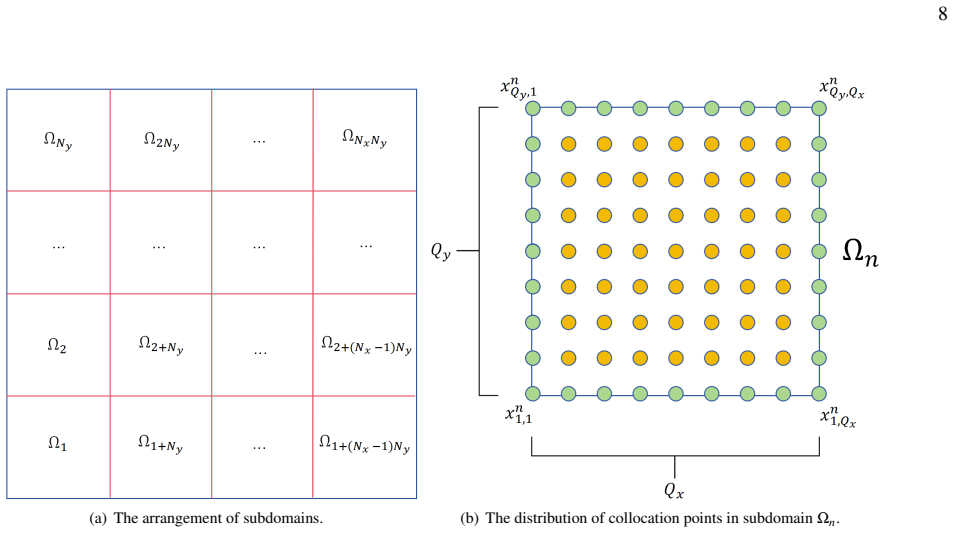
The machine that carries the argument is the explicit Runge-Kutta increment operator $H$ from (18), which turns one time step into the update $\phi_{t_{k+1}} = \phi_{t_k} + \Delta t\,H(x,t_k,\phi_{t_k},\Delta t)$. The spatial basis is supplied by the random feature method: on each subdomain $\Omega_n$ a partition-of-unity weight $\psi_n$ multiplies random feature functions $\sigma(W_{n,j}\cdot\tilde{x}+b_{n,j})$ with randomly drawn, fixed weights, leaving only the output coefficients to be fitted by linear least squares. The error theorem runs on two ingredients: a universal approximation lemma for these feature dictionaries (Lemma III.1) and an assumed uniform Lipschitz property of $H$ (Theorem III.1), which together produce the split error bound (26). Manual precomputation of derivatives of the activation function replaces automatic differentiation, and one shared feature dictionary per step turns the multi-field least-squares problem into a single block system (24).
What would settle it
Run the same algorithm on equation (9) with a much smaller interface width, say $\lambda=0.5$ instead of $2.5$, and compare with a high-resolution finite-difference reference; if the relative $L^2$ error does not shrink as the number of features, subdomains, or collocation points grows, or if it worsens as $\Delta t$ is reduced below the predicted balance point, the uniform-Lipschitz and per-step approximability assumptions fail for sharp-interface solutions.
Extended reading notes
Core claim
The paper's central claim is that the Runge-Kutta random feature method solves the active-droplet phase-field system (9) for collective cell migration to high accuracy in both space and time while remaining mesh-free. At each time step the solution is represented as a partition-of-unity sum of random feature functions over subdomains, and the field is advanced by an explicit p-th order Runge-Kutta step (18); the coefficients are found by a linear least-squares fit of the representation to the RK increment at collocation points. The same random feature dictionary is used for all $d_\varphi$ cell fields, so one coefficient matrix serves the whole system. Theorem III.1 bounds the expected $L^2$ error by $e_1(\Delta t)+e_2(\Delta t)$, where $e_1$ contains the random-feature fitting and optimization error divided by $\Delta t$ and $e_2$ is the order-$p$ Runge-Kutta truncation error. The convergence tests show second-order time accuracy and decreasing errors as $M_p$, $J_n$, and $Q$ grow, and the cell simulations reproduce the reference model's threshold behavior for $v_{rms}$ and $S_{rms}$.
Load-bearing premise
The load-bearing premise is that the one-step Runge-Kutta update does not magnify errors by more than a fixed factor at every time step and that the random feature fit is uniformly accurate at every step, even though the target cell interfaces are sharp, the equation is cubic and nonlocal, and the approximation theorem is stated only for continuous functions.
Editorial extensions
If this is right
- The method's reuse of one random feature dictionary for all cell fields means the spatial least-squares coefficient matrix is assembled once per time step, so the cost of adding more cells grows mainly through the right-hand side.
- The two-part error bound (26) predicts an optimal time step where spatial fitting error and Runge-Kutta truncation error balance; the convergence tests observe minimal error exactly in the predicted regime ($\Delta t = 5\times10^{-4}$ for tanh, $\Delta t = 5\times10^{-5}$ for cos).
- Being mesh-free, the scheme can be applied on irregular domains without regenerating a grid, and manual precomputation of derivatives removes the need for automatic differentiation during time marching.
- The cell simulations reproduce the active-nematic phenomenology of the reference model: $v_{rms}$ and $S_{rms}$ rise with activity $\zeta$, sustained flows appear above an activity threshold, and negative activity restores a stable equilibrium.
Reading between the lines
- A natural extension not tested in the paper would use the same error split to calibrate $\Delta t$ for other strongly nonlinear PDEs: with a fixed spatial random-feature budget, reducing $\Delta t$ first shrinks the temporal error and then increases the fitting-error contribution, yielding a measurable optimal step size.
- If the reuse of one dictionary generalizes, the approach should transfer to vector-valued or multi-physics PDEs with different coupling terms, as long as the Runge-Kutta right-hand side can be evaluated at the collocation points.
- Sharp-interface limits ($\lambda \to 0$) are the natural stress test for the theory: the universal approximation lemma is stated for continuous functions, while the phase-field solutions develop layers of width $\lambda$, so accuracy at small $\lambda$ needs separate numerical verification.
- The extension to three-dimensional active-droplet models is plausible: the deformation tensor $S_i$ becomes a $3\times3$ traceless matrix, and the per-step least-squares structure is unchanged, though the collocation cost grows.
Editorial analysis
A structured set of objections, weighed in public.
Referee Report
Summary. The paper proposes the Runge-Kutta random feature method (RK-RFM) for the strongly nonlinear, coupled multiphase flow problem of cells. The method combines a random feature spatial approximation with an explicit Runge-Kutta time integrator, and the authors report mesh-free computation, parallelization, avoidance of automatic differentiation, and numerical experiments including a manufactured-solution convergence study and a 240-cell simulation. The paper also presents an error estimate, Theorem III.1 and Eq. (26), which is intended to bound the expected L2 error of the RK-RFM approximation in terms of a random-feature fitting error, a coefficient-error variance, and the RK truncation error.
Significance. If the theoretical claims were sound, the RK-RFM would be a notable contribution: it offers a mesh-free, easily parallelized solver for a challenging active-matter phase-field system, and the numerical results do demonstrate second-order temporal convergence on a smooth manufactured solution and qualitatively plausible collective cell dynamics, including activity-induced nematic order consistent with the reference model. The reported computational times and the no-automatic-differentiation implementation are practically valuable. However, the advertised error estimates are the main theoretical contribution, and the proof of the central norm-equivalence lemma is invalid; the numerical evidence cannot compensate for the fact that the stated error bound is not established.
major comments (3)
- [Section III B, Lemma III.3] The proof of Lemma III.3 is invalid. It asserts ||\hat G_M - \tilde G_M||_{L2}^2 = \sum_{i,n,j} (\hat u^i_{nj} - \tilde u^i_{nj})^2 \int_\Omega (\phi^i_{nj})^2 dx, but this equality suppresses the cross terms 2 \sum_{j<k} \delta u_j \delta u_k \int_\Omega \phi_j \phi_k dx. The random features (5) are not L2-orthogonal on a subdomain under the partition-of-unity construction (3), so those cross terms are generically nonzero. The claimed constants C1 = max ||\phi||_{L2} and C2 = min ||\phi||_{L2} are therefore not valid frame bounds. For example, with two identical unit-norm features and coefficient differences (1,1), the function norm is 2 while C1||U|| = sqrt(2), violating the upper bound; with coefficient differences (1,-1), the function norm is 0 while C2||U|| = sqrt(2), violating the lower bound. Since Lemma III.2 bounds only the coefficient difference, the conversion from coefficient error to L2 function error, which is the first term e1(\Delta t) in Eq. (26), has no valid proof.
- [Section III B, Theorem III.1] The assumed uniform L2-Lipschitz condition on H is not established for the operator F in Eq. (9). The map H(x,t,φ,Δt) defined by Eq. (18) contains the Laplacian Δφ_i, cubic terms φ_i(1-φ_i)(1-2φ_i), nonlocal area integrals, and the deformation tensor S_i from Eq. (17). These operations are not L2-Lipschitz on L2; in particular, the Laplacian is unbounded on L2, and cubic products require additional regularity. The theorem states the condition for all φ in R^{dφ}, but the relevant objects are functions, and no Sobolev-space framework or a priori regularity bound is supplied. This assumption is load-bearing: the recurrence in the proof of Theorem III.1 uses it at every time step to obtain the factor (1 + Δt L).
- [Section III B, Theorem III.1 and Lemma III.2] The remaining assumptions entering e1(\Delta t) are also unverified. The theorem assumes a per-step random-feature fit error ||\tilde φ_{t_k} - φ_{t_k}||_{L2} ≤ sqrt(d_φ) ε for every k, but Lemma III.1 is only an asymptotic universal-approximation statement for a fixed continuous function as M → ∞; it provides no rate, no uniformity in k, and no justification for sharp-interface solutions whose interface width λ is small. Similarly, Lemma III.2 assumes the coefficient errors δu_j are i.i.d. with zero mean and variance δ², but this is not derived from the least-squares problem (A1) or from the rescaling procedure. Consequently even a corrected norm-equivalence lemma would leave e1(\Delta t) as an estimate depending on unquantified and unconnected quantities, not a rigorous a priori bound.
minor comments (5)
- [Section IV B] The parameter list after Eq. (31) contains 'µ = 3' twice; one occurrence appears to be a typo for another parameter.
- [Figure 1] The caption reads 'The architecture of of Algorithm 1'; 'of' is duplicated.
- [Section III B, Lemma III.2] The phrase 'unitary orthogonal basis' should be 'orthonormal basis'.
- [Algorithm 1] Line 9 writes 'φ_{t_{k+1}}(x) := φ~_{t_{k+1}}(x)', which reuses the symbol for the exact RK stage solution; using a distinct symbol for the RFM-corrected solution would avoid ambiguity in the error analysis.
- [Section III A, Remark 2] The statement 'we only need to calculate the coefficient matrix A_{t_{k+1}} once' is correct only because the same random features are reused for all components φ^i; this is an implementation choice and should be flagged as a possible source of coupling in future generalizations, though it is not an error in the present setting.
Circularity Check
No circularity: the RK-RFM error bound is a conditional upper bound in abstract constants, not a fitted or self-referential prediction.
full rationale
Walking the derivation chain, the central claims are not equivalent to their inputs by construction. The method combines a known spatial random-feature approximation (RFM) with an explicit Runge-Kutta time integrator; the numerical scheme is not obtained by fitting the target solution. Theorem III.1 states an error estimate (26) of the form e1(Δt) + e2(Δt), where e1 depends on assumed per-step coefficient error δ, assumed random-feature fit error ε, and an assumed L-Lipschitz condition on H, while e2 is the standard RK local truncation term. These are explicitly stated assumptions, not conclusions, and the bound is an upper bound in abstract constants rather than a quantity calibrated to the experiments. Lemma III.1 invokes an external universal approximation theorem (reference 21), and the convergence tests are checked against the independent exact solution (27) and the qualitative cell behavior of reference 2. There are no self-citations by the present authors that carry a load-bearing argument, no fitted parameter renamed as a prediction, and no uniqueness theorem imported from the authors' prior work. The apparent weaknesses noted by a skeptical reader, such as the unverified norm-equivalence expansion in Lemma III.3 and the unproved H-Lipschitz condition for the strongly nonlinear operator F, are mathematical correctness or rigor gaps rather than circular reductions: even if the proof of Lemma III.3 is invalid, the claimed estimate does not reduce to its input by definition. No passage in the paper asserts a limitation that would reveal a circular step. Accordingly, the circularity score is 0.
Assumptions & free parameters
free parameters (2)
- c (rescaling constant) =
100
- Rm (random weight range) =
1.7 (convergence test), 5.0 (cell simulation)
assumptions (5)
- domain assumption H satisfies a uniform L2-Lipschitz condition ||H(x,t,phi_hat,Delta t) - H(x,t,phi_e,Delta t)|| <= L ||phi_hat - phi_e|| (Theorem III.1).
- ad hoc to paper At each time step the RFM optimal solution satisfies ||phi_tilde_tk - phi_tk|| <= sqrt(d_phi) epsilon for all k (Theorem III.1).
- ad hoc to paper Coefficient errors delta u_j are i.i.d. with zero mean and variance delta^2 (Lemma III.2).
- domain assumption The random feature functions form a Riesz basis on each subdomain, so that C2 ||U|| <= ||sum_j U_j phi_j|| (Lemma III.3).
- standard math Universal approximation via bounded nonconstant piecewise continuous activation functions for any f in C(Omega) (Lemma III.1).
Cite this review
Pith. "Pith review of Runge-Kutta Random Feature Method for Solving Multiphase Flow Problems of Cells." pith.science (2026). https://pith.science/paper/WESJAPG7
@misc{pith2026241205920,
  author       = {Pith},
  title        = {Pith review of: Runge-Kutta Random Feature Method for Solving Multiphase Flow Problems of Cells},
  year         = {2026},
  howpublished = {\url{https://pith.science/paper/WESJAPG7}},
  note         = {Machine review of arXiv:2412.05920}
}
read the original abstract
Cell collective migration plays a crucial role in a variety of physiological processes. In this work, we propose the Runge-Kutta random feature method to solve the nonlinear and strongly coupled multiphase flow problems of cells, in which the random feature method in space and the explicit Runge-Kutta method in time are utilized. Experiments indicate that this algorithm can effectively deal with time-dependent partial differential equations with strong nonlinearity, and achieve high accuracy both in space and time. Moreover, in order to improve computational efficiency and save computational resources, we choose to implement parallelization and non-automatic differentiation strategies in our simulations. We also provide error estimates for the Runge-Kutta random feature method, and a series of numerical experiments are shown to validate our method.
Figures


Figures from the paper (7 more)


Reference graph
Works this paper leans on
-
[1]
merlin.mbs aapmrev4-1.bst 2010-07-25 4.21a (PWD, AO, DPC) hacked
FUNCTION id.bst "merlin.mbs aapmrev4-1.bst 2010-07-25 4.21a (PWD, AO, DPC) hacked" ENTRY address archive archivePrefix author bookaddress booktitle chapter collaboration doi edition editor eid eprint howpublished institution isbn issn journal key language month note number organization pages primaryClass publisher school SLACcitation series title translat...
2010
-
[2]
merlin.mbs aipauth4-1.bst 2010-07-25 4.21a (PWD, AO, DPC) hacked
FUNCTION id.bst "merlin.mbs aipauth4-1.bst 2010-07-25 4.21a (PWD, AO, DPC) hacked" ENTRY address archive archivePrefix author bookaddress booktitle chapter collaboration doi edition editor eid eprint howpublished institution isbn issn journal key language month note number organization pages primaryClass publisher school SLACcitation series title translat...
2010
-
[3]
merlin.mbs aipnum4-1.bst 2010-07-25 4.21a (PWD, AO, DPC) hacked
FUNCTION id.bst "merlin.mbs aipnum4-1.bst 2010-07-25 4.21a (PWD, AO, DPC) hacked" ENTRY address archive archivePrefix author bookaddress booktitle chapter collaboration doi edition editor eid eprint howpublished institution isbn issn journal key language month note number organization pages primaryClass publisher school SLACcitation series title translati...
2010
-
[4]
author author B. Ladoux \ and\ author R.-M. \ M \`e ge ,\ title title Mechanobiology of collective cell behaviours , \ @noop journal journal Nature reviews Molecular cell biology \ volume 18 ,\ pages 743--757 ( year 2017 ) NoStop
work page 2017
-
[5]
author author R. Mueller , author J. M. \ Yeomans , \ and\ author A. Doostmohammadi ,\ title title E mergence of A ctive N ematic B ehavior in M onolayers of I sotropic C ells , \ @noop journal journal Physical review letters \ volume 122 ,\ pages 048004 ( year 2019 ) NoStop
work page 2019
-
[6]
author author R. J. \ LeVeque ,\ @noop title Finite difference methods for ordinary and partial differential equations: steady-state and time-dependent problems \ ( publisher SIAM ,\ year 2007 ) NoStop
work page 2007
-
[7]
author author F. Moukalled , author L. Mangani , author M. Darwish , author F. Moukalled , author L. Mangani , \ and\ author M. Darwish ,\ @noop title The F inite V olume M ethod \ ( publisher Springer ,\ year 2016 ) NoStop
work page 2016
-
[8]
Thom \'e e ,\ @noop title Galerkin F inite E lement M ethods for P arabolic P roblems ,\ Vol
author author V. Thom \'e e ,\ @noop title Galerkin F inite E lement M ethods for P arabolic P roblems ,\ Vol. volume 25 \ ( publisher Springer Science & Business Media ,\ year 2007 ) NoStop
work page 2007
Show all 32 references
-
[9]
Goodfellow ,\ @noop title Deep learning , \ ( year 2016 ) NoStop
author author I. Goodfellow ,\ @noop title Deep learning , \ ( year 2016 ) NoStop
2016
-
[10]
author author G. Cybenko ,\ title title Approximation by superpositions of a sigmoidal function , \ @noop journal journal Mathematics of control, signals and systems \ volume 2 ,\ pages 303--314 ( year 1989 ) NoStop
1989
-
[11]
Han , author A
author author J. Han , author A. Jentzen , et al. ,\ title title Deep L earning- B ased N umerical M ethods for H igh- D imensional P arabolic P artial D ifferential E quations and B ackward S tochastic D ifferential E quations , \ @noop journal journal Communications in mathe...
2017
-
[12]
Han , author A
author author J. Han , author A. Jentzen , \ and\ author W. E ,\ title title Solving high-dimensional partial differential equations using deep learning , \ @noop journal journal Proceedings of the National Academy of Sciences \ volume 115 ,\ pages 8505--8510 ( year 2018 ) NoStop
2018
-
[13]
Yu et al
author author B. Yu et al. ,\ title title The D eep R itz M ethod: A D eep L earning- B ased N umerical A lgorithm for S olving V ariational P roblems , \ @noop journal journal Communications in Mathematics and Statistics \ volume 6 ,\ pages 1--12 ( year 2018 ) NoStop
2018
-
[14]
Sirignano \ and\ author K
author author J. Sirignano \ and\ author K. Spiliopoulos ,\ title title DGM : A deep learning algorithm for solving partial differential equations , \ @noop journal journal Journal of computational physics \ volume 375 ,\ pages 1339--1364 ( year 2018 ) NoStop
2018
-
[15]
Zang , author G
author author Y. Zang , author G. Bao , author X. Ye , \ and\ author H. Zhou ,\ title title Weak adversarial networks for high-dimensional partial differential equations , \ @noop journal journal Journal of Computational Physics \ volume 411 ,\ pages 109409 ( year 2020 ) NoStop
2020
-
[16]
Raissi , author P
author author M. Raissi , author P. Perdikaris , \ and\ author G. E. \ Karniadakis ,\ title title Physics-informed neural networks: A deep learning framework for solving forward and inverse problems involving nonlinear partial differential equations , \ @noop journal journal J...
2019
-
[17]
Weinan , author J
author author E. Weinan , author J. Han , \ and\ author A. Jentzen ,\ title title Algorithms for solving high dimensional PDE s: from nonlinear M onte C arlo to machine learning , \ @noop journal journal Nonlinearity \ volume 35 ,\ pages 278 ( year 2021 ) NoStop
2021
-
[18]
\ Huang , author Q.-Y
author author G.-B. \ Huang , author Q.-Y. \ Zhu , \ and\ author C.-K. \ Siew ,\ title title Extreme learning machine: T heory and applications , \ @noop journal journal Neurocomputing \ volume 70 ,\ pages 489--501 ( year 2006 ) NoStop
2006
-
[19]
author author R. M. \ Neal ,\ @noop title Bayesian learning for neural networks ,\ Vol.\ volume 118 \ ( publisher Springer Science & Business Media ,\ year 2012 ) NoStop
2012
-
[20]
Rahimi \ and\ author B
author author A. Rahimi \ and\ author B. Recht ,\ title title Random F eatures for L arge- S cale K ernel M achines , \ @noop journal journal Advances in neural information processing systems \ volume 20 ( year 2007 ) NoStop
2007
-
[21]
Huang , author G.-B
author author G. Huang , author G.-B. \ Huang , author S. Song , \ and\ author K. You ,\ title title Trends in extreme learning machines: A review , \ @noop journal journal Neural Networks \ volume 61 ,\ pages 32--48 ( year 2015 ) NoStop
2015
-
[22]
Chen , author X
author author J. Chen , author X. Chi , author Z. Yang , et al. ,\ title title Bridging T raditional and M achine L earning- B ased A lgorithms for S olving PDE s: T he R andom F eature M ethod , \ @noop journal journal J Mach Learn \ volume 1 ,\ pages 268--98 ( year 2022 ) NoStop
2022
-
[23]
Chen , author Y
author author J. Chen , author Y. Luo , et al. ,\ title title The R andom F eature M ethod for T ime-dependent P roblems , \ @noop journal journal arXiv preprint arXiv:2304.06913 \ ( year 2023 ) NoStop
2023 arXiv
-
[24]
\ Huang , author L
author author G.-B. \ Huang , author L. Chen , \ and\ author C.-K. \ Siew ,\ title title Universal A pproximation using I ncremental C onstructive F eedforward N etworks with R andom H idden N odes , \ @noop journal journal IEEE transactions on neural networks \ volume 17 ,\ p...
2006
-
[25]
Dwivedi \ and\ author B
author author V. Dwivedi \ and\ author B. Srinivasan ,\ title title Physics I nformed E xtreme L earning M achine ( PIELM )-- A rapid method for the numerical solution of partial differential equations , \ @noop journal journal Neurocomputing \ volume 391 ,\ pages 96--118 ( ye...
2020
-
[26]
Calabr \`o , author G
author author F. Calabr \`o , author G. Fabiani , \ and\ author C. Siettos ,\ title title Extreme learning machine collocation for the numerical solution of elliptic PDE s with sharp gradients , \ @noop journal journal Computer Methods in Applied Mechanics and Engineering \ vo...
2021
-
[27]
Dong \ and\ author Z
author author S. Dong \ and\ author Z. Li ,\ title title Local extreme learning machines and domain decomposition for solving linear and nonlinear partial differential equations , \ @noop journal journal Computer Methods in Applied Mechanics and Engineering \ volume 387 ,\ pag...
2021
-
[28]
Fabiani , author F
author author G. Fabiani , author F. Calabr \`o , author L. Russo , \ and\ author C. Siettos ,\ title title Numerical solution and bifurcation analysis of nonlinear partial differential equations with extreme learning machines , \ @noop journal journal Journal of Scientific Co...
2021
-
[29]
Yang , author M
author author Y. Yang , author M. Hou , \ and\ author J. Luo ,\ title title A novel improved extreme learning machine algorithm in solving ordinary differential equations by L egendre neural network methods , \ @noop journal journal Advances in Difference Equations \ volume 20...
2018
-
[30]
author author J. C. \ Butcher ,\ title title A history of R unge- K utta methods , \ @noop journal journal Applied numerical mathematics \ volume 20 ,\ pages 247--260 ( year 1996 ) NoStop
1996
-
[31]
merlin.mbs apsrev4-1.bst 2010-07-25 4.21a (PWD, AO, DPC) hacked
FUNCTION id.bst "merlin.mbs apsrev4-1.bst 2010-07-25 4.21a (PWD, AO, DPC) hacked" ENTRY address archive archivePrefix author bookaddress booktitle chapter collaboration doi edition editor eid eprint howpublished institution isbn issn journal key language month note number orga...
2010
-
[32]
merlin.mbs apsrmp4-1.bst 2010-07-25 4.21a (PWD, AO, DPC) hacked
FUNCTION id.bst "merlin.mbs apsrmp4-1.bst 2010-07-25 4.21a (PWD, AO, DPC) hacked" ENTRY address archive archivePrefix author bookaddress booktitle chapter collaboration doi edition editor eid eprint howpublished institution isbn issn journal key language month note number orga...
2010
Reviewed August 11, 2026 · model on record in the stance chip above.
Discussion (0). Continue with ORCID to comment.