REVIEW 3 major objections 4 minor 2 cited by
Perturbed Traceless SU(2) Character Varieties of Tangle Sums
T0 review · 3 major / 4 minor · reviewed 2026-08-11 · deepseek-v4-flash
Pith's one-line read A cut-and-paste formula computes perturbed tangle-sum character varieties, replacing each internal circle by two intervals.
desk verdict A real gluing theorem for pillowcase Lagrangians, with an overclaimed Proposition 5.7 and a bigon count that deserves a second pass; still worth refereeing. read the letter →
The pith
A machine-rendered reading of the paper's core claim, the machinery that carries it, and where it could break.
The reading
What carries the argument
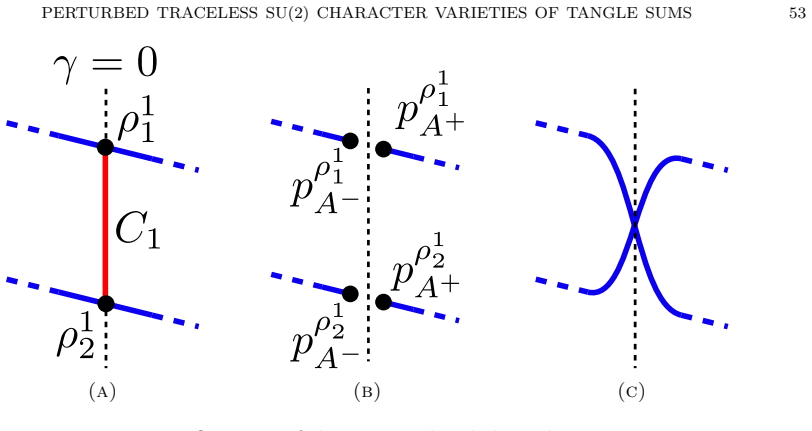
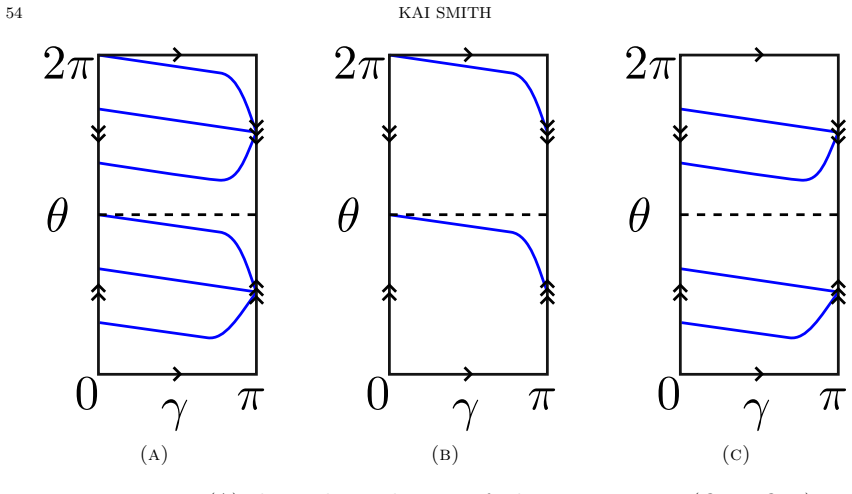
The central object is the tangle sum $T_1+T_2$, formed by gluing two tangles into the elementary tangle $C_3$, whose character variety fibers over the fiber product $R_{\pi_1}(T_1)\times_{[0,\pi]}R_{\pi_2}(T_2)$ over the common $\gamma$-coordinate (Theorem 3.15). The perturbation is a holonomy perturbation along a single curve $D$ in $C_3$; the mechanism that carries the argument is the zero-set $V_t=\Phi_t^{-1}(0)$ for an explicit trigonometric function $\Phi_t$, whose values near the singular locus are controlled by a sign function $s$ on the set $S$ of binary-dihedral representations. The sign of $s$ decides how each internal circle reconnects: neighborhoods of the singular pair are replaced by two intervals joining the $A^+$ and $A^-$ endpoints, while the $s=0$ locus keeps the cone-on-four-points structure (Theorem 4.13 and Corollary 4.15).
What would settle it
For a concrete good pair, such as $Q_{1/2}+Q_{-1/3}$ with perturbation $D_t$, explicitly enumerate all auxiliary components and check whether any auxiliary circle persists, intersects the other Lagrangian under every sufficiently small perturbation, or fails to shrink to a point as $t\to0$; finding one such circle would disprove Proposition 5.7 and undo the Floer-rank conclusion in Theorem 5.9.
Extended reading notes
Core claim
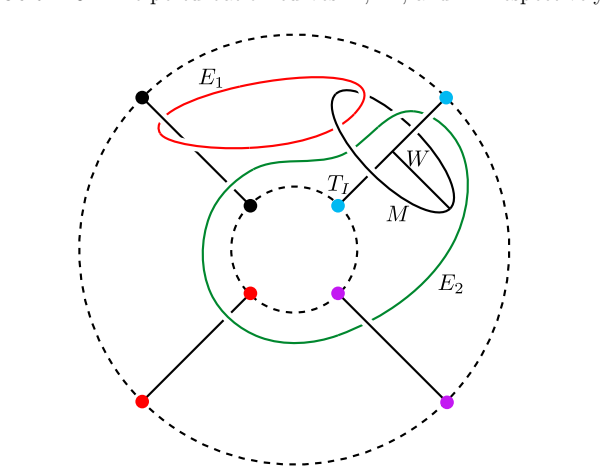
The paper's load-bearing claim is Theorem 4.22: for a good pair of tangles with no corner circles and sufficiently small $t>0$, the perturbed character variety $R_{D_t\cup\pi_1\cup\pi_2}(T_1+T_2)$ contains a main component obtained from $R_{\pi_1\cup\pi_2}(T_1+T_2)$ by removing a neighborhood of each internal circle $C_i$ and inserting two intervals whose images in the pillowcase converge to the image of $C_i$; every other component is an auxiliary circle whose image converges to the singular set as $t\to0$. The paper then derives two consequences: arborescent tangle character varieties are linear with rational slopes (Proposition 5.8), and, conditional on the pillowcase bounding-cochain conjecture, there exists a tangle without an earring whose bounding cochain is nontrivial, shown by computing nine intersection points and two bigons for the knot $P(-2,3,5)$ and finding Floer rank five rather than the known rank seven of $I^\natural$ (Theorem 5.9).
Load-bearing premise
The argument rests on assuming that the auxiliary circle components left undetermined by Theorem 4.22 can always be made irrelevant to Lagrangian Floer homology by an arbitrarily small perturbation of the other Lagrangian (Proposition 5.7); if for some tangle pair those circles cannot be avoided, the computed Floer homology and the nontriviality of the bounding cochain could change.
Editorial extensions
If this is right
- For any good pair with no corner circles, the perturbed character variety of a tangle sum has a main component obtained from the unperturbed variety by replacing each internal circle by two intervals, with all other components collapsing to points as $t\to0$ (Theorem 4.22).
- Arborescent tangles have piecewise-linear pillowcase images with rational slopes and endpoints in $(\pi\mathbb{Q})^2$, so their character varieties are algorithmically computable (Proposition 5.8).
- If the pillowcase bounding-cochain conjecture holds, the bounding cochain assigned to some tangle without an earring is nontrivial; the example is the decomposition of $P(-2,3,5)$ into $dQ_{-1/2}$ and $Q_{1/3}+Q_{1/5}$ (Theorem 5.9).
- Under Proposition 5.7, auxiliary components do not affect Lagrangian Floer homology, so the $t\to0$ limit of the perturbed character variety can be used in place of the actual Lagrangian in computations.
Reading between the lines
- Editorial inference: the same surgery can likely be iterated over arbitrary arborescent diagrams, turning the paper's one-step tangle-sum move into an inductive algorithm that computes pillowcase Lagrangians for all Montesinos and arborescent knots, not only the examples checked.
- Editorial inference: the existence of auxiliary components whose number and placement are undetermined suggests that the pillowcase Lagrangian is not unique up to Hamiltonian isotopy; proving the bounding-cochain conjecture may require a canonical choice or a bounding-cochain correction that absorbs these components rather than only perturbing them away.
- Editorial inference: the rank-five versus rank-seven mismatch for $P(-2,3,5)$ can be used as a test case: any proposed bounding cochain for $Q_{1/3}+Q_{1/5}$ must add exactly two units of rank, and a computer search over piecewise-linear cochains could identify the minimal correction.
Editorial analysis
A structured set of objections, weighed in public.
Referee Report
Summary. The paper develops a cut-and-paste description of holonomy-perturbed traceless SU(2) character varieties for tangle sums. After computing the unperturbed character variety of the elementary tangle C3, it proves a fiber-product description of R_{π1∪π2}(T1+T2) (Theorem 3.15), then studies the effect of a specific perturbation curve D on C3. The main structural result, Theorem 4.22, states that for a good pair with no corner circles, the perturbed character variety contains a 'main component' obtained from the unperturbed variety by deleting neighborhoods of each internal circle and inserting two intervals, with any remaining components being auxiliary circles that shrink to points as the perturbation parameter tends to zero. The paper then applies this structure to Lagrangian Floer homology in the pillowcase: Proposition 5.7 asserts that auxiliary components may be ignored, Proposition 5.8 claims arborescent tangles are linear with rational slopes, and Theorem 5.9 claims that, assuming Conjecture 5.2, there must exist tangles without earrings whose bounding cochains are nontrivial, via a computation for the pretzel knot P(−2,3,5).
Significance. If the main structural and Floer-theoretic claims are correct, the paper would provide a substantial new computational tool for traceless SU(2) character varieties of tangle sums and would make progress on the CHKK Conjecture D program. The manuscript has notable strengths: the computation of the perturbation function Φ_t for C3 is explicit and detailed, the sign function s in Section 4.1.4 gives a concrete local mechanism for how the perturbation reconnects components, Theorem 3.15 and Proposition 5.8 are self-contained and do not depend on the undetermined auxiliary components, and the author provides a reproducible computer program pcase for further computations. However, the bridge from Theorem 4.22 to the Floer-theoretic applications rests on Proposition 5.7, which is not justified, and the rank computation in the proof of Theorem 5.9 appears internally inconsistent. The significance of the paper is therefore currently conditional: the structural Theorem 4.22 may well be correct, but the advertised applications are not yet established.
major comments (3)
- [§5.5, Proposition 5.7] The assertion that auxiliary components may be ignored in Lagrangian Floer homology is not proved. An auxiliary component B of L := R_{Dt∪π1∪π2}(T1+T2) contributes not only intersection points with a second Lagrangian L3, but also self-intersections of L, including intersections between B and the main component; these self-intersections are generators of CF(L,L). The proof only arranges a perturbation of L3 so that its image misses the limit points {p_i}, which does not control whether auxiliary and main components intersect in the pillowcase. Moreover, the restriction b† of a bounding cochain b to the main component is not shown to satisfy the Maurer-Cartan equation (Eq. 5.3.1) for the restricted Lagrangian: terms in the Maurer-Cartan equation supported on B, and holomorphic polygons with a b-vertex on B whose remaining edges lie on L, can contribute to differentials between main-component intersection points even when L3 avoids B. Therefore the equality HF((L,b),(L3,b′)) = HF((L†,b†),(L3,b′)) is unproved, and the applications in §5.5 that ignore auxiliary components rest on this gap.
- [§5.5, proof of Theorem 5.9 and Figure 31] The rank computation in the proof of Theorem 5.9 is arithmetically inconsistent. The text states that CF has nine generators and that there are two bigons whose vertices are distinct. Over F2, each such bigon contributes at most one elementary differential, so the image of the boundary map has rank at most 2 and the homology has rank at least 7, not 5 as claimed. To obtain rank(HF)=5 the author would need to exhibit additional differentials or explain how two bigons reduce the dimension by four. As written, the comparison rank(I♮(P(−2,3,5)))=7 does not force b2 to be nonzero, because the unperturbed computation appears to give HF rank at least 7.
- [Abstract, Introduction, and Theorem 4.22] The paper promises a method to compute the perturbed character variety of a tangle sum, but Theorem 4.22 identifies only a subspace of R_{Dt∪π1∪π2}(T1+T2): the main components. The theorem explicitly leaves the number and placement of auxiliary circle components undetermined, and Section 5.5 concedes that 'At first the result of Theorem 4.22 may seem less than helpful because it does not determine the number of auxiliary components.' Since Proposition 5.7, which is the only mechanism proposed for handling these components in Floer-theoretic computations, is unproved (see the first major comment), the full computation of the perturbed character variety and the subsequent HF computation in Theorem 5.9 are not established. The structural theorem may be correct, but it does not yet deliver the complete cut-and-paste computation announced in the abstract.
minor comments (4)
- [Proposition 3.12, second and third bullets] The image formulas state p3(ρ) = (γ(ρ1), γ(ρ1)+γ(ρ2)), but the proof and the analogous statement in Theorem 3.15 use the θ-coordinates. These bullets should read (γ(ρ1), θ(ρ1)+θ(ρ2)).
- [Lemma 3.25] The condition for the existence of a corner circle is written as p(W^1_∅) ∩ W^2_∅ ≠ ∅; since W^2_∅ is a subset of the character variety rather than of the pillowcase, the intended statement is p(W^1_∅) ∩ p(W^2_∅) ≠ ∅.
- [Lemma 4.18] The proof refers to 'the proof of Theorem 3.8', but the relevant statement is Lemma 3.8, not Theorem 3.8.
- [Section 5.5, proof of Theorem 5.9] The notation 'rank(HF^1(K))' appears to be a typo; the surrounding text concerns HF((R♮(T1),0),(RD(T2),0)), not a separate invariant HF^1(k).
Circularity Check
No significant circularity: the main constructions are explicit cut-and-paste computations, and the only conditional step is stated as conditional on an external conjecture.
full rationale
The paper's central derivation chain is self-contained. The unperturbed tangle-sum statement (Theorem 3.15) is obtained by explicit computation of the fiber product of character varieties of the tangles and of C3, using explicit gluing parameter formulas from Lemma 2.32 and explicit spherical-trigonometry computations in Lemmas 3.7 and 3.8. The perturbed statement (Theorem 4.22) is derived from an explicit trace formula (Equation 4.1.5) for the perturbation curve D and a local analysis of the zero set Vt, including explicit Hessian computations at corners (Theorem 4.16). No parameter is fitted to a target answer, and no component of the construction is normalized so as to force the claimed pillowcase images or slopes. The linearity of arborescent tangles (Proposition 5.8) follows from explicit slope arithmetic for rational tangles (Proposition 2.27, Lemmas 2.28, 2.29, 2.30) and the additive formulas in Theorem 3.15, rather than from assuming the conclusion. The undetermined auxiliary components of Theorem 4.22 are explicitly acknowledged in Section 5.5 ('At first the result of Theorem 4.22 may seem less than helpful because it does not determine the number of auxiliary components'), and Proposition 5.7 offers a perturbation argument for ignoring them in Floer-theoretic computations; whether that argument is fully justified is a correctness question, not a circularity. Theorem 5.9 is explicitly conditional on Conjecture 5.2, which is an external conjecture of Cazassus, Herald, Kirk, and Kotelskiy, and it derives nontriviality of bounding cochains from explicit Lagrangian intersection and bigon counts, so the conjecture is not smuggled in as a conclusion. The only self-citation is the author's software pcase [Smi22], used as a computational tool for examples; it is not load-bearing for any theorem proof. The paper is therefore not circular.
Assumptions & free parameters
assumptions (4)
- domain assumption Theorem 2.35 (Herald-Kirk): for a 2-tangle in a homology ball, arbitrarily small holonomy perturbations make the (Z/2,Z/2) stratum a Lagrangian immersion into P* and empty the (Z/2,U(1)) stratum.
- standard math Gluing character varieties via double coset stabilizers (Lemma 2.32 and Lemma 2.34).
- domain assumption [CHK22, Theorem A]: the relevant relative character varieties map into products of pillowcases as Lagrangian immersions.
- domain assumption Conjecture 5.2 (CHKK20, Conjecture D).
Cite this review
Pith. "Pith review of Perturbed Traceless SU(2) Character Varieties of Tangle Sums." pith.science (2026). https://pith.science/paper/IMWFNWRX
@misc{pith2026241206066,
  author       = {Pith},
  title        = {Pith review of: Perturbed Traceless SU(2) Character Varieties of Tangle Sums},
  year         = {2026},
  howpublished = {\url{https://pith.science/paper/IMWFNWRX}},
  note         = {Machine review of arXiv:2412.06066}
}
abstract
If a link $L$ can be decomposed into the union of two tangles $T\cup_{S^2} S$ along a 2-sphere intersecting $L$ in 4 points, then the intersections of perturbed traceless SU(2) character varieties of tangles in a space called the pillowcase form a set of generators for Kronheimer and Mrowka's reduced singular instanton homology, $I^\natural$. It is conjectured by Cazassus, Herald, Kirk, and Kotelskiy that with the addition of bounding cochains, the differential of $I^\natural$ can be recovered from these Lagrangians as well. This article gives a method to compute the perturbed character variety for a large class of tangles using cut-and-paste methods. In particular, given two tangles, $T$ and $S$, Conway defines the tangle sum $T+S$. Given the character varieties of $T$ and $S$, we show how to construct the perturbed character variety of $T+S$. This is done by first studying the perturbed character variety of a certain tangle $C_3$ properly embedded in $S^3$ with 3 balls removed. Using these results, we prove a nontriviality result for the bounding cochains in the conjecture of Cazassus, Herald, Kirk, and Kotelskiy.
Figures


Figures from the paper (23 more)






Forward citations
Cited by 2 Pith papers
-
The instanton homology of the $(-2,3,q)$ pretzel knots and computed bounding cochains in the pillowcase
For every odd q≥3, the reduced singular instanton knot homology of P(-2,3,q) has rank q+2, and explicit pillowcase bounding cochains are computed that cancel or create one differential to match this rank.
-
Traceless $\mathrm{SU}(2)$ characters and $\mathbb{Z}/4$ instanton gradings for two-bridge and $(3,n)$-torus knots
For two-bridge knots every traceless SU(2) character is binary-dihedral; for (3,n)-torus knots the characters are mostly non-dihedral, with gradings that predict when knot-instanton homology shrinks below the chain complex.
Reference graph
Works this paper leans on
-
[1]
[Abo08] Mohammed Abouzaid, On the Fukaya categories of higher genus surfaces , Adv. Math. 217 (2008), no. 3, 1192–1235. MR2383898 [Ati88] Michael Atiyah, New invariants of 3- and 4-dimensional manifolds , The mathematical heritage of Hermann Weyl (Durham, NC, 1987), 1988, pp. 285–299. MR974342 [BS16] Francis Bonahon and Laurent Siebenmann, New geometric s...
work page 2008
-
[2009]
MR2553465 [GK97] Jay R. Goldman and Louis H. Kauffman, Rational tangles, Adv. in Appl. Math. 18 (1997), no. 3, 300–332. MR1436484 [Her94] Christopher M. Herald, Legendrian cobordism and Chern-Simons theory on3-manifolds with bound- ary, Comm. Anal. Geom. 2 (1994), no. 3, 337–413. MR1305710 [HHK14] Matthew Hedden, Christopher M. Herald, and Paul Kirk, The ...
work page 1997
-
[2018]
[LZ20] Andrew Lobb and Raphael Zentner, On spectral sequences from Khovanov homology, Algebr
Computer program available at https://github.com/ LLewark/khoca. [LZ20] Andrew Lobb and Raphael Zentner, On spectral sequences from Khovanov homology, Algebr. Geom. Topol. 20 (2020), no. 2, 531–564. MR4092306 [PS17] Prayat Poudel and Nikolai Saveliev, Link homology and equivariant gauge theory , Algebr. Geom. Topol. 17 (2017), no. 5, 2635–2685. MR3704238 ...
work page 2020
-
[2020]
[Con70] J. H. Conway, An enumeration of knots and links, and some of their algebraic properties , Computa- tional Problems in Abstract Algebra (Proc. Conf., Oxford, 1967), 1970, pp. 329–358. MR0258014 [DFL21] Aliakbar Daemi, Kenji Fukaya, and Maksim Lipyanskiy, Lagrangians, so(3)-instantons and the atiyah-floer conjecture, arXiv,
work page 1967
-
[2021]
Salamon, Self-dual instantons and holomorphic curves , Ann
[DS94] Stamatis Dostoglou and Dietmar A. Salamon, Self-dual instantons and holomorphic curves , Ann. of Math. (2) 139 (1994), no. 3, 581–640. MR1283871 [FKPC17] Yoshihiro Fukumoto, Paul Kirk, and Juanita Pinz´ on-Caicedo,Traceless SU (2) representations of 2-stranded tangles, Math. Proc. Cambridge Philos. Soc. 162 (2017), no. 1, 101–129. MR3581901 [Flo88]...
work page 1994
-
[2022]
[Tau90] Clifford Henry Taubes, Casson ’s invariant and gauge theory, J
Computer program available at https://github.com/KaiSmith/pcase. [Tau90] Clifford Henry Taubes, Casson ’s invariant and gauge theory, J. Differential Geom. 31 (1990), no. 2, 547–599. MR1037415 64 KAI SMITH [Thi91] Morwen B. Thistlethwaite, On the algebraic part of an alternating link, Pacific J. Math. 151 (1991), no. 2, 317–333. MR1132393 [Wei64] Andr´ e ...
work page 1990
Reviewed August 11, 2026 · model on record in the stance chip above.
Discussion (0). Continue with ORCID to comment.