REVIEW 3 major objections 4 minor 56 references
Fourier-enhanced reduced-order surrogate modeling for uncertainty quantification in electric machine design
T0 review · 3 major / 4 minor · reviewed 2026-08-11 · deepseek-v4-flash
Pith's one-line read Compressing torque signals with a discrete Fourier transform and regressing the retained frequency components—best with Gaussian processes—yields the most accurate surrogate for a permanent magnet synchronous machine's torque under 20…
desk verdict Useful engineering comparison with a real flaw: the DFT basis is selected on the full dataset, so the reported validation accuracy does not actually measure generalization to unseen designs. read the letter →
The pith
A machine-rendered reading of the paper's core claim, the machinery that carries it, and where it could break.
The reading
What carries the argument
The load-bearing object is the reduced Fourier representation. Each 120-sample torque signal $\tau^{(m)}$ is transformed by the discrete Fourier transform into complex coefficients $c_k^{(m)}$, the per-frequency power contributions $\eta_k^{(m)} = |c_k^{(m)}|^2$ are averaged over the $M=2000$ training signals, and the $R=11$ frequencies with the largest averaged contributions form the index set $I$ that defines the reduced quantity of interest $r\in\mathbb{C}^R$. A response surface $S:p\mapsto r$, built with polynomial chaos, a neural network, or a Gaussian process, is trained on this reduced target, and prediction is $R^{-1}(S(p^*))$, the inverse DFT using only the retained modes. The fixed index set is what decouples the truncation error from the regression error and keeps the training target low-dimensional while preserving the signal's periodic content.
What would settle it
Take a design parameter combination outside the uniform training ranges in Table 1 (or a Gaussian sample near a range boundary), compute the full 120-sample torque with the high-fidelity IGA model, and compare it with the inverse DFT reconstructed from the fixed 11-component index set. If the worst-case reconstruction MAE grows well above the $9.0\times10^{-5}$ reported for the training distribution—for instance because a formerly negligible harmonic becomes dominant—the fixed-basis assumption fails and the surrogate's accuracy ceiling is set by the truncation, not the regressor.
Extended reading notes
Core claim
The central claim is that periodicity makes the discrete Fourier transform a better dimension-reduction basis than principal component analysis for surrogate modeling of electric-machine torque. The authors fix a reduced basis of $R=11$ frequency components selected from the averaged power spectrum of the training set, fit response surfaces from design parameters to the complex Fourier coefficients, and reconstruct torque by inverse DFT. In their numerical comparison, DFT-based reduction outperforms direct approximation of the 120-dimensional torque signal for every regressor and training size tested, and edges out PCA for the best regressors. The best surrogate, DFT reduction with a Gaussian process response surface, reaches a signal-averaged MAPE of $0.0029$ at $M_t=1800$ and, in Monte Carlo studies, reproduces mean torque estimates to within a few ten-thousandths of the reference while cutting the cost of a $10^4$-sample study dramatically.
Load-bearing premise
The assumption that the 11 frequency components chosen from the average power spectrum of 2000 uniformly sampled training designs remain the right reduced basis for every unseen design and for the narrower Gaussian sampling distribution; if geometric variations shift the torque's spectral content into omitted frequencies, the fixed truncation adds reconstruction error the surrogate cannot correct.
Editorial extensions
If this is right
- With 1,800 training signals, the DFT-plus-GP surrogate predicts full torque waveforms on unseen designs with a signal-averaged MAPE of 0.0029, slightly better than the best PCA-based GP (0.0030) and far below direct no-reduction surrogates.
- Monte Carlo UQ with $10^4$ samples costs about 10 seconds of online surrogate time instead of roughly 833 CPU-hours for the high-fidelity model; including offline data generation and training, total savings are 5.5 to 16.7 times depending on training set size.
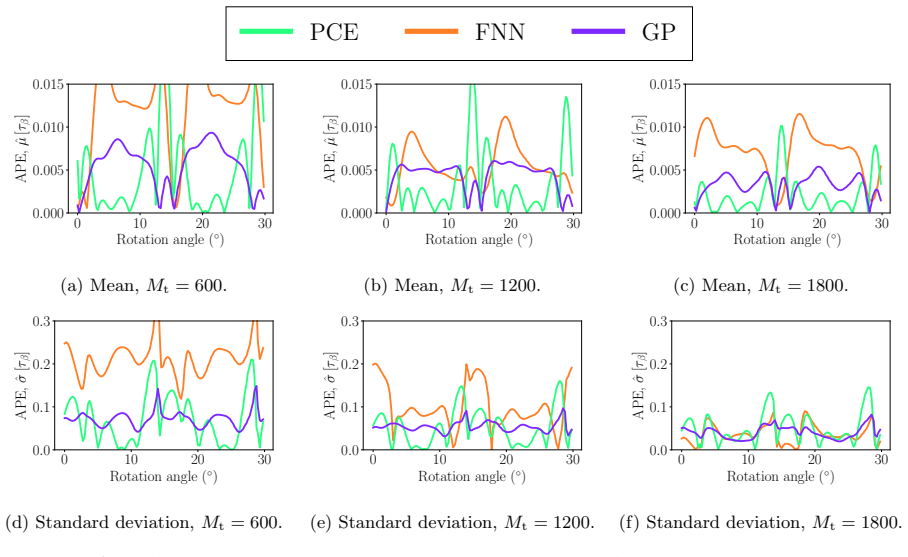
- For uniform parameter distributions, surrogate-based estimates of the torque mean stay within a signal-averaged APE of about $4\times10^{-5}$ for the best GP at $M_t=1800$, with standard-deviation estimates within about 0.6%.
- Training on uniform data and then sampling under a Gaussian distribution degrades statistics accuracy by roughly an order of magnitude, but the Gaussian-process surrogate still shows the smallest maximum errors and the least fluctuation.
- Omitting dimension reduction altogether severely hurts all regressors, most visibly the neural network, so the reduction step itself carries much of the accuracy gain.
Reading between the lines
- Beyond the paper's experiments, the averaged-power-spectrum recipe should transfer to other periodic electric-machine outputs—cogging torque, flux linkage, force ripple—where the retained harmonic set can be chosen automatically instead of from expert harmonic analysis.
- A targeted robustness test would train on uniform data and then re-fit only the response surface on Gaussian-sampled data; the paper's results suggest most of the Gaussian-case error comes from distribution shift in the regressor rather than from the 11-mode DFT truncation.
- An adaptive variant that re-selects the frequency index set per parameter region would be a natural extension if spectra shift with geometry; the fixed 11-mode basis is the clear point to revisit first.
- For manufacturing-tolerance studies with tight distributions around nominal values, re-selecting the reduced basis on the target distribution is a low-cost safeguard, since the truncation verified on wide uniform samples may keep irrelevant modes and miss narrow-range spectral features.
Signed reviews
Editorial analysis
A structured set of objections, weighed in public.
Referee Report
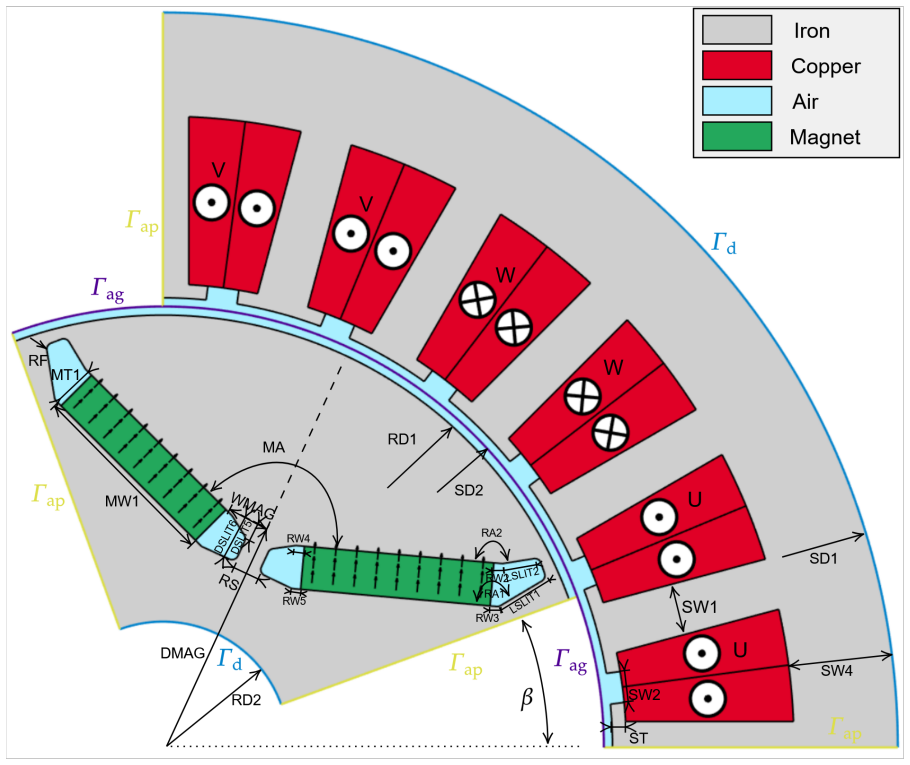
Summary. The paper proposes a data-driven surrogate modeling framework for predicting the electromagnetic torque of a permanent magnet synchronous machine under geometric design variations. The framework combines discrete Fourier transform (DFT) based dimension reduction of torque signals with three response surface models (polynomial chaos expansion, feedforward neural network, Gaussian process). The authors report that the DFT-plus-GP combination yields the best surrogate accuracy, outperforming direct torque approximation and PCA-based reduction, and that the surrogates enable Monte Carlo uncertainty quantification at 5.5x–16.7x lower computational cost including offline expenses. The central claim is that the framework produces accurate predictions for previously unseen design configurations and reliable torque statistics.
Significance. If the reported results are robust, the framework is a useful contribution to surrogate-based electric machine design, with a physically motivated dimension reduction step and a systematic comparison across three regression models and three reduction schemes. The paper also provides a clear computational cost analysis and explicitly tests both uniform and Gaussian parameter distributions in the UQ studies. The main methodological strength is the use of DFT to exploit torque periodicity while retaining physical interpretability of the reduced representation. However, the validation protocol has a data-leakage issue that directly affects the reported generalization errors, and the advantage of DFT over PCA is numerically small, so the central claim requires a corrected validation before the results can be taken at face value.
major comments (3)
- [Section 4.1 and Section 4.2] The DFT basis is selected using the full dataset of M=2000 torque signals, including the Mv=200 validation samples later used in Section 4.2. Specifically, Eq. (13) averages power-spectrum contributions over all M signals to determine the index set I and the truncation R=11, and the reconstruction MAE in Eq. (26) is also computed on the same M=2000 signals. Consequently, the MAPE and SDAPE values in Table 3 and Figures 5–6 are computed on validation data that influenced the reduced basis, so they do not measure generalization to genuinely unseen design configurations as claimed in Section 1 and the Abstract. This is load-bearing because the DFT-vs-PCA gap is small (0.0029 vs 0.0030 at Mt=1800), and the reported advantage could be an artifact of leakage. The authors should either reselect the basis and R using only the training portion of the data, or use a nested cross-validation scheme, and report the resulting errors. They should also state explicitly whether the PCA components are fitted on all 2000 samples or only on the training set.
- [Section 4.2 and Table 3] The FNN is trained with stochastic gradient descent, but no repeated-seed or confidence-interval information is reported for the MAPE/SDAPE values. Since the FNN is the worst-performing RSM and the differences among PCE and GP are sometimes small, it is unclear whether the reported ordering of RSMs is stable. The authors should report means and standard deviations over multiple training runs with different random seeds, or at least indicate the number of runs used.
- [Section 4.3.2] In the Gaussian-distribution UQ study, the surrogate models are trained on uniformly distributed parameters but sampled under a Gaussian distribution concentrated around the nominal values. The authors acknowledge this distributional shift, but the reduced basis I was also selected from the uniform dataset. Since the Gaussian sampling region is a small subset of the training range, the fixed DFT basis may not be appropriate there. The paper should either test the reconstruction accuracy of the fixed basis within the Gaussian sampling region or discuss why the basis is expected to remain adequate; otherwise the UQ statistics errors in Table 5 may partly reflect basis mismatch rather than RSM accuracy.
minor comments (4)
- [Section 2.1] In the paragraph following Eq. (3), 'Not that' should be 'Note that'.
- [Section 4.1 and Figure 4] The caption of Figure 4 refers to 'worst-case signal reconstruction' but the worst-case signal is not defined; please clarify whether it is the signal with maximum reconstruction error.
- [Section 4.2] The sentence 'In the former case, 21 principal components are kept, resulting in an MAE equal to 2.8·10−5' does not state the dataset on which this MAE is computed; please specify whether it is the same M=2000 dataset used for the DFT reconstruction study.
- [Section 3.2.3 and Eq. (23)] The notation k(p*,P) and k(P,p*) is introduced after Eq. (23) but is used before the definitions; please define these terms in the text preceding the equation for clarity.
Circularity Check
Validation leakage in DFT basis selection undermines the 'previously unseen' MAPE, but the RSM/UQ derivation is otherwise self-contained.
-
fitted input called prediction
[Section 4.1, Eq. (13), and Section 4.2, dataset partition]
"To that end, we use a sample of M = 2000 torque signals ... ηk = 1/M Σ_{m=1}^{M} |c^{(m)}_k|^2 ... Based on these observations and numerical results, in the following, R = 11 frequency components will be retained after the DFT. ... For training and validation, an initial dataset D = {p^{(m)}, τ^{(m)} = τ(p^{(m)})}_{m=1}^{M}, M = 2000, is partitioned into a training dataset Dt and a validation dataset Dv, where Dt ∩ Dv = ∅."
The DFT reduced basis (index set I and truncation R=11) is selected from the averaged power spectrum over all M=2000 torque signals (Eq. 13) and from the reconstruction MAE in Eq. (26) over the same M=2000 signals. Section 4.2 then partitions this exact M=2000 dataset into training Dt and validation Dv. Hence the 200 validation designs used to compute the MAPE values in Table 3 and Figure 5 already contributed to the choice of the reduced basis. The abstract calls these 'previously unseen design configurations,' but at the level of dimension reduction they are seen by construction.
full rationale
The one substantive circularity is in the validation protocol: the DFT-based dimension reduction (I and R=11) is fitted using the full M=2000 dataset before that same dataset is split into training and validation in Section 4.2. Therefore the validation MAPE does not measure true generalization of the complete DFT+RSM pipeline to previously unseen designs. I found no other circular steps. The regression models (PCE, FNN, GP) are trained only on the training subset; the UQ statistics in Section 4.3 are compared against fresh high-fidelity Monte Carlo reference statistics; and the self-citations ([21], [30], [33]-[35]) serve as background/model sources rather than load-bearing justifications of the framework's claims. The central 'DFT+GP best-in-class' conclusion still has independent empirical content, because it is a comparative study under the same protocol and because the surrogate-based UQ estimates are checked against the original high-fidelity model. The score of 4 reflects the partial circularity in the reported generalization error, not a collapse of the whole derivation.
Assumptions & free parameters
free parameters (5)
- R: number of retained DFT components =
11
- Number of PCA components =
21
- FNN architecture (layers and neurons) =
4 layers, 45/60/80/25 neurons
- GP covariance hyperparameters =
Optimized via CMA-ES
- PCE polynomial basis truncation =
Adaptive sparse via LAR
assumptions (4)
- domain assumption The 2D magnetostatic model with quarter symmetry, harmonic mortaring, and neglected eddy/end effects adequately represents torque.
- domain assumption Torque signal is periodic with known 30-degree period and the DFT index set I of R=11 components selected from training data remains adequate for all unseen designs and sampling distributions.
- domain assumption Training design parameters are uniformly distributed and independent; surrogate trained on this distribution is then evaluated on Gaussian-distributed parameters.
- standard math Standard DFT/IDFT and probability theory results hold.
Cite this review
Pith. "Pith review of Fourier-enhanced reduced-order surrogate modeling for uncertainty quantification in electric machine design." pith.science (2026). https://pith.science/paper/X2JGRMYD
@misc{pith2026241206485,
  author       = {Pith},
  title        = {Pith review of: Fourier-enhanced reduced-order surrogate modeling for uncertainty quantification in electric machine design},
  year         = {2026},
  howpublished = {\url{https://pith.science/paper/X2JGRMYD}},
  note         = {Machine review of arXiv:2412.06485}
}
read the original abstract
This work proposes a data-driven surrogate modeling framework for cost-effectively inferring the torque of a permanent magnet synchronous machine under geometric design variations. The framework is separated into a reduced-order modeling and an inference part. Given a dataset of torque signals, each corresponding to a different set of design parameters, torque dimension is first reduced by post-processing a discrete Fourier transform and keeping a reduced number of frequency components. This allows to take advantage of torque periodicity and preserve physical information contained in the frequency components. Next, a response surface model is computed by means of machine learning regression, which maps the design parameters to the reduced frequency components. The response surface models of choice are polynomial chaos expansions, feedforward neural networks, and Gaussian processes. Torque inference is performed by evaluating the response surface model for new design parameters and then inverting the dimension reduction. Numerical results show that the resulting surrogate models lead to sufficiently accurate torque predictions for previously unseen design configurations. The framework is found to be significantly advantageous compared to approximating the original (not reduced) torque signal directly, as well as slightly advantageous compared to using principal component analysis for dimension reduction. The combination of discrete Fourier transform-based dimension reduction with Gaussian process-based response surfaces yields the best-in-class surrogate model for this use case. The surrogate models replace the original, high-fidelity model in Monte Carlo-based uncertainty quantification studies, where they provide accurate torque statistics estimates at significantly reduced computational cost.
Figures


Figures from the paper (10 more)




Reference graph
Works this paper leans on
-
[1]
Steven Nadel. ‘Electrification in the transportation, buildings, and industrial sectors: a review of opportunities, barriers, and policies’. In:Current Sustainable/Renewable Energy Reports6.4 (2019), pp. 158–168
work page 2019
-
[2]
‘Effect of the manufacturing impact on the optimal electric machine design and performance’
Gerd Bramerdorfer. ‘Effect of the manufacturing impact on the optimal electric machine design and performance’. In:IEEE Transactions on Energy Conversion35.4 (2020), pp. 1935–1943
work page 2020
-
[3]
‘On the separation of aleatory and epistemic uncertainties in probabilistic assessments’
Mikko I Jyrkama and Mahesh D Pandey. ‘On the separation of aleatory and epistemic uncertainties in probabilistic assessments’. In:Nuclear Engineering and Design303 (2016), pp. 68–74
work page 2016
-
[4]
Uncertainty Quantification: Theory, Implementation, and Applications.Philadelphia, PA: SIAM, 2024
RalphCSmith. Uncertainty Quantification: Theory, Implementation, and Applications.Philadelphia, PA: SIAM, 2024
work page 2024
-
[5]
‘Modern Monte Carlo methods for efficient uncertainty quantification and propaga- tion: a survey’
Jiaxin Zhang. ‘Modern Monte Carlo methods for efficient uncertainty quantification and propaga- tion: a survey’. In:Wiley Interdisciplinary Reviews: Computational Statistics13.5 (2021), e1539
work page 2021
-
[6]
‘Managing computational complexity using surrogate models: a critical review’
Reza Alizadeh, Janet K Allen and Farrokh Mistree. ‘Managing computational complexity using surrogate models: a critical review’. In:Research in Engineering Design31.3 (2020), pp. 275–298
work page 2020
-
[7]
Jack P. C. Kleijnen. ‘Response Surface Methodology’. In: Handbook of Simulation Optimization. Ed. by Michael C Fu. New York, NY: Springer New York, 2015, pp. 81–104
work page 2015
-
[8]
Serhat Hosder. ‘Stochastic response surfaces based on non-intrusive polynomial chaos for uncer- tainty quantification’. In:International Journal of Mathematical Modelling and Numerical Optim- isation 3.1-2 (2012), pp. 117–139
work page 2012
Show all 56 references
-
[9]
‘Uncertainty quantification and statistical modeling of select- ive laser sintering process using polynomial chaos based response surface method’
Utkarsh Thakre and Rakesh G Mote. ‘Uncertainty quantification and statistical modeling of select- ive laser sintering process using polynomial chaos based response surface method’. In:Journal of Manufacturing Processes81 (2022), pp. 893–906
2022
-
[10]
‘New neural network- based response surface method for reliability analysis of structures’
Hossein Beheshti Nezhad, Mahmoud Miri and Mohammad Reza Ghasemi. ‘New neural network- based response surface method for reliability analysis of structures’. In:Neural Computing and Applications 31 (2019), pp. 777–791
2019
-
[11]
‘Artificial neural network based response surface for data-driven dimensional analysis’
Zhaoyue Xu et al. ‘Artificial neural network based response surface for data-driven dimensional analysis’. In:Journal of Computational Physics459 (2022), p. 111145
2022
-
[12]
‘Gaussian process model – an exploratory study in the response surface methodology’
Nuno Ricardo Costa and João Lourenço. ‘Gaussian process model – an exploratory study in the response surface methodology’. In:Quality and Reliability Engineering International32.7 (2016), pp. 2367–2380. 22
2016
-
[13]
‘Modeling and prediction of spindle dynamic precision using the Kriging- based response surface method with a novel sampling strategy’
Chuanhai Chen et al. ‘Modeling and prediction of spindle dynamic precision using the Kriging- based response surface method with a novel sampling strategy’. In:Nonlinear Dynamics 111.1 (2023), pp. 559–579
2023
-
[14]
‘A survey of projection-based model reduction methods for parametric dynamical systems’
Peter Benner, Serkan Gugercin and Karen Willcox. ‘A survey of projection-based model reduction methods for parametric dynamical systems’. In:SIAM Review57.4 (2015), pp. 483–531
2015
-
[15]
‘Model order reduction’
Francisco Chinesta et al. ‘Model order reduction’. In: Encyclopedia of Computational Mechanics (2016), pp. 1–36
2016
-
[16]
‘Nonlinear model order reduction via dynamic mode decom- position’
Alessandro Alla and J Nathan Kutz. ‘Nonlinear model order reduction via dynamic mode decom- position’. In:SIAM Journal on Scientific Computing39.5 (2017), B778–B796
2017
-
[17]
‘Low-Rank Tensor Methods for Model Order Reduction’
Anthony Nouy. ‘Low-Rank Tensor Methods for Model Order Reduction’. In:Handbook of Uncer- tainty Quantification. Ed. by Roger Ghanem, David Higdon and Houman Owhadi. Cham: Springer International Publishing, 2017, pp. 857–882
2017
-
[18]
‘Uncertainty quantification for nonlinear solid mechanics using reduced order models with Gaussian process regression’
Ludovica Cicci et al. ‘Uncertainty quantification for nonlinear solid mechanics using reduced order models with Gaussian process regression’. In: Computers & Mathematics with Applications 149 (2023), pp. 1–23
2023
-
[19]
‘FastSVD–ML–ROM: A reduced-order modeling framework based on machine learning for real-time applications’
George I Drakoulas et al. ‘FastSVD–ML–ROM: A reduced-order modeling framework based on machine learning for real-time applications’. In:Computer Methods in Applied Mechanics and En- gineering 414 (2023), p. 116155
2023
-
[20]
‘Multi-fidelity reduced-order surrogate modelling’
Paolo Conti et al. ‘Multi-fidelity reduced-order surrogate modelling’. In:Proceedings of the Royal Society A480.2283 (2024), p. 20230655
2024
-
[21]
‘Combined parameter and shape optimization of electric machines with isogeometric analysis’
Michael Wiesheu et al. ‘Combined parameter and shape optimization of electric machines with isogeometric analysis’. In:Optimization and Engineering(2024), pp. 1–28
2024
-
[22]
In:Computer Methods in Applied Mechanics and Engineering 194.39-41 (2005), pp
ThomasJRHughes,JohnACottrellandYuriBazilevs.‘Isogeometricanalysis:CAD,finiteelements, NURBS, exact geometry and mesh refinement’. In:Computer Methods in Applied Mechanics and Engineering 194.39-41 (2005), pp. 4135–4195
2005
-
[23]
‘Dimensionality reduction in surrogate modeling: A review of combined methods’
Chun Kit Jeffery Hou and Kamran Behdinan. ‘Dimensionality reduction in surrogate modeling: A review of combined methods’. In:Data Science and Engineering7.4 (2022), pp. 402–427
2022
-
[24]
‘A review of data-driven surrogate models for design optimization of electric motors’
Mengyu Cheng et al. ‘A review of data-driven surrogate models for design optimization of electric motors’. In:IEEE Transactions on Transportation Electrification(2024)
2024
-
[25]
JMAG-RT Model Library
JSOL Corporation. JMAG-RT Model Library. 2024. url: https://www.jmag- international. com/modellibrary/
2024
-
[26]
MotorOptimization
Michael Wiesheu. MotorOptimization. Nov. 2023.doi: 10.5281/zenodo.10160086
2023 doi
-
[27]
‘A new design for the implementation of isogeometric analysis in Octave and Matlab: GeoPDEs 3.0’
Rafael Vázquez. ‘A new design for the implementation of isogeometric analysis in Octave and Matlab: GeoPDEs 3.0’. In:Computers & Mathematics with Applications72.3 (2016), pp. 523–554
2016
-
[28]
Berlin Heidelberg: Springer Verlag, 2012
Les Piegl and Wayne Tiller.The NURBS Book. Berlin Heidelberg: Springer Verlag, 2012
2012
-
[29]
‘Approximation estimates for isogeometric spaces in multipatch geometries’
Annalisa Buffa et al. ‘Approximation estimates for isogeometric spaces in multipatch geometries’. In: Numerical Methods for Partial Differential Equations31.2 (2015), pp. 422–438
2015
-
[30]
‘On torque computation in electric machine simulation by harmonic mortar methods’
Herbert Egger et al. ‘On torque computation in electric machine simulation by harmonic mortar methods’. In:Journal of Mathematics in Industry12.1 (2022), p. 6
2022
-
[31]
‘Isogeometric analysis and harmonic stator–rotor coupling for simulating electric machines’
Zeger Bontinck et al. ‘Isogeometric analysis and harmonic stator–rotor coupling for simulating electric machines’. In:Computer Methods in Applied Mechanics and Engineering334 (2018), pp. 40– 55
2018
-
[32]
‘Finite element method magnetics, version 4.2 (28feb2018 build)’
David C Meeker. ‘Finite element method magnetics, version 4.2 (28feb2018 build)’. In: URL: http://www. femm. info(2019). 23
2019
-
[33]
‘Response surface models for the uncer- tainty quantification of eccentric permanent magnet synchronous machines’
Zeger Bontinck, Herbert De Gersem and Sebastian Schöps. ‘Response surface models for the uncer- tainty quantification of eccentric permanent magnet synchronous machines’. In:IEEE Transactions on Magnetics 52.3 (2015), pp. 1–4
2015
-
[34]
‘Uncertainty quantification and sensitivity analysis in electrical machines with stochastically varying machine parameters’
Peter Offermann et al. ‘Uncertainty quantification and sensitivity analysis in electrical machines with stochastically varying machine parameters’. In:IEEE Transactions on Magnetics51.3 (2015), pp. 1–4
2015
-
[35]
‘A multilevel Monte Carlo method for high-dimensional uncertainty quanti- fication of low-frequency electromagnetic devices’
Armin Galetzka et al. ‘A multilevel Monte Carlo method for high-dimensional uncertainty quanti- fication of low-frequency electromagnetic devices’. In:IEEE Transactions on Magnetics55.8 (2019), pp. 1–12
2019
-
[36]
In:IEEE Transactions on Energy Conversion 35.4 (2020), pp
AndresBeltran-Pulidoetal.‘Uncertaintyquantificationandsensitivityanalysisinanonlinearfinite- element model of a permanent magnet synchronous machine’. In:IEEE Transactions on Energy Conversion 35.4 (2020), pp. 2152–2161
2020
-
[37]
‘Robust shape optimization of electric devices based on deterministic optim- ization methods and finite-element analysis with affine parametrization and design elements’
Ion Gabriel Ion et al. ‘Robust shape optimization of electric devices based on deterministic optim- ization methods and finite-element analysis with affine parametrization and design elements’. In: Electrical Engineering100.4 (2018), pp. 2635–2647
2018
-
[38]
‘Robust design optimization of electrical machines: multi-objective approach’
Gang Lei et al. ‘Robust design optimization of electrical machines: multi-objective approach’. In: IEEE Transactions on Energy Conversion36.1 (2020), pp. 390–401
2020
-
[39]
‘Multiobjective electric machine optimization for highest reliability demands’
Gerd Bramerdorfer. ‘Multiobjective electric machine optimization for highest reliability demands’. In: CES Transactions on Electrical Machines and Systems4.2 (2020), pp. 71–78
2020
-
[40]
‘The Wiener–Askey polynomial chaos for stochastic differential equations’
Dongbin Xiu and George Em Karniadakis. ‘The Wiener–Askey polynomial chaos for stochastic differential equations’. In:SIAM Journal on Scientific Computing24.2 (2002), pp. 619–644
2002
-
[41]
‘Multivariate polynomial chaos expansions with dependent variables’
Jonathan Feinberg, Vinzenz Gregor Eck and Hans Petter Langtangen. ‘Multivariate polynomial chaos expansions with dependent variables’. In:SIAM Journal on Scientific Computing40.1 (2018), A199–A223
2018
-
[42]
‘Sparse polynomial chaos expansions: Literature survey and benchmark’
Nora Lüthen, Stefano Marelli and Bruno Sudret. ‘Sparse polynomial chaos expansions: Literature survey and benchmark’. In:SIAM/ASA Journal on Uncertainty Quantification9.2 (2021), pp. 593– 649
2021
-
[43]
‘Adaptive sparse polynomial chaos expansion based on least angle regression’
Géraud Blatman and Bruno Sudret. ‘Adaptive sparse polynomial chaos expansion based on least angle regression’. In:Journal of Computational Physics230.6 (2011), pp. 2345–2367
2011
-
[44]
‘UQLab: A framework for uncertainty quantification in Mat- lab’
Stefano Marelli and Bruno Sudret. ‘UQLab: A framework for uncertainty quantification in Mat- lab’. In:Vulnerability, Uncertainty, and Risk: Quantification, Mitigation, and Management. 2014, pp. 2554–2563
2014
-
[45]
‘Optimization methods for large-scale machine learning’
Léon Bottou, Frank E Curtis and Jorge Nocedal. ‘Optimization methods for large-scale machine learning’. In:SIAM Review60.2 (2018), pp. 223–311
2018
-
[46]
‘Automatic differentiation in machine learning: a survey’
Atilim Gunes Baydin et al. ‘Automatic differentiation in machine learning: a survey’. In:Journal of Machine Learning Research18.153 (2018), pp. 1–43
2018
-
[47]
‘Tensorflow: Large-scale machine learning on heterogeneous distributed sys- tems’
Martín Abadi et al. ‘Tensorflow: Large-scale machine learning on heterogeneous distributed sys- tems’. In:arXiv preprint arXiv:1603.04467(2016)
2016 arXiv
-
[48]
Christopher KI Williams and Carl Edward Rasmussen.Gaussian Processes for Machine Learning. Vol. 2. 3. Cambridge, MA: MIT Press, 2006
2006
-
[49]
‘Completely derandomized self-adaptation in evolution strategies’
Nikolaus Hansen and Andreas Ostermeier. ‘Completely derandomized self-adaptation in evolution strategies’. In:Evolutionary Computation 9.2 (2001), pp. 159–195
2001
-
[50]
‘Remarks on multi-output Gaussian process regression’
Haitao Liu, Jianfei Cai and Yew-Soon Ong. ‘Remarks on multi-output Gaussian process regression’. In: Knowledge-Based Systems144 (2018), pp. 102–121. 24
2018
-
[51]
In:IEEE Transactions on Industrial Electronics58.5 (2010), pp
ArunGandhi,TimothyCorriganandLeilaParsa.‘Recentadvancesinmodelingandonlinedetection of stator interturn faults in electrical motors’. In:IEEE Transactions on Industrial Electronics58.5 (2010), pp. 1564–1575
2010
-
[52]
‘Evaluation of interlaminar eddy currents in induction machines’
Paul Handgruber et al. ‘Evaluation of interlaminar eddy currents in induction machines’. In:IECON 2013-39th Annual Conference of the IEEE Industrial Electronics Society. IEEE. 2013, pp. 2792– 2797
2013
-
[53]
‘Principal component analysis’
Hervé Abdi and Lynne J Williams. ‘Principal component analysis’. In: Wiley Interdisciplinary Reviews: Computational Statistics2.4 (2010), pp. 433–459
2010
-
[54]
‘The curse of dimensionality in data mining and time series prediction’
Michel Verleysen and Damien François. ‘The curse of dimensionality in data mining and time series prediction’. In:International work-conference on artificial neural networks. Springer. 2005, pp. 758– 770
2005
-
[55]
‘Learning nonlinear operators in latent spaces for real-time predictions of complex dynamics in physical systems’
Katiana Kontolati et al. ‘Learning nonlinear operators in latent spaces for real-time predictions of complex dynamics in physical systems’. In:Nature Communications15.1 (2024), p. 5101
2024
-
[56]
‘Explanation Shift: How Did the Distribution Shift Impact the Model?’ In: arXiv preprint arXiv:2303.08081(2023)
Carlos Mougan et al. ‘Explanation Shift: How Did the Distribution Shift Impact the Model?’ In: arXiv preprint arXiv:2303.08081(2023). Appendix 0.0 0.2 0.4 0.6 0.8 1.00.0 0.2 0.4 0.6 0.8 1.0 Original PCE FNN GP 0 10 20 30 Rotation angle ( ◦) 0.30 0.35 0.40 0.45 0.50 0.55 0.60 T...
2023 arXiv
Reviewed August 11, 2026 · model on record in the stance chip above.
Discussion (0). Continue with ORCID to comment.