REVIEW 3 major objections 5 minor 31 references
Supermassive Black Hole Spin Constraints from Polarimetry in an Equatorial Disk Model
T0 review · 3 major / 5 minor · reviewed 2026-08-11 · deepseek-v4-flash
Pith's one-line read Spin rotates a black hole's direct and lensed image polarization in opposite directions, so measuring both spiral phases can constrain spin.
desk verdict A transparent, honest forecast paper whose quantitative spin constraints ride entirely on the anti-aligned B–v assumption; the opposite-twist geometric result is solid, the M87* preference is provisional. read the letter →
The pith
A machine-rendered reading of the paper's core claim, the machinery that carries it, and where it could break.
The reading
What carries the argument
The load-bearing object is the polarimetric spiral pitch angle, $\angle\beta_2$, defined from the radially integrated, image-averaged Fourier coefficient $\beta_2$ of the complex linear polarization image. KerrBAM produces exact ray-traced images with semi-analytic geodesic integration and parallel-transported electric vector position angles, so the spin twist enters through the Penrose-Walker constant. The model couples the plasma velocity orientation $\chi$ to the equatorial magnetic field direction, making $\chi$ the leading-order control on polarized morphology. A grid search over 1,008,000 parameter combinations generates predicted pairs of $\angle\beta_{2,0}$ and $\angle\beta_{2,1}$, and hard measurement cuts on those phases yield the marginalized spin-amplitude uncertainties.
What would settle it
Measure $\angle\beta_{2,0}$ and $\angle\beta_{2,1}$ for M87* with the projected ngEHT and BHEX baselines to the quoted precision; if the indirect spiral does not rotate with spin while the direct rotates against it, or if both rotate together, the central opposite-twist claim fails. A cheaper test: ray-trace a Kerr spacetime with an equatorial emitter but with velocity and magnetic field decoupled; if the opposite twist disappears, the generic result is model-dependent.
Extended reading notes
Core claim
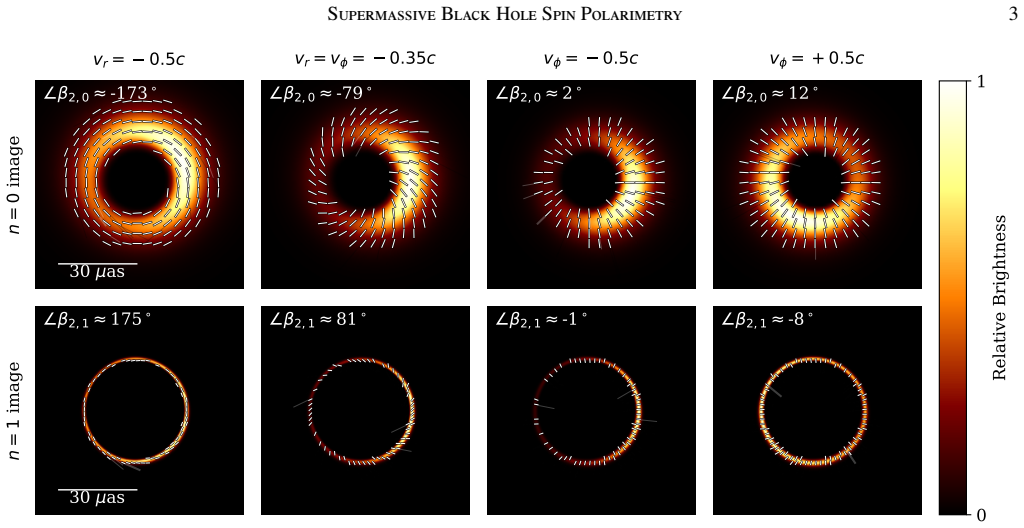
Using KerrBAM, a semi-analytic model of optically thin synchrotron emission from an axisymmetric, equatorial disk around a Kerr black hole, the paper computes the image-averaged polarization coefficient $\beta_2$ for the direct and first lensed sub-images. The central finding is a generic geometric result: dimensionless spin $a_*$ rotates the phase $\angle\beta_{2,0}$ of the direct image against the on-sky spin direction, while it rotates $\angle\beta_{2,1}$ of the indirect image with the spin, a consequence of terms in the Penrose-Walker constant proportional to $a_* p_z$ at the midplane. The size of the relative twist depends on the emission radius and plasma velocity orientation, and the paper shows through a 1,008,000-model grid that radial infall models are the most sensitive to spin. Under the assumption of anti-aligned equatorial velocity and magnetic field, the observed M87* polarization spiral prefers velocity angles with strong radial infall components, close to the configurations that give the strongest spin constraints.
Load-bearing premise
The load-bearing premise is that the equatorial magnetic field points exactly opposite to a spatially uniform plasma velocity in the ZAMO frame (the locally non-rotating observer frame), with only a free vertical component, so that a single parameter $\chi$ controls the leading-order polarization morphology; if the velocity and magnetic field decouple, the spin uncertainties and the M87* preference for radial infall do not transfer.
Editorial extensions
If this is right
- A measurement of $\angle\beta_{2,0}$ and $\angle\beta_{2,1}$ to $\pm5^\circ$ would constrain the spin amplitude $|a_*|$ to about 0.25 for radially infalling accretion, and to about 0.15 at $\pm1^\circ$.
- For most plasma velocity configurations, polarimetric spiral phases alone give spin constraints no better than a uniform prior, so spin inference requires a plasma prior or independent astrophysical constraints.
- Knowing the rotation measure, so that the absolute electric vector position angle is usable, greatly sharpens spin constraints; without it, only the relative rotation $\Delta\angle\beta_2$ survives and all but radial-infall models lose spin information.
- The observed M87* polarization pattern, interpreted with anti-aligned velocity and magnetic field, favors strong radial inflow, the regime most promising for future spin measurements.
- Which sub-image carries more spin variation depends on emission radius, with the tipping point near the photon sphere.
Reading between the lines
- Editorial inference: The opposite-twist signature likely reflects parallel transport geometry rather than the specific emission model, so it may persist for other optically thin equatorial emitters, but the quantitative error budget would need recalculation.
- Editorial inference: If real M87* has velocity and magnetic field decoupled, the paper's $\chi$ preference and the 0.25 spin uncertainty would not transfer; in that case the magnetic field geometry, not velocity, would set the spiral and a different observable would be needed.
- Editorial inference: The same two-spiral measurement strategy could be applied to Sgr A*, where a large, variable rotation measure would need to be modeled, and the radial-infall preference suggests retrograde magnetically arrested disks as the most favorable targets.
- Editorial inference: Combining the pitch-angle phases with photon-ring size or shape measurements might break the plasma-spin degeneracies that the pitch angles alone cannot resolve.
Editorial analysis
A structured set of objections, weighed in public.
Referee Report
Summary. This paper uses the semi-analytic KerrBAM model of optically thin equatorial synchrotron emission around a Kerr black hole to study how measurements of the polarization spiral pitch angle (the phase of the image-averaged coefficient beta_2) in the direct (n=0) and indirect (n=1) images could constrain the dimensionless spin amplitude |a*|. After reviewing beta_2 and the model's assumptions, the author presents a grid of 1,008,000 models spanning spin, inclination, fluid speed, velocity angle, magnetic-field angle, spectral index, emission radius, and Gaussian width. The central geometric finding is that the spin twists the n=0 and n=1 polarization phases in opposite directions (Fig. 2). Using hard cuts on the grid to simulate measurements of the two phases with 1-degree or 5-degree uncertainties, the paper reports that radially infalling velocity configurations yield the best spin constraints, with sigma_|a*| ~ 0.15-0.25, while most plasma configurations give constraints no better than a uniform prior (Fig. 4). Under the stated assumption that equatorial magnetic fields oppose plasma velocities, the observed M87* image-integrated beta_2 range favors models with strong radial velocity components. The paper closes with observing-time estimates for reaching the required phase precision.
Significance. If correct, the paper provides a useful and transparent framework for translating future EHT, ngEHT, and BHEX polarimetric measurements of the n=0 and n=1 images into spin constraints. The opposite-handed twist of the direct and indirect image polarization is a concrete, falsifiable prediction of parallel transport in Kerr spacetime, and the large explicit grid search is a strength: the parameter ranges are clearly tabulated, the sub-image decomposition is natural in KerrBAM, and the author is explicit about the model's limitations, including the poor fit of radially uniform plasma assumptions to GRMHD. The quantitative forecasts are, however, entirely conditional on the assumed anti-alignment of the equatorial magnetic field and the plasma velocity; the paper itself concedes that this coupling fails for magnetically dissipative flows. The M87* comparison also relies on treating an image-integrated beta_2 measurement as if it pertained only to the n=0 image. These caveats do not invalidate the geometric core, but they bound the applicability of the quoted spin uncertainties and the inferred radial-inflow preference.
major comments (3)
- [Section 3.1, Section 3.2] The quantitative results—sigma_|a*| ~ 0.25 at ±5° and ~ 0.15 at ±1° for radial infall, and the M87* preference for radial velocity—are governed by the assumption that the equatorial magnetic field is exactly anti-aligned with the plasma velocity, leaving only a vertical component free. The paper itself notes (Section 2.2) that this is a poor assumption for fully general GRMHD and that decoupled fields would make the magnetic field, not the velocity, the primary determinant of polarization. Since the cited GRMHD support (Ricarte et al. 2022) is only approximate statistical opposition, the quoted uncertainties and the chi preference are conditional on a specific plasma coupling and should be presented as such throughout, not only in the abstract and conclusion. I recommend either adding a robustness test with decoupled equatorial B and v, or explicitly reframing the forecasts as 'within the KerrBAM model family with anti-aligned B and v' in the abstract and headline claims.
- [Section 3.2, Fig. 4] The spin uncertainties are estimated from hard cuts on a discrete grid: models whose beta_2 phases fall within the quoted tolerance are assigned equal weight, and all others are discarded. Because spin is sampled in steps of 0.1 (Table 1), the resulting sigma_|a*| has a floor set by the grid spacing and depends on which discrete values happen to pass the cut; it also ignores the likelihood of models just outside the cut. This is not a full posterior and can either overstate or understate constraints, especially when the passing set is small or multimodal. Please demonstrate that the quoted sigma_|a*| values are robust to grid resolution (e.g., by repeating with a* steps of 0.05) or replace the hard-cut procedure with a likelihood-based weight.
- [Section 3.2, Fig. 4] The M87* comparison uses the published image-integrated beta_2 constraint (-163° to -127°) as if it applied to the n=0 sub-image alone, while Section 2.1 correctly notes that image-integrated beta_2 mixes n=0 and n=1 contributions. Because the n=0 and n=1 phases can differ by large amounts (Fig. 2), this approximation could bias the inferred chi preference toward radial inflow. The author should either justify the n=0-only assumption (e.g., by arguing that the n=1 flux is subdominant at EHT baselines at 230 GHz) or show that the preferred chi range is unchanged when the observed constraint is interpreted as a mixture of n=0 and n=1 phases.
minor comments (5)
- [Section 2.2] The definition of beta_m in Eq. (1) is clear, but the units or normalization of P(rho, phi) are not stated; please specify whether P is the polarized intensity with dimensions of flux per unit area or a dimensionless fractional polarization map.
- [Section 2.2, Eq. (3)] The Gaussian emissivity profile is not normalized; please clarify whether J(r) is a relative weight or an actual emissivity, and note that the profile is scale-free except for the fixed width w.
- [Figure 3] The histograms in Figure 3 are normalized to unit peak probability density, which can be misleading when comparing the widths of different panels; please also report the actual number of passing models or use a consistent normalization (e.g., unit integral).
- [Section 3.2, Eq. (4)] The definition of Delta(beta_2) in Eq. (4) is correct, but the text should state explicitly that the sign convention follows the complex-plane argument and that a positive Delta corresponds to a counter-clockwise rotation from beta_2,0 to beta_2,1.
- [Section 4] The final paragraph moves from the model results to a discussion of GRMHD magnetically arrested disks; consider making the connection quantitative (e.g., citing the typical near-horizon radial-velocity fractions in those simulations) rather than qualitative.
Circularity Check
No significant circularity: the spin-twist result is computed from parallel transport, the quantitative constraints are explicitly self-consistency forecasts, and the M87* preference is conditional on a transparently stated model assumption.
full rationale
The paper is a forward-modeling study, not a derivation that reduces to its inputs. The central claim that spin twists the n=0 and n=1 polarization phases in opposite directions is obtained by explicit ray tracing and is independently motivated by the Penrose-Walker constant (Walker & Penrose 1970), an external GR result. The quantitative spin uncertainties in Section 3 are presented as self-fits over the KerrBAM grid: the paper states it 'use[s] self-fits to examine marginalized spin amplitude measurements' and defines the passing subset by comparing model pitch angles to grid pitch angles. This is a legitimate model-degeneracy forecast, not a fitted parameter renamed as a prediction. The M87* radial-velocity preference is explicitly conditional on the assumption that equatorial magnetic fields and velocities are oppositely oriented; the paper labels this as an assumption and cites Ricarte et al. (2022) as approximate GRMHD support, while also conceding that the assumption fails for magnetically dissipative flows. Because the assumption is transparent and not disguised as a derived result, it is a modeling limitation rather than circularity. Self-citations to KerrBAM (Palumbo et al. 2022), the beta2 formalism (Palumbo et al. 2020), and GRMHD phase distributions (Palumbo & Wong 2022) reference prior published tools and results; these are not tuned within this paper to manufacture the headline outcome, and the paper's own grid results show that most plasma configurations give weak spin constraints, which is contrary to a forced circular conclusion.
Assumptions & free parameters
free parameters (8)
- Fluid speed beta =
grid: 0.3, 0.5, 0.7, 0.9 c
- Equatorial fluid velocity angle chi =
grid: -180 to 165 degrees in 15 degree steps
- Vertical magnetic field angle iota =
grid: 0, 22.5, 45, 67.5, 90 degrees
- Spectral index alpha_nu =
grid: 0, 1
- Characteristic emission radius R_e =
grid: 2, 3, 4, 5, 6 M
- Gaussian width w =
grid: 2, 4, 8 M
- Observer inclination theta_o =
grid: 10, 15, 20, 25, 30 degrees
- Dimensionless spin a* =
grid: -1.0 to 1.0 in 0.1 steps
assumptions (6)
- standard math Kerr spacetime geometry and null geodesic propagation are exact
- standard math Parallel transport of polarization is governed by the Walker-Penrose constant
- domain assumption Optically thin, axisymmetric, equatorial synchrotron emission with a Gaussian radial emissivity profile
- ad hoc to paper Equatorial magnetic field is anti-aligned with the plasma velocity, with only a vertical component free
- domain assumption Faraday rotation and differential internal Faraday rotation between n=0 and n=1 are negligible
- domain assumption The phase of β2 can be measured separately for n=0 and n=1 with hard-cut uncertainties and no amplitude information
Cite this review
Pith. "Pith review of Supermassive Black Hole Spin Constraints from Polarimetry in an Equatorial Disk Model." pith.science (2026). https://pith.science/paper/M7R4AEEM
@misc{pith2026241206719,
  author       = {Pith},
  title        = {Pith review of: Supermassive Black Hole Spin Constraints from Polarimetry in an Equatorial Disk Model},
  year         = {2026},
  howpublished = {\url{https://pith.science/paper/M7R4AEEM}},
  note         = {Machine review of arXiv:2412.06719}
}
abstract
The Event Horizon Telescope has released polarized images of the supermassive black holes Messier 87* (M87*) and Sagittarius A* (Sgr A*) accretion disks. As more images are produced, our understanding of the average polarized emission from near the event horizon improves. In this letter, we use a semi-analytic model for optically thin, equatorial emission near a Kerr black hole to study how spin constraints follow from measurements of the average polarization spiral pitch angle. We focus on the case of M87* and explore how the direct, weakly lensed image spiral is coupled to the strongly lensed indirect image spiral, and how a precise measurement of both provides a powerful spin tracer. We find a generic result that spin twists the direct and indirect image polarization in opposite directions. Using a grid search over model parameters, we find a strong dependence of the resulting spin constraint on plasma properties near the horizon. Grid constraints suggest that, under reasonable assumptions for the accretion disk, a measurement of the direct and indirect image spiral pitch angles to $\pm 5^\circ$ yields a dimensionless spin amplitude measurement with uncertainty $\sigma_{|a_*|}\sim0.25$ for radially infalling models, but otherwise provides only weak constraints; an error of $1^\circ$ can reach $\sigma_{|a_*|}\sim0.15$. We also find that a well-constrained rotation measure greatly improves spin measurements. Assuming that equatorial velocity and magnetic field are oppositely oriented, we find that the observed M87* polarization pattern favors models with strong radial velocity components, which are close to optimal for future spin measurements.
Figures


Figures from the paper (1 more)

Reference graph
Works this paper leans on
-
[1]
1952, MNRAS, 112, 195 Broderick, A
Bondi, H. 1952, MNRAS, 112, 195 Broderick, A. E., Pesce, D. W., Tiede, P., Pu, H.-Y ., & Gold, R. 2020, ApJ, 898, 9 Supermassive Black Hole Spin Polarimetry 9
work page 1952
-
[2]
Chael, A., Lupsasca, A., Wong, G. N., & Quataert, E. 2023, ApJ, 958, 65
work page 2023
-
[3]
O., Johnson, M
Chang, D. O., Johnson, M. D., Tiede, P., & Palumbo, D. C. M. 2024, ApJ, 974, 143
2024
-
[4]
A., Piran, T., & Stark, R
Connors, P. A., Piran, T., & Stark, R. F. 1980, ApJ, 235, 224
1980
- [5]
-
[6]
S., Barrett, J., Blackburn, L., et al
Doeleman, S. S., Barrett, J., Blackburn, L., et al. 2023, Galaxies, 11, 107
2023
-
[7]
Emami, R., Ricarte, A., Wong, G. N., et al. 2023, ApJ, 950, 38 Event Horizon Telescope Collaboration, Akiyama, K., Alberdi, A., et al. 2019e, ApJL, 875, L5 Event Horizon Telescope Collaboration, Akiyama, K., Algaba, J. C., et al. 2021a, ApJL, 910, L12 —. 2021b, ApJL, 910, L13 Event Horizon Telescope Collaboration, Akiyama, K., Alberdi, A., et al. 2022, Ap...
work page 2023
-
[8]
2000, ApJL, 528, L13
Falcke, H., Melia, F., & Agol, E. 2000, ApJL, 528, L13
2000
Show all 31 references
-
[9]
Gelles, Z., Himwich, E., Palumbo, D. C. M., & Johnson, M. D. 2021, arXiv e-prints, arXiv:2105.09440
2021 arXiv
-
[10]
E., & Lupsasca, A
Gralla, S. E., & Lupsasca, A. 2020, Physical Review D, 101, doi:10.1103/physrevd.101.044032. http://dx.doi.org/10.1103/PhysRevD.101.044032
2020 doi
-
[11]
D., Lupsasca, A
Himwich, E., Johnson, M. D., Lupsasca, A. r., & Strominger, A. 2020, PhRvD, 101, 084020
2020
-
[12]
2024, arXiv e-prints, arXiv:2409.07248
Hou, Y ., Huang, J., Mizuno, Y ., Guo, M., & Chen, B. 2024, arXiv e-prints, arXiv:2409.07248
2024 arXiv
-
[13]
2010, ApJ, 718, 446
Johannsen, T., & Psaltis, D. 2010, ApJ, 718, 446
2010
-
[14]
D., Lupsasca, A., Strominger, A., et al
Johnson, M. D., Lupsasca, A., Strominger, A., et al. 2020, Science Advances, 6, eaaz1310
2020
-
[15]
D., Akiyama, K., Baturin, R., et al
Johnson, M. D., Akiyama, K., Baturin, R., et al. 2024, in Society of Photo-Optical Instrumentation Engineers (SPIE) Conference
2024
-
[16]
13092, Space Telescopes and Instrumentation 2024:
Series, V ol. 13092, Space Telescopes and Instrumentation 2024:
2024
-
[17]
Lupsasca, A., C´ardenas-Avenda˜no, A., Palumbo, D. C. M., et al. 2024, in Society of Photo-Optical Instrumentation Engineers (SPIE) Conference Series, V ol. 13092, Space Telescopes and Instrumentation 2024: Optical, Infrared, and Millimeter Wave, ed. L. E. Coyle, S. Matsuura, ...
2024
-
[18]
D., & Gammie, C
Narayan, R., Johnson, M. D., & Gammie, C. F. 2019, ApJL, 885, L33
2019
-
[19]
Narayan, R., Palumbo, D. C. M., Johnson, M. D., et al. 2021, ApJ, 912, 35
2021
-
[20]
Palumbo, D. C. M., Baub¨ock, M., & Gammie, C. F. 2024, ApJ, 970, 151
2024
-
[21]
Palumbo, D. C. M., Gelles, Z., Tiede, P., et al. 2022, ApJ, 939, 107
2022
-
[22]
Palumbo, D. C. M., & Wong, G. N. 2022, ApJ, 929, 49
2022
-
[23]
Palumbo, D. C. M., Wong, G. N., Chael, A., & Johnson, M. D. 2023, ApJL, 952, L31
2023
-
[24]
Palumbo, D. C. M., Wong, G. N., & Prather, B. S. 2020, ApJ, 894, 156
2020
-
[25]
P., & Blandford, R
Rauch, K. P., & Blandford, R. D. 1994, ApJ, 421, 46
1994
-
[26]
2022, ApJL, 941, L12
Emami, R. 2022, ApJL, 941, L12
2022
-
[27]
2021, MNRAS, 505, 523
Ricarte, A., Qiu, R., & Narayan, R. 2021, MNRAS, 505, 523
2021
-
[28]
M., & Palumbo, D
Shavelle, K. M., & Palumbo, D. C. M. 2024, ApJL, 970, L24
2024
-
[29]
Tamar, A., & Palumbo, D. C. M. 2024, arXiv e-prints, arXiv:2410.15325
2024 arXiv
-
[30]
1970, Communications in Mathematical Physics, 18, 265
Walker, M., & Penrose, R. 1970, Communications in Mathematical Physics, 18, 265
1970
-
[31]
2024, A&A, 682, A97
Wielgus, M., Issaoun, S., Mart´ı-Vidal, I., et al. 2024, A&A, 682, A97
2024
Reviewed August 11, 2026 · model on record in the stance chip above.
Discussion (0). Continue with ORCID to comment.