REVIEW 4 major objections 4 minor 3 cited by
Prospects of a statistical detection of the 21-cm forest and its potential to constrain the thermal state of the neutral IGM during reionization
T0 review · 4 major / 4 minor · reviewed 2026-08-11 · deepseek-v4-flash
Pith's one-line read A statistical detection of the 21-cm forest is within reach of uGMRT and SKA1-low, and a null detection would tighten constraints on the thermal state of the neutral IGM at the end of reionization.
desk verdict A genuinely useful forecast paper whose headline P21 detection claim is not backed by a detection statistic; the null-detection constraints are the stronger and more interesting result. read the letter →
The pith
A machine-rendered reading of the paper's core claim, the machinery that carries it, and where it could break.
The reading
What carries the argument
The load-bearing object is the one-dimensional power spectrum $P_{21}(k)$ of the normalized 21-cm forest flux $F_{21}=e^{-\tau_{21}}$, computed from mock spectra drawn from 21cmfast semi-numerical simulations of a $(50\,\mathrm{cMpc})^3$ volume at $z=6$. The power spectrum converts the forest from a set of rare individual absorption features into a statistically measurable quantity; the paper uses it to define detectability against the noise power of the telescope and to build a Gaussian likelihood whose covariance matrix includes both telescope noise and, dominantly, sample variance. The spin temperature is assumed equal to the kinetic temperature, which is valid when the Ly$\alpha$ background is strong at this redshift, and the telescope noise is modelled from the sensitivity curves of uGMRT and SKA1-low.
What would settle it
Take a 500-h uGMRT band-2 spectrum (or 50-h SKA1-low spectrum) of a z≈6 quasar with S147 ≈ 64 mJy in the cold, 25%-neutral IGM model; if the measured 1D power spectrum shows no excess above the noise-only power at k < 8.5 $MHz^{-1}$ (or k < 32.4 $MHz^{-1}$ for SKA1-low), the central detectability claim is falsified. A cleaner test is to run the same forward model in a simulation box larger than 50 cMpc, or with lightcone effects, and check whether the low-k power spectrum changes by more than the claimed noise margin.
Extended reading notes
Core claim
The central claim is that the 21-cm forest should be pursued as a statistical signal measured through the one-dimensional power spectrum of the transmitted flux, $P_{21}(k)$, rather than through direct detection of individual absorption lines. In the authors' forward model, for an IGM that is $\langle x_{\mathrm{HI}}\rangle = 0.25$ neutral and preheated so that the spin temperature is $\lesssim 30$ K, the signal exceeds the noise level at $k \lesssim 8.5$ MHz$^{-1}$ for 500 h of uGMRT band-2 observations and $k \lesssim 32.4$ MHz$^{-1}$ for 50 h of SKA1-low observations of a bright $z \approx 6$ radio-loud quasar. The paper further claims that sample variance, not telescope noise, dominates the uncertainty in parameter inference, so SKA1-low does not dramatically outperform uGMRT for the same integration, and that a null detection of the power spectrum from ten such spectra would place upper limits on the neutral fraction and lower limits on X-ray heating that are competitive with or tighter than current Ly$\alpha$ forest and 21-cm tomography constraints.
Load-bearing premise
The forecasts assume that the 50 cMpc simulation box contains all the neutral-hydrogen structure that produces the 21-cm forest power at the claimed detection scales; the paper itself notes that larger neutral islands, which late-reionization models predict, lie outside the box and could change both the predicted signal and the null-detection limits.
Editorial extensions
If this is right
- With 500 h of uGMRT on one bright $z\approx 6$ quasar, the 1D power spectrum is detectable at $k \lesssim 8.5$ MHz$^{-1}$ if the IGM is 25% neutral and colder than roughly 30 K.
- SKA1-low achieves a similar or better detection window, $k \lesssim 32.4$ MHz$^{-1}$, in only 50 h per source.
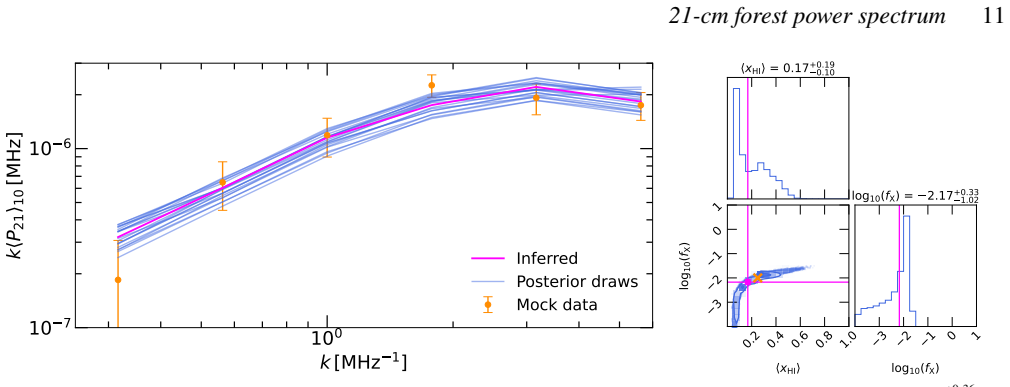
- Ten measured spectra of 22.1 MHz bandwidth can jointly constrain $\log_{10} f_X$ and $\langle x_{\mathrm{HI}}\rangle$, and for cold, neutral models these constraints are tighter than current Ly$\alpha$ forest and 21-cm tomography measurements.
- A null detection from ten 500-h uGMRT spectra would rule out $T_{\mathrm{HI}} \lesssim 54$ K at 25% neutral fraction, with correspondingly higher temperature limits at higher neutral fractions, a region of parameter space currently unconstrained.
- Even 50 h of uGMRT on ten quasars, if null, would disfavour very cold IGMs with neutral fraction $\gtrsim 0.18$, already competitive with existing probes.
Reading between the lines
- If late-reionization neutral islands extend beyond the 50 cMpc simulation box, the large-scale (low-$k$) power could be larger than forecast, making detection easier while strengthening the null-detection limits; the paper's convergence tests address resolution but not box size.
- The Gaussian likelihood used may be suboptimal for the non-Gaussian 21-cm forest, so likelihood-free inference could extract more information from the same ten spectra and sharpen the thermal constraints.
- The same $P_{21}$ statistic could also probe small-scale structure such as minihaloes or dark-matter candidates, since those imprint on the high-$k$ end of the power spectrum beyond the scales used here for the IGM constraints.
- The requirement of a single ultra-bright quasar could be relaxed by targeting the predicted population of roughly 50 radio-loud quasars brighter than 100 mJy at $z>5.5$, if such a population is confirmed by forthcoming surveys.
Editorial analysis
A structured set of objections, weighed in public.
Referee Report
Summary. The paper forward-models 21-cm forest spectra at z=6 using 21cmfast semi-numerical simulations, adds telescope noise and spectral resolution for uGMRT and SKA1-low, and studies two statistical observables: the differential number density of the transmitted flux and the 1D power spectrum P21. The authors claim that a statistical detection of P21 is possible with 500 hr of uGMRT or 50 hr of SKA1-low time under a late-end reionization model with <xHI> = 0.25 and spin temperature < 30 K, and that a null detection of 10 such spectra would constrain the neutral fraction and X-ray heating of the IGM more tightly than current Ly-alpha forest and 21-cm tomography limits. The paper also presents Bayesian MCMC forecasts for joint constraints on log10 fX and <xHI>.
Significance. If the detection claim holds, the paper would provide a timely and observationally actionable forecast: the 21-cm forest 1D power spectrum could be probed with existing or near-future telescopes at z=6, and a null detection would place competitive limits on a cold, neutral IGM. The forward-modelling is careful in several respects: the code is public, a resolution convergence test is included in Appendix A, the covariance matrix is estimated from 10^4 mock realizations, and the authors explicitly discuss omitted effects such as minihaloes, RFI, mode-mixing, and redshift evolution. The main shortfall is that the headline detectability statement is not backed by a detection significance computed from the total variance, and the null-detection criterion is not defined at the data level.
major comments (4)
- [§3.2 and abstract] The detectability claim for P21 is based on comparing the median signal power with the noise-only power in Fig. 6, but §4.1 and Fig. 8 show that sample variance is orders of magnitude stronger than telescope noise and dominates the covariance. For a band-power measurement, the relevant uncertainty is the total variance, not the noise floor. The paper reports no detection S/N, no detection probability, and no false-detection rate for P21 itself: the KS-test fractions in §3.1 and the per-channel SNR in Appendix C concern different statistics, and the MCMC recovery in §4.2 starts from mock observations that already contain the signal. The abstract's statement that it is 'possible to detect the 1D power spectrum ... k < 8.5 MHz^{-1}' is therefore under-supported as written. Please compute a detection significance using the full covariance (e.g. S/N per k-bin or a detection fraction over mock realizations) or soften the claim accordingly.
- [§2.1 and Figs. 6, 10] The simulation volume is (50 cMpc)^3, and §2.1 explicitly states that coherent HI islands on scales larger than the box are not captured. This is a direct limitation for the low-k part of P21, where the claimed detection is strongest: a 50 cMpc spectrum corresponds to a fundamental mode around k ≈ 1 MHz^{-1}, so bins below this scale are influenced by modes outside the box. Late-end reionization models, which motivate the paper, predict large neutral islands. Please quantify how much of the low-k signal in Fig. 6 could come from scales larger than the box, for example by comparing with a larger-volume simulation at lower resolution or by estimating the contribution of modes k < 2π/L_box. Without this, both the detection forecast and the null-detection constraints in Figs. 10, 12, and 13 are uncertain.
- [§4.2 (null-detection definition, Fig. 10)] The null-detection criterion is defined as the model power <P21_sim>10 falling below the noise-only power in at least one bin below 8.5 MHz^{-1}, and the 32% threshold is used to draw the solid black curves in Figs. 10, 12, and 13. This is not a data-level detection criterion: it does not include the sample-variance fluctuations of an actual mock observation, and it does not correspond to a likelihood-based or hypothesis-test decision. Please define a null detection operationally (for example, the fraction of mock observations for which the posterior excludes a nonzero signal, or a detection S/N threshold), and calibrate that criterion on mock realizations. The current definition makes the claimed null-detection constraints difficult to interpret.
- [§4.1, Eq. (6)] The multivariate Gaussian likelihood is used for all parameter inference, and the conclusions themselves note that the 21-cm forest is expected to be non-Gaussian (citing Wolfson et al. 2023). Because sample variance dominates the covariance matrix, the shape of the likelihood is what sets the credible intervals in Figs. 9–13. Please add a validation of the likelihood, for example a coverage test on mock observations across the parameter grid, to verify that the reported 1σ and 2σ contours are calibrated. Without such a test, the joint constraints and the comparisons with Ly-alpha forest and HERA limits are not fully supported.
minor comments (4)
- [Fig. 6 caption vs. §2.3] The Fig. 6 caption says the power spectrum is from a single 50 cMpc spectrum, while §2.3 constructs spliced 200 cMpc spectra and states that they are used in Section 3.2 and Section 4; please clarify which spectrum length underlies the detectability statement, since the longer spectra lower the noise floor and add low-k bins.
- [§3.1 and Fig. 5 caption] The text says the solid curves are 'mean values over 1000 LOS', while the Fig. 5 caption says 'solid lines correspond to the median values'; please make the terminology consistent.
- [Eq. (6)] The Gaussian likelihood as written omits the (2π)^{n/2} normalization factor; this is irrelevant for the MCMC implementation, but it would be clearer to state that the normalization is dropped.
- [Conclusions, first bullet] The statement that 'the SNR achieved by the uGMRT (SKA1-low) ... is 0.37 (1.2)' refers to the per-channel absorption SNR from Appendix C, not to a detection significance of P21; please rename this quantity to avoid confusion with the power-spectrum detection claim.
Circularity Check
No significant circularity: the paper is a forward-model forecast with self-consistency tests, not a derivation that reduces to its inputs.
full rationale
The paper's central claims are forecasts from a forward model: 21cmfast simulations are used to generate the IGM fields, the 21-cm optical depth is computed from a standard formula (Eq. 2), instrumental noise and resolution are added, and the resulting mock spectra are used to estimate the detectability of the 1D power spectrum and to test Bayesian parameter recovery. None of these steps identifies the predicted quantity with an input by construction. The detection claim is conditional on a specified fiducial model (x_HI = 0.25, log10 fX = -2, THI ~ 30 K) and compares the simulated signal to a separately modeled noise power spectrum; this is a sensitivity forecast, not a circular reduction. The Bayesian recovery uses mock observations drawn from the same simulation model, which is a self-consistency check of the inference pipeline rather than an independent empirical validation, but it is not circular in the sense of deriving the target result from its own assumption. Self-citations to Soltinsky et al. (2021) are methodological or motivational (e.g., the form of the optical depth calculation, the claim that the 21-cm forest is strongest in cold neutral gas) and are not used as a load-bearing uniqueness theorem; the optical depth formula is standard and the cited prior work is not invoked to forbid alternatives. The paper's own caveats, such as the limited simulation box size, missing HI islands on large scales, neglect of minihaloes, and the use of a Gaussian likelihood, are acknowledged limitations and do not constitute circularity. The skeptic's concern that the P21 detection claim compares median signal to the noise floor rather than to the total variance is a statistical-correctness issue, not a circularity issue, and is therefore outside the scope of this circularity analysis.
Assumptions & free parameters
free parameters (3)
- Fiducial X-ray efficiency log10 fX = -2 =
-2.0 (fiducial)
- Fiducial mean neutral fraction <xHI> = 0.25 =
0.25 (fiducial)
- Quasar flux density S147 and spectral index alpha_R =
S147 = 64.2 mJy, alpha_R = -0.44
assumptions (5)
- domain assumption Spin temperature is fully coupled to gas kinetic temperature, Ts = TK, at z=6
- domain assumption The 21cmfast excursion-set model with bimodal xHI, equal to 0 or about 1, represents the reionization-era IGM
- domain assumption A 50 cMpc simulation box contains the relevant large-scale modes for the power spectrum
- domain assumption Telescope noise is Gaussian white noise with Aeff/Tsys from Braun et al. 2019
- ad hoc to paper A multivariate Gaussian likelihood is adequate for P21 parameter inference
Cite this review
Pith. "Pith review of Prospects of a statistical detection of the 21-cm forest and its potential to constrain the thermal state of the neutral IGM during reionization." pith.science (2026). https://pith.science/paper/NB2J6DMT
@misc{pith2026241206879,
  author       = {Pith},
  title        = {Pith review of: Prospects of a statistical detection of the 21-cm forest and its potential to constrain the thermal state of the neutral IGM during reionization},
  year         = {2026},
  howpublished = {\url{https://pith.science/paper/NB2J6DMT}},
  note         = {Machine review of arXiv:2412.06879}
}
abstract
The 21-cm forest signal is a promising probe of the Epoch of Reionization complementary to other 21-cm line observables and Ly$\alpha$ forest signal. Prospects of detecting it have significantly improved in the last decade thanks to the discovery of more than 30 radio-loud quasars at these redshifts, upgrades to telescope facilities, and the notion that neutral hydrogen islands persist down to $z\lesssim 5.5$. We forward-model the 21-cm forest signal using semi-numerical simulations and incorporate various instrumental features to explore the potential of detecting the 21-cm forest at $z=6$, both directly and statistically, with the currently available (uGMRT) and forthcoming (SKA1-low) observatories. We show that it is possible to detect the 1D power spectrum of the 21-cm forest spectrum, especially at large scales of $k\lesssim8.5\,\rm MHz^{-1}$ with the $500\,\rm hr$ of the uGMRT time and $k\lesssim32.4\,\rm MHz^{-1}$ with the SKA1-low over $50\,\rm hr$ if the intergalactic medium (IGM) is $25\%$ neutral and these neutral hydrogen regions have a spin temperature of $\lesssim30\,\rm K$. On the other hand, we infer that a null-detection of the signal with such observations of 10 radio-loud sources at $z\approx6$ can be translated into constraints on the thermal and ionization state of the IGM which are tighter than the currently available measurements. Moreover, a null-detection of the 1D 21-cm forest power spectrum with only $50\,\rm hr$ of the uGMRT observations of 10 radio-loud sources can already be competitive with the Ly$\alpha$ forest and 21-cm tomographic observations in disfavouring models of significantly neutral and cold IGM at $z=6$.
Figures


Figures from the paper (9 more)



Forward citations
Cited by 3 Pith papers
-
Forest without Trees is still Fruitful: Constraints on the thermal state of the neutral IGM at $z\approx5.6$ with the 21-cm forest power spectrum
A null detection of the 21-cm forest toward quasar J352–15 at z≈5.8 disfavors very cold and substantially neutral intergalactic gas, giving the first observational constraints from a 21-cm forest power spectrum.
-
Prospects for measuring neutrino mass with 21-cm forest
Using an analytic halo model, the authors forecast that 21-cm forest observations with SKA-LOW could constrain the total neutrino mass to about 0.1 eV, potentially distinguishing neutrino mass hierarchies.
-
Probing initial isocurvature perturbation with 21cm one-point statistics
A Fisher forecast from 21cmFAST simulations shows 21cm variance can constrain the CDM isocurvature fraction to about 3e-4 with SKA, while skewness is an order of magnitude weaker.
Reference graph
Works this paper leans on
-
[1]
write newline
" write newline "" before.all 'output.state := FUNCTION fin.entry write newline FUNCTION new.block output.state before.all = 'skip after.block 'output.state := if FUNCTION new.sentence output.state after.block = 'skip output.state before.all = 'skip after.sentence 'output.state := if if FUNCTION not #0 #1 if FUNCTION and 'skip pop #0 if FUNCTION or pop #1...
-
[2]
write newline
" write newline "" before.all 'output.state := FUNCTION fin.entry write newline FUNCTION new.block output.state before.all = 'skip after.block 'output.state := if FUNCTION new.sentence output.state after.block = 'skip output.state before.all = 'skip after.sentence 'output.state := if if FUNCTION not #0 #1 if FUNCTION and 'skip pop #0 if FUNCTION or pop #1...
-
[3]
Astropy Collaboration et al., 2013, @doi [ ] 10.1051/0004-6361/201322068 , https://ui.adsabs.harvard.edu/abs/2013A&A...558A..33A 558, A33
-
[4]
Ba \ n ados E., et al., 2015, @doi [ ] 10.1088/0004-637X/804/2/118 , https://ui.adsabs.harvard.edu/abs/2015ApJ...804..118B 804, 118
-
[5]
P., Mazzucchelli C., Venemans B
Ba \ n ados E., Carilli C., Walter F., Momjian E., Decarli R., Farina E. P., Mazzucchelli C., Venemans B. P., 2018, @doi [ ] 10.3847/2041-8213/aac511 , https://ui.adsabs.harvard.edu/abs/2018ApJ...861L..14B 861, L14
-
[6]
Ba \ n ados E., et al., 2021, @doi [ ] 10.3847/1538-4357/abe239 , https://ui.adsabs.harvard.edu/abs/2021ApJ...909...80B 909, 80
-
[7]
Ba \ n ados E., et al., 2023, @doi [ ] 10.3847/1538-4365/acb3c7 , https://ui.adsabs.harvard.edu/abs/2023ApJS..265...29B 265, 29
-
[8]
Ba \ n ados E., et al., 2024, @doi [Nature Astronomy] 10.1038/s41550-024-02431-4 , https://ui.adsabs.harvard.edu/abs/2024NatAs.tmp..293B
Show all 113 references
-
[9]
D., Bolton J
Becker G. D., Bolton J. S., Madau P., Pettini M., Ryan-Weber E. V., Venemans B. P., 2015, @doi [ ] 10.1093/mnras/stu2646 , https://ui.adsabs.harvard.edu/abs/2015MNRAS.447.3402B 447, 3402
2015 doi
-
[10]
D., D'Aloisio A., Christenson H
Becker G. D., D'Aloisio A., Christenson H. M., Zhu Y., Worseck G., Bolton J. S., 2021, @doi [ ] 10.1093/mnras/stab2696 , https://ui.adsabs.harvard.edu/abs/2021MNRAS.508.1853B 508, 1853
2021 doi
-
[11]
D., Bolton J
Becker G. D., Bolton J. S., Zhu Y., Hashemi S., 2024, @doi [ ] 10.1093/mnras/stae1918 , https://ui.adsabs.harvard.edu/abs/2024MNRAS.533.1525B 533, 1525
2024 doi
-
[12]
Belladitta S., et al., 2020, @doi [ ] 10.1051/0004-6361/201937395 , https://ui.adsabs.harvard.edu/abs/2020A&A...635L...7B 635, L7
2020 doi
-
[13]
Bhagwat A., Ciardi B., Zackrisson E., Schaye J., 2022, @doi [ ] 10.1093/mnras/stac2663 , https://ui.adsabs.harvard.edu/abs/2022MNRAS.517.2331B 517, 2331
2022 doi
-
[14]
Bosman S. E. I., et al., 2022, @doi [ ] 10.1093/mnras/stac1046 , https://ui.adsabs.harvard.edu/abs/2022MNRAS.514...55B 514, 55
2022 doi
-
[15]
D., Rogers A
Bowman J. D., Rogers A. E. E., Monsalve R. A., Mozdzen T. J., Mahesh N., 2018, @doi [ ] 10.1038/nature25792 , https://ui.adsabs.harvard.edu/abs/2018Natur.555...67B 555, 67
2018 doi
- [16]
-
[17]
D., 2021, @doi [ ] 10.3847/2041-8213/ac1ace , https://ui.adsabs.harvard.edu/abs/2021ApJ...917L..37C 917, L37
Cain C., D'Aloisio A., Gangolli N., Becker G. D., 2021, @doi [ ] 10.3847/2041-8213/ac1ace , https://ui.adsabs.harvard.edu/abs/2021ApJ...917L..37C 917, L37
2021 doi
-
[18]
L., Gnedin N
Carilli C. L., Gnedin N. Y., Owen F., 2002, @doi [ ] 10.1086/342179 , https://ui.adsabs.harvard.edu/abs/2002ApJ...577...22C 577, 22
2002 doi
-
[19]
L., Wang R., van Hoven M
Carilli C. L., Wang R., van Hoven M. B., Dwarakanath K., Chengalur J. N., Wyithe S., 2007, @doi [ ] 10.1086/518436 , https://ui.adsabs.harvard.edu/abs/2007AJ....133.2841C 133, 2841
2007 doi
-
[20]
K., Ben \' tez-Llambay A., Theuns T., Frenk C., Bower R., 2024, @doi [ ] 10.1093/mnras/stae114 , https://ui.adsabs.harvard.edu/abs/2024MNRAS.528.1296C 528, 1296
Chan T. K., Ben \' tez-Llambay A., Theuns T., Frenk C., Bower R., 2024, @doi [ ] 10.1093/mnras/stae114 , https://ui.adsabs.harvard.edu/abs/2024MNRAS.528.1296C 528, 1296
2024 doi
-
[21]
R., Paranjape A., Bosman S
Choudhury T. R., Paranjape A., Bosman S. E. I., 2021, @doi [ ] 10.1093/mnras/stab045 , https://ui.adsabs.harvard.edu/abs/2021MNRAS.501.5782C 501, 5782
2021 doi
-
[22]
M., Becker G
Christenson H. M., Becker G. D., Furlanetto S. R., Davies F. B., Malkan M. A., Zhu Y., Boera E., Trapp A., 2021, @doi [ ] 10.3847/1538-4357/ac2a34 , https://ui.adsabs.harvard.edu/abs/2021ApJ...923...87C 923, 87
2021 doi
-
[23]
Ciardi B., et al., 2013, @doi [ ] 10.1093/mnras/sts156 , https://ui.adsabs.harvard.edu/abs/2013MNRAS.428.1755C 428, 1755
2013 doi
-
[24]
Ciardi B., et al., 2015, @doi [ ] 10.1093/mnras/stv1640 , https://ui.adsabs.harvard.edu/abs/2015MNRAS.453..101C 453, 101
2015 doi
-
[25]
K., Bharadwaj S., Choudhury T
Datta K. K., Bharadwaj S., Choudhury T. R., 2007, @doi [ ] 10.1111/j.1365-2966.2007.12421.x , https://ui.adsabs.harvard.edu/abs/2007MNRAS.382..809D 382, 809
2007
-
[26]
Dzurov c \'i kov \'a D urov c \'i kov \'a D urov c \'i kov \'a D., et al., 2024, @doi [ ] 10.3847/1538-4357/ad4888 , https://ui.adsabs.harvard.edu/abs/2024ApJ...969..162D 969, 162
2024 doi
-
[27]
Endsley R., et al., 2023, @doi [ ] 10.1093/mnras/stad266 , https://ui.adsabs.harvard.edu/abs/2023MNRAS.520.4609E 520, 4609
2023 doi
-
[28]
S., Mesinger A., Hewitt J., 2014, @doi [ ] 10.1093/mnras/stu666 , https://ui.adsabs.harvard.edu/abs/2014MNRAS.441.2476E 441, 2476
Ewall-Wice A., Dillon J. S., Mesinger A., Hewitt J., 2014, @doi [ ] 10.1093/mnras/stu666 , https://ui.adsabs.harvard.edu/abs/2014MNRAS.441.2476E 441, 2476
2014 doi
-
[29]
Fan X., et al., 2001, @doi [ ] 10.1086/324111 , https://ui.adsabs.harvard.edu/abs/2001AJ....122.2833F 122, 2833
2001 doi
-
[30]
Foreman-Mackey D., 2016, @doi [The Journal of Open Source Software] 10.21105/joss.00024 , https://ui.adsabs.harvard.edu/abs/2016JOSS....1...24F 1, 24
2016 doi
-
[31]
W., Lang D., Goodman J., 2013, @doi [ ] 10.1086/670067 , https://ui.adsabs.harvard.edu/abs/2013PASP..125..306F 125, 306
Foreman-Mackey D., Hogg D. W., Lang D., Goodman J., 2013, @doi [ ] 10.1086/670067 , https://ui.adsabs.harvard.edu/abs/2013PASP..125..306F 125, 306
2013 doi
-
[32]
R., 2006, @doi [ ] 10.1111/j.1365-2966.2006.10725.x , https://ui.adsabs.harvard.edu/abs/2006MNRAS.371..867F 371, 867
Furlanetto S. R., 2006, @doi [ ] 10.1111/j.1365-2966.2006.10725.x , https://ui.adsabs.harvard.edu/abs/2006MNRAS.371..867F 371, 867
2006
-
[33]
R., Loeb A., 2002, @doi [ ] 10.1086/342757 , https://ui.adsabs.harvard.edu/abs/2002ApJ...579....1F 579, 1
Furlanetto S. R., Loeb A., 2002, @doi [ ] 10.1086/342757 , https://ui.adsabs.harvard.edu/abs/2002ApJ...579....1F 579, 1
2002 doi
-
[35]
R., Oh S
Furlanetto S. R., Oh S. P., Briggs F. H., 2006, @doi [ ] 10.1016/j.physrep.2006.08.002 , https://ui.adsabs.harvard.edu/abs/2006PhR...433..181F 433, 181
2006 doi
-
[36]
Gaikwad P., et al., 2020, @doi [ ] 10.1093/mnras/staa907 , https://ui.adsabs.harvard.edu/abs/2020MNRAS.494.5091G 494, 5091
2020 doi
-
[37]
Gaikwad P., et al., 2023, @doi [ ] 10.1093/mnras/stad2566 , https://ui.adsabs.harvard.edu/abs/2023MNRAS.525.4093G 525, 4093
2023 doi
-
[38]
Garaldi E., et al., 2024, @doi [ ] 10.1093/mnras/stae839 , https://ui.adsabs.harvard.edu/abs/2024MNRAS.530.3765G 530, 3765
2024 doi
-
[39]
J., et al., 2022, @doi [ ] 10.1051/0004-6361/202244763 , https://ui.adsabs.harvard.edu/abs/2022A&A...668A..27G 668, A27
Gloudemans A. J., et al., 2022, @doi [ ] 10.1051/0004-6361/202244763 , https://ui.adsabs.harvard.edu/abs/2022A&A...668A..27G 668, A27
2022 doi
-
[40]
J., et al., 2023, @doi [ ] 10.1051/0004-6361/202347582 , https://ui.adsabs.harvard.edu/abs/2023A&A...678A.128G 678, A128
Gloudemans A. J., et al., 2023, @doi [ ] 10.1051/0004-6361/202347582 , https://ui.adsabs.harvard.edu/abs/2023A&A...678A.128G 678, A128
2023 doi
-
[41]
Goodman J., Weare J., 2010, @doi [Communications in Applied Mathematics and Computational Science] 10.2140/camcos.2010.5.65 , https://ui.adsabs.harvard.edu/abs/2010CAMCS...5...65G 5, 65
2010 doi
-
[42]
M., Barry N., Mutch S
Greig B., Trott C. M., Barry N., Mutch S. J., Pindor B., Webster R. L., Wyithe J. S. B., 2021a, @doi [ ] 10.1093/mnras/staa3494 , https://ui.adsabs.harvard.edu/abs/2021MNRAS.500.5322G 500, 5322
-
[43]
Greig B., et al., 2021b, @doi [ ] 10.1093/mnras/staa3593 , https://ui.adsabs.harvard.edu/abs/2021MNRAS.501....1G 501, 1
-
[44]
Greig B., et al., 2024, @doi [ ] 10.1093/mnras/stae1080 , https://ui.adsabs.harvard.edu/abs/2024MNRAS.530.3208G 530, 3208
2024 doi
-
[45]
Gupta Y., et al., 2017, @doi [Current Science] 10.18520/cs/v113/i04/707-714 , https://ui.adsabs.harvard.edu/abs/2017CSci..113..707G 113, 707
2017 doi
-
[46]
HERA Collaboration 2022, @doi [ ] 10.3847/1538-4357/ac1c78 , https://ui.adsabs.harvard.edu/abs/2022ApJ...925..221A 925, 221
2022 doi
-
[47]
HERA Collaboration 2023, @doi [ ] 10.3847/1538-4357/acaf50 , https://ui.adsabs.harvard.edu/abs/2023ApJ...945..124H 945, 124
2023 doi
-
[48]
R., et al., 2020, @doi [Nature] 10.1038/s41586-020-2649-2 , https://ui.adsabs.harvard.edu/abs/2020arXiv200610256H 585, 357
Harris C. R., et al., 2020, @doi [Nature] 10.1038/s41586-020-2649-2 , https://ui.adsabs.harvard.edu/abs/2020arXiv200610256H 585, 357
2020 doi
-
[49]
F., Davies F
Hennawi J. F., Davies F. B., Wang F., O \ n orbe J., 2021, @doi [ ] 10.1093/mnras/stab1883 , https://ui.adsabs.harvard.edu/abs/2021MNRAS.506.2963H 506, 2963
2021 doi
-
[50]
J., Prochaska J
Hsyu T., Cooke R. J., Prochaska J. X., Bolte M., 2020, @doi [ ] 10.3847/1538-4357/ab91af , https://ui.adsabs.harvard.edu/abs/2020ApJ...896...77H 896, 77
2020 doi
-
[51]
D., 2007, @doi [Computing in Science and Engineering] 10.1109/MCSE.2007.55 , https://ui.adsabs.harvard.edu/abs/2007CSE.....9...90H 9, 90
Hunter J. D., 2007, @doi [Computing in Science and Engineering] 10.1109/MCSE.2007.55 , https://ui.adsabs.harvard.edu/abs/2007CSE.....9...90H 9, 90
2007 doi
-
[52]
W., Drouart G., Moretti A., Seymour N., 2021, @doi [ ] 10.1051/0004-6361/202140362 , https://ui.adsabs.harvard.edu/abs/2021A&A...647L..11I 647, L11
Ighina L., Belladitta S., Caccianiga A., Broderick J. W., Drouart G., Moretti A., Seymour N., 2021, @doi [ ] 10.1051/0004-6361/202140362 , https://ui.adsabs.harvard.edu/abs/2021A&A...647L..11I 647, L11
2021 doi
-
[53]
W., Drouart G., Leung J
Ighina L., Caccianiga A., Moretti A., Belladitta S., Broderick J. W., Drouart G., Leung J. K., Seymour N., 2023, @doi [ ] 10.1093/mnras/stac3668 , https://ui.adsabs.harvard.edu/abs/2023MNRAS.519.2060I 519, 2060
2023 doi
-
[54]
Ighina L., et al., 2024, @doi [ ] 10.1051/0004-6361/202451376 , https://ui.adsabs.harvard.edu/abs/2024A&A...692A.241I 692, A241
2024 doi
-
[55]
T., Jagannathan P., Mooley K
Intema H. T., Jagannathan P., Mooley K. P., Frail D. A., 2017, @doi [ ] 10.1051/0004-6361/201628536 , https://ui.adsabs.harvard.edu/abs/2017A&A...598A..78I 598, A78
2017 doi
-
[56]
Ioka K., M \'e sz \'a ros P., 2005, @doi [ ] 10.1086/426785 , https://ui.adsabs.harvard.edu/abs/2005ApJ...619..684I 619, 684
2005 doi
-
[57]
Kadota K., Villanueva-Domingo P., Ichiki K., Hasegawa K., Naruse G., 2023, @doi [ ] 10.1088/1475-7516/2023/03/017 , https://ui.adsabs.harvard.edu/abs/2023JCAP...03..017K 2023, 017
2023 doi
-
[58]
J., Shibuya T., Ouchi M., Kashikawa N., 2020, @doi [ ] 10.3847/1538-4357/ab5a7d , https://ui.adsabs.harvard.edu/abs/2020ApJ...888....6K 888, 6
Kashino D., Lilly S. J., Shibuya T., Ouchi M., Kashikawa N., 2020, @doi [ ] 10.3847/1538-4357/ab5a7d , https://ui.adsabs.harvard.edu/abs/2020ApJ...888....6K 888, 6
2020 doi
-
[59]
Kawasaki M., Nakano W., Nakatsuka H., Sonomoto E., 2021, @doi [ ] 10.1088/1475-7516/2021/04/019 , https://ui.adsabs.harvard.edu/abs/2021JCAP...04..019K 2021, 019
2021 doi
-
[60]
C., Weinberger L
Keating L. C., Weinberger L. H., Kulkarni G., Haehnelt M. G., Chardin J., Aubert D., 2020, @doi [ ] 10.1093/mnras/stz3083 , https://ui.adsabs.harvard.edu/abs/2020MNRAS.491.1736K 491, 1736
2020 doi
-
[61]
K., Kulkarni G., Bolton J
Khan N. K., Kulkarni G., Bolton J. S., Haehnelt M. G., Ir s i c V., Puchwein E., Asthana S., 2024, @doi [ ] 10.1093/mnras/stae662 , https://ui.adsabs.harvard.edu/abs/2024MNRAS.530.4920K 530, 4920
2024 doi
-
[62]
Kondapally R., et al., 2021, @doi [ ] 10.1051/0004-6361/202038813 , https://ui.adsabs.harvard.edu/abs/2021A&A...648A...3K 648, A3
2021 doi
-
[63]
C., Haehnelt M
Kulkarni G., Keating L. C., Haehnelt M. G., Bosman S. E. I., Puchwein E., Chardin J., Aubert D., 2019, @doi [ ] 10.1093/mnrasl/slz025 , https://ui.adsabs.harvard.edu/abs/2019MNRAS.485L..24K 485, L24
2019 doi
-
[64]
Lewis J. S. W., et al., 2022, @doi [ ] 10.1093/mnras/stac2383 , https://ui.adsabs.harvard.edu/abs/2022MNRAS.tmp.2259L 516, 3389
2022 doi
-
[65]
Liu Y., et al., 2021, @doi [ ] 10.3847/1538-4357/abd3a8 , https://ui.adsabs.harvard.edu/abs/2021ApJ...908..124L 908, 124
2021 doi
-
[66]
J., Wyithe J
Mack K. J., Wyithe J. S. B., 2012, @doi [ ] 10.1111/j.1365-2966.2012.21561.x , https://ui.adsabs.harvard.edu/abs/2012MNRAS.425.2988M 425, 2988
2012
-
[67]
D., Becker R
McGreer I. D., Becker R. H., Helfand D. J., White R. L., 2006, @doi [ ] 10.1086/507767 , https://ui.adsabs.harvard.edu/abs/2006ApJ...652..157M 652, 157
2006 doi
-
[68]
D., Mesinger A., D'Odorico V., 2015, @doi [ ] 10.1093/mnras/stu2449 , https://ui.adsabs.harvard.edu/abs/2015MNRAS.447..499M 447, 499
McGreer I. D., Mesinger A., D'Odorico V., 2015, @doi [ ] 10.1093/mnras/stu2449 , https://ui.adsabs.harvard.edu/abs/2015MNRAS.447..499M 447, 499
2015 doi
-
[69]
Meiksin A., 2011, @doi [ ] 10.1111/j.1365-2966.2011.19362.x , https://ui.adsabs.harvard.edu/abs/2011MNRAS.417.1480M 417, 1480
2011
-
[70]
G., et al., 2020, @doi [ ] 10.1093/mnras/staa327 , https://ui.adsabs.harvard.edu/abs/2020MNRAS.493.1662M 493, 1662
Mertens F. G., et al., 2020, @doi [ ] 10.1093/mnras/staa327 , https://ui.adsabs.harvard.edu/abs/2020MNRAS.493.1662M 493, 1662
2020 doi
-
[72]
Murray S., Greig B., Mesinger A., Mu \ n oz J., Qin Y., Park J., Watkinson C., 2020, @doi [The Journal of Open Source Software] 10.21105/joss.02582 , https://ui.adsabs.harvard.edu/abs/2020JOSS....5.2582M 5, 2582
2020 doi
-
[73]
Nakane M., et al., 2024, @doi [ ] 10.3847/1538-4357/ad38c2 , https://ui.adsabs.harvard.edu/abs/2024ApJ...967...28N 967, 28
2024 doi
-
[74]
Nakatani R., Fialkov A., Yoshida N., 2020, @doi [ ] 10.3847/1538-4357/abc5b4 , https://ui.adsabs.harvard.edu/abs/2020ApJ...905..151N 905, 151
2020 doi
-
[75]
Naruse G., Hasegawa K., Kadota K., Tashiro H., Ichiki K., 2024, @doi [ ] 10.1088/1475-7516/2024/10/091 , https://ui.adsabs.harvard.edu/abs/2024JCAP...10..091N 2024, 091
2024 doi
-
[76]
Nasir F., D'Aloisio A., 2020, @doi [ ] 10.1093/mnras/staa894 , https://ui.adsabs.harvard.edu/abs/2020MNRAS.494.3080N 494, 3080
2020 doi
- [77]
-
[78]
B., Luki \'c Z., Hennawi J
O \ n orbe J., Davies F. B., Luki \'c Z., Hennawi J. F., Sorini D., 2019, @doi [ ] 10.1093/mnras/stz984 , https://ui.adsabs.harvard.edu/abs/2019MNRAS.486.4075O 486, 4075
2019 doi
-
[79]
R., et al., 2015, @doi [ ] 10.1017/pasa.2015.7 , https://ui.adsabs.harvard.edu/abs/2015PASA...32....8O 32, e008
Offringa A. R., et al., 2015, @doi [ ] 10.1017/pasa.2015.7 , https://ui.adsabs.harvard.edu/abs/2015PASA...32....8O 32, e008
2015 doi
-
[80]
R., Choi J.-h., Yoshida N., Hirano S., Ahn K., 2016, @doi [ ] 10.3847/0004-637X/831/1/86 , https://ui.adsabs.harvard.edu/abs/2016ApJ...831...86P 831, 86
Park H., Shapiro P. R., Choi J.-h., Yoshida N., Hirano S., Ahn K., 2016, @doi [ ] 10.3847/0004-637X/831/1/86 , https://ui.adsabs.harvard.edu/abs/2016ApJ...831...86P 831, 86
2016 doi
-
[81]
Planck Collaboration et al., 2014, @doi [ ] 10.1051/0004-6361/201321591 , https://ui.adsabs.harvard.edu/abs/2014A&A...571A..16P 571, A16
2014 doi
-
[82]
R., Loeb A., 2012, @doi [Reports on Progress in Physics] 10.1088/0034-4885/75/8/086901 , https://ui.adsabs.harvard.edu/abs/2012RPPh...75h6901P 75, 086901
Pritchard J. R., Loeb A., 2012, @doi [Reports on Progress in Physics] 10.1088/0034-4885/75/8/086901 , https://ui.adsabs.harvard.edu/abs/2012RPPh...75h6901P 75, 086901
2012 doi
-
[83]
Puchwein E., et al., 2023, @doi [ ] 10.1093/mnras/stac3761 , https://ui.adsabs.harvard.edu/abs/2023MNRAS.519.6162P 519, 6162
2023 doi
-
[84]
Qin Y., Mesinger A., Bosman S. E. I., Viel M., 2021, @doi [ ] 10.1093/mnras/stab1833 , https://ui.adsabs.harvard.edu/abs/2021MNRAS.506.2390Q 506, 2390
2021 doi
-
[85]
Semelin B., 2016, @doi [ ] 10.1093/mnras/stv2312 , https://ui.adsabs.harvard.edu/abs/2016MNRAS.455..962S 455, 962
2016 doi
-
[86]
Shao Y., Xu Y., Wang Y., Yang W., Li R., Zhang X., Chen X., 2023, @doi [Nature Astronomy] 10.1038/s41550-023-02024-7 , https://ui.adsabs.harvard.edu/abs/2023NatAs...7.1116S 7, 1116
2023 doi
- [87]
-
[88]
Shimabukuro H., Ichiki K., Inoue S., Yokoyama S., 2014, @doi [ ] 10.1103/PhysRevD.90.083003 , https://ui.adsabs.harvard.edu/abs/2014PhRvD..90h3003S 90, 083003
2014 doi
-
[89]
Shimabukuro H., Ichiki K., Kadota K., 2020, @doi [ ] 10.1103/PhysRevD.102.023522 , https://ui.adsabs.harvard.edu/abs/2020PhRvD.102b3522S 102, 023522
2020 doi
-
[90]
Shimabukuro H., Ichiki K., Kadota K., 2023, @doi [ ] 10.1103/PhysRevD.107.123520 , https://ui.adsabs.harvard.edu/abs/2023PhRvD.107l3520S 107, 123520
2023 doi
-
[91]
W., et al., 2017, @doi [ ] 10.1051/0004-6361/201629313 , https://ui.adsabs.harvard.edu/abs/2017A&A...598A.104S 598, A104
Shimwell T. W., et al., 2017, @doi [ ] 10.1051/0004-6361/201629313 , https://ui.adsabs.harvard.edu/abs/2017A&A...598A.104S 598, A104
2017 doi
-
[92]
Singh S., et al., 2022, @doi [Nature Astronomy] 10.1038/s41550-022-01610-5 , https://ui.adsabs.harvard.edu/abs/2022NatAs...6..607S 6, 607
2022 doi
-
[93]
Smith D. J. B., et al., 2016, in Reyl \'e C., Richard J., Cambr \'e sy L., Deleuil M., P \'e contal E., Tresse L., Vauglin I., eds, SF2A-2016: Proceedings of the Annual meeting of the French Society of Astronomy and Astrophysics. pp 271--280 ( @eprint arXiv 1611.02706 )
2016 arXiv
-
[94]
Spina B., Bosman S. E. I., Davies F. B., Gaikwad P., Zhu Y., 2024, @doi [ ] 10.1051/0004-6361/202450798 , https://ui.adsabs.harvard.edu/abs/2024A&A...688L..26S 688, L26
2024 doi
- [95]
-
[96]
Szoltinsk \'y S oltinsk \'y S oltinsk \'y T., et al., 2021, @doi [ ] 10.1093/mnras/stab1830 , https://ui.adsabs.harvard.edu/abs/2021MNRAS.506.5818S 506, 5818
2021 doi
-
[97]
S., Molaro M., Hatch N., Haehnelt M
Szoltinsk \'y S oltinsk \'y S oltinsk \'y T., Bolton J. S., Molaro M., Hatch N., Haehnelt M. G., Keating L. C., Kulkarni G., Puchwein E., 2023, @doi [ ] 10.1093/mnras/stac3710 , https://ui.adsabs.harvard.edu/abs/2023MNRAS.519.3027S 519, 3027
2023 doi
-
[98]
Thyagarajan N., 2020, @doi [ ] 10.3847/1538-4357/ab9e6d , https://ui.adsabs.harvard.edu/abs/2020ApJ...899...16T 899, 16
2020 doi
-
[99]
S., Hennawi J
Tie S. S., Hennawi J. F., Wang F., Onorato S., Yang J., Ba \ n ados E., Davies F. B., O \ n orbe J., 2024, @doi [ ] 10.1093/mnras/stae2193 , https://ui.adsabs.harvard.edu/abs/2024MNRAS.535..223T 535, 223
2024 doi
-
[100]
M., et al., 2020, @doi [ ] 10.1093/mnras/staa414 , https://ui.adsabs.harvard.edu/abs/2020MNRAS.493.4711T 493, 4711
Trott C. M., et al., 2020, @doi [ ] 10.1093/mnras/staa414 , https://ui.adsabs.harvard.edu/abs/2020MNRAS.493.4711T 493, 4711
2020 doi
-
[101]
Villanueva-Domingo P., Ichiki K., 2023, @doi [ ] 10.1093/pasj/psab119 , https://ui.adsabs.harvard.edu/abs/2023PASJ...75S..33V 75, S33
2023 doi
-
[102]
Virtanen P., et al., 2020, @doi [Nature Methods] 10.1038/s41592-019-0686-2 , https://ui.adsabs.harvard.edu/abs/2020NatMe..17..261V 17, 261
2020 doi
-
[103]
B., et al., 2015, @doi [ ] 10.1017/pasa.2015.26 , https://ui.adsabs.harvard.edu/abs/2015PASA...32...25W 32, e025
Wayth R. B., et al., 2015, @doi [ ] 10.1017/pasa.2015.26 , https://ui.adsabs.harvard.edu/abs/2015PASA...32...25W 32, e025
2015 doi
-
[104]
H., Haehnelt M
Weinberger L. H., Haehnelt M. G., Kulkarni G., 2019, @doi [ ] 10.1093/mnras/stz481 , https://ui.adsabs.harvard.edu/abs/2019MNRAS.485.1350W 485, 1350
2019 doi
-
[105]
J., et al., 2010, @doi [ ] 10.1088/0004-6256/140/2/546 , https://ui.adsabs.harvard.edu/abs/2010AJ....140..546W 140, 546
Willott C. J., et al., 2010, @doi [ ] 10.1088/0004-6256/140/2/546 , https://ui.adsabs.harvard.edu/abs/2010AJ....140..546W 140, 546
2010 doi
-
[106]
Wolf J., et al., 2024, @doi [ ] 10.1051/0004-6361/202451035 , https://ui.adsabs.harvard.edu/abs/2024A&A...691A..30W 691, A30
2024 doi
- [107]
-
[108]
Xu Y., Chen X., Fan Z., Trac H., Cen R., 2009, @doi [ ] 10.1088/0004-637X/704/2/1396 , https://ui.adsabs.harvard.edu/abs/2009ApJ...704.1396X 704, 1396
2009 doi
-
[109]
Xu Y., Ferrara A., Chen X., 2011, @doi [ ] 10.1111/j.1365-2966.2010.17579.x , https://ui.adsabs.harvard.edu/abs/2011MNRAS.410.2025X 410, 2025
2011
-
[110]
R., White R
Zeimann G. R., White R. L., Becker R. H., Hodge J. A., Stanford S. A., Richards G. T., 2011, @doi [ ] 10.1088/0004-637X/736/1/57 , https://ui.adsabs.harvard.edu/abs/2011ApJ...736...57Z 736, 57
2011 doi
-
[111]
W., Li W., 2020, @doi [ ] 10.1093/mnras/staa3011 , https://ui.adsabs.harvard.edu/abs/2020MNRAS.499.3434Z 499, 3434
Zheng Q., Wu X.-P., Guo Q., Johnston-Hollitt M., Shan H., Duchesne S. W., Li W., 2020, @doi [ ] 10.1093/mnras/staa3011 , https://ui.adsabs.harvard.edu/abs/2020MNRAS.499.3434Z 499, 3434
2020 doi
-
[112]
Zhu Y., et al., 2021, @doi [ ] 10.3847/1538-4357/ac26c2 , https://ui.adsabs.harvard.edu/abs/2021ApJ...923..223Z 923, 223
2021 doi
-
[113]
Zhu Y., et al., 2022, @doi [ ] 10.3847/1538-4357/ac6e60 , https://ui.adsabs.harvard.edu/abs/2022ApJ...932...76Z 932, 76
2022 doi
-
[114]
Zhu Y., et al., 2023, @doi [ ] 10.3847/1538-4357/aceef4 , https://ui.adsabs.harvard.edu/abs/2023ApJ...955..115Z 955, 115
2023 doi
-
[115]
Zhu Y., et al., 2024, @doi [ ] 10.1093/mnrasl/slae061 , https://ui.adsabs.harvard.edu/abs/2024MNRAS.533L..49Z 533, L49
2024 doi
Reviewed August 11, 2026 · model on record in the stance chip above.
Discussion (0). Continue with ORCID to comment.