REVIEW 3 major objections 7 minor 73 references
The High Time Resolution Universe Pulsar Survey-XIX. A coherent GPU accelerated reprocessing and the discovery of 71 pulsars in the Southern Galactic plane
T0 review · 3 major / 7 minor · reviewed 2026-08-11 · deepseek-v4-flash
Pith's one-line read Reprocessing archived southern-sky pulsar survey data with full time resolution and coherent folding reveals 71 previously missed pulsars, including six millisecond pulsars and seven high-dispersion objects.
desk verdict Solid reprocessing haul, but the '71 new pulsars' headline double-counts PSR J1325–6253, already published in 2022; fix the count and the paper is a strong contribution. read the letter →
The pith
A machine-rendered reading of the paper's core claim, the machinery that carries it, and where it could break.
The reading
What carries the argument
The load-bearing mechanism is coherent folding of low-significance Fourier candidates: instead of accepting or rejecting pulsar candidates by a fixed spectral signal-to-noise cutoff, the pipeline folds every plausible candidate — including those near the Fourier noise floor — at the candidate period, dispersion measure, and acceleration, so the full pulse energy is summed in the time domain. This is paired with a GPU-accelerated time-domain resampling acceleration search that covers the complete 72-minute observation at 64-microsecond native sampling over accelerations up to |50| m $s^{-2}$, which is most sensitive to binary pulsars whose orbital acceleration is nearly constant across the observation. The FFT search itself uses up to 32 harmonics, which helps recover narrow-duty-cycle pulsars whose power is spread across many harmonics.
What would settle it
Obtain precise interferometric positions and independent distance estimates (for example via parallax or HI absorption) for a representative subset of the 71 pulsars; if the recalculated 1400-MHz flux densities and distances no longer show a statistically significant difference from the previous 100-pulsar sample in a Kolmogorov-Smirnov test, the paper's central statistical claim would be falsified.
Extended reading notes
Core claim
The paper's central claim is that a coherent, GPU-accelerated reprocessing of the full 72-minute HTRU-S LowLat observations — searched at native sampling, with an acceleration range up to |50| m $s^{-2}$, 2778 trial dispersion measures up to 2000 pc $cm^{-3}$, and 32-harmonic summing — discovers 71 new pulsars, increasing the survey's new-pulsar yield by roughly 75% over the 100 found in the previous two passes. The key evidence is that many of the new pulsars were found by folding candidates with Fourier signal-to-noise ratios near or below the conventional detection threshold; for narrow-duty-cycle pulsars the folded signal-to-noise ratio can be 1.5 to 2.5 times higher than the incoherent harmonic sum, so a fixed threshold had been discarding real signals. The paper further shows that the new sample has higher dispersion measures, lower flux densities, and larger DM-derived distances than the earlier sample, and that the survey's normal-pulsar detection count now matches population-synthesis expectations.
Load-bearing premise
The claim that the new pulsars are systematically fainter and more distant assumes that each discovery position, corrected only by the median 3.94 arcminute offset, is close enough to the true position that the derived minimum flux densities are unbiased, and that the NE2001 and YMW16 electron-density models give reliable distances.
Editorial extensions
If this is right
- The known pulsar census in the southern Galactic plane grows by 71 objects, including five binary millisecond pulsars and a double neutron star, improving statistics for binary-evolution and population studies.
- The survey's normal-pulsar yield now essentially matches the predicted ~890 detections from population synthesis, indicating that the original survey design and sensitivity estimates were correct.
- Seven new pulsars with dispersion measures above 800 pc cm^-3, two among the top ten highest-DM pulsars known, provide new probes of the Galactic electron distribution and scattering along tangential spiral-arm directions.
- Since 34 of the 71 pulsars are also detectable in older multibeam-survey data, the result implies that comparable archived surveys reprocessed this way could yield similar numbers of hidden pulsars.
- The five binary millisecond pulsars found through the acceleration search demonstrate the value of searching full-length observations without segmentation or downsampling for finding mildly accelerated binary systems.
Reading between the lines
- An editorial extension: other archived pulsar surveys that used data downsampling and fixed S/N thresholds may harbour a comparable hidden population; re-running them with coherent folding at native resolution could yield a similar fractional increase in discoveries.
- An editorial extension: the paper's emphasis on full-length coherent acceleration searches suggests that a GPU-reimplemented segmented or jerk-aware search, applied to the same data, might still find short-orbit relativistic binaries that constant-acceleration searches miss.
- An editorial extension: the measured scattering timescales that exceed NE2001 predictions for many high-DM pulsars could be used to identify foreground H II regions and to test improved electron-density models, since these pulsars trace particularly complex sightlines.
- An editorial extension: if future large surveys adopt the 'fold everything near the noise floor' strategy, GPU-accelerated folding will become the practical bottleneck, since CPU-side folding of millions of candidates will not scale to SKA-era data volumes.
Editorial analysis
A structured set of objections, weighed in public.
Referee Report
Summary. This paper reports a GPU-accelerated coherent reprocessing of 87.3% of the HTRU-S LowLat survey data using the PEASOUP pipeline, searching the full 72-minute observations at native time resolution with an acceleration range up to |50| m/s^2. The authors report 71 confirmed pulsar discoveries, including 6 millisecond pulsars and 7 pulsars with DM > 800 pc cm^-3, and compare the new sample with previous HTRU-S LowLat pulsars and the background pulsar population in period, DM, signal-to-noise, flux density, distance, and luminosity. The paper also evaluates survey yield against population-synthesis predictions and discusses why the pulsars were missed in earlier processing passes. The core discovery claim is supported by follow-up confirmations, while the statistical characterization rests on minimum flux densities and model-dependent distances.
Significance. If the discovery-count issue is corrected, this is a valuable survey paper. The 71 pulsars were confirmed in follow-up observations, the pipeline was validated by redetecting 792 unique known pulsars, the search parameters are explicitly tabulated, and the open-source PEASOUP code is used. The demonstration that folding candidates below the FFT false-alarm threshold yields real pulsars, and the identification of the incorrect downsampling scaling as a cause of missed pulsars, are concrete and useful technical contributions. The paper also provides a careful comparison with population-synthesis predictions and a detailed account of the reasons for earlier non-detections. These strengths make the manuscript worth publishing after the counting and statistical-claim issues below are resolved.
major comments (3)
- [§4, Table 3, §5, §10] The headline 'discovery of 71 pulsars' is internally inconsistent with the paper's own statements. Section 5 says 'Among the 71 new pulsars reported in this work, PSR J1325–6253 is a double neutron star system', while Table 3 footnotes PSR J1325–6253 as published in Sengar et al. (2022), and Section 10 says 'with the exception of PSR J1325–6253, which has already been published'. In addition, Section 5.3 states that PSR J1638−47 and PSR J1710−3946 'were reported as an independent discovery by Sengar et al. (2023)', and Section 6 states that 10 of the PMPS blind-FFT detections 'are included as independent discoveries in the PMPS reprocessing (Sengar et al. 2023) (they were originally discovered for the first time in this work)'. Because Sengar et al. (2023) is published, these objects already have public discovery papers. The abstract's unqualified 'discovery of 71 pulsars' and the conclusion's 'reported for the first time in this study' must be corrected, and the counts in Section 8.2 and Table 6 must be re-derived consistently.
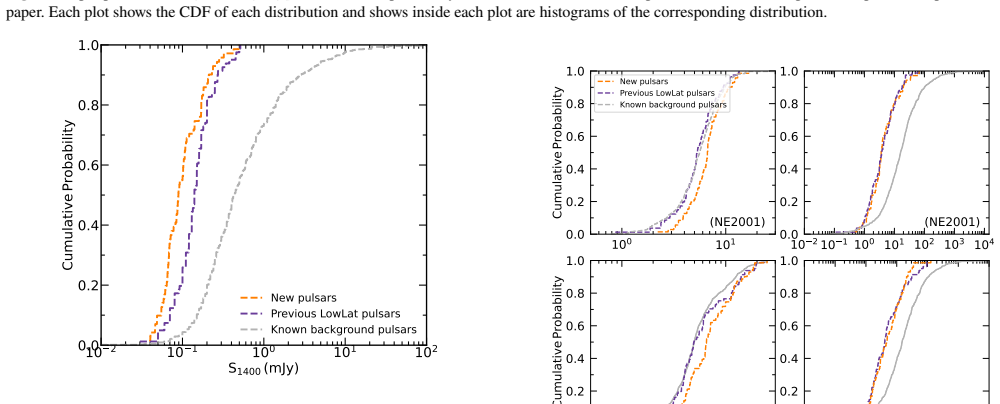
- [§7.2] The claim that the new sample probes fainter pulsars is based on minimum flux densities computed under the assumption that the discovery position is the beam centre, with a single median positional offset of 3.94 arcmin transferred from the previous 88-pulsar sample to the new sample. Because the actual positional offsets of the new pulsars are unknown, and because S_min is a lower bound that increases when a pulsar is off-axis, the KS-test comparison with p=0.014 is conditional on an unverified assumption. The authors should either propagate the uncertainty in the offset distribution, demonstrate that the conclusion is robust to the plausible range of offsets, or explicitly state in the abstract and conclusions that the 'fainter' claim depends on the beam-centre assumption.
- [§7.3] The claim that the new pulsars are on average more distant rests entirely on NE2001 and YMW16 dispersion-measure distances. The text cautions that DM-derived distances are not well constrained, but the abstract presents the greater average distance as a headline result. The KS p-values of 0.007 and 0.009 are model-dependent and do not include systematic errors in the electron-density models. The authors should add a systematic-error treatment or soften the summary and conclusions to make the model dependence and the 'could be' caveat explicit, rather than presenting model-dependent distances as a firm population difference.
minor comments (7)
- [§5.1.1, Table 3, Figure 2, Table 4] The pulsar is called PSR J1445−63 in the text and Table 3, but PSR J1449−63 in Figure 2 and Table 4; the listed right ascension 14:49.8 suggests J1449−63 is the correct name, and the inconsistency should be fixed.
- [§5.3] The text refers to 'PSR J1651–42' with DM ~931 pc cm^-3, but Table 3 lists PSR J1652−4237 with DM 943 pc cm^-3; the intended pulsar should be identified consistently.
- [§6] The search radius is given as 'one beam-width (14.4◦)'; this should be 14.4 arcminutes, not degrees, since the Parkes multibeam receiver's beam FWHM is approximately 14.4 arcmin.
- [§7.2] The text says the sky temperature was 'scaled at 1400GHz as ν^-2.6'; this should be 1400 MHz.
- [§8.1 and Figure 8] The text states that 457 unique pulsars were selected, while the Figure 8 caption says 467; the correct number should be used consistently.
- [Table 3 and Table 4] The column header 'S/NPMPS' is repeated in Table 3, and the table caption contains the typo 'The paramteres'; also, the period and DM units in the Table 3 continuation header are inconsistent with the first part of the table.
- [§2] The text says the total observing bandwidth went 'from 288 MHz for PMPS to 3402 MHz for HTRU-S LowLat'; this should be 340 MHz, consistent with the effective bandwidth stated elsewhere.
Circularity Check
No circularity found: the discovery pipeline is validated against independent known pulsars and the central claims do not reduce to their inputs; the PSR J1325–6253 count inconsistency is a non-circular correctness issue.
full rationale
The paper's central claims (71 pulsar discoveries, fainter/more distant population, survey yield) are not derived by fitting parameters to the target discoveries. The pipeline (PEASOUP) is reused from Sengar et al. (2023) and validated by redetecting 792 known pulsars, with S/N comparisons against PSRCAT fluxes using the radiometer equation (Section 8.1). Candidate selection and folding follow prior published methodology, but the 71 candidates were confirmed through independent Parkes follow-up observations (Section 4), so the discoveries are not constructed from the selection criteria. The statistical comparisons in Sections 7.2–7.3 rely on stated assumptions (beam-centre discovery positions, NE2001/YMW16 distances) that the paper explicitly caveats; these are modelling uncertainties, not circular reductions. The paper does cite the authors' prior work (Sengar et al. 2022, 2023) for the pipeline and for PSR J1325–6253, but these citations are not load-bearing in a circular sense: prior results are independently published and the pipeline is benchmarked externally. One internal inconsistency should be noted as a correctness issue, not circularity: the abstract and Section 10 count '71 new pulsars... reported for the first time in this study,' while Table 3 footnotes PSR J1325–6253 as 'A double neutron star system (Sengar et al. 2022)' and Section 10 later excludes it ('with the exception of PSR J1325–6253, which has already been published'). This affects the headline count but does not make any prediction equivalent to its input by construction. Overall, no circular step meets the evidentiary bar; score 0.
Assumptions & free parameters
assumptions (5)
- domain assumption Radiometer equation parameters (system temperature, gain, degradation factor) from prior literature are used to estimate flux densities and expected S/N.
- domain assumption NE2001 and YMW16 electron density models give reliable distance estimates from dispersion measures.
- domain assumption The coherent acceleration search with |a| <= 50 m/s^2 over the full 72-minute observation is adequate to detect the binary pulsars of interest.
- ad hoc to paper Candidate selection thresholds (S/Nfold > 8.8 for normal pulsars, > 12 for MSPs, and a false-alarm threshold of 8 in previous processing) are appropriate for separating real pulsars from noise.
- ad hoc to paper The earlier processing used an incorrect downsampling scaling factor, reducing data to effective 1-bit precision.
Cite this review
Pith. "Pith review of The High Time Resolution Universe Pulsar Survey-XIX. A coherent GPU accelerated reprocessing and the discovery of 71 pulsars in the Southern Galactic plane." pith.science (2026). https://pith.science/paper/SR6V6CVC
@misc{pith2026241207104,
  author       = {Pith},
  title        = {Pith review of: The High Time Resolution Universe Pulsar Survey-XIX. A coherent GPU accelerated reprocessing and the discovery of 71 pulsars in the Southern Galactic plane},
  year         = {2026},
  howpublished = {\url{https://pith.science/paper/SR6V6CVC}},
  note         = {Machine review of arXiv:2412.07104}
}
abstract
We have conducted a GPU accelerated reprocessing of $\sim 87\%$ of the archival data from the High Time Resolution Universe South Low Latitude (HTRU-S LowLat) pulsar survey by implementing a pulsar search pipeline that was previously used to reprocess the Parkes Multibeam pulsar survey (PMPS). We coherently searched the full 72-min observations of the survey with an acceleration search range up to $|50|\, \rm m\,s^{-2}$, which is most sensitive to binary pulsars experiencing nearly constant acceleration during 72 minutes of their orbital period. Here we report the discovery of 71 pulsars, including 6 millisecond pulsars (MSPs) of which five are in binary systems, and seven pulsars with very high dispersion measures (DM $>800 \, \rm pc \, cm^{-3}$). These pulsar discoveries largely arose by folding candidates to a much lower spectral signal-to-noise ratio than previous surveys, and exploiting the coherence of folding over the incoherent summing of the Fourier components to discover new pulsars as well as candidate classification techniques. We show that these pulsars could be fainter and on average more distant as compared to both the previously reported 100 HTRU-S LowLat pulsars and background pulsar population in the survey region. We have assessed the effectiveness of our search method and the overall pulsar yield of the survey. We show that through this reprocessing we have achieved the expected survey goals including the predicted number of pulsars in the survey region and discuss the major causes as to why these pulsars were missed in previous processings of the survey.
Figures


Figures from the paper (8 more)



Reference graph
Works this paper leans on
-
[1]
Agazie G., et al., 2023, @doi [ ] 10.3847/2041-8213/acdac6 , https://ui.adsabs.harvard.edu/abs/2023ApJ...951L...8A 951, L8
-
[2]
Arzoumanian Z., Chernoff D. F., Cordes J. M., 2002, @doi [ ] 10.1086/338805 , https://ui.adsabs.harvard.edu/abs/2002ApJ...568..289A 568, 289
doi:10.1086/338805 2002
-
[3]
Bailes M., et al., 2011, @doi [Science] 10.1126/science.1208890 , https://ui.adsabs.harvard.edu/abs/2011Sci...333.1717B 333, 1717
-
[4]
Barsdell B. R., Bailes M., Barnes D. G., Fluke C. J., 2012, @doi [ ] 10.1111/j.1365-2966.2012.20622.x , https://ui.adsabs.harvard.edu/abs/2012MNRAS.422..379B 422, 379
arXiv 2012
-
[5]
Bates S. D., Lorimer D. R., Rane A., Swiggum J., 2014, @doi [ ] 10.1093/mnras/stu157 , https://ui.adsabs.harvard.edu/abs/2014MNRAS.439.2893B 439, 2893
-
[6]
Bhat N. D. R., Cordes J. M., Camilo F., Nice D. J., Lorimer D. R., 2004, @doi [ ] 10.1086/382680 , https://ui.adsabs.harvard.edu/abs/2004ApJ...605..759B 605, 759
doi:10.1086/382680 2004
-
[7]
Cameron A. D., et al., 2018, @doi [ ] 10.1093/mnrasl/sly003 , https://ui.adsabs.harvard.edu/abs/2018MNRAS.475L..57C 475, L57
-
[8]
Cameron A. D., et al., 2020, @doi [ ] 10.1093/mnras/staa039 , https://ui.adsabs.harvard.edu/abs/2020MNRAS.493.1063C 493, 1063
Show all 73 references
-
[9]
J., et al., 2016, @doi [ ] 10.1093/mnrasl/slw069 , https://ui.adsabs.harvard.edu/abs/2016MNRAS.460L..30C 460, L30
Champion D. J., et al., 2016, @doi [ ] 10.1093/mnrasl/slw069 , https://ui.adsabs.harvard.edu/abs/2016MNRAS.460L..30C 460, L30
2016 doi
- [10]
-
[11]
T., et al., 2020, @doi [Nature Astronomy] 10.1038/s41550-019-0880-2 , https://ui.adsabs.harvard.edu/abs/2020NatAs...4...72C 4, 72
Cromartie H. T., et al., 2020, @doi [Nature Astronomy] 10.1038/s41550-019-0880-2 , https://ui.adsabs.harvard.edu/abs/2020NatAs...4...72C 4, 72
2020 doi
-
[12]
T., et al., 2019, @doi [ ] 10.3847/1538-4357/ab11c7 , https://ui.adsabs.harvard.edu/abs/2019ApJ...875..100D 875, 100
Deller A. T., et al., 2019, @doi [ ] 10.3847/1538-4357/ab11c7 , https://ui.adsabs.harvard.edu/abs/2019ApJ...875..100D 875, 100
2019 doi
-
[13]
Dirson L., P \'e tri J., Mitra D., 2022, @doi [ ] 10.1051/0004-6361/202243305 , https://ui.adsabs.harvard.edu/abs/2022A&A...667A..82D 667, A82
2022 doi
-
[14]
P., Kramer M., Lyne A
Eatough R. P., Kramer M., Lyne A. G., Keith M. J., 2013, @doi [ ] 10.1093/mnras/stt161 , https://ui.adsabs.harvard.edu/abs/2013MNRAS.431..292E 431, 292
2013 doi
-
[15]
J., et al., 2004, @doi [ ] 10.1111/j.1365-2966.2004.08310.x , https://ui.adsabs.harvard.edu/abs/2004MNRAS.355..147F 355, 147
Faulkner A. J., et al., 2004, @doi [ ] 10.1111/j.1365-2966.2004.08310.x , https://ui.adsabs.harvard.edu/abs/2004MNRAS.355..147F 355, 147
2004
-
[16]
A., Goss W
Frail D. A., Goss W. M., Whiteoak J. B. Z., 1994, @doi [ ] 10.1086/175038 , https://ui.adsabs.harvard.edu/abs/1994ApJ...437..781F 437, 781
1994 doi
-
[17]
S., et al., 1990, @doi [ ] 10.1086/168502 , https://ui.adsabs.harvard.edu/abs/1990ApJ...351..642F 351, 642
Fruchter A. S., et al., 1990, @doi [ ] 10.1086/168502 , https://ui.adsabs.harvard.edu/abs/1990ApJ...351..642F 351, 642
1990 doi
-
[18]
Gitika P., et al., 2023, @doi [ ] 10.1093/mnras/stad2841 , https://ui.adsabs.harvard.edu/abs/2023MNRAS.526.3370G 526, 3370
2023 doi
-
[19]
L., Manchester R
Han J. L., Manchester R. N., Qiao G. J., 1999, @doi [ ] 10.1046/j.1365-8711.1999.02544.x , https://ui.adsabs.harvard.edu/abs/1999MNRAS.306..371H 306, 371
1999
-
[20]
L., et al., 2021, @doi [Research in Astronomy and Astrophysics] 10.1088/1674-4527/21/5/107 , https://ui.adsabs.harvard.edu/abs/2021RAA....21..107H 21, 107
Han J. L., et al., 2021, @doi [Research in Astronomy and Astrophysics] 10.1088/1674-4527/21/5/107 , https://ui.adsabs.harvard.edu/abs/2021RAA....21..107H 21, 107
2021 doi
-
[21]
Haslam C. G. T., Salter C. J., Stoffel H., Wilson W. E., 1982, , https://ui.adsabs.harvard.edu/abs/1982A&AS...47....1H 47, 1
1982
-
[22]
J., Pilkington J
Hewish A., Bell S. J., Pilkington J. D. H., Scott P. F., Collins R. A., 1968, @doi [ ] 10.1038/217709a0 , http://adsabs.harvard.edu/abs/1968Natur.217..709H 217, 709
1968 doi
-
[23]
Hobbs G., et al., 2020, @doi [ ] 10.1017/pasa.2020.2 , https://ui.adsabs.harvard.edu/abs/2020PASA...37...12H 37, e012
2020 doi
-
[24]
W., van Straten W., Manchester R
Hotan A. W., van Straten W., Manchester R. N., 2004, @doi [ ] 10.1071/AS04022 , https://ui.adsabs.harvard.edu/abs/2004PASA...21..302H 21, 302
2004 doi
-
[25]
Y., Wu K., Han Q., Kong A
Hui C. Y., Wu K., Han Q., Kong A. K. H., Tam P. H. T., 2018, @doi [ ] 10.3847/1538-4357/aad5ec , https://ui.adsabs.harvard.edu/abs/2018ApJ...864...30H 864, 30
2018 doi
-
[26]
G., Manchester R
Johnston S., Lyne A. G., Manchester R. N., Kniffen D. A., D'Amico N., Lim J., Ashworth M., 1992, @doi [ ] 10.1093/mnras/255.3.401 , https://ui.adsabs.harvard.edu/abs/1992MNRAS.255..401J 255, 401
1992 doi
-
[27]
L., et al., 2019, @doi [The Astrophysical Journal] 10.3847/1538-4357/ab397f , 884, 96
Kaplan D. L., et al., 2019, @doi [The Astrophysical Journal] 10.3847/1538-4357/ab397f , 884, 96
2019 doi
-
[28]
F., Kramer M., Lyne A
Keane E. F., Kramer M., Lyne A. G., Stappers B. W., McLaughlin M. A., 2011, @doi [ ] 10.1111/j.1365-2966.2011.18917.x , https://ui.adsabs.harvard.edu/abs/2011MNRAS.415.3065K 415, 3065
2011
-
[29]
J., et al., 2010, @doi [ ] 10.1111/j.1365-2966.2010.17325.x , https://ui.adsabs.harvard.edu/abs/2010MNRAS.409..619K 409, 619
Keith M. J., et al., 2010, @doi [ ] 10.1111/j.1365-2966.2010.17325.x , https://ui.adsabs.harvard.edu/abs/2010MNRAS.409..619K 409, 619
2010
-
[30]
Knispel B., et al., 2013, @doi [ ] 10.1088/0004-637X/774/2/93 , https://ui.adsabs.harvard.edu/abs/2013ApJ...774...93K 774, 93
2013 doi
-
[31]
H., Reynolds J., 2010, @doi [ ] 10.1088/0004-6256/140/6/2086 , https://ui.adsabs.harvard.edu/abs/2010AJ....140.2086K 140, 2086
Kocz J., Briggs F. H., Reynolds J., 2010, @doi [ ] 10.1088/0004-6256/140/6/2086 , https://ui.adsabs.harvard.edu/abs/2010AJ....140.2086K 140, 2086
2010 doi
-
[32]
Konar S., Deka U., 2019, @doi [Journal of Astrophysics and Astronomy] 10.1007/s12036-019-9608-z , https://ui.adsabs.harvard.edu/abs/2019JApA...40...42K 40, 42
2019 doi
-
[33]
Kramer M., et al., 2021, @doi [Physical Review X] 10.1103/PhysRevX.11.041050 , https://ui.adsabs.harvard.edu/abs/2021PhRvX..11d1050K 11, 041050
2021 doi
-
[34]
A., Mitra D., Naidu A., Joshi B
Krishnakumar M. A., Mitra D., Naidu A., Joshi B. C., Manoharan P. K., 2015, @doi [ ] 10.1088/0004-637X/804/1/23 , https://ui.adsabs.harvard.edu/abs/2015ApJ...804...23K 804, 23
2015 doi
-
[35]
M., Hobbs G., Os owski S., 2017, @doi [ ] 10.1093/mnras/stx580 , https://ui.adsabs.harvard.edu/abs/2017MNRAS.468.1474L 468, 1474
Lentati L., Kerr M., Dai S., Shannon R. M., Hobbs G., Os owski S., 2017, @doi [ ] 10.1093/mnras/stx580 , https://ui.adsabs.harvard.edu/abs/2017MNRAS.468.1474L 468, 1474
2017 doi
-
[36]
Levin L., et al., 2010, @doi [ ] 10.1088/2041-8205/721/1/L33 , https://ui.adsabs.harvard.edu/abs/2010ApJ...721L..33L 721, L33
2010 doi
-
[37]
Levin L., et al., 2013, @doi [ ] 10.1093/mnras/stt1103 , 434, 1387–1397
2013 doi
-
[38]
Levin L., et al., 2018, in Weltevrede P., Perera B. B. P., Preston L. L., Sanidas S., eds, Vol. 337, Pulsar Astrophysics the Next Fifty Years. pp 171--174 ( @eprint arXiv 1712.01008 ), @doi 10.1017/S1743921317009528
2018 arXiv
-
[39]
Lorimer D., 2011, PSRPOP: Pulsar Population Modelling Programs , Astrophysics Source Code Library, record ascl:1107.019 ( @eprint ascl 1107.019 )
2011
-
[40]
R., Kramer M., 2004, Handbook of Pulsar Astronomy
Lorimer D. R., Kramer M., 2004, Handbook of Pulsar Astronomy
2004
-
[41]
R., et al., 2006, @doi [ ] 10.1111/j.1365-2966.2006.10887.x , 372, 777–800
Lorimer D. R., et al., 2006, @doi [ ] 10.1111/j.1365-2966.2006.10887.x , 372, 777–800
2006
-
[42]
R., Bailes M., McLaughlin M
Lorimer D. R., Bailes M., McLaughlin M. A., Narkevic D. J., Crawford F., 2007, @doi [Science] 10.1126/science.1147532 , https://ui.adsabs.harvard.edu/abs/2007Sci...318..777L 318, 777
2007 doi
-
[43]
G., Mankelow S
Lyne A. G., Mankelow S. H., Bell J. F., Manchester R. N., 2000, @doi [ ] 10.1046/j.1365-8711.2000.03517.x , 316, 491–493
2000
-
[44]
G., et al., 2017, @doi [ ] 10.3847/1538-4357/834/1/72 , https://ui.adsabs.harvard.edu/abs/2017ApJ...834...72L 834, 72
Lyne A. G., et al., 2017, @doi [ ] 10.3847/1538-4357/834/1/72 , https://ui.adsabs.harvard.edu/abs/2017ApJ...834...72L 834, 72
2017 doi
-
[45]
N., et al., 2001, @doi [ ] 10.1046/j.1365-8711.2001.04751.x , https://ui.adsabs.harvard.edu/abs/2001MNRAS.328...17M 328, 17
Manchester R. N., et al., 2001, @doi [ ] 10.1046/j.1365-8711.2001.04751.x , https://ui.adsabs.harvard.edu/abs/2001MNRAS.328...17M 328, 17
2001
-
[46]
N., Hobbs G
Manchester R. N., Hobbs G. B., Teoh A., Hobbs M., 2005, @doi [ ] 10.1086/428488 , https://ui.adsabs.harvard.edu/abs/2005AJ....129.1993M 129, 1993
2005 doi
-
[47]
N., Fan G., Lyne A
Manchester R. N., Fan G., Lyne A. G., Kaspi V. M., Crawford F., 2006, @doi [ ] 10.1086/505461 , https://ui.adsabs.harvard.edu/abs/2006ApJ...649..235M 649, 235
2006 doi
-
[48]
A., et al., 2006, @doi [ ] 10.1038/nature04440 , https://ui.adsabs.harvard.edu/abs/2006Natur.439..817M 439, 817
McLaughlin M. A., et al., 2006, @doi [ ] 10.1038/nature04440 , https://ui.adsabs.harvard.edu/abs/2006Natur.439..817M 439, 817
2006 doi
-
[49]
B., et al., 2012, @doi [ ] 10.1088/0004-637X/759/2/127 , https://ui.adsabs.harvard.edu/abs/2012ApJ...759..127M 759, 127
Mickaliger M. B., et al., 2012, @doi [ ] 10.1088/0004-637X/759/2/127 , https://ui.adsabs.harvard.edu/abs/2012ApJ...759..127M 759, 127
2012 doi
-
[50]
Middleditch J., Kristian J., 1984, @doi [ ] 10.1086/161876 , https://ui.adsabs.harvard.edu/abs/1984ApJ...279..157M 279, 157
1984 doi
-
[51]
Morello V., et al., 2019, @doi [ ] 10.1093/mnras/sty3328 , https://ui.adsabs.harvard.edu/abs/2019MNRAS.483.3673M 483, 3673
2019 doi
-
[52]
Ng C., et al., 2015, @doi [ ] 10.1093/mnras/stv753 , https://ui.adsabs.harvard.edu/abs/2015MNRAS.450.2922N 450, 2922
2015 doi
-
[53]
K., Cordes J
Ocker S. K., Cordes J. M., Chatterjee S., 2020, @doi [ ] 10.3847/1538-4357/ab98f9 , https://ui.adsabs.harvard.edu/abs/2020ApJ...897..124O 897, 124
2020 doi
-
[54]
V., et al., 2023, @doi [ ] 10.1093/mnras/stad1900 , https://ui.adsabs.harvard.edu/abs/2023MNRAS.524.1291P 524, 1291
Padmanabh P. V., et al., 2023, @doi [ ] 10.1093/mnras/stad1900 , https://ui.adsabs.harvard.edu/abs/2023MNRAS.524.1291P 524, 1291
2023 doi
-
[55]
Philippov A., Timokhin A., Spitkovsky A., 2020, @doi [ ] 10.1103/PhysRevLett.124.245101 , https://ui.adsabs.harvard.edu/abs/2020PhRvL.124x5101P 124, 245101
2020 doi
-
[56]
M., Cordes J
Ransom S. M., Cordes J. M., Eikenberry S. S., 2003, @doi [ ] 10.1086/374806 , https://ui.adsabs.harvard.edu/abs/2003ApJ...589..911R 589, 911
2003 doi
-
[57]
J., et al., 2023, @doi [ ] 10.3847/2041-8213/acdd02 , https://ui.adsabs.harvard.edu/abs/2023ApJ...951L...6R 951, L6
Reardon D. J., et al., 2023, @doi [ ] 10.3847/2041-8213/acdd02 , https://ui.adsabs.harvard.edu/abs/2023ApJ...951L...6R 951, L6
2023 doi
-
[58]
Sengar R., 2023, PhD thesis, Swinburne University of technology, http://hdl.handle.net/1959.3/471917
2023
-
[59]
Sengar R., et al., 2022, @doi [ ] 10.1093/mnras/stac821 , https://ui.adsabs.harvard.edu/abs/2022MNRAS.512.5782S 512, 5782
2022 doi
-
[60]
Sengar R., et al., 2023, @doi [ ] 10.1093/mnras/stad508 , https://ui.adsabs.harvard.edu/abs/2023MNRAS.522.1071S 522, 1071
2023 doi
-
[61]
H., 1969, @doi [IEEE Proceedings] 10.1109/PROC.1969.7051 , https://ui.adsabs.harvard.edu/abs/1969IEEEP..57..724S 57, 724
Staelin D. H., 1969, @doi [IEEE Proceedings] 10.1109/PROC.1969.7051 , https://ui.adsabs.harvard.edu/abs/1969IEEEP..57..724S 57, 724
1969
-
[62]
H., 2004, @doi [Science] 10.1126/science.1096986 , https://ui.adsabs.harvard.edu/abs/2004Sci...304..547S 304, 547
Stairs I. H., 2004, @doi [Science] 10.1126/science.1096986 , https://ui.adsabs.harvard.edu/abs/2004Sci...304..547S 304, 547
2004 doi
-
[63]
Stappers B., Kramer M., 2016, in MeerKAT Science: On the Pathway to the SKA. p. 9
2016
-
[64]
Staveley-Smith L., et al., 1996, , https://ui.adsabs.harvard.edu/abs/1996PASA...13..243S 13, 243
1996
-
[65]
M., et al., 2018, @doi [ ] 10.3847/1538-4357/aade88 , https://ui.adsabs.harvard.edu/abs/2018ApJ...866...54T 866, 54
Tan C. M., et al., 2018, @doi [ ] 10.3847/1538-4357/aade88 , https://ui.adsabs.harvard.edu/abs/2018ApJ...866...54T 866, 54
2018 doi
- [66]
-
[67]
M., et al., 2017, @doi [ ] 10.3847/1538-4357/aa7e89 , https://ui.adsabs.harvard.edu/abs/2017ApJ...846..170T 846, 170
Tauris T. M., et al., 2017, @doi [ ] 10.3847/1538-4357/aa7e89 , https://ui.adsabs.harvard.edu/abs/2017ApJ...846..170T 846, 170
2017 doi
-
[68]
Wongphechauxsorn J., et al., 2024, @doi [ ] 10.1093/mnras/stad3283 , https://ui.adsabs.harvard.edu/abs/2024MNRAS.527.3208W 527, 3208
2024 doi
-
[69]
M., Manchester R
Yao J. M., Manchester R. N., Wang N., 2017, @doi [ ] 10.3847/1538-4357/835/1/29 , https://ui.adsabs.harvard.edu/abs/2017ApJ...835...29Y 835, 29
2017 doi
-
[70]
Young N., 2011, in 41st Young European Radio Astronomers Conference. p. 47
2011
-
[71]
van den Heuvel E. P. J., Bonsema P. T. J., 1984, , https://ui.adsabs.harvard.edu/abs/1984A&A...139L..16V 139, L16
1984
-
[72]
write newline
" write newline "" before.all 'output.state := FUNCTION fin.entry write newline FUNCTION new.block output.state before.all = 'skip after.block 'output.state := if FUNCTION new.sentence output.state after.block = 'skip output.state before.all = 'skip after.sentence 'output.stat...
-
[73]
write newline
" write newline "" before.all 'output.state := FUNCTION fin.entry write newline FUNCTION new.block output.state before.all = 'skip after.block 'output.state := if FUNCTION new.sentence output.state after.block = 'skip output.state before.all = 'skip after.sentence 'output.stat...
Reviewed August 11, 2026 · model on record in the stance chip above.
Discussion (0). Continue with ORCID to comment.