REVIEW 4 major objections 6 minor 91 references
Connecting GRBs from Binary Neutron Star Mergers to Nuclear Properties of Neutron Stars
T0 review · 4 major / 6 minor · reviewed 2026-08-11 · deepseek-v4-flash
Pith's one-line read The ratio of long to short gamma-ray bursts from neutron-star mergers pins the remnant collapse threshold near 1.3 times the maximum neutron-star mass.
desk verdict A plausible new population-level constraint on the neutron-star remnant threshold mass, but the precision of M_ls ~ 1.3 M_TOV is limited by an unquantified remnant-to-GRB classification and a hand-drawn observational band. read the letter →
The pith
A machine-rendered reading of the paper's core claim, the machinery that carries it, and where it could break.
The reading
What carries the argument
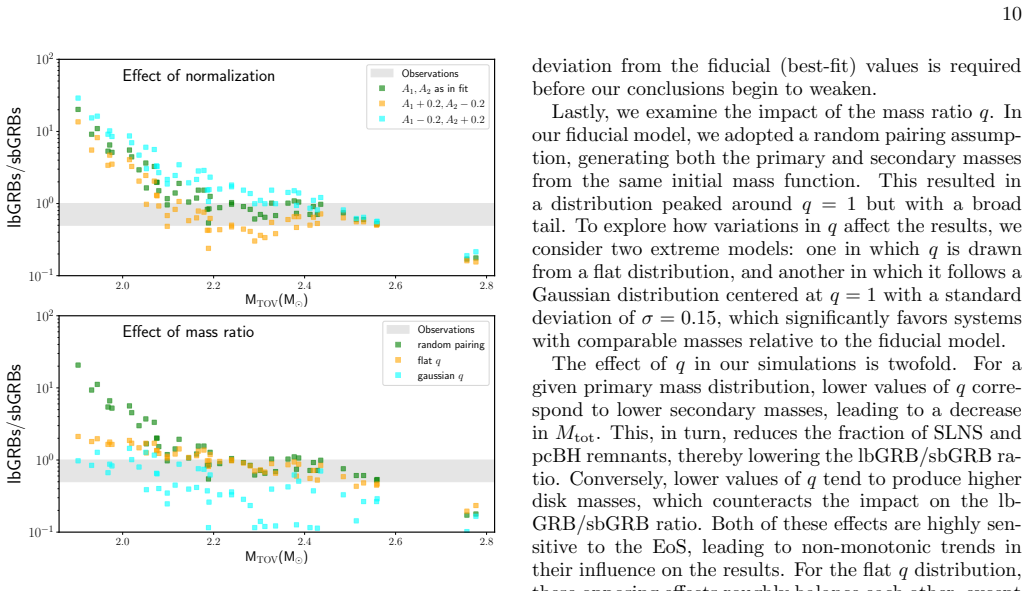
The central object is the threshold mass $M_{\rm ls}\equiv a\,M_{\rm TOV}$, the boundary between a long-lived neutron-star remnant and a short-lived one that collapses on the gravitational-wave timescale. The machinery is a Monte Carlo population synthesis: draw two neutron-star masses from a bimodal distribution, classify the remnant into one of five outcomes (stable neutron star, very long-lived neutron star, long-lived neutron star, short-lived neutron star, prompt-collapse black hole), assign each a disk mass from a fitting formula depending on total mass and mass ratio, and convert outcomes to GRB classes using the unification model: long-lived neutron stars power short GRBs, short-lived neutron stars and prompt-collapse black holes with disk mass $\gtrsim 0.1\,M_\odot$ power long GRBs, and stable or very long-lived neutron stars produce no detectable GRB. The observed long-to-short GRB ratio is the single number that carries the constraint.
What would settle it
A decisive test is a gravitational-wave-detected binary neutron star merger with an on-axis gamma-ray burst and well-measured total mass and disk mass: the model predicts a long burst when the remnant is a short-lived neutron star or prompt-collapse black hole with a disk mass above about 0.1 solar masses, and a short burst when it is a long-lived neutron star. One event whose observed burst contradicts that pairing would falsify the mapping and shift the inferred threshold; a larger low-redshift sample that fixes the long-to-short ratio outside the 0.5-1 band would similarly test the conclusion.
Extended reading notes
Core claim
The paper's core claim is that the dimensionless ratio of long- to short-duration gamma-ray bursts from compact binary mergers is a sharp probe of the neutron-star equation of state, specifically of the threshold mass $M_{\rm ls}=a\,M_{\rm TOV}$ at which a post-merger neutron star becomes too massive to survive even as a long-lived remnant. Assigning long-lived neutron stars to the short-GRB population, and short-lived neutron stars plus prompt-collapse black holes with disk mass $\gtrsim 0.1\,M_\odot$ to the long-GRB population, the authors compute the predicted long-to-short ratio for 52 equations of state as a function of $M_{\rm TOV}$. Comparing with the observationally estimated ratio of roughly 0.5-1 in the local universe, they conclude that the transition must lie at $M_{\rm ls}\simeq 1.3\,M_{\rm TOV}$, with viable equations of state having $M_{\rm TOV}\lesssim 2.6\,M_\odot$. Collapse times in the numerical-relativity catalog show the same transition near 1.3-to-1.4 $M_{\rm TOV}$, which the authors take as independent confirmation. The paper presents this as a new observational handle on nuclear properties: physics that would cause a catastrophic pressure loss and rapid collapse of binaries with total mass below roughly $1.3\,M_{\rm TOV}$ is disfavored.
Load-bearing premise
The argument rests on the classification of which remnant makes which burst: long-lived neutron stars are taken to produce short gamma-ray bursts, while long gamma-ray bursts require a black hole with a massive disk. If a long-lived remnant can also produce a long burst, the inferred threshold shifts.
Editorial extensions
If this is right
- Long-lived remnants survive over a wider mass range than the commonly quoted supramassive limit of about $1.2\,M_{\rm TOV}$, so a sizable fraction of mergers above that limit should still emit short GRBs before their neutron star collapses.
- Dense-matter scenarios that lose pressure catastrophically at a few times nuclear density—certain phase transitions, pion or kaon condensation—are disfavored for binaries with total mass below about $1.3\,M_{\rm TOV}$; such binaries should not collapse promptly if the inferred threshold is right.
- The high-threshold conclusion restricts viable equations of state to $M_{\rm TOV}\lesssim 2.6\,M_\odot$, in line with existing gravitational-wave constraints.
- Each future gravitational-wave event with an on-axis GRB, together with a kilonova-based disk-mass estimate, can bound $M_{\rm ls}$ individually; a small sample of such events would turn the statistical constraint into a per-event test.
Reading between the lines
- Because the paper draws both binary masses from the same bimodal distribution under random pairing, the inferred $M_{\rm ls}$ inherits the uncertainty in the mass-ratio distribution; an empirically calibrated mass-ratio distribution from future gravitational-wave and radio surveys could shift the preferred band even if the observed GRB ratio stays fixed.
- A complementary test would combine this GRB-ratio constraint with independent measurements of $M_{\rm TOV}$ from radio timing and X-ray observations; since the paper's constraint is on $M_{\rm ls}\simeq 1.3\,M_{\rm TOV}$, any improvement in $M_{\rm TOV}$ directly sharpens the statement about when remnants collapse.
- If future kilonova observations associate more blue-kilonova long GRBs with the sample, the clean split between long-lived neutron stars powering short GRBs and massive-disk black holes powering long GRBs would need revision, and the inferred threshold would likely move; the current classification rests on a small number of such events.
Editorial analysis
A structured set of objections, weighed in public.
Referee Report
Summary. The paper proposes a population-synthesis method to constrain the threshold mass M_ls that separates long-lived from short-lived neutron star merger remnants by connecting it to the observed ratio of long to short gamma-ray bursts from compact binary mergers. Using a bimodal neutron-star mass distribution, a five-way merger-outcome classification, and a disk-mass fitting formula, the authors compute the predicted ratio R_pred = N_LLNS / N_(SLNS+pcBH, Mdisk>=0.1 Msun) for 52 equations of state and compare it with an adopted observed band of 50%-100%. They conclude that M_ls is around 1.3 M_TOV, implying M_TOV less than about 2.6 solar masses, which they argue disfavors equations of state with catastrophic pressure loss at high density and temperature. They also compare with 273 numerical-relativity simulations from the CoRe catalog and report support for a transition near 1.3 M_TOV, while acknowledging that the transition region is broad.
Significance. The proposed method is novel and, if the central-engine mapping is correct, offers an observable route to the post-merger remnant hierarchy and the neutron-star equation of state. The paper's strengths are its explicit scan over 52 EoSs, the systematic one-at-a-time robustness checks in the appendix, and the use of a large numerical-relativity catalog. However, the quantitative claim depends on an externally adopted, unquantified GRB classification and a hand-adopted observed ratio; the appendix is a sensitivity study rather than a formal error propagation. The result is therefore best viewed as a proof-of-concept with indicative constraints, not as a precise measurement of M_ls.
major comments (4)
- [IIIB] The observational constraint is not a reproducible measurement. The text quotes a 40-50% ratio from Fong et al. and then adopts a 'broad conservative range' of 50-100%, whose upper end rests on a private communication (A. Levan). No Poisson, selection, or redshift-completeness uncertainties are assigned, and the lower edge excludes part of the quoted Fong et al. range. Because R_pred in Fig. 4 spans orders of magnitude, the set of allowed a values is controlled by this band. The paper should either derive the band from a published sample with quantified uncertainties or explicitly label the result as conditional on the adopted band.
- [IIIB] The predicted ratio is defined by three central-engine assumptions: LLNSs produce sbGRBs exclusively, SLNSs/pcBHs with Mdisk>=0.1 Msun produce lbGRBs exclusively, and SNS/VLNSs produce no detectable GRB. The manuscript itself notes (engine 3) that 'some LLNSs may contribute to the lbGRB population' and cites Margalit et al. [66] as allowing VLNS-powered sbGRBs. The appendix varies the two extreme VLNS cases but does not vary the LLNS-to-lb contamination fraction or the 0.1 Msun disk threshold. Since the ratio is steep in a, even a modest contamination in either channel changes which a-values match the observed band; the central claim M_ls ~ 1.3 M_TOV is therefore conditional on this untested mapping.
- [IIIB and Appendix] The inference is not a statistical fit. The scan over a = 1.2, 1.25, 1.3, 1.35, 1.4 is compared visually with a grey band; no likelihood, posterior, or goodness-of-fit is computed, and the appendix changes one input at a time without joint propagation of uncertainties. The abstract's 'broadly favour' and the conclusion's 'likely occurs in the range 1.3-1.4 M_TOV' therefore lack a quantitative significance. A formal propagation of the input uncertainties (NS mass function, M_th fit, disk-mass fit, observed ratio) is needed before this can be presented as a constraint on nuclear properties.
- [IIIC] The numerical-relativity comparison is qualitative. BH-formation times are identified by a peak-finding algorithm with manual inspection, many entries are lower limits, and the text itself notes that the transition region is broad (1.3-1.4 M_TOV) and that precise collapse times cannot be extracted reliably. The abstract's claim that the result is 'consistent with numerical simulations, as also shown here' overstates the support: no quantitative measure of consistency (e.g., the fraction of simulations in each remnant class versus the model prediction) is given. Please downgrade this to supporting evidence or provide a quantitative comparison.
minor comments (6)
- [Fig. 4] The y-axis label 'lbGRBs/sbGRBs' is the inverse of the ratio as defined in the text ('the ratio of LLNSs to [SLNSs + pcBHs]'); please make the convention consistent among the text, caption, and axis.
- [Fig. 2 caption] The caption 'Remnant fractions as a function of the total mass of the binary merger remnant' is inaccurate because the x-axis is M_TOV; please correct the caption.
- [Fig. 3 caption] The caption uses 'Mls = 1.3M⊙' where the text defines M_ls = a M_TOV; this should read 'Mls = 1.3MTOV' to avoid confusing a dimensionless ratio with a solar-mass value.
- [Fig. 5] The axis label 'tbh tm(ms)' is unclear; define t_BH and t_merg explicitly and label the axis as '(t_BH - t_merg) [ms]'.
- [Abstract, IIIB, IV] The central value is stated inconsistently: the abstract says M_ls ~ 1.3 M_TOV, Section IIIB concludes 'likely occurs in the range 1.3-1.4 M_TOV,' and Section IV says 'M_ls >= 1.3 M_TOV'; please harmonize the statement of the result.
- [IIIA] The sentence 'the disk mass can vary from several tens of solar masses for high unequal mass ratios' appears to be a typo; the disk masses shown in Fig. 3 and typical merger ejecta masses are well below ten solar masses.
Circularity Check
No significant circularity: the Mls constraint is inferred from an external GRB rate ratio and independently checked against numerical-relativity collapse times, with the Gottlieb et al. classification serving as an openly cited external model rather than a re-derivation of the target parameter.
full rationale
The derivation chain is a forward population-synthesis model whose output, the lbGRB/sbGRB ratio, is compared to an observed ratio taken from Fong et al. and Levan (private communication). The parameter Mls = a MTOV enters only through the definitions of LLNS and SLNS/pcBH remnant classes, so scanning a and matching the observed band is a standard parameter inference, not a prediction of the input data. The central-engine mapping (LLNS to sbGRBs; SLNS/pcBH with Mdisk >= 0.1 Msun to lbGRBs; SNS/VLNS to no detectable GRB) is adopted from Gottlieb et al. [24,25], on which one author overlaps with the present paper. However, that mapping rests on published GRMHD simulations and kilonova modeling, i.e., code-reproduced external evidence whose assumptions do not include the fitted value of Mls; it is therefore independent support under the review rules and does not constitute load-bearing circularity. The paper explicitly acknowledges the LLNS-exclusivity assumption, explores the two extreme VLNS contamination cases, and quantifies sensitivity to mass distribution, Mth, and disk mass in the appendix; these are stated limitations and robustness checks, not circular reductions. The independent CoRe numerical-relativity sample provides a separate check of the ~1.3 MTOV transition. No equation or fitted parameter is renamed as a prediction, and no result reduces by construction to its own input.
Assumptions & free parameters
free parameters (5)
- M_sp/M_TOV (VLNS-to-LLNS transition) =
1.15
- M_th fit parameters (kth and f(q) parameters) =
from Kashyap et al. [45] and Perego et al. [46]; q_tilde=0.725, beta_l and beta_h determined by continuity
- Disk mass fit parameters (a0, delta_a, b0, delta_b, c, d, beta, qtrans) =
a0=-1.581, delta_a=-2.439, b0=-0.538, delta_b=-0.406, c=0.953, d=0.0417, beta=3.910, qtrans=0.900
- NS mass distribution parameters (double Gaussian) =
mu1=1.351, sigma1=0.084, A1=0.539; mu2=1.816, sigma2=0.260, A2=0.460
- Disk mass threshold for detectable lbGRB =
0.1 Msun (detectable), 0.01 Msun (too faint)
assumptions (4)
- domain assumption Random pairing of NS masses in binaries: both masses drawn from the same bimodal distribution, with the larger drawn as primary.
- domain assumption Merger remnant classification and mapping to GRB classes: LLNSs power sbGRBs; SLNS/pcBH with Md >= 0.1 Msun power lbGRBs; SNS/VLNS do not produce detectable GRBs.
- domain assumption The threshold mass M_ls = a M_TOV with a single value across EoSs.
- domain assumption Negligible contribution of NS-BH mergers to the observed lbGRB population.
Cite this review
Pith. "Pith review of Connecting GRBs from Binary Neutron Star Mergers to Nuclear Properties of Neutron Stars." pith.science (2026). https://pith.science/paper/XRUGWYHM
@misc{pith2026241207846,
  author       = {Pith},
  title        = {Pith review of: Connecting GRBs from Binary Neutron Star Mergers to Nuclear Properties of Neutron Stars},
  year         = {2026},
  howpublished = {\url{https://pith.science/paper/XRUGWYHM}},
  note         = {Machine review of arXiv:2412.07846}
}
abstract
The fate of the binary neutron star (NS) merger remnants hinges sensitively upon the NS equation of state and the threshold mass, $M_{\rm ls}$, that separates a long-lived from a short-lived NS remnant. The nature of the electromagnetic counterparts is also influenced by the remnant type, particularly in determining whether a gamma-ray burst from a compact binary merger (cbGRB) is of short or long duration. We propose a novel approach to probe $M_{\rm ls}$ by linking it to the estimated observed ratio of long to short cbGRBs. We find that current observations broadly favour a relatively high value for this transition, $M_{\rm ls}\simeq 1.3 M_{\rm TOV}$, for which $ M_{\rm TOV} \lesssim 2.6\,M_\odot $, consistent with numerical simulations, as also shown here. Our results disfavour nuclear physics scenarios that would lead to catastrophic pressure loss at a few times nuclear density and temperatures of tens of MeV, leading to a rapid gravitational collapse of binaries with total mass $M \lesssim 1.3 M_{\rm TOV}$. Future individual gravitational wave events with on-axis cbGRBs can further bound $M_{\rm ls}$.
Figures


Figures from the paper (5 more)


Reference graph
Works this paper leans on
-
[66]
Ciolfi, International Journal of Modern Physics D 27, 1842004 (2018), arXiv:1804.03684 [astro-ph.HE]
R. Ciolfi, International Journal of Modern Physics D 27, 1842004 (2018), arXiv:1804.03684 [astro-ph.HE]
arXiv 2018
-
[1]
Numerical simula- tions of BNS mergers also generally suggest that a hypermassive NS phase is likely necessary to launch a successful GRB jet (see e.g
Millisecond SNSs and VLNSs are disfavoured as GRB progenitors since their immense rotational en- ergy is notably absent in GRB radio afterglows [56– 59] and optical kilonova signals. Numerical simula- tions of BNS mergers also generally suggest that a hypermassive NS phase is likely necessary to launch a successful GRB jet (see e.g. [60–62], but also note
-
[2]
When the disk mass is high, Md ≳ 0.1 M⊙, the BH will inevitably produce a long-lived jet, leading to a detectable lbGRB
The outcome of mergers resulting in SLNSs or prompt BH formation depends on the disk mass. When the disk mass is high, Md ≳ 0.1 M⊙, the BH will inevitably produce a long-lived jet, leading to a detectable lbGRB. However, if the disk mass is Md ≲ 10−2 M⊙, then given the magnetic flux on the BH, proportional to B2 ∼ Md, is reduced, the jet would be too fain...
-
[3]
supramassive
LLNSs power the standard sbGRBs, where the NS remnant lifetime roughly determines the GRB du- ration. We note that LLNSs are predicted to form massive accretion disks [e.g., 7]. This implies that in some cases, the collapse of the LLNSs into a BH could extend the emission, potentially produc- ing an lbGRB. However, the classification of the GRB would depe...
-
[4]
B. Margalit and B. D. Metzger, ApJ 850, L19 (2017), arXiv:1710.05938 [astro-ph.HE]
arXiv 2017
-
[5]
M. Shibata, S. Fujibayashi, K. Hotokezaka, K. Kiuchi, K. Kyutoku, Y. Sekiguchi, and M. Tanaka, Phys. Rev. D 96, 123012 (2017), arXiv:1710.07579 [astro-ph.HE]
arXiv 2017
-
[6]
B. P. Abbott, R. Abbott, T. D. Abbott, F. Acernese, K. Ackley, C. Adams, T. Adams, P. Addesso, R. X. Ad- hikari, V. B. Adya, C. Affeldt, M. Afrough, B. Agar- wal, M. Agathos, K. Agatsuma, N. Aggarwal, O. D. Aguiar, L. Aiello, A. Ain, P. Ajith, B. Allen, G. Allen, A. Allocca, P. A. Altin, A. Amato, A. Ananyeva, S. B. Anderson, W. G. Anderson, S. V. Angelov...
arXiv 2017
-
[7]
K. P. Mooley, A. T. Deller, O. Gottlieb, E. Nakar, G. Hallinan, S. Bourke, D. A. Frail, A. Horesh, A. Corsi, and K. Hotokezaka, Nature 561, 355 (2018), arXiv:1806.09693 [astro-ph.HE]
arXiv 2018
Show all 91 references
-
[8]
B. P. Abbott, R. Abbott, T. D. Abbott, F. Acernese, K. Ackley, C. Adams, T. Adams, P. Addesso, R. X. Ad- 11 hikari, V. B. Adya, C. Affeldt, B. Agarwal, M. Agathos, K. Agatsuma, N. Aggarwal, O. D. Aguiar, L. Aiello, A. Ain, P. Ajith, B. Allen, G. Allen, A. Allocca, M. A. Aloy, ...
2018 arXiv
-
[9]
Rezzolla, E
L. Rezzolla, E. R. Most, and L. R. Weih, ApJ 852, L25 (2018), arXiv:1711.00314 [astro-ph.HE]
2018 arXiv
-
[10]
Shibata, E
M. Shibata, E. Zhou, K. Kiuchi, and S. Fujibayashi, Phys. Rev. D 100, 023015 (2019), arXiv:1905.03656 [astro-ph.HE]
2019 arXiv
-
[11]
E. R. Most, L. R. Weih, L. Rezzolla, and J. Schaffner- Bielich, Phys. Rev. Lett. 120, 261103 (2018), arXiv:1803.00549 [gr-qc]
2018 arXiv
-
[12]
Radice, A
D. Radice, A. Perego, K. Hotokezaka, S. A. Fromm, S. Bernuzzi, and L. F. Roberts, ApJ 869, 130 (2018), arXiv:1809.11161 [astro-ph.HE]
2018 arXiv
-
[13]
Radice, A
D. Radice, A. Perego, F. Zappa, and S. Bernuzzi, ApJ 852, L29 (2018), arXiv:1711.03647 [astro-ph.HE]
2018 arXiv
-
[14]
S. E. Woosley, ApJ 405, 273 (1993)
1993
-
[15]
A. I. MacFadyen and S. E. Woosley, ApJ524, 262 (1999), arXiv:astro-ph/9810274 [astro-ph]
1999 arXiv
-
[16]
Dietrich, M
T. Dietrich, M. W. Coughlin, P. T. H. Pang, M. Bulla, J. Heinzel, L. Issa, I. Tews, and S. Antier, Science 370, 1450 (2020), arXiv:2002.11355 [astro-ph.HE]
2020 arXiv
-
[17]
Lazzati and R
D. Lazzati and R. Perna, ApJ 881, 89 (2019), arXiv:1904.08425 [astro-ph.HE]
2019 arXiv
-
[18]
Kouveliotou, C
C. Kouveliotou, C. A. Meegan, G. J. Fishman, N. P. Bhat, M. S. Briggs, T. M. Koshut, W. S. Paciesas, and G. N. Pendleton, ApJ 413, L101 (1993)
1993
-
[20]
Zhang, Y.-Y
H.-M. Zhang, Y.-Y. Huang, J.-H. Zheng, R.-Y. Liu, and X.-Y. Wang, ApJ 933, L22 (2022), arXiv:2205.09675 [astro-ph.HE]
2022 arXiv
-
[21]
J. C. Rastinejad, B. P. Gompertz, A. J. Levan, W.-f. Fong, M. Nicholl, G. P. Lamb, D. B. Malesani, A. E. Nu- gent, S. R. Oates, N. R. Tanvir, A. de Ugarte Postigo, C. D. Kilpatrick, C. J. Moore, B. D. Metzger, M. E. Ravasio, A. Rossi, G. Schroeder, J. Jencson, D. J. Sand, N. S...
2022 arXiv
-
[22]
Troja, C
E. Troja, C. L. Fryer, B. O’Connor, G. Ryan, S. Dichiara, A. Kumar, N. Ito, R. Gupta, R. T. Wollaeger, J. P. Norris, N. Kawai, N. R. Butler, A. Aryan, K. Misra, R. Hosokawa, K. L. Murata, M. Niwano, S. B. Pandey, A. Kutyrev, H. J. van Eerten, E. A. Chase, Y. D. Hu, M. D. Cabal...
2022 arXiv
-
[23]
J. Yang, S. Ai, B.-B. Zhang, B. Zhang, Z.-K. Liu, X. I. Wang, Y.-H. Yang, Y.-H. Yin, Y. Li, and H.-J. L¨ u, Na- ture 612, 232 (2022), arXiv:2204.12771 [astro-ph.HE]
2022 arXiv
-
[24]
Gottlieb, B
O. Gottlieb, B. D. Metzger, E. Quataert, D. Issa, T. Martineau, F. Foucart, M. D. Duez, L. E. Kidder, H. P. Pfeiffer, and M. A. Scheel, ApJ 958, L33 (2023), arXiv:2309.00038 [astro-ph.HE]
2023 arXiv
-
[25]
Gottlieb, B
O. Gottlieb, B. D. Metzger, F. Foucart, and E. Ramirez- Ruiz, ApJ (2024), arXiv:2411.13657 [astro-ph.HE]
2024 arXiv
-
[26]
Levan, B
A. Levan, B. P. Gompertz, O. S. Salafia, M. Bulla, E. Burns, K. Hotokezaka, L. Izzo, G. P. Lamb, D. B. Malesani, S. R. Oates, M. E. Ravasio, A. Rouco Esco- rial, B. Schneider, N. Sarin, S. Schulze, N. R. Tanvir, K. Ackley, G. Anderson, G. B. Brammer, L. Christensen, V. S. Dhil...
2023 arXiv
-
[27]
H. Sun, C. W. Wang, J. Yang, B. B. Zhang, S. L. Xiong, Y. H. I. Yin, Y. Liu, Y. Li, W. C. Xue, Z. Yan, C. Zhang, W. J. Tan, H. W. Pan, J. C. Liu, H. Q. Cheng, Y. Q. Zhang, J. W. Hu, C. Zheng, Z. H. An, C. Cai, L. Hu, C. Jin, D. Y. Li, X. Q. Li, H. Y. Liu, M. Liu, W. X. Peng, L...
2023 arXiv
-
[28]
Lazzati, R
D. Lazzati, R. Perna, B. P. Gompertz, and A. J. Levan, ApJ 950, L20 (2023), arXiv:2303.12935 [astro-ph.HE]
2023 arXiv
-
[29]
O. S. Salafia, A. Colombo, F. Gabrielli, and I. Mandel, A&A 666, A174 (2022), arXiv:2202.01656 [astro-ph.HE]
2022 arXiv
-
[30]
A. L. Piro, B. Giacomazzo, and R. Perna, ApJ 844, L19 (2017), arXiv:1704.08697 [astro-ph.HE]
2017 arXiv
-
[31]
J. C. Rastinejad, W. Fong, C. D. Kilpatrick, M. Nicholl, and B. D. Metzger, arXiv e-prints , arXiv:2409.02158 (2024), arXiv:2409.02158 [astro-ph.HE]
2024 arXiv
-
[32]
Belczynski, R
K. Belczynski, R. O’Shaughnessy, V. Kalogera, F. Ra- sio, R. E. Taam, and T. Bulik, ApJ 680, L129 (2008), arXiv:0712.1036 [astro-ph]
2008 arXiv
-
[33]
C. L. Fryer, K. Belczynski, E. Ramirez-Ruiz, S. Ross- wog, G. Shen, and A. W. Steiner, ApJ 812, 24 (2015), arXiv:1504.07605 [astro-ph.HE]
2015 arXiv
-
[34]
R. W. Romani, D. Kandel, A. V. Filippenko, T. G. Brink, and W. Zheng, ApJ 934, L17 (2022), arXiv:2207.05124 [astro-ph.HE]
2022 arXiv
-
[35]
Schwab, P
J. Schwab, P. Podsiadlowski, and S. Rappaport, ApJ 719, 722 (2010), arXiv:1006.4584 [astro-ph.HE]
2010 arXiv
-
[36]
Sarin, P
N. Sarin, P. D. Lasky, and G. Ashton, Phys. Rev. D 101, 12 063021 (2020), arXiv:2001.06102 [astro-ph.HE]
2020 arXiv
-
[37]
Guglielmi, G
L. Guglielmi, G. Stratta, S. Dall’Osso, P. Singh, M. Brusa, and R. Perna, arXiv e-prints , arXiv:2410.07941 (2024), arXiv:2410.07941 [astro- ph.HE]
2024 arXiv
-
[38]
T. M. Tauris, M. Kramer, P. C. C. Freire, N. Wex, H. T. Janka, N. Langer, P. Podsiadlowski, E. Bozzo, S. Chaty, M. U. Kruckow, E. P. J. van den Heuvel, J. Antoniadis, R. P. Breton, and D. J. Champion, ApJ 846, 170 (2017), arXiv:1706.09438 [astro-ph.HE]
2017 arXiv
-
[39]
Galaudage, C
S. Galaudage, C. Adamcewicz, X.-J. Zhu, S. Stevenson, and E. Thrane, ApJ 909, L19 (2021), arXiv:2011.01495 [astro-ph.HE]
2021 arXiv
-
[40]
L. S. Rocha, J. E. Horvath, L. M. de S´ a, G. Y. Chinen, L. G. Bar˜ ao, and M. G. B. de Avellar, Universe 10, 3 (2023), arXiv:2312.13244 [astro-ph.HE]
2023 arXiv
-
[41]
Antoniadis, T
J. Antoniadis, T. M. Tauris, F. Ozel, E. Barr, D. J. Champion, and P. C. C. Freire, arXiv e-prints , arXiv:1605.01665 (2016), arXiv:1605.01665 [astro- ph.HE]
2016 arXiv
-
[42]
Alsing, H
J. Alsing, H. O. Silva, and E. Berti, MNRAS 478, 1377 (2018), arXiv:1709.07889 [astro-ph.HE]
2018 arXiv
-
[43]
W. M. Farr and K. Chatziioannou, Research Notes of the American Astronomical Society 4, 65 (2020), arXiv:2005.00032 [astro-ph.GA]
2020 arXiv
- [44]
-
[45]
Kashyap, A
R. Kashyap, A. Das, D. Radice, S. Padamata, A. Prakash, D. Logoteta, A. Perego, D. A. Godzieba, S. Bernuzzi, I. Bombaci, F. J. Fattoyev, B. T. Reed, and A. d. S. Schneider, Phys. Rev. D 105, 103022 (2022), arXiv:2111.05183 [astro-ph.HE]
2022 arXiv
-
[46]
Zhang, S
W. Zhang, S. E. Woosley, and A. Heger, ApJ 679, 639 (2008), arXiv:astro-ph/0701083 [astro-ph]
2008 arXiv
-
[47]
M. B. N. Kouwenhoven, A. G. A. Brown, S. P. Good- win, S. F. Portegies Zwart, and L. Kaper, A&A 493, 979 (2009), arXiv:0811.2859 [astro-ph]
2009 arXiv
-
[48]
Radice, S
D. Radice, S. Bernuzzi, and A. Perego, Annual Re- view of Nuclear and Particle Science 70, 95 (2020), arXiv:2002.03863 [astro-ph.HE]
2020 arXiv
-
[49]
Dietrich, M
T. Dietrich, M. Ujevic, W. Tichy, S. Bernuzzi, and B. Br¨ ugmann, Phys. Rev. D 95, 024029 (2017), arXiv:1607.06636 [gr-qc]
2017 arXiv
-
[50]
Kiuchi, K
K. Kiuchi, K. Kyutoku, M. Shibata, and K. Taniguchi, ApJ 876, L31 (2019), arXiv:1903.01466 [astro-ph.HE]
2019 arXiv
-
[51]
Perego, D
A. Perego, D. Logoteta, D. Radice, S. Bernuzzi, R. Kashyap, A. Das, S. Padamata, and A. Prakash, Phys. Rev. Lett. 129, 032701 (2022), arXiv:2112.05864 [astro-ph.HE]
2022 arXiv
-
[52]
P. T. H. Pang, L. Sivertsen, R. Somasundaram, T. Dietrich, S. Sen, I. Tews, M. W. Coughlin, and C. Van Den Broeck, Phys. Rev. C 109, 025807 (2024), arXiv:2308.15067 [nucl-th]
2024 arXiv
-
[53]
Hotokezaka, K
K. Hotokezaka, K. Kyutoku, H. Okawa, M. Shibata, and K. Kiuchi, Phys. Rev. D 83, 124008 (2011), arXiv:1105.4370 [astro-ph.HE]
2011 arXiv
-
[54]
We note that this is a rough estimate and possibly subject to change with more future data
to represent the lbGRB share. We note that this is a rough estimate and possibly subject to change with more future data. A more comprehensive analysis extending the sample to z ≲ 0.5 suggests that the long-to-short ra- tio might be even as high as ∼ 1 (A. Levan, private com- ...
-
[55]
Tchekhovskoy, R
A. Tchekhovskoy, R. Narayan, and J. C. McKinney, MN- RAS 418, L79 (2011), arXiv:1108.0412 [astro-ph.HE]
2011 arXiv
-
[56]
M. W. Coughlin, T. Dietrich, Z. Doctor, D. Kasen, S. Coughlin, A. Jerkstrand, G. Leloudas, O. McBrien, B. D. Metzger, R. O’Shaughnessy, and S. J. Smartt, MN- RAS 480, 3871 (2018), arXiv:1805.09371 [astro-ph.HE]
2018 arXiv
-
[57]
W.-f. Fong, A. E. Nugent, Y. Dong, E. Berger, K. Pater- son, R. Chornock, A. Levan, P. Blanchard, K. D. Alexan- der, J. Andrews, B. E. Cobb, A. Cucchiara, D. Fox, C. L. Fryer, A. C. Gordon, C. D. Kilpatrick, R. Lun- nan, R. Margutti, A. Miller, P. Milne, M. Nicholl, D. Perley,...
2022 arXiv
-
[58]
Gehrels, J
N. Gehrels, J. P. Norris, V. Mangano, S. D. Barthelmy, D. N. Burrows, J. Granot, Y. Kaneko, C. Kouveliotou, C. B. Markwardt, P. Meszaros, E. Nakar, J. A. Nousek, P. T. O’Brien, M. Page, D. M. Palmer, A. M. Parsons, P. W. A. Roming, T. Sakamoto, C. L. Sarazin, P. Schady, and M....
2006
-
[59]
Y.-H. Yang, E. Troja, B. O’Connor, C. L. Fryer, M. Im, J. Durbak, G. S. H. Paek, R. Ricci, C. R. Bom, J. H. Gillanders, A. J. Castro-Tirado, Z.-K. Peng, S. Dichiara, G. Ryan, H. van Eerten, Z.-G. Dai, S.-W. Chang, H. Choi, K. De, Y. Hu, C. D. Kil- patrick, A. Kutyrev, M. Jeong...
2024 arXiv
-
[60]
Margalit, B
B. Margalit, B. D. Metzger, and A. M. Beloborodov, Phys. Rev. Lett. 115, 171101 (2015), arXiv:1505.01842 [astro-ph.HE]
2015 arXiv
-
[61]
B. D. Metzger and G. C. Bower, MNRAS 437, 1821 (2014), arXiv:1310.4506 [astro-ph.HE]
2014 arXiv
-
[62]
Horesh, K
A. Horesh, K. Hotokezaka, T. Piran, E. Nakar, and P. Hancock, ApJ 819, L22 (2016), arXiv:1601.01692 [astro-ph.HE]
2016 arXiv
-
[63]
for a successful outcome). While we adopt this as our fiducial model, however we also explore how our results vary if this assumption is released and magnetars associated with VLNSs make up a size- able fraction of cbGRBs
-
[64]
Beniamini and W
P. Beniamini and W. Lu, ApJ 920, 109 (2021), arXiv:2104.01181 [astro-ph.HE]
2021 arXiv
-
[65]
H. Wang, P. Beniamini, and D. Giannios, MNRAS 527, 5166 (2024), arXiv:2308.09164 [astro-ph.HE]
2024 arXiv
-
[67]
Murguia-Berthier, E
A. Murguia-Berthier, E. Ramirez-Ruiz, G. Montes, F. De Colle, L. Rezzolla, S. Rosswog, K. Takami, A. Perego, and W. H. Lee, ApJ 835, L34 (2017), arXiv:1609.04828 [astro-ph.HE]
2017 arXiv
-
[68]
Kiuchi, A
K. Kiuchi, A. Reboul-Salze, M. Shibata, and Y. Sekiguchi, Nature Astronomy 8, 298 (2024), arXiv:2306.15721 [astro-ph.HE]
2024 arXiv
- [69]
-
[70]
Abbott, others (LIGO Scientific Collaboration, and V
R. Abbott, others (LIGO Scientific Collaboration, and V. Collaboration), The Astrophysical Journal Letters 915, L5 (2021)
2021
-
[71]
Margalit, A
B. Margalit, A. S. Jermyn, B. D. Metzger, L. F. Roberts, and E. Quataert, ApJ 939, 51 (2022), arXiv:2206.10645 [astro-ph.HE]
2022 arXiv
-
[72]
T. W. Baumgarte, S. L. Shapiro, and M. Shibata, ApJ 528, L29 (2000), arXiv:astro-ph/9910565 [astro-ph]
2000 arXiv
-
[73]
P. D. Lasky, B. Haskell, V. Ravi, E. J. Howell, and D. M. Coward, Phys. Rev. D 89, 047302 (2014), arXiv:1311.1352 [astro-ph.HE]
2014 arXiv
-
[74]
Dietrich, D
T. Dietrich, D. Radice, S. Bernuzzi, F. Zappa, A. Perego, B. Br¨ ugmann, S. V. Chaurasia, R. Dudi, W. Tichy, and M. Ujevic, Class. Quant. Grav. 35, 24LT01 (2018), arXiv:1806.01625 [gr-qc]
2018 arXiv
-
[75]
Gonzalez et al., Class
A. Gonzalez et al., Class. Quant. Grav. 40, 085011 13 (2023), arXiv:2210.16366 [gr-qc]
2023 arXiv
-
[76]
Zappa, S
F. Zappa, S. Bernuzzi, D. Radice, and A. Perego, MN- RAS 520, 1481 (2023), arXiv:2210.11491 [astro-ph.HE]
2023 arXiv
-
[77]
Bruegmann, J
B. Bruegmann, J. A. Gonzalez, M. Hannam, S. Husa, U. Sperhake, and W. Tichy, Phys. Rev. D 77, 024027 (2008), arXiv:gr-qc/0610128
2008 arXiv
-
[78]
Thierfelder, S
M. Thierfelder, S. Bernuzzi, and B. Bruegmann, Phys. Rev. D 84, 044012 (2011), arXiv:1104.4751 [gr-qc]
2011 arXiv
-
[79]
Radice and L
D. Radice and L. Rezzolla, Astron. Astrophys. 547, A26 (2012), arXiv:1206.6502 [astro-ph.IM]
2012 arXiv
-
[80]
Radice, L
D. Radice, L. Rezzolla, and F. Galeazzi, Class. Quant. Grav. 31, 075012 (2014), arXiv:1312.5004 [gr-qc]
2014 arXiv
-
[81]
Radice, L
D. Radice, L. Rezzolla, and F. Galeazzi, ASP Conf. Ser. 498, 121 (2015), arXiv:1502.00551 [gr-qc]
2015 arXiv
-
[82]
Bernuzzi, A
S. Bernuzzi, A. Nagar, S. Balmelli, T. Dietrich, and M. Ujevic, Phys. Rev. Lett. 112, 201101 (2014), arXiv:1402.6244 [gr-qc]
2014 arXiv
-
[83]
Fan, M.-Z
Y.-Z. Fan, M.-Z. Han, J.-L. Jiang, D.-S. Shao, and S.-P. Tang, Phys. Rev. D 109, 043052 (2024), arXiv:2309.12644 [astro-ph.HE]
2024 arXiv
-
[84]
Nedora, S
V. Nedora, S. Bernuzzi, D. Radice, A. Perego, A. Endrizzi, and N. Ortiz, ApJ 886, L30 (2019), arXiv:1907.04872 [astro-ph.HE]
2019 arXiv
-
[85]
Nedora, F
V. Nedora, F. Schianchi, S. Bernuzzi, D. Radice, B. Daszuta, A. Endrizzi, A. Perego, A. Prakash, and F. Zappa, Classical and Quantum Gravity 39, 015008 (2022), arXiv:2011.11110 [astro-ph.HE]
2022 arXiv
-
[86]
Bernuzzi, F
S. Bernuzzi, F. Magistrelli, M. Jacobi, D. Lo- goteta, A. Perego, and D. Radice, arXiv e-prints , arXiv:2409.18185 (2024), arXiv:2409.18185 [astro- ph.HE]
2024 arXiv
-
[87]
B. D. Metzger, P. Beniamini, and D. Giannios, ApJ 857, 95 (2018), arXiv:1802.07750 [astro-ph.HE]
2018 arXiv
-
[88]
Combi and D
L. Combi and D. M. Siegel, Phys. Rev. Lett. 131, 231402 (2023), arXiv:2303.12284 [astro-ph.HE]
2023 arXiv
-
[89]
Bauswein, S
A. Bauswein, S. Blacker, G. Lioutas, T. Soultanis, V. Vi- jayan, and N. Stergioulas, Phys. Rev. D 103, 123004 (2021), arXiv:2010.04461 [astro-ph.HE]
2021 arXiv
-
[90]
S. D. Tootle, L. J. Papenfort, E. R. Most, and L. Rezzolla, ApJ 922, L19 (2021), arXiv:2109.00940 [gr-qc]
2021 arXiv
-
[91]
K¨ olsch, T
M. K¨ olsch, T. Dietrich, M. Ujevic, and B. Br¨ ugmann, Phys. Rev. D 106, 044026 (2022), arXiv:2112.11851 [gr- qc]
2022 arXiv
-
[92]
Chattopadhyay, S
D. Chattopadhyay, S. Stevenson, J. R. Hurley, L. J. Rossi, and C. Flynn, MNRAS 494, 1587 (2020), arXiv:1912.02415 [astro-ph.HE]
2020 arXiv
Reviewed August 11, 2026 · model on record in the stance chip above.
Discussion (0). Continue with ORCID to comment.