REVIEW 3 major objections 4 minor 37 references
Phase Diagram of Spin-3/2 Fermions in One Dimensional Optical Lattices
T0 review · 3 major / 4 minor · reviewed 2026-08-11 · deepseek-v4-flash
Pith's one-line read This paper maps the full phase diagram of spin-3/2 fermions in a one-dimensional optical lattice, finding quartet, atomic-density-wave, and FFLO-like quintet pairing orders, plus a generalized S=2 bosonic t-J chain near half-filling under…
desk verdict A competent DMRG phase-diagram study of spin-3/2 fermions whose genuinely new U=V region needs a finite-size check before its boundaries are trusted. read the letter →
The pith
A machine-rendered reading of the paper's core claim, the machinery that carries it, and where it could break.
The reading
What carries the argument
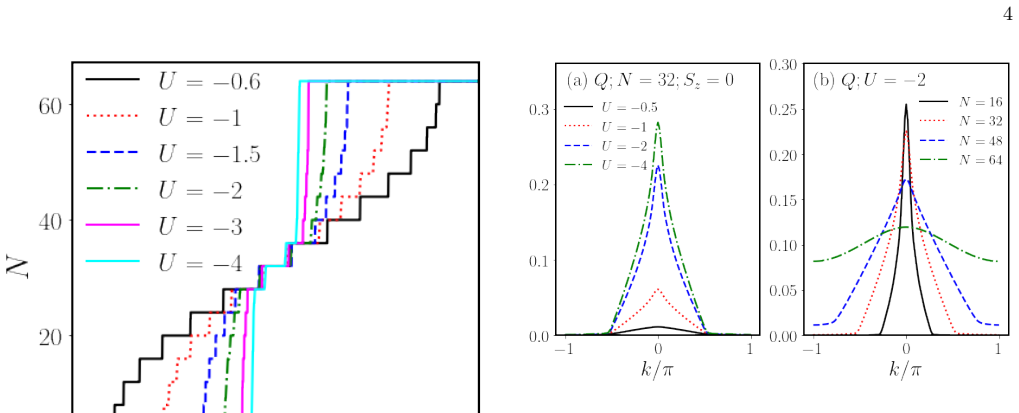
The argument is carried by the Hamiltonians in Eqs. (1)-(3), written equivalently in terms of singlet and quintet pair creation operators $P^\dagger_{S,m}$, and by the DMRG computation of canonical ground-state energies $E_0(N,S_z)$ on L=16 open chains. A Maxwell construction converts these energies into grand-canonical phase diagrams, while order parameters---quartet operator $Q^\dagger_i = c^\dagger_{3/2}c^\dagger_{-3/2}c^\dagger_{1/2}c^\dagger_{-1/2}$, trion operator $T^\dagger_i$, pair-pair correlations in momentum space, and the static spin and density structure factors---identify which order dominates. The SU(4) case uses the identities linking the density/spin form to the pair operators, and the U=V case leverages the earlier mapping of the model to an S=2 spin chain. The key mechanism is the competition between quartet formation (favored by U<0 at low density) and atomic density wave order (pinned by open boundaries), with magnetic field breaking spin degeneracy and selecting finite-momentum quintet pairing channels.
What would settle it
Run DMRG on the same model at L=32, 48, and 64 with open and periodic boundary conditions, and extrapolate the Maxwell-construction phase boundaries; if the half-filling ADW region or the quartet-versus-ADW boundary moves substantially, or if the pinned density modulation disappears under periodic boundary conditions, the claimed phase diagram would need revision.
Extended reading notes
Core claim
On the paper's own terms, the central discovery is a phase diagram: for the SU(4) Hubbard chain with attractive interactions (V=0), the ground state at zero field and half-filling is a robust atomic density wave across the entire interaction range studied, while away from half-filling the system favors a quartet quasi-condensate whose density steps in units of four particles; at finite polarization the system evolves into featureless metallic regions and, in two-band regions, into FFLO-like pairing with finite center-of-mass momentum. In the presence of single-ion anisotropy U=V, S=2 pairs are energetically favored, and near half-filling the model maps onto a generalized S=2 bosonic t-J chain with a charge gap and a spin (Haldane) gap; away from half-filling it behaves as holes moving in a background of S=2 spins, with pair-pair correlations decaying within a few lattice spacings. The paper explicitly concludes that no trion or quartet long-range order appears at finite polarization in the studied regime.
Load-bearing premise
The phase diagram is built from DMRG energies on 16-site open chains with no finite-size extrapolation, and the atomic-density-wave order is inferred from density modulations that the open boundaries automatically pin, so boundary and size effects could shift the quoted phase boundaries.
Editorial extensions
If this is right
- In the SU(4) sector, the ground state at half-filling and zero polarization is an atomic density wave for all studied U, with a spin gap but gapless charge.
- Away from half-filling and at zero field, particles enter in quartets, forming a quartet quasi-condensate at low densities instead of Cooper pairs.
- Under a magnetic field, two partially filled bands support FFLO-like quintet pairing with finite center-of-mass momentum, analogous to spin-1/2 imbalanced chains.
- For U=V, the half-filled system is a charge-gapped, spin-gapped S=2 Mott insulator, and doping it produces a generalized S=2 bosonic t-J chain.
- Large negative |U| drives phase separation into quartet 'bubbles', so the stable phases occur only at moderate interaction strength.
Reading between the lines
- Because the Maxwell construction is done at L=16, a systematic extrapolation in chain length could shift boundaries between quartet, ADW, and paired regions, so the quantitative locations in Figs. 2 and 9 are the least secure part of the diagram.
- The paper reads open-boundary density modulations as intrinsic ADW order; a periodic-boundary study with a twist would test whether the modulation is bulk order or boundary-induced.
- The S=2 bosonic t-J chain picture suggests that spin quadrupolar or Haldane-type correlations could be probed directly in experiments through spin structure factors at momentum $k_F$, a signature the paper computes but does not emphasize as a detection route.
- Extending the same Maxwell-construction approach to longer chains and to the integrable SO(4) point could connect the numerical phase diagram to known exact solutions.
Editorial analysis
A structured set of objections, weighed in public.
Referee Report
Summary. The paper reports DMRG calculations for a generalized Hubbard chain of spin-3/2 fermions with SU(4)-symmetric interactions and with additional single-ion anisotropy. Using canonical ground-state energies on L=16 open chains and a Maxwell construction, the authors map density and polarization as functions of chemical potential and magnetic field, and identify phases including quartet correlations, atomic density waves, FFLO-like quintet pairing, and, near half-filling for U=V, an S=2 bosonic t-J regime. The SU(4) results largely confirm earlier studies (Refs. 27 and 29), while the U=V analysis extends the S=2 chain mapping of Ref. 13 to finite densities and polarizations.
Significance. If the phase assignments are robust, the paper provides a useful unified phase diagram for a model relevant to ultracold spin-3/2 fermions and sharpens the interpretation of the U=V regime as a doped S=2 bosonic t-J chain. The work is honest in using independent order parameters and in reporting converged DMRG energies to seven decimal places. However, the central claims currently rest on a single chain length for the phase boundaries and on boundary-pinned density modulations, so the significance is not yet fully established.
major comments (3)
- [Sec. III A 1, Fig. 2] The full phase diagram is constructed from canonical DMRG energies E0(N,Sz) on L=16 open chains via a Maxwell construction, with no finite-size scaling or error bars. The only statement about larger systems is the parenthetical 'results for larger U and larger L –not shown here– corroborate these findings' in Sec. III B. Because the claimed S=2 bosonic t-J region near half-filling is precisely where finite-size level crossings and open-boundary effects can alter the convex hull of E(N,Sz), the phase boundaries and the central novelty are not yet established at the level claimed. Please provide a quantitative finite-size study (at least for representative cuts at L=24, 32, and 48) or explicitly restrict the claims to L=16.
- [Sec. III A 2, Fig. 5] The ADW phase is identified from real-space density modulations in open chains that are said to be 'automatically pinned.' The paper does not provide the density structure factor D(k) or a scaling analysis showing that the modulation amplitude survives the thermodynamic limit. Since ADW is one of the principal competing orders, boundary pinning alone is insufficient evidence; please add D(k) or an L-dependence of the modulation amplitude.
- [Sec. III B, Figs. 9-10] The central new claim that away from half-filling the U=V system behaves as a generalized S=2 bosonic t-J chain rests on a singular peak in Sz(k) at k=kF that is described in a parenthetical remark as 'not shown.' The displayed Fig. 10(b) is only at half-filling; the doped regime is where the t-J interpretation is asserted. Please show the doped spin structure factor and, ideally, the pairing correlations supporting the statement that pairs behave as free-like hard-core bosons whose condensation is frustrated by spin order.
minor comments (4)
- [Fig. 3 caption / Sec. III A 1] The caption states the curve is 'obtained by means of the Maxwell construction' while the text describes the construction as applied to canonical energies; please clarify the exact role of the Maxwell construction in generating this figure.
- [Eqs. (7)-(8)] The momentum-space quartet correlator Q(k), density structure factor D(k), and spin structure factor Sz(k) are introduced verbally after Eq. (7) but not written explicitly; please provide their definitions for reproducibility.
- [Fig. 10 caption] The caption contains a duplicated phrase and an incomplete sentence ('for a chain of length L = 32 at half-filling and for several values of U = V'); please revise.
- [Sec. III A 3] The particle numbers quoted in the text for region III are not stated explicitly in the body; including N and 2Sz for Fig. 7 in the main text would improve readability.
Circularity Check
No significant circularity: the phase diagram is generated from raw DMRG energies and the S=2 t-J interpretation is checked against independent correlation functions.
full rationale
The paper's central outputs are canonical DMRG energies E0(N,Sz) on L=16 chains processed through a Maxwell construction (Sec. III A 1). No parameter is fitted to any quantity that is later presented as a prediction; the phase boundaries are a convex-hull minimization of E0(N,Sz) - mu N - h Sz, and the ordering assignments are made through independently computed momentum-space correlators (pair, quartet, density, and spin structure factors). The claimed near-half-filling correlated phase 'understood in terms of a generalized S=2 bosonic t-J chain' is not derived by fitting: it is supported by the plateau in n vs. mu (Fig. 10a), the half-filling Mott behavior, and the spin structure factor Sz(k); the t-J expectation is attributed to the external mapping of Ref. [13] (Tu, Zhang, and Yu) and to standard t-J literature, not to a self-citation chain. The one self-cited reference used for the k = kF peak expectation (Ref. [33], Yang, Hamad, Manuel, and Feiguin) is corroborative rather than load-bearing, and the peak is explicitly marked as 'not shown'. No equation in the paper defines an output in terms of an input or renames a known result; the SU(4) agreement with Refs. [27] and [29] is a confirmation, not a circular derivation. Finite-size and open-boundary concerns about the L=16 Maxwell construction and the automatic pinning of density modulations are correctness risks, not circularity.
Assumptions & free parameters
assumptions (5)
- domain assumption DMRG ground-state energies for L=16 and L=32 open chains, converged to seven decimal places, faithfully represent the low-energy physics of the infinite chain.
- domain assumption Density modulations pinned by open boundary conditions are taken to reveal intrinsic atomic density wave order rather than boundary artifacts.
- standard math The Maxwell construction over a finite set of (N, Sz) sectors gives the full stability regions in (mu, h) space.
- standard math S=1 and S=3 two-body scattering channels are forbidden for identical fermions by Pauli exclusion; s-wave contact interactions suffice.
- domain assumption Identification of phases from momentum-space correlation cusps (quartet, FFLO) uses Luttinger-liquid criteria for quasi-long-range order at finite L.
Cite this review
Pith. "Pith review of Phase Diagram of Spin-3/2 Fermions in One Dimensional Optical Lattices." pith.science (2026). https://pith.science/paper/3WSUGOAI
@misc{pith2026241207900,
  author       = {Pith},
  title        = {Pith review of: Phase Diagram of Spin-3/2 Fermions in One Dimensional Optical Lattices},
  year         = {2026},
  howpublished = {\url{https://pith.science/paper/3WSUGOAI}},
  note         = {Machine review of arXiv:2412.07900}
}
read the original abstract
We present a density matrix renormalization group(DMRG) study of a generalized Hubbard chain describing effective spin S=3/2 fermions in an optical lattice.We determine the full phase diagram for the SU(4) symmetric case, and in the presence of single-ion anisotropy in terms of density and polarization.We investigate the stability and competition between different orders, such as quintet Fulde-Ferrell-Larkin-Ovchinnikov(FFLO) pairing, trion and quartet formation, and spin and atomic density waves.Notably, near half-filling, single-ion anisotropy stabilizes a correlated phase that can be understood in terms of a generalized S=2 bosonic t-J chain.
Figures


Figures from the paper (3 more)


Reference graph
Works this paper leans on
-
[1]
Phase diagram In order to gain intuition on the problem and predict possible pairing scenarios, we first analyze the phase di- agram of the non-interacting chain as a function of field and chemical potential, as shown in Fig.1. In Fig.1(a) we depict the non-interacting bands with the broken de- generacy due to the magnetic field. As a consequence, the che...
-
[2]
Unpolarized states We begin by first identifying a region that is not in the non-interacting phase diagram: At all densities we en- counter an unpolarized phase – seen in black in Figs.2(b) – that extends to small but finite magnetic fields because, as we will establish, the system is spin gapped. We examine the properties of the ground state in this regi...
-
[3]
Paired states at finite magnetic Field In this section we investigate other exotic paired states by introducing a finite polarization or spin imbalance. We proceed by examining correlations in momentum space for various values of external magnetic field h. We focus first on region IV. As seen in the illustra- tion of Fig. 1(a), the system has 8 gapless mo...
-
[4]
S. Capponi, P. Lecheminant, and K. Totsuka, Phases of one-dimensional su(n) cold atomic fermi gases—from molecular luttinger liquids to topological phases, Annals of Physics 367, 50 (2016)
work page 2016
-
[5]
Bloch, J
I. Bloch, J. Dalibard, and W. Zwerger, Many-body physics with ultracold gases, Rev. Mod. Phys. 80, 885 (2008)
2008
-
[6]
M. Lewenstein, A. Sanpera, V. Ahufinger, B. Damski, A. Sen(De), and U. Sen, Ultracold atomic gases in optical lattices: mimicking condensed matter physics and beyond, Advances in Physics 56, 243 (2007), https://doi.org/10.1080/00018730701223200
-
[7]
Wu, Hidden symmetries and quantum phases in spin- 3/2 cold atomic systems, Mod
C. Wu, Hidden symmetries and quantum phases in spin- 3/2 cold atomic systems, Mod. Phys. Lett. 20, 1707 (2006)
work page 2006
-
[8]
S. R. Manmana, K. R. A. Hazzard, G. Chen, A. E. Feiguin, and A. M. Rey, Su(n) magnetism in chains of ul- tracold alkaline-earth-metal atoms: Mott transitions and quantum correlations, Phys. Rev. A 84, 043601 (2011)
work page 2011
Show all 37 references
-
[9]
Honerkamp and W
C. Honerkamp and W. Hofstetter, Ultracold fermions and the SU( n) hubbard model, Phys. Rev. Lett. 92, 170403 (2004)
2004
-
[10]
particles
We show results for different values of U = −0.5, −1, −2. where we show horizontal cuts of density as a function of the chemical potential, Fig.9(a), for several values of the magnetic field h. The incompressible phase can be clearly identified as a plateau at the particle-hol...
-
[11]
Wu, J.-p
C. Wu, J.-p. Hu, and S.-c. Zhang, Exact so(5) symmetry in the spin-3 /2 fermionic system, Phys. Rev. Lett. 91, 186402 (2003)
2003
-
[12]
A. V. Gorshkov, M. Hermele, V. Gurarie, C. Xu, P. S. Julienne, J. Ye, P. Zoller, E. Demler, M. D. Lukin, and A. M. Rey, Two-orbital s u(n) magnetism with ultracold alkaline-earth atoms, Nature Physics 6, 289 (2010)
2010
-
[13]
Boettcher and I
I. Boettcher and I. F. Herbut, Superconducting quan- tum criticality in three-dimensional Luttinger semimet- als, Phys. Rev. B 93, 1 (2016), arXiv:1603.00031
2016 arXiv
-
[14]
P. M. R. Brydon, L. Wang, M. Weinert, and D. F. Agter- berg, Pairing of j = 3/2 fermions in half-heusler super- conductors, Phys. Rev. Lett. 116, 177001 (2016)
2016
-
[15]
H. Kim, K. Wang, Y. Nakajima, R. Hu, S. Ziemak, P. Syers, L. Wang, H. Hodovanets, J. D. Denlinger, P. M. Brydon, D. F. Agterberg, M. A. Tanatar, R. Prozorov, and J. Paglione, Beyond triplet: Unconventional super- conductivity in a spin-3/2 topological semimetal, Sci. Adv. 4, 1...
2018 arXiv
-
[16]
Wu, Competing orders in one-dimensional spin-3 /2 fermionic systems, Phys
C. Wu, Competing orders in one-dimensional spin-3 /2 fermionic systems, Phys. Rev. Lett. 95, 266404 (2005)
2005
-
[17]
H. H. Tu, G. M. Zhang, and L. Yu, Spin-quadrupole ordering of spin- 3 2 ultracold fermionic atoms in opti- cal lattices in the one-band Hubbard model, Phys. Rev. B - Condens. Matter Mater. Phys. 74, 10.1103/Phys- RevB.74.174404 (2006), arXiv:0608673 [cond-mat]
2006 doi
-
[18]
Capponi, G
S. Capponi, G. Roux, P. Azaria, E. Boulat, and P. Le- cheminant, Confinement versus deconfinement of cooper pairs in one-dimensional spin-3 /2 fermionic cold atoms, Phys. Rev. B 75, 100503 (2007)
2007
-
[19]
Jiang, X
Y. Jiang, X. Guan, J. Cao, and H. Q. Lin, Exotic pairing in 1D spin-3/2 atomic gases with SO(4) symmetry, Nucl. Phys. B 895, 206 (2015), arXiv:1505.01532
2015 arXiv
-
[20]
Fulde and R
P. Fulde and R. A. Ferrell, Superconductivity in a strong spin-exchange field, Phys. Rev. 135, A550 (1964)
1964
-
[21]
A. I. Larkin and Y. N. Ovchinnikov, Nonuniform state of superconductors, Zh. Eksp. Teor. Fiz. 47, 1136 (1964)
1964
-
[22]
A. E. Feiguin and F. Heidrich-Meisner, Pairing states of a polarized fermi gas trapped in a one-dimensional optical lattice, Phys. Rev. B 76, 220508 (2007)
2007
-
[23]
G. G. Batrouni, M. H. Huntley, V. G. Rousseau, and R. T. Scalettar, Exact numerical study of pair formation with imbalanced fermion populations, Phys. Rev. Lett. 100, 116405 (2008)
2008
-
[24]
A. E. Feiguin and F. Heidrich-Meisner, Pair correlations of a spin-imbalanced fermi gas on two-leg ladders, Phys. Rev. Lett. 102, 076403 (2009)
2009
-
[25]
A. E. Feiguin and D. A. Huse, Spectral proper- ties of a partially spin-polarized one-dimensional hub- bard/luttinger superfluid, Phys. Rev. B 79, 100507 (2009). 9
2009
-
[26]
Heidrich-Meisner, A
F. Heidrich-Meisner, A. E. Feiguin, U. Schollw¨ ock, and W. Zwerger, Bcs-bec crossover and the disappearance of fulde-ferrell-larkin-ovchinnikov correlations in a spin- imbalanced one-dimensional fermi gas, Phys. Rev. A 81, 023629 (2010)
2010
-
[27]
Heidrich-Meisner, G
F. Heidrich-Meisner, G. Orso, and A. E. Feiguin, Phase separation of trapped spin-imbalanced fermi gases in one- dimensional optical lattices, Phys. Rev. A 81, 053602 (2010)
2010
-
[28]
Dalmonte, K
M. Dalmonte, K. Dieckmann, T. Roscilde, C. Hartl, A. E. Feiguin, U. Schollw¨ ock, and F. Heidrich-Meisner, Dimer, trimer, and fulde-ferrell-larkin-ovchinnikov liq- uids in mass- and spin-imbalanced trapped binary mix- tures in one dimension, Phys. Rev. A 85, 063608 (2012)
2012
-
[29]
Lecheminant, E
P. Lecheminant, E. Boulat, and P. Azaria, Confine- ment and superfluidity in one-dimensional degenerate fermionic cold atoms, Phys. Rev. Lett.95, 240402 (2005)
2005
-
[30]
Lecheminant, P
P. Lecheminant, P. Azaria, E. Boulat, S. Capponi, G. Roux, and S. R. White, Trionic and quartetting phases in one-dimensional multicomponent ultracold fermions, International Journal of Modern Physics E 17, 2110 (2008), https://doi.org/10.1142/S0218301308011185
2008 doi
-
[31]
G. Roux, S. Capponi, P. Lecheminant, and P. Azaria, Spin 3/2 fermions with attractive interactions in a one- dimensional optical lattice: phase diagrams, entangle- ment entropy, and the effect of the trap, The European Physical Journal B 68, 293 (2009)
2009
-
[32]
Barcza, E
G. Barcza, E. Szirmai, ¨O. Legeza, and J. S´ olyom, Emer- gence of mixed quintet superfluidity in the chain of par- tially polarized spin-3/2 ultracold atoms, Phys. Rev. A - At. Mol. Opt. Phys. 86, 1 (2012)
2012
-
[33]
Szirmai, G
E. Szirmai, G. Barcza, J. S´ olyom, and Legeza, Interplay between exotic superfluidity and magnetism in a chain of four-component ultracold atoms, Phys. Rev. A 95, 1 (2017)
2017
-
[34]
S. R. White, Density matrix formulation for quantum renormalization groups, Phys. Rev. Lett.69, 2863 (1992)
1992
-
[35]
S. R. White, Density-matrix algorithms for quantum renormalization groups, Phys. Rev. B 48, 10345 (1993)
1993
-
[36]
Moreno, A
A. Moreno, A. Muramatsu, and S. R. Manmana, Ground- state phase diagram of the one-dimensional t-j model, Phys. Rev. B 83, 205113 (2011)
2011
-
[37]
L. Yang, I. Hamad, L. O. Manuel, and A. E. Feiguin, Fate of pairing and spin-charge separation in the presence of long-range antiferromagnetism, Phys. Rev. B 105, 195104 (2022)
2022
Reviewed August 11, 2026 · model on record in the stance chip above.
Discussion (0). Continue with ORCID to comment.