REVIEW 3 major objections 5 minor 50 references
YbNi$_4$Mg: Superheavy fermion with enhanced Wilson ratio and magnetocaloric effect
T0 review · 3 major / 5 minor · reviewed 2026-08-11 · deepseek-v4-flash
Pith's one-line read YbNi4Mg is a superheavy-fermion metal with γ0 = 5.65 J mol^-1 K^-2 and Wilson ratio RW = 32.1, and demagnetization from 8 T cools it from 2 K to 0.21 K, rivaling GGG.
desk verdict A solid new single-crystal superheavy-fermion candidate whose qualitative claim holds, but the headline gamma0 and Wilson ratio rest on a fit that is more fragile than the abstract suggests; it still deserves peer review. read the letter →
The pith
A machine-rendered reading of the paper's core claim, the machinery that carries it, and where it could break.
The reading
What carries the argument
The load-bearing object is the superheavy-fermion state, quantified by the zero-temperature electronic specific-heat coefficient $\gamma_0$ and by the Wilson ratio $R_W = (\pi^2 k_B^2 / 3 \mu_B^2)\,\chi_0/\gamma_0$, which compares spin-susceptibility enhancement with specific-heat enhancement. The paper isolates $\gamma_0$ by subtracting the lattice heat capacity of LuNi$_4$Mg and fitting the $C/T$ rise below 0.1 K to $\gamma_0 + A_n T^{-3}$, where the $T^{-3}$ term is the high-temperature tail of the nuclear magnetic contribution from Yb nuclei in the hyperfine field of the $4f$ electrons; the same magnetic entropy, fed through a spin-1/2 Kondo-model relation, gives $T_K \approx 0.9$ K. The argument is carried by three synchronized signatures: the $C/T$ maximum at $T^* \approx 0.3$ K, the shoulders in $d\chi/dT$ and $d\rho/dT$, and the field-induced crossover near $B^* \approx 0.1$ T seen in $C(B)$, magnetoresistance, and the $T(B)$ demagnetization trace. Together they tie the very large $\gamma_0$ to short-range cooperative magnetism and make the entropy release field-sensitive enough to produce the observed sub-Kelvin cooling.
What would settle it
Measure $C/T$ below 0.1 K at several applied fields and check that the fitted constant electronic term $\gamma_0$ stays unchanged while the nuclear $T^{-3}$ term changes with field as expected; if $\gamma_0$ shifts when the fit window is varied or the decomposition fails, the central claim collapses. Alternatively, measure the susceptibility below 0.4 K in 0.1 T: if its zero-temperature limit is not close to 2.49 emu/mol, the Wilson ratio of 32.1 is not a zero-temperature statement.
Extended reading notes
Core claim
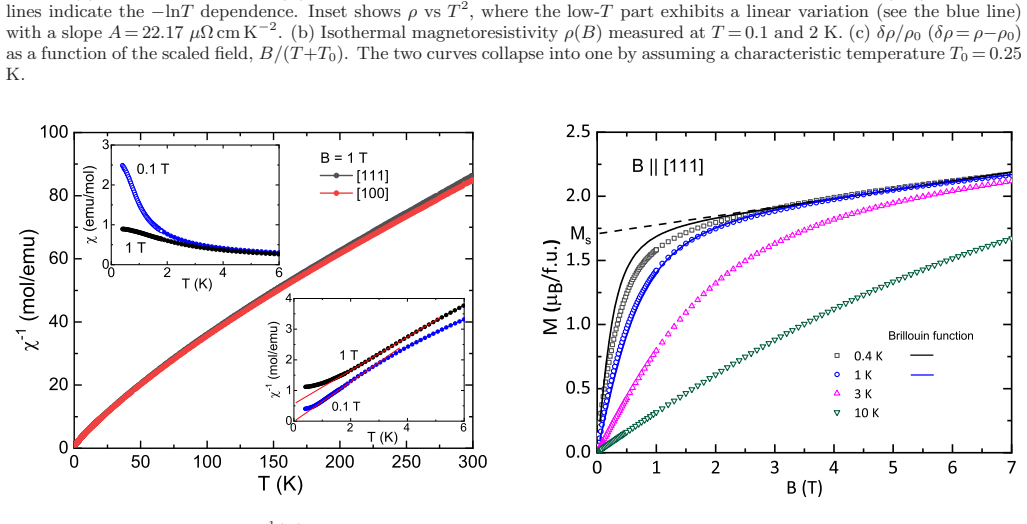
YbNi$_4$Mg realizes a superheavy-fermion ground state: after subtracting the lattice contribution of LuNi$_4$Mg and a low-temperature nuclear term, the electronic specific-heat coefficient is $\gamma_0 = 5.65$ J mol$^{-1}$ K$^{-2}$, and the low-field susceptibility gives a Wilson ratio $R_W = 32.1$. No long-range magnetic order appears down to 70 mK; instead a broad $C/T$ maximum at $T^* = 0.3$ K, with matching shoulders in $d\chi/dT$ and $d\rho/dT$, marks short-range cooperative magnetism entwined with the heavy-electron liquid. A field of about 0.1 T drives a metamagnetic-like crossover, and quasi-adiabatic demagnetization from 8 T and 2 K reaches 0.21 K (from 3 T, 0.42 K), cooling below Gd$_3$Ga$_5$O$_{12}$ under comparable conditions. The paper takes the large Wilson ratio and the reduced Kadowaki-Woods ratio as evidence that residual spin fluctuations, possibly spin-liquid-like, distinguish the non-ordering superheavy-fermion state from a conventional heavy-fermion Fermi liquid.
Load-bearing premise
The headline electronic specific heat rests on the assumption that everything in the measured $C/T$ below 0.1 K is either a constant electronic term or a nuclear term from the magnetic moments of Yb nuclei, with no other contribution; if a different source of heat capacity enters that range, $\gamma_0 = 5.65$ J mol$^{-1}$ K$^{-2}$ and the Wilson ratio built on it would change.
Editorial extensions
If this is right
- If the compound is a superheavy fermion, its $\gamma_0 = 5.65$ J mol$^{-1}$ K$^{-2}$ and $A = 22.17$ $\mu\Omega$ cm K$^{-2}$ place it in the same class as YbCu$_4$Ni and YbPt$_2$Sn, and the reduced Kadowaki-Woods ratio shows that its thermodynamic mass enhancement exceeds its transport enhancement.
- The absence of long-range order down to 70 mK, together with a broad $C/T$ maximum at $T^* \approx 0.3$ K, means the magnetic degrees of freedom remain cooperative but short-ranged, entangled with the heavy-electron state rather than frozen into an ordered lattice.
- A field of roughly 0.1 T suppresses the short-range order and the heavy-electron state, producing a metamagnetic-like crossover at which the magnetic Grüneisen ratio changes sign without diverging, so the crossover is not a quantum critical point.
- Quasi-adiabatic demagnetization from 8 T and 2 K reaches 0.21 K (from 3 T, 0.42 K) with a 160 mg sample, and under similar initial conditions YbNi$_4$Mg cools below Gd$_3$Ga$_5$O$_{12}$, supporting superheavy-fermion metals as sub-Kelvin refrigerants.
- The large Wilson ratio $R_W = 32.1$, together with similar values in other non-ordering superheavy-fermion compounds and ordinary values in ordering ones, supports residual spin fluctuations as a defining feature of the non-ordering superheavy-fermion ground state.
Reading between the lines
- A direct check of the spin-liquid interpretation would be muon spin rotation or neutron scattering: if the Wilson ratio reflects residual spin dynamics, YbNi$_4$Mg should show persistent dynamic spin fluctuations without static order below $T^*$, with the fluctuation spectrum softening near $B^* \approx 0.1$ T.
- The refrigerant claim could be sharpened into an engineering comparison by measuring thermal conductivity and cooling power per gram against Gd$_3$Ga$_5$O$_{12}$ and the classic hydrated paramagnetic salts; the paper demonstrates the effect but does not give a full refrigeration-cycle comparison.
- Because the nuclear term comes from the magnetic moments of Yb nuclei, changing the Yb isotope mix would shift $A_n$ without changing the electronic $\gamma_0$, providing an experimental test of the specific-heat decomposition.
- The comparative pattern in the paper implies a testable trend: if long-range order is introduced into a related superheavy-fermion compound by pressure or chemical substitution, the Wilson ratio should fall from values near 32 toward the Fermi-liquid value near 2 while the broad $C/T$ maximum sharpens into a transition.
Signed reviews
Editorial analysis
A structured set of objections, weighed in public.
Referee Report
Summary. The manuscript reports the synthesis of single-crystalline YbNi4Mg and a low-temperature study combining resistivity, magnetization, specific heat down to below 0.1 K, and quasi-adiabatic demagnetization measurements. It claims a superheavy-fermion state with electronic specific-heat coefficient γ0 = 5.65 J mol^-1 K^-2, an elevated Wilson ratio RW = 32.1, a Kondo temperature TK ≈ 0.9 K, and no long-range magnetic order down to 70 mK. A broad specific-heat maximum at T* ≈ 0.3 K is attributed to short-range cooperative magnetism, and the magnetocaloric response is shown to cool a sample from 2 K to 0.21 K starting from 8 T, outperforming GGG under comparable starting conditions.
Significance. If the quantitative characterization holds, this paper is a valuable addition to the small family of superheavy-fermion compounds and strengthens the case for using such materials in sub-kelvin adiabatic demagnetization refrigeration. The qualitative phenomenology is convincingly supported by multiple independent probes: the T^2 resistivity, the magnetoresistivity scaling with T0 = 0.25 K, the absence of a sharp ordering anomaly in C(T), the field-dependent Weiss temperature, and the direct T(B) traces all consistently point to a weak-coupling Kondo lattice with short-range correlations. The direct comparison of the cooling performance with GGG in Fig. 9 is a useful practical benchmark. The main weakness is that the headline quantitative claims — γ0, RW, and all derived ratios — rest on a two-component decomposition of the specific heat in a narrow temperature window and on a finite-temperature value of χ0, neither of which is accompanied by an uncertainty estimate or a test of the assumed functional form.
major comments (3)
- [§III, Fig. 5(b) inset] The central value γ0 = 5.65 J mol^-1 K^-2 is obtained by fitting (C−Cl)/T below 0.1 K to γ0 + An T^-3, assuming that the only temperature-dependent contribution in that window is the high-temperature tail of a single nuclear Schottky term and that the electronic term is already T-independent. This assumption is not tested: the same data show C/T ∝ T^-2 above T* ≈ 0.3 K and a broad maximum at T*, so a short-range magnetic contribution with a different power law could persist below 0.1 K and be absorbed into either γ0 or An. The authors should fit (C−Cl)/T to γ0 + An T^-α with α free, estimate An independently from the known 171Yb/173Yb hyperfine parameters, and report the fit residuals and parameter uncertainties. Without such a test, the superheavy-fermion classification, RW = 32.1, and RKW all inherit an unquantified systematic error.
- [§IV, Wilson ratio] The Wilson ratio RW = 32.1 is computed using χ0 = 2.49 emu/mol measured at T = 0.4 K and B = 0.1 T, not at the zero-temperature limit. Since χ(T) rises steeply on cooling and short-range correlations develop below 0.3 K, the T→0 value of χ0 could differ substantially from the 0.4 K value. The authors should either provide a χ(T) extrapolation to T→0 or quote RW with a stated uncertainty that includes this finite-temperature ambiguity. In addition, the entries in Table I for other SHF compounds use χ values measured at different temperatures and fields, so the cross-material claim that large RW is a common feature of SHF compounds without long-range order is not yet quantitatively robust.
- [§III, Fig. 5(a) and Fig. 8] The statement that no magnetic ordering is observed down to 70 mK is based primarily on the absence of a sharp anomaly in C(T), on ρ(B) data at 0.1 K, and on χ(T) data that extend only to 0.4 K. The authors should state this limitation explicitly and, if possible, provide a low-field χ measurement below 0.4 K or μSR data to support the absence of static order. As written, the combination of the T^-2 rise in C/T above T* and the low-temperature upturn could also be consistent with a distribution of hyperfine fields or a frozen spin state, which would directly affect the γ0 decomposition and the interpretation of the ground state.
minor comments (5)
- [Title and introduction] The title in the manuscript text reads 'magne tocaloric effect' with a spurious space, and the introduction contains 'miliKevin' instead of 'millikelvin'; both should be corrected.
- [References] References [38] and [39] are the same Desgranges–Schotte paper and should be merged into a single citation.
- [Fig. 5 caption] The caption contains the typo 'Schottcky' for 'Schottky' in two places.
- [Fig. 9] The text refers to a device sketch as 'to be sketched in Fig. 9(a) inset' and later to 'Fig. 9(c) inset', but the figure has multiple insets; please clarify which panel contains the thermal-stage drawing and which contains the PPMS cooling-device photograph.
- [Table I] The footnotes for YbPt2Sn and Ce4Pt12Sn25 give the temperatures at which χ0 is read but not the magnetic field values; providing the field would make the Wilson-ratio comparison reproducible.
Circularity Check
No circularity: gamma0 is a data-reduction fit parameter, and the derived ratios and comparisons are not independent predictions.
full rationale
The paper's central derivation chain is experimental and non-circular. The electronic specific-heat coefficient gamma0 = 5.65 J mol^-1 K^-2 is obtained by an explicitly stated two-component fit of (C - Cl)/T below 0.1 K to gamma0 + An T^-3 (Section III, Fig. 5b inset). This is a data-reduction fit, not a fitted parameter later renamed as a prediction. The Wilson ratio RW = 32.1 is then computed directly from measured chi0 = 2.49 emu/mol and the fitted gamma0, with the relation expressed in the paper; it is a derived characterization, not an independent prediction. Similarly, TK is read from the magnetic entropy via the published Desgranges-Schotte relation Sm(TK) = 0.65 R ln2, and the Kadowaki-Woods ratio uses the measured A coefficient and the fitted gamma0. No uniqueness theorem is imported, and the only self-citation of note (ref. [33], describing the PPMS-based cooling stage) supports a device design rather than the central physics claim. The magnetocaloric effect is compared directly with measured GGG data under similar initial conditions, providing an external benchmark. The fragility of the gamma0 decomposition discussed by a skeptic (e.g., possible non-nuclear or distributed-hyperfine contributions in the fit window) is a robustness and uncertainty concern, not circularity: the paper labels the procedure as a fit and does not claim that gamma0 or the derived ratios are predictions independent of the data. No load-bearing argument reduces to its own inputs, so the appropriate circularity score is 0.
Assumptions & free parameters
free parameters (8)
- gamma0 (electronic specific-heat coefficient) =
5.65 J mol^-1 K^-2
- An (nuclear Schottky coefficient) =
1.438 x 10^-3 J K mol^-1
- A (T^2 resistivity coefficient) =
22.17 micro-ohm cm K^-2
- T0 (magnetoresistivity scaling temperature) =
0.25 K
- theta_LT_p (low-T Weiss temperature) =
about 0 K at 0.1 T; -0.9 K at 1 T
- High-T modified Curie-Weiss parameters =
mu_eff = 4.51 mu_B, theta_p = -6.43 K, chi0 = 0.00385 emu/mol
- van Vleck linear slope alpha =
0.07 mu_B/(T f.u.) at 0.4 K; 0.06 at 1 K
- CEF level scheme Delta1, Delta2 =
40 K and 150 K
assumptions (6)
- domain assumption The low-temperature upturn of (C - Cl)/T below 0.1 K is only the sum of a nuclear Schottky term (An T^-3) and a constant electronic term gamma0.
- domain assumption LuNi4Mg's specific heat is an accurate lattice background for YbNi4Mg.
- domain assumption Susceptibility measured at 0.4 K in 0.1 T can stand in for the zero-temperature susceptibility chi0 in the Wilson ratio.
- domain assumption The spin-1/2 Kondo model of Desgranges and Schotte describes the ground doublet of YbNi4Mg, allowing extraction of TK = 0.9 K from entropy.
- standard math The Maxwell relation (dM/dT)_B = (dS/dB)_T and the Gruneisen relation Gamma_m = T^-1 (dT/dB)_S apply to the quasi-adiabatic measurements.
- domain assumption A three-level CEF scheme with a doublet-doublet-quartet arrangement and gaps of 40 K and 150 K captures the high-temperature Schottky anomaly.
Cite this review
Pith. "Pith review of YbNi$_4$Mg: Superheavy fermion with enhanced Wilson ratio and magnetocaloric effect." pith.science (2026). https://pith.science/paper/3NOZ2YD2
@misc{pith2026241208043,
  author       = {Pith},
  title        = {Pith review of: YbNi$_4$Mg: Superheavy fermion with enhanced Wilson ratio and magnetocaloric effect},
  year         = {2026},
  howpublished = {\url{https://pith.science/paper/3NOZ2YD2}},
  note         = {Machine review of arXiv:2412.08043}
}
abstract
A comprehensive study of the low-temperature properties of YbNi$_4$Mg has revealed evidence of a superheavy-fermion state, characterized by a large electronic specific-heat coefficient $\gamma_0$ $\approx$ 5.65 J mol$^{-1}$ K$^{-2}$ and an elevated Wilson ratio $R_W$ = 32.1. No magnetic ordering was observed down to 70 mK; however, a broad maximum appears in the specific heat at $T^*$ = 0.3 K, along with a shoulder in the derivative of susceptibility d$\chi$/d$T$ and resistivity d$\rho$/d$T$. These features indicate a cooperative yet short-ranged magnetism entwined with the superheavy Fermi liquid. The large Wilson ratio, which is also detected in other superheavy-fermion compounds lacking long-range order, might be a signature of residual spin fluctuations. Applying a weak magnetic field of $\sim$0.1 T induces a metamagnetic-like crossover, as demonstrated by the quasi-adiabatic demagnetization measurements showing a broad minimum in the temperature-field trace. Here, an enhanced magnetocaloric cooling effect stemming from the field-sensitive superheavy-fermion state is observed, rivaling that of the well-established insulating magnetic coolants like the rare-earth garnet Gd$_3$Ga$_5$O$_{12}$.
Figures


Figures from the paper (4 more)


Reference graph
Works this paper leans on
-
[1]
Si and F
Q. Si and F. Steglich, Science 329, 1161 (2010)
2010
-
[2]
G. R. Stewart, Rev. Mod. Phys. 56, 755 (1984)
1984
-
[3]
J. G. Sereni, I. ˇCurl ´ ık, M. Giovannini, A. Strydom, and M. Reiffers, Phys. Rev. B 98, 094420 (2018)
work page 2018
-
[4]
Y. Shimura, T. Kitazawa, S. Tsuda, S. Bachus, Y. Tokiwa, P. Gegenwart, R. Yamamoto, Y. Yamane, I. Nishihara, K. Umeo, T. Onimaru, T. Takabatake, H. T. Hirose, N. Kikugawa, T. Terashima, and S. Uji, Phys. Rev. B 101, 241102 (2020)
work page 2020
-
[5]
E. D. Mun, S. L. Bud’ko, C. Martin, H. Kim, M. A. Tanatar, J. H. Park, T. Murphy, G. M. Schmiedeshoff, N. Dilley, R. Prozorov, and P. C. Can- field, Physical Review B 87, 075102 (2013)
work page 2013
-
[6]
A. Yatskar, W. P. Beyermann, R. Movshovich, and P. C. Canfield, Phys. Rev. Lett. 77, 3637 (1996)
work page 1996
-
[7]
J. G. Sereni, Physica B: Condensed Matter 536, 397 (2018)
work page 2018
-
[8]
V. T. Rajan, Phys. Rev. Lett. 51, 308 (1983)
work page 1983
Show all 50 references
-
[9]
Doniach, Physica B+C 91, 231 (1977)
S. Doniach, Physica B+C 91, 231 (1977)
1977
-
[10]
D. Jang, T. Gruner, A. Steppke, K. Mit- sumoto, C. Geibel, and M. Brando, Nature Communications 6, 8680 (2015)
2015
-
[11]
Tokiwa, B
Y. Tokiwa, B. Piening, H. S. Jeevan, S. L. Bud’ko, P. C. Canfield, and P. Gegenwart, Science Advances 2, e1600835 (2016)
2016
-
[12]
J. G. Sereni, Philosophical Magazine 100, 1211 (2020)
2020
-
[13]
W. F. Giauque, R. A. Fisher, E. W. Hornung, and G. E. Brodale, The Journal of Chemical Physics 58, 2621 (1973)
1973
-
[14]
Ambler and R
E. Ambler and R. P. Hudson, Reports on Progress in Physics 18, 251 (1955)
1955
-
[15]
Cho, Science 326, 778 (2009)
A. Cho, Science 326, 778 (2009)
2009
-
[16]
Linsinger, M
S. Linsinger, M. Eul, C. Schwickert, R. Decourt, B. Chevalier, U. C. Rodewald, J.-L. Bobet, and R. P¨ ottgen, Intermetallics 19, 1579 (2011)
2011
-
[17]
Osato, T
K. Osato, T. Taniguchi, H. Okabe, T. Kitazawa, M. Kawamata, Z. Hongfei, Y. Ikeda, Y. Nambu, D. P. Sari, I. Watanabe, J. G. Nakamura, A. Koda, J. Gouchi, Y. Uwatoko, and M. Fujita, Phys. Rev. B 109, 024435 (2024)
2024
-
[18]
Shimura, K
Y. Shimura, K. Watanabe, T. Taniguchi, K. Os- ato, R. Yamamoto, Y. Kusanose, K. Umeo, M. Fujita, T. Onimaru, and T. Takabatake, Journal of Applied Physics 131, 013903 (2022)
2022
-
[19]
Gruner, D
T. Gruner, D. Jang, A. Steppke, M. Brando, F. Ritter, C. Krellner, and C. Geibel, Journal of Physics: Condensed Matter 26, 485002 (2014)
2014
-
[20]
Gastaldo, S
F. Gastaldo, S. Gab´ ani, A. Dˇ zubinsk´ a, M. Reif- fers, G. Prist´ aˇ s, I. ˇCurl ´ ık, P. Skyba, M. Clovecko, F. Vavrek, J. G. Sereni, and M. Giovannini, Phys. Rev. B 100, 174422 (2019)
2019
-
[21]
H.-O. Lee, N. Kurita, P. chun Ho, C. L. Condron, P. Klavins, S. M. Kauzlarich, M. B. Maple, R. Movshovich, E. D. Bauer, J. D. Thompson, and Z. Fisk, Journal of Physics: Condensed Matter 22, 065601 (2010)
2010
-
[22]
Kurita, H.-O
N. Kurita, H.-O. Lee, Y. Tokiwa, C. F. Miclea, E. D. Bauer, F. Ronning, J. D. Thompson, Z. Fisk, P.- C. Ho, M. B. Maple, P. Sengupta, I. Vekhter, and R. Movshovich, Phys. Rev. B 82, 174426 (2010)
2010
-
[23]
Honda, Y
F. Honda, Y. Taga, Y. Hirose, S. Yoshi- uchi, Y. Tomooka, M. Ohya, J. Sakaguchi, T. Takeuchi, R. Settai, Y. Shimura, T. Sakakibara, I. Sheikin, T. Tanaka, Y. Kubo, and Y. ¯Onuki, Journal of the Physical Society of Japan 83, 044703 (2014)
2014
-
[24]
M. S. Torikachvili, S. Jia, E. D. Mun, S. T. Hannahs, R. C. Black, W. K. Neils, D. Mar- tien, S. L. Bud’ko, and P. C. Canfield, Proceedings of the National Academy of Sciences 104, 9960 (2007)
2007
-
[25]
Shimura, T
Y. Shimura, T. Sakakibara, S. Yoshi- uchi, F. Honda, R. Settai, and Y. ¯Onuki, Journal of the Physical Society of Japan 80, 073707 (2011)
2011
-
[26]
Takeuchi, S
T. Takeuchi, S. Yoshiuchi, M. Ohya, Y. Taga, Y. Hirose, K. Sugiyama, F. Honda, M. Hagi- wara, K. Kindo, R. Settai, and Y. ¯Onuki, Journal of the Physical Society of Japan 80, 114703 (2011) . 10
2011
-
[27]
Takeuchi, M
T. Takeuchi, M. Ohya, M. Matsushita, S. Yoshi- uchi, F. Honda, R. Settai, and Y. ¯Onuki, Journal of the Physical Society of Japan 80, SA052 (2011)
2011
-
[28]
Z. Fisk, P. C. Canfield, W. P. Beyermann, J. D. Thomp- son, M. F. Hundley, H. R. Ott, E. Felder, M. B. Maple, M. A. Lopez de la Torre, P. Visani, and C. L. Seaman, Phys. Rev. Lett. 67, 3310 (1991)
1991
-
[29]
Killer, E.-W
U. Killer, E.-W. Scheidt, G. Eickerling, H. Mi- chor, J. Sereni, T. Pruschke, and S. Kehrein, Phys. Rev. Lett. 93, 216404 (2004)
2004
-
[30]
Movshovich, A
R. Movshovich, A. Yatskar, M. F. Hund- ley, P. C. Canfield, and W. P. Beyermann, Phys. Rev. B 59, R6601 (1999)
1999
-
[31]
Schr¨ oder, H
A. Schr¨ oder, H. Schlager, and H. L¨ ohneysen, Journal of Magnetism and Magnetic Materials 108, 47 (1992)
1992
-
[32]
Amato, D
A. Amato, D. Jaccard, J. Flouquet, F. Lapierre, J. L. Tholence, R. A. Fisher, S. E. Lacy, J. A. Olsen, and N. E. Phillips, Journal of Low Temperature Physics 68, 371 (1987)
1987
-
[33]
Xiang, C
J. Xiang, C. Zhang, Y. Gao, W. Schmidt, K. Schmalzl, C.-W. Wang, B. Li, N. Xi, X.-Y. Liu, H. Jin, et al. , Nature 625, 270 (2024)
2024
-
[34]
SCHLOTTMANN, ZEITSCHRIFT FUR PHYSIK B-CONDENSED MATTER 51, 223 (1983)
P. SCHLOTTMANN, ZEITSCHRIFT FUR PHYSIK B-CONDENSED MATTER 51, 223 (1983)
1983
-
[35]
Pietri, B
R. Pietri, B. Andraka, D. Kaczorowski, A. Leithe-Jaspe r, and P. Rogl, Phys. Rev. B 61, 12169 (2000)
2000
-
[36]
Friedemann, T
S. Friedemann, T. Westerkamp, M. Brando, N. Oeschler, P. Gegenwart, C. Krellner, C. Geibel, S. MaQuilon, Z. Fisk, F. Steglich, and S. Wirth, JOURNAL OF LOW TEMPERATURE PHYSICS 161, 67 (2010)
2010
-
[37]
O. V. Lounasmaa and R. A. Guenther, Physical Review 126, 1357 (1962)
1962
-
[39]
Desgranges and K
H.-U. Desgranges and K. Schotte, Physics Letters A 91, 240 (1982)
1982
-
[40]
Tokiwa, T
Y. Tokiwa, T. Radu, C. Geibel, F. Steglich, and P. Gegenwart, Phys. Rev. Lett. 102, 066401 (2009)
2009
-
[41]
L. Zhu, M. Garst, A. Rosch, and Q. Si, Phys Rev Lett 91, 066404 (2003)
2003
-
[42]
M. E. Fisher and J. S. Langer, Physical Review Letters 20, 665 (1968)
1968
-
[43]
R. A. Fisher, G. E. Brodale, E. W. Hornung, and W. F. Giauque, The Journal of Chemical Physics 59, 4652 (1973)
1973
-
[44]
Garst and A
M. Garst and A. Rosch, Phys. Rev. B 72, 205129 (2005)
2005
-
[45]
Y. Aoki, T. Namiki, T. Matsuda, H. Sug- awara, H. Sato, R. Settai, and Y. ¯Onuki, Physica B: Condensed Matter 259-261, 28 (1999)
1999
-
[46]
A. C. Hewson, The Kondo Problem to Heavy Fermions , Cambridge Studies in Magnetism (Cambridge University Press, Cambridge, 1993)
1993
-
[47]
Z. FISK, H. OTT, and G. AEPPLI, JAPANESE JOURNAL OF APPLIED PHYSICS PART 1-REGULAR
-
[48]
Gegenwart, J
P. Gegenwart, J. Custers, Y. Tokiwa, C. Geibel, and F. Steglich, Physical Review Letters 94, 076402 (2005)
2005
-
[49]
Chen and Y
G. Chen and Y. B. Kim, Physical Review B 87, 165120 (2013)
2013
-
[50]
Tsujii, H
N. Tsujii, H. Kontani, and K. Yoshimura, Phys Rev Lett 94, 057201 (2005)
2005
-
[51]
M. Lyu, H. Zhao, J. Zhang, Z. Wang, S. Zhang, and P. Sun, Chinese Physics B 30, 087101 (2021)
2021
Reviewed August 11, 2026 · model on record in the stance chip above.
Discussion (0). Continue with ORCID to comment.