REVIEW 4 major objections 6 minor 39 references
Analysis of $(3+1)D$ and $(2+1)D$ nonlinear ultrasonic waves using conformal invariance
T0 review · 4 major / 6 minor · reviewed 2026-08-12 · deepseek-v4-flash
Pith's one-line read This paper claims that nonlinear ultrasonic spectral peaks in a damaged sample match the J(J−1) eigenvalues of the O(2,1) Casimir operator, and that an Echo State Network with tanh can learn the (3+1)D path weights.
desk verdict The conformal-symmetry claim collapses on the paper's own algebra: the Casimir is misidentified, so the 2Δν/6Δν match is numerology, and the paper should be desk-rejected. read the letter →
The pith
A machine-rendered reading of the paper's core claim, the machinery that carries it, and where it could break.
The reading
What carries the argument
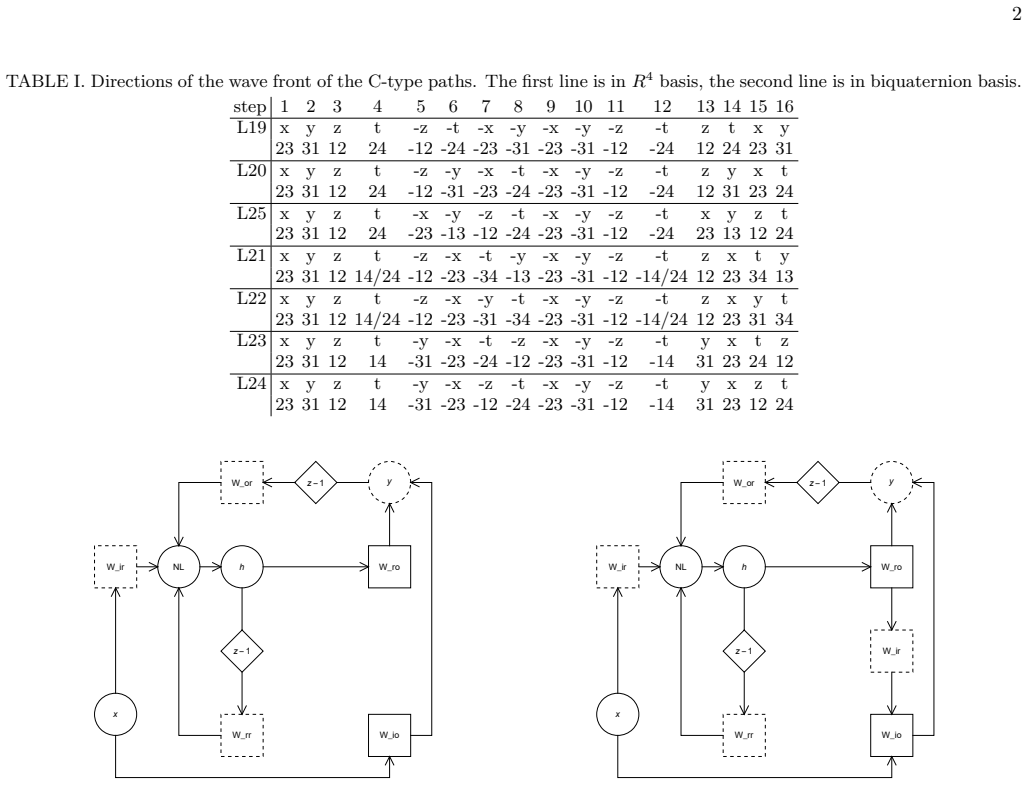
The load-bearing object is the conformal quantum mechanics with O(2,1) symmetry, generated by a Hamiltonian H, a dilation generator D, and a conformal generator K, whose algebra [H,D]=iH, [K,D]=−iK, [H,K]=2iD makes any combination G=uH+vD+wK conserved. Its Casimir operator $D^{2}$ has eigenvalues J(J−1), and the paper identifies the QESAM peak multiples (2 and 6, or 3 and 9) with those eigenvalues for J=2 and J=3. On the (3+1)D side, the machinery is the biquaternion fixed-point-action lattice with seven C-type paths L19–L25, whose weight matrices are trained by an Echo State Network with a tanh activation function and whose time-delay/hysteresis effects are implemented through Preisach–Mayergoyz superposition and groupoid composition of time shifts.
What would settle it
Run the same QESAM measurement on an undamaged reference sample of the same material and transducer; if the peaks at 2Δν and 6Δν (or 3Δν and 9Δν) persist, they are not damage-specific conformal signatures. Alternatively, vary the excitation amplitude: conformal Casimir peak positions should stay fixed, while ordinary harmonic distortion would shift or rescale with drive level.
Extended reading notes
Core claim
On its own terms, the paper's central discovery is that the measured QESAM spectrum of TR-NEWS signals from a damaged WAAM sample is organized by the conformal group O(2,1): the peaks appear at integer multiples of a fundamental frequency spacing Δν, and the multiples 2 and 6 (for receiver R12x; 3 and 9 for R6x) coincide with the eigenvalues J(J−1) of the Casimir operator for J=2 and J=3. That is, the spectral peak positions are what a conformally invariant quantum-mechanical model would predict, so the (2+1)D TR-NEWS data can be simulated by a conformal transformation model. In parallel, the paper shows that in (3+1)D spacetime the weight function of the seven C-type paths defined by the fixed-point action can be optimized by an Echo State Network: tanh activation gives stable, much-reduced deviations compared with sigmoid activation, and the optimized weights run stably from cycle 3000 to cycle 4000. These two results together propose that nonlinear ultrasonic waves in damaged media are governed by the same algebraic structures used in conformal quantum mechanics and lattice field theory.
Load-bearing premise
The identification of the observed spectral peaks with integer multiples of a single spacing Δν and with Casimir eigenvalues J(J−1) assumes that nothing else—transducer harmonic distortion, sample resonance, or noise—creates those peaks; the paper does not define Δν and provides no error bars or baseline comparison.
Editorial extensions
If this is right
- The spectral-peak positions in TR-NEWS/QESAM would be fixed by the conformal Casimir eigenvalues J(J−1), so no material-specific parameter except the fundamental spacing Δν is needed to index the peaks.
- The same conformal model should predict peaks at higher multiples (for example 12Δν for J=4) whenever the measurement bandwidth and signal-to-noise allow them to be seen.
- For (3+1)D damage localization, the trained ESN weight function defines the relative weight of the seven fixed-point-action paths, giving a concrete algorithm to combine signals from transducers distributed in 3D space.
- The 0.5 shift added to the action in the first half-cycle can be interpreted as an extra Preisach–Mayergoyz contribution, so hysteresis can be folded into the path weights rather than treated as an external correction.
- If the supersymmetric extension's shifted eigenvalues r0+n apply, the model gives a candidate explanation of the observed spacing's offset, a point the paper leaves open.
Reading between the lines
- If the conformal assignment is correct, a natural next test is to look for a peak at 12Δν (J=4) in wider-bandwidth QESAM data; the unexplained dip near 13Δν would then be where an expected conformal peak is absent or masked, which would sharpen or falsify the identification.
- The paper's comparison would be much stronger if Δν is defined from the excitation or from a calibration line and if the same peaks are checked on an undamaged control sample; that would separate material nonlinearity from transducer and measurement artifacts.
- The biquaternion/ESN scheme suggests that the same time-shift filter matrices could be applied to an experimental 3D transducer array, with the seven path weights serving as a sparse dictionary for volumetric TR-NEWS localization.
- If conformal symmetry genuinely organizes the spectrum, one would expect the 2:6 (and 3:9) peak ratios to be invariant under changes of excitation amplitude and transducer position, a testable scaling prediction that goes beyond the paper's data.
Editorial analysis
A structured set of objections, weighed in public.
Referee Report
Summary. The paper extends a quaternion-based Time Reversal Nonlinear Elastic Wave Spectroscopy (TR-NEWS) analysis from (2+1)D to (3+1)D by representing ultrasonic paths with biquaternions and optimizing path weights with an Echo State Network (ESN). It also analyzes QESAM spectral data from a WAAM sample using de Alfaro-Fubini-Furlan (DFF) conformal quantum mechanics, claiming that spectral peaks at 2Δν and 6Δν equal the O(2,1) Casimir eigenvalues J(J-1) for J=2 and J=3. The conclusion states that the fixed-point action weight function can be optimized by the ESN with tanh nonlinearity and that (2+1)D TR-NEWS data can be simulated by a conformal transformation model.
Significance. If the central claims were correct, the paper would demonstrate that conformal symmetry provides a quantitative organizing principle for nonlinear ultrasonic spectral signatures and that echo-state networks can learn path weights defined by a lattice fixed-point action. Such results could be of interest to nondestructive testing and to applications of conformal field theory in signal processing. However, the paper ships no machine-checked proofs, no reproducible code, and no falsifiable quantitative predictions with error bars; the one quantitative match (2Δν and 6Δν peaks) is read from the spectrum after the fact and assigned to Casimir eigenvalues without a valid derivation. The ESN optimization is altered after observing the data (the target vector is changed to zero and a constant offset is added), which prevents the reported stability from being evidence for the claimed optimization.
major comments (4)
- [Section VII, Eqs. (33)-(34)] The Casimir identification of the spectral peaks is not derived. Eq. (33) defines C = 1/2(HK+KH) - D^2 = g/4 - 3/16, yet the text immediately states 'D^2 is the Casimir operator.' Using the given commutator [H,K] = 2√-1D, one obtains HK = D^2 + √-1D + g/4 - 3/16, not D^2 - √-1D as written in the derivation of Eq. (34). Consequently the step ⟨χ|D^2|ψ⟩ ≈ ⟨χ|D^2|χ⟩ = J(J-1) does not follow from the DFF construction, and no argument connects the discrete-series label of the true Casimir C to the measured peaks at 2Δν and 6Δν. The 2Δν/6Δν match is therefore numerology rather than a quantitative test of conformal invariance.
- [Section VII, Fig. 10] The frequency spacing Δν is never defined, and the spectral peaks are read from the figure by eye and assigned to integer multiples of Δν. No error bars, baseline comparison, or test against alternative mechanisms (harmonic distortion, sample resonance, noise) is provided. The dip at 23Δν is dismissed as 'an artifact near the edge of spectrum' without analysis, and the 'shift of 1' is left as 'need to be examined further.' These admissions directly undermine the conclusion that the (2+1)D TR-NEWS data can be simulated by the conformal transformation model.
- [Section IV, ESN procedure] The ESN result is not a valid optimization of the fixed-point action weight function. After observing large deviations near t=9 and t=16, the authors write: 'we abort our choice of y∗[t], and took y∗[t] = 0 for all t.' They then add a constant 0.5 to the output in 0<t<8 and interpret this shift as a Preisach-Mayergoyz contribution. Changing the target after seeing the deviations and post-hoc shifting the output means that the loss function is modified to fit the data; the reported stability of weights between cycles 3000 and 4000 is not evidence that the original fixed-point action weights are optimal. No test error, cross-validation, or comparison with a null model is provided.
- [Section III, ESN setup] The ESN training procedure is under-specified and internally inconsistent. The main text defines the loss L = ||S W - y*||^2, but the Appendix describes a different update procedure in which W_rr is modified by gradient descent on a sigmoid/tanh activation error. The dimensions of the matrices are given, but initial values, regularization, learning-rate schedule, and the relation between the bias term b_h in Eq. (1) and the reservoir update are not specified. These omissions make the claim that the weight function is 'optimized' unreproducible.
minor comments (6)
- [Abstract/Introduction] The abstract claims 'we use biquaternion bases' for (3+1)D, but the manuscript only displays the matrix representation j(A_{3,1}) and does not explain how this representation is used in the path analysis or the ESN; the connection should be made explicit.
- [Section I] The sentence 'Actions of A-type and B-type aree presented in [1, 9]' contains a typo ('aree'); please correct.
- [Section IV] The text 'meight be inappropriate' should read 'might be inappropriate.'
- [Section VI] The groupoid formalism in Eqs. (18)-(22) is introduced but never used in a calculation or in the interpretation of the data; if it is not essential, it should be removed or its role should be clarified.
- [Section VII] The symbol Δν appears only in the caption of Fig. 10 and in the text, but its definition (e.g., frequency bin width or fundamental spacing) is never given; this should be defined in the text.
- [Figure 6] The correlation surface plots in Fig. 6 have no color scale or axis labels beyond '3000th cycle' and '4000th cycle'; this makes the claimed similarity between cycles difficult to evaluate.
Circularity Check
Central claims reduce to construction: QESAM peaks are read from the spectrum and matched by choosing J with J(J−1)=2,6, while the ESN success is produced by resetting y*=0 and adding a 0.5 offset.
-
fitted input called prediction
[Section VII, after Eq. (34), discussion of Fig. 10]
"The peaks of QESAM spectrum or R12x appear at 2∆ ν, 6∆ν and the dip of the spectrum appears at 13∆ν, 23∆ν (∆ν corresponds to 0.55MHz in the Fig 10.) For R6x, peaks appear at 3∆ ν, 9∆ν and the dips are outside the range of measurement. The coefficient of peaks 2 = 2 ∗ 1 and 6 = 3 ∗ 2 are expection value of the Casimir operator."
The 'prediction' is retroactive: the peak positions 2Δν and 6Δν are read from the measured QESAM spectrum, and J=2,3 are then selected because J(J−1)=2,6, so the match holds by construction. No independent computation of Δν or of J is given, and the dips do not fit the J(J−1) sequence: 23 is dismissed as 'an artifact' and the shift of 1 is said to 'need to be examined further.' The supporting assertion 'D^2 is the Casimir operator' also contradicts the paper's own Eq. (33), where the Casimir combination is 1/2(HK+KH)−D², so ⟨χ|D²|χ⟩=J(J−1) is not a derived consequence of the DFF construction.
-
other
[Section IV (ESN Monte Carlo results) and Fig. 7 caption]
"Therefore, we consider data between 3000 cycles and 4000 cycles and abort our choice of y∗[t], and took y∗[t] = 0 for all t. ... We shifted the output in the range 0 < t <8 of all cycles by adding 0.5, and found that outputs in 0 < t <8 and 8 < t <16 become smooth."
The ESN is trained against loss L = ||SW − y*||², but the target y* is not an independent datum: the paper explicitly abandons the original y* and sets y*[t]=0 for all t, so the optimization is self-fulfilling. A manual 0.5 offset is then added to outputs in 0<t<8 after seeing the results to force smoothness across the two halves of the time range. The conclusion that the fixed-point-action path weights 'can be optimized by the ESN using the tanh function' is therefore a property of the redefined training target and post-hoc correction, not a validated prediction.
full rationale
The paper does not rely on a load-bearing self-citation chain: the fixed-point action [11] and the DFF/FR conformal machinery [32,33] are external references, and there is no uniqueness theorem imported from the authors' prior work. The circularity is instead in the two construction steps above. In Section VII, the only quantitative link between conformal symmetry and the TR-NEWS data is the assertion that spectral peaks at 2Δν and 6Δν equal the Casimir expectation J(J−1) for J=2 and J=3. Since those peak positions are read from the measured spectrum, and no derivation fixes J or Δν in advance, the match is ex post facto. The paper's own Eq. (33) gives the O(2,1) Casimir as 1/2(HK+KH)−D², not D², so the J(J−1) step is additionally unsupported; the paper calls the 23Δν dip 'an artifact' and defers the shift of 1, which confirms that the spectral features were neither predicted nor explained. The ESN result is similarly constructed: after abandoning the original y* and setting y*[t]=0, the residual 0.5 offset is added by hand. These are not honest independent successes, so the central claims of the paper reduce to fitted inputs renamed as predictions.
Assumptions & free parameters
free parameters (5)
- Conformal parameter a =
1
- ESN output offset =
0.5
- ESN target vector y* =
0 for all t
- ESN learning rate eta =
not stated
- Frequency spacing Delta_nu =
0.55 MHz
assumptions (7)
- standard math O(2,1) conformal algebra of de Alfaro-Fubini-Furlan and its supersymmetric extension by Fubini-Rabinovici.
- standard math Feynman path integral and Preisach-Mayergoyz hysteresis model provide the correct description of ultrasonic wave propagation and material memory.
- domain assumption Ultrasonic waves in solid media can be represented as phonons on a (3+1)D lattice filled with Weyl fermions represented by biquaternions.
- domain assumption The fixed point action of DeGrand et al. [11] for SU(3) gauge theory remains valid after replacing Dirac fermions by Weyl fermions and can serve as the input to the ESN.
- ad hoc to paper Time shifts/hysteresis occur stochastically at 'balls' on the lattice paths and can be inserted without altering the unaffected paths.
- ad hoc to paper Adding a constant 0.5 to the output in 0<t<8 is equivalent to a Preisach-Mayergoyz model contribution.
- ad hoc to paper The observed spectral peaks can be assigned to integer multiples of Delta_nu and to O(2,1) Casimir eigenvalues.
invented entities (3)
-
Biquaternion Weyl fermion lattice model
-
'Balls' where hysteretic time shifts occur
-
Extended groupoid time-shift unit (x,1)
Cite this review
Pith. "Pith review of Analysis of $(3+1)D$ and $(2+1)D$ nonlinear ultrasonic waves using conformal invariance." pith.science (2026). https://pith.science/paper/FK43AHDH
@misc{pith2026241208655,
  author       = {Pith},
  title        = {Pith review of: Analysis of $(3+1)D$ and $(2+1)D$ nonlinear ultrasonic waves using conformal invariance},
  year         = {2026},
  howpublished = {\url{https://pith.science/paper/FK43AHDH}},
  note         = {Machine review of arXiv:2412.08655}
}
read the original abstract
Localization and classification of scattered nonlinear ultrasonic signatures in 2 dimensional complex damaged media using Time Reversal based Nonlinear Elastic Wave Spectroscopy (TR-NEWS) approach is extended to 3 dimensional complex damaged media. In (2+1)D, i.e. space 2 dimensional time 1 dimensional spacetime, we used quaternion bases for analyses, while in (3+1)D, we use biquaternion bases. The optimal weight function of the path of ultrasonic wave in (3+1)D lattice is obtained by using the Echo State Network (ESN) which is a Machine Learning technique. The hysteresis effect is incorporated by using the Preisach-Mayergoyz model. We analyze the spectrum data of Wire Arc Additive Manufacturing (WAAM) sample obtained by Quaternion Excitation Symmetry Analysis Method (QESAM) using the conformally invariant quantum mechanical variables of de Alfaro-Fubini-Furlan and their supersymmetrically extended variables of Fubini-Rabinovici.
Figures


Figures from the paper (6 more)


Reference graph
Works this paper leans on
-
[1]
s(γ1 ◦ γ2) = s(γ2), r(γ1 ◦ γ2) = r(γ1)
-
[2]
s(x) = r(x) = x, x∈ G → G(0)
-
[3]
γ ◦ s(γ) = γ, r(γ) ◦ γ = γ
-
[4]
( γ1 ◦ γ2) ◦ γ3 = γ1 ◦ (γ2 ◦ γ3)
-
[5]
γγ −1 = r(γ), γ−1γ = s(γ). We consider G(0) ⊂ M × [0, 1] with inclusion (x, ϵ) → (x, x, ϵ) ∈ M × M × [0, 1] for x ∈ M, ϵ >0 (x, 0) → x ∈ M ⊂ T M, (20) where T Mis the tangent manifold defined by the se- quence ( xn, yn, ϵn) in G1 = M × M ×]0, 1] in the limit of xn → x, yn → y, xn − yn ϵn → X. (21) The range map and the source map satisfy r(x, y, ϵ) = (x, ...
work page 1976
-
[6]
S. Furui and S. Dos Santos, Application of Quaternion Neural Network to Time Reversal Based Nonlinear Elas- tic Wave Spectroscopy, INAE, 8 183-199, (2023)
work page 2023
-
[7]
S. Dos Santos, and S. Furui,: Quaternion Signal Process- ing for Nonlinear Ultrasonics , BEC 2024; Tallinn, Esto- nia, October (2024)
work page 2024
-
[8]
S. Dos Santos, B.K. Choi, A. Sutin and A. Sarvazyan, Nonlinear imaging Based on Time Reversal Acaustic For- cussing, CF A 2006 (2006)
work page 2006
Show all 39 references
-
[9]
Dos Santos and S
S. Dos Santos and S. Furui, A memristor based ultrasonic transducer: the memoducer, IEEE Ultrasonic Symposium IUS 2016. (2016)
2016
-
[10]
Lints, A
M. Lints, A. Salpere and S. Dos Santos, Simulation of defects in CFRP and delayed TR-NEWS analysis , Re- search Report Mech 320/17 (2017)
2017
-
[11]
Montaldo, P
G. Montaldo, P. Roux, A. Derode, C. Negreira and M. Fink, Generation of very high pressure pulse with 1-bit time reversal in a solid waveguide , J. Acoust. Soc. Am. 110 (6) 2849-2857 (2001)
2001
-
[12]
Bacot, M
V. Bacot, M. Labousse, A. Eddi, M. Fink and E. Fort, Time reversal and holography with spacetime transforma- tions, Nature Physics, 12 (10) (2016)
2016
-
[13]
Bendat and A.G
J.S. Bendat and A.G. Piersol, Engineering Applications of Correlation and Spectral Analysis , Second Edition, John Wiley & Sons (1993)
1993
-
[14]
Furui and S
S. Furui and S. Dos Santos, Clifford Fourier Trans- forms in (2+1)D Lattice Simulations of Soliton Prop- agations, PoS Lattice 2022 Bonn, Germany, (2023), arXiv:2302.07871v1[hep-lat]
2023 arXiv
-
[15]
Garling, Clifford Algebras: An Introduction , Cambridge University Press (2011)
D.J.H. Garling, Clifford Algebras: An Introduction , Cambridge University Press (2011)
2011
-
[16]
DeGrand, A
T. DeGrand, A. Hasenfratz, P. Hasenfratz, and F. Nie- dermayer, Non-perturbative tests of the fixed point action for SU(3) gauge theory,Nucl. Phys.B454 615-637 (1995): arXiv:9506031[hep-lat]
1995
-
[17]
Feynman, Space-Time Approach to Non-Relativistic Quantum Mechanics , Rev
R.P. Feynman, Space-Time Approach to Non-Relativistic Quantum Mechanics , Rev. Mod. Phys. 20 (2) 367-387 (1948)
1948
-
[18]
Mayergoyz, Mathematical Models of Hysteresis and their Applications, Elsevier, Amsterdam (2003)
I. Mayergoyz, Mathematical Models of Hysteresis and their Applications, Elsevier, Amsterdam (2003)
2003
-
[19]
Connes, Noncommutative Geometry, Academic Press, San Diego (1994)
A. Connes, Noncommutative Geometry, Academic Press, San Diego (1994)
1994
-
[20]
Bianchi et al
F.M. Bianchi et al. , Recurrent Neural Networks for Short-Term Load Forecasting, Springer Briefs in Com- puter Science, https://doi.org/10.1007/978-3-319-70338- 1
-
[21]
Bianchi., S
F.M. Bianchi., S. Scardapane, A. Uncini, A. Rizzi and A. Sadeghian, Prediction of telephone calls load using Echo State Network with exogeneous variables , Neural Networks,Elsevier 71, 204-213 (2015)
2015
-
[22]
Marwan, M.C
N. Marwan, M.C. Romano, M. Thiel and J. Kurths,Recurrence plots for the analysis of complex systems, Physics Reports 438 237-329, Elsevier(2007)
2007
-
[23]
Furui and S
S. Furui and S. Dos Santos,Optimization of Weight Func- tion of R3,1 Space Time by the Echo State Network , Int. Journal of Soft Computing (IJSC) 15 (3) 39-54 (2024). 10
2024
-
[24]
Papouskova, V
J. Papouskova, V. Kus and S. Dos Santos, Preisach- Mayergoyz space model density identification for nonlin- ear physical systems: ”L-2” and ”D-divergence” mini- mization methods, Proceedings of Meetings on Acoustics, 16, 045018 (2012)
2012
-
[25]
Dvorakova, S
Z. Dvorakova, S. Dos Santos, V. Kus V and Z. Pre- volovsky, Localization and Classification of scattered non- linear ultrasonic signatures in bio-mechanical media us- ing time reversal approach, .J. Acoust. Soc. Am. 154 (3) pp.1684-1695 (2023)
2023
-
[26]
Goursolle, S
T. Goursolle, S. Call´ e, S. Dos Santos and O. Bou Matar, A two-dimensional pseudospectral model for time reversal and nonlinear elastic wave spectroscopy, J. Accoust. Soc. Am 122(6) pp.3220-3229 (2007)
2007
-
[27]
Dos Santos and C
S. Dos Santos and C. Plag, Excitation Symmetry Analysis Method (ESAM) for Calculatiion of Higher Order Non- lenearities, Int. J. Non-Linear Mech. 43 104-119 (2008)
2008
-
[28]
Dos Santos and Z
S. Dos Santos and Z. Prevorovsky, Ultrasonographie den- taire par techniques TR-NEWS, 10` eme Congr` es Francais d’Acoustique, Lyon (2010)
2010
-
[29]
Vejvodova, Z
S. Vejvodova, Z. Prevorovsky and S. Dos Santos, Nonlin- ear Time eversal Tomography of Structural Defects Pro- ceedings of Meetings on Acoustics 3, 045093 (2009)
2009
-
[30]
Dos Santos A
S. Dos Santos A. Masood, S. Furui and G. Nardoni, Self- calibration of multiscale hysteresis with memristors in nonlinear time reversal based processes IEEE BEC 2018. (2018)
2018
-
[31]
Raschka, Y
S. Raschka, Y. Liu and V. Mirjalili, Machine Learn- ing with Pytorch and Scikit-Learn , Packt, Birmingham (2022)
2022
-
[32]
Kokare, J
S. Kokare, J. Shen, P.P. Fonseca, J.G. Lopes, C.M. Machado, T.G. Santos, J.P. Oliveira and R. Godina, Wire arc additive manufacturing of a high-strength low- alloy steel part: evironmental impacts, costs, and me- chanical properties The international Journal of Ad- vanced Manu...
2024
-
[33]
Finkelstein, J.M
D. Finkelstein, J.M. Jauch, S.Schiminovich and D. Speiser, Foundation of Quaternion Quantum Mechanics , Journal of Mathematical Physics, 7 (2) 207-220 (1962)
1962
-
[34]
Adler, Quaternionic Quantum Field Theory , Phys
S.L. Adler, Quaternionic Quantum Field Theory , Phys. Rev. Lett. 55 (8) 783-786 (1985). Errata 55 (13) 1430 (1985)
1985
-
[35]
Adler, Quaternionic Quantum Field Theory , Com- mun
S.L. Adler, Quaternionic Quantum Field Theory , Com- mun. Math. Phys, 104, 611-656 (1986)
1986
-
[36]
Adler, Generalized quantum dynamics , Nuclear Physics, B415, 195-242 (1994)
S.L. Adler, Generalized quantum dynamics , Nuclear Physics, B415, 195-242 (1994)
1994
-
[37]
de Alfaro, S
V. de Alfaro, S. Fubini and G. Furlan, :Conformal In- variance in Quantum Mechanics Nuovo Cim. A34 561 (1976)
1976
-
[38]
Fubini and E
S. Fubini and E. Rabinovici, Superconformal Quantum Mechanics, Nucl. Phys. B245 17-44 (1984)
1984
-
[39]
Furui and S
S. Furui and S. Dos Santos, A memosducer based bi- quaternionic signal processing for nonlinear ultrason- ics imaging applied to nondestructive testing , UFFC-JS 2024, Taipei, Taiwan, September (2024)
2024
Reviewed August 12, 2026 · model on record in the stance chip above.
Discussion (0). Continue with ORCID to comment.