REVIEW 3 major objections 4 minor 59 references
Equivariant Q-sliceness of strongly invertible knots
T0 review · 3 major / 4 minor · reviewed 2026-08-11 · deepseek-v4-flash
Pith's one-line read Every Klein amphichiral knot bounds an equivariant slice disk in one fixed rational homology 4-ball.
desk verdict A promising paper whose obstruction side looks solid but whose main construction (Theorem A) is not proven as written due to inconsistent local models in §2.2. read the letter →
The pith
A machine-rendered reading of the paper's core claim, the machinery that carries it, and where it could break.
The reading
What carries the argument
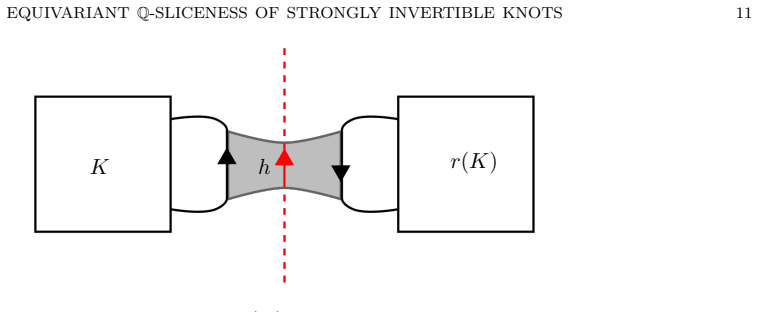
The load-bearing construction starts with $S^3\times[0,1]$, attaches a $0$-framed $2$-handle along the knot, and glues the resulting boundary component to itself by the free orientation-reversing involution $\tau$, producing the $\mathbb{Q}$-homology $4$-ball $Z_K$; a previously established result identifies all these balls, up to diffeomorphism, with a single manifold $Z$. The new equivariant step is Lemma 2.5: after quotienting the complement of the fixed-point sets by the Klein four group generated by $\rho$ and $\tau$, the $3$-manifold is $\mathbb{RP}^2\times I \natural \mathbb{RP}^2\times I$, and any two arcs joining the two distinguished boundary components are homotopic, so every Klein amphichiral knot can be turned into the standard unknot by equivariant crossing changes. That lemma powers the uniqueness statement. The obstruction in Theorem B runs through the order of the twisted homology $H_1(S^3_0(K);\varphi)$, which the involution forces to be symmetric, making $\Delta_K(t^n)$ and hence $\Delta_K(t)$ a square.
What would settle it
Compute the relative homotopy set $\pi_1(Y,A,B)$ for the explicit quotient model in Section 2.1 using the stated fixed-point sets. If it contains more than one class, Lemma 2.5 collapses and Theorem A's uniqueness statement would need a different proof; alternatively, exhibiting two Klein amphichiral knots whose equivariant slice disks in $Z$ are not related by any equivariant diffeomorphism would disprove the uniqueness claim.
Extended reading notes
Core claim
The paper's central claim is Theorem A: for every Klein amphichiral knot $(K,\rho,\tau)$, the strongly invertible pair $(K,\rho)$ bounds a slice disk in the Kawauchi manifold $Z$, a $\mathbb{Q}$-homology $4$-ball independent of $K$, and the disk is invariant under an involution $\rho_K$ of $Z$ that extends $\rho$. Moreover $\rho_K$ is unique up to conjugacy in $\mathrm{Diff}(Z)$, so all Klein amphichiral knots share the same equivariant rational slice data. Theorem B is the complementary obstruction: if $(K,\rho)$ is equivariantly $\mathbb{Q}$-slice, then the Alexander polynomial $\Delta_K(t)$ is a square. This makes equivariant $\mathbb{Q}$-sliceness strictly finer than ordinary $\mathbb{Q}$-sliceness, since $\mathbb{Q}$-slice knots such as the figure-eight knot and the knots $K_n$ are not equivariantly $\mathbb{Q}$-slice.
Load-bearing premise
Everything rests on the assertion in Lemma 2.5 that in the quotient 3-manifold obtained from $S^3$ by removing neighbourhoods of the symmetry axes, every arc joining the Klein-bottle boundary component to the projective-plane boundary component is homotopic to every other arc; if that relative homotopy set is non-trivial, the uniqueness of the extension involution can fail.
Editorial extensions
If this is right
- Every Klein amphichiral knot, including every Turk's head knot $J_n$ with $n$ odd and not divisible by $3$, admits an equivariant slice disk in the fixed rational homology ball $Z$.
- An equivariantly $\mathbb{Q}$-slice knot must have square Alexander polynomial, so the figure-eight knot, the knots $K_n$, and the Turk's head knots $J_n$ with even $n$ are not equivariantly $\mathbb{Q}$-slice even though they are $\mathbb{Q}$-slice.
- The equivariant $\mathbb{Q}$-concordance group contains a nonabelian subgroup whose abelianization is free abelian of infinite rank and whose image in the classical concordance group is $2$-torsion.
- There is a subgroup of the kernel of the forgetful map from equivariant to non-equivariant $\mathbb{Q}$-concordance that surjects onto $(\mathbb{Z}/2\mathbb{Z})^\infty$.
Reading between the lines
- If the uniqueness statement survives scrutiny, the exterior of the equivariant slice disk is a single equivariant 4-manifold for all Klein amphichiral knots, so invariants of that exterior (such as equivariant intersection forms or twisted torsion) would give uniform knot invariants.
- The square-polynomial obstruction is only a rational analogue of the classical Fox-Milnor condition; one could try to refine it with higher-order Alexander modules or Blanchfield forms to separate equivariantly $\mathbb{Q}$-slice knots.
- The same quotient-model argument might classify which periodic or freely periodic symmetries can be extended to the Kawauchi manifold, not just strong inversions.
- Computing moth polynomials for additional pairs of Turk's head knots could confirm that the nonabelian subgroup in Theorem C is not just generated by the two smallest cases.
Editorial analysis
A structured set of objections, weighed in public.
Referee Report
Summary. The paper introduces equivariant Q-sliceness for strongly invertible knots and studies a new equivariant rational concordance group. Its central constructive claim, Theorem A, is that every Klein amphichiral knot (K,rho,tau) is equivariantly Q-slice in the Kawauchi manifold and that the extending involution is unique up to conjugacy. The paper also proves a Fox-Milnor type obstruction (Theorem B), constructs a nonabelian subgroup in the kernel of the map from the equivariant concordance group to the equivariant Q-concordance group (Theorem C), and constructs torsion in the kernel of the forgetful map to the rational concordance group (Theorem D). The paper closes with open problems.
Significance. The notion of equivariant Q-sliceness is a natural and useful merge of two well-studied concepts, and Theorem A, if correct, would give a striking uniformity statement: all Klein amphichiral knots share one equivariant rational slice disk exterior in a single Q-homology ball. Theorem B provides a simple and checkable obstruction that applies to many explicit knots, and Theorems C and D show that the new equivariant Q-concordance group has interesting algebraic structure. The use of moth polynomials, Milnor invariants, and the computer program stringcmp in the proof of Theorem C is a strength and makes that part of the paper reproducible. However, as written, the proof of Theorem A rests on internally inconsistent local models for the Klein-four action; since the existence and uniqueness halves of Theorem A both depend on these models, the central constructive claim is not currently established.
major comments (3)
- [§2.1, standard model for Klein amphichiral symmetry] The displayed involution tau(z,w)=(z,-w) is orientation-preserving and its fixed-point set is {w=0}, which is a circle, not the two points Fix(tau)={(±1,0)} claimed in the text. The stated fixed sets correspond instead to tau(z,w)=(z-bar,-w). This is not a harmless typo: the quotient manifold Y, its boundary components, and the relative homotopy set pi_1(Y,A,B) used in Lemma 2.5 are computed from this model. Please correct the model and recompute the quotient; as written, the description of Y in the paragraph after the displayed formulas is inconsistent.
- [§2.2, proof of Theorem A, first half] The proof declares rho(z,w)=(z,w) on a rho-invariant tubular neighbourhood N(K)≅S^1×D^2. For a strong inversion rho, the fixed-point set is a circle meeting K in two points, so rho cannot be the identity on any neighbourhood of K. Therefore the extension of rho over the 0-framed 2-handle by the identity does not extend the given strong inversion, and the claim that rho induces an involution rho_ZK on the Kawauchi manifold with rho_ZK(D')=D' does not follow from the written formulas. A neighborhood model compatible with Fix(rho)∩K=S^0 is needed before the existence part of Theorem A is proved.
- [Lemma 2.5] The proof that every Klein amphichiral knot can be transformed into the standard unknot by equivariant crossing changes reduces to the assertion that pi_1(Y,A,B) is a single point. The two bullet facts given in the proof are not enough: the fact pi_1(Y)=<pi_1(A),pi_1(B)> is simply asserted, and with the corrected quotient there are three boundary components, a Klein bottle and two RP^2s, so this generation claim is exactly the point that must be checked. If pi_1(Y,A,B) is nontrivial, the uniqueness part of Theorem A, which is delegated to the second half of its proof, would not follow. As written, Lemma 2.5 is unsupported and needs a complete argument.
minor comments (4)
- [Abstract and §2.2] There are typographical errors: 'equivairant' in the abstract and 'conconcordance' in §2.3 should be 'equivariant' and 'concordance'.
- [Definition 2.1] In the bullet defining strongly positive amphichiral knots, the text says 'we have Fix(tau)=S^0'; this should refer to the involution delta, not tau.
- [§2.4, proof of Proposition 2.7] The proof refers to 'Proposition A', but no Proposition A exists in the paper; the intended reference is presumably Proposition 2.3.
- [§2.5, proof of Theorem D] The displayed determinant computation reads det(K_n)=4n^2+1=(2n^2)^2+1, which is arithmetically wrong; the correct expression is (2n)^2+1 or simply 4n^2+1. The contradiction is unaffected.
Circularity Check
No significant circularity: Theorem A relies on Kawauchi, Levine, and Boyle–Chen external results; Theorem B is proved from Cochran–Franklin–Hedden–Horn; self-citations supply definitions, prior invariants, and context but are not used as assumptions of the target conclusions.
full rationale
No circular step can be exhibited from the text. The constructive part of Theorem A is built on Kawauchi's slice-disk theorem and Levine's uniqueness theorem, both external to this paper; the new content is Lemma 2.5 and the equivariant handle extension. The proof of Lemma 2.5 contains unproved assertions (notably π1(Y)=⟨π1(A),π1(B)⟩), and the local model in §2.2 appears internally inconsistent, e.g. the declaration ρ(z,w)=(z,w) on N(K) is incompatible with ρ being a strong inversion. These are correctness gaps, not circular reductions: no equation in the paper defines a target quantity in terms of itself, and no fitted parameter is renamed as a prediction. The obstruction Theorem B is proved directly from [CFHH13] rather than by citing the first author's [DP24]. The repeated self-citations, including [DP24], [DP23], [DPF23a], [DPF23b], and [DPŞ24], provide definitions, moth polynomials, Milnor-invariant techniques, and previously published structural theorems; none of these cited results is identical with, or assumed as, the present paper's Theorems A–D. The main derivation chain is therefore not circular, even though parts of the proof are incomplete as written.
Assumptions & free parameters
assumptions (10)
- standard math Resolution of the Smith conjecture
- domain assumption Kawauchi's characterization that strongly negative amphichiral knots are Q-slice
- domain assumption Levine's uniqueness of the Kawauchi manifold Z
- domain assumption Cochran-Franklin-Hedden-Horn propositions on twisted homology orders
- domain assumption Boyle-Chen equivariant unknotting theorem
- domain assumption Kankaanrinta equivariant isotopy extension theorem
- domain assumption Moth polynomial homomorphism of Di Prisa and Framba
- domain assumption Milnor invariant obstruction for string links
- domain assumption Sakuma-Weeks computation of symmetry groups of Turk's head knots
- domain assumption AlSukaiti-Chbili formulas for determinants and Alexander roots
invented entities (2)
-
Klein amphichiral knot (K,ρ,τ)
-
Equivariant Q-concordance group ~C_Q
Cite this review
Pith. "Pith review of Equivariant Q-sliceness of strongly invertible knots." pith.science (2026). https://pith.science/paper/HKIBIBCO
@misc{pith2026241209322,
  author       = {Pith},
  title        = {Pith review of: Equivariant Q-sliceness of strongly invertible knots},
  year         = {2026},
  howpublished = {\url{https://pith.science/paper/HKIBIBCO}},
  note         = {Machine review of arXiv:2412.09322}
}
abstract
We introduce and study the notion of equivariant $\mathbb{Q}$-sliceness for strongly invertible knots. On the constructive side, we prove that every Klein amphichiral knot, which is a strongly invertible knot admitting a compatible negative amphichiral involution, is equivariant $\mathbb{Q}$-slice in a single $\mathbb{Q}$-homology $4$-ball, by refining Kawauchi's construction and generalizing Levine's uniqueness result. On the obstructive side, we show that the equivariant version of the classical Fox-Milnor condition, proved recently by the first author, also obstructs equivariant $\mathbb{Q}$-sliceness. We then introduce the equivariant $\mathbb{Q}$-concordance group and study the natural maps between concordance groups as an application. We also list some open problems for future study.
Figures


Figures from the paper (11 more)




Reference graph
Works this paper leans on
-
[1]
Mark E. AlSukaiti and Nafaa Chbili, Alexander and J ones polynomials of weaving 3-braid links and W hitney rank polynomials of L ucas lattice , Heliyon 10 (2024), no. 7, e28945
work page 2024
-
[2]
Selman Akbulut and Kyle Larson, Brieskorn spheres bounding rational balls, Proc. Amer. Math. Soc. 146 (2018), no. 4, 1817--1824. 3754363 https://mathscinet.ams.org/mathscinet-getitem?mr=3754363
work page 2018
-
[3]
Keegan Boyle and Wenzhao Chen, Negative amphichiral knots and the half- C onway polynomial , Rev. Mat. Iberoam. 40 (2024), no. 2, 581--622. 4717098 https://mathscinet.ams.org/mathscinet-getitem?mr=4717098
work page 2024
-
[4]
Keegan Boyle and Ahmad Issa, Equivariant 4-genera of strongly invertible and periodic knots, J. Topol. 15 (2022), no. 3, 1635--1674. 4461855 https://mathscinet.ams.org/mathscinet-getitem?mr=4461855
work page 2022
-
[5]
Keegan Boyle, Nicholas Rouse, and Ben Williams, A classification of symmetries of knots, Preprint (2023), arXiv:2306.04812 https://arxiv.org/abs/2306.04812
arXiv 2023
-
[6]
Tim D. Cochran, Bridget D. Franklin, Matthew Hedden, and Peter D. Horn, Knot concordance and homology cobordism, Proc. Amer. Math. Soc. 141 (2013), no. 6, 2193--2208. 3034445 https://mathscinet.ams.org/mathscinet-getitem?mr=3034445
work page 2013
-
[7]
Jae Choon Cha, The structure of the rational concordance group of knots, Mem. Amer. Math. Soc. 189 (2007), no. 885, x+95. 2343079 https://mathscinet.ams.org/mathscinet-getitem?mr=2343079
work page 2007
-
[8]
Jae Choon Cha and Ki Hyoung Ko, Signatures of links in rational homology spheres, Topology 41 (2002), no. 6, 1161--1182. 1923217 https://mathscinet.ams.org/mathscinet-getitem?mr=1923217
work page 2002
Show all 59 references
-
[9]
Irving Dai, Matthew Hedden, and Abhishek Mallick, Corks, involutions, and H eegaard F loer homology , J. Eur. Math. Soc. (JEMS) 25 (2023), no. 6, 2319--2389. 4592871 https://mathscinet.ams.org/mathscinet-getitem?mr=4592871
2023
-
[10]
Irving Dai, Sungkyung Kang, Abhishek Mallick, JungHwan Park, and Matthew Stoffregen, The (2,1) -cable of the figure-eight knot is not smoothly slice, Preprint (2022), arXiv:2207.14187 https://arxiv.org/abs/2207.14187
2022 arXiv
-
[11]
Irving Dai, Abhishek Mallick, and Matthew Stoffregen, Equivariant knots and knot F loer homology , J. Topol. 16 (2023), no. 3, 1167--1236. 4638003 https://mathscinet.ams.org/mathscinet-getitem?mr=4638003
2023
-
[12]
Alessio Di Prisa, The equivariant concordance group is not abelian, Bull. Lond. Math. Soc. 55 (2023), no. 1, 502--507. 4568356 https://mathscinet.ams.org/mathscinet-getitem?mr=4568356
2023
-
[13]
4, e70006
, Equivariant algebraic concordance of strongly invertible knots, Journal of Topology 17 (2024), no. 4, e70006
2024
-
[14]
Alessio Di Prisa and Giovanni Framba, A new invariant of equivariant concordance and results on 2 -bridge knots, Preprint (2023), arXiv:2303.08794 https://arxiv.org/abs/2303.08794, to appear in Algebr. Geom. Topol
2023 arXiv
-
[15]
, Solvability of concordance groups and M ilnor invariants , Preprint (2023), arXiv:2312.02058 https://arxiv.org/abs/2312.02058
2023 arXiv
-
[16]
Alessio Di Prisa and O g uz S avk, Turk's head knots and links: a survey, Preprint (2024), arXiv:2409.20106 https://arxiv.org/abs/2409.20106
2024
-
[17]
Fox and John W
Ralph H. Fox and John W. Milnor, Singularities of 2 -spheres in 4 -space and cobordism of knots , Osaka Math. J. 3 (1966), 257--267. 211392 https://mathscinet.ams.org/mathscinet-getitem?mr=211392
1966
-
[18]
Stern, A -invariant one homology 3 -sphere that bounds an orientable rational ball , Four-manifold theory ( D urham, N
Ronald Fintushel and Ronald J. Stern, A -invariant one homology 3 -sphere that bounds an orientable rational ball , Four-manifold theory ( D urham, N . H ., 1982), Contemp. Math., vol. 35, Amer. Math. Soc., Providence, RI, 1984, pp. 265--268. 780582 https://mathscinet.ams.org/...
1982
-
[19]
C. McA. Gordon and R. A. Litherland, On the signature of a link, Invent. Math. 47 (1978), no. 1, 53--69. 500905 https://mathscinet.ams.org/mathscinet-getitem?mr=500905
1978
-
[20]
Mikami Hirasawa, Ryota Hiura, and Makoto Sakuma, Invariant S eifert surfaces for strongly invertible knots , Essays in geometry---dedicated to N orbert A ' C ampo, IRMA Lect. Math. Theor. Phys., vol. 34, EMS Press, Berlin, 2023, pp. 325--349. 4631272 https://mathscinet.ams.org...
2023
-
[21]
Horn and Charles R
Roger A. Horn and Charles R. Johnson, Matrix analysis, Cambridge University Press, Cambridge, 1985. 832183 https://mathscinet.ams.org/mathscinet-getitem?mr=832183
1985
-
[22]
Richard Hartley and Akio Kawauchi, Polynomials of amphicheiral knots, Math. Ann. 243 (1979), no. 1, 63--70. 543095 https://mathscinet.ams.org/mathscinet-getitem?mr=543095
1979
-
[23]
Jennifer Hom, Sungkyung Kang, JungHwan Park, and Matthew Stoffregen, Linear independence of rationally slice knots, Geom. Topol. 26 (2022), no. 7, 3143--3172. 4540903 https://mathscinet.ams.org/mathscinet-getitem?mr=4540903
2022
-
[24]
London Math
Nathan Habegger and Xiao-Song Lin, On link concordance and M ilnor's invariants , Bull. London Math. Soc. 30 (1998), no. 4, 419--428. 1620841 https://mathscinet.ams.org/mathscinet-getitem?mr=1620841
1998
-
[25]
Knot Theory Ramifications 26 (2017), no
Jennifer Hom, A survey on H eegaard F loer homology and concordance , J. Knot Theory Ramifications 26 (2017), no. 2, 1740015, 24. 3604497 https://mathscinet.ams.org/mathscinet-getitem?mr=3604497
2017
-
[26]
, Homology cobordism, knot concordance, and H eegaard F loer homology , I CM --- I nternational C ongress of M athematicians. V ol. 4. S ections 5--8, EMS Press, Berlin, 2023, pp. 2740--2766. 4680339 https://mathscinet.ams.org/mathscinet-getitem?mr=4680339
2023
-
[27]
Jim Hoste and Morwen Thistlethwaite, Knotscape, URL: https://web.math.utk.edu/ morwen/knotscape.html, Last accessed: December 2024
2024
-
[28]
74 (1992), no
Uwe Kaiser, Strong band sum and dichromatic invariants, Manuscripta Math. 74 (1992), no. 3, 237--251. 1149761 https://mathscinet.ams.org/mathscinet-getitem?mr=1149761
1992
-
[29]
Marja Kankaanrinta, Equivariant collaring, tubular neighbourhood and gluing theorems for proper L ie group actions , Algebr. Geom. Topol. 7 (2007), 1--27. 2289802 https://mathscinet.ams.org/mathscinet-getitem?mr=2289802
2007
-
[30]
Japan Acad
Akio Kawauchi, The invertibility problem on amphicheiral excellent knots, Proc. Japan Acad. Ser. A Math. Sci. 55 (1979), no. 10, 399--402. 559040 https://mathscinet.ams.org/mathscinet-getitem?mr=559040
1979
-
[31]
, The (1,2)-cable of the figure eight knot is rationally slice, Unpublished note (1980), available here https://drive.google.com/file/d/1bww1EW6kvfxZpJL5XEG9zu8JDr3GP7hN/view
1980
-
[32]
1417494 https://mathscinet.ams.org/mathscinet-getitem?mr=1417494
, A survey of knot theory, Birkh\" a user Verlag, Basel, 1996, Translated and revised from the 1990 Japanese original by the author. 1417494 https://mathscinet.ams.org/mathscinet-getitem?mr=1417494
1996
-
[33]
, Rational-slice knots via strongly negative-amphicheiral knots, Commun. Math. Res. 25 (2009), no. 2, 177--192. 2554510 https://mathscinet.ams.org/mathscinet-getitem?mr=2554510
2009
-
[34]
Taehee Kim, Knot reversal and rational concordance, Bull. Lond. Math. Soc. 55 (2023), no. 3, 1210--1221. 4599109 https://mathscinet.ams.org/mathscinet-getitem?mr=4599109
2023
-
[35]
(N.S.) 28 (2022), no
Taehee Kim and Charles Livingston, Knot reversal acts non-trivially on the concordance group of topologically slice knots, Selecta Math. (N.S.) 28 (2022), no. 2, Paper No. 38, 17. 4363837 https://mathscinet.ams.org/mathscinet-getitem?mr=4363837
2022
-
[36]
Sungkyung Kang, JungHwan Park, and Masaki Taniguchi, Cables of the figure-eight knot via real F r yshov invariants , Preprint (2024), arXiv:2405.09295 https://arxiv.org/abs/2405.09295
2024
-
[37]
323--340
Kouzi Kodama and Makoto Sakuma, Symmetry groups of prime knots up to 10 crossings , Knots 90 ( O saka, 1990), de Gruyter, Berlin, 1992, pp. 323--340. 1177431 https://mathscinet.ams.org/mathscinet-getitem?mr=1177431
1990
-
[38]
Min Hoon Kim and Zhongtao Wu, On rational sliceness of M iyazaki's fibered, -amphicheiral knots , Bull. Lond. Math. Soc. 50 (2018), no. 3, 462--476. 3829733 https://mathscinet.ams.org/mathscinet-getitem?mr=3829733
2018
-
[39]
Sadayoshi Kojima and Masayuki Yamasaki, Some new invariants of links, Invent. Math. 54 (1979), no. 3, 213--228. 553219 https://mathscinet.ams.org/mathscinet-getitem?mr=553219
1979
-
[40]
Jean-Yves Le Dimet, Cobordisme d'enlacements de disques, M\'em. Soc. Math. France (N.S.) (1988), no. 32, ii+92. 971415 https://mathscinet.ams.org/mathscinet-getitem?mr=971415
1988
-
[41]
Jaewon Lee, Obstructing two-torsion in the rational knot concordance group, Preprint (2024), arXiv:2406.12761 https://arxiv.org/abs/2406.12761
2024 arXiv
-
[42]
Levine, Invariants of knot cobordism, Invent
J. Levine, Invariants of knot cobordism, Invent. Math. 8 (1969), 98--110; addendum, ibid. 8 (1969), 355. 253348 https://mathscinet.ams.org/mathscinet-getitem?mr=253348
1969
-
[43]
, Knot cobordism groups in codimension two, Comment. Math. Helv. 44 (1969), 229--244. 246314 https://mathscinet.ams.org/mathscinet-getitem?mr=246314
1969
-
[44]
Adam Simon Levine, A note on rationally slice knots, New York J. Math. 29 (2023), 1363--1372. 4689111 https://mathscinet.ams.org/mathscinet-getitem?mr=4689111
2023
-
[45]
Charles Livingston, Knots which are not concordant to their reverses, Quart. J. Math. Oxford Ser. (2) 34 (1983), no. 135, 323--328. 711524 https://mathscinet.ams.org/mathscinet-getitem?mr=711524
1983
-
[46]
V., Amsterdam, 2005, pp
, A survey of classical knot concordance, Handbook of knot theory, Elsevier B. V., Amsterdam, 2005, pp. 319--347. 2179265 https://mathscinet.ams.org/mathscinet-getitem?mr=2179265
2005
-
[47]
Moore, Knotinfo: Table of knot invariants, URL: knotinfo.math.indiana.edu, Last accessed: December 2024
Charles Livingston and Allison H. Moore, Knotinfo: Table of knot invariants, URL: knotinfo.math.indiana.edu, Last accessed: December 2024
2024
-
[48]
Morgan and Hyman Bass, The S mith conjecture , Pure and Applied Mathematics, vol
John W. Morgan and Hyman Bass, The S mith conjecture , Pure and Applied Mathematics, vol. 112, Academic Press, Inc., Orlando, FL, 1984, Papers presented at the symposium held at Columbia University, New York, 1979. 758459 https://mathscinet.ams.org/mathscinet-getitem?mr=758459
1984
-
[49]
Miller, Amphichiral knots with large 4-genus, Bull
Allison N. Miller, Amphichiral knots with large 4-genus, Bull. Lond. Math. Soc. 54 (2022), no. 2, 624--634. 4453695 https://mathscinet.ams.org/mathscinet-getitem?mr=4453695
2022
-
[50]
Miller and Mark Powell, Strongly invertible knots, equivariant slice genera, and an equivariant algebraic concordance group, J
Allison N. Miller and Mark Powell, Strongly invertible knots, equivariant slice genera, and an equivariant algebraic concordance group, J. Lond. Math. Soc. (2) 107 (2023), no. 6, 2025--2053. 4598178 https://mathscinet.ams.org/mathscinet-getitem?mr=4598178
2023
-
[51]
176--196
Makoto Sakuma, On strongly invertible knots, Algebraic and topological theories ( K inosaki, 1984), Kinokuniya, Tokyo, 1986, pp. 176--196. 1102258 https://mathscinet.ams.org/mathscinet-getitem?mr=1102258
1984
-
[52]
286 (2020), 107400, 10
O g uz S avk, More B rieskorn spheres bounding rational balls , Topology Appl. 286 (2020), 107400, 10. 4179129 https://mathscinet.ams.org/mathscinet-getitem?mr=4179129
2020
-
[53]
, A survey of the homology cobordism group, Bull. Amer. Math. Soc. (N.S.) 61 (2024), no. 1, 119--157. 4678574 https://mathscinet.ams.org/mathscinet-getitem?mr=4678574
2024
-
[54]
Makoto Sakuma and Jeffrey Weeks, Examples of canonical decompositions of hyperbolic link complements, Japan. J. Math. (N.S.) 21 (1995), no. 2, 393--439. 1364387 https://mathscinet.ams.org/mathscinet-getitem?mr=1364387
1995
-
[55]
Takabatake, T
Y. Takabatake, T. Kuboyama, and H. Sakamoto, String CMP : Faster calculation for M ilnor invariant , Available at https://github.com/tkbtkysms/stringcmp, 2013
2013
-
[56]
W. T. Tutte, Graph theory, Encyclopedia of Mathematics and its Applications, vol. 21, Cambridge University Press, Cambridge, 2001, With a foreword by Crispin St. J. A. Nash-Williams, Reprint of the 1984 original. 1813436 https://mathscinet.ams.org/mathscinet-getitem?mr=1813436
2001
-
[57]
1-2, 5--9
WT Tutte, Graph-polynomials, Advances in Applied Mathematics 32 (2004), no. 1-2, 5--9
2004
-
[58]
U ber I nvolutionen der 3 - S ph\
Friedhelm Waldhausen, \"U ber I nvolutionen der 3 - S ph\"are , Topology 8 (1969), 81--91. 236916 https://mathscinet.ams.org/mathscinet-getitem?mr=236916
1969
-
[59]
Liam Watson, Khovanov homology and the symmetry group of a knot, Adv. Math. 313 (2017), 915--946. 3649241 https://mathscinet.ams.org/mathscinet-getitem?mr=3649241
2017
Reviewed August 11, 2026 · model on record in the stance chip above.
Discussion (0). Continue with ORCID to comment.