REVIEW 3 major objections 5 minor 58 references
Identification of structures driving trailing-edge noise. Part II -- Numerical investigation
T0 review · 3 major / 5 minor · reviewed 2026-08-11 · deepseek-v4-flash
Pith's one-line read This paper shows that spanwise-coherent, streamwise-travelling wavepackets in the turbulent boundary layer drive broadband trailing-edge noise, and that two acoustic-weighted SPOD modes reproduce the far-field spectrum.
desk verdict Careful, well-validated LES that extends wavepacket identification to nonzero spanwise wavenumbers; the low-rank acoustic claim is real but partly conditioned on the Mach- and span-limited domain, and the causal wording outruns the correlational evidence. read the letter →
The pith
A machine-rendered reading of the paper's core claim, the machinery that carries it, and where it could break.
The reading
What carries the argument
The central object is the extended spectral proper orthogonal decomposition (ESPOD), a data-driven modal decomposition in which the compressible-energy inner product is evaluated in one subdomain, here the turbulent boundary layer near the trailing edge (H-SPOD) or the acoustic far field (A-SPOD), while the resulting modes are projected over the whole flow. The analysis is carried out on spanwise Fourier-transformed snapshots, so each mode carries a definite spanwise wavenumber $k_z$ and frequency. The scattering condition $k_z < k_0$, with $k_0 = \omega/a_0$, is the criterion that separates radiating from evanescent modes; it is used both to design the spanwise domain width and to interpret the mode shapes.
What would settle it
Perform an identical LES and A-SPOD analysis at the experimental freestream Mach number near 0.1 while keeping the same tripping and spanwise domain; if two A-SPOD modes then fail to reconstruct the far field within about 1 dB, or if modes with $k_z \ge k_0$ radiate appreciable sound, the wavepacket and scattering claim does not generalize.
Extended reading notes
Core claim
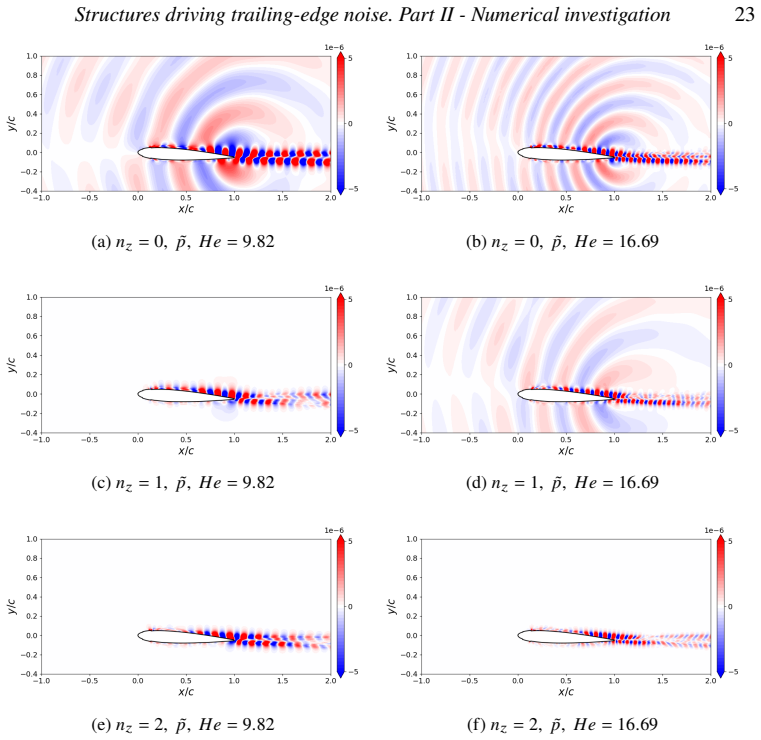
The paper's central claim is that the structures driving broadband trailing-edge noise are spanwise-coherent, streamwise-travelling wavepackets concentrated near the trailing edge, with acoustic radiation governed by the scattering condition $k_z < k_0$. The authors establish this by applying spectral proper orthogonal decomposition to spanwise Fourier-transformed LES data: for each low spanwise wavenumber the leading mode is a wavepacket that extends from the trip to the wake, and its far-field signature is propagative only when the scattering condition is met. Weighting the decomposition in the acoustic region (A-SPOD) shows that the acoustic field is strongly low-rank: the leading mode carries most of the sound power, and two modes reproduce the LES far-field spectrum within about 1 dB. The same modes show that only a small fraction of the near-wall hydrodynamic energy is actually radiating.
Load-bearing premise
The numerical validation transfers from Mach 0.3 to the experimental Mach 0.088–0.133 through $M^5$ acoustic scaling and by ignoring the open-jet and side-plate installation; if compressibility at Mach 0.3 or the installation changes the noise-generation mechanism, the identified wavepackets are not certified as the true low-Mach sources.
Editorial extensions
If this is right
- Only spanwise wavenumbers satisfying $k_z < k_0$ radiate: for a fixed spanwise domain each wavenumber turns on at a distinct cutoff frequency, and the integrated far-field spectrum is assembled wavenumber by wavenumber according to that rule.
- The far-field acoustic field is low-rank: the leading A-SPOD mode carries up to about 80% of the acoustic energy in the broadband range $3 \le He \le 25$, and two modes reconstruct the LES far-field spectrum within about 1 dB.
- Hydrodynamic SPOD is inefficient for acoustics, needing roughly 24 modes for 1 dB accuracy, because most turbulent kinetic energy near the trailing edge does not radiate; acoustic-weighted SPOD is the better basis for reduced-order noise models.
- Wavepacket structures exist for nonzero spanwise wavenumbers as well, appearing as oblique three-dimensional wavepackets whose radiation obeys the same scattering condition, extending earlier analyses that were limited to $k_z = 0$.
- The coherence between span-averaged surface pressure and far-field acoustics reaches about 0.8 in the broadband noise range, showing that the radiating part of the flow is the spanwise-coherent component rather than individually incoherent eddies.
Reading between the lines
- If this low-rank picture generalizes to full-scale Reynolds and Mach numbers, trailing-edge noise prediction could shift from measuring surface-pressure coherence lengths to tracking a handful of wavepacket amplitudes, lowering the cost of both experiments and numerical models.
- The same A-SPOD basis could be combined with resolvent analysis to identify which frequencies and spanwise wavenumbers most need control, giving a physical target for serrations or other trailing-edge treatments instead of an empirical one.
- A direct test of the scattering condition at a higher Mach number, for example near $M=0.5$, would reveal whether the $k_z < k_0$ cutoff remains sharp or shifts with mean-flow convection, a detail the paper already hints at when it notes that the observed cutoffs sit slightly below the theoretical values.
- The observation that only a small fraction of hydrodynamic energy radiates suggests why coherence-length-based models are hard to calibrate: what matters is the projection of the turbulent field onto a few radiating wavenumbers, not the total turbulence amplitude.
Signed reviews
Editorial analysis
A structured set of objections, weighed in public.
Referee Report
Summary. This paper reports a wall-resolved compressible implicit LES of a NACA 0012 airfoil at chord Reynolds number 200,000, Mach 0.3 and 3 degrees angle of attack, with zig-zag trip strips and a spanwise length of 0.4375c, designed to match companion experiments at Mach 0.088-0.133, Re=2-3e5 and span 4c. The simulation is validated against experimental mean-flow profiles, surface-pressure and far-field spectra, coherence lengths, and the scattering condition. Spanwise Fourier decomposition and spectral proper orthogonal decomposition (SPOD), including hydrodynamic- and acoustic-weighted extended SPOD (H-SPOD and A-SPOD), are used to identify coherent structures. The central claims are that (i) the dominant hydrodynamic structures are spanwise-coherent, streamwise-travelling wavepackets concentrated near the trailing edge; (ii) their radiation obeys the scattering condition k_z < k_0; and (iii) A-SPOD yields a low-rank reconstruction of the far-field acoustics, with two modes matching the LES spectra within about 1 dB up to He≈25.
Significance. If correct, the paper provides a strong confirmation of the wavepacket mechanism for broadband trailing-edge noise and a promising basis for reduced-order modelling. The manuscript is careful in its validation: mean flow, surface-pressure and far-field spectra, coherence lengths, and the scattering condition are all compared with experiment, and Appendix B confirms SPOD convergence for the leading modes (σ≥0.98 for He<25). The use of the spanwise Fourier basis is justified via CSD eigenvalue analysis in Appendix A, and the A-SPOD energy ranking is transparent. The main caveat is that the quantitative low-rank result is demonstrated for a specific Mach-number/span combination and may not transfer directly to the experimental configuration; this limits the generality of the title-level claim that wavepackets drive the noise, although the core identification is plausible.
major comments (3)
- [§3.4 and §4.4.3] The claim that the acoustic field is low rank and that two A-SPOD modes suffice is conditioned on the LES spanwise domain and Mach number. For the LES parameters (M=0.3, L_z=0.4375c), Eq. (3.2) gives cut-on Helmholtz numbers He_nz = 2π M St n_z = 14.36 n_z, so that at St=10 only n_z=0 and 1 radiate. At the experimental conditions (M=0.1, L_z=4c), the same Strouhal number admits n_z=0,...,4 as radiating wavenumbers. The statement in §3.3 that the larger experimental span has 'a small impact on the spectrum' is based on the total PSD at one far-field location, not on a mode-resolved energy budget. I ask the authors to either compute the cumulative acoustic energy of the radiating wavenumbers from the experimental frequency-wavenumber CSD (Fig. 8b) or provide an error bound for the two-mode A-SPOD model at the experimental span, and to qualify the 'low rank' conclusion as domain-specific if no such evidence can be provided.
- [§3.6 and §4.3] The causal language 'structures driving trailing-edge noise' is only directly supported for k_z=0. The time-delay analysis in §3.6 (Fig. 10c) is performed exclusively for the spanwise-averaged (k_z=0) signals and is reported to hold up to St≈10. For n_z>0, the relationship between the SPOD-identified wavepackets and the radiated sound is inferred from spatial correlation and the scattering condition, not from a time-resolved causal test. The paper should either extend the time-delay/coherence analysis to n_z>0 (the simulation data are available to do this) or explicitly state that for non-zero spanwise wavenumbers the identification is correlational, thereby tempering the conclusion that wavepackets 'drive' the noise across all wavenumbers.
- [§2.2 and §3.3] The Mach-number compromise (LES at M=0.3 vs experiments at M=0.088–0.133) is acknowledged but not quantitatively assessed. The M^5 scaling in §3.3 validates the total radiated sound power level, but the wavepacket source structure, the radiation directivity, and the set of cut-on spanwise wavenumbers are Mach-dependent through Eq. (3.2). The paper does not provide an argument or a calculation showing that the dominant wavepacket mechanism and the two-mode low-rank property persist at the experimental Mach number. A resolvent analysis or a companion low-Mach simulation (even at reduced span) would directly address this; at minimum, the authors should discuss the expected Mach dependence of the scattering and of the wavepacket convection speed (here taken as c_ph=0.6U_inf) and why the identified mechanism is expected to be invariant.
minor comments (5)
- [§3.3] In the paragraph after Fig. 7, 'the acoustic radiation on the suction side is stronger than on the suction side' should presumably read 'stronger on the suction side than on the pressure side'.
- [§5] The concluding sentence, 'The current work stats the ground for future resolvent analysis...' appears to contain a typo; it should likely read 'sets the ground'.
- [§3.4] Equation (3.2) uses the Helmholtz number He without a definition; please define He = 2π St M at first use, and ensure the notation is consistent with the Strouhal number St used elsewhere in the paper.
- [References] The companion paper entry (Demange et al. 2024b) contains the placeholder 'arXiv:Number here' and needs the complete reference.
- [Figure 16b and §4.4.1] In Figure 16b, the vertical dashed lines are labeled as the scattering condition of Eq. (3.2), but the text notes that the observed cut-offs are somewhat lower; please clarify in the caption whether the lines are the theoretical values, and state the interpretation of the offset. In §4.4.1, the phrase 'the ratio ... exceeds 80%' should specify that this is the energy share of the leading A-SPOD mode.
Circularity Check
No significant circularity: the wavepacket-source identification is cross-validated by independent SPOD weightings and experimental comparisons.
full rationale
The derivation chain is not circular. H-SPOD modes are computed with a hydrodynamic weighting region near the trailing edge, and their acoustic content is then examined; the finding that the leading modes are spanwise-coherent, streamwise-travelling wavepackets that radiate according to k_z < k_0 is an empirical result of the LES data, not an input to the decomposition. A-SPOD is, by construction, optimal with respect to acoustic energy in the far field, so its efficient reconstruction of that same far field with two modes is partly a consequence of the chosen norm; however, the paper frames this as an optimal data-driven reconstruction rather than an out-of-sample prediction, and the eigenvalue dominance that yields the low-rank result is a data-dependent property, not an identity. Moreover, the A-SPOD mode shapes independently reproduce the hydrodynamic wavepackets found by H-SPOD, providing a cross-check across two different weighting regions. The scattering condition is imported from Nogueira et al. (2017), an externally derived and independently falsifiable theoretical result, and the experimental companion paper is used for validation of PSD, coherence, and mean flow rather than as the sole basis for the central claim. The acknowledged compromises in Mach number and spanwise domain (Sections 2.2 and 3.4) are validity limitations that could affect transferability to the experimental regime, but they do not make any derivation equivalent to its inputs. No fitted parameter is renamed as a prediction, and no load-bearing argument reduces to a self-citation. Therefore the circularity score is 0.
Assumptions & free parameters
free parameters (1)
- Hydrodynamic convection velocity ratio c_ph/U_inf =
0.6
assumptions (6)
- standard math Compressible energy norm (Chu 1965; Mack 1984; Hanifi et al. 1996) defines the SPOD inner product (Eq. 4.3).
- domain assumption Spanwise periodicity and local homogeneity justify spanwise Fourier decomposition near the trailing edge (Appendix A).
- domain assumption Scattering condition k_z < k_0 (Nogueira et al. 2017) governs which wavenumbers radiate.
- ad hoc to paper Mach number M=0.3 with M^5 scaling approximates the low-Mach experiments (M=0.088-0.133), and installation effects are negligible.
- ad hoc to paper Time-shifting with phase velocity c_ph=0.6U_inf restores coherence lost by block averaging (Jaunet et al. 2017; Blanco et al. 2022).
- domain assumption The implicit LES with the stated grid and polynomial order resolves acoustic waves up to St about 25-30 and the relevant turbulent scales.
Cite this review
Pith. "Pith review of Identification of structures driving trailing-edge noise. Part II -- Numerical investigation." pith.science (2026). https://pith.science/paper/7G2R64R4
@misc{pith2026241209562,
  author       = {Pith},
  title        = {Pith review of: Identification of structures driving trailing-edge noise. Part II -- Numerical investigation},
  year         = {2026},
  howpublished = {\url{https://pith.science/paper/7G2R64R4}},
  note         = {Machine review of arXiv:2412.09562}
}
read the original abstract
The aim of the present work is to investigate the mechanisms of broadband trailing-edge noise generation to improve prediction tools and control strategies. We focus on a NACA 0012 airfoil at 3 degrees angle of attack and chord Reynolds number Re = 200,000. A high-fidelity wall-resolved compressible implicit large eddy simulation (LES) is performed to collect data for our analysis. The simulation is designed in close alignment with the experiment described in detail in the companion paper (Demange et al. 2024b). Zig-zag geometrical tripping elements, added to generate a turbulent boundary layer, are meshed to closely follow the experimental setup. A large spanwise domain is used in the simulation to include propagative acoustic waves with low wavenumbers. An in-depth comparison with experiments is conducted showing good agreement in terms of mean flow statistics, acoustic and hydrodynamic spectra, and coherence lengths. Furthermore, a strong correlation is found between the radiated acoustics and spanwise-coherent structures. To investigate the correlation for higher wavenumbers, spectral proper orthogonal decomposition (SPOD) is applied to the spanwise Fourier-transformed LES dataset. The analysis of all SPOD modes for the leading spanwise wavenumbers reveals streamwise-travelling wavepackets as the source of the radiated acoustics. This finding, confirming observations from experiments in the companion paper, leads to a new understanding of the turbulent structures driving the trailing-edge noise. By performing extended SPOD based on the acoustic region, we confirm the low rank nature of the acoustics, and a reduced-order model based on acoustic extended SPOD is proposed for the far-field acoustic reconstruction.
Figures


Figures from the paper (20 more)




Reference graph
Works this paper leans on
-
[1]
, " * write output.state after.block = add.period write newline
ENTRY address author booktitle chapter edition editor howpublished institution journal key month note number organization pages publisher school series title type volume year eprint label extra.label sort.label short.list INTEGERS output.state before.all mid.sentence after.sentence after.block FUNCTION init.state.consts #0 'before.all := #1 'mid.sentence ...
-
[2]
write newline
" write newline "" before.all 'output.state := FUNCTION n.dashify 't := "" t empty not t #1 #1 substring "-" = t #1 #2 substring "--" = not "--" * t #2 global.max substring 't := t #1 #1 substring "-" = "-" * t #2 global.max substring 't := while if t #1 #1 substring * t #2 global.max substring 't := if while FUNCTION word.in bbl.in capitalize " " * FUNCT...
-
[3]
Abreu, Leandra I. , Cavalieri, André V. G. , Schlatter, Philipp , Vinuesa, Ricardo & Henningson, Dan S. 2020 Spectral proper orthogonal decomposition and resolvent analysis of near-wall coherent structures in turbulent pipe flows . Journal of fluid mechanics 900
work page 2020
-
[4]
, Tanarro, Alvaro , Cavalieri, André V.G
Abreu, Leandra I. , Tanarro, Alvaro , Cavalieri, André V.G. , Schlatter, Philipp , Vinuesa, Ricardo , Hanifi, Ardeshir & Henningson, Dan S. 2021 Spanwise coherent hydrodynamic waves around flat plates and airfoils . Journal of Fluid Mechanics 927
work page 2021
-
[5]
1975 Acoustic radiation from an airfoil in a turbulent stream
Amiet, R.K. 1975 Acoustic radiation from an airfoil in a turbulent stream . Journal of Sound and Vibration 41 (4), 407--420
work page 1975
-
[6]
1976 Noise due to turbulent flow past a trailing edge
Amiet, R.K. 1976 Noise due to turbulent flow past a trailing edge . Journal of Sound and Vibration 47 (3), 387--393
work page 1976
-
[7]
Arbey, H. & Bataille, J. 1983 Noise generated by airfoil profiles placed in a uniform laminar flow . Journal of fluid mechanics 134 (1), 33--47
work page 1983
-
[8]
Journal of personality and social psychology 73 , 5--18
Arndt, Jamie , Greenberg, Jeff , Solomon, Sheldon , Pyszczynski, Tom & Simon, Linda 1997 Suppression, accessibility of death-related thoughts, and cultural worldview defense: Exploring the psychodynamics of terror management . Journal of personality and social psychology 73 , 5--18
work page 1997
Show all 58 references
-
[9]
Annual review of fluid mechanics 25 (1), 539--575
Berkooz, G , Holmes, P & Lumley, J L 1993 The proper orthogonal decomposition in the analysis of turbulent flows . Annual review of fluid mechanics 25 (1), 539--575
1993
-
[10]
, Martini, Eduardo , Sasaki, Kenzo & Cavalieri, André V.G
Blanco, Diego C.P. , Martini, Eduardo , Sasaki, Kenzo & Cavalieri, André V.G. 2022 Improved convergence of the spectral proper orthogonal decomposition through time shifting . Journal of Fluid Mechanics 950 , A9
2022
-
[11]
2006 Analysis of sponge zones for computational fluid mechanics
Bodony, Daniel J. 2006 Analysis of sponge zones for computational fluid mechanics . Journal of computational physics 212 (2), 681--702
2006
-
[12]
Experiments in fluids 35 (2), 188--192
Bor\'ee, J 2003 Extended proper orthogonal decomposition: a tool to analyse correlated events in turbulent flows . Experiments in fluids 35 (2), 188--192
2003
-
[13]
AIAA journal 23 (2), 207--213
Brooks, Thomas F & Marcolini, Michael A 1985 Scaling of airfoil self-noise using measured flow parameters . AIAA journal 23 (2), 207--213
1985
-
[14]
, Pope, D
Brooks, Thomas F. , Pope, D. Stuart & Marcolini, Michael A. 1989 Airfoil self-noise and prediction
1989
-
[15]
G , Jordan, Peter & Lesshafft, Lutz 2019 Wave-packet models for jet dynamics and sound radiation
Cavalieri, André V. G , Jordan, Peter & Lesshafft, Lutz 2019 Wave-packet models for jet dynamics and sound radiation . Applied mechanics reviews 71 (2)
2019
-
[16]
Acta mechanica 1 (3), 215--234
Chu, Boa-Teh 1965 On the energy transfer to small disturbances in fluid flow (part i) . Acta mechanica 1 (3), 215--234
1965
-
[17]
Crighton, D. G. & Gaster, M. 1976 Stability of slowly diverging jet flow . Journal of Fluid Mechanics 77 (2), 397–413
1976
-
[18]
, Yuan, Z
Demange, S. , Yuan, Z. , Jekosch, S. , Hanifi, A. , Cavalieri, A. V. G. , Sarradj, E. , L., Kaiser T. & Oberleithner, K. 2024 a\/ Resolvent model for aeroacoustics of trailing edge noise . Theoretical and Computational Fluid Dynamics
2024
-
[19]
& Oberleithner, Kilian 2024 b\/ Wavepackets driving trailing edge noise, part i – experimental investigation
Demange, Simon , Yuan, Zhenyang , Jekosch, Simon , Sarradj, Ennes , Hanifi, Ardeshir , Cavalieri, André V.G. & Oberleithner, Kilian 2024 b\/ Wavepackets driving trailing edge noise, part i – experimental investigation . arXiv preprint arXiv:Number here
2024
-
[20]
B 1997 Proposed inflow/outflow boundary condition for direct computation of aerodynamic sound
Freund, J. B 1997 Proposed inflow/outflow boundary condition for direct computation of aerodynamic sound . AIAA journal 35 (4), 740--742
1997
-
[21]
Applied sciences 11 (3), 1057--
Golubev, Vladimir 2021 Recent advances in acoustics of transitional airfoils with feedback-loop interactions: A review . Applied sciences 11 (3), 1057--
2021
-
[22]
& Colonius, Tim 2011 Instability wave models for the near-field fluctuations of turbulent jets
Gudmundsson, K. & Colonius, Tim 2011 Instability wave models for the near-field fluctuations of turbulent jets . Journal of Fluid Mechanics 689 , 97–128 , funding by Aeroacoustics Research Consortium
2011
-
[23]
& Henningson, Dan S
Hanifi, Ardeshir , Schmid, Peter J. & Henningson, Dan S. 1996 Transient growth in compressible boundary layer flow . Physics of fluids (1994) 8 (3), 826--837
1994
-
[24]
, Würz, W
Herrig, Andreas , Kamruzzaman, M. , Würz, W. & Wagner, S. 2013 Broadband airfoil trailing-edge noise prediction from measured surface pressures and spanwise length scales . International journal of aeroacoustics 12 (1-2), 53--82
2013
-
[25]
, Lumley, John L
Holmes, Philip J. , Lumley, John L. , Berkooz, Gal , Mattingly, Jonathan C. & Wittenberg, Ralf W. 1997 Low-dimensional models of coherent structures in turbulence . Physics Reports 287 (4), 337--384
1997
-
[26]
Physical review letters 108 (9), 094501--094501
Hultmark, M , Vallikivi, M , Bailey, S C C & Smits, A J 2012 Turbulent pipe flow at extreme reynolds numbers . Physical review letters 108 (9), 094501--094501
2012
-
[27]
, Arbos, S
Jaunet, V. , Arbos, S. , Lehnasch, G. & Girard, S. 2017 Wall pressure and external velocity field relation in overexpanded supersonic jets . AIAA Journal 55 (12), 4245--4257
2017
-
[28]
& Towne, Aaron 2022 Solutions to aliasing in time-resolved flow data
Karban, Ugur , Martini, Eduardo , Jordan, Peter , Brès, Guillaume A. & Towne, Aaron 2022 Solutions to aliasing in time-resolved flow data . Theoretical and computational fluid dynamics 36 (6), 887--914
2022
-
[29]
Progress in aerospace sciences 126 , 100737--
Lee, Seongkyu , Ayton, Lorna , Bertagnolio, Franck , Moreau, Stephane , Chong, Tze Pei & Joseph, Phillip 2021 Turbulent boundary layer trailing-edge noise: Theory, computation, experiment, and application . Progress in aerospace sciences 126 , 100737--
2021
-
[30]
general theory
Lighthill, Michael James 1952 On sound generated aerodynamically i. general theory . Proceedings of the Royal Society of London. Series A, Mathematical and physical sciences 211 (1107), 564--587
1952
-
[31]
1977 Vortex shedding noise of low tip speed, axial flow fans
Longhouse, R.E. 1977 Vortex shedding noise of low tip speed, axial flow fans . Journal of sound and vibration 53 (1), 25--46
1977
-
[32]
(John Leask) 1967 The structure of inhomogeneous turbulent flows
Lumley, John L. (John Leask) 1967 The structure of inhomogeneous turbulent flows. In Atmospheric turbulence and radio wave propagation, Nauka, Moscow\/ , pp. 166--177 . A.M. Yaglom, V.I. Tatarsky (Eds.)
1967
-
[33]
(John Leask) 1970 Stochastic tools in turbulence\/ , p
Lumley, John L. (John Leask) 1970 Stochastic tools in turbulence\/ , p. 209 . New York: Academic Press
1970
-
[34]
, Azarpeyvand, M
Lyu, B. , Azarpeyvand, M. & Sinayoko, S. 2016 Prediction of noise from serrated trailing edges . Journal of fluid mechanics 793 , 556--588
2016
-
[35]
Mack, L. M. 1984 Boundary layer stability theory. In AGARD Conference Proceedings\/ , , vol. 1 , pp. 1--1–1--22 . NATO
1984
-
[36]
, Hultmark, Marcus & Smits, Alexander J
Marusic, Ivan , Monty, Jason P. , Hultmark, Marcus & Smits, Alexander J. 2013 On the logarithmic region in wall turbulence . Journal of fluid mechanics 716 , np--np
2013
-
[37]
1972 The instability of free shear layers
Michalke, A. 1972 The instability of free shear layers . Progress in Aerospace Sciences 12 , 213--216
1972
-
[38]
, Cavalieri, André V.G
Nogueira, Petrônio A.S. , Cavalieri, André V.G. & Jordan, Peter 2017 A model problem for sound radiation by an installed jet . Journal of sound and vibration 391 , 95--115
2017
-
[39]
Noorani, Azad , Peplinski, Adam & Schlatter, Philipp 2015 Informal introduction to program structure of spectral interpolation in nek5000 . Tech. Rep.\/ . KTH Mechanics, Royal Institute of Technology
2015
-
[40]
R 2002 Computation of trailing-edge noise due to turbulent flow over an airfoil
Oberai, Assad A , Roknaldin, Farzam & Hughes, Thomas J. R 2002 Computation of trailing-edge noise due to turbulent flow over an airfoil . AIAA journal 40 (11), 2206--2216
2002
-
[41]
& Delville, J
Picard, C. & Delville, J. 2000 Pressure velocity coupling in a subsonic round jet . International Journal of Heat and Fluid Flow 21 (3), 359--364
2000
-
[42]
, Sipp, Denis & Colonius, Tim 2021 Optimal eddy viscosity for resolvent-based models of coherent structures in turbulent jets
Pickering, Ethan , Rigas, Georgios , Schmidt, Oliver T. , Sipp, Denis & Colonius, Tim 2021 Optimal eddy viscosity for resolvent-based models of coherent structures in turbulent jets . Journal of Fluid Mechanics 917 , A29
2021
-
[43]
, Scarano, F
Pröbsting, S. , Scarano, F. & Morris, S. C. 2015 Regimes of tonal noise on an airfoil at moderate reynolds number . Journal of fluid mechanics 780 , 407--438
2015
-
[44]
, Wolf, William R
Ricciardi, Tulio R. , Wolf, William R. & Taira, Kunihiko 2022 Transition, intermittency and phase interference effects in airfoil secondary tones and acoustic feedback loop . Journal of fluid mechanics 937
2022
-
[45]
arXiv preprint arXiv:2309.11808
Rogowski, Marcin , Yeung, Brandon CY , Schmidt, Oliver T , Maulik, Romit , Dalcin, Lisandro , Parsani, Matteo & Mengaldo, Gianmarco 2023 Unlocking massively parallel spectral proper orthogonal decompositions in the pyspod package . arXiv preprint arXiv:2309.11808
2023 arXiv
-
[46]
, Jones, L.E
Sandberg, R.D. , Jones, L.E. , Sandham, N.D. & Joseph, P.F. 2009 Direct numerical simulations of tonal noise generated by laminar flow past airfoils . Journal of sound and vibration 320 (4), 838--858
2009
-
[47]
, Cavalieri, André V.G
Sano, Alex , Abreu, Leandra I. , Cavalieri, André V.G. & Wolf, William R. 2019 Trailing-edge noise from the scattering of spanwise-coherent structures . Physical Review Fluids 4
2019
-
[48]
Journal of fluid mechanics 710 , 5--34
Schlatter, Philipp & Örlü, Ramis 2012 Turbulent boundary layers at moderate reynolds numbers: inflow length and tripping effects . Journal of fluid mechanics 710 , 5--34
2012
-
[49]
& Henningson, Dan S
Schmid, Peter J. & Henningson, Dan S. 2001 Stability and transition in shear flows\/ , 1st edn., p. 400 . New York, NY: Springer
2001
-
[50]
& Colonius, Tim 2020 Guide to Spectral Proper Orthogonal Decomposition
Schmidt, Oliver T. & Colonius, Tim 2020 Guide to Spectral Proper Orthogonal Decomposition . AIAA Journal 58 (3), 1023--1033
2020
-
[51]
, Towne, Aaron , Rigas, Georgios , Colonius, Tim & Brès, Guillaume A
Schmidt, Oliver T. , Towne, Aaron , Rigas, Georgios , Colonius, Tim & Brès, Guillaume A. 2018 Spectral analysis of jet turbulence . Journal of fluid mechanics 855 , 953--982
2018
-
[52]
, Sarradj, Ennes & Gründemann, Daniel 2021 Design und Charakterisierung eines aeroakustischen Windkanals
Schneehagen, Erik W. , Sarradj, Ennes & Gründemann, Daniel 2021 Design und Charakterisierung eines aeroakustischen Windkanals . In Proceedings of the 47th Annual Acoustics Conference\/ , pp. 1414--1417 . Wien: DEGA
2021
-
[53]
Oliver & Oberleithner, Kilian 2016 Spectral proper orthogonal decomposition
Sieber, Moritz , Paschereit, C. Oliver & Oberleithner, Kilian 2016 Spectral proper orthogonal decomposition . Journal of fluid mechanics 792 , 798--828
2016
-
[54]
Quarterly of Applied Mathematics 45 , 561--571
Sirovich, Lawrence 1987 Turbulence and the dynamics of coherent structures . Quarterly of Applied Mathematics 45 , 561--571
1987
-
[55]
Journal of Fluid Mechanics 565 , 197–226
Suzuki, Takao & Colonius, Tim 2006 Instability waves in a subsonic round jet detected using a near-field phased microphone array . Journal of Fluid Mechanics 565 , 197–226
2006
-
[56]
1967 The use of fast fourier transform for the estimation of power spectra: A method based on time averaging over short, modified periodograms
Welch, P. 1967 The use of fast fourier transform for the estimation of power spectra: A method based on time averaging over short, modified periodograms . IEEE transactions on audio and electroacoustics 15 (2), 70--73
1967
-
[57]
Williams, J. E. Ffowcs & Hall, L. H. 1970 Aerodynamic sound generation by turbulent flow in the vicinity of a scattering half plane . Journal of Fluid Mechanics 40 (4), 657–670
1970
-
[58]
, Farrington, A.M
Witherden, F.D. , Farrington, A.M. & Vincent, P.E. 2014 Pyfr: An open source framework for solving advection–diffusion type problems on streaming architectures using the flux reconstruction approach . Computer Physics Communications 185 (11), 3028--3040
2014
Reviewed August 11, 2026 · model on record in the stance chip above.
Discussion (0). Continue with ORCID to comment.