REVIEW 1 major objections 7 minor 16 references
Results on the generalized numerical ranges in max algebra
T0 review · 1 major / 7 minor · reviewed 2026-08-12 · deepseek-v4-flash
Pith's one-line read The paper transplants the classical rank-k numerical range into max algebra, proving a nested hierarchy that for Toeplitz matrices shrinks to the diagonal entry at rank two and disappears at higher ranks, and develops joint and…
desk verdict The flagged gap in Theorem 4.7(vii) is a one-line pigeonhole argument, and the new max-algebra rank-k and joint ranges are a solid niche contribution. read the letter →
The pith
A machine-rendered reading of the paper's core claim, the machinery that carries it, and where it could break.
The reading
What carries the argument
The central object is the max-isometry set $X_{n\times k}=\{X\in M_{n\times k}(\mathbb{R}_+): X^t\otimes X=I_k\}$: its columns are nonnegative vectors of max-norm one with pairwise disjoint supports. The argument is carried by the equation $X^t\otimes A\otimes X=\lambda I_k$, which forces each diagonal entry $x_j^t\otimes A\otimes x_j$ to equal $\lambda$ and every off-diagonal block between two column supports to vanish; this support-disjointness is what makes the Toeplitz hierarchy collapse. For the joint range, the load-bearing mechanism is a pigeonhole step over $m$ coordinatewise maxima: if there are more columns than matrices, one column can be deleted without changing any of the $m$ max-trace entries, yielding the nesting inclusion.
What would settle it
Enumerate all $X\in X_{4\times 2}$ for the $4\times4$ Toeplitz matrix with $a_0=1$, $a_1=2$, $a_{-1}=3$, $a_2=4$, $a_{-2}=5$: any solution of $X^t\otimes A\otimes X=\lambda I_2$ with $\lambda\neq1$ disproves Theorem 2.7, as would any $X\in X_{4\times3}$ satisfying the rank-three equation. Separately, for $n=3$, $m=2$, $k=2$, an exhaustive search over all triples of disjoint-support unit columns and all diagonal pairs $(A_1,A_2)$ would settle whether every point of $W^3_{\max}(\mathcal{A})$ lies in $W^2_{\max}(\mathcal{A})$.
Extended reading notes
Core claim
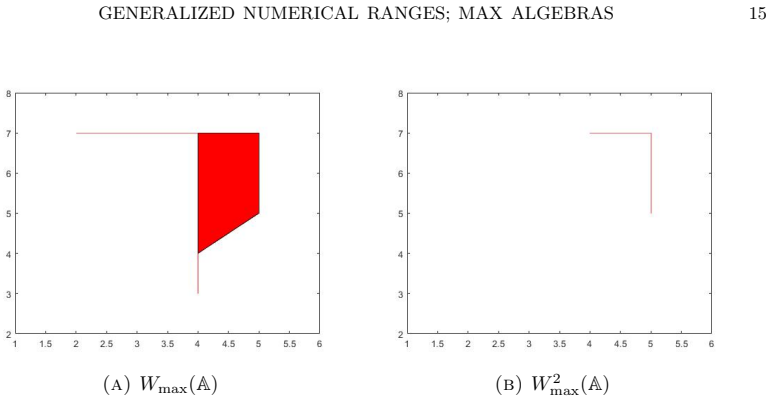
The paper's central claim is that the classical higher-rank numerical range has a faithful and computable analogue in max algebra. For an entrywise nonnegative matrix $A$, $\Lambda^{\max}_k(A)$ is defined by the equation $X^t \otimes A \otimes X = \lambda I_k$ with $X$ ranging over max-isometries, and the paper establishes the basic structure of these sets: the $k=1$ case recovers $W_{\max}(A)=[\min_i a_{ii},\max_{i,j}a_{ij}]$, the sets are nested in $k$, principal submatrices give subsets, and $\Lambda^{\max}_n(A)$ is nonempty exactly when $A$ is a scalar matrix. The flagship computation is Theorem 2.7: for a Toeplitz matrix with nonzero band entries and two zero corners, $\Lambda^{\max}_1(A)=[a_0,\max_i a_i]$, $\Lambda^{\max}_2(A)=\{a_0\}$, and $\Lambda^{\max}_k(A)=\emptyset$ for all $k\ge 3$. The joint-range sections carry the same program to $m$-tuples, showing that $W^k_{\max}(\mathcal{A})$ is compact and locally Lipschitz and that it shrinks with $k$, with an inclusion $W^{k+1}_{\max}(\mathcal{A})\subseteq W^k_{\max}(\mathcal{A})$ whenever $k+1>m$.
Load-bearing premise
The proof of the joint nesting inclusion rests on an unproved assertion in Theorem 4.7(vii): when there are more columns than matrices, some column of the isometry can be removed without changing any of the $m$ max-trace entries; if that assertion failed, the inclusion $W^{k+1}_{\max}(\mathcal{A})\subseteq W^k_{\max}(\mathcal{A})$ would collapse.
Editorial extensions
If this is right
- For every Toeplitz matrix of the stated banded form, membership in $\Lambda^{\max}_k(A)$ is decided by comparing $\lambda$ to $a_0$: only $\lambda=a_0$ works at rank two and nothing works at higher ranks.
- The equality $\Lambda^{\max}_n(A)\neq\emptyset \iff A=\lambda I_n$ gives a max-algebra test for scalar matrices using the top of the rank hierarchy.
- For an $m$-tuple, the inclusion $W^{k+1}_{\max}(\mathcal{A})\subseteq W^k_{\max}(\mathcal{A})$ for $k+1>m$ implies the joint range stabilizes once the number of columns exceeds the number of matrices, and at $k=n$ it is the single point $(\mathrm{tr}_\otimes A_1,\dots,\mathrm{tr}_\otimes A_m)$.
- The rank-one bound of Proposition 2.10 yields an explicit upper bound on the max higher-rank numerical radius of a max-sum of rank-one matrices, so the radius can be estimated from the individual rank-one factors.
Reading between the lines
- The paper leaves implicit that the support-disjointness mechanism gives a graph-theoretic reading: $\Lambda^{\max}_k(A)\neq\emptyset$ should force the existence of $k$ pairwise anticomplete vertex sets in the support digraph of $A$, making higher-rank ranges a combinatorial partition problem.
- The pigeonhole deleted-column argument actually works for every $k\ge m$, so the nesting in Theorem 4.7(vii) plausibly extends to all $k>m-1$; one testable consequence is that $W^k_{\max}(\mathcal{A})$ becomes constant for all $k\ge m$.
- Because every $X\in U_n$ in max algebra is a permutation matrix, the max joint $C$-numerical range is a finite set; computing it is a bottleneck-assignment problem over permutations, so exact algorithms from max-plus optimization could evaluate it efficiently.
- Connecting these ranges to max-plus spectral theory, the nesting may encode information about the tropical spectrum beyond the Perron root; a natural next step would be to check whether the support nodes selected by $\Lambda^{\max}_k(A)$ correspond to critical eigenvectors of matrix powers.
Editorial analysis
A structured set of objections, weighed in public.
Referee Report
Summary. The paper introduces the max rank-k numerical range Λmax_k(A) for a nonnegative matrix A in the max algebra (Definition 2.1), as the set of λ ∈ R+ for which X^t ⊗ A ⊗ X = λ I_k for some max-isometry X ∈ X_{n×k}. It develops basic properties (Proposition 2.5), derives explicit characterizations for Toeplitz matrices (Theorem 2.7), and computes several examples. It then extends the joint numerical range to tuples of matrices, defining the max joint k-numerical range W^k_max(A) (Definition 4.1) and the max joint c- and C-numerical ranges (Definitions 5.1 and 5.9), with a number of algebraic properties (Theorems 4.7 and 5.12). The proofs largely follow from prior results in [15,16], and the main new technical ingredient is the nesting W^{k+1}_max(A) ⊆ W^k_max(A) under the condition m−1 < k < n.
Significance. If the results are accepted, the paper provides a coherent max-algebra analogue of higher-rank numerical ranges and their joint/C variants. The explicit computations for Toeplitz matrices (Theorem 2.7) and block-diagonal examples (2.4, 2.6) are useful for illustrating the non-classical behavior, e.g., Λmax_2(A) may be a non-degenerate interval even though the classical higher-rank ranges are intervals too. The paper is honest about an open problem on connectedness (Remark 4.5). It does not provide machine-checked proofs or numerical code; its strengths are the clear definitions and the explicit, checkable examples. The dependence on [15,16] for the description of unitary matrices as permutation matrices and for W^k_max characterization is explicit and not circular.
major comments (1)
- [Theorem 4.7(vii)] The proof asserts that since k+1 > m, there exists s such that x_s^t A_j x_s ≤ ⊕_{i≠s} x_i^t A_j x_i for all j. This is the key step in proving W^{k+1}_max(A) ⊆ W^k_max(A), and it is stated without justification. The statement is true: for each coordinate j, at most one index is the strict maximizer of (x_i^t A_j x_i)_{i=1}^{k+1}, so the set of indices that are strict maximizers in at least one coordinate has size at most m; since k+1 > m, some s is not a strict maximizer in any coordinate. The authors should include this argument, and also note that deleting column s from X preserves X ∈ X_{n×k}. As written, the proof is incomplete at a load-bearing point.
minor comments (7)
- [Example 2.4] In the converse direction, the displayed matrix X appears to have misordered entries: with the entries as shown, the first column yields max(5, 8λ/10), not λ. The entry sqrt(λ/10) should be placed in the third coordinate, and the matrix convention (before/after transpose) should be clarified.
- [Theorem 4.7(vii)] In the last displayed line of the proof, the index in the deletion should be i ≠ s, not i ≠ j.
- [Proposition 2.10] The text 'there exist i ≤ k ≤ k and 1 ≤ j ≤ s' should read 'there exist i ∈ {1,...,k} and 1 ≤ j ≤ s', and 'Wmax(xj ⊗ jt_j)' should read 'Wmax(xj ⊗ y_j^t)'.
- [Remark 3.4] The index condition should be 1 ≤ i_1 < ... < i_k ≤ n, not < n; and the equality W^k_max(A) = {max_i x_i y_i} is true only for k = n, not for general k.
- [Remark 5.4] In parts (i) and (ii), the formulas use ⊕ where the max-algebra product ⊗ is intended; for example, α_i ⊕ (⊕_{j=1}^n c_j) should be α_i ⊗ (⊕_{j=1}^n c_j), and c_1 ⊕ (⊕_{j=1}^n (A_i)_{jj}) should be c_1 ⊗ (⊕_{j=1}^n (A_i)_{jj}).
- [Proposition 5.2] The displayed formula has an unmatched closing parenthesis after the m-th coordinate; add a closing parenthesis before the colon over the set.
- [Throughout] There are numerous typographical errors (e.g., 'Sloveniah' in the acknowledgments, 'Thaghizadeh' in reference [15], and inconsistent use of X_n×k vs X_{n×k}); these should be corrected in a final polish.
Circularity Check
No material circularity: the new rank-k ranges are defined by analogy with the complex case and computed directly; the cited prior results by the same authors are elementary lemmas, not the target claims, and the flagged dominated-column step in Theorem 4.7(vii) is valid by a one-line pigeonhole argument.
full rationale
The paper's central new object, Λmax_k(A) in Definition 2.1, is a fresh definition modeled on the complex rank-k numerical range characterization (2.1), and its properties are proved from that definition rather than imported as conclusions. Equation (2.3), Wmax(A)=Λmax_1(A)⊇Λmax_2(A)⊇...⊇Λmax_n(A), is a direct consequence of the isometry definition: dropping a column of an X∈X_{n×(k+1)} that satisfies Xᵗ⊗A⊗X=λI_{k+1} leaves an X'∈X_{n×k} with X'ᵗ⊗A⊗X'=λI_k; this is not a disguised restatement of the conclusion. The Toeplitz characterizations in Theorem 2.7 are computed from the explicit off-diagonal zero equations, not fitted or assumed. The paper does rely on the same authors' prior works [15,16] for background facts: the max numerical range formula, the characterization of max unitary matrices as permutation matrices, and the formula W^k_max(A)=[c,d] in Theorem 3.2. These are self-citations, but they are not load-bearing in a circular way: the cited facts are elementary, parameter-free, and do not include the paper's new Λmax_k claims as hypotheses. Theorem 4.7(vii) is the only step the reader flagged as an unproved assertion. The paper states: 'Since k + 1 > m, there is a 1 ≤ s ≤ k + 1 such that xₛᵗ⊗Aⱼ⊗xₛ ≤ ⊕_{i=1,i≠s}^{k+1} xᵢᵗ⊗Aⱼ⊗xᵢ ∀j = 1,...,m.' This is correct: for each j, at most one index can be the unique maximizer of the (k+1)-tuple (xᵢᵗ Aⱼ xᵢ); any index tied at the maximum already satisfies the inequality. With at most m bad indices and k+1>m, one index s survives, and deleting that column preserves each coordinate maximum. The proof should have included this pigeonhole argument, but its omission is a presentational gap, not a circular step. Consequently, no claim in the paper reduces by construction to a fitted parameter or to a self-citation chain, and the derivation is self-contained apart from minor non-load-bearing self-citations.
Assumptions & free parameters
assumptions (5)
- domain assumption The set of max-algebra unitary matrices U_n equals the group of permutation matrices.
- standard math Max trace cyclicity: tr_circle-plus(A circle-times B) = tr_circle-plus(B circle-times A).
- domain assumption Theorem 3.2: W^k_max(A) = [min over k-subsets of max diagonal entry, max entry].
- domain assumption Theorem 1.1: W_max(A) = [min diagonal entry, max entry].
- ad hoc to paper For k+1 > m, among k+1 isometry columns there exists a column whose contribution is dominated by the other columns in all m coordinates.
invented entities (5)
-
Max rank-k numerical range Lambda^max_k(A)
-
Max higher rank numerical radius omega_Lambda^max_k(A)
-
Max joint k-numerical range W^k_max(A) for tuples
-
Max joint c-numerical range W^c_max(A) for tuples
-
Max joint C-numerical range W^C_max(A) for tuples
Cite this review
Pith. "Pith review of Results on the generalized numerical ranges in max algebra." pith.science (2026). https://pith.science/paper/FSKMDCQK
@misc{pith2026241210375,
  author       = {Pith},
  title        = {Pith review of: Results on the generalized numerical ranges in max algebra},
  year         = {2026},
  howpublished = {\url{https://pith.science/paper/FSKMDCQK}},
  note         = {Machine review of arXiv:2412.10375}
}
abstract
Let $n$ and $k$ be two positive integers with $k\leq n$ and $C$ an $n \times n$ matrix with nonnegative entries. In this paper, the rank-$k$ numerical range in the max algebra setting is introduced and studied. The related notions of the max joint $k$-numerical range and the max joint $C$-numerical range of an entry-wise nonnegative matrix and an $m$-tuple of nonnegative matrices are also introduced. Some interesting algebraic properties of these concepts are investigated.
Figures
Reference graph
Works this paper leans on
-
[1]
G. H. Aghamollaei, N. Ghasemizadeh, Some results on matrix polynomials in the max algebra, Banach J. Math. Anal. 9 (2015), 17-26
work page 2015
-
[2]
Y. H. Au-Yeung, Y. T. Poon, Some results on matrix polynomials in the max algebra, Banach J. Math. Anal., 9: 17-26, 2015
work page 2015
-
[3]
Butkoviˇ c, Max-linear Systems: Theory and Algorithms, Springer-Verlag, London (2010)
P. Butkoviˇ c, Max-linear Systems: Theory and Algorithms, Springer-Verlag, London (2010). GENERALIZED NUMERICAL RANGES; MAX ALGEBRAS 23
work page 2010
-
[4]
M.D. Choi, M. Giesinger, J.A. Holbrook and D.W. Kribs, Geometry of higher rank numer- ical ranges, Linear Multilinear Algebra, 56 (2008), 53-64
work page 2008
-
[5]
M-T. Chiena, H-L. Gaub, C-K. Li, M-C. Tsaidan and K-Z. Wang, Product of operators and numerical range, Linear and Multilinear Algebra, 64 (2016), 58-67
work page 2016
- [6]
- [7]
-
[8]
S. Gaubert, M. Sharify, Tropical scaling of polynomial matrices, Lect. Notes Control Inf. Sci. 389 (2009), 291-303
work page 2009
Show all 16 references
-
[9]
Guglilmi, O
N. Guglilmi, O. Mason, F. Wirth, Barabanov norms, Lipschitz continuity and monotonicity for the max algebraic joint spectral radius, Linear Algebra and its Applications, 550 (2018), 37-58
2018
-
[10]
B. B. Gursoy, O. Mason, Spectral properties of matrix polynomials in the max algebra, Linear Algebra and its Applications, 435 (2011), 1626-1630
2011
-
[11]
M¨ uller, A
V. M¨ uller, A. Peperko, Generalized spectral radius and its max algebra version, Linear Algebra and its Applications, 439 (2013), 1006-1016
2013
-
[12]
M¨ uller, A
V. M¨ uller, A. Peperko, On the spectrum in max algebra, Linear Algebra and its Applica- tions, 485 (2015), 250-266
2015
-
[13]
Muanalifah, S
A. Muanalifah, S. Sergeev, Modifying the tropical version of Stickel’s key exchange protocol, Applications of Mathematics, 65 (2020), 727-753
2020
-
[14]
Tavakolipour and F
H. Tavakolipour and F. Shakeri, On the numerical range in tropical algebra, Lin. Mult. Algebra, 67, (2019), 1985-1998
2019
-
[15]
Thaghizadeh, M
D. Thaghizadeh, M. Zahraei, A. Peperko, and N. H. Aboutalebi, On the numerical ranges of matrices in max algebra, Banach J. Math. Anal. 14 (2020), 1773–1792
2020
-
[16]
Taghizadeh, M
D. Taghizadeh, M. Zahraei, A. Peperko, N. H. Aboutalebi, and S. Fallat, Correction to: On the numerical ranges of matrices in max algebra, Banach J. Math. Anal. (2025) 19:3. https://doi.org/10.1007/s43037-024-00391-5 1Department of Mathematics, Shahrood Branch, Islamic Azad Un...
2025 doi
Reviewed August 12, 2026 · model on record in the stance chip above.
Discussion (0). Continue with ORCID to comment.