REVIEW 4 major objections 4 minor 44 references
Many Hands Make Light Work: Accelerating Edge Inference via Multi-Client Collaborative Caching
T0 review · 4 major / 4 minor · reviewed 2026-08-12 · deepseek-v4-flash
Pith's one-line read CoCa, a multi-client collaborative caching framework, claims to cut edge inference latency by 23.01-45.19% on VGG, ResNet, and AST models while keeping accuracy loss below 3%.
desk verdict Useful extension of semantic caching to multi-client edge inference, but the headline latency gains are calibrated to an idealized same-class stream and should be read as conditional. read the letter →
The pith
A machine-rendered reading of the paper's core claim, the machinery that carries it, and where it could break.
The reading
What carries the argument
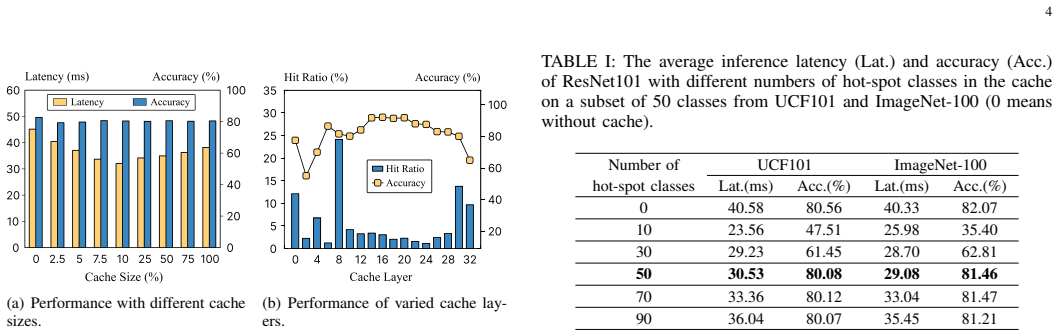
The central object is the two-dimensional global cache table together with the ACA allocation algorithm. Each cell stores a per-class semantic vector center for one cache layer; during inference the model extracts a semantic vector at a layer and compares it with stored entries using accumulated cosine similarity, with a discriminative score $D_j = (A_{a,j}-A_{b,j})/A_{b,j}$ controlling whether a hit is trusted. ACA selects hot-spot classes with the score $s_i^k = \Phi_i \cdot (0.20)^{\lfloor \tau_i^k / F \rfloor}$, where $\Phi_i$ is the global class frequency and $\tau_i^k$ is the number of inferences since class $i$ last appeared on client $k$, then selects layers by iteratively taking the layer with the largest product of expected hit ratio and saved inference time. This machinery keeps lookup overhead low while maximizing hit ratio under skewed, non-stationary data.
What would settle it
Take a naturally interleaved video or audio stream (or shuffle the frames of the UCF101/ESC-50 test batches so class labels vary within each batch), run CoCa with the same thresholds, and compare average latency against Edge-Only; if the reduction falls well below 23% or accuracy loss exceeds 3%, the central claim fails. A second check: record per-sample hit patterns across cache layers and test whether a hit at layer $b$ indeed implies a hit at layer $b+1$, since ACA's expected-hit-ratio adjustment relies on that assumption.
Extended reading notes
Core claim
CoCa's central discovery is that semantic caching for edge inference can be made collaborative and adaptive. The server keeps a global cache table whose rows are classes and whose columns are preset cache layers, periodically refreshes it with semantic vectors collected from all clients, and each round allocates each client a local sub-table of recently frequent hot-spot classes at selected cache layers. Inference walks through the model and performs sequential lookups at the allocated layers; a sample exits early when a cross-layer accumulated cosine similarity exceeds a threshold. The ACA allocation algorithm scores classes by global frequency decayed by local recency, keeps the top classes covering 95% of total score, and greedily chooses cache layers by expected latency reduction. The paper argues that this combination handles non-IID and long-tail distributions and reports consistent latency reductions across image and audio models.
Load-bearing premise
The latency reductions are measured on test data deliberately arranged so that every batch contains a single class label, producing strong temporal locality; real streams with interleaved classes would likely lower cache hit ratios and shrink the reported 23-45% gains.
Editorial extensions
If this is right
- CoCa can meet a 30% latency-reduction service-level objective on the tested image and audio models while keeping accuracy loss under 3%.
- Global collaborative cache updates make cache entries better match current client data, improving inference accuracy relative to static or single-client caches.
- Dynamic allocation of cache layers and hot-spot classes, not global updates, is the dominant source of latency reduction: the ablation shows DCA alone cuts latency by about 39% on ResNet152.
- The framework scales with client count: increasing from 60 to 160 clients raises average cache-request response latency by only about 7.5% in the reported setup.
- Handling long-tail distributions by caching only high-score classes lowers latency further, with CoCa achieving about 4% lower latency on the long-tail group than on the uniform group.
Reading between the lines
- If real video or audio streams mix classes within short windows rather than arriving in same-class bursts, the reported 23-45% latency reductions likely shrink; the framework should be re-measured on naturally interleaved streams to bound this effect.
- ACA's assumption that a sample hitting at cache layer $b$ will also hit at layer $b+1$ can be tested directly from per-layer hit logs; if it fails, replacing the adjustment with measured conditional hit probabilities would make allocation more accurate.
- Because CoCa shares only semantic vectors and class statistics, not raw samples, it is a natural candidate for privacy-preserving aggregation techniques such as secure aggregation or noise injection.
- The same global-table structure could extend to other spatially correlated edge tasks, such as multi-camera object detection or anomaly detection, where nearby cameras see overlapping semantics.
Editorial analysis
A structured set of objections, weighed in public.
Referee Report
Summary. The paper proposes CoCa, a multi-client collaborative caching framework for accelerating edge inference. Each client runs a DNN with multiple pre-assigned cache layers; during inference, the model performs sequential cache lookups using accumulated cosine-similarity scores against per-class semantic centroids. The server maintains a two-dimensional global cache, periodically aggregates client information to update the cache entries, and dynamically allocates cache entries (classes and layers) to each client via a heuristic Adaptive Cache Allocation (ACA) algorithm. The optimization minimizes expected inference latency subject to cache-size and accuracy-loss constraints, using empirical hit-ratio and accuracy-loss functions estimated on a shared dataset. Experiments on ImageNet-100, UCF101, and ESC-50 with VGG16_BN, ResNet variants, and AST report average latency reductions of 23.01% to 45.19% compared to Edge-Only, with accuracy loss below 3%.
Significance. If the reported gains hold under realistic streaming conditions, CoCa is a useful contribution: it combines multi-client global cache updates with per-client adaptive allocation, which is a natural extension of single-client semantic caching (SMTM) to collaborative edge settings. The paper is clearly written, provides algorithmic detail at a reimplementable level, includes an ablation separating dynamic allocation from global updates, and tests non-IID and long-tail distribution effects. The system-load analysis and the use of real hardware (Jetson TX2) are strengths. However, the headline quantitative claims are established only under idealized conditions: all test batches are class-homogeneous, key thresholds are selected on the evaluation datasets, and no variance is reported. The significance of the measured latency reductions is therefore conditional on additional evaluation with mixed-class streams and a more rigorous threshold-selection protocol.
major comments (4)
- [Section VI-A] The evaluation data is constructed so that 'all samples in a batch sharing the same class label to simulate temporal locality' (Section VI-A). Consequently, every test batch is class-homogeneous, which maximizes the probability of cache hits under the cosine-similarity scoring mechanism. The non-IID and long-tail experiments vary class frequencies across clients but never remove the same-class batch structure, so they do not probe weaker temporal locality. The latency reductions in Table II (23.01% to 45.19%) are therefore upper bounds for perfectly class-correlated streams, not general results for real video/audio streams that mix classes over short windows. I ask the authors to add experiments with mixed-class batches (e.g., batches drawn from the natural stream order or with a tunable class-switch probability) and to report how hit ratios and latency reductions degrade as temporal locality weakens.
- [Section VI-D and Eq. (9)] The accuracy-loss constraint in Eq. (9) is enforced using G_k(X_k, Θ_k), an empirical function estimated on a shared dataset, and the thresholds Θ, Γ, and Δ are selected on the evaluation datasets in Section VI-D (Figs. 5 and 6). Thus the reported '<3% accuracy loss' is a calibrated outcome, not a prediction on unseen data: the same data used to tune the thresholds is used to measure the resulting accuracy loss. To support the claim that CoCa preserves accuracy under SLO constraints, the authors should either fix thresholds a priori (e.g., on a validation split) or demonstrate that the chosen thresholds transfer across independent test distributions, and report accuracy loss as a function of threshold choice on held-out data.
- [Algorithm 1, lines 19-21] The ACA algorithm adjusts the expected hit ratio of subsequent cache layers by subtracting the current layer's hit ratio, based on the hypothesis that 'samples hitting in cache layer b will also hit in cache layer b+1'. This monotonicity assumption is load-bearing because it directly determines which layers are selected for allocation. The paper does not provide empirical evidence for this assumption. If the assumption fails (e.g., if some samples hit at a shallow layer but miss at a deeper layer due to different feature distributions), the layer ordering chosen by ACA could be suboptimal. Please add a validation of the monotonicity, for example a per-layer hit matrix on the tested models, or at least a sensitivity analysis showing that the allocation and final latency are robust to violations of this assumption.
- [Section VI, Tables II-III and Figs. 7-10] All experimental results are reported as single numbers with no variance, confidence intervals, or number of repeated trials. On physical hardware (Jetson TX2) with wireless networking, small latency differences of a few milliseconds (e.g., 23.05 ms vs. 25.51 ms in Table II) can be within run-to-run noise. Since the central claim is a numerical latency reduction, the experiments should report means over multiple runs with standard deviations or confidence intervals. Without this, it is difficult to assess whether the reported differences between CoCa and the baselines are statistically meaningful.
minor comments (4)
- [Section VI-E] The text states 'CoCa achieves a latency reduction of 23.2% to 28.8% on ResNet125', but the corresponding model in Table II is ResNet152; this appears to be a typo and should be corrected.
- [Section V-A, Eq. (8)] The notation around Eq. (8) is inconsistent: T(W) is defined on the left, while the right-hand side uses T^k(W^k) and W is later defined as {W_1,...,W_N}. Please unify the notation and clarify whether W includes only allocation variables or also the thresholds.
- [Section VI-D] The recommended thresholds (e.g., Θ=0.012 for ResNet models, Γ=0.1, Δ=0.25) are stated to be similar across datasets, but the supporting evidence is only shown for UCF101 with ResNet101. Please report the corresponding threshold-sensitivity plots for the other model/dataset combinations or state explicitly that the thresholds were chosen on UCF101 and applied without retuning.
- [General] The abstract says '23.0% to 45.2%' while Section I and the conclusion say '23.01% to 45.19%'; please make the numbers consistent throughout.
Circularity Check
No significant circularity: the paper's central latency and accuracy claims are experimental measurements with explicitly stated calibration steps, not quantities forced by construction.
full rationale
The paper's headline reductions (23.01%–45.19%) are measured latency values from Table II and the evaluation section, not derived from a predictive model that assumes those reductions. The latency objective in Eq. 7 does use empirically estimated hit probabilities P_j(X_k, Theta_k) and lookup times C_j(X_k), but this is a standard data-driven formulation; the final latency numbers are measured on the test platform rather than obtained by evaluating the same formula, so the result is not equivalent to its input by construction. The accuracy-loss constraint is handled by explicitly calibrating threshold Theta in Section VI-D, e.g. 'we set Theta = 0.012 to meet the 3% accuracy loss requirement', so the '<3% accuracy loss' statement is a calibration outcome, not a claim that accuracy is predicted from theory; this is acknowledged in the text and does not constitute a fitted parameter being renamed as a prediction. The evaluation's use of same-class batches in Section VI-A is an experimental design choice that isolates the intended temporal-locality regime; it may limit external validity for mixed-class streams, but it does not make the measured latency reduction a tautology. The assumption in Algorithm 1 that a hit at layer b implies a hit at layer b+1 is explicitly labeled a hypothesis, not derived from the definition of the cache. Self-citations are not load-bearing: the semantic caching mechanism is attributed to external prior work (SMTM, Ref. [13]), and no uniqueness or correctness theorem is imported from the present authors' earlier papers. Accordingly, no circular step meeting the evidence standard was found.
Assumptions & free parameters
free parameters (9)
- Cache hit threshold Theta =
0.012 for ResNet at 3% accuracy loss; 0.008 at 5%; 0.035 and 0.027 for VGG16_BN
- Sample collection threshold Gamma =
0.1 recommended for ResNet models
- Sample collection threshold Delta =
0.25 recommended for ResNet models
- Score decay coefficient alpha =
0.5
- Cache update decay coefficient beta =
0.95
- Global cache decay coefficient gamma =
0.99
- Update cycle F =
300 frames
- Timestamp decay base 0.20 =
0.20
- Hot-spot score cutoff 95% =
95% of total class score sum
assumptions (5)
- domain assumption Temporal locality in stream data: consecutive frames are similar enough that storing previous class results accelerates inference.
- domain assumption Cross-client aggregation of semantic vectors improves cache representativeness under non-IID data.
- ad hoc to paper The empirical hit-ratio function P_j(X, Theta) and accuracy-loss function G_k(X, Theta) estimated on a shared dataset remain valid for different allocations.
- ad hoc to paper Samples that hit cache layer b will also hit cache layer b+1.
- domain assumption Class semantic centers, mean feature vectors, are representative cache entries at every cache layer.
Cite this review
Pith. "Pith review of Many Hands Make Light Work: Accelerating Edge Inference via Multi-Client Collaborative Caching." pith.science (2026). https://pith.science/paper/DXK4KEG2
@misc{pith2026241210382,
  author       = {Pith},
  title        = {Pith review of: Many Hands Make Light Work: Accelerating Edge Inference via Multi-Client Collaborative Caching},
  year         = {2026},
  howpublished = {\url{https://pith.science/paper/DXK4KEG2}},
  note         = {Machine review of arXiv:2412.10382}
}
read the original abstract
Edge inference is a technology that enables real-time data processing and analysis on clients near the data source. To ensure compliance with the Service-Level Objectives (SLOs), such as a 30% latency reduction target, caching is usually adopted to reduce redundant computations in inference tasks on stream data. Due to task and data correlations, sharing cache information among clients can improve the inference performance. However, the non-independent and identically distributed (non-IID) nature of data across different clients and the long-tail distributions, where some classes have significantly more samples than others, will reduce cache hit ratios and increase latency. To address the aforementioned challenges, we propose an efficient inference framework, CoCa, which leverages a multi-client collaborative caching mechanism to accelerate edge inference. On the client side, the model is pre-set with multiple cache layers to achieve a quick inference. During inference, the model performs sequential lookups at cache layers activated by the edge server. On the server side, CoCa uses a two-dimensional global cache to periodically aggregate information from clients, mitigating the effects of non-IID data. For client cache allocation, CoCa first evaluates the importance of classes based on how frequently and recently their samples have been accessed. CoCa then selects frequently recurring classes to address long-tail distribution challenges. Finally, CoCa dynamically activates cache layers to balance lookup overhead and accuracy. Extensive experiments demonstrate that CoCa reduces inference latency by 23.0% to 45.2% on the VGG, ResNet and AST models with a slight loss of accuracy.
Figures


Figures from the paper (5 more)


Reference graph
Works this paper leans on
-
[1]
Eagleeye: Wearable camera- based person identification in crowded urban spaces,
J. Yi, S. Choi, and Y . Lee, “Eagleeye: Wearable camera- based person identification in crowded urban spaces,” in Proceedings of the 26th Annual International Conference on Mobile Computing and Networking , 2020, pp. 1–14
work page 2020
-
[2]
Object detection in the context of mobile augmented reality,
X. Li, Y . Tian, F. Zhang, S. Quan, and Y . Xu, “Object detection in the context of mobile augmented reality,” in 2020 IEEE International Symposium on Mixed and Augmented Reality (ISMAR) . IEEE, 2020, pp. 156–163
work page 2020
-
[3]
Ac- tion recognition framework in traffic scene for autonomous driving system,
F. Xu, F. Xu, J. Xie, C.-M. Pun, H. Lu, and H. Gao, “Ac- tion recognition framework in traffic scene for autonomous driving system,” IEEE Transactions on Intelligent Trans- portation Systems , vol. 23, no. 11, pp. 22 301–22 311, 2021
work page 2021
-
[4]
Omnidet: Surround view cameras based multi-task visual perception network for autonomous driving,
V . R. Kumar, S. Yogamani, H. Rashed, G. Sitsu, C. Witt, I. Leang, S. Milz, and P. Mäder, “Omnidet: Surround view cameras based multi-task visual perception network for autonomous driving,” IEEE Robotics and Automation Letters, vol. 6, no. 2, pp. 2830–2837, 2021
work page 2021
-
[5]
Bdd100k: A diverse driving dataset for heterogeneous multitask learning,
F. Yu, H. Chen, X. Wang, W. Xian, Y . Chen, F. Liu, V . Madhavan, and T. Darrell, “Bdd100k: A diverse driving dataset for heterogeneous multitask learning,” in Proceed- ings of the IEEE/CVF conference on computer vision and pattern recognition, 2020, pp. 2636–2645
work page 2020
-
[6]
The effect of the gdpr on privacy policies: Recent progress and future promise,
R. N. Zaeem and K. S. Barber, “The effect of the gdpr on privacy policies: Recent progress and future promise,” ACM Transactions on Management Information Systems (TMIS), vol. 12, no. 1, pp. 1–20, 2020
2020
-
[7]
An overview on edge computing research,
K. Cao, Y . Liu, G. Meng, and Q. Sun, “An overview on edge computing research,” IEEE access , vol. 8, pp. 85 714–85 728, 2020
work page 2020
-
[8]
L. Zeng, X. Chen, Z. Zhou, L. Yang, and J. Zhang, “Co- edge: Cooperative dnn inference with adaptive workload partitioning over heterogeneous edge devices,” IEEE/ACM Transactions on Networking, vol. 29, no. 2, pp. 595–608, 2020
work page 2020
Show all 44 references
-
[9]
Efficient acceleration of deep learning infer- ence on resource-constrained edge devices: A review,
M. M. H. Shuvo, S. K. Islam, J. Cheng, and B. I. Morshed, “Efficient acceleration of deep learning infer- ence on resource-constrained edge devices: A review,” Proceedings of the IEEE, vol. 111, no. 1, pp. 42–91, 2022
2022
-
[10]
Vision-based traffic sign detection and recognition systems: Current trends and challenges,
S. B. Wali, M. A. Abdullah, M. A. Hannan, A. Hussain, S. A. Samad, P. J. Ker, and M. B. Mansor, “Vision-based traffic sign detection and recognition systems: Current trends and challenges,” Sensors, vol. 19, no. 9, p. 2093, 2019
2019
-
[11]
Deepmon: Mobile gpu-based deep learning framework for continuous vision applications,
L. N. Huynh, Y . Lee, and R. K. Balan, “Deepmon: Mobile gpu-based deep learning framework for continuous vision applications,” in Proceedings of the 15th Annual Interna- tional Conference on Mobile Systems, Applications, and Services, 2017, pp. 82–95
2017
-
[12]
Deepcache: Principled cache for mobile deep vision,
M. Xu, M. Zhu, Y . Liu, F. X. Lin, and X. Liu, “Deepcache: Principled cache for mobile deep vision,” in Proceedings of the 24th annual international conference on mobile computing and networking , 2018, pp. 129–144
2018
-
[13]
Boosting mobile cnn inference through semantic memory,
Y . Li, C. Zhang, S. Han, L. L. Zhang, B. Yin, Y . Liu, and M. Xu, “Boosting mobile cnn inference through semantic memory,” in Proceedings of the 29th ACM International Conference on Multimedia , 2021, pp. 2362–2371
2021
-
[14]
Semisupervised distributed learning with non-iid data for aiot service platform,
T.-C. Chiu, Y .-Y . Shih, A.-C. Pang, C.-S. Wang, W. Weng, and C.-T. Chou, “Semisupervised distributed learning with non-iid data for aiot service platform,” IEEE Internet of Things Journal, vol. 7, no. 10, pp. 9266–9277, 2020
2020
-
[15]
Videolt: Large-scale long-tailed video recognition,
X. Zhang, Z. Wu, Z. Weng, H. Fu, J. Chen, Y .-G. Jiang, and L. S. Davis, “Videolt: Large-scale long-tailed video recognition,” in Proceedings of the IEEE/CVF Interna- tional Conference on Computer Vision , 2021, pp. 7960– 7969
2021
-
[16]
Use your head: Improving long-tail video recognition,
T. Perrett, S. Sinha, T. Burghardt, M. Mirmehdi, and D. Damen, “Use your head: Improving long-tail video recognition,” in Proceedings of the IEEE/CVF Conference on Computer Vision and Pattern Recognition , 2023, pp. 2415–2425
2023
-
[17]
Sports video classification with deep convolution neural network: a test on ucf101 dataset,
M. Ramesh and K. Mahesh, “Sports video classification with deep convolution neural network: a test on ucf101 dataset,” International Journal of Engineering and Ad- vanced Technology, vol. 8, no. 4S2, pp. 2249–8958, 2019
2019
-
[18]
Lru is better than fifo,
M. Chrobak and J. Noga, “Lru is better than fifo,” Algo- rithmica, vol. 23, pp. 180–185, 1999
1999
-
[19]
Accelerating deep learning inference via learned caches,
A. Balasubramanian, A. Kumar, Y . Liu, H. Cao, S. Venkataraman, and A. Akella, “Accelerating deep learning inference via learned caches,” arXiv preprint arXiv:2101.07344, 2021
2021 arXiv
-
[20]
Foggycache: Cross- device approximate computation reuse,
P. Guo, B. Hu, R. Li, and W. Hu, “Foggycache: Cross- device approximate computation reuse,” in Proceedings of the 24th annual international conference on mobile computing and networking , 2018, pp. 19–34
2018
-
[21]
Fed- erated learning in smart city sensing: Challenges and opportunities,
J. C. Jiang, B. Kantarci, S. Oktug, and T. Soyata, “Fed- erated learning in smart city sensing: Challenges and opportunities,” Sensors, vol. 20, no. 21, p. 6230, 2020
2020
-
[22]
Task offloading and resource allocation for mobile edge computing by deep reinforcement learning based on sarsa,
T. Alfakih, M. M. Hassan, A. Gumaei, C. Savaglio, and G. Fortino, “Task offloading and resource allocation for mobile edge computing by deep reinforcement learning based on sarsa,” IEEE Access, vol. 8, pp. 54 074–54 084, 2020
2020
-
[23]
Context-aware image compression optimization for visual analytics offloading,
B. Chen, Z. Yan, and K. Nahrstedt, “Context-aware image compression optimization for visual analytics offloading,” in Proceedings of the 13th ACM Multimedia Systems Conference, 2022, pp. 27–38
2022
-
[24]
Elf: accelerate high- resolution mobile deep vision with content-aware parallel offloading,
W. Zhang, Z. He, L. Liu, Z. Jia, Y . Liu, M. Gruteser, D. Raychaudhuri, and Y . Zhang, “Elf: accelerate high- resolution mobile deep vision with content-aware parallel offloading,” in Proceedings of the 27th Annual Interna- tional Conference on Mobile Computing and Networking ...
2021
-
[25]
Quantized cnn: A unified approach to accelerate and compress convo- lutional networks,
J. Cheng, J. Wu, C. Leng, Y . Wang, and Q. Hu, “Quantized cnn: A unified approach to accelerate and compress convo- lutional networks,” IEEE transactions on neural networks and learning systems , vol. 29, no. 10, pp. 4730–4743, 14 2017
2017
-
[26]
Accelerating dnn inference by edge-cloud collaboration,
J. Chen, Q. Qi, J. Wang, H. Sun, and J. Liao, “Accelerating dnn inference by edge-cloud collaboration,” in 2021 IEEE International Performance, Computing, and Communica- tions Conference (IPCCC) . IEEE, 2021, pp. 1–7
2021
-
[27]
Efficient federated-learning model debugging,
A. Li, L. Zhang, J. Wang, J. Tan, F. Han, Y . Qin, N. M. Freris, and X.-Y . Li, “Efficient federated-learning model debugging,” in 2021 IEEE 37th International Conference on Data Engineering (ICDE) . IEEE, 2021, pp. 372–383
2021
-
[28]
Federated learning’s blessing: Fedavg has linear speedup,
Z. Qu, K. Lin, Z. Li, and J. Zhou, “Federated learning’s blessing: Fedavg has linear speedup,” in ICLR 2021- Workshop on Distributed and Private Machine Learning (DPML), 2021
2021
-
[29]
C. H. Papadimitriou and K. Steiglitz, Combinatorial opti- mization: algorithms and complexity . Courier Corpora- tion, 2013
2013
-
[30]
Imagenet: A large-scale hierarchical image database,
J. Deng, W. Dong, R. Socher, L.-J. Li, K. Li, and L. Fei-Fei, “Imagenet: A large-scale hierarchical image database,” in 2009 IEEE conference on computer vision and pattern recognition . Ieee, 2009, pp. 248–255
2009
-
[31]
Ucf101: A dataset of 101 human actions classes from videos in the wild,
K. Soomro, A. R. Zamir, and M. Shah, “Ucf101: A dataset of 101 human actions classes from videos in the wild,” arXiv preprint arXiv:1212.0402 , 2012
2012 arXiv
-
[32]
Esc: Dataset for environmental sound clas- sification,
K. J. Piczak, “Esc: Dataset for environmental sound clas- sification,” in Proceedings of the 23rd ACM international conference on Multimedia , 2015, pp. 1015–1018
2015
-
[33]
Fast: Enhancing federated learning through adaptive data sampling and local training,
Z. Wang, H. Xu, Y . Xu, Z. Jiang, J. Liu, and S. Chen, “Fast: Enhancing federated learning through adaptive data sampling and local training,” IEEE Transactions on Par- allel and Distributed Systems , 2023
2023
-
[34]
Mergesfl: Split federated learning with feature merging and batch size regulation,
Y . Liao, Y . Xu, H. Xu, L. Wang, Z. Yao, and C. Qiao, “Mergesfl: Split federated learning with feature merging and batch size regulation,” in 2024 IEEE 40th Interna- tional Conference on Data Engineering (ICDE) . IEEE, 2024, pp. 2054–2067
2024
-
[35]
Learning imbalanced datasets with label-distribution- aware margin loss,
K. Cao, C. Wei, A. Gaidon, N. Arechiga, and T. Ma, “Learning imbalanced datasets with label-distribution- aware margin loss,” Advances in neural information pro- cessing systems, vol. 32, 2019
2019
-
[36]
Going deeper in spiking neural networks: Vgg and residual architectures,
A. Sengupta, Y . Ye, R. Wang, C. Liu, and K. Roy, “Going deeper in spiking neural networks: Vgg and residual architectures,” Frontiers in neuroscience , vol. 13, p. 95, 2019
2019
-
[37]
Deep residual learn- ing for image recognition,
K. He, X. Zhang, S. Ren, and J. Sun, “Deep residual learn- ing for image recognition,” in Proceedings of the IEEE conference on computer vision and pattern recognition , 2016, pp. 770–778
2016
-
[38]
Application combining vmd and resnet101 in intelligent diagnosis of motor faults,
S.-L. Lin, “Application combining vmd and resnet101 in intelligent diagnosis of motor faults,” Sensors, vol. 21, no. 18, p. 6065, 2021
2021
-
[39]
Thermal facial expression recognition using modified resnet152,
A. K. Prabhakaran, J. J. Nair, and S. Sarath, “Thermal facial expression recognition using modified resnet152,” in Advances in Computing and Network Communications: Proceedings of CoCoNet 2020, Volume 2. Springer, 2021, pp. 389–396
2020
-
[40]
Ast: Audio spec- trogram transformer,
Y . Gong, Y .-A. Chung, and J. Glass, “Ast: Audio spec- trogram transformer,” arXiv preprint arXiv:2104.01778 , 2021
2021 arXiv
-
[41]
Benchmark anal- ysis of jetson tx2, jetson nano and raspberry pi using deep-cnn,
A. A. Süzen, B. Duman, and B. ¸ Sen, “Benchmark anal- ysis of jetson tx2, jetson nano and raspberry pi using deep-cnn,” in 2020 International Congress on Human- Computer Interaction, Optimization and Robotic Appli- cations (HORA). IEEE, 2020, pp. 1–5
2020
-
[42]
Load balancing and service discovery using docker swarm for microservice based big data applications,
N. Singh, Y . Hamid, S. Juneja, G. Srivastava, G. Dhiman, T. R. Gadekallu, and M. A. Shah, “Load balancing and service discovery using docker swarm for microservice based big data applications,” Journal of Cloud Computing, vol. 12, no. 1, p. 4, 2023
2023
-
[43]
A strong reinforcement parallel implementation of k- means algorithm using message passing interface,
T. Ragunthar, P. Ashok, N. Gopinath, and M. Subashini, “A strong reinforcement parallel implementation of k- means algorithm using message passing interface,” Mate- rials Today: Proceedings, vol. 46, pp. 3799–3802, 2021
2021
-
[44]
Accelerating con- volutional neural networks for continuous mobile vision via cache reuse,
M. Xu, X. Liu, Y . Liu, and F. X. Lin, “Accelerating con- volutional neural networks for continuous mobile vision via cache reuse,” arXiv preprint arXiv:1712.01670 , 2017
2017 arXiv
Reviewed August 12, 2026 · model on record in the stance chip above.
Discussion (0). Continue with ORCID to comment.