REVIEW 2 major objections 5 minor 1 cited by
Matrix-free implementation of the non-nested multigrid method
T0 review · 2 major / 5 minor · reviewed 2026-08-11 · deepseek-v4-flash
Pith's one-line read The paper claims that non-nested geometric multigrid can be implemented entirely matrix-free with pointwise interpolation, yielding nearly level-independent iteration counts on Poisson and linear elasticity problems.
desk verdict A genuinely useful, open-source matrix-free non-nested multigrid implementation; the curved-boundary tolerance is an unquantified heuristic but the paper's own experiments give it empirical support. read the letter →
The pith
A machine-rendered reading of the paper's core claim, the machinery that carries it, and where it could break.
The reading
What carries the argument
The load-bearing object is the matrix-free two-level transfer operator. It combines (i) a distributed geometric search that associates every fine-grid degree-of-freedom point with an owning coarse cell and reference coordinate, using axis-aligned bounding boxes or a distributed tree search; (ii) a tensor-product evaluation routine that computes $\sum_{i,j,k} \varphi^{1D}_i(\hat x_1)\varphi^{1D}_j(\hat x_2)\varphi^{1D}_k(\hat x_3)u_{ijk}$ at arbitrary points, with complexity $O((N^{1D}_{DoFs})^d)$ per point and no assembled interpolation matrix; and (iii) pointwise nodal interpolation $P^{(c,f)}_{ij}=\varphi^{l-1}_j(x_i)$ defining prolongation, with restriction as its transpose. For curved boundaries, points outside the coarse mesh are projected to the nearest point in the reference cell according to $\hat p := \arg\min_{\hat x \in \hat K} d(\hat x, F_K^{-1}(p))$; this is the heuristic step whose tolerance must be 'large enough'. The structure is generic: it extends an existing global-coarsening multigrid framework by a new two-level transfer base class, so the same smoothers, coarse solvers, and matrix-free kernels are reused.
What would settle it
Vary the bounding-box tolerance in the piston or wrench experiments on the same hierarchy and record conjugate-gradient iteration counts; a strong dependence on the tolerance would show that the curved-boundary projection, not the matrix-free transfer itself, is carrying the reported stability.
Extended reading notes
Core claim
The paper's central claim is that non-nested geometric multigrid can be competitive with the best nested and algebraic alternatives if the transfer operator is evaluated matrix-free. For each pair of levels, the prolongation operator is the pointwise nodal interpolant from the coarse space $V_{l-1}$ to the fine space $V_l$: $P^{(c,f)}_{ij} = \varphi^{l-1}_j(x_i)$, where $x_i$ are the fine-grid support points and $\varphi_j^{l-1}$ are coarse basis functions. Restriction is the transpose of this operator. The implementation locates each fine point in an independently partitioned coarse mesh by a distributed geometric search, then evaluates the coarse field at the reference coordinates using tensor-product sum-factorization, never assembling the interpolation matrix. With this machinery, the paper reports nearly level-independent iteration counts on 2D and 3D Poisson problems and linear elasticity tests (piston, wrench) for polynomial degrees 1 through 4, and competitive or better time-to-solution than algebraic multigrid and polynomial multigrid, especially at higher orders. It is claimed to be the first matrix-free realization of multigrid for non-nested finite-element levels.
Load-bearing premise
The method's reliability on curved geometries rests on the heuristic that a fine-grid boundary point falling outside the coarse mesh can be safely associated with the nearest point of a nearby coarse cell, using a bounding-box tolerance described only as 'large enough'; if that projection is inaccurate, the transfer operator loses accuracy and iteration counts may stop being level-independent.
Editorial extensions
If this is right
- Geometric multigrid no longer requires a nested hierarchy, so coarse levels can be produced by independent remeshing or from CAD models; this removes the main obstacle for unstructured and complex-geometry meshes.
- The reported iteration counts stay essentially constant as the number of levels grows, for polynomial degrees 1 through 4 and for 2D and 3D Poisson and elasticity problems, so the method behaves reliably in the tested regimes.
- For higher-order elements (Q3, Q4), the matrix-free non-nested solver matches or beats algebraic multigrid and polynomial multigrid in time to solution, and the gap in favor of the non-nested method widens with polynomial degree.
- The transfer cost is comparable to the smoother cost rather than negligible, so the method trades some per-iteration cost for the flexibility of arbitrary level generation; future optimizations of arbitrary-point evaluation would directly reduce total time.
- Since the implementation reuses an existing multigrid framework, adding non-nested transfer capability makes the whole machinery available to applications that already use global coarsening.
Reading between the lines
- The new vertical communication efficiency metric (share of fine-grid points whose coarse owner is the same process) could be used proactively to choose partitionings that minimize transfer communication; the reported matching-partition policy raises it from a few percent to roughly 90 percent in the piston case.
- A natural next experiment is to compare the nearest-point projection for curved boundaries against a CAD-aware transfer that propagates geometry information; the paper's own remarks suggest the latter is more reliable and less heuristic.
- For very high polynomial degrees, the complexity of arbitrary-point evaluation, $O((N^{1D}_{DoFs})^d)$ per point, will eventually dominate; exploiting tensor-product structure of point sets within a coarse cell, as already done for nested transfers, is a concrete optimization path.
- If the reliability claim extends to simplex meshes and discontinuous nodal spaces, which the implementation already supports but the paper does not analyze, the method would apply to a much wider class of unstructured finite-element workflows.
Signed reviews
Editorial analysis
A structured set of objections, weighed in public.
Referee Report
Summary. The paper proposes a matrix-free, parallel implementation of the non-nested geometric multigrid method for continuous Lagrange finite elements on independently generated and partitioned triangulations. The transfer operator is built from pointwise nodal interpolation, supported by a distributed geometric search and tensor-product evaluation at arbitrary reference points. The implementation is integrated into the deal.II multigrid framework. Numerical experiments cover Poisson and linear elasticity problems in 2D and 3D, polynomial degrees p=1 to 4, several mesh hierarchies (L-shaped, Fichera corner, piston, wrench), and comparisons with algebraic multigrid, polynomial multigrid, and the nested global-coarsening variant. The central claim is that the method is robust, in the sense that iteration counts remain nearly independent of the number of levels, and that the matrix-free realization is competitive in time to solution.
Significance. If the claims hold, this is a useful contribution: it provides the first matrix-free non-nested geometric multigrid implementation in a public finite-element library, with code integrated into deal.II and reproducible experiments. The paper has notable strengths: the nested sanity check reproduces global-coarsening iteration counts, the experiments cover a wider range of geometries and polynomial degrees than is common for non-nested multigrid, the performance breakdown is informative, and the strong-scaling study gives a clear picture of efficiency. The main weakness is that the treatment of curved boundaries, which is essential for the piston and wrench cases, relies on an unquantified heuristic projection in Eq. (17). Because the robustness claim is demonstrated experimentally and no theory is supplied for this projection, the curved-geometry results are not yet fully supported.
major comments (2)
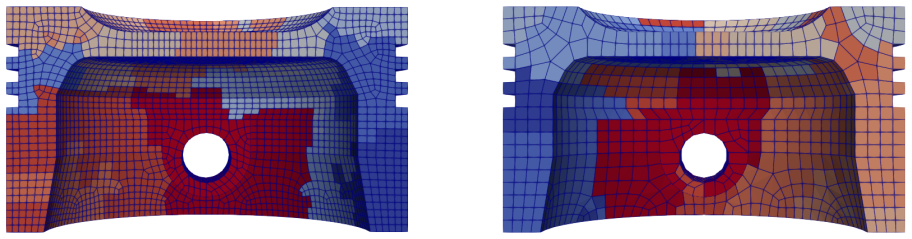
- [3.3, Eq. (17)] The curved-boundary transfer is the only component of the algorithm whose accuracy is not verified. The text states that local bounding boxes are expanded by a tolerance only described as 'large enough', and that points outside the coarse mesh are mapped to the nearest point in the reference cell via Eq. (17). The tolerance value is never stated or varied, and no experiment compares Eq. (17) with an alternative such as propagating CAD geometry or a projection onto the true boundary. Since the piston and wrench results of Section 4.3 are obtained with this default setting, the claim that the method is robust for curved geometries is not yet supported. Please report the tolerance used, study its sensitivity, and comment on the possible association of boundary points with the wrong coarse cell near corners or for large gaps.
- [Section 2, [15]] The convergence framework of Bramble, Pasciak, and Xu [15] requires the intergrid transfer operators to satisfy appropriate approximation properties. The pointwise interpolation P^{(c,f)} combined with the projection in Eq. (17) replaces the evaluation point by a nearby point in the reference cell, and the paper provides no verification that the resulting transfer still meets the assumptions of that theory. Please either give a bound on the projection error in a suitable norm, or state explicitly that the robustness in the curved-boundary case is demonstrated only experimentally and may not be covered by the cited analysis.
minor comments (5)
- [Eq. (3)] The mesh-size condition is written as C h_l <= h_{l+1} <= h_l; for C > 1 this is contradictory, and the standard condition should be h_l <= C h_{l+1} (or h_{l+1} <= h_l <= C h_{l+1}). Please correct the inequality.
- [3.3] The phrase 'large enough tolerance' should be replaced with a concrete value or rule, for example a multiple of the local mesh size, so that the experiments are reproducible.
- [Figure 5] The caption says 'Gauss-Lobatto points for a quadrature rule of order p=4', but Section 4 states that Gauss-Legendre quadrature is used; clarify whether the figure shows support points or quadrature points.
- [Section 1] The novelty statement 'To the best of the authors' knowledge, no matrix-free realizations...' is an assertion; consider phrasing it more cautiously or supporting it with a more systematic literature search.
- [Tables 6 and 7] The sub-column layout in these tables is difficult to parse because the same header names are reused across polynomial degrees; use separate table blocks or clearer column headers to distinguish AMG, NN, and PMG entries for each p.
Circularity Check
No circularity: the non-nested multigrid implementation is validated against external baselines; the curved-boundary tolerance is a stated heuristic but not a circular input.
full rationale
The derivation chain is an implementation of the standard non-nested multigrid V-cycle: the transfer operator P^{(c,f)} is pointwise nodal interpolation evaluated at fine-grid degrees of freedom (Eqs. 8 and 13), restriction is its transpose (Eqs. 11-12), and the iterative scheme is the textbook V-cycle of Algorithm 1. No step defines the reported results in terms of themselves, and no parameter is fitted to make the iteration counts come out as observed. Self-citations to the deal.II infrastructure, matrix-free evaluation kernels, and prior multigrid frameworks are implementation building blocks with independently available code and are not load-bearing for the core algorithmic claim. The numerical claims are checked against external baselines (Trilinos AMG, polynomial multigrid, global coarsening) and, importantly, against a nested-mesh sanity case where the non-nested transfer must coincide with classical injection (Tables 1-2), giving an independent consistency check. The curved-boundary handling in Section 3.3 is explicitly acknowledged as heuristic: the paper says points are associated with a coarse element 'by expanding local bounding boxes by a large enough tolerance' and then evaluates shape functions at the closest reference point (Eq. 17), adding that 'Another approach, more robust and requiring fewer heuristics' would propagate CAD geometry information. This tolerance is not stated, varied, or empirically studied, so its effect on the piston and wrench results is a real open robustness risk. However, that is a correctness and generalizability concern, not circularity: the paper does not derive the robustness claim from this heuristic, and the heuristic is not tuned to force the observed iteration counts. The 'first matrix-free non-nested multigrid' novelty statement is a literature claim, not a derivation, and no uniqueness theorem or author-imported ansatz is invoked to forbid alternatives. Overall, the paper is self-contained against external benchmarks and the central claims do not reduce to their inputs by construction.
Assumptions & free parameters
free parameters (1)
- bounding-box expansion tolerance for boundary points =
not specified (described as 'large enough')
assumptions (4)
- standard math Convergence theory for multigrid with non-nested spaces and non-inherited bilinear forms applies to the present setting (Bramble, Pasciak, Xu 1991).
- domain assumption Each level is a shape-regular partition of the same domain, with mesh sizes satisfying C h_l <= h_{l+1} <= h_l (Eq. 3).
- domain assumption Pointwise nodal interpolation between non-matching Lagrangian finite element spaces is an accurate enough transfer operator to keep multigrid iteration counts bounded.
- standard math Coercivity and continuity of the bilinear form a(.,.) hold (Lax-Milgram).
Cite this review
Pith. "Pith review of Matrix-free implementation of the non-nested multigrid method." pith.science (2026). https://pith.science/paper/YEOSTK5Q
@misc{pith2026241210910,
  author       = {Pith},
  title        = {Pith review of: Matrix-free implementation of the non-nested multigrid method},
  year         = {2026},
  howpublished = {\url{https://pith.science/paper/YEOSTK5Q}},
  note         = {Machine review of arXiv:2412.10910}
}
read the original abstract
Traditionally, the geometric multigrid method is used with nested levels. However, the construction of a suitable hierarchy for very fine and unstructured grids is, in general, highly non-trivial. In this scenario, the non-nested multigrid method could be exploited in order to handle the burden of hierarchy generation, allowing some flexibility on the choice of the levels. We present a parallel, matrix-free, implementation of the non-nested multigrid method for continuous Lagrange finite elements, where each level may consist of independently partitioned triangulations. Our algorithm has been added to the multigrid framework of the C++ finite-element library deal.II. Several 2D and 3D numerical experiments are presented, ranging from Poisson problems to linear elasticity. We test the robustness and performance of the proposed implementation with different polynomial degrees and geometries.
Figures


Figures from the paper (16 more)



Forward citations
Cited by 1 Pith paper
-
An agglomeration-based multigrid solver for the discontinuous Galerkin discretization of cardiac electrophysiology
An R-tree-based agglomeration multigrid preconditioner makes PCG for the DG monodomain model converge in 6-13 iterations per time step across p=1..3, with 3-7.5x total-time speedups over AMG at high polynomial degree.
Reference graph
Works this paper leans on
-
[15]
J. H. Bramble, J. E. Pasciak, and J. Xu. The analysis of multigrid algorithms with nonnested spaces or noninherited quadratic forms. Mathematics of Computation, 56(193):1–34, 1991
work page 1991
-
[1]
Coreform Cubit 2023.4.0 [Computer software]. Orem, UT: Coreform LLC. Retrieved from http://coreform.com
work page 2023
-
[2]
M. Ainsworth and C. Parker. Unlocking the secrets of locking: Finite element analysis in planar linear elasticity. Computer Methods in Applied Mechanics and Engineering, 395:115034, 2022
work page 2022
-
[3]
P. Antonietti, S. Berrone, M. Busetto, and M. Verani. Agglomeration-based geometric multigrid schemes for the virtual element method. SIAM Journal on Numerical Analysis, 61(1):223–249, 2023
work page 2023
-
[4]
P. Antonietti, M. Corti, and G. Martinelli. Polytopal mesh agglomeration via geometrical deep learning for three-dimensional heterogeneous domains. 2024. arXiv preprint 2406.10587
work page Pith review arXiv 2024
-
[5]
P. Antonietti and G. Pennesi. V-cycle multigrid algorithms for discontinuous Galerkin methods on non-nested polytopic meshes. Journal of Scientific Computing, 78:625–652, 2019
work page 2019
-
[6]
P. F. Antonietti, P. Houston, M. Sarti, and M. Verani. Multigrid algorithms for hp-version interior penalty discontinuous galerkin methods on polygonal and polyhedral meshes. Calcolo, 54:1169–1198, 2017
work page 2017
- [7]
Show all 53 references
-
[8]
Arndt, W
D. Arndt, W. Bangerth, D. Davydov, T. Heister, L. Heltai, M. Kronbichler, M. Maier, J.-P. Pelteret, B. Tur- cksin, and D. Wells. The deal.II finite element library: Design, features, and insights. Computers & Mathe- matics with Applications, 81:407–422, 2021
2021
-
[9]
A. H. Baker, T. V . Kolev, and U. M. Yang. Improving algebraic multigrid interpolation operators for linear elasticity problems. Numerical Linear Algebra with Applications, 17(2-3):495–517, 2010
2010
-
[10]
Bastian and C
P. Bastian and C. Wieners. Multigrid methods on adaptively refined grids. Computing in Science & Engi- neering, 8(6):44–54, 2006
2006
-
[11]
Becker and M
R. Becker and M. Braack. Multigrid techniques for finite elements on locally refined meshes. Numerical Linear Algebra with Applications, 7(6):363–379, 2000
2000
-
[12]
Bergbauer, P
M. Bergbauer, P. Munch, W. A. Wall, and M. Kronbichler. High-performance matrix-free unfitted finite element operator evaluation, 2024. arXiv preprint 2404.07911
2024 arXiv
-
[13]
M. L. Bittencourt, C. C. Douglas, and R. A. Feij ´oo. Nonnested multigrid methods for linear problems. Numerical Methods for Partial Differential Equations, 17(4):313–331, 2001
2001
-
[14]
Boffi, F
D. Boffi, F. Brezzi, and M. Fortin. Mixed finite element methods and applications , volume 44 of Springer Series in Computational Mathematics. Springer, Heidelberg, 2013
2013
-
[16]
J. Brown. Efficient nonlinear solvers for nodal high-order finite elements in 3D. Journal of Scientific Com- puting, 45:48–63, 2010
2010
-
[17]
Burstedde
C. Burstedde. Parallel tree algorithms for amr and non-standard data access. ACM Trans. Math. Softw. , 46(4), nov 2020
2020
-
[18]
T. C. Clevenger, T. Heister, G. Kanschat, and M. Kronbichler. A flexible, parallel, adaptive geometric multigrid method for FEM. ACM Trans. Math. Softw., 47(1), 2020. 22
2020
-
[19]
Davydov, J
D. Davydov, J. Pelteret, D. Arndt, M. Kronbichler, and P. Steinmann. A matrix-free approach for finite- strain hyperelastic problems using geometric multigrid. International Journal for Numerical Methods in Engineering, 121(13):2874––2895, 2020
2020
-
[20]
Di Pietro, F
D. Di Pietro, F. H ¨ulsemann, P. Matalon, P. Mycek, U. R ¨ude, and D. Ruiz. Towards robust, fast solutions of elliptic equations on complex domains through HHO discretizations and non-nested multigrid methods. International Journal for Numerical Methods in Engineering, pages 6...
2021
-
[21]
Dickopf and R
T. Dickopf and R. Krause. A study of prolongation operators between non-nested meshes. In Y . Huang, R. Kornhuber, O. Widlund, and J. Xu, editors, Domain Decomposition Methods in Science and Engineering XIX, volume 78 of Lecture Notes in Computational Science and Engineering, ...
2011
-
[22]
Ern and J.-L
A. Ern and J.-L. Guermond. Theory and practice of finite elements. 2004
2004
-
[23]
Feder, A
M. Feder, A. Cangiani, and L. Heltai. R3mg: R-tree based agglomeration of polytopal grids with applications to multilevel methods. 2024. arXiv preprint 2404.18505
2024 arXiv
-
[24]
N. Fehn, P. Munch, W. A. Wall, and M. Kronbichler. Hybrid multigrid methods for high-order discontinuous Galerkin discretizations. J. Comput. Phys., 415:109538, 2020
2020
-
[25]
M. Gee, C. Siefert, J. Hu, R. Tuminaro, and M. Sala. Ml 5.0 smoothed aggregation user’s guide. 01 2006
2006
-
[26]
Geuzaine and J.-F
C. Geuzaine and J.-F. Remacle. Gmsh: A 3-d finite element mesh generator with built-in pre- and post- processing facilities. International Journal for Numerical Methods in Engineering, 79(11):1309–1331, 2009
2009
-
[27]
Glowinski, T.-W
R. Glowinski, T.-W. Pan, and J. P´eriaux. A fictitious domain method for Dirichlet problem and applications. Comput. Methods Appl. Mech. Engrg., 111(3-4):283–303, 1994
1994
-
[28]
Golshan, P
S. Golshan, P. Munch, R. Gassmoller, M. Kronbichler, and B. Blais. Lethe-DEM: An open-source parallel discrete element solver with load balancing. 2021
2021
-
[29]
Gropp, E
W. Gropp, E. Lusk, N. Doss, and A. Skjellum. A high-performance, portable implementation of the MPI message passing interface standard. Parallel Computing, 22(6):789–828, 1996
1996
-
[30]
Gurtin and W
M. Gurtin and W. Drugan. An introduction to continuum mechanics. Journal of Applied Mechanics, 51:949, 12 1984
1984
-
[31]
Hackbusch
W. Hackbusch. Multi-Grid Methods and Applications, volume 4. 01 1985
1985
-
[32]
Heinz, P
J. Heinz, P. Munch, and M. Kaltenbacher. High-order non-conforming discontinuous galerkin methods for the acoustic conservation equations. International Journal for Numerical Methods in Engineering , 124(9):2034–2049, 2023
2023
-
[33]
Heltai, W
L. Heltai, W. Bangerth, M. Kronbichler, and A. Mola. Propagating geometry information to finite element computations. ACM Trans. Math. Softw., 47(4), sep 2021
2021
-
[34]
Hoefler, C
T. Hoefler, C. Siebert, and A. Lumsdaine. Scalable communication protocols for dynamic sparse data ex- change. page 159–168, 2010
2010
-
[35]
Joachim, C.-A
J. Joachim, C.-A. Daunais, V . Bibeau, L. Heltai, and B. Blais. A parallel and adaptative nitsche immersed boundary method to simulate viscous mixing. Journal of Computational Physics, 488:112189, 2023
2023
-
[36]
Kanschat
G. Kanschat. Multilevel methods for discontinuous Galerkin FEM on locally refined meshes. Computers & Structures, 82(28):2437–2445, 2004. Preconditioning methods: algorithms, applications and software environments
2004
-
[37]
Karypis and V
G. Karypis and V . Kumar. A fast and high quality multilevel scheme for partitioning irregular graphs.SIAM Journal on Scientific Computing, 20(1):359–392, 1998
1998
-
[38]
Krause and P
R. Krause and P. Zulian. A parallel approach to the variational transfer of discrete fields between arbitrarily distributed unstructured finite element meshes. SIAM Journal on Scientific Computing , 38(3):C307–C333, 2016
2016
-
[39]
Kronbichler and K
M. Kronbichler and K. Kormann. A generic interface for parallel cell-based finite element operator applica- tion. Computers & Fluids, 63:135–147, 2012. 23
2012
-
[40]
Kronbichler and K
M. Kronbichler and K. Ljungkvist. Multigrid for matrix-free high-order finite element computations on graphics processors. ACM Transactions on Parallel Computing, 6(1):2:1–32, 2019
2019
-
[41]
Kronbichler and P.-O
M. Kronbichler and P.-O. Persson. Efficient High-Order Discretizations for Computational Fluid Dynamics. 01 2021
2021
-
[42]
Kronbichler and W
M. Kronbichler and W. A. Wall. A performance comparison of continuous and discontinuous Galerkin methods with fast multigrid solvers. SIAM J. Sci. Comput., 40(5):A3423–A3448, 2018
2018
-
[43]
Laughton, G
E. Laughton, G. Tabor, and D. Moxey. A comparison of interpolation techniques for non-conformal high-order discontinuous Galerkin methods. Computer Methods in Applied Mechanics and Engineering , 381:113820, 2021
2021
-
[44]
Lebrun-Grandi ´e, A
D. Lebrun-Grandi ´e, A. Prokopenko, B. Turcksin, and S. R. Slattery. ArborX: A performance portable geo- metric search library. ACM Trans. Math. Softw., 47(1), dec 2020
2020
-
[45]
Munch, T
P. Munch, T. Heister, L. Prieto Saavedra, and M. Kronbichler. Efficient distributed matrix-free multigrid methods on locally refined meshes for FEM computations. ACM Trans. Parallel Comput., 10(1), 2023
2023
-
[46]
O’Malley, J
B. O’Malley, J. K ´oph´azi, R. Smedley-Stevenson, and M. Eaton. P-multigrid expansion of hybrid multi- level solvers for discontinuous Galerkin finite element discrete ordinate (DG-FEM-SN) diffusion synthetic acceleration (DSA) of radiation transport algorithms. Progress in Nu...
2017
-
[47]
S. A. Orszag. Spectral methods for problems in complex geometries. J. Comput. Phys., 37:70–92, 1980
1980
-
[48]
C. S. Peskin. The immersed boundary method. Acta Numerica, 11:479–517, 2002
2002
-
[49]
O. C. S.A.S. Opencascade technology, 2010. http://www.opencascade.org
2010
-
[50]
Stadler and G
G. Stadler and G. Biros. Comparison of multigrid algorithms for high-order continuous finite element dis- cretizations. Numerical Linear Algebra with Applications, 22, 02 2014
2014
-
[51]
St ¨uben
K. St ¨uben. Algebraic multigrid (amg): Experiences and comparisons. Appl. Math. Comput. , 13(3–4):419–451, jan 1983
1983
-
[52]
Trottenberg, C
U. Trottenberg, C. Oosterlee, and A. Sch ¨uller. Multigrid. Elsevier Academic Press, London, 2001
2001
-
[53]
Wesseling and C
P. Wesseling and C. Oosterlee. Geometric multigrid with application to computational fluid dynamics. Jour- nal of Computational and Applied Mathematics, 128:311–334, 03 2001. 24
2001
Reviewed August 11, 2026 · model on record in the stance chip above.
Discussion (0). Continue with ORCID to comment.