Ramsey-like theorems for the Schreier barrier
Pith reviewed 2026-05-23 07:16 UTC · model grok-4.3
The pith
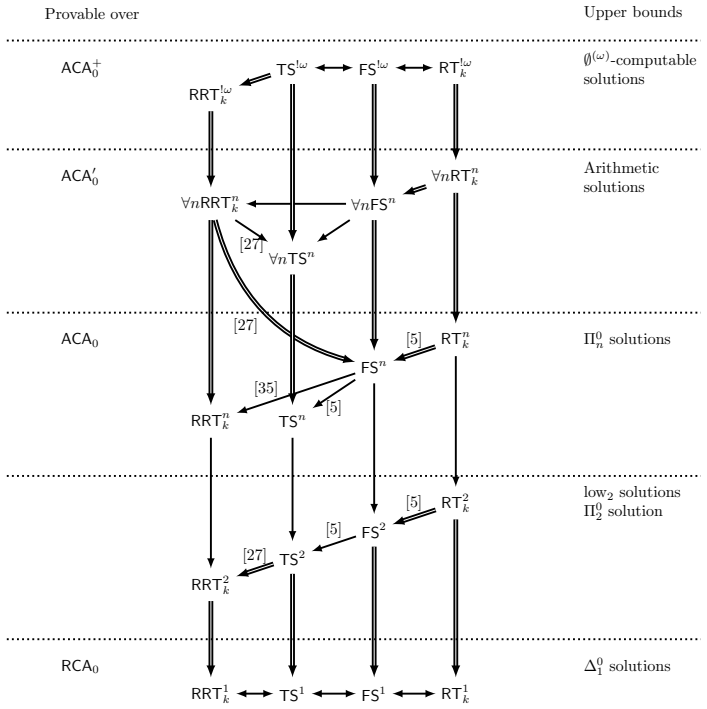
The exactly ω-large Thin Set and Free Set theorems code ∅^(ω) but the Rainbow Ramsey version does not code the halting set.
A machine-rendered reading of the paper's core claim, the machinery that carries it, and where it could break.
Core claim
The authors show that generalizations of the Thin Set and Free Set theorems to colorings of exactly ω-large sets can code the ω-th jump of the empty set, whereas the generalization of the Rainbow Ramsey theorem does not code even the halting set.
What carries the argument
The Schreier barrier, the collection of finite sets s ⊆ ℕ with |s| = 1 + min(s), serving as the domain for the colorings in the generalized theorems.
If this is right
- The Thin Set theorem on the Schreier barrier yields sets computing ∅^(ω).
- The Free Set theorem on the Schreier barrier yields sets computing ∅^(ω).
- The Rainbow Ramsey theorem on the Schreier barrier does not yield sets computing the halting problem.
- These results are obtained via computability-theoretic constructions and reverse mathematics.
Where Pith is reading between the lines
- This separation may indicate that additive principles like Thin and Free Set interact more strongly with the size constraint of the barrier than multiplicative ones like Rainbow.
- Similar analyses could be performed for other combinatorial barriers to see if the coding power pattern persists.
- Applications might arise in understanding the computability of homogeneous sets in infinite combinatorics beyond standard Ramsey theory.
Load-bearing premise
That the chosen generalizations to colorings of the Schreier barrier faithfully capture the spirit of the original Free Set, Thin Set, and Rainbow Ramsey theorems.
What would settle it
A specific coloring of the Schreier barrier for which every thin homogeneous set fails to compute ∅^(ω) would falsify the coding claim for the Thin Set version.
Figures

read the original abstract
The family of finite subsets $s$ of the natural numbers such that $|s|=1+\min s$ is known as the Schreier barrier in combinatorics and Banach Space theory, and as the family of exactly $\omega$-large sets in Logic. We formulate and prove the generalizations of Friedman's Free Set and Thin Set theorems and of Rainbow Ramsey's theorem to colorings of the Schreier barrier. We analyze the strength of these theorems from the point of view of Computability Theory and Reverse Mathematics. Surprisingly, the exactly $\omega$-large counterparts of the Thin Set and Free Set theorems can code $\emptyset^{(\omega)}$, while the exactly $\omega$-large Rainbow Ramsey theorem does not code the halting set.
Editorial analysis
A structured set of objections, weighed in public.
Referee Report
Summary. The paper formulates and proves generalizations of Friedman's Free Set and Thin Set theorems and the Rainbow Ramsey theorem to colorings of the Schreier barrier (exactly ω-large sets). It then analyzes the computability-theoretic strength of these statements, claiming that the Thin Set and Free Set versions can code ∅^(ω) while the Rainbow Ramsey version does not code the halting set 0'.
Significance. If the chosen generalizations faithfully extend the classical theorems while preserving their combinatorial content, the reported separation between coding ∅^(ω) and failing to code even 0' would be a notable contribution to the computability analysis of Ramsey-like principles at the ω level, distinguishing the behavior of thin/free set principles from rainbow principles in this setting.
major comments (1)
- [Introduction / Definitions of generalizations] The central coding claims (Thin Set/Free Set coding ∅^(ω) vs. Rainbow Ramsey not coding 0') are load-bearing on the specific definitions of the 'exactly ω-large' generalizations. The manuscript should include an explicit argument (e.g., in the introduction or the section defining the generalizations) showing that these definitions preserve the key combinatorial features of the original theorems for colorings of pairs or infinite sets; without this, the separation could be an artifact of the formulation rather than a robust phenomenon.
minor comments (1)
- The abstract states the results clearly but the full manuscript should provide more detail on the exact statements of the generalized theorems (e.g., the precise uniformity or minimality conditions on the barrier colorings) to allow verification of the faithfulness assumption.
Simulated Author's Rebuttal
We thank the referee for the detailed reading and the constructive suggestion regarding the justification of our generalizations. We agree that an explicit discussion will strengthen the manuscript and clarify that the observed separation is not an artifact of the formulation.
read point-by-point responses
-
Referee: [Introduction / Definitions of generalizations] The central coding claims (Thin Set/Free Set coding ∅^(ω) vs. Rainbow Ramsey not coding 0') are load-bearing on the specific definitions of the 'exactly ω-large' generalizations. The manuscript should include an explicit argument (e.g., in the introduction or the section defining the generalizations) showing that these definitions preserve the key combinatorial features of the original theorems for colorings of pairs or infinite sets; without this, the separation could be an artifact of the formulation rather than a robust phenomenon.
Authors: We agree that an explicit justification is valuable. The definitions are the direct, standard extensions in which 'infinite' or 'pair' is replaced by 'exactly ω-large' (i.e., members of the Schreier barrier). This is the canonical way to lift classical Ramsey-type statements to barriers, as done in the literature on Ramsey theory for barriers (e.g., in the work of Galvin-Prikry and subsequent developments). The combinatorial content is preserved because the free-set and thin-set properties are expressed in terms of avoiding monochromatic structures on the chosen sets, and the rainbow condition likewise concerns distinct colors on the chosen ω-large sets. We will add a short paragraph in the introduction (and a brief remark in Section 2) spelling out this preservation, thereby addressing the concern that the separation might be formulation-dependent. revision: yes
Circularity Check
No circularity: new formulations and direct proofs
full rationale
The paper explicitly formulates new generalizations of the Thin Set, Free Set, and Rainbow Ramsey theorems to colorings of the Schreier barrier (exactly ω-large sets) and derives their computability-theoretic strength via direct proofs in reverse mathematics and computability. No quoted step equates a claimed prediction or theorem to its own inputs by definition, fitted parameter, or self-citation chain. The central separation (coding ∅^(ω) vs. not coding 0') follows from the stated combinatorial properties of the new statements rather than reducing tautologically to the choice of generalization. This is self-contained original work.
Axiom & Free-Parameter Ledger
axioms (1)
- standard math Standard axioms of second-order arithmetic (or ZFC) as used in reverse mathematics and computability theory
Reference graph
Works this paper leans on
-
[1]
Caract´ erisation du type d’ordre des barri` eres de Nash- Williams.Publ
Marc Assous. Caract´ erisation du type d’ordre des barri` eres de Nash- Williams.Publ. D´ ep. Math. (Lyon), 11(4):89–106, 1974
work page 1974
-
[2]
Lorenzo Carlucci, Leonardo Mainardi, and Konread Zdanowski. Reduc- tions of well-ordering principles to combinatorial theorems.arXiv preprint arXiv:2401.04451, 2024
-
[3]
The strength of Ramsey’s theo- rem for coloring relatively large sets.J
Lorenzo Carlucci and Konrad Zdanowski. The strength of Ramsey’s theo- rem for coloring relatively large sets.J. Symb. Log., 79(1):89–102, 2014
work page 2014
-
[4]
Thin set theorems and cone avoidance
Peter Cholak and Ludovic Patey. Thin set theorems and cone avoidance. Trans. Amer. Math. Soc., 373(4):2743–2773, 2020
work page 2020
-
[5]
Cholak, Mariagnese Giusto, Jeffry L
Peter A. Cholak, Mariagnese Giusto, Jeffry L. Hirst, and Carl G. Jockusch, Jr. Free sets and reverse mathematics. InReverse mathematics 2001, volume 21 ofLect. Notes Log., pages 104–119. Assoc. Symbol. Logic, La Jolla, CA, 2005
work page 2001
-
[6]
A recursion theoretic analysis of the clopen Ramsey theorem
Peter Clote. A recursion theoretic analysis of the clopen Ramsey theorem. The Journal of symbolic logic, 49(2):376–400, 1984
work page 1984
-
[7]
A generalization of the limit lemma and clopen games.Journal of Symbolic Logic, 51(2):273–291, 1986
Peter Clote. A generalization of the limit lemma and clopen games.Journal of Symbolic Logic, 51(2):273–291, 1986
work page 1986
-
[8]
Barbara F. Csima and Joseph R. Mileti. The strength of the rainbow ramsey theorem.The Journal of Symbolic Logic, 74(4):1310–1324, 2009
work page 2009
-
[9]
Fran¸ cois G. Dorais, Damir D. Dzhafarov, Jeffry L. Hirst, Joseph R. Mileti, and Paul Shafer. On uniform relationships between combinatorial prob- lems.Trans. Amer. Math. Soc., 368(2):1321–1359, 2016
work page 2016
- [10]
-
[11]
Dzhafarov and Carl Mummert.Reverse mathematics—problems, reductions, and proofs
Damir D. Dzhafarov and Carl Mummert.Reverse mathematics—problems, reductions, and proofs. Theory and Applications of Computability. Springer, Cham, [2022]©2022
work page 2022
-
[12]
V. Farmaki and S. Negrepontis. Schreier sets in Ramsey theory.Trans. Amer. Math. Soc., 360(2):849–880, 2008. 31
work page 2008
-
[13]
Harvey Friedman and Stephen G. Simpson. Issues and problems in reverse mathematics. InComputability theory and its applications (Boulder, CO, 1999), volume 257 ofContemp. Math., pages 127–144. Amer. Math. Soc., Providence, RI, 2000
work page 1999
-
[14]
Borel sets and Ramsey’s theorem.The Journal of Symbolic Logic, 38:193–198, 1973
Fred Galvin and Karel Prikry. Borel sets and Ramsey’s theorem.The Journal of Symbolic Logic, 38:193–198, 1973
work page 1973
-
[15]
Gerhard Gentzen.Die Widerspruchsfreiheit der reinen Zahlentheorie. Li- belli, Band 185. Wissenschaftliche Buchgesellschaft, Darmstadt, 1967
work page 1967
-
[16]
Perspectives in Mathematical Logic
Petr H´ ajek and Pavel Pudl´ ak.Metamathematics of first-order arithmetic. Perspectives in Mathematical Logic. Springer-Verlag, Berlin, 1998. Second printing
work page 1998
-
[17]
Hirschfeldt.Slicing the truth, volume 28 ofLecture Notes Se- ries
Denis R. Hirschfeldt.Slicing the truth, volume 28 ofLecture Notes Se- ries. Institute for Mathematical Sciences. National University of Singapore. World Scientific Publishing Co. Pte. Ltd., Hackensack, NJ, 2015. On the computable and reverse mathematics of combinatorial principles, Edited and with a foreword by Chitat Chong, Qi Feng, Theodore A. Slaman, W...
work page 2015
- [18]
-
[19]
Sur une caract´ erisation des alephs.Fund
Casimir Kuratowski. Sur une caract´ erisation des alephs.Fund. Math., 38:14–17, 1951
work page 1951
-
[20]
RT22 does not imply WKL0.The Journal of Symbolic Logic, 77(2):609–620, 2012
Jiayi Liu. RT22 does not imply WKL0.The Journal of Symbolic Logic, 77(2):609–620, 2012
work page 2012
-
[21]
Cone avoiding closed sets.Trans
Lu Liu. Cone avoiding closed sets.Trans. Amer. Math. Soc., 367(3):1609– 1630, 2015
work page 2015
-
[22]
Lu Liu and Ludovic Patey. The Reverse Mathematics of the Thin Set and Erd˝ os-Moser Theorems.Journal of Symbolic Logic, 87(1):313–346, 2022
work page 2022
-
[23]
Wqo and bqo theory in subsystems of second order arithmetic
Alberto Marcone. Wqo and bqo theory in subsystems of second order arithmetic. InReverse mathematics 2001, volume 21 ofLect. Notes Log., pages 303–330. Assoc. Symbol. Logic, La Jolla, CA, 2005
work page 2001
-
[24]
Open questions in reverse mathematics.Bulletin of Symbolic Logic, 17(03):431–454, 2011
Antonio Montalb´ an. Open questions in reverse mathematics.Bulletin of Symbolic Logic, 17(03):431–454, 2011. Publisher: Cambridge Univ Press
work page 2011
-
[25]
C. St. J. A. Nash-Williams. On better-quasi-ordering transfinite sequences. Proc. Cambridge Philos. Soc., 64:273–290, 1968
work page 1968
-
[26]
A mathematical incompleteness in Peano Arithmetic
Jeff Paris and Leo Harrington. A mathematical incompleteness in Peano Arithmetic. In Jon Barwise, editor,Handbook of mathematical logic, pages 90–1133. North-Holland, 1977. 32
work page 1977
-
[27]
Somewhere over the rainbow Ramsey theorem for pairs
Ludovic Patey. Somewhere over the rainbow ramsey theorem for pairs. arXiv preprint arXiv:1501.07424, 2015
work page internal anchor Pith review Pith/arXiv arXiv 2015
-
[28]
The weakness of being cohesive, thin or free in reverse mathematics.Israel J
Ludovic Patey. The weakness of being cohesive, thin or free in reverse mathematics.Israel J. Math., 216(2):905–955, 2016
work page 2016
-
[29]
Iterative forcing and hyperimmunity in reverse mathemat- ics.Computability, 6(3):209–221, 2017
Ludovic Patey. Iterative forcing and hyperimmunity in reverse mathemat- ics.Computability, 6(3):209–221, 2017
work page 2017
-
[30]
Sur les pr´ emeilleurordres.Annales de l’institut Fourier, 22(2):1–19, 1972
Maurice Pouzet. Sur les pr´ emeilleurordres.Annales de l’institut Fourier, 22(2):1–19, 1972
work page 1972
-
[31]
Partition theorems for systems of finite subsets of integers.Discrete Math., 39(1):67–73, 1982
Pavel Pudl´ ak and Vojtˇ ech R¨ odl. Partition theorems for systems of finite subsets of integers.Discrete Math., 39(1):67–73, 1982
work page 1982
-
[32]
David Seetapun and Theodore A. Slaman. On the strength of Ramsey’s theorem. volume 36, pages 570–582. 1995. Special Issue: Models of arith- metic
work page 1995
-
[33]
Simpson.Subsystems of second order arithmetic
Stephen G. Simpson.Subsystems of second order arithmetic. Perspectives in Logic. Cambridge University Press, Cambridge; Association for Symbolic Logic, Poughkeepsie, NY, second edition, 2009
work page 2009
-
[34]
Princeton University Press, Princeton, 2010
Stevo Todorcevic.Introduction to Ramsey Spaces. Princeton University Press, Princeton, 2010
work page 2010
-
[35]
Some logically weak Ramseyan theorems.Adv
Wei Wang. Some logically weak Ramseyan theorems.Adv. Math., 261:1–25, 2014. 33
work page 2014
discussion (0)
Sign in with ORCID, Apple, or X to comment. Anyone can read and Pith papers without signing in.