REVIEW 1 major objections 5 minor 58 references
Quasi-geodesics in integrable and non-integrable exclusion processes
T0 review · 1 major / 5 minor · reviewed 2026-08-11 · deepseek-v4-flash
Pith's one-line read For flat TASEP, the backwards geodesic endpoint converges to the Airy-2 argmax; the same law is conjectured and numerically supported for quasi-geodesics in ASEP and speed-changed ASEP.
desk verdict Rigorous TASEP endpoint theorem plus clearly-labeled conjectures for non-integrable models; the unproved characteristic-line centering is the main gap. read the letter →
The pith
A machine-rendered reading of the paper's core claim, the machinery that carries it, and where it could break.
The reading
What carries the argument
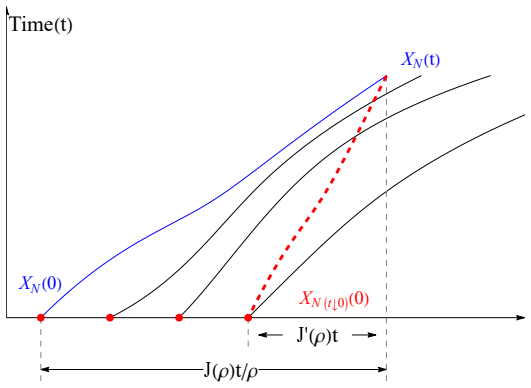
The backwards geodesic and its index process: a trajectory built backwards in time from a chosen particle, switching labels whenever a suppressed jump of that particle is encountered, so that it tracks the space-time randomness that actually influences the particle's position. For TASEP this object satisfies the exact variational identity (2.9), $X_N(t)=\min_{M\le N}\{X^{\mathrm{step},X,M}_{N-M}(t)+X_M(0)\}$, which reduces the endpoint to the argmax of a rescaled height function $H_t$ that converges weakly to $A_2(u)-u^2$; tightness of the argmax then transfers the limit. For ASEP and speed-changed ASEP the same construction defines the quasi-geodesic, and KPZ scaling theory provides the centering and scaling constants through the stationary current $J(\rho)$, the integrated covariance $A(\rho)$, and $\Gamma(\rho)=-A(\rho)^2J''(\rho)$.
What would settle it
Run high-precision simulations of ASEP with $p$ close to $1/2$ (say $p=0.55$) and of speed-changed ASEP with different $\beta$ and $E$, at times where the $t^{-1/3}$ drift is resolved, and test whether the empirical endpoint distribution, after subtracting the paper's analytically computed centering, converges to $\hat{u}$ with the predicted decays of the first four moments; any $t^{2/3}$-scale residual drift or variance mismatch that persists at large $t$ would disconfirm Conjectures 2.7 and 2.8.
Extended reading notes
Core claim
In Theorem 2.6 the paper proves for TASEP with $X_n(0)=-2n$ that $(X_{N(t\downarrow 0)}(0)-X_N(0)-t/2)/(2^{1/3}t^{2/3})$ converges in distribution to $\hat{u}=\arg\max_{u\in\mathbb{R}}\{A_2(u)-u^2\}$, where $A_2$ is the Airy$_2$ process. It conjectures the identical limit for the quasi-geodesic endpoint in ASEP (Conjecture 2.7) and in speed-changed ASEP (Conjecture 2.8), with the centering $(p-q)t/2$ and the model-dependent but analytically known constants $J(\beta,E)$, $\Gamma(\beta,E)$, $A(\beta)$ respectively, and provides numerical evidence for both. It also conjectures and tests numerically that the one-point particle distribution in speed-changed ASEP is GOE Tracy-Widom, and that the ASEP discrepancy $D_N(t)$ — the difference between the quasi-geodesic reconstruction and the true particle position — converges to a non-degenerate random variable without rescaling.
Load-bearing premise
The conjectured centering assumes the quasi-geodesic tracks the characteristic line at the macroscopic speed of information propagation in the model, a property proved only for TASEP; if that heuristic fails for ASEP or speed-changed ASEP, the conjectured limiting law would be off-center even though its fluctuation shape might still be right.
Editorial extensions
If this is right
- The endpoint of the backwards geodesic for flat TASEP has the same limit law as the endpoint of the point-to-line geodesic in exponential LPP, namely the argmax of $A_2$ minus a parabola.
- If Conjectures 2.7 and 2.8 hold, then the endpoint fluctuation of quasi-geodesics in ASEP and speed-changed ASEP is universal and given by that same law, with no fitted constants.
- Conjecture 2.9 implies that the one-point distribution of a tagged particle in speed-changed ASEP with flat initial condition is the GOE Tracy-Widom distribution $F_{\mathrm{GOE}}(2s)$.
- Conjecture 2.11 states that for ASEP the difference between the quasi-geodesic value and the true particle position stays random but bounded as $t\to\infty$, meaning the minimization identity (1.2) fails only by an $O(1)$ error.
- The numerical evidence suggests the convergence rates: for both ASEP and speed-changed ASEP, the empirical mean of the scaled endpoint approaches that of $\hat{u}$ at rate $t^{-1/3}$, while variance and skewness converge at rate $t^{-2/3}$.
Reading between the lines
- The same KPZ scaling formula in Conjecture 3.9 should apply to other non-integrable exclusion-type models with known stationary measures; testing it on, say, the inclusion process or multi-species exclusion would separate the characteristic-line heuristic from the universal fluctuation law.
- If Conjecture 2.11 is right, the ASEP height function is within $O(1)$ of a line-ensemble maximum, which suggests a concrete route to a rigorous ASEP analogue of the LPP variational formula.
- The empirical shift of about $0.385$ in the speed-changed ASEP one-point function hints at a universal $O(1)$ correction to the KPZ scaling; a refined next-order theory could turn the numerical fits into a sharper test.
Editorial analysis
A structured set of objections, weighed in public.
Referee Report
Summary. The paper studies backwards geodesics (and their generalization, quasi-geodesics) in exclusion processes. For TASEP with flat initial condition X_n(0)=-2n, it proves Theorem 2.6: the endpoint of the backwards geodesic, after centering by t/2 and scaling by 2^{1/3}t^{2/3}, converges in distribution to argmax_{u}{A_2(u)-u^2}. The proof uses the variational identity (2.9), a distributional reduction to step initial conditions, weak convergence of the rescaled height function to A_2-u^2, and exponential tightness of the argmax. The paper then defines the same backwards index process for ASEP and speed-changed ASEP, derives (via KPZ scaling theory) explicit scaling conjectures for the endpoint (Conjectures 2.7 and 2.8), a GOE one-point conjecture for ASEPsc (Conjecture 2.9), and a conjecture that the ASEP discrepancy D_N(t) converges to a finite random variable (Conjecture 2.11). These are tested with 10^6-sample simulations.
Significance. If the conjectures are correct, the paper gives a clean and natural analogue for dynamical backwards geodesics of the point-to-line LPP geodesic endpoint, and it provides parameter-free KPZ predictions for non-integrable models. The rigorous TASEP theorem is a solid contribution, with tightness handled through large-deviation bounds rather than only by soft compactness arguments. The non-integrable part is also valuable: all non-universal coefficients are computed analytically from the known stationary measures, and the numerical evidence is extensive and power-law in time. The main weakness is that the centering of the endpoint conjectures rests on an unproved characteristic-line heuristic; the paper is honest in labelling the statements as conjectures, but the abstract's wording 'numerically verify' overstates the strength of the evidence for the centering.
major comments (1)
- [Section 3.2.2 / Conjectures 2.7 and 2.8] The centering in Conjectures 2.7 and 2.8 is derived from the assertion that 'the backwards geodesic mimics the characteristic line', giving the macroscopic velocity J(ρ)/ρ − J′(ρ) (Section 3.2.2, around equations (3.43)–(3.46)). For TASEP this follows from the equality (2.9), but for ASEP the equality is replaced by the inequality (2.12), and the index process of Definition 2.1 is not known to solve any variational principle whose implied velocity is the characteristic velocity. If the actual label drift of N(t↓0) differs from (J(ρ)/ρ − J′(ρ))t by a constant c, then the numerator in Conjectures 2.7 and 2.8 contains an extra −ct term and the rescaled variable diverges like c t^{1/3}; the conjectured limit would fail exactly through the centering, even if the t^{2/3} fluctuation scale and the Airy_2−u^2 shape were correct. The numerical evidence in Section 4.1.1 (empirical mean of B_t^{ASEP} decaying like t^{−1/3}) is consistent with c=0 for p=3/4, and Figure 13 gives similar evidence for one parameter choice of ASEPsc, but this does not prove the centering and covers only a single point in parameter space. I recommend that the paper explicitly state that the characteristic-line centering is an unproved additional assumption, and, if feasible, add a direct check of the macroscopic label drift (for example, regressing X_{N(t↓0)}(0)−X_N(0) on t) for more than one asymmetry or density.
minor comments (5)
- [Section 3.1.1, Lemma 3.2] The proof says 'we only need to show the case N=t/4', but Theorem 2.6 is stated for a fixed N; please add a sentence explaining that the scaled label difference is asymptotically independent of the fixed offset N, since the relevant backward label drifts by about t/4.
- [Section 4.1.2, Conjecture 2.11] The evidence for convergence of the unscaled discrepancy D_N(t) is suggestive but not conclusive: Table 1 shows the empirical mean increasing from 4.34 at t=400 to 4.95 at t=2000 and the variance increasing from 12.96 to 14.07, with no error bars or extrapolation. Please soften the wording and state more clearly that the data are consistent with, but do not establish, a finite limit.
- [Remark 4.1] There is a typo: 'KPT universality class' should be 'KPZ universality class'.
- [References] In reference [32], 'Eletron. J. Probab.' should be 'Electron. J. Probab.'; also, the BonnData repository reference [29] should include a stable URL or DOI to be useful.
- [Section 3.2.1, Equation (3.39)] The phrase 'there exist universal constants c1 and c2' followed by 'The constants are c1=2 and c2=1' is slightly redundant; consider clarifying that these constants are fixed by matching the TASEP case.
Circularity Check
No significant circularity: the TASEP theorem is proved from external convergence and tightness results, and the ASEP/ASEPsc statements are explicitly labeled conjectures with analytically computed coefficients rather than fitted restatements of the target.
full rationale
The paper's central rigorous result, Theorem 2.6, is not circular. The endpoint of the TASEP backwards geodesic is identified with the argmax of a TASEP height-function process via the distributional identity (3.5), proved in Lemma 3.2; the limiting weak convergence of that process to A_2(u)-u^2 is imported from the independent result of [15], and tightness is proved in Lemma 3.3. The limit law therefore comes from established external inputs, not from assuming the answer. For ASEP and ASEPsc, the paper formulates Conjectures 2.7 and 2.8 by applying the KPZ scaling theory: universal constants c1, c2 are calibrated once from the TASEP result (using [16]), while the model-dependent coefficients J, A, Gamma are computed analytically from the stationary measures (Lemma 3.10). The endpoint prediction is not used to fit any of these parameters, so it is not a fitted input called a prediction. The characteristic-line centering in Section 3.2.2 is explicitly a heuristic assumption ("the backwards geodesic mimics the characteristic line"), and the paper flags the unsolved discrepancy for ASEP; an unproved assumption is a correctness risk, not circularity. Numerical checks compare with the known density of argmax{A_2-u^2} obtained from the independent formula of [35]; no parameter is fitted for the geodesic endpoint. The only empirically adjusted constant, 0.385 in Remark 4.1, is an explicitly finite-time shift in an auxiliary GOE one-point check and is not used to derive or verify Conjectures 2.7/2.8. Self-citations to prior work of the authors (e.g., [26], [28], [15], [16], [20]) supply established tools and estimates, not the paper's own conclusions, and none of those citations smuggles in the target result. Accordingly, no circular step can be exhibited, and the appropriate score is 0.
Assumptions & free parameters
free parameters (1)
- mean shift constant =
0.385
assumptions (5)
- domain assumption Assumption 3.7: spatially ergodic and time stationary measures are labeled by average density rho, with |rho| <= 1.
- domain assumption The KPZ scaling theory universality (Conjectures 3.8 and 3.9): rescaled height functions and backward geodesic endpoints converge to universal objects with constants c1=2, c2=1 determined from TASEP.
- ad hoc to paper The backwards geodesic follows the characteristic line with macroscopic velocity J'(rho).
- standard math Large deviation and tightness estimates for TASEP and LPP from [2] and [28].
- standard math Uniqueness of the maximizer of A_2(u) - u^2.
Cite this review
Pith. "Pith review of Quasi-geodesics in integrable and non-integrable exclusion processes." pith.science (2026). https://pith.science/paper/MXTAZPMB
@misc{pith2026241211626,
  author       = {Pith},
  title        = {Pith review of: Quasi-geodesics in integrable and non-integrable exclusion processes},
  year         = {2026},
  howpublished = {\url{https://pith.science/paper/MXTAZPMB}},
  note         = {Machine review of arXiv:2412.11626}
}
abstract
Backwards geodesics for TASEP were introduced in [Fer18]. We consider flat initial conditions and show that under proper scaling its end-point converges to maximizer argument of the Airy$_2$ process minus a parabola. We generalize its definition to generic non-integrable models including ASEP and speed changed ASEP (call it quasi-geodesics). We numerically verify that its end-point is universal, where the scaling coefficients are analytically computed through the KPZ scaling theory.
Figures


Figures from the paper (10 more)



Reference graph
Works this paper leans on
-
[1]
A. Aggarwal, I. Corwin, and M. Hedge, Scaling limit of the colored ASEP and stochastic six-vertex models , arXiv:2403.01341 (2024)
arXiv 2024
- [2]
-
[3]
J. Baik, K. Liechty, and G. Schehr, On the joint distribution of the maximum and its position of the Airy 2 process minus a parabola, J. Math. Phys. 53 (2012), 083303
work page 2012
-
[4]
M. Bal´ azs, O. Busani, and T. Sepp¨ al¨ ainen, Non-existence of bi-infinite geodesics in the exponential corner growth model , Forum of Mathematics, Sigma 8 (2020), e46
work page 2020
-
[5]
M. Bal´ azs, O. Busani, and T. Sepp¨ al¨ ainen,Local stationarity of exponential last passage percolation , Probab. Theory Relat. Fields 180 (2021), 112–162
work page 2021
-
[6]
R. Basu, O. Busani, and P.L. Ferrari, On the exponent governing the correlation decay of the Airy 1 process, Commun. Math. Phys. 398 (2023), 1171–1211
work page 2023
-
[7]
R. Basu and S. Ganguly, Time correlation exponents in last passage percolation, In and Out of Equilibrium 3: Celebrating Vladas Sidoravicius (M.E. Vares , R. Fern´ andez, L.R. Fontes, and C.M. Newman, eds.), Progress in P robability, vol. 77, Birkh¨ auser, 2021
work page 2021
-
[8]
R. Basu, S. Ganguly, A. Hammond, and M. Hedge, Interlacing and scaling exponents for the geodesic watermelon in last passage perco lation, Commun. Math. Phys. 393 (2022), 1241–1309
work page 2022
Show all 58 references
-
[9]
R. Basu, S. Ganguly, and L. Zhang, Temporal correlation in last passage per- colation with flat initial condition via Brownian compariso n, Commun. Math. Phys. 383 (2021), no. 3, 1805–1888
2021
-
[10]
R. Basu, C. Hoffman, and A. Sly, Nonexistence of bigeodesics in integrable models of last passage percolation , Commun. Math. Phys. 389 (2022), no. 1
2022
-
[11]
R. Basu, S. Sarkar, and A. Sly, Coalescence of geodesics in exactly solvable models of last passage percolation , Journal of Mathematical Physics 60 (2019), no. 9, 093301
2019
-
[12]
Bates, S
E. Bates, S. Ganguly, and A. Hammond, Hausdorff dimensions for shared endpoints of disjoint geodesics in the directed landscape , Electron. J. Probab. 27 (2022), 1 – 44
2022
-
[13]
Ben Arous and I
G. Ben Arous and I. Corwin, Current fluctuations for TASEP: a proof of the Pr¨ ahofer-Spohn conjecture, Ann. Probab. 39 (2011), 104–138. 32
2011
-
[14]
Bornemann, On the numerical evaluation of Fredholm determinants , Math
F. Bornemann, On the numerical evaluation of Fredholm determinants , Math. Comput. 79 (2009), 871–915
2009
-
[15]
Borodin, A
A. Borodin, A. Bufetov, and P.L. Ferrari, TASEP with a moving wall , Ann. Inst. Henri Poincar´ e Probab. Statist. 60 (2024), 692–720
2024
-
[16]
Borodin, P.L
A. Borodin, P.L. Ferrari, M. Pr¨ ahofer, and T. Sasamoto, Fluctuation properties of the TASEP with periodic initial configuration , J. Stat. Phys. 129 (2007), 1055–1080
2007
-
[17]
Bufetov and P.L
A. Bufetov and P.L. Ferrari, Shock fluctuations in TASEP under a variety of time scalings , Ann. Appl. Probab. 32 (2022), 3614–3644
2022
-
[18]
Busani and P.L
O. Busani and P.L. Ferrari, Universality of the geodesic tree in last passage percolation, Ann. Probab. 50 (2022), 90–130
2022
-
[19]
Ofer Busani, Non-existence of three non-coalescing infinite geodesics w ith the same direction in the directed landscape , arXiv:2401.00513 (2024)
2024 arXiv
-
[20]
Chhita, P.L
S. Chhita, P.L. Ferrari, and H. Spohn, Limit distributions for KPZ growth mod- els with spatially homogeneous random initial conditions , Ann. Appl. Probab. 28 (2018), 1573–1603
2018
-
[21]
Corwin and A
I. Corwin and A. Hammond, Brownian Gibbs property for Airy line ensembles , Inventiones mathematicae 195 (2013), 441–508
2013
-
[22]
Dauvergne, The 27 geodesic networks in the directed landscape , arXiv:2302.07802 (2023)
D. Dauvergne, The 27 geodesic networks in the directed landscape , arXiv:2302.07802 (2023)
2023 arXiv
-
[23]
Dauvergne, J
D. Dauvergne, J. Ortmann, and B. Vir´ ag, The directed landscape, Acta Math- ematica 229 (2022), 201–285
2022
-
[24]
Dauvergne, S
D. Dauvergne, S. Sarkar, and B. Vir´ ag, Three-halves variation of geodesics in the directed landscape, Ann. Probab. 50 (2022), 1947 – 1985
2022
-
[25]
Ferrari, TASEP hydrodynamics using microscopic characteristics , Prob- ability Surveys 15 (2018), 1–27
P.A. Ferrari, TASEP hydrodynamics using microscopic characteristics , Prob- ability Surveys 15 (2018), 1–27
2018
-
[26]
Ferrari, Finite GUE distribution with cut-off at a shock , J
P.L. Ferrari, Finite GUE distribution with cut-off at a shock , J. Stat. Phys. 172 (2018), 505–521
2018
-
[27]
Ferrari and R
P.L. Ferrari and R. Frings, Finite time corrections in KPZ growth models , J. Stat. Phys. 144 (2011), 1123–1150
2011
-
[28]
Ferrari and S
P.L. Ferrari and S. Gernholt, Tagged particle fluctuations for TASEP with dynamics restricted by a moving wall , arXiv:2403.05366 (2024)
2024 arXiv
-
[29]
Ferrari and M
P.L. Ferrari and M. Liu, Simulation for quasi-geodesic in ASEP and speed changed ASEP, 2024, BonnData repository
2024
-
[30]
Ferrari and P
P.L. Ferrari and P. Nejjar, Statistics of TASEP with three merging character- istics, J. Stat. Phys. 180 (2020), 398–413. 33
2020
-
[31]
Ferrari and P
P.L. Ferrari and P. Nejjar, The second class particle process at shocks , Stoch. Proc. Appl. 170 (2024), 104298
2024
-
[32]
Ferrari and A
P.L. Ferrari and A. Occelli, Universality of the GOE Tracy-Widom distribu- tion for TASEP with arbitrary particle density , Eletron. J. Probab. 23 (2018), no. 51, 1–24
2018
-
[33]
Ferrari and A
P.L. Ferrari and A. Occelli, Time-time covariance for last passage percolation with generic initial profile , Math. Phys. Anal. Geom. 22 (2019), 1
2019
-
[34]
Ferrari and A
P.L. Ferrari and A. Occelli, Time-time covariance for last passage percolation in half-space, Ann. Appl. Probab. 34 (2022), 627 – 674
2022
-
[35]
Moreno Flores, J
G. Moreno Flores, J. Quastel, and D. Remenik, Endpoint distribution of direc- ted polymers in 1+ 1 dimensions , Ann. Inst. H. Poincar´ e Probab. Statist. 51 (2015), 1–17
2015
-
[36]
Harris, Additive set-valued markov processes and pharical methods , Ann
T. Harris, Additive set-valued markov processes and pharical methods , Ann. Probab. 6 (1878), 355–378
-
[37]
Harris, Nearest-neighbor Markov interaction processes on multidi men- sional lattices, Adv
T.E. Harris, Nearest-neighbor Markov interaction processes on multidi men- sional lattices, Adv. Math. 9 (1972), 66–89
1972
-
[38]
Janjigian, F
C. Janjigian, F. Rassoul-Agha, and T. Sepp¨ al¨ ainen, Geometry of geodesics through Busemann measures in directed last-passage percol ation, J. Eur. Math. Soc. 25 (2023), 2573–2639
2023
-
[39]
Johansson, Discrete polynuclear growth and determinantal processes , Com- mun
K. Johansson, Discrete polynuclear growth and determinantal processes , Com- mun. Math. Phys. 242 (2003), 277–329
2003
-
[40]
Krug and H
J. Krug and H. Spohn, Kinetic roughening of growning surfaces , Solids far from equilibrium: growth, morphology and defects, Cambridge University Press, 1992, pp. 479–582
1992
-
[41]
Liggett, Stochastic interacting systems: contact, voter and exclus ion pro- cesses, Springer Verlag, Berlin, 1999
T.M. Liggett, Stochastic interacting systems: contact, voter and exclus ion pro- cesses, Springer Verlag, Berlin, 1999
1999
-
[42]
Matetski, J
K. Matetski, J. Quastel, and D. Remenik, The KPZ fixed point , Acta Math. 227 (2021), 115–203
2021
-
[43]
Ortmann, J
J. Ortmann, J. Quastel, and D. Remenik, A Pfaffian representation for flat ASEP, Comm. Pure Appl. Math. 70 (2016), 3–89
2016
-
[44]
Pimentel, On the location of the maximum of a continuous stochastic pro cess, Journal of Applied Probability 51 (2014), 152–161
L. Pimentel, On the location of the maximum of a continuous stochastic pro cess, Journal of Applied Probability 51 (2014), 152–161
2014
-
[45]
Pimentel, Duality between coalescence times and exit points in last- passage percolation models, Ann
L.P.R. Pimentel, Duality between coalescence times and exit points in last- passage percolation models, Ann. Probab. 44 (2016), no. 5, 3187–3206
2016
-
[46]
Pr¨ ahofer and H
M. Pr¨ ahofer and H. Spohn, Current fluctuations for the totally asymmetric simple exclusion process , In and out of equilibrium (V. Sidoravicius, ed.), Pro- gress in Probability, Birkh¨ auser, 2002. 34
2002
-
[47]
Pr¨ ahofer and H
M. Pr¨ ahofer and H. Spohn, Scale invariance of the PNG droplet and the Airy process, J. Stat. Phys. 108 (2002), 1071–1106
2002
-
[48]
Quastel and S
J. Quastel and S. Sarkar, Convergence of exclusion processes and KPZ equation to the KPZ fixed point , J. Amer. Math. Soc. 36 (2022), 251–289
2022
-
[49]
Rahman and B
M. Rahman and B. Vir´ ag, Infinite geodesics, competition interfaces and the second class particle in the scaling limit , arXiv:2112.06849 (2023)
2023 arXiv
-
[50]
Schehr, Extremes of N vicious walkers for large N: application to the directed polymer and KPZ interfaces , Journal of Statistical Physics 149 (2012), no
G. Schehr, Extremes of N vicious walkers for large N: application to the directed polymer and KPZ interfaces , Journal of Statistical Physics 149 (2012), no. 3, 385–410
2012
-
[51]
Schmid and A
D. Schmid and A. Sly, Mixing times for the TASEP on the circle , arXiv:2203.11896 (2022)
2022
-
[52]
Sepp¨ al¨ ainen,Coupling the totally asymmetric simple exclusion process w ith a moving interface , Markov Proc
T. Sepp¨ al¨ ainen,Coupling the totally asymmetric simple exclusion process w ith a moving interface , Markov Proc. Rel. Fields 4 no.4 (1998), 593–628
1998
-
[53]
Spitzer, Interaction of Markov processes , Adv
F. Spitzer, Interaction of Markov processes , Adv. Math. 5 (1970), 246–290
1970
-
[54]
Spohn, KPZ scaling theory and the semidiscrete directed polymer mo del, Random Matrix Theory, Interacting Particle Systems and Integra ble Systems 65 (2014), 483–493
H. Spohn, KPZ scaling theory and the semidiscrete directed polymer mo del, Random Matrix Theory, Interacting Particle Systems and Integra ble Systems 65 (2014), 483–493
2014
-
[55]
Takeuchi and M
K.A. Takeuchi and M. Sano, Growing interfaces of liquid crystal turbulence: universal scaling and fluctuations , Phys. Rev. Lett. 104 (2010), 230601
2010
-
[56]
Takeuchi, M
K.A. Takeuchi, M. Sano, T. Sasamoto, and H. Spohn, Growing interfaces un- cover universal fluctuations behind scale invariance , Sci. Rep. 1 (2011), 34
2011
-
[57]
Tracy and H
C.A. Tracy and H. Widom, On orthogonal and symplectic matrix ensembles , Commun. Math. Phys. 177 (1996), 727–754
1996
-
[58]
Zhang, Optimal exponent for coalescence of finite geodesics in expo nential last passage percolation , Electron
L. Zhang, Optimal exponent for coalescence of finite geodesics in expo nential last passage percolation , Electron. Commun. Probab. 25 (2020), 14 pp. 35
2020
Reviewed August 11, 2026 · model on record in the stance chip above.
Discussion (0). Continue with ORCID to comment.