REVIEW 3 major objections 3 minor 39 references
On loops in the complement to dimers
T0 review · 3 major / 3 minor · reviewed 2026-08-11 · deepseek-v4-flash
Pith's one-line read Every non-frozen dimer state on the hexagonal lattice has either one bi-infinite path or infinitely many loops around every face.
desk verdict The path-swapping technique is real and the paper deserves referee time, but Lemma 4.2's exclusion of N8=2 is not proven as written, so the main theorem currently rests on a gap. read the letter →
The pith
A machine-rendered reading of the paper's core claim, the machinery that carries it, and where it could break.
The reading
What carries the argument
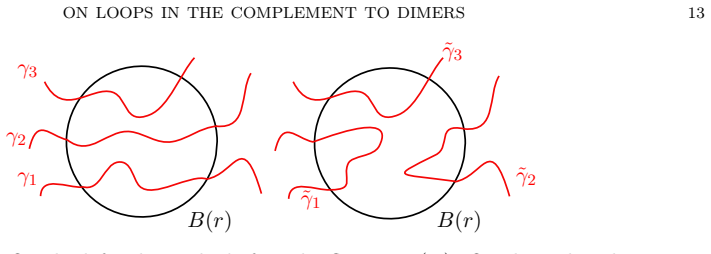
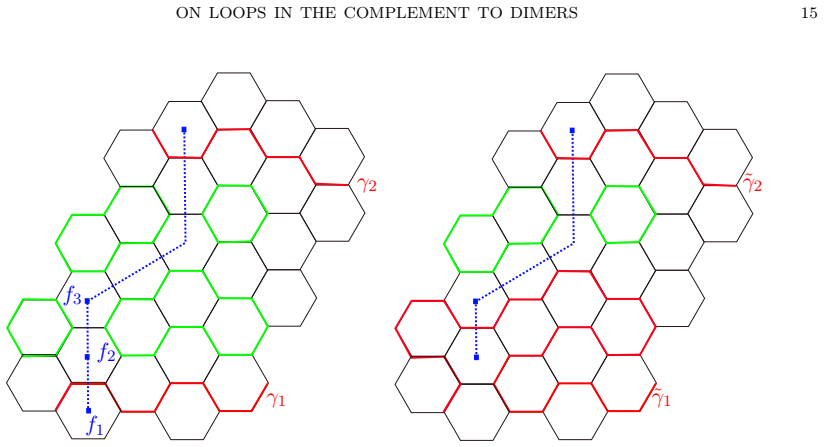
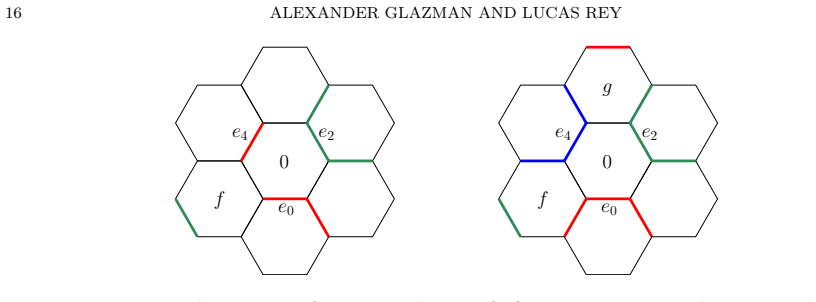
The flip (or XOR) operation replaces the three dimers in a hexagon by the other three edges, and when a hexagon contains exactly three dimers this locally rewires loops while preserving the Gibbs property; a positive density of flippable hexagons is guaranteed by Lemma 3.8. This bounded local move substitutes for insertion tolerance and powers the path-swapping lemma, which rewires the branches of two parallel bi-infinite paths through finitely many flips. The Burton-Keane argument rules out trifurcation points using compatible 3-partitions. The double-dimer model supplies the other half: for every rough (equivalently non-frozen) dimer measure, two independent dimers have infinitely many alternated cycles around every point, so XORing a long circuit into the loop configuration creates loops at every scale.
What would settle it
Exhibit any translation-invariant ergodic non-frozen Gibbs measure for the loop O(1) model at x=8 on the hexagonal lattice under which, almost surely, there are exactly two (or any finite number at least two) bi-infinite paths; the theorem then fails. A lighter check is to compute the number of bi-infinite paths in the uniform toral limit $Dimp(1,1,1)$: finding $N_8=1$ or $N_8=0$ is consistent, while finding $N_8=2$ would falsify the dichotomy.
Extended reading notes
Core claim
The central claim is Theorem 1.4: for any ergodic translation-invariant non-frozen Gibbs measure Loop of the loop O(1) model at x=8 on the hexagonal lattice, either Loop-almost surely there are infinitely many loops around every face, or Loop-almost surely there is a unique bi-infinite path. In particular, the number $N_8$ of bi-infinite paths is almost surely 0 or 1, and in the $N_8=0$ case every face is surrounded by infinitely many loops. The paper proves this by establishing four lemmas: $N_8\neq 2$; if $N_8\geq 3$ or $N_8=\infty$ then a trifurcation event has positive probability; the trifurcation event has probability zero by a Burton-Keane argument; and in the $N_8=0$ case, the XOR trick combined with infinitely many double-dimer cycles around every point forces loops of arbitrarily large diameter around every face.
Load-bearing premise
The proof leans on the deep classification of translation-invariant ergodic dimer Gibbs measures by the slope triangle, including the facts that non-frozen measures are exactly the interior of the triangle, are rough, and have double-dimer cycles around every point; if that classification missed any hexagonal-lattice case, then flip invariance, the positive flip probability, and the $N_8=0$ half of the dichotomy would all fail.
Editorial extensions
If this is right
- For every non-frozen ergodic translation-invariant Gibbs measure, the number of bi-infinite paths is almost surely either 0 or 1; the case of exactly 2 is impossible.
- When there are no bi-infinite paths, every face of the hexagonal lattice is almost surely surrounded by infinitely many loops, so the configuration has loops at every scale around each point.
- The periodic-boundary uniform measure on fully packed loop configurations converges to a non-frozen ergodic Gibbs measure, so the dichotomy applies to this natural reference state.
- The result sharpens the phase diagram of the loop O(1) model at x=8: the only ways to leave the infinite-loops regime are frozen measures or a unique bi-infinite path.
- A natural next step suggested by the paper is to establish Russo-Seymour-Welsh estimates at x=8, which would place the model in the macroscopic-loop regime.
Reading between the lines
- The same flip-plus-Burton-Keane route should extend to other bipartite Z2-periodic graphs where non-frozen dimer measures are rough and flippable faces occur with positive density; testing the square lattice, with its different flip move, would isolate which parts of the argument are hexagonal-specific.
- If the unique bi-infinite path case could be excluded, the conclusion would be that every non-frozen Gibbs state is fully loop-rich; one route is finding an FKG-type representation on the antiferromagnetic side, which the paper notes is missing.
- Under the infinite-loops alternative, the loop O(1) model at x=8 would have non-trivial large-scale loop structure consistent with a conformally invariant scaling limit; whether it is CLE(4)-like as in dimers or CLE(6)-like as in percolation is a concrete question the paper poses.
Editorial analysis
A structured set of objections, weighed in public.
Referee Report
Summary. The paper studies translation-invariant ergodic Gibbs measures for the loop O(1) model at x=∞ on the hexagonal lattice, equivalently dimer Gibbs measures under edge complementation. The main theorem claims that every non-frozen such measure either has infinitely many loops around every face or has a unique bi-infinite path. The proof combines flip invariance (the XOR operation) as a substitute for finite energy, a path-swapping lemma, the Burton–Keane trifurcation argument, and the double-dimer/roughness classification of Sheffield and Kenyon–Okounkov–Sheffield. The central structural step is Lemma 4.2, which rules out exactly two bi-infinite paths; the remaining lemmas rule out three or more bi-infinite paths and handle the no-bi-infinite-path case via the XOR trick.
Significance. If the dichotomy were established, it would be a substantial advance for an extremely rigid model, extending the CGHP24 XOR-trick result to the x=∞ fully-packed limit and clarifying the predicted phase diagram of the loop O(1) model. The paper’s high-level idea is attractive: flip invariance is used to overcome the absence of insertion tolerance, and the external dimer inputs (Sheffield’s classification, KOS06 amoeba results, Kasteleyn formulas) are clearly identified and not used circularly. The exposition is detailed and the computations of flip probabilities are explicit and parameter-free. However, the proof of the key exclusion N8≠2 contains a genuine logical error, so the manuscript in its current form does not establish the main theorem.
major comments (3)
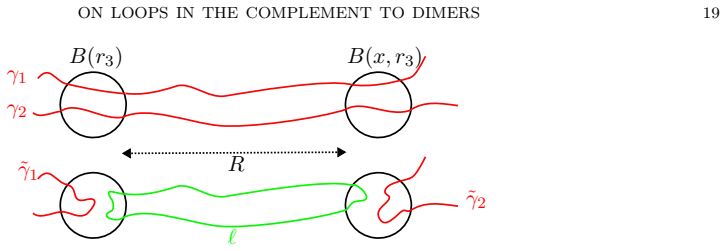
- [Section 6, proof of Lemma 4.2] The event E_R = {∃ ℓ ∈ Loops_R(w), |ℓ| ≥ R} is not decreasing in R, so the positive lower bound obtained for each R does not pass to the intersection over all R. A loop of length at least R that intersects B(R) need not intersect B(R′) for R′ > R, and the required length threshold changes with R. The sentence “Since the events on the left-hand side are decreasing in R” is therefore false, and the claimed contradiction does not follow.
- [Section 6, proof of Lemma 4.2, final sentence] The assertion “since all loops are finite, this event has probability 0” is invalid: finiteness of every loop does not imply uniform boundedness of loop lengths. A configuration consisting of two bi-infinite paths and nested finite loops with diameters tending to infinity has all loops finite, yet for every R there is a loop of length at least R intersecting B(R). The event in question can therefore have positive probability, so it is not a contradiction.
- [Theorem 1.4 and Remark 6.1] Lemma 4.2 is the sole mechanism excluding N8=2. Because its proof fails, the derivation of Theorem 1.4 (“By Lemmata 4.2–4.4, N8 ∈ {0,1}”) does not rule out the possibility of exactly two bi-infinite paths. This is a load-bearing gap: the main dichotomy is not proven as written. Remark 6.1, which claims the same argument excludes any finite N8 ≥ 2, inherits the same defect.
minor comments (3)
- [Definition 2.3] The branch notation in the displayed definition writes B(f,R)\B(f,R), which is empty; it should presumably be B(f,R)\B(f,r).
- [Remark 3.7] There is a typo: “wether” should be “whether”.
- [Proof of Lemma 4.4, Step 3] The estimate in Step 3 would benefit from spelling out why the compatible family of 3-partitions gives a bound linear in R; the displayed inequality |tp(C*∩B(R))| ≤ |C*∩B(R+r)| alone does not make the O(R) bound transparent.
Circularity Check
No circularity: the derivation rests on independent dimer classification and a parameter-free XOR lemma; the CGHP24 self-citation is independent evidence and does not smuggle in the conclusion.
full rationale
The paper's claimed derivation chain contains no step that reduces to its own conclusion. The main dichotomy (Theorem 1.4) is obtained from: (a) the Sheffield/KOS06 classification and explicit Kasteleyn parametrization (Appendix A, Theorems A.1 and A.4), which describe dimer measures by slope and edge probabilities and never mention the number of bi-infinite loops; (b) the KOS06 rough-phase double-dimer theorem (Theorem 3.12), which is about alternated cycles in the union of two independent dimer configurations, not about loops of a single loop configuration; (c) the deterministic XOR lemma from CGHP24 (Lemma 4.5), whose stated assumptions are only that w has no bi-infinite paths and Gamma is a circuit, and which does not assume the present theorem; and (d) Grimmett's Burton-Keane partition lemma. The flip-invariance (Lemma 3.6) follows from the uniform DLR condition (equivalently from Theorem A.1), and the positive flip probability (Lemma 3.8) is an explicit computation from Theorem A.4; neither claims the conclusion. The only self-citation that is load-bearing is the CGHP24 XOR lemma, but because it is a published, parameter-free combinatorial statement whose assumptions do not include the target result, it is independent evidence under the stated rules and does not raise the circularity score. No parameter is fitted to data and then called a prediction, and no quantity is defined in terms of the quantity it is used to derive. Concerns one might raise about the proof, such as the claimed monotonicity of the events in Lemma 4.2 and the terse 'standard arguments' leading to equations (5)-(6), are potential correctness or rigor issues, not examples of a conclusion being equivalent to an input by definition, so they lie outside circularity.
Assumptions & free parameters
assumptions (5)
- standard math The set of translation-invariant ergodic dimer Gibbs measures on the hexagonal lattice is parameterized by the slope triangle, with non-frozen measures corresponding to the interior (Theorem A.1 from [She05, KOS06]).
- standard math Non-frozen translation-invariant ergodic dimer Gibbs measures are rough, and the associated double dimer measure has almost surely infinitely many cycles around every point (Corollary A.7 and Theorem 3.12 from [KOS06]).
- standard math Grimmett's bound on compatible 3-partitions (Lemma 4.6, [Gri99] Lemma 8.5) and the Burton-Keane framework apply to the trifurcation event.
- standard math XOR trick lemma (Lemma 4.5, [CGHP24] Lemma 1.5): for any circuit Gamma surrounding B(r), either w or w XOR Gamma has a loop of diameter at least r surrounding 0.
- domain assumption The DLR conditions for the loop O(1) model at x=8 coincide with dimer DLR under complementation, and the flip at a face with exactly three dimers is a measure-preserving involution for ergodic Gibbs measures.
Cite this review
Pith. "Pith review of On loops in the complement to dimers." pith.science (2026). https://pith.science/paper/5CQCMHEW
@misc{pith2026241211708,
  author       = {Pith},
  title        = {Pith review of: On loops in the complement to dimers},
  year         = {2026},
  howpublished = {\url{https://pith.science/paper/5CQCMHEW}},
  note         = {Machine review of arXiv:2412.11708}
}
abstract
We consider ergodic translation-invariant Gibbs measures for the dimer model (i.e. perfect matchings) on the hexagonal lattice. The complement to a dimer configuration is a fully-packed loop configuration: each vertex has degree two. This is also known as the loop $O(1)$ model at $x=\infty$. We show that, if the measure is non-frozen, then it exhibits either infinitely many loops around every face or a unique bi-infinite path. Our main tool is the flip (or XOR) operation: if a hexagon contains exactly three dimers, one can replace them by the other three edges. Classical results in the dimer theory imply that such hexagons appear with a positive density. Up to some extent, this replaces the finite-energy property and allows to make use of tools from the percolation theory, in particular the Burton--Keane argument, to exclude existence of more than one bi-infinite path.
Figures
Figures from the paper (1 more)
Reference graph
Works this paper leans on
-
[1]
M. Aizenman, D. J. Barsky, and R. Fern \'a ndez, The phase transition in a general class of I sing-type models is sharp , J. Statist. Phys. 47 (1987), no. 3-4, 343--374. 894398 (89f:82013)
work page 1987
-
[2]
Amol Aggarwal, Universality for lozenge tiling local statistics, Annals of Mathematics 198 (2023), 881--1012
work page 2023
-
[3]
M. Aizenman, Translation invariance and instability of phase coexistence in the two-dimensional I sing system , Comm. Math. Phys. 73 (1980), no. 1, 83--94
work page 1980
-
[4]
St \'e phane Benoist and Cl \'e ment Hongler, The scaling limit of critical ising interfaces is CLE 3 , The Annals of Probability 47 (2019), no. 4, 2049--2086
work page 2019
-
[5]
R. M. Burton and M. Keane, Density and uniqueness in percolation, Comm. Math. Phys. 121 (1989), no. 3, 501--505
work page 1989
-
[6]
Henk W.J. Bl \"o te and Bernard Nienhuis, The phase diagram of the O (n) model , Physica A: Statistical Mechanics and its Applications 160 (1989), no. 2, 121 -- 134
work page 1989
-
[7]
Dmitry Chelkak, Hugo Duminil-Copin , Cl\' e ment Hongler, Antti Kemppainen, and Stanislav Smirnov, Convergence of I sing interfaces to S chramm's SLE curves , C. R. Math. Acad. Sci. Paris 352 (2014), no. 2, 157--161. 3151886
2014
-
[8]
Theory Related Fields 158 (2014), no
Loren Coquille, Hugo Duminil-Copin , Dmitry Ioffe, and Yvan Velenik, On the G ibbs states of the noncritical P otts model on Z ^2 , Probab. Theory Related Fields 158 (2014), no. 1-2, 477--512
work page 2014
Show all 39 references
-
[9]
Nicholas Crawford, Alexander Glazman, Matan Harel, and Ron Peled, Macroscopic loops in the loop O (n) model via the XOR trick , accepted to Annals of Probability, preprint on arXiv:2001.11977 (2024)
2024 arXiv
-
[10]
2, 297--346
Henry Cohn, Richard Kenyon, and James Propp, A variational principle for domino tilings, Journal of the American Mathematical Society 14 (2001), no. 2, 297--346
2001
-
[11]
Newman, Two-dimensional critical percolation: the full scaling limit, Comm
Federico Camia and Charles M. Newman, Two-dimensional critical percolation: the full scaling limit, Comm. Math. Phys. 268 (2006), no. 1, 1--38
2006
-
[12]
Dmitry Chelkak and Stanislav Smirnov, Discrete complex analysis on isoradial graphs, Adv. Math. 228 (2011), no. 3, 1590--1630
2011
-
[13]
Hugo Duminil-Copin , Aran Raoufi, and Vincent Tassion, Sharp phase transition for the random-cluster and P otts models via decision trees , Ann. of Math. (2) 189 (2019), no. 1, 75--99
2019
-
[14]
Duminil-Copin and V
H. Duminil-Copin and V. Tassion, A new proof of the sharpness of the phase transition for B ernoulli percolation and the I sing model , Communications in M athematical P hysics 343 (2016), no. 2, 725--745
2016
-
[15]
Fisher, On the dimer solution of planar I sing models , Journal of Math
M. Fisher, On the dimer solution of planar I sing models , Journal of Math. Physics 7 (1966), no. 10, 1776--1781
1966
-
[16]
Alexander Glazman and Piet Lammers, Delocalisation and continuity in 2D : loop O(2) , six-vertex, and random-cluster models , arXiv preprint arXiv:2306.01527 (2023)
2023 arXiv
-
[17]
2, 209--256
Alexander Glazman and Ioan Manolescu, Structure of G ibbs measures for planar FK -percolation and P otts models , Probability and Mathematical Physics 4 (2023), no. 2, 209--256
2023
-
[18]
Grimmett, Percolation, second ed., Grundlehren der Mathematischen Wissenschaften [Fundamental Principles of Mathematical Sciences], vol
G. Grimmett, Percolation, second ed., Grundlehren der Mathematischen Wissenschaften [Fundamental Principles of Mathematical Sciences], vol. 321, Springer-Verlag, Berlin, 1999
1999
-
[19]
Higuchi, On the absence of non-translation invariant G ibbs states for the two-dimensional I sing model , Random fields, V ol
Y. Higuchi, On the absence of non-translation invariant G ibbs states for the two-dimensional I sing model , Random fields, V ol. I , II ( E sztergom, 1979), Colloq. Math. Soc. J \'a nos Bolyai, vol. 27, North-Holland, Amsterdam, 1981, pp. 517--534
1979
-
[20]
Ivailo Hartarsky, Lyuben Lichev, and Fabio Toninelli, Local dimer dynamics in higher dimensions, arXiv preprint arXiv:2304.10930 (2023)
2023 arXiv
-
[21]
P. W. Kasteleyn, The statistics of dimers on a lattice, PhysicA 27 (1961), 1209--1225
1961
-
[22]
Pieter Willem Kasteleyn, Graph theory and crystal physics, Graph Theory Theor. Phys. (1967), 43--110
1967
-
[23]
Richard Kenyon, Local statistics of lattice dimers, Ann. Instit. Henri Poincare Probab. Stat. 33 (1997), no. 5, 591--618
1997
-
[24]
Richard Kenyon, Dominos and the G aussian free field , Ann. Probab. 29 (2001), no. 3, 1128--1137
2001
-
[25]
Kenyon, The L aplacian and D irac operators on critical planar graphs , Invent
R. Kenyon, The L aplacian and D irac operators on critical planar graphs , Invent. Math. 150 (2002), no. 2, 409--439. 1933589 (2004c:31015)
2002
-
[26]
Ser., vol
Richard Kenyon, Lectures on dimers, Statistical mechanics, IAS/Park City Math. Ser., vol. 16, Amer. Math. Soc., Providence, RI, 2009, pp. 191--230. 2523460 (2010j:82023)
2009
-
[27]
Wouter Kager and Bernard Nienhuis, A guide to stochastic L \"o wner evolution and its applications , J. Statist. Phys. 115 (2004), no. 5-6, 1149--1229
2004
-
[28]
Richard Kenyon, Andrei Okounkov, and Scott Sheffield, Dimers and amoebae, Ann. of Math. (2) 163 (2006), no. 3, 1019--1056. 2215138 (2007f:60014)
2006
-
[29]
Khristoforov and S
M. Khristoforov and S. Smirnov, Percolation and O (1) loop model , arXiv:2111.15612 (2021)
2021 arXiv
-
[30]
3-4, 1243--1264, http://doi.org/10.1007/s00440\
Beno \^ t Laslier, Local limits of lozenge tilings are stable under bounded boundary height perturbations, Probability Theory and Related Fields 173 (2018), no. 3-4, 1243--1264, http://doi.org/10.1007/s00440\
2018 doi
-
[31]
Newman, Ising models and dependent percolation, Topics in statistical dependence ( S omerset, PA , 1987), IMS Lecture Notes Monogr
Charles M. Newman, Ising models and dependent percolation, Topics in statistical dependence ( S omerset, PA , 1987), IMS Lecture Notes Monogr. Ser., vol. 16, Inst. Math. Statist., Hayward, CA, 1990, pp. 395--401. 1193993
1987
-
[32]
Bernard Nienhuis, Exact critical point and critical exponents of O (n) models in two dimensions , Phys. Rev. Lett. 49 (1982), no. 15, 1062--1065
1982
-
[33]
Ron Peled and Yinon Spinka, Lectures on the spin and loop O (n) models , Springer Proceedings in Mathematics and Statistics (2019), 246--320
2019
-
[34]
304, vi+175
Scott Sheffield, Random surfaces, Ast\' e risque (2005), no. 304, vi+175. 2251117 (2007g:82021)
2005
-
[35]
Stanislav Smirnov, Critical percolation in the plane: conformal invariance, C ardy's formula, scaling limits , C. R. Acad. Sci. Paris S\' e r. I Math. 333 (2001), no. 3, 239--244
2001
-
[36]
, Conformal invariance in random cluster models. I . H olomorphic fermions in the I sing model , Ann. of Math. (2) 172 (2010), no. 2, 1435--1467
2010
-
[37]
2, 239--252
Nicolau Saldanha and Carlos Tomei, An overview of domino and lozenge tilings, Resenhas do Instituto de Matem \'a tica e Estat \'i stica da Universidade de S \ a o Paulo 2 (1996), no. 2, 239--252
1996
-
[38]
Vincent Tassion, Crossing probabilities for V oronoi percolation , Ann. Probab. 44 (2016), no. 5, 3385--3398
2016
-
[39]
Thurston, Conway's tiling groups, Am
William P. Thurston, Conway's tiling groups, Am. Math. Monthly 97 (1990), no. 8, 757--756
1990
Reviewed August 11, 2026 · model on record in the stance chip above.
Discussion (0). Continue with ORCID to comment.