REVIEW 4 major objections 5 minor 15 references
Population synthesis of hot-subdwarf B stars with COMPAS: parameter variations and a prescription for hydrogen-rich shells
T0 review · 4 major / 5 minor · reviewed 2026-08-11 · deepseek-v4-flash
Pith's one-line read A new analytic prescription for hydrogen-rich shells makes synthetic subdwarf B stars match observed surface gravity and temperature.
desk verdict A useful 162-run parameter study undermined by an unreproducible H-shell prescription: Equation (15) as printed contradicts the paper's own Fig. B.1. read the letter →
The pith
A machine-rendered reading of the paper's core claim, the machinery that carries it, and where it could break.
The reading
What carries the argument
The central object is the analytic hydrogen-shell prescription: three fitted formulas, $\tau_{\rm He}(M, M_H)$, $R(t_r, M, M_H)$, and $L(t_r, M, M_H)$, with coefficients parameterized by the zero-age helium main sequence mass, the zero-age main sequence mass of the progenitor, and the hydrogen shell mass $M_H$. It carries the argument by converting naked helium stars, as classified by the Hurley et al. (2000) stellar types, into cooler and larger objects whose positions in the Kiel diagram can be compared to observations. The second load-bearing mechanism is the helium ignition threshold: stars that would be classified as helium white dwarfs are reclassified as subdwarf B candidates when their mass lies within 3 or 5 percent of the expected core mass at the tip of the red giant branch, which strongly boosts the canonical $\sim0.47\,M_\odot$ peak.
What would settle it
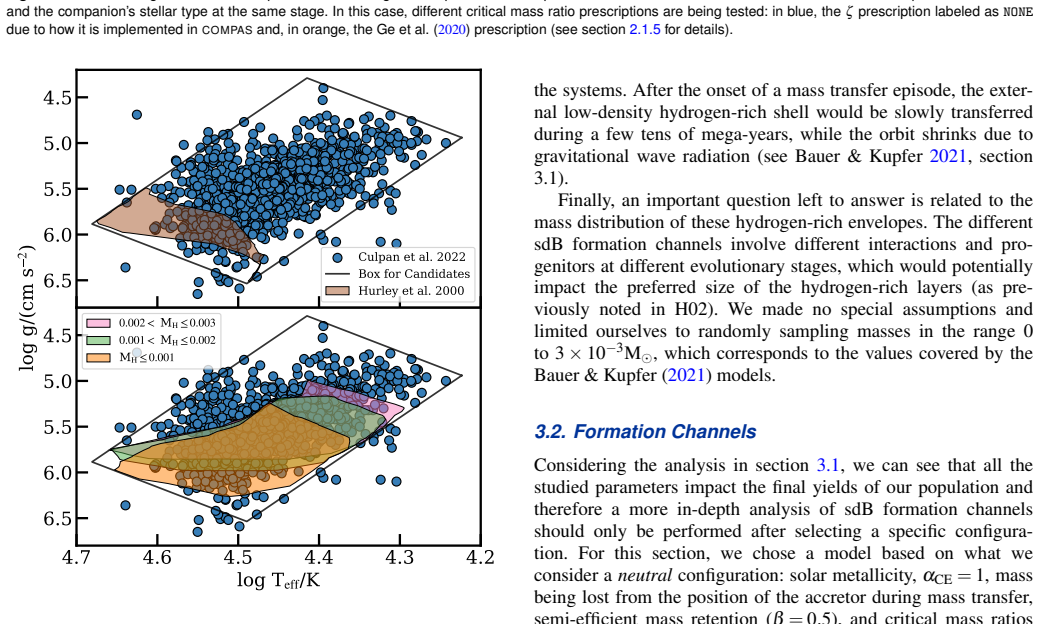
Measure or infer the hydrogen shell masses of a large sample of field subdwarf B stars, for example through asteroseismology or through the depth of the hydrogen Balmer lines, and compare the distribution to the uniform zero-to-$3\times10^{-3}\,M_\odot$ assumption used here; a clear metallicity or channel dependence would break the prescription. Alternatively, rerun the same synthesis with metallicity-dependent shell masses and check whether the improved Kiel diagram agreement in Figure 12 survives.
Extended reading notes
Core claim
On the paper's own terms, the discovery is a workable shortcut: rapid binary population synthesis codes treat subdwarf B progenitors as naked helium stars, and that assumption places the synthetic population at hotter temperatures and higher surface gravity than observed. The paper derives a post-processing prescription, based on the MESA models of Bauer & Kupfer (2021), that adds a hydrogen-rich outer shell of up to $3\times10^{-3}\,M_\odot$ and recomputes radius, luminosity, and lifetime through three fitted relations, with separate coefficient sets for progenitors that ignite helium in a flash and those that ignite it smoothly. When this prescription is applied to the helium main sequence stars produced by COMPAS, the synthetic sample in the Kiel diagram spreads out to cover the observed subdwarf B box. The study's claim is therefore that hydrogen shells, not just the choice of binary parameters, are what reconcile population synthesis predictions with the observed $\log g$ and $T_{\rm eff}$ distributions, and that the prescription can be ported to any rapid binary population synthesis output.
Load-bearing premise
The prescription assumes that detailed models built at solar metallicity, without overshooting, for a restricted range of masses can be applied to binary population synthesis helium stars of any metallicity and history, and that the hydrogen shell mass is uniformly distributed between zero and $3\times10^{-3}\,M_\odot$.
Editorial extensions
If this is right
- If the prescription is correct, any rapid binary population synthesis code can post-process its helium stars to predict subdwarf B surface gravities and effective temperatures without running detailed stellar models.
- The parameter study maps which uncertain binary physics matters most: common envelope efficiency and the helium ignition threshold dominate yields, while mass-loss geometry shifts period and mass distributions.
- Predicted subdwarf B populations can now be compared to observed catalogs in the Kiel diagram, enabling future current-day Galactic population synthesis with a chosen configuration.
- The early common envelope plus stable mass transfer channel is predicted to produce most subdwarf B plus neutron star systems with periods longer than one day, a testable prediction.
- Hydrogen shells change candidate counts by only about 1 percent, but they change the observable properties of the population substantially, so counts and distributions should be treated separately.
Reading between the lines
- If real hydrogen shell masses are correlated with formation channel or progenitor metallicity, the uniform random sampling between 0 and $3\times10^{-3}\,M_\odot$ used here would bias the inferred population, and the Kiel coverage would change.
- The lack of coverage at low surface gravity in Figure 12 suggests that envelopes heavier than $3\times10^{-3}\,M_\odot$ exist in nature; a targeted asteroseismic or spectroscopic survey of subdwarf B shell masses would test this directly.
- The same fitting strategy could be transferred to subdwarf O stars or other stripped stars, where hydrogen shells also regulate temperature and radius.
- A direct test is to compare the predicted fraction of subdwarf B plus neutron star systems from the early common envelope channel against the accumulating sample of wide subdwarf B binaries with neutron star companions.
Editorial analysis
A structured set of objections, weighed in public.
Referee Report
Summary. This paper uses the rapid binary population synthesis code COMPAS to generate sdB populations across 162 configurations, varying common-envelope efficiency, metallicity, angular momentum loss, mass accretion efficiency, mass-transfer stability, and the helium-ignition threshold. The authors introduce an analytic post-processing prescription, fit to Bauer & Kupfer (2021) MESA models, for helium-main-sequence stars with hydrogen-rich shells, and apply it to convert COMPAS naked-HeMS tracks into sdB candidates in the Kiel diagram. They report that all studied parameters strongly affect sdB yields and distributions, identify formation channels (stable RLOF, one/two CE episodes, mergers), and claim that the H-shell prescription improves agreement with observed sdB samples. The paper explicitly states several limitations, including solar-metallicity-only fits, no extrapolation testing, and post-processing-only implementation.
Significance. If the H-shell prescription were correct and validated, the paper would be a useful contribution: it extends COMPAS to low-mass non-compact remnants for the first time, provides a systematic sensitivity map over 162 binary population configurations, and offers a fast analytic fitting scheme that other rapid BPS codes could adopt. The authors are transparent about limitations such as solar metallicity, no overshooting in the underlying MESA models, and the post-processing nature of the prescription. However, the reproducibility failure of Eq. (15) and the ad hoc random sampling of the hydrogen-shell mass mean that the paper's headline claim is not currently supported by the submitted manuscript.
major comments (4)
- [2.2.1, Eq. (15), Table B.1, Fig. B.1] Equation (15) as printed cannot reproduce the lifetimes shown in Fig. B.1. For the above-MHeF branch, taking the example MZAMS=4.0, MHeMS=0.479, MH=0 and interpreting the first term as (A1-MH)/(M+MH-A2) yields base = 0.05161968/(0.479-0.25380777) - 0.09981282 - 0.479 = -0.3496, which is negative and cannot be raised to the fractional exponent 1/(A4M+A5) in real arithmetic. For the below-MHeF branch with M=0.462 and MH=0, the same reading gives base = 7.185 and exponent = -0.01617, so tau_He is approximately 0.97 Myr, whereas Fig. B.1 and the text report roughly 150 Myr. As printed, the central prescription is therefore internally inconsistent and cannot be the function that generated the model tracks or the improved Kiel-diagram coverage in Fig. 12. The authors should provide a corrected, unambiguous equation, verified by a code snippet or a table of evaluated lifetimes, and re-run the affected post-processing.
- [3.1.6, Fig. 12] The claimed reconciliation with observations in Fig. 12 is obtained by drawing the hydrogen-rich shell mass MH uniformly from [0, 3e-3] Msun with no physical motivation, as stated in Section 3.1.6. Because the headline claim is that the H-shell prescription improves agreement with observed Teff and log g, the result is conditional on this ad hoc distribution. A different MH distribution, or one correlated with formation channel or metallicity, would change the spread and location of the synthetic candidates. The authors should quantify the sensitivity of the Kiel-diagram agreement to the assumed MH distribution, or justify the uniform draw from formation physics.
- [2.2.1, 3.1.2] The H-shell prescription is fit to Bauer & Kupfer (2021) models computed at solar metallicity with no overshooting, and the authors explicitly state that it has not been tested for extrapolation. Nevertheless, it is applied to all 162 runs, including Z=0.0012 and Z=0.03, and it enters the sdB-candidate selection through the Kiel-diagram cuts used throughout Section 3.1. The metallicity trends reported in Section 3.1.2 could therefore be partly influenced by extrapolating the H-shell fits beyond their validity range. Please either restrict the H-shell prescription to solar-metallicity runs, validate it against MESA models at sub- and super-solar Z, or demonstrate that the candidate selection is insensitive to the extrapolation.
- [3.1.6, Fig. 12] The central validation of the H-shell prescription is a visual comparison in Fig. 12; no quantitative metric is given for the claimed improvement, such as the fraction of synthetic candidates inside the observed box, a two-dimensional KS test, or chi-squared statistics on log g and Teff. Given the reproducibility problem in Eq. (15), this visual claim is currently unsupported. A quantitative comparison, ideally performed with the corrected prescription, should be added.
minor comments (5)
- [2.2.1, Eq. (15)] The expression for tau_He is ambiguous because the fraction is not typeset unambiguously in the text; please use explicit parentheses and define the order of operations.
- [2.1.3, Eq. (7)] The relation [Fe/H] approximately equal to log(Z/Zsun) ignores the dependence on hydrogen mass fraction and alpha enhancement; please state it as an approximation and give the resulting Z values explicitly.
- [Table A.1] The column header 'FA' is not defined in the table or caption; it appears to denote the mass accretion efficiency beta. Please rename and define it.
- [2.2.1] The word 'ellapsed' should be 'elapsed'.
- [Data Availability] The manuscript says that all data are available upon reasonable request, but no fitting code is released. For a prescription with dozens of fitted coefficients in Tables B.1-B.3, providing the fitting code or a machine-readable table of evaluated fits would greatly aid reproducibility.
Circularity Check
No significant circularity: the H-shell prescription is an external fit to Bauer & Kupfer (2021) MESA models, not to the observed Kiel-diagram sample, and the parameter-study claims rest on independent input variations.
full rationale
The derivation chain is not circular. The H-shell prescription (Sec. 2.2.1, Eqs. 15-18) is an analytic fit, by scipy curve_fit, to the externally computed MESA models of Bauer & Kupfer (2021); its coefficients were not fitted to the Culpan et al. (2022) or Lei et al. (2023) observational samples used for evaluation. The sdB selection box (Eqs. 1-4) is defined by visual inspection of those observed samples before the prescription is applied, and is used as a fixed evaluation criterion rather than as a fitting target; the H-shell masses are randomly sampled from a stated uniform range (Sec. 3.1.6), so the improved Kiel-diagram coverage in Fig. 12 is not forced by any parameter fitted to that box. The parameter study (alpha, Z, MLF, beta, mass-transfer stability, ignition threshold) varies independent COMPAS input physics and compares outputs; none of those outputs is defined in terms of the varied parameter. The minimum-ignition-mass threshold is computed with independent MESA runs (Sec. 2.2.2), explicitly flagged as differing from H02, and the formation-channel comparison is against independent literature populations. The only self-citation, Toonen et al. (2014) cited as a 'but see' example of a BPS parameter study, is non-load-bearing. An important non-circularity concern remains: as printed, Eq. 15 with Table B.1 appears unable to reproduce the model lifetimes shown in Fig. B.1 (a negative base under a fractional exponent for the above-MHeF branch, and about 1 Myr rather than roughly 150 Myr for the below-MHeF case); this is a reproducibility/correctness issue, not a circularity of the argument's inputs.
Assumptions & free parameters
free parameters (4)
- Hydrogen-rich shell mass M_H =
randomly sampled uniformly from 0 to 3e-3 Msun
- Helium ignition mass cutoff =
3% and 5% of expected core mass
- sdB candidate mass cut =
M <= 0.58 Msun
- Prescription coefficients A_i, B_i, C_i =
Tables B.1, B.2, B.3
assumptions (5)
- domain assumption Hurley et al. (2000) stellar type evolution, as implemented in COMPAS, adequately represents low-mass stripped star evolution and HeMS lifetimes.
- ad hoc to paper Bauer & Kupfer (2021) MESA models, computed at solar metallicity with no overshooting, can be applied to COMPAS HeMS stars of other metallicities and masses.
- domain assumption The Moe & Di Stefano (2017) correlated initial binary distributions are representative of Galactic binaries.
- domain assumption Common envelope evolution is captured by the energy formalism with a constant alpha and the Xu & Li lambda prescription.
- domain assumption Mass transfer stability is captured by either the zeta prescription or Ge et al. (2020) adiabatic critical mass ratios.
Cite this review
Pith. "Pith review of Population synthesis of hot-subdwarf B stars with COMPAS: parameter variations and a prescription for hydrogen-rich shells." pith.science (2026). https://pith.science/paper/EN4RUOWZ
@misc{pith2026241211712,
  author       = {Pith},
  title        = {Pith review of: Population synthesis of hot-subdwarf B stars with COMPAS: parameter variations and a prescription for hydrogen-rich shells},
  year         = {2026},
  howpublished = {\url{https://pith.science/paper/EN4RUOWZ}},
  note         = {Machine review of arXiv:2412.11712}
}
read the original abstract
Subdwarf B stars are a well-known class of hot, low-mass stars thought to be formed through interactions in stellar binary systems. While different formation channels for subdwarf B stars have been studied through a binary population synthesis approach, it has also become evident that the characteristics of the found populations depend on the initial set of assumptions that describe the sometimes poorly constrained physical processes, such as common envelope episodes or angular momentum loss during mass transfer events. In this work we present a parameter study of subdwarf B populations, including a novel analytic prescription that approximates the evolution of subdwarf B stars with hydrogen-rich outer shells, an element previously overlooked in rapid binary population synthesis. We find that all studied parameters strongly impact the properties of the population, with the possibility of igniting helium below the expected core-mass value near the tip of the red giant branch strongly affecting the total number of subdwarf B candidates. Critically, our newly proposed prescription for the evolution of subdwarf B stars with hydrogen-shells helps to reconcile theoretical predictions of surface gravity and effective temperature with observational results. Our prescription is useful in the context of rapid binary population synthesis studies and can be applied to other rapid binary population synthesis codes' output.
Figures


Figures from the paper (11 more)




Reference graph
Works this paper leans on
-
[1]
Amaro-Seoane, P., Andrews, J., Arca Sedda, M., et al. 2023, Living Reviews in Relativity, 26, 2, doi: 10.1007/s41114-022-00041-y Arancibia-Rojas, E., Zorotovic, M., Vuˇckovi´c, M., et al. 2024, MNRAS, 527, 11184, doi: 10.1093/mnras/stad3891 Asplund, M., Grevesse, N., Sauval, A. J., & Scott, P. 2009, ARA&A, 47, 481, doi: 10.1146/annurev.astro.46.060407.145...
arXiv 2023
-
[3]
2020, ApJ, 898, 71, doi: 10.3847/ 1538-4357/ab9d85 Broekgaarden, F
1086/323959 Breivik, K., Coughlin, S., Zevin, M., et al. 2020, ApJ, 898, 71, doi: 10.3847/ 1538-4357/ab9d85 Broekgaarden, F. S., Berger, E., Stevenson, S., et al. 2022, MNRAS, 516, 5737, doi: 10.1093/mnras/stac1677 Brown, T. M. 2004, Ap&SS, 291, 215, doi: 10.1023/B:ASTR.0000044324. 60467.d2 Caloi, V . 1972, A&A, 20, 357 Cassisi, S. 2014, in EAS Publicatio...
arXiv 2020
-
[4]
2013, MNRAS, 434, 186, doi: 10.1093/mnras/stt992 Choi, J., Dotter, A., Conroy, C., et al
1051/0004-6361/201527412 Chen, X., Han, Z., Deca, J., & Podsiadlowski, P. 2013, MNRAS, 434, 186, doi: 10.1093/mnras/stt992 Choi, J., Dotter, A., Conroy, C., et al. 2016, ApJ, 823, 102, doi: 10.3847/ 0004-637X/823/2/102 Clausen, D., Wade, R. A., Kopparapu, R. K., & O’Shaughnessy, R. 2012, ApJ, 746, 186, doi: 10.1088/0004-637X/746/2/186 Culpan, R., Geier, S...
-
[5]
1111/j.1365-2966.2010.17891.x Ge, H., Webbink, R. F., Chen, X., & Han, Z. 2020, ApJ, 899, 132, doi:
arXiv 2010
-
[6]
3847/1538-4357/aba7b7 Geier, S., Marsh, T. R., Wang, B., et al. 2013, A&A, 554, A54, doi: 10.1051/ 0004-6361/201321395 Ghasemi, H., Moravveji, E., Aerts, C., Safari, H., & Vu ˇckovi´c, M. 2017, MNRAS, 465, 1518, doi: 10.1093/mnras/stw2839 Hall, P. D., & Jeffery, C. S. 2016, MNRAS, 463, 2756, doi: 10.1093/mnras/ stw2188 Han, Z., Podsiadlowski, P., Maxted, ...
arXiv 2013
-
[7]
1046/j.1365-8711.2000.03426.x Hurley, J. R., Tout, C. A., & Pols, O. R. 2002, MNRAS, 329, 897, doi:
arXiv 2000
-
[8]
1046/j.1365-8711.2002.05038.x Iben, Icko, J., & Tutukov, A. V . 1987, ApJ, 313, 727, doi: 10.1086/165011 Ivanova, N., Justham, S., & Ricker, P. 2020, Common Envelope Evolution, doi: 10.1088/2514-3433/abb6f0 Izzard, R. G., Tout, C. A., Karakas, A. I., & Pols, O. R. 2004, MNRAS, 350, 407, doi: 10.1111/j.1365-2966.2004.07446.x Krzesinski, J., Blokesz, A., Ba...
arXiv 2002
-
[9]
2023, ApJ, 942, 109, doi: 10.3847/1538-4357/ aca542 18 N
3847/2041-8213/ac48f1 Lei, Z., He, R., N´emeth, P., et al. 2023, ApJ, 942, 109, doi: 10.3847/1538-4357/ aca542 18 N. Rodriguez-Segovia et al. Livne, E. 1990, ApJ, 354, L53, doi: 10.1086/185721 Maxted, P. F. L., Heber, U., Marsh, T. R., & North, R. C. 2001, MNRAS, 326, 1391, doi: 10.1111/j.1365-2966.2001.04714.x Moe, M., & Di Stefano, R. 2017, ApJS, 230, 1...
arXiv 2023
Show all 15 references
-
[10]
1994, A&AS, 106, 275 Blomberg, L., El-Badry, K., & Breivik, K
1086/521026 Bertelli, G., Bressan, A., Chiosi, C., Fagotto, F., & Nasi, E. 1994, A&AS, 106, 275 Blomberg, L., El-Badry, K., & Breivik, K. 2024, arXiv e-prints, arXiv:2408.15334, doi: 10.48550/arXiv.2408.15334 Brassard, P., Fontaine, G., Bill `eres, M., et al. 2001, ApJ, 563, 1...
-
[11]
D., Slayton, A., Baran, A
1017/pasa.2018.25 Reed, M. D., Slayton, A., Baran, A. S., et al. 2021, MNRAS, 507, 4178, doi:
2018
-
[12]
2023, MNRAS, 521, 524, doi: 10.1093/mnras/stad159 Riley, J., Agrawal, P., Barrett, J
1093/mnras/stab2405 Renzini, A. 2023, MNRAS, 521, 524, doi: 10.1093/mnras/stad159 Riley, J., Agrawal, P., Barrett, J. W., et al. 2022, ApJS, 258, 34, doi: 10.3847/ 1538-4365/ac416c R¨opke, F. K., & De Marco, O. 2023, Living Reviews in Computational Astrophysics, 9, 2, doi: 10....
-
[13]
E., Ivanova, N., van der Sluys, M
3847/1538-4357/acffb1 Woods, T. E., Ivanova, N., van der Sluys, M. V ., & Chaichenets, S. 2012, ApJ, 744, 12, doi: 10.1088/0004-637X/744/1/12 Woosley, S. E., & Weaver, T. A. 1994, ApJ, 423, 371, doi: 10.1086/173813 Xiong, H., Casagrande, L., Chen, X., et al. 2022, A&A, 668, A112, doi:
2012 doi
-
[14]
2010a, ApJ, 716, 114, doi: 10.1088/0004-637X/716/1/ 114 —
1051/0004-6361/202244571 Xu, X.-J., & Li, X.-D. 2010a, ApJ, 716, 114, doi: 10.1088/0004-637X/716/1/ 114 —. 2010b, ApJ, 722, 1985, doi: 10.1088/0004-637X/722/2/1985 Yungelson, L. R. 2008, Astronomy Letters, 34, 620, doi: 10.1134/ S1063773708090053 Zorotovic, M., & Schreiber, M....
1985 doi
-
[17]
The specific form of each Fi expression is defined in appendix B.2. Progenitor mass below MHeF Coefficient Expression B1 F1 (−0.434436, 1.973170, −1.205341, 0.313716, 370.599542, −77521.575181, 0.036542, 11.479660) B2 F2 (15.270717, 0.200441, 18.522382, 0.396108, 2.937080, −40...
-
[18]
The relevant Fi expressions are defined in appendix B.3. Progenitor mass below MHeF Coefficient Expression C1 F4 (−2.832156, 1.893389, −8.330816, 0.362427, 2.673373, 1.079903, 8.669519) C2 F4 (4.347669, 11.368773, −51.446872, 3.973225, −33.695657, −9.207025, −424.934405) C3 F4...
Reviewed August 11, 2026 · model on record in the stance chip above.
Discussion (0). Continue with ORCID to comment.