REVIEW 4 major objections 5 minor 43 references
Beyond Graph Convolution: Multimodal Recommendation with Topology-aware MLPs
T0 review · 4 major / 5 minor · reviewed 2026-08-11 · deepseek-v4-flash
Pith's one-line read This paper establishes that a topology-aware MLP, trained with a neighborhood-alignment mutual-information loss on a topologically pruned item graph, beats nine baselines on three Amazon datasets, improving Recall@10 by 7.53%, 5.49%, and…
desk verdict A genuinely useful empirical paper on MLP-based multimodal recommendation, but the causal claim about topology is not fully pinned down and the efficiency story is overstated. read the letter →
The pith
A machine-rendered reading of the paper's core claim, the machinery that carries it, and where it could break.
The reading
What carries the argument
The central mechanism is replacing graph convolution with a mutual-information alignment objective over a pruned item graph. The Topological Pruning Strategy (TPS) computes, for each item, the topological similarity $$TS(X_m;X_n)=\sum_{x_m}\sum_{x_n} p(x_m,x_n)\log\frac{p(x_m,x_n)}{p(x_m)p(x_n)}$$ between its neighborhood-membership distribution and each neighbor's, and retains the top-K edges per node; this runs once before training. The Intra (Inter)-Modality Learning (IML) module then injects this topology into an MLP: per-modality MLP encoders produce visual and textual item representations, a fuser combines them, and the neighborhood-alignment (NA) loss $$L_{NA} = -\mathbb{E}_{v_m}\left[\log \frac{\sum_{n} \mathbb{1}[\bar{A}_{mn}]^r \exp(\operatorname{sim}(z_m,z_n)/\tau)}{\sum_{k \neq m} \exp(\operatorname{sim}(z_m,z_k)/\tau)}\right]$$ maximizes mutual information between an item and its r-hop neighbors under MINE estimation. The joint objective $L = L_{BPR} + \alpha L_{NA} + \lambda\|\Theta\|^2$ makes the MLP topology-aware without any message passing at inference.
What would settle it
Measure TMLP against its own w/o Pruning variant on a dataset whose visual and textual features are randomly permuted across items before building the item-item graph; if TMLP's margin over w/o Pruning persists under permutation, the improvement is not attributable to topological denoising of real semantics.
Extended reading notes
Core claim
TMLP establishes that the performance gains previously attributed to GCN message passing in multimodal recommendation can be obtained, and surpassed, by a topology-aware MLP. The item-item graph is first denoised by TPS, which keeps only the top-K neighbours per item according to a topological similarity score computed as the mutual information between neighborhood membership distributions (Equation 5). The MLP is then trained with the BPR ranking loss plus a neighborhood-alignment (NA) contrastive loss (Equation 8) that maximizes mutual information between an item's representation and its r-hop neighbours, implemented through MINE; an optional fuser combines visual and textual MLP branches. The resulting item representations feed a LightGCN aggregator on the user-item graph for final ranking. Empirically, TMLP outperforms nine baselines on three Amazon datasets, improves Recall@10 by 7.53%, 5.49%, and 5.69% over the second-best model, converges in fewer epochs, and maintains performance when up to 10% of item-item edges are corrupted.
Load-bearing premise
The load-bearing premise is that the item-item graph built from pretrained visual and textual features carries genuine semantic similarity after pruning, rather than encoding the same modality mismatch the pruning is meant to remove; if that graph is mostly noise, the gains could come from extra MLP capacity instead of topology awareness.
Editorial extensions
If this is right
- Performance on the Amazon Electronics dataset keeps rising with MLP depth, while GCN-based baselines degrade after one layer, indicating TMLP sidesteps over-smoothing rather than merely tolerating it.
- Because topological pruning is done once before training and MLP forward passes do not propagate messages, TMLP reaches peak Recall@20 in roughly 10 to 30 epochs, compared with about 200 for FREEDOM and BM3, and its per-epoch cost is lower.
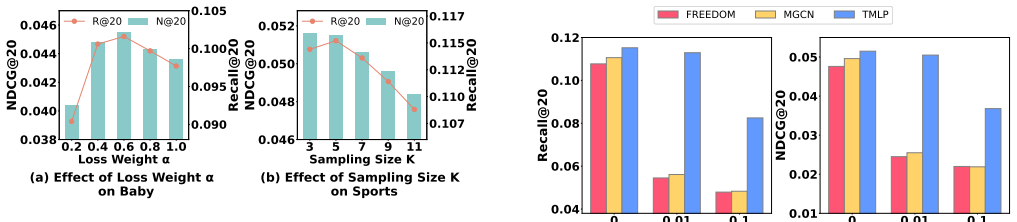
- When the item-item graph is corrupted at 1% and 10% noise ratios, TMLP's Recall@20 on Sports stays nearly flat, while FREEDOM and MGCN drop substantially, so the pruning step appears to make the model robust to modality mismatch.
- At inference the model needs only item features, not the item-item graph, so the learned representations can be served without maintaining graph topology.
Reading between the lines
- A natural extension is to learn the pruning decision per dataset instead of fixing K: random pruning was competitive on Sports at K=5, so a learned edge-dropping rule might improve TMLP further on datasets with different degree distributions.
- Because the NA loss is a contrastive objective on a denoised graph, the same TPS-plus-MI recipe could transfer to other graph-based prediction tasks that currently rely on shallow GCNs, such as node classification on small graphs.
- If the reported gains largely stem from MLP capacity rather than topology awareness, then a plain MLP with the same width, depth, and BPR loss but no NA loss should close much of the gap; the paper's w/o NA Loss ablation suggests it does not, but that comparison is only shown on two datasets.
- The paper's claim that unrelated items stay separated under depth (Figure 1d) implies a testable diagnostic: on larger catalogs, TMLP's item embeddings should retain higher average pairwise cosine distance than GCN baselines at every depth.
Editorial analysis
A structured set of objections, weighed in public.
Referee Report
Summary. The paper proposes TMLP, a multimodal recommender system that replaces GCN-based item-item relation modeling with MLPs. Two auxiliary components are introduced: a Topological Pruning Strategy (TPS) that denoises an item-item graph built from pretrained visual and textual features, and an intra/inter-modality learning objective based on a neighborhood-alignment (NA) mutual-information loss. Experiments on Amazon Baby, Sports, and Electronics report consistent improvements over nine baselines in Recall and NDCG, accompanied by ablations, hyperparameter sensitivity studies, training-efficiency comparisons, and a robustness test under corrupted item-item graphs.
Significance. The central idea is interesting and practically relevant: if MLPs with auxiliary topological supervision can match or exceed shallow GCNs in multimodal recommendation, this would avoid over-smoothing and improve scalability. The paper has concrete strengths: multi-seed experiments with t-tests and standard deviations in the ablations, a robustness check, a case study, and a code release link. The empirical gains are consistently positive across datasets. However, the mechanism attribution is not fully settled, and one efficiency claim is contradicted by the paper's own runtime table, so the headline conclusions need revision and additional experiments.
major comments (4)
- [§5.2 (Table 2) and Abstract] The abstract and contributions claim 'achieving over a 7% performance gain on Amazon Baby'. In Table 2, the improvement over the second-best model on Baby is 7.53% for Recall@10, but only 3.15% for R@20, 6.19% for N@10, and 5.15% for N@20; on Sports and Electronics the gains range from 3.83% to 6.84%. The headline claim is therefore metric-selective and should be qualified as 'up to 7.53% on Recall@10' or presented as a range across metrics.
- [§5.5 and Table 6] The paper repeatedly states that TMLP achieves 'significant improvements in training efficiency' (Abstract and §5.5). However, Table 6 reports a total training cost of 10.2 minutes for TMLP versus 8.9 minutes for MGCN, with MGCN reaching R@20 = 0.1106 in 64 epochs and TMLP in 73 epochs. Thus the efficiency advantage does not hold for MGCN in total wall-clock time. The claim should be scoped to per-epoch time or to the other baselines, or the total-cost comparison should be revisited after controlling for convergence criteria and hardware.
- [§5.3 (Table 3), Eqs. (2)–(8)] The ablations do not settle the paper's central attribution that topological structure, as captured by TPS and the neighborhood-alignment loss, drives the gains. 'w/o Pruning' still supervises with the item-item graph A built from the same pretrained visual/textual features, and 'Rand Pruning' keeps the same degree and the same feature-derived edge set. Neither variant replaces graph supervision with direct raw-feature nearest-neighbor supervision (e.g., kNN on the raw visual or textual embeddings without constructing A) or increases MLP capacity to match the removed supervision. Without such a same-capacity control, the observed improvements could come from pulling together semantically similar pretrained features rather than from topology awareness. Please add this control; if it performs similarly, the 'topology-aware' mechanism claim should be weakened.
- [§5.1 Implementation Details] The paper does not document hyperparameter tuning for the nine baselines. It states that TMLP's hyperparameters are searched over the grids listed in §5.1, but for baselines it only refers to MMRec and 'same settings as Zhou et al. (2023)'. If the baselines were not individually tuned on each dataset, the SOTA comparisons may be unfair. I ask the authors to report the search ranges and selected hyperparameters for each baseline, or to state explicitly that they were taken verbatim from prior work without tuning, and to confirm that the same evaluation split and ranking protocol were applied.
minor comments (5)
- [Abstract and Introduction] The phrase 'discarding the internal message passing in GCNs' is imprecise because TMLP retains LightGCN layers on the user-item interaction graph (Eqs. 10–12); the contribution concerns item-item relation modeling specifically.
- [§1 and throughout] There are several typos, including 'lrocessing' in the Introduction, 'Univeristy' in the affiliation, 'Objctive' in §4.5, and 'dependices' in Eqs. (5)–(6) and in the Training and Inference paragraph. A careful proofread is needed.
- [Eq. (8)] The notation 1_{n≠m}(Āmn)^r in the numerator is confusing because the same symbol Āmn acts as both a mask and an exponent, and only r=1 is used in the experiments. Please clarify the general definition or state r=1 directly in the equation.
- [Table 2 and Table 5] Table 2 reports only means and starred significance, while the appendix reports standard deviations only for ablations. Please add standard deviations to Table 2 as well, since the variability across the five seeds is relevant for the claimed margins over the second-best baseline.
- [§5.7] The case study is qualitative. It would be more convincing to quantify the effect of TPS, for example by measuring the fraction of pruned edges that connect items with different ground-truth category labels, or by reporting a small human-evaluation agreement score.
Circularity Check
No circularity found: the pipeline's graph construction, topology pruning, and mutual-information losses are all self-supervised components whose outputs are checked against held-out user-item interactions, with no target value reused as an input.
full rationale
The paper's claimed derivation chain is: pretrained visual/textual features are converted into top-K item-item graphs via Eq. 2; TPS uses only the topology of A to define a pruned graph in Eqs. 5-6; IML uses the NA loss in Eq. 8 to align MLP item representations with that pruned graph; user/item representations are trained with BPR loss on observed interactions, Eq. 13; and performance is measured by Recall/NDCG against held-out test users in Table 2. Nothing in this chain defines a target quantity in terms of itself: the item graph is not defined by the recommendation labels, the topological similarity in Eq. 5 is computed from neighborhood overlaps of A rather than from the model outputs, and the NA-loss supervision is an auxiliary training signal, not a quantity whose value is 'predicted' and then compared with the input that produced it. Using the same graph as supervision is a standard self-supervised-loop design, not a circular derivation of results. The ablations in Table 3 compare variants against external metrics. The concern that gains could come from MLP capacity rather than topology awareness is a confound in causal attribution, not a circularity, because the central empirical claims are external benchmark comparisons. No load-bearing step is justified only by a self-citation; the MINE estimator and neighborhood-alignment idea are used as implemented components with stated equations, and the paper's claims do not depend on a self-citation uniqueness theorem. Therefore score 0.
Assumptions & free parameters
free parameters (9)
- NA loss weight alpha =
Tuned in [0, 2], per-dataset optimum (e.g., 0.7 to 1.9 shown in Appendix)
- TPS sampling size K =
Tuned from 3 to 10; best 5 on Sports, range 3 to 11 on Baby
- Visual modality weight beta_m =
0.1
- kNN edge count K' =
10
- MLP depth and width =
2 to 4 layers, hidden size 512
- Learning rate =
Grid-searched in {1e-4, 5e-4, 1e-3, 5e-3}
- Embedding dimension =
64
- L2 regularization weight lambda =
0
- LightGCN layers on interaction graph =
2
assumptions (5)
- domain assumption Pretrained visual (4096-d) and textual (384-d) features contain semantically meaningful signal for constructing item-item similarity graphs.
- domain assumption Topological similarity via neighborhood-overlap mutual information (Eq. 5) can denoise a fused modality graph.
- domain assumption The neighborhood alignment contrastive loss (Eq. 8) is a faithful and effective approximation of mutual information maximization in this setting.
- domain assumption LightGCN aggregation on the user-item interaction graph remains a suitable backbone when item embeddings come from TMLP instead of GCN message passing.
- standard math BPR loss with randomly sampled non-interacted items provides an unbiased learning signal for top-N recommendation.
Cite this review
Pith. "Pith review of Beyond Graph Convolution: Multimodal Recommendation with Topology-aware MLPs." pith.science (2026). https://pith.science/paper/YR4DNPP3
@misc{pith2026241211747,
  author       = {Pith},
  title        = {Pith review of: Beyond Graph Convolution: Multimodal Recommendation with Topology-aware MLPs},
  year         = {2026},
  howpublished = {\url{https://pith.science/paper/YR4DNPP3}},
  note         = {Machine review of arXiv:2412.11747}
}
read the original abstract
Given the large volume of side information from different modalities, multimodal recommender systems have become increasingly vital, as they exploit richer semantic information beyond user-item interactions. Recent works highlight that leveraging Graph Convolutional Networks (GCNs) to explicitly model multimodal item-item relations can significantly enhance recommendation performance. However, due to the inherent over-smoothing issue of GCNs, existing models benefit only from shallow GCNs with limited representation power. This drawback is especially pronounced when facing complex and high-dimensional patterns such as multimodal data, as it requires large-capacity models to accommodate complicated correlations. To this end, in this paper, we investigate bypassing GCNs when modeling multimodal item-item relationship. More specifically, we propose a Topology-aware Multi-Layer Perceptron (TMLP), which uses MLPs instead of GCNs to model the relationships between items. TMLP enhances MLPs with topological pruning to denoise item-item relations and intra (inter)-modality learning to integrate higher-order modality correlations. Extensive experiments on three real-world datasets verify TMLP's superiority over nine baselines. We also find that by discarding the internal message passing in GCNs, which is sensitive to node connections, TMLP achieves significant improvements in both training efficiency and robustness against existing models.
Figures


Figures from the paper (4 more)


Reference graph
Works this paper leans on
-
[1]
, " * write output.state after.block = add.period write newline
ENTRY address archivePrefix author booktitle chapter edition editor eid eprint howpublished institution isbn journal key month note number organization pages publisher school series title type volume year label extra.label sort.label short.list INTEGERS output.state before.all mid.sentence after.sentence after.block FUNCTION init.state.consts #0 'before.a...
-
[2]
write newline
" write newline "" before.all 'output.state := FUNCTION n.dashify 't := "" t empty not t #1 #1 substring "-" = t #1 #2 substring "--" = not "--" * t #2 global.max substring 't := t #1 #1 substring "-" = "-" * t #2 global.max substring 't := while if t #1 #1 substring * t #2 global.max substring 't := if while FUNCTION word.in bbl.in capitalize " " * FUNCT...
-
[3]
Ba, J. L.; Kiros, J. R.; and Hinton, G. E. 2016. Layer normalization. arXiv preprint arXiv:1607.06450
arXiv 2016
-
[4]
I.; Baratin, A.; Rajeshwar, S.; Ozair, S.; Bengio, Y.; Courville, A.; and Hjelm, D
Belghazi, M. I.; Baratin, A.; Rajeshwar, S.; Ozair, S.; Bengio, Y.; Courville, A.; and Hjelm, D. 2018. Mutual information neural estimation. In International conference on machine learning, 531--540. PMLR
2018
-
[5]
Chen, D.; Lin, Y.; Li, W.; Li, P.; Zhou, J.; and Sun, X. 2020. Measuring and relieving the over-smoothing problem for graph neural networks from the topological view. In Proceedings of the AAAI conference on artificial intelligence, volume 34, 3438--3445
work page 2020
-
[6]
Chen, X.; Chen, H.; Xu, H.; Zhang, Y.; Cao, Y.; Qin, Z.; and Zha, H. 2019. Personalized fashion recommendation with visual explanations based on multimodal attention network: Towards visually explainable recommendation. In Proceedings of the 42nd International ACM SIGIR Conference on Research and Development in Information Retrieval, 765--774
work page 2019
-
[7]
Dong, W.; Wu, J.; Luo, Y.; Ge, Z.; and Wang, P. 2022. Node representation learning in graph via node-to-neighbourhood mutual information maximization. In Proceedings of the IEEE/CVF Conference on Computer Vision and Pattern Recognition, 16620--16629
work page 2022
-
[8]
Du, K.; Chen, J.; Lin, J.; Xi, Y.; Wang, H.; Dai, X.; Chen, B.; Tang, R.; and Zhang, W. 2024. DisCo: Towards Harmonious Disentanglement and Collaboration between Tabular and Semantic Space for Recommendation. In Proceedings of the 30th ACM SIGKDD Conference on Knowledge Discovery and Data Mining, 666--676
work page 2024
Show all 43 references
-
[9]
Du, K.; Zhang, W.; Zhou, R.; Wang, Y.; Zhao, X.; Jin, J.; Gan, Q.; Zhang, Z.; and Wipf, D. P. 2022. Learning enhanced representation for tabular data via neighborhood propagation. Advances in Neural Information Processing Systems, 35: 16373--16384
2022
-
[10]
Glorot, X.; and Bengio, Y. 2010. Understanding the difficulty of training deep feedforward neural networks. In Proceedings of the thirteenth international conference on artificial intelligence and statistics, 249--256. JMLR Workshop and Conference Proceedings
2010
-
[11]
He, R.; and McAuley, J. 2016 a . Ups and downs: Modeling the visual evolution of fashion trends with one-class collaborative filtering. In proceedings of the 25th international conference on world wide web, 507--517
2016
-
[12]
He, R.; and McAuley, J. 2016 b . VBPR: visual bayesian personalized ranking from implicit feedback. In Proceedings of the AAAI conference on artificial intelligence, volume 30
2016
-
[13]
He, X.; Deng, K.; Wang, X.; Li, Y.; Zhang, Y.; and Wang, M. 2020. Lightgcn: Simplifying and powering graph convolution network for recommendation. In Proceedings of the 43rd International ACM SIGIR conference on research and development in Information Retrieval, 639--648
2020
-
[14]
Hu, Y.; You, H.; Wang, Z.; Wang, Z.; Zhou, E.; and Gao, Y. 2021. Graph-mlp: Node classification without message passing in graph. arXiv preprint arXiv:2106.04051
2021 arXiv
-
[15]
Huang, J.; Chen, J.; Lin, J.; Qin, J.; Feng, Z.; Zhang, W.; and Yu, Y. 2024. A Comprehensive Survey on Retrieval Methods in Recommender Systems. arXiv preprint arXiv:2407.21022
2024
-
[16]
Huang, Q.; He, H.; Singh, A.; Lim, S.-N.; and Benson, A. R. 2020. Combining label propagation and simple models out-performs graph neural networks. arXiv preprint arXiv:2010.13993
2020 arXiv
-
[17]
B.; Chess, B.; Child, R.; Gray, S.; Radford, A.; Wu, J.; and Amodei, D
Kaplan, J.; McCandlish, S.; Henighan, T.; Brown, T. B.; Chess, B.; Child, R.; Gray, S.; Radford, A.; Wu, J.; and Amodei, D. 2020. Scaling laws for neural language models. arXiv preprint arXiv:2001.08361
2020 arXiv
-
[18]
Lin, J.; Dai, X.; Xi, Y.; Liu, W.; Chen, B.; Zhang, H.; Liu, Y.; Wu, C.; Li, X.; Zhu, C.; et al. 2023. How can recommender systems benefit from large language models: A survey. arXiv preprint arXiv:2306.05817
2023 arXiv
-
[19]
Liu, C.; Lin, J.; Wang, J.; Liu, H.; and Caverlee, J. 2024. Mamba4rec: Towards efficient sequential recommendation with selective state space models. arXiv preprint arXiv:2403.03900
2024 arXiv
-
[20]
Liu, Q.; Wu, S.; and Wang, L. 2017. Deepstyle: Learning user preferences for visual recommendation. In Proceedings of the 40th international acm sigir conference on research and development in information retrieval, 841--844
2017
-
[21]
McAuley, J.; Targett, C.; Shi, Q.; and Van Den Hengel, A. 2015. Image-based recommendations on styles and substitutes. In Proceedings of the 38th international ACM SIGIR conference on research and development in information retrieval, 43--52
2015
-
[22]
Monti, F.; Bronstein, M.; and Bresson, X. 2017. Geometric matrix completion with recurrent multi-graph neural networks. Advances in neural information processing systems, 30
2017
-
[23]
Rendle, S.; Freudenthaler, C.; Gantner, Z.; and Schmidt-Thieme, L. 2012. BPR: Bayesian personalized ranking from implicit feedback. arXiv preprint arXiv:1205.2618
2012 arXiv
-
[24]
S.; Rosenfeld, A.; Belinkov, Y.; and Shavit, N
Rosenfeld, J. S.; Rosenfeld, A.; Belinkov, Y.; and Shavit, N. 2019. A Constructive Prediction of the Generalization Error Across Scales. In International Conference on Learning Representations
2019
-
[25]
K.; Bronstein, M
Rusch, T. K.; Bronstein, M. M.; and Mishra, S. 2023. A survey on oversmoothing in graph neural networks. arXiv preprint arXiv:2303.10993
2023 arXiv
-
[26]
Simonyan, K.; and Zisserman, A. 2014. Very deep convolutional networks for large-scale image recognition. arXiv preprint arXiv:1409.1556
2014 arXiv
-
[27]
Su, X.; and Khoshgoftaar, T. M. 2009. A survey of collaborative filtering techniques. Advances in artificial intelligence, 2009
2009
-
[28]
Tao, Z.; Liu, X.; Xia, Y.; Wang, X.; Yang, L.; Huang, X.; and Chua, T.-S. 2022. Self-supervised learning for multimedia recommendation. IEEE Transactions on Multimedia
2022
-
[29]
Tian, Y.; Zhang, C.; Guo, Z.; Zhang, X.; and Chawla, N. 2022. Learning MLPs on graphs: A unified view of effectiveness, robustness, and efficiency. In The Eleventh International Conference on Learning Representations
2022
-
[30]
Wang, Q.; Wei, Y.; Yin, J.; Wu, J.; Song, X.; and Nie, L. 2021. Dualgnn: Dual graph neural network for multimedia recommendation. IEEE Transactions on Multimedia, 25: 1074--1084
2021
-
[31]
Wang, X.; He, X.; Wang, M.; Feng, F.; and Chua, T.-S. 2019. Neural graph collaborative filtering. In Proceedings of the 42nd international ACM SIGIR conference on Research and development in Information Retrieval, 165--174
2019
-
[32]
Wei, Y.; Wang, X.; Nie, L.; He, X.; and Chua, T.-S. 2020. Graph-refined convolutional network for multimedia recommendation with implicit feedback. In Proceedings of the 28th ACM international conference on multimedia, 3541--3549
2020
-
[33]
Wei, Y.; Wang, X.; Nie, L.; He, X.; Hong, R.; and Chua, T.-S. 2019. MMGCN: Multi-modal graph convolution network for personalized recommendation of micro-video. In Proceedings of the 27th ACM international conference on multimedia, 1437--1445
2019
-
[34]
Wu, Y.; Liu, H.; and Yang, Y. 2018. Graph Convolutional Matrix Completion for Bipartite Edge Prediction. In KDIR, 49--58
2018
-
[35]
Xi, Y.; Liu, W.; Lin, J.; Cai, X.; Zhu, H.; Zhu, J.; Chen, B.; Tang, R.; Zhang, W.; and Yu, Y. 2024. Towards open-world recommendation with knowledge augmentation from large language models. In Proceedings of the 18th ACM Conference on Recommender Systems, 12--22
2024
-
[36]
Yang, C.; Wu, Q.; Wang, J.; and Yan, J. 2022. Graph neural networks are inherently good generalizers: Insights by bridging gnns and mlps. arXiv preprint arXiv:2212.09034
2022 arXiv
-
[37]
Yu, P.; Tan, Z.; Lu, G.; and Bao, B.-K. 2023. Multi-View Graph Convolutional Network for Multimedia Recommendation. In Proceedings of the 31st ACM International Conference on Multimedia, 6576--6585
2023
-
[38]
N.; Adeshina, S.; Zhang, J.; Qin, X.; Faloutsos, C.; Zheng, D.; Karypis, G.; and Yu, P
Zhang, H.; Wang, S.; Ioannidis, V. N.; Adeshina, S.; Zhang, J.; Qin, X.; Faloutsos, C.; Zheng, D.; Karypis, G.; and Yu, P. S. 2023. Orthoreg: Improving graph-regularized mlps via orthogonality regularization. arXiv preprint arXiv:2302.00109
2023 arXiv
-
[39]
Zhang, J.; Zhu, Y.; Liu, Q.; Wu, S.; Wang, S.; and Wang, L. 2021 a . Mining latent structures for multimedia recommendation. In Proceedings of the 29th ACM International Conference on Multimedia, 3872--3880
2021
-
[40]
Zhang, S.; Liu, Y.; Sun, Y.; and Shah, N. 2021 b . Graph-less neural networks: Teaching old mlps new tricks via distillation. arXiv preprint arXiv:2110.08727
2021 arXiv
-
[41]
Zhou, X. 2023. MMRec: Simplifying Multimodal Recommendation. arXiv preprint arXiv:2302.03497
2023 arXiv
-
[42]
Zhou, X.; and Shen, Z. 2023. A tale of two graphs: Freezing and denoising graph structures for multimodal recommendation. In Proceedings of the 31st ACM International Conference on Multimedia, 935--943
2023
-
[43]
Zhou, X.; Zhou, H.; Liu, Y.; Zeng, Z.; Miao, C.; Wang, P.; You, Y.; and Jiang, F. 2023. Bootstrap latent representations for multi-modal recommendation. In Proceedings of the ACM Web Conference 2023, 845--854
2023
Reviewed August 11, 2026 · model on record in the stance chip above.
Discussion (0). Continue with ORCID to comment.