REVIEW 4 major objections 4 minor 1 cited by
Thistlethwaite Theorems for Knotoids and Linkoids
T0 review · 4 major / 4 minor · reviewed 2026-08-11 · deepseek-v4-flash
Pith's one-line read The arrow polynomial of a knotoid equals a single evaluation of the Bollobás-Riordan polynomial of a marked ribbon graph associated to any Kauffman state.
desk verdict Real Thistlethwaite extension for knotoids with a solid virtual case, but the twisted and planar theorems depend on an unproved partial-duality invariance. read the letter →
The pith
A machine-rendered reading of the paper's core claim, the machinery that carries it, and where it could break.
The reading
What carries the argument
The load-bearing construction is the marked ribbon graph $G_K^s$ associated to a Kauffman state $s$ of a knotoid diagram $K$: loops of the state become ordinary vertex disks, the unique arc component becomes a vertex disk with a marking that linearizes the cyclic order of its incident half-edges, and each smoothed crossing becomes a signed ribbon edge carrying two arrow decorations, with bars or a puncture carried along in the twisted and planar settings. The arrow Bollobás-Riordan polynomial $R_G$ sums over spanning subgraphs $F\subseteq E(G)$, recording the number of connected components, boundary components, and reduced arrow and bar decorations; the theorem evaluates it at $a=1$ with edge weights $b_e$ determined by the crossing signs. Partial duality is the mechanism that makes the theorem independent of the chosen state: passing from one state to another is exactly partial dualizing the marked ribbon graph, and $R_G$ transforms by a known product of edge weights under that operation.
What would settle it
A concrete calculation that would settle the central identity: take the one-crossing twisted knotoid of Example 3.15, compute its twisted arrow polynomial directly from the oriented state expansion, and compute the evaluation in Theorem 5.7 from the Bollobás-Riordan polynomial of its state ribbon graph; any mismatch in the coefficient of $\Lambda_1 K_1$ would refute the paper's central claim.
Extended reading notes
Core claim
The central claim is Theorem 5.5: for a virtual knotoid diagram $K$ and any state $s$, the arrow bracket satisfies $\langle K\rangle = \frac{A^{e_+}B^{e_-}}{d}\, R_{G_K^s}(1,b,d)$, where $G_K^s$ is the marked ribbon graph whose vertices are the state components of $s$ and whose signed, arrow-decorated edges record the smoothed crossings. After substituting $B=A^{-1}$ and $d=-A^2-A^{-2}$, the normalized arrow polynomial becomes $A^{e_+-e_-}/(-A^2-A^{-2})$ times the arrow Bollobás-Riordan polynomial with edge weights $b_e=B/A$ or $A/B$. The same identity holds for twisted knotoids with bars (Theorem 5.7), for planar knotoids through the loop arrow polynomial (Theorem 5.8), and for spherical linkoids (Theorem 6.8), with the appropriate decorated version of the Bollobás-Riordan polynomial. Independence of the chosen state follows because changing states is exactly partial duality of marked ribbon graphs, and the relevant polynomial transforms by a known edge-weight factor under that operation.
Load-bearing premise
The geometric bridge identifying twisted knotoids with simple H-curves in thickened surfaces relies on the assertion, made without proof in Proposition 2.10, that any ambient isotopy between standard H-curves can be deformed so that the curve stays standard at every intermediate stage; if that smoothing step fails, the interpretation of twisted knotoids as knotoids on compact possibly non-orientable surfaces, and with it the stated significance of Theorems 5.7 and 5.8, would need revision.
Editorial extensions
If this is right
- For any knotoid diagram, the arrow polynomial can be computed by enumerating spanning subgraphs of a single state's marked ribbon graph, rather than summing over all smoothings of the diagram.
- The corollaries in Remark 5.6 and Corollary 5.9 recover Thistlethwaite-type statements for the Kauffman bracket of knotoids, twisted knotoids, and the Turaev loop bracket of planar knotoids when arrows and orientations are dropped.
- Because Theorem 5.7 covers bars, the twisted arrow polynomial is invariant under stable equivalence of twisted knotoids, so the graph evaluation is a genuine invariant of knotoids on compact possibly non-orientable surfaces.
- The linkoid version (Theorem 6.8) includes the odd-arrow, half-integer states that appear when several open components are present, so the same Thistlethwaite mechanism extends beyond single-arc diagrams.
Reading between the lines
- Beyond the paper, the marked-ribbon-graph formulation suggests a practical route to tabulating knotoids: the Bollobás-Riordan evaluation can be computed from a single state, and state-independence via partial duality offers a built-in consistency check for tables such as the protein-motivated classifications.
- One testable extension would be to use the paper's half-integer arrow states, introduced for linkoids, to define refined arrow polynomials for multi-component open diagrams and ask whether they distinguish linkoids that the current invariants do not separate.
- The H-curve bijection, if it holds, also implies that the arrow polynomial of a planar knotoid can be reinterpreted as an invariant in a thickened sphere with a puncture, potentially connecting the loop arrow polynomial to existing invariants of tangles in such thickened surfaces.
Signed reviews
Editorial analysis
A structured set of objections, weighed in public.
Referee Report
Summary. The paper introduces twisted knotoids as knotoid diagrams on compact, not necessarily orientable surfaces modulo stable equivalence, and associates to them a twisted arrow polynomial. It also defines marked ribbon graphs and three variants of the Bollobás–Riordan polynomial (arrow, twisted, and loop), and proves Thistlethwaite-type state-sum theorems: Theorem 5.5 for virtual/spherical knotoids, Theorem 5.7 for twisted knotoids, Theorem 5.8 for planar knotoids, and Theorem 6.8 for spherical linkoids. The main constructions are illustrated by explicit small examples.
Significance. If the gaps noted below are repaired, the paper would give a natural extension of Thistlethwaite's theorem to open-ended diagrams and would place the arrow polynomial of knotoids in a ribbon-graph framework. The definition of marked ribbon graphs and the state-sum correspondence in Theorem 5.5 are genuinely useful, and the worked examples are a strength. However, the advertised scope currently exceeds what is proved: several later theorems depend on partial-duality invariance statements that are only asserted by analogy, and the geometric interpretation of twisted knotoids rests on an unproved smoothing assertion.
major comments (4)
- [§5, Theorems 5.7 and 5.8; Proposition 4.13] The right-hand sides of Theorems 5.7 and 5.8 are claimed to be independent of the chosen state s, but the only partial-duality invariance proved in the paper is Proposition 4.13, and that is for the untwisted arrow polynomial R_G. The proofs of Theorems 5.7 and 5.8 are dismissed as 'Analogous' and 'again analogous'. This is a load-bearing omission: for Theorem 5.7, the polynomial R^t_G (Definition 4.7) involves bar decorations and the reduction rules of Figures 8 and 9, and Proposition 4.13 does not track bars through the partial-duality correspondence, where a bar can move from one boundary component to another when vertex and edge arcs are re-paired. For Theorem 5.8, R^ℓ_G (Definition 4.8) involves a puncture-nesting index ℓ whose behaviour under partial duality is not discussed at all. Until the partial-duality identities for R^t_G and R^ℓ_G are proved, or state-independence is proved directly, Theorems 5.7 and 5.8 are unsupported.
- [Proposition 2.10] The proof of Proposition 2.10 contains the statement 'It is also easy to see that any equivalence of standard H-curves can be modified such that the H-curve at every step of the deformation remains standard', with only a formal restatement following. This smoothing assertion is exactly what makes it legitimate to reduce H-curves to knotoid diagrams on Σ, and it is not obvious: an ambient isotopy between standard H-curves could temporarily move the rails away from being vertical fibres. Since Proposition 2.10 is the basis for the geometric interpretation of twisted knotoids and for the significance of Theorems 5.7 and 5.8, a complete proof or a precise reference is needed.
- [Lemmas 3.5 and 3.7] The classification of fully reduced twisted and planar states is only sketched. Lemma 3.5 asserts that after moving bars and cancelling arrows one always obtains one of the stated forms, but the interaction between Lemma 3.4 (passing a bar over an arrow flips the arrow) and the requirement of alternating arrows needs a detailed case analysis, especially for loop components with an odd number of bars. Lemma 3.7 asserts that all non-contractible loop components form a nested set, without ruling out non-nested configurations when several loops separate the arc component from the puncture. These lemmas define the variables that appear in the state sums and in the Bollobás–Riordan definitions, so they should be proved in full.
- [Definition 6.6 and Theorem 6.8] Theorem 6.8 is again stated with a proof 'analogous to that of Theorem 5.5'. In addition, Definition 6.6 uses an index ℓ(f) defined as the minimum of the numbers of arc components in the interior and exterior of a circular boundary component f. This is meaningful only after fixing an embedding of the boundary component in the sphere, whereas R^m_G is defined for abstract marked ribbon graphs. The manuscript should specify how ℓ(f) is computed from the ribbon graph data and how the partial-duality invariance needed for Theorem 6.8 is obtained.
minor comments (4)
- [Theorems 5.5, 5.7, 5.8] The displayed formulas such as '⟨K⟩ = Ae+Be− d R_{G^s_K}(1,b,d)' should read (A^{e_+}B^{e_-}/d) R_{G^s_K}(1,b,d); the division by d is missing in the displayed equation, although the subsequent text and examples use it.
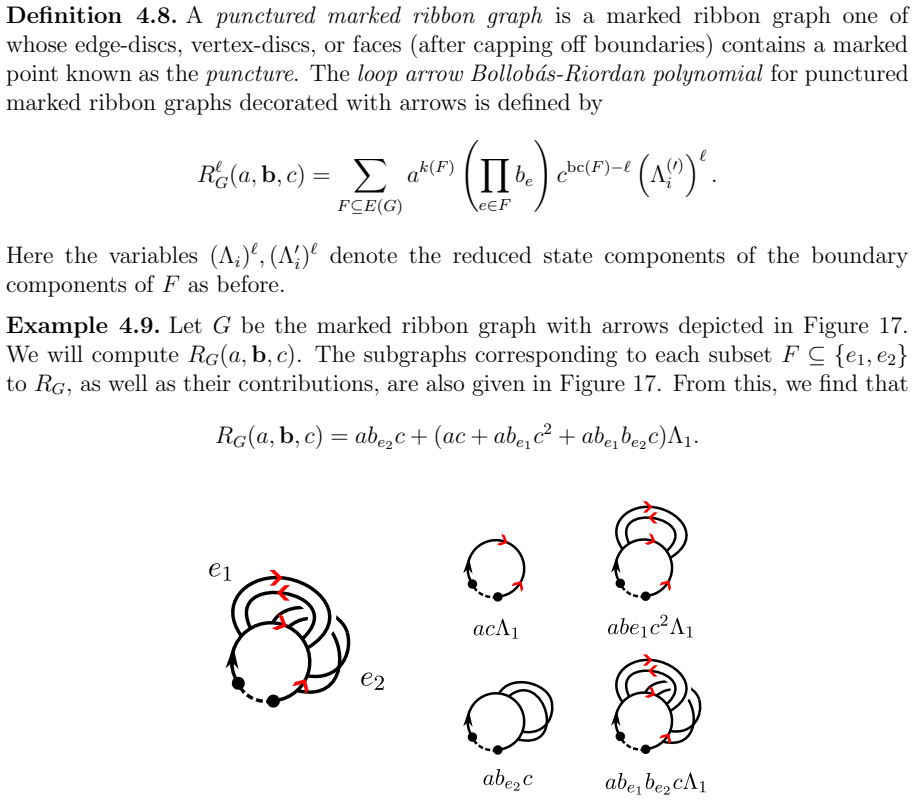
- [Definition 4.8] The exponent ℓ in the formula for R^ℓ_G is never defined. The prose after the definition only says that the variables denote reduced state components; it should state precisely how the puncture and the number ℓ of enclosing loops are determined for a spanning subgraph F.
- [Example 5.10] In the computation for the twisted knotoid K2, the text says 'where e1, e2 are the edges of G^s_{K1} as indicated in Figure 20'; this should refer to G^s_{K2}.
- [Remark 3.16 and Remark 4.12] The product rules for Λ_i and Λ'_i under concatenation are stated, but the corresponding behaviour of the variables K_i (and of the half-index variables in the linkoid setting) is not discussed, so the claimed multiplicativity is incomplete.
Circularity Check
No circular derivation: the state-sum bijection in Theorem 5.5 is a genuine translation; the main risks are unproved 'analogous' cases, not circularity.
full rationale
The central Thistlethwaite-type relation (Theorem 5.5) is not circular. The arrow Bollobás-Riordan polynomial in Definition 4.6 is defined for marked ribbon graphs by a sum over spanning subgraphs, with formal boundary-component variables (K_i, Λ_i, Λ'_i) subject to the same arrow-reduction rules; those variables also occur in the knotoid arrow polynomial, which gives the theorem a by-construction flavor, but the graph polynomial has independent content (deletion-contraction, partial-duality behaviour) and the proof is a bijection between Kauffman states of K and subgraphs of G^s_K, with matching A/B powers checked rather than assumed. State-independence is delegated to Proposition 4.13, which cites the unmarked partial-duality result [3, Prop. 2.7]; that is a legitimate independent prior theorem (it does not assume knotoids), so the self-citation is not load-bearing in a circular way. The paper does contain omissions that should be weighed as correctness risks rather than circularity: Proposition 2.10 asserts, with 'It is also easy to see', that any equivalence of standard H-curves can be kept standard throughout; Theorems 5.7 and 5.8 are dismissed as 'Analogous', although they require partial-duality invariance for the twisted and loop Bollobás-Riordan polynomials that is not proved in the text; and Definition 4.8 leaves the index ℓ in R^ℓ_G imprecise. These are gaps in proof detail, not reductions of the theorems to their inputs. Accordingly, there is no significant circularity, and the score is low.
Assumptions & free parameters
assumptions (3)
- standard math Jordan curve theorem: a simple closed curve in the plane separates the plane into an interior and an exterior region.
- domain assumption The twisted Reidemeister moves (Figure 2) generate the same equivalence on twisted knotoid diagrams as knotoid diagrams on compact surfaces up to stable equivalence.
- ad hoc to paper For any ambient isotopy between standard H-curves, there exists a smooth map F keeping the H-curves standard at every stage.
invented entities (3)
-
Twisted knotoids
-
Marked ribbon graphs
-
H-curves
Cite this review
Pith. "Pith review of Thistlethwaite Theorems for Knotoids and Linkoids." pith.science (2026). https://pith.science/paper/M7FKGORL
@misc{pith2026241212357,
  author       = {Pith},
  title        = {Pith review of: Thistlethwaite Theorems for Knotoids and Linkoids},
  year         = {2026},
  howpublished = {\url{https://pith.science/paper/M7FKGORL}},
  note         = {Machine review of arXiv:2412.12357}
}
read the original abstract
The classical Thistlethwaite theorem for links can be phrased as asserting that the Kauffman bracket of a link can be obtained from an evaluation of the Bollob\'as-Riordan polynomial of a ribbon graph associated to one of the link's Kauffman states. In this paper, we extend this result to knotoids, which are a generalization of knots that naturally arises in the study of protein topology. Specifically we extend the Thistlethwaite theorem to the twisted arrow polynomial of knotoids, which is an invariant of knotoids on compact, not necessarily orientable, surfaces. To this end, we define twisted knotoids, marked ribbon graphs, and their arrow- and Bollob\'as-Riordan polynomials. We also extend the Thistlethwaite theorem to the loop arrow polynomial of knotoids in the plane, and to spherical linkoids.
Figures


Figures from the paper (21 more)




Forward citations
Cited by 1 Pith paper
-
Biquandle Virtual Brackets and Virtual Knotoids
The biquandle virtual bracket matrix is an invariant of virtual knotoids that properly enhances the biquandle counting matrix, the biquandle counting invariant, and the biquandle virtual bracket polynomial.
Reference graph
Works this paper leans on
-
[1]
Double branched covers of knotoids
Agnese Barbensi, Dorothy Buck, Heather A Harrington, and Marc Lackenby. Double branched covers of knotoids. arXiv preprint arXiv:1811.09121 , 2018
work page Pith review arXiv 2018
-
[2]
Mario O Bourgoin. Twisted link theory. Algebraic & Geometric Topology, 8(3):1249– 1279, 2008
work page 2008
-
[3]
Robert Bradford, Clark Butler, and Sergei Chmutov. Arrow ribbon graphs. Journal of Knot Theory and its Ramifications , 21(13):1240002, 2012
work page 2012
-
[4]
Generalized duality for graphs on surfaces and the signed Bollob´ as- Riordan polynomial
Sergei Chmutov. Generalized duality for graphs on surfaces and the signed Bollob´ as- Riordan polynomial. Journal of Combinatorial Theory, Ser. B , 99(3):617–638, 2009. 27
work page 2009
-
[5]
Sergei Chmutov and Igor Pak. The Kauffman bracket of virtual links and the Bol- lob´ as-Riordan polynomial.Moscow Mathematical Journal , 7(3):409–418, 2007
work page 2007
-
[6]
Sergei Chmutov and Jeremy Voltz. Thistlethwaite’s theorem for virtual links.Journal of Knot Theory and Its Ramifications , 17(10):1189 ¨O–1198, 2008
work page 2008
-
[7]
The Jones polynomial and graphs on surfaces
Oliver Dasbach, David Futer, Efstratia Kalfagianni, Xiao-Song Lin, and Neal Stoltz- fus. The Jones polynomial and graphs on surfaces. Journal of Combinatorial Theory, Ser.B, 98:384–399, 2008
work page 2008
-
[8]
One conjecture on cut points of virtual links and the arrow polyno- mial of twisted links
Qingying Deng. One conjecture on cut points of virtual links and the arrow polyno- mial of twisted links. Journal of Knot Theory and Its Ramifications , 31(10):2250066, 2022
work page 2022
Show all 26 references
-
[9]
Knoto- ID: a tool to study the entanglement of open protein chains using the concept of knotoids
Julien Dorier, Dimos Goundaroulis, Fabrizio Benedetti, and Andrzej Stasiak. Knoto- ID: a tool to study the entanglement of open protein chains using the concept of knotoids. Bioinformatics, 34(19):3402–3404, 2018
2018
-
[10]
Graphs on surfaces: dualities, polyno- mials, and knots , volume 84
Joanna A Ellis-Monaghan and Iain Moffatt. Graphs on surfaces: dualities, polyno- mials, and knots , volume 84. Springer, 2013
2013
-
[11]
Invariants of multi-linkoids.Mediter- ranean Journal of Mathematics , 20(3):165, 2023
Boˇ stjan Gabrovˇ sek and Neslihan G¨ ug¨ umc¨ u. Invariants of multi-linkoids.Mediter- ranean Journal of Mathematics , 20(3):165, 2023
2023
-
[12]
A systematic classification of knotoids on the plane and on the sphere
Dimos Goundaroulis, Julien Dorier, and Andrzej Stasiak. A systematic classification of knotoids on the plane and on the sphere. arXiv preprint arXiv:1902.07277 , 2019
1902 arXiv
-
[13]
Knotoids and protein structure
Dimos Goundaroulis, Julien Dorier, and Andrzej Stasiak. Knotoids and protein structure. Topol. Geom. Biopolym, 746:185, 2020
2020
-
[14]
Topological models for open-knotted protein chains using the concepts of knotoids and bonded knotoids
Dimos Goundaroulis, Neslihan G¨ ug¨ umc¨ u, Sofia Lambropoulou, Julien Dorier, An- drzej Stasiak, and Louis Kauffman. Topological models for open-knotted protein chains using the concepts of knotoids and bonded knotoids. Polymers, 9(9):444, 2017
2017
-
[15]
New invariants of knotoids.European Journal of Combinatorics , 65:186–229, 2017
Neslihan G¨ ug¨ umc¨ u and Louis H Kauffman. New invariants of knotoids.European Journal of Combinatorics , 65:186–229, 2017
2017
-
[16]
On combinatorial isotopy
John FP Hudson and Eric Christopher Zeeman. On combinatorial isotopy. Publica- tions Math´ ematiques de l’IH´ES, 19:69–94, 1964
1964
-
[17]
State models and the Jones polynomial
Louis H Kauffman. State models and the Jones polynomial. Topology, 26(3):395–407, 1987
1987
-
[18]
A Tutte polynomial for signed graphs
Louis H Kauffman. A Tutte polynomial for signed graphs. Discrete Appl. Math. , 25:105–127, 1989
1989
-
[19]
Introduction to virtual knot theory
Louis H Kauffman. Introduction to virtual knot theory. Journal of Knot Theory and Its Ramifications, 21(13):1240007, 2012
2012
-
[20]
Virtual knot theory
Louis H Kauffman. Virtual knot theory. Encyclopedia of Knot Theory , page 261, 2021. 28
2021
-
[21]
Framed knotoids and their quantum invariants
Wout Moltmaker. Framed knotoids and their quantum invariants. Communications in Mathematical Physics , pages 1–27, 2022
2022
-
[22]
New quantum invariants of planar knotoids
Wout Moltmaker and Roland van der Veen. New quantum invariants of planar knotoids. Communications in Mathematical Physics , pages 1–28, 2023
2023
-
[23]
Knot polynomials of open and closed curves
Eleni Panagiotou and Louis H Kauffman. Knot polynomials of open and closed curves. Proceedings of the Royal Society A , 476(2240):20200124, 2020
2020
-
[24]
A twisted Thistleth- waite theorem
Joseph Paugh, Justin Wu, and Gavin Zhang. A twisted Thistleth- waite theorem. A talk at the Young Mathematician Conference . Available at https://people.math.osu.edu/chmutov.1/wor-gr-su21/Paugh-slides.pdf, 2021
2021
-
[25]
A spanning tree expansion for the Jones polynomial
Morwen Thistlethwaite. A spanning tree expansion for the Jones polynomial. Topol- ogy, 26:297–309, 1987
1987
-
[26]
Knotoids
Vladimir Turaev. Knotoids. Osaka Journal of Mathematics , 49(1):195–223, 2012. 29
2012
Reviewed August 11, 2026 · model on record in the stance chip above.
Discussion (0). Continue with ORCID to comment.