REVIEW 6 major objections 6 minor 94 references
A Model-based Approach to Assess Regular, Constant, and Progressive User Interface Adaptivity
T0 review · 6 major / 6 minor · reviewed 2026-08-11 · deepseek-v4-flash
Pith's one-line read GUI adaptation should be regular, constant, and progressive rather than sudden, fluctuating, and abrupt, and the Taoist system shows how to deliver that by proposing one fractional interface change at a time.
desk verdict A genuinely new integration of task models, Markov chains, and LRS for gradual UI adaptation, but the empirical triad claim is unsupported—worth a serious referee with major revisions. read the letter →
The pith
A machine-rendered reading of the paper's core claim, the machinery that carries it, and where it could break.
The reading
What carries the argument
The load-bearing mechanism is the pairing of a W3C task model with a hidden Markov model whose state space is discretely produced from the task model and whose observations are dynamically generated from a categorical distribution over longest repeating subsequences (LRS) of user actions, with repetition threshold T=1. The LRS is computed from monitored interaction traces and simulated sequences derived from the task tree's temporal operators, and it is used to predict the next action, to score candidate abstract UIs, and to decide which part of the interface to reify fractionally at runtime. Around this core, Taoist adds scoring functions for order-free probability, content prediction, and task position, plus a user-controlled weighting scheme that trades fidelity to the task model against fidelity to the learned LRS.
What would settle it
Run the same car-rental task four times with a control group whose UI never changes: if the control group shows the same completion-time drops across iterations, the claimed adaptation benefit is indistinguishable from a practice effect. Separately, instrument Taoist to log the number of widgets changed and the time gap between consecutive adaptations; if the step sizes or gaps vary widely across iterations, the regular and constant properties are not realized by the mechanism, regardless of what users say.
Extended reading notes
Core claim
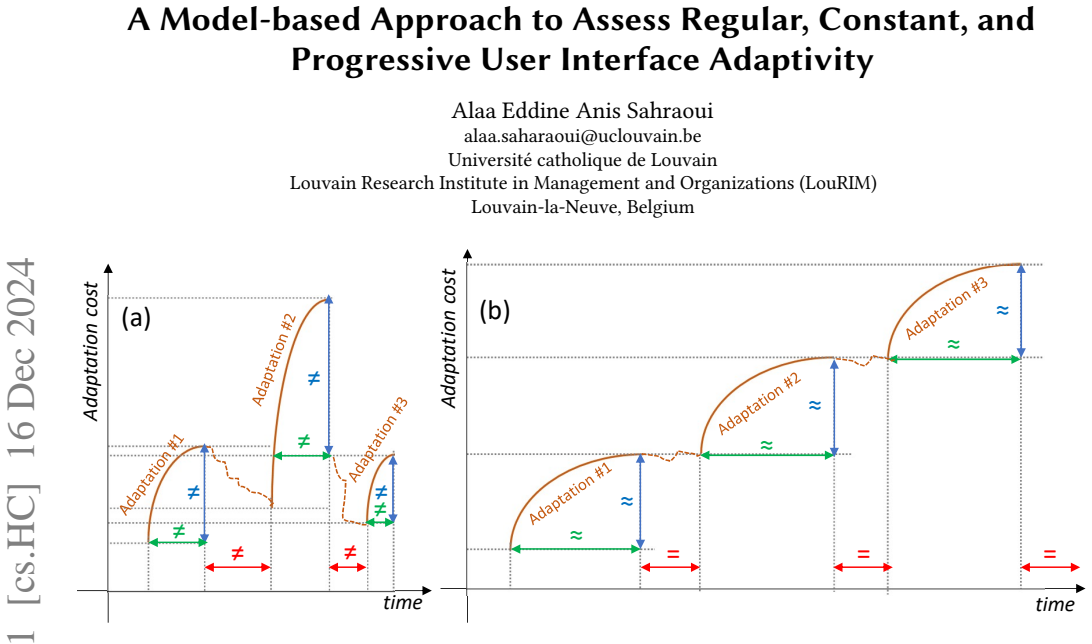
The central claim is that adaptivity quality can be engineered and assessed through three properties—regular instead of sudden, constant instead of fluctuating, and progressive instead of abrupt—and that a task-model-driven hidden Markov model with longest repeating subsequences realizes them. Taoist builds a discrete interaction state space from a W3C task model, derives a first-order Markov model from simulated action sequences, then extends it into a kth-order model as real user actions are monitored, pruning the data to the longest repeating subsequences with threshold T=1. At each adaptation step only the abstract UI corresponding to the current subtask is fractionally reified into a runnable UI, so the user experiences a series of small changes rather than one large one. The accompanying experiment with ten practitioners found that the perceived regularity and progressiveness of the adaptations were high, that constancy was not convincingly established, and that task completion time dropped significantly between the first and second iterations and between the third and fourth.
Load-bearing premise
The load-bearing premise is that answering one 7-point Likert question per construct after a four-round session tells you whether adaptation was genuinely regular, constant, and progressive, and that the observed speed-ups come from the adaptation rather than from simple practice on the same task.
Editorial extensions
If this is right
- If Taoist's claim is correct, adaptation cost can be distributed across several small steps rather than paid in one disruptive change, because each iteration reifies only the currently relevant abstract container.
- New users can inherit useful adaptations through the inter-session scenario, since the LRS accumulated by a group seeds the Markov model for a session that has no personal interaction history.
- Because the user can accept, decline, modify, postpone, or reinitiate each proposal, adaptivity becomes a negotiation between system and user rather than a one-shot system decision.
- On the W3C car-rental case, Taoist reduces the layout appropriateness metric from L=67 to L=49, and completion times dropped significantly between iterations 1-2 and 3-4, suggesting the repeated small adaptations help rather than hinder.
- Pruning to LRS with T=1 plus Tabu partial search keeps combinatorial growth tractable, although the underlying complexity in the number of concurrent tasks remains exponential.
Reading between the lines
- The regular/constant/progressive distinction could serve as a general evaluation rubric for any adaptive-interface system, not only Taoist: one could score a system by measuring the variance of its adaptation step sizes, their spacing in time, and their magnitude.
- Because constancy was the weakest result, the hard part appears to be intensity control; a follow-on system could add an explicit intensity knob that caps the number of widgets changed per iteration and test whether that raises perceived constancy.
- Since the completion-time improvement is entangled with practice effects, a direct test would compare Taoist against a fixed-UI condition in a between-subjects design; if the fixed condition reproduces the same time curve, the benefit is learning, not adaptation.
- The Markov-LRS core does not itself depend on W3C notation, so the approach could transfer to other UI families if a lightweight way to obtain a task model exists, for instance by mining interaction logs.
Signed reviews
Editorial analysis
A structured set of objections, weighed in public.
Referee Report
Summary. This paper introduces Taoist, a model-based approach to graphical user interface adaptivity that combines a W3C-compliant task model, a growing-order Markov chain, and longest repeating subsequences (LRS) mined from observed task/action sequences. The approach generates one abstract user interface and one fractional final UI at a time, with centralized parameters and user feedback mechanisms that let the user accept, decline, modify, postpone, or reinitiate adaptations. The paper defines three desired properties — regular, constant, and progressive adaptation — and claims that Taoist can realize and assess them. It illustrates the method on a bank transfer example and the W3C car-rental reference case, reports a performance evaluation of execution time, node counts, and solution counts, and presents a user study with ten practitioners who performed the car-rental task four times and then rated the three properties on 7-point Likert scales. The central empirical claim is therefore that Taoist yields adaptations that users perceive as regular, constant, and progressive.
Significance. If the central claim were fully established, the paper would make a useful contribution: a concrete, user-controllable mechanism for generating stepped UI adaptations and a first operationalization of 'regular, constant, progressive' as evaluable properties. The manuscript has real strengths: it ships a detailed implementation (Appendix A), grounds the case study in W3C standards, reports a performance evaluation with explicit measures, and is candid about internal and external validity threats. The authors also propose a controllability interface that is unusual in this literature. However, the empirical support for the triad is not sufficient as it stands. The 'constant' component is non-significant and explicitly not endorsed by the majority of the sample; the three constructs are each measured with a single retrospective Likert item; and the completion-time improvement has no control condition and is acknowledged by the authors as possibly a learning effect. The paper therefore reads as an exploratory system paper with an over-claimed empirical headline, rather than a validated demonstration of the three properties.
major comments (6)
- [This comment concerns the central claim as reported in Section 7, Figure 20, and the Abstract.] The data do not support the triad in its full form. Section 7 reports that 80% of participants perceived the adaptation as regular (M=4.90) and 90% as progressive (M=5.40), but only 40% were convinced of constancy (M=4.18, n.s.), with the authors explicitly stating that 60% of participants were not convinced. The abstract nevertheless asserts that practitioners 'assessed the regular, constant, and progressive character of adaptivity,' and the conclusion repeats the three properties. Please revise the claims to distinguish between the two supported properties and the unsupported one, or add evidence for constancy.
- [This comment concerns Section 7's completion-time analysis and the Threats to Internal Validity.] The Kruskal-Wallis result (H(3)=16.19, p=.00103) is presented as evidence that adaptation reduced completion time, but there is no non-adaptive control group or condition. The paper's own Threats to Internal Validity paragraph acknowledges that a carry-over/learning effect could explain the improvement. Without a control, the quantitative evaluation cannot distinguish adaptation effects from practice effects, and any wording implying causation should be removed.
- [This comment concerns the measurement of the three constructs in Section 7.] A single retrospective 7-point Likert item per construct, administered after all four iterations, cannot establish temporal properties such as even spacing, constant intensity, or gradual stepwise change. Participants were never asked to rate each adaptation iteration, and no objective logged measure of adaptation step size, timing, or UI-change magnitude is reported. The paper should either add per-iteration ratings and objective trace-based metrics, or explicitly limit the claims to 'participants who retrospectively agreed with the three statements.'
- [This comment concerns the Abstract and Section 7's description of the scenario.] The abstract states that participants assessed adaptivity 'after four intra-session iterations of the same task,' but Section 7 says the task was run 'with Taoist running in an inter-session scenario.' Intra-session and inter-session differ in who initiates adaptation and whether adaptation occurs within or across sessions, so this inconsistency affects the interpretation of the study. The manuscript should use one consistent scenario label and make the actual procedure explicit.
- [This comment concerns Section 4.1, Section 4.2, and Appendix A.] The title and abstract describe Taoist as 'hidden Markov model-based,' but the formal description and implementation specify a kth-order Markov chain over observable task/action states. No hidden state variables, observation/emission distributions, or HMM inference procedures (e.g., forward-backward or Viterbi) are defined. Please either provide the HMM formalization with the relevant equations, or rename the approach to avoid the HMM claim.
- [This comment concerns Section 4.2 (fractional reification) and Section 4.1 (LRS).] Fractional reification always generates one FUI at a time (Section 4.2, step 4), and the LRS mechanism is derived only from repeated observed subsequences (Section 4.1). As a result, 'regular' and 'progressive' may be largely guaranteed by construction, which would explain the high user agreement without demonstrating that the model's parameters control these properties. To rule this out, the evaluation should include objective measures of adaptation step size and timing across iterations, ideally under different parameter settings (e.g., varying T, UBPWeight, modelWeight), or the paper should explicitly state that these properties are design guarantees rather than learned outcomes.
minor comments (6)
- [This comment concerns the statistical reporting in Section 7.] The text reports 'M=4.90*, significantly higher than the median' without stating which test was used; please give the test (e.g., one-sample Wilcoxon signed-rank) and exact p-values for all three Likert items, and correct the typo 'Kruskall-Wallis.'
- [This comment concerns Equations (1)-(3).] The scoring equations contain undefined or malformed symbols: Eq. (2) uses 'OrderIndepProbability(t)' that is not defined, Eq. (3) reads 'i· modelWeight| max i userTask[0,i].sublist0(DFS(tm))' and needs reformatting, and UBPWeight/modelWeight are not given domains or ranges. Please define all terms and state how weights are set by default.
- [This comment concerns Section 5.3.] The sentence 'which proves that the adaptation reduces this metric' overstates a single comparison (L=67 to L=49); suggest replacing 'proves' with 'suggests' or adding a quantitative analysis.
- [This comment concerns Section 7 sampling language.] The text calls the recruiting procedure 'random sampling,' but the participants were volunteers from the authors' network of collaborators; 'convenience sample' is the more precise term, and 'representative' in the abstract is not supported.
- [This comment concerns Figure 18's caption.] The caption describes both the time plot and the solutions plot as 'bottom left'; the second should read 'bottom right.'
- [This comment concerns Section 8.1.] The sentence 'The results of the usability survey [6,7] show...' appears to refer to old tool evaluations not described in this paper; either describe the survey or remove the sentence.
Circularity Check
'Progressive' is built into the one-AUI-at-a-time design; the rest of the triad is empirically assessed and not circular.
-
self definitional
[Section 1 (definition of progressive) and Section 4.2 (adaptation process, steps 3 and 4)]
"Adaptation should be progressive: the adaptation process should gradually move from the current state (before adaptation) to a future state (after adaptation) following several steps instead of a single step. In GUIs, we interpret the adaptation to consist of a series of gradually evolving steps. ... we focus on the dynamic generation at run-time of one AUI at a time, the one corresponding to the current subtask. ... a fractional reification instantiates the AUI into a fractional final UI (FUI) at runtime."
The paper's operational definition of 'progressive' is 'several steps instead of a single step' / 'a series of gradually evolving steps.' The Taoist generator is specified to produce 'one AUI at a time' through 'fractional reification.' Therefore, the conclusion that Taoist adaptations are progressive is entailed by the definition plus the construction: any interface produced by fractional reification across iterations is, by definition, a series of steps. The Section 7 Likert rating of 'progressive' (M=5.40, 90% agree) thus restates the design property rather than testing a separate hypothesis.
full rationale
The only reduction-by-definition I can exhibit is the progressive property: 'progressive' is defined as a series of steps, and the generator is designed to emit one AUI at a time, so the design satisfies the definition tautologically. The user ratings remain an independent measurement of perception, and the regular and constant properties are not definitionally entailed; the paper's own data show that 'constant' was not endorsed (M=4.18, n.s.). I found no equation-level circularity: the Markov/LRS scores (Eqs. 1-3) take the task model and interaction history as inputs and are not re-used as outputs. No load-bearing self-citation is present: references to LRS [59], HMM [24], and W3C [57] are standard external sources. The internal-validity weaknesses (single post-hoc Likert item per construct, no non-adaptive control, possible learning effect, and the abstract's 'intra-session' versus Section 7's 'inter-session' inconsistency) undercut the strength of the empirical claim, but they are validity concerns, not circularity. Score 3 reflects one definitional entailment for 'progressive' while the triad claim retains independent empirical content.
Assumptions & free parameters
free parameters (5)
- LRS threshold T =
T = 1
- UBPWeight =
not specified
- modelWeight =
not specified
- Performance evaluation weights =
platform weight = 4, action weight = 1
- User-controllable adaptivity weights =
user-defined in Figure 16
assumptions (6)
- domain assumption The W3C task model and abstract UI metamodel are expressive enough to generate valid partial user interfaces for real applications.
- domain assumption kth-order Markov chains and longest repeating subsequences with T=1 capture interaction patterns that matter for adaptation.
- ad hoc to paper The scoring functions in Equations (1)-(3) rank candidate AUIs by quality.
- domain assumption Skipping the Concrete User Interface level via fractional reification preserves enough information for usable final interfaces.
- domain assumption Layout appropriateness is a valid proxy for adaptation quality.
- domain assumption Self-reported Likert ratings after the final iteration measure the regular, constant, and progressive character of adaptivity.
Cite this review
Pith. "Pith review of A Model-based Approach to Assess Regular, Constant, and Progressive User Interface Adaptivity." pith.science (2026). https://pith.science/paper/ZH22YBYZ
@misc{pith2026241212389,
  author       = {Pith},
  title        = {Pith review of: A Model-based Approach to Assess Regular, Constant, and Progressive User Interface Adaptivity},
  year         = {2026},
  howpublished = {\url{https://pith.science/paper/ZH22YBYZ}},
  note         = {Machine review of arXiv:2412.12389}
}
read the original abstract
Adaptive user interfaces adapt their contents, presentation, or behavior mostly in a sudden, fluctuating, and abrupt way, which may cause negative effects on the end users, such as cognitive disruption. Instead, adaptivity should be regular, constant, and progressive. To assess these requirements, we present Taoist, a hidden Markov model-based approach and software environment that seek the longest repeating action subsequences in a task model. The interaction state space is discretely produced from a task model and the interaction observations are dynamically generated from a categorical distribution exploiting the subsequences. Parameters governing adaptivity and its results are centralized to support two scenarios: intra-session for the same user and inter-session for the same or any other user, even new ones. The end-user can control the adaptivity when initiated by accepting, declining, modifying, postponing,or reinitiating the process before propagating it to the next iteration. We describe the Taoist implementation and its algorithm for adaptivity. We illustrate its application with examples, including the W3C reference case study. We report the results of an experiment that evaluated Taoist with a representative group of ten practitioners who assessed the regular, constant, and progressive character of adaptivity after four intra-session iterations of the same task.
Figures


Figures from the paper (23 more)


Reference graph
Works this paper leans on
-
[1]
Model- based intelligent user interface adaptation: challenges and future directions
Silvia Abrahão, Emilio Insfrán, Arthur Sluÿters, and Jean Vanderdonckt. Model- based intelligent user interface adaptation: challenges and future directions. Software and Systems Modelling , 20(5):1335–1349, 2021. doi: 10.1007/s10270-021- 00909-7. URL https://doi.org/10.1007/s10270-021-00909-7
-
[2]
Pierre A. Akiki, Arosha K. Bandara, and Yijun Yu. Adaptive model-driven user interface development systems. ACM Computing Surveys, 47(1):9:1–9:33, 2014. doi: 10.1145/2597999. URL https://doi.org/10.1145/2597999
doi:10.1145/2597999 2014
-
[3]
Pierre A. Akiki, Arosha K. Bandara, and Yijun Yu. Engineering adaptive model- driven user interfaces. IEEE Transactions on Software Engineering , 42(12):1118– 1147, 2016. doi: 10.1109/TSE.2016.2553035. URL https://doi.org/10.1109/TSE.2016. 2553035
-
[4]
Victor Alvarez-Cortes, Victor H. Zarate, Jorge A. Ramirez Uresti, and Benjamin E. Zayas. Current challenges and applications for adaptive user interfaces. In Inaki Maurtua, editor, Human-Computer Interaction , chapter 3, pages 49–68. IntechOpen, London, UK, 2009. doi: http://dx.doi.org/10.5772/7745. URL https: //www.intechopen.com/chapters/8958
-
[5]
Exploring adverse effects of adaptive voice menu
Siddhartha Asthana, Pushpendra Singh, and Amarjeet Singh. Exploring adverse effects of adaptive voice menu. In Proc. of ACM Conf. on Human Factors in Computing Systems, Extended Abstracts , CHI EA ’13, pages 775–780, New York, NY, USA, 2013. Association for Computing Machinery. ISBN 978-1-4503-1952-2. doi: 10.1145/2468356.2468494. URL http://doi.acm.org/1...
-
[6]
A frame- work and a language for usability automatic evaluation of web sites by static analysis of HTML source code
Abdo Beirekdar, Jean Vanderdonckt, and Monique Noirhomme-Fraiture. A frame- work and a language for usability automatic evaluation of web sites by static analysis of HTML source code. In Christophe Kolski and Jean Vanderdonckt, editors, Computer-Aided Design of User Interfaces III, Proceedings of the Fourth International Conference on Computer-Aided Desig...
2002
-
[7]
Flexible reporting for automated usabil- ity and accessibility evaluation of web sites
Abdo Beirekdar, Marc Keita, Monique Noirhomme-Fraiture, Frédéric Randolet, Jean Vanderdonckt, and Céline Mariage. Flexible reporting for automated usabil- ity and accessibility evaluation of web sites. In Maria Francesca Costabile and Fabio Paternò, editors, Human-Computer Interaction - INTERACT 2005, IFIP TC13 International Conference, Rome, Italy, Septe...
-
[8]
Ensuring user interface adaptation consistency through triple graph grammars
Kai Biermeier, Enes Yigitbas, Nils Weidmann, and Gregor Engels. Ensuring user interface adaptation consistency through triple graph grammars. In Carmelo Ardito, Rosa Lanzilotti, Alessio Malizia, Marta Lárusdóttir, Lucio Davide Spano, José Creissac Campos, Morten Hertzum, Tilo Mentler, José L. Abdelnour-Nocera, Lara S. G. Piccolo, Stefan Sauer, and Gerrit ...
2021
Show all 94 references
-
[10]
Bridging models and systems at runtime to build adaptive user interfaces
Marco Blumendorf, Grzegorz Lehmann, and Sahin Albayrak. Bridging models and systems at runtime to build adaptive user interfaces. In Noi Sukaviriya, Jean Vanderdonckt, and Michael Harrison, editors, Proceedings of the 2nd ACM SIGCHI Symposium on Engineering Interactive Computi...
2010
-
[11]
Affordance-derived declarative interaction models for con- text adaptation
Cristian Bogdan. Affordance-derived declarative interaction models for con- text adaptation. In Carmelo Ardito, Rosa Lanzilotti, Alessio Malizia, Marta Larusdottir, Lucio Davide Spano, José Campos, Morten Hertzum, Tilo Mentler, José Abdelnour Nocera, Lara Piccolo, Stefan Sauer...
2021
-
[12]
Model driven engineering of accessible and multi-platform graphical user interfaces by parameterized model transformations
Amina Bouraoui and Imen Gharbi. Model driven engineering of accessible and multi-platform graphical user interfaces by parameterized model transformations. Science of Computer Programming , 172:63–101, 2019. doi: 10.1016/j.scico.2018.11
2019 doi
-
[13]
URL https://doi.org/10.1016/j.scico.2018.11.002
2018 doi
-
[14]
Adaptive User Interfaces
Dermot Browne, Peter Totterdell, and Mike Norman, editors. Adaptive User Interfaces. Computers and People Series. Academic Press, London, UK, 1990. ISBN 0-12-137755-5
1990
-
[15]
A unifying reference framework for multi-target user interfaces
Gaëlle Calvary, Joëlle Coutaz, David Thevenin, Quentin Limbourg, Laurent Bouil- lon, and Jean Vanderdonckt. A unifying reference framework for multi-target user interfaces. Interacting with Computers, 15(3):289–308, 2003. doi: 10.1016/S0953- 5438(03)00010-9. URL https://doi.or...
2003 doi
-
[16]
End users as unwitting software developers
Maria Francesca Costabile, Piero Mussio, Loredana Parasiliti Provenza, and Antonio Piccinno. End users as unwitting software developers. In Pro- ceedings of the 4th International Workshop on End-User Software Engineering , WEUSE ’08, page 6–10, New York, NY, USA, 2008. Associa...
2008
-
[17]
Selective markov models for predicting web-page accesses
Mukund Deshpande and George Karypis. Selective markov models for predicting web-page accesses. In Vipin Kumar and Robert L. Grossman, editors, Proceedings of the First SIAM International Conference on Data Mining , SDM ’01, pages 1–
-
[18]
doi: 10.1137/1.9781611972719.4
SIAM, 2001. doi: 10.1137/1.9781611972719.4. URL https://doi.org/10.1137/1. 9781611972719.4
2001 doi
-
[19]
Showing user interface adaptivity by animated transitions
Charles-Eric Dessart, Vivian Genaro Motti, and Jean Vanderdonckt. Showing user interface adaptivity by animated transitions. In Proceedings of the ACM Symposium on Engineering Interactive Computing Systems , EICS ’11, pages 95– 104, New York, NY, USA, 2011. Association for Com...
2011
-
[20]
On the importance of spatial perception for the design of adaptive user interfaces
Tilman Deuschel and Ted Scully. On the importance of spatial perception for the design of adaptive user interfaces. In Giacomo Cabri, Gauthier Picard, and Niranjan Suri, editors,Proceedings of the 10th IEEE International Conference on Self- Adaptive and Self-Organizing Systems...
2016 doi
-
[21]
State of the art in adaptive user interfaces
Hartmut Dieterich, Uwe Malinowski, Thomas Kuhme, and Matthias Schneider- Hufschmidt. State of the art in adaptive user interfaces. In M. Schneider- Hufschmidt, T. Kuhme, and U. Malinowski, editors,Adaptive User Interfaces Princi- ples and Practice, chapter 10, pages 13–48. Els...
-
[22]
Jacob Eisenstein, Jean Vanderdonckt, and Angel R. Puerta. Adapting to mobile contexts with user-interface modeling. InProc. of the 3rd IEEE Workshop on Mobile Computing Systems and Applications, WMCSA’ 00, pages 83–92, Los Alamitos, CA, USA, 2000. IEEE Computer Society. doi: 1...
- [23]
-
[25]
Gajos and Krysta Chauncey
Krzysztof Z. Gajos and Krysta Chauncey. The influence of personality traits and cognitive load on the use of adaptive user interfaces. In Proceedings of the 22nd International Conference on Intelligent User Interfaces, IUI ’17, pages 301–306, New York, NY, USA, 2017. ACM. ISBN...
2017
-
[26]
User preferences for adaptive user interfaces in health information systems
Mahboubeh Eslami, Mohammad Firoozabadi, and Elaheh Homayounvala. User preferences for adaptive user interfaces in health information systems. Universal Access in Information Society , 17(4):875–883, November 2018. ISSN 1615-5289. doi: 10.1007/s10209-017-0569-1. URL https://doi...
2018 doi
-
[27]
Hidden markov models
Monica Franzese and Antonella Iuliano. Hidden markov models. In Shoba Ranganathan, Michael Gribskov, Kenta Nakai, and Christian Schönbach, editors, Encyclopedia of Bioinformatics and Computational Biology - Volume 1 , pages 753–
-
[28]
Measuring user experience of adaptive user interfaces using EEG: A replication study
Daniel Gaspar-Figueiredo, Silvia Abrahão, Emilio Insfrán, and Jean Vanderdonckt. Measuring user experience of adaptive user interfaces using EEG: A replication study. In Proceedings of the 27th International Conference on Evaluation and Assessment in Software Engineering , EAS...
2023
-
[29]
Reinforcement learning-based framework for the intelligent adaptation of user interfaces
Daniel Gaspar-Figueiredo, Marta Fernández-Diego, Ruben Nuredini, Silvia Abrahão, and Emilio Insfrán. Reinforcement learning-based framework for the intelligent adaptation of user interfaces. In Michael Nebeling, Lucio Davide Spano, and José Creissac Campos, editors, Companion ...
2024
-
[30]
Gajos, Mary Czerwinski, Desney S
Krzysztof Z. Gajos, Mary Czerwinski, Desney S. Tan, and Daniel S. Weld. Explor- ing the design space for adaptive graphical user interfaces. In Proceedings of the Working Conference on Advanced Visual Interfaces , AVI ’06, pages 201–208, New York, NY, USA, 2006. Association fo...
2006
-
[31]
Gajos, Katherine Everitt, Desney S
Krzysztof Z. Gajos, Katherine Everitt, Desney S. Tan, Mary Czerwinski, and Daniel S. Weld. Predictability and accuracy in adaptive user interfaces. In Proceedings of the ACM Conference on Human Factors in Computing Systems , CHI ’08, pages 1271—-1274, New York, NY, USA, 2008. ...
2008
-
[32]
A probabilistic mental model for estimating disruption
Bowen Hui, Grant Partridge, and Craig Boutilier. A probabilistic mental model for estimating disruption. In Proceedings of the 14th International Conference on Intelligent User Interfaces , IUI ’09, page 287–296, New York, NY, USA, 2009. Association for Computing Machinery. IS...
2009
-
[33]
Model-based adaptive user interface based on context and user experience evaluation
Jamil Hussain, Anees Ul Hassan, Hafiz Syed Muhammad Bilal, Rahman Ali, Muhammad Afzal, Shujaat Hussain, Jae Hun Bang, Oresti Banos, and Sungyoung Lee. Model-based adaptive user interface based on context and user experience evaluation. Journal of Multimodal User Interfaces , 1...
2018 doi
-
[34]
Ammar, and Makram Soui
Adnane Ghannem, Mohamed Salah Hamdi, Hany H. Ammar, and Makram Soui. A systematic classification of requirements engineering approaches for adaptive systems. In Hani Hamdan, Djallel Eddine Boubiche, Homero Toral-Cruz, Sedat Akleylek, and Hamid Mcheick, editors, Proceedings of ...
2017
-
[35]
Principles of mixed-initiative user interfaces
Eric Horvitz. Principles of mixed-initiative user interfaces. In Proceeding of the ACM Int. Conf. on Human Factors in Computing Systems , CHI ’99, pages 159–166, New York, NY, USA, 1999. Association for Computing Machinery. doi: 10.1145/302979.303030. URL http://doi.acm.org/10...
1999
-
[36]
A digital twin-based multi-modal ui adaptation framework for assistance systems in industry 4.0
Klementina Josifovska, Enes Yigitbas, and Gregor Engels. A digital twin-based multi-modal ui adaptation framework for assistance systems in industry 4.0. In Masaaki Kurosu, editor, Proc. of the 21st International Conference on Human- Computer Interaction. Design Practice in Co...
2019 doi
-
[37]
Adaptive runtime layout of hierarchical ui components
Heikki Keränen and Johan Plomp. Adaptive runtime layout of hierarchical ui components. In Proceedings of the Second Nordic Conference on Human-Computer Interaction, NordiCHI ’02, page 251–254, New York, NY, USA, 2002. Association for Computing Machinery. ISBN 1581136161. doi: ...
2002
-
[38]
Computational ap- proaches for understanding, generating, and adapting user interfaces
Yue Jiang, Yuwen Lu, Jeffrey Nichols, Wolfgang Stuerzlinger, Chun Yu, Christof Lutteroth, Yang Li, Ranjitha Kumar, and Toby Jia-Jun Li. Computational ap- proaches for understanding, generating, and adapting user interfaces. In Simone D. J. Barbosa, Cliff Lampe, Caroline Appert...
-
[39]
Marlui: Multi-agent reinforcement learning for adaptive point-and-click uis
Thomas Langerak, Sammy Christen, Mert Albaba, Christoph Gebhardt, Christian Holz, and Otmar Hilliges. Marlui: Multi-agent reinforcement learning for adaptive point-and-click uis. Proc. ACM Hum.-Comput. Interact., 8(EICS), jun 2024. doi: 10.1145/3661147. URL https://doi.org/10....
2024 doi
-
[40]
Adaptive play: A prototype of a responsive children’s videogame for greater inclusivity
Rhianne Jones. Adaptive play: A prototype of a responsive children’s videogame for greater inclusivity. In Proceedings of the 9th Nordic Conference on Human- Computer Interaction, NordiCHI ’16, New York, NY, USA, 2016. Association for Computing Machinery. ISBN 9781450347631. d...
2016
-
[41]
Benefits and costs of adaptive user interfaces
Talia Lavie and Joachim Meyer. Benefits and costs of adaptive user interfaces. International Journal of Human-Computer Studies , 68(8):508–524, 2010. doi: https: //doi.org/10.1016/j.ijhcs.2010.01.004. URL http://www.sciencedirect.com/science/ article/pii/S1071581910000145
2010 doi
-
[42]
An adaptive user interface based on spatiotemporal structure learning
Hosub Lee, Youngsang Choi, and Yeojin Kim. An adaptive user interface based on spatiotemporal structure learning. In Proceedings of IEEE Consumer Commu- nications and Networking Conference , CCNC’11, pages 923–927, Los Alamitos, CA, USA, Jan 2011. IEEE Computer Society. doi: 1...
2011
-
[43]
Constraint programming in embedded systems design: Considered helpful
Krzysztof Kuchcinski. Constraint programming in embedded systems design: Considered helpful. Microprocessors and Microsystems , 69:24–34, 2019. ISSN 0141-9331. doi: https://doi.org/10.1016/j.micpro.2019.05.012. URL https://www. sciencedirect.com/science/article/pii/S0141933119300821
2019 doi
-
[44]
Luis A. Leiva. Responsive snippets: adaptive skim-reading for mobile devices. In Adjunct Proceedings of the 20th International Conference on Human-Computer Interaction with Mobile Devices and Services , MobileHCI 2018, pages 327–331, New York, NY, USA, 2018. Association for Co...
2018
-
[45]
Machine learning for adaptive user interfaces
Pat Langley. Machine learning for adaptive user interfaces. In Gerhard Brewka, Christopher Habel, and Bernhard Nebel, editors, Proceedings of 21st Annual German Conference on Artificial Intelligence, Advances in Artificial Intelligence 97, volume 1303 of Lecture Notes in Artif...
1997 doi
-
[46]
Towards an extended model of user interface adaptation: The ISATINE framework
Víctor López-Jaquero, Jean Vanderdonckt, Francisco Montero Simarro, and Pas- cual González. Towards an extended model of user interface adaptation: The ISATINE framework. In Jan Gulliksen, Morten Borup Harning, Philippe A. Palanque, Gerrit C. van der Veer, and Janet Wesson, ed...
2007
-
[47]
Derivation of a dialog model from a task model by activity chain extraction
Kris Luyten, Tim Clerckx, Karin Coninx, and Jean Vanderdonckt. Derivation of a dialog model from a task model by activity chain extraction. In Joaquim A. Jorge, Nuno Jardim Nunes, and João Falcão e Cunha, editors, Proceedings of 10th International Workshop on Design, Specifica...
2003 doi
-
[48]
Luis A. Leiva. Restyling website design via touch-based interactions. In Pro- ceedings of the 13th International Conference on Human Computer Interaction with Mobile Devices and Services , MobileHCI ’11, page 599–604, New York, NY, USA, 2011. Association for Computing Machiner...
2011
-
[49]
Toward a task-driven intelligent gui adaptation by mixed-initiative
Nesrine Mezhoudi and Jean Vanderdonckt. Toward a task-driven intelligent gui adaptation by mixed-initiative. International Journal of Human–Computer Inter- action, 37(5):445–458, 2021. doi: https://doi.org/10.1080/10447318.2020.1824742. URL https://www.tandfonline.com/doi/abs/...
2021
-
[50]
USIXML: A user interface description language supporting multiple levels of independence
Quentin Limbourg, Jean Vanderdonckt, Benjamin Michotte, Laurent Bouillon, and Murielle Florins. USIXML: A user interface description language supporting multiple levels of independence. In Maristella Matera and Sara Comai, editors, Proceedings of Workshops in connection with t...
2004
-
[51]
Miraz, Maaruf Ali, and Peter S
Mahdi H. Miraz, Maaruf Ali, and Peter S. Excell. Adaptive user interfaces and universal usability through plasticity of user interface design. Computer Sci- ence Review , 40:100363, 2021. ISSN 1574-0137. doi: https://doi.org/10.1016/ j.cosrev.2021.100363. URL https://www.scien...
2021
-
[52]
Motti and Jean Vanderdonckt
Vivian G. Motti and Jean Vanderdonckt. A computational framework for context- aware adaptation of user interfaces. In Proceedings of the 7th IEEE Int. Conf. on Research Challenges in Information Science , RCIS ’13, pages 1–12, May 2013. doi: 10.1109/RCIS.2013.6577709. URL http...
2013
-
[53]
Capturing human sequence-learning abilities in configuration design tasks through markov chains
Christopher McComb, Jonathan Cagan, and Kenneth Kotovsky. Capturing human sequence-learning abilities in configuration design tasks through markov chains. Journal of Mechanical Design , 139(9), 07 2017. ISSN 1050-0472. doi: 10.1115/1. 4037185. URL https://doi.org/10.1115/1.403...
2017 doi
-
[54]
Extraction of interesting adaptation rules
Rim Nasfi and Makram Soui. Extraction of interesting adaptation rules. vol- ume 34 of FNC ’14, pages 607–612. Elsevier, 2014. doi: 10.1016/j.procs.2014.07.081. URL https://doi.org/10.1016/j.procs.2014.07.081. Proc. of the 9th International Conference on Future Networks and Com...
2014 doi
-
[55]
Wisel: a mixed initiative approach for widget selection
Nesrine Mezhoudi, Iyad Khaddam, and Jean Vanderdonckt. Wisel: a mixed initiative approach for widget selection. In Esmaeil S. Nadimi, Tomás Cerný, Sung- Ryul Kim, and Wei Wang, editors,Proceedings of the ACM International Conference on research in adaptive and convergent syste...
-
[56]
Model-driven architecture in practice - a software production environment based on conceptual modeling
Oscar Pastor and Juan Carlos Molina. Model-driven architecture in practice - a software production environment based on conceptual modeling . Springer, 2007. ISBN 978-3-540-71867-3. URL http://www.springerlink.com/content/978-3-540- 71867-3
2007
-
[57]
Model- based user interface (mbui) - task models, w3c working group note
Fabio Paternò, Carmen Santoro, Lucio Davide Spano, and Dave Raggett. Model- based user interface (mbui) - task models, w3c working group note. Technical report, World-Wide Web Consortium, Cambridge, Massachusetts, USA, 04 2014. URL https://www.w3.org/TR/task-models/
2014
-
[58]
Myui: gen- erating accessible user interfaces from multimodal design patterns
Matthias Peissner, Dagmar Häbe, Doris Janssen, and Thomas Sellner. Myui: gen- erating accessible user interfaces from multimodal design patterns. In Simone Di- niz Junqueira Barbosa, José Creissac Campos, Rick Kazman, Philippe A. Palanque, Michael D. Harrison, and Steve Reeves...
-
[59]
Model-based user-interface adaptation by exploiting situations, emotions and software patterns
Christian Märtin, Christian Herdin, and Jürgen Engel. Model-based user-interface adaptation by exploiting situations, emotions and software patterns. In Proceed- ings of the International Conference on Computer-Human Interaction Research and Applications, volume 1 of CHIRA ’17...
-
[60]
Puerta and David Maulsby
Angel R. Puerta and David Maulsby. Management of interface design knowledge with MOBI-D. In Johanna D. Moore, Ernest A. Edmonds, and Angel R. Puerta, editors, Proceedings of the 2nd International Conference on Intelligent User Inter- faces, IUI 1997, Orlando, Florida, USA, Jan...
1997
-
[61]
An adaptive industrial human-machine inter- face to optimise operators working performance
Daniel Reguera-Bakhache, Iñaki Garitano, Carlos Cernuda, Roberto Uribeetxeber- ria, Urko Zurutuza, and Ganix Lasa. An adaptive industrial human-machine inter- face to optimise operators working performance. In Proceedings of IEEE/ASME In- ternational Conference on Advanced Int...
2021
-
[62]
Reinhard Oppermann and Rasher R. Kinshuk. Adaptability and adaptivity in learn- ing systems. Knowledge transfer, 2:173–179, 1997. URL https://www.geocities. ws/tgsrao/kt97_gmd.pdf
1997
-
[63]
Generative programming of graphical user interfaces
Max Schlee and Jean Vanderdonckt. Generative programming of graphical user interfaces. In Proceedings of the ACM Working Conference on Advanced Visual Interfaces, AVI ’04, page 403–406, New York, NY, USA, 2004. Association for Computing Machinery. ISBN 1581138679. doi: 10.1145...
2004
-
[64]
Layout appropriateness: a metric for evaluating user interface widget layout
Andrew Sears. Layout appropriateness: a metric for evaluating user interface widget layout. IEEE Transactions on Software Engineering, 19(7):707–719, 1993. doi: 10.1109/32.238571. URL https://ieeexplore.ieee.org/abstract/document/238571
1993 doi
-
[65]
Louis, Sergiu Dascalu, Linda J
Anil Shankar, Sushil J. Louis, Sergiu Dascalu, Linda J. Hayes, and Ramona Houmanfar. User-context for adaptive user interfaces. In Proceedings of the 12th International Conference on Intelligent User Interfaces , IUI ’07, page 321–324, New York, NY, USA, 2007. Association for ...
2007
-
[66]
KKumuditha G. G. H. Silva, W. A. P. S. Abeyasekare, Dulshani M. H. E. Dasanayake, T. B. Nandisena, Dharshana Kasthurirathna, and Archchana Ku- gathasan. Dynamic user interface personalization based on deep reinforcement learning. In Proceeding of 3rd International Conference o...
2021
-
[67]
Mining longest repeated subsequences to predict world wide web surfing
Jim Pitkow and Peter Pirolli. Mining longest repeated subsequences to predict world wide web surfing. In Proc. of Second USENIX Symposium on Internet Technologies & Systems , USITS ’99, Boulder, CO, USA, October 1999. USENIX Association. URL https://www.usenix.org/conference/u...
1999
-
[68]
An ontology-based approach for user interface adaptation
Makram Soui, Soumaya Diab, Ali Ouni, Aroua Essayeh, and Mourad Abed. An ontology-based approach for user interface adaptation. In Natalya Shakhovska, editor, Proc. of International Conference on Computer Science and Information Technologies, Advances in Intelligent Systems and...
2017 doi
-
[69]
User interface derivation from business processes: A model- driven approach for organizational engineering
Kênia Sousa, Hildeberto Mendonça, Jean Vanderdonckt, Els Rogier, and Joannes Vandermeulen. User interface derivation from business processes: A model- driven approach for organizational engineering. In Proceedings of the 2008 ACM Symposium on Applied Computing, SAC ’08, page 5...
2008
-
[70]
Depth-first search and linear graph algorithms
Robert Tarjan. Depth-first search and linear graph algorithms. In Proceedings of 12th Annual Symposium on Switching and Automata Theory , SWAT 1971, pages 114–121, 1971. doi: 10.1109/SWAT.1971.10
1971 doi
-
[71]
Facilitating user interface adaptation to mobile devices
Pertti Repo. Facilitating user interface adaptation to mobile devices. InProceedings of the Third Nordic Conference on Human-Computer Interaction , NordiCHI ’04, page 433–436, New York, NY, USA, 2004. Association for Computing Machinery. ISBN 1581138571. doi: 10.1145/1028014.1...
2004
-
[72]
Adapting user interfaces with model-based reinforcement learning
Kashyap Todi, Gilles Bailly, Luis Leiva, and Antti Oulasvirta. Adapting user interfaces with model-based reinforcement learning. In Proceedings of the ACM Conference on Human Factors in Computing Systems , CHI ’21, New York, NY, USA, 2021. Association for Computing Machinery. ...
2021
-
[73]
System- atic generation of abstract user interfaces
Vi Tran, Jean Vanderdonckt, Ricardo Tesoriero, and François Beuvens. System- atic generation of abstract user interfaces. In Simone Diniz Junqueira Barbosa, José Creissac Campos, Rick Kazman, Philippe A. Palanque, Michael D. Harri- son, and Steve Reeves, editors, Proceedings o...
-
[74]
Mocadix: Designing cross-device user interfaces of an information system based on its class diagram
Jean Vanderdonckt and Thanh-Diane Nguyen. Mocadix: Designing cross-device user interfaces of an information system based on its class diagram. Proc. ACM Hum.-Comput. Interact., 3(EICS), jun 2019. doi: 10.1145/3331159. URL https: A Model-based Approach to Assess Regular, Consta...
2019 doi
-
[75]
Model-based user interface (mbui) - abstract user interface models, w3c working group note
Jean Vanderdonckt, Ricardo Tesoriero, Nesrine Mezhoudi, Vivian Motti, François Beuvens, and Jérémie Melchior. Model-based user interface (mbui) - abstract user interface models, w3c working group note. Technical report, World-Wide Web Consortium, Cambridge, Massachusetts, USA,...
2014
-
[76]
Evaluating user interface adaptation using the context of use.International Journal of Adaptive, Resilient and Autonomic Systems (IJARAS), 6(1):1–24, 2015
Makram Soui, Khaled Ghédira, and Mourad Abed. Evaluating user interface adaptation using the context of use.International Journal of Adaptive, Resilient and Autonomic Systems (IJARAS), 6(1):1–24, 2015. doi: 10.4018/IJARAS.2015010101. URL https://doi.org/10.4018/IJARAS.2015010101
2015 doi
-
[77]
A machine learning ap- proach to generate adaptive user interfaces
Anuradha Welivita and Tharindu Ranathunga. A machine learning ap- proach to generate adaptive user interfaces. Technical report, 99X Technology, Walukarama Road, Colombo 03, Sri Lanka, 04 2016. URL https://www.researchgate.net/publication/321483367_A_Machine_Learning_ Approach...
2016
-
[78]
Engineering context-adaptive UIs for task- continuous cross-channel applications
Enes Yigitbas and Stefan Sauer. Engineering context-adaptive UIs for task- continuous cross-channel applications. In Proceedings of IFIP WG 13.2/13.5 Joint Working Conference on Human-Centered and Error-Resilient Systems Development , HCSE ’16 and HESSD ’16, pages 281–300, Cha...
2016 doi
-
[79]
Context- and data-driven satisfaction analysis of user interface adaptations based on instant user feedback
Enes Yigitbas, André Hottung, Sebastian Mansfield Rojas, Anthony Anjorin, Stefan Sauer, and Gregor Engels. Context- and data-driven satisfaction analysis of user interface adaptations based on instant user feedback. Proc. of ACM Human-Computer Interaction, 3(EICS):19:1–19:20, ...
2019 doi
-
[80]
Component-based development of adaptive user interfaces
Enes Yigitbas, Klementina Josifovska, Ivan Jovanovikj, Ferhat Kalinci, Anthony Anjorin, and Gregor Engels. Component-based development of adaptive user interfaces. In José Ignacio Panach, Jean Vanderdonckt, and Oscar Pastor, editors, Proceedings of the ACM Symposium on Enginee...
2019
-
[81]
Usability analysis with markov models
Harold Thimbleby, Paul Cairns, and Matt Jones. Usability analysis with markov models. ACM Trans. Comput.-Hum. Interact., 8(2):99–132, jun 2001. ISSN 1073-
2001
-
[82]
Integrated model-driven development of self-adaptive user interfaces
Enes Yigitbas, Ivan Jovanovikj, Kai Biermeier, Stefan Sauer, and Gregor Engels. Integrated model-driven development of self-adaptive user interfaces. Software and Systems Modelling, 19(5):1057–1081, 2020. doi: 10.1007/s10270-020-00777-7. URL https://doi.org/10.1007/s10270-020-00777-7
2020 doi
-
[83]
Williams
Steve Young, Milica Gašić, Blaise Thomson, and Jason D. Williams. Pomdp- based statistical spoken dialog systems: A review. Proceedings of the IEEE , 101(5): 1160–1179, 2013. doi: 10.1109/JPROC.2012.2225812
2013
-
[84]
Model” abstract class. It contains a reference to the root “Task
Lamia Zouhaier, Yousra Ben Daly Hlaoui, and Leila Ben Ayed. A reinforcement learning based approach of context-driven adaptive user interfaces. InProceedings of IEEE 45th Annual Computers, Software, and Applications Conference , COMP- SAC ’21, pages 1463–1468, Los Alamitos, US...
2021
-
[85]
doi: 10.1145/2305484.2305502
Association for Computing Machinery. doi: 10.1145/2305484.2305502. URL https://doi.org/10.1145/2305484.2305502
-
[88]
Grundy, Anuradha Madugalla, and Humphrey O
Wei Wang, Hourieh Khalajzadeh, John C. Grundy, Anuradha Madugalla, and Humphrey O. Obie. Adaptive user interfaces for software supporting chronic disease. In Proceedings of the 46th International Conference on Software Engineering: Software Engineering in Society , ICSE-SEIS 2...
2024
-
[93]
On-the-fly usability evaluation of mobile adaptive uis through instant user feedback
Enes Yigitbas, Ivan Jovanovikj, Klementina Josifovska, Stefan Sauer, and Gregor Engels. On-the-fly usability evaluation of mobile adaptive uis through instant user feedback. In David Lamas, Fernando Loizides, Lennart E. Nacke, Helen Petrie, Marco Winckler, and Panayiotis Zaphi...
-
[516]
URL https://doi.org/10.1145/376929.376941
doi: 10.1145/376929.376941. URL https://doi.org/10.1145/376929.376941
-
[762]
doi: 10.1016/b978-0-12-809633- 8.20488-3
Elsevier, Amsterdam, The Netherlands, 2019. doi: 10.1016/b978-0-12-809633- 8.20488-3. URL https://doi.org/10.1016/b978-0-12-809633-8.20488-3
2019 doi
-
[1994]
URL https://www.elsevier.com/books/adaptive-user- interfaces/schneider-hufschmidt/978-0-444-81545-3
ISBN 9780444815453. URL https://www.elsevier.com/books/adaptive-user- interfaces/schneider-hufschmidt/978-0-444-81545-3
-
[1997]
URL https://doi.org/10.1145/238218.238337
doi: 10.1145/238218.238337. URL https://doi.org/10.1145/238218.238337
-
[2008]
ISBN 9781595937537
Association for Computing Machinery. ISBN 9781595937537. doi: 10.1145/ 1363686.1363821. URL https://doi.org/10.1145/1363686.1363821
-
[2015]
URL https://doi.org/10.1145/2811411.2811527
doi: 10.1145/2811411.2811527. URL https://doi.org/10.1145/2811411.2811527
-
[2017]
doi: 10.5220/0006502400500059
ISBN 978-989-758-267-7. doi: 10.5220/0006502400500059. URL https: //www.scitepress.org/PublicationsDetail.aspx?ID=tFgG4Dvy4h0d&t=1
-
[2019]
URL https://doi.org/10.1007/978-3- 030-29390-1_38
doi: 10.1007/978-3-030-29390-1\_38. URL https://doi.org/10.1007/978-3- 030-29390-1_38
-
[2022]
doi: 10.1145/3491101.3504030
Association for Computing Machinery. doi: 10.1145/3491101.3504030. URL https://doi.org/10.1145/3491101.3504030
Reviewed August 11, 2026 · model on record in the stance chip above.
Discussion (0). Continue with ORCID to comment.