REVIEW 3 minor 8 references
Tangential homoclinic points for Lozi maps
T0 review · 0 major / 3 minor · reviewed 2026-05-23 · grok-4.3
Pith's one-line read On the boundary of homoclinic existence for the saddle X in Lozi maps, stable and unstable manifolds intersect only tangentially or along segments, with every homoclinic point arising as an iterate of Z or V or a point on the segment from V
desk verdict The paper reduces all homoclinics on the Lozi boundary to iterates of Z and V or a connecting segment and supplies explicit equations for several boundary curves. read the letter →
The pith
A machine-rendered reading of the paper's core claim, the machinery that carries it, and where it could break.
The reading
What carries the argument
The boundary curves in the two-dimensional parameter plane together with the special points Z and V whose forward and backward orbits generate every homoclinic point on the boundary.
What would settle it
Discovery of even one homoclinic point to X on a claimed boundary parameter that is neither an iterate of Z or V nor lies on a segment joining V to an iterate of Z.
Extended reading notes
Core claim
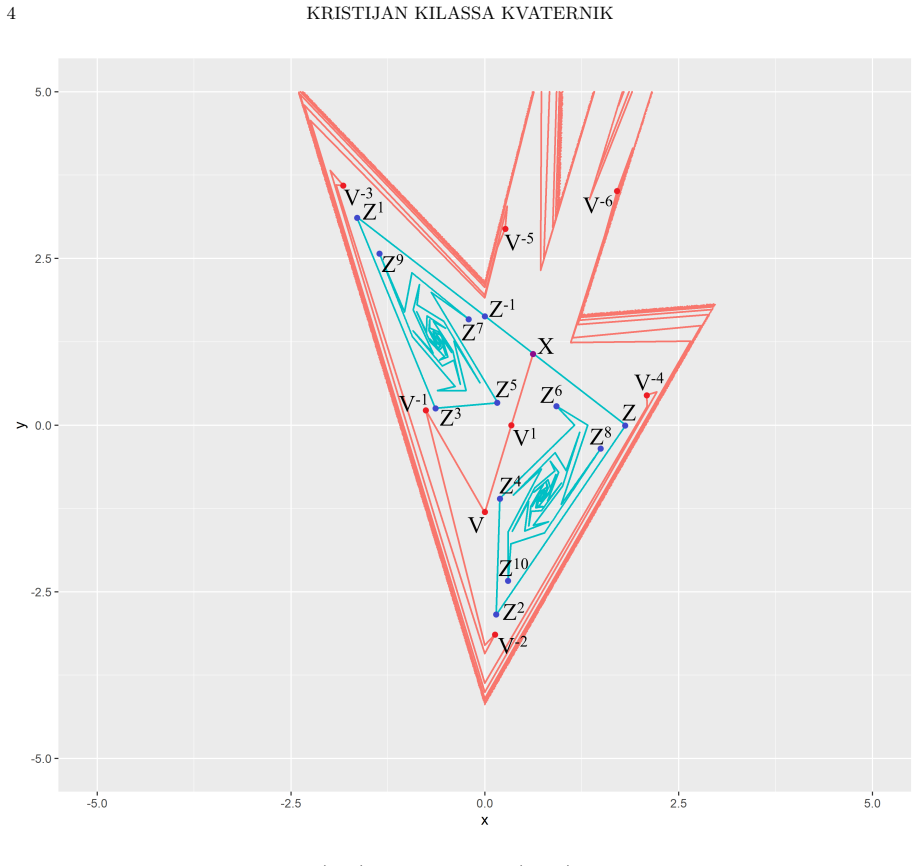
For all parameters on the boundary of the region in which homoclinic points for X exist, all intersections of the stable and unstable manifold of X, apart from X, are tangential, or these manifolds intersect along a segment. We ultimately prove that for such parameters, all possible homoclinic points for X are iterates of two special points Z and V, or iterates of points on a segment joining V with an iterate of Z. The parameter curves that form the boundary are described and explicit equations are provided for several of them.
Load-bearing premise
The Lozi map lies in the standard parameter regime with X a saddle fixed point in the first quadrant so that its stable and unstable manifolds can be computed explicitly piece by piece from the piecewise-linear definition.
Editorial extensions
If this is right
- The complete set of homoclinic points on the boundary is exhausted by the orbits of Z and V and the indicated connecting segment.
- No transverse intersections between the manifolds occur for parameters exactly on the boundary.
- The region of homoclinic existence is delimited by these tangency and segment loci.
- Several components of the boundary admit explicit algebraic equations in the parameters.
Reading between the lines
- Crossing any such boundary curve is expected to introduce transverse homoclinic intersections inside the existence region.
- The reduction to two generating points may simplify analytic or numerical continuation of homoclinics near the boundary.
- The same tangency-or-segment condition could serve as a template for locating analogous boundaries in other piecewise-linear planar maps.
Editorial analysis
A structured set of objections, weighed in public.
Referee Report
Summary. The manuscript studies homoclinic points to the saddle fixed point X of the Lozi map family in the first quadrant. It focuses on the boundary of the parameter region where such homoclinics exist, proving that on this boundary all intersections of the stable and unstable manifolds (apart from X itself) are tangential or occur along a line segment. All homoclinic points are shown to be iterates of two distinguished points Z and V or to lie on a segment joining V to an iterate of Z. Explicit algebraic equations are derived for several of the boundary curves in parameter space.
Significance. If the central claims hold, the work supplies an exact, piecewise-linear description of the homoclinic boundary for a canonical family of piecewise hyperbolic maps. The reduction of every homoclinic orbit to the orbits of Z, V or a connecting segment is a strong structural result that exploits the explicit form of the stable and unstable manifolds; such complete analytic control is rare and provides a benchmark for numerical or perturbative studies of homoclinic bifurcations in more general systems.
minor comments (3)
- [§2.2] §2.2, after Eq. (7): the combinatorial itinerary used to label the successive linear pieces of W^u(X) and W^s(X) is introduced without an accompanying figure; a schematic diagram would clarify the ordering of the segments that later enter the tangency conditions.
- [Theorem 3.1] Theorem 3.1: the statement that “all homoclinic points are iterates of Z, V or points on the segment” is proved by exhaustive case analysis on the possible intersection pieces; the authors should indicate whether any of the linear equations arising in the tangency conditions admit extraneous roots that must be discarded by an additional inequality.
- [Figure 4] Figure 4: the plotted boundary curves are labeled only by their algebraic equations; adding the corresponding numerical parameter values (a,b) at a few marked points would help the reader verify the plotted loci against the explicit formulas given in §4.
Simulated Author's Rebuttal
We thank the referee for their positive summary of our work on the homoclinic boundary for Lozi maps and for recommending minor revision. No specific major comments were listed in the report, so we have no points requiring direct rebuttal or revision at this stage. We remain available to address any additional minor issues the referee or editor may identify.
Circularity Check
No significant circularity; direct analytic proof
full rationale
The paper is a self-contained mathematical proof in dynamical systems. It uses the piecewise-linear definition of the Lozi map to compute stable/unstable manifolds explicitly as unions of line segments, solves linear equations for their intersections on the boundary of the homoclinic-existence region, and classifies all homoclinics as iterates of two special points or a segment. No parameters are fitted, no results are renamed as predictions, and no load-bearing steps reduce to self-citations or self-definitions. The abstract and description indicate an explicit, combinatorial argument that stands on its own equations without circular reduction.
Assumptions & free parameters
assumptions (2)
- standard math Stable and unstable manifolds exist and are invariant for a saddle fixed point in a discrete dynamical system
- domain assumption The Lozi map is piecewise linear, permitting explicit computation of manifold branches in each linear region
Cite this review
Pith. "Pith review of Tangential homoclinic points for Lozi maps." pith.science (2026). https://pith.science/paper/2412.12536
@misc{pith2026241212536,
  author       = {Pith},
  title        = {Pith review of: Tangential homoclinic points for Lozi maps},
  year         = {2026},
  howpublished = {\url{https://pith.science/paper/2412.12536}},
  note         = {Machine review of arXiv:2412.12536}
}
abstract
For the family of Lozi maps, we study homoclinic points for the saddle fixed point $X$ in the first quadrant. Specifically, in the parameter space, we examine the boundary of the region in which homoclinic points for $X$ exist. For all parameters on that boundary, all intersections of the stable and unstable manifold of $X$, apart from $X$, are tangential, or these manifolds intersect along a segment. We ultimately prove that for such parameters, all possible homoclinic points for $X$ are iterates of two special points $Z$ and $V$, or iterates of points on a segment joining $V$ with an iterate of $Z$. Additionally, we describe the parameter curves that form the boundary and provide explicit equations for several of them.
Figures


Figures from the paper (7 more)


Lean theorems connected to this paper
-
IndisputableMonolith/Cost/FunctionalEquation.leanwashburn_uniqueness_aczel unclear?
unclearRelation between the paper passage and the cited Recognition theorem.
all intersections of WsX and WuX apart from X are tangential... all possible homoclinic points for X are iterates of two special points Z and V, or iterates of points on a segment joining V with an iterate of Z
-
IndisputableMonolith/Foundation/AlexanderDuality.leanalexander_duality_circle_linking unclear?
unclearRelation between the paper passage and the cited Recognition theorem.
boundary curves Cn ... Pn(a,b) + Qn(a,b)√(a²+4b)=0
What do these tags mean?
- matches
- The paper's claim is directly supported by a theorem in the formal canon.
- supports
- The theorem supports part of the paper's argument, but the paper may add assumptions or extra steps.
- extends
- The paper goes beyond the formal theorem; the theorem is a base layer rather than the whole result.
- uses
- The paper appears to rely on the theorem as machinery.
- contradicts
- The paper's claim conflicts with a theorem or certificate in the canon.
- unclear
- Pith found a possible connection, but the passage is too broad, indirect, or ambiguous to say the theorem truly supports the claim.
Reference graph
Works this paper leans on
-
[1]
J. Boro´ nski and S.ˇStimac, Densely branching trees as models for H´ enon-like and Lozi-like attractors, Advances in Mathematics 429 (2023), 109191
work page 2023
-
[2]
K. Burns and H. Weiss, A geometric criterion for positive topological entropy , Communications in mathematical physics 172 (1995), 95–118
work page 1995
-
[3]
Y. Ishii, Towards a kneading theory for Lozi mappings I: A solution of the prunning front conjecture and the first tangency problem , Nonlinearity 10 (1997), 731–747
work page 1997
-
[4]
K. Kilassa Kvaternik, Tangential homoclinic points locus of the Lozi maps and applications, Doctoral dissertation, University of Zagreb, Croatia (2022), available online: https://repozitorij.pmf. unizg.hr/islandora/object/pmf:11546
work page 2022
-
[5]
Lozi, Un attracteur ´ etrange(?) du type attracteur de H´ enon, J
R. Lozi, Un attracteur ´ etrange(?) du type attracteur de H´ enon, J. Physique (Paris) 39 (Coll. C5) (1978), 9–10
work page 1978
-
[6]
Misiurewicz, Strange attractor for the Lozi mappings , Ann
M. Misiurewicz, Strange attractor for the Lozi mappings , Ann. New York Acad. Sci. 357 (1980) (Nonlinear Dynamics), 348–358
work page 1980
-
[7]
M. Misiurewicz and S. ˇStimac, The zero entropy locus for the Lozi maps , preprint 2024, arXiv:2411.17836
-
[8]
I. B. Yildiz, Monotonicity of the Lozi family and the zero entropy locus , Nonlinearity 24 (2011), 1613–1628 (K. Kilassa Kvaternik)University of Zagreb, Faculty of Electrical Engineering and Com- puting, Department of Applied Mathematics, Unska 3, 10 000 Zagreb, Croatia – and – Jagiellonian University, Institute of Mathematics, ul. prof. Stanis lawa Lojas...
work page 2011
Reviewed May 23, 2026 · model on record in the stance chip above.
Discussion (0). Sign in to comment.