REVIEW 3 minor 27 references
Fast construction of self-avoiding polygons and efficient evaluation of closed walk fractions on the square lattice
T0 review · 0 major / 3 minor · reviewed 2026-05-23 · grok-4.3
Pith's one-line read New algorithms compute the fractions of closed walks for each of over 762 billion self-avoiding polygons of length at most 38 on the square lattice.
desk verdict The paper delivers a massive new set of F_p fractions via novel algorithms for self-avoiding polygons and lattice Green's functions. read the letter →
The pith
A machine-rendered reading of the paper's core claim, the machinery that carries it, and where it could break.
The reading
What carries the argument
Efficient algorithms for constructing self-avoiding polygons and for precise evaluation of the lattice Green's function on vertex-transitive lattices.
What would settle it
Direct numerical comparison of the computed F_p values against the six previously published fractions in the literature for the smallest polygons.
Extended reading notes
Core claim
We accurately compute the fractions F_p of all closed walks on the infinite square lattice whose last erased loop corresponds to any one of the 762,207,869,373 self-avoiding polygons p of length at most 38. Prior to this work, only 6 values of F_p had been calculated in the literature. The main computational engine uses efficient algorithms for both the construction of self-avoiding polygons and the precise evaluation of the lattice Green's function. Based on our results, we propose two conjectures: one regarding the asymptotic behavior of sums of F_p, and another concerning the value of F_p when p is a large square. We provide strong theoretical arguments supporting the second conjecture.
Load-bearing premise
The novel algorithms for construction of self-avoiding polygons and precise evaluation of the lattice Green's function scale correctly to 762 billion polygons without introducing errors.
Editorial extensions
If this is right
- The sum of F_p over all polygons of a given length obeys a specific asymptotic form.
- F_p for a large square polygon equals a definite closed-form expression supported by theory.
- The same algorithms apply in principle to compute analogous fractions on any vertex-transitive infinite lattice.
- Two open questions on the triangular lattice Green's function are settled by the extension.
Reading between the lines
- The computed F_p values could be used to test numerical predictions for loop-erased random walk statistics on the square lattice.
- The construction algorithms may be adapted to enumerate or weight polygons on other regular lattices such as the hexagonal lattice.
- If the conjectures hold, they would simplify the large-scale probability that a closed walk's final loop is a square.
Editorial analysis
A structured set of objections, weighed in public.
Referee Report
Summary. The manuscript introduces novel algorithms for efficient construction of self-avoiding polygons (SAPs) and precise evaluation of the lattice Green's function. These enable computation of the exact fractions F_p for all 762,207,869,373 SAPs of length at most 38 on the infinite square lattice, where F_p is the fraction of closed walks whose last erased loop is the polygon p. Prior literature had only 6 such values. The authors propose two conjectures (one on asymptotics of sums of F_p, one on F_p for large squares with strong theoretical support), and show the algorithms extend to other vertex-transitive lattices, resolving two open questions on the triangular lattice Green's function.
Significance. If the reported computations hold, the work supplies an unprecedented volume of exact data on erased-loop fractions for self-avoiding walks, opening new avenues for asymptotic analysis and conjecture testing in enumerative combinatorics. The algorithmic framework and its explicit extension to general lattices constitute reusable tools that could accelerate exact computations beyond the square lattice.
minor comments (3)
- Abstract: the sentence 'whose the last erased loop corresponds is any one of the 762,207,869,373 self-avoiding polygons p' contains a grammatical error ('whose the' and 'corresponds is') that should be corrected for clarity.
- The manuscript states that only 6 prior F_p values existed; a brief table or citation list of those 6 values in the introduction would help readers assess the scale of the advance.
- Complexity analysis is mentioned for the new algorithms; adding a short explicit statement of the dominant time or space complexity (e.g., O(n^k) for length-n polygons) in the relevant algorithmic section would strengthen the presentation.
Simulated Author's Rebuttal
We thank the referee for the positive summary of our work, the recognition of its significance for enumerative combinatorics, and the recommendation of minor revision. The report contains no specific major comments requiring point-by-point rebuttal.
Circularity Check
No significant circularity identified
full rationale
The paper's core contribution is a large-scale exact computation of the fractions F_p via newly introduced algorithms for enumerating self-avoiding polygons and evaluating the lattice Green's function on the square lattice (with extension to the triangular lattice). These results are presented as the direct output of the stated procedures and complexity analyses rather than any fitted parameter, self-definitional relation, or load-bearing self-citation chain. No equation or claim reduces by construction to its inputs, and the work resolves independent open questions on other lattices.
Assumptions & free parameters
Cite this review
Pith. "Pith review of Fast construction of self-avoiding polygons and efficient evaluation of closed walk fractions on the square lattice." pith.science (2026). https://pith.science/paper/2412.12655
@misc{pith2026241212655,
  author       = {Pith},
  title        = {Pith review of: Fast construction of self-avoiding polygons and efficient evaluation of closed walk fractions on the square lattice},
  year         = {2026},
  howpublished = {\url{https://pith.science/paper/2412.12655}},
  note         = {Machine review of arXiv:2412.12655}
}
abstract
We build upon a recent theoretical breakthrough by employing novel algorithms to accurately compute the fractions $F_p$ of all closed walks on the infinite square lattice whose the last erased loop corresponds is any one of the $762, 207, 869, 373$ self-avoiding polygons $p$ of length at most 38. Prior to this work, only 6 values of $F_p$ had been calculated in the literature. The main computational engine uses efficient algorithms for both the construction of self-avoiding polygons and the precise evaluation of the lattice Green's function. Based on our results, we propose two conjectures: one regarding the asymptotic behavior of sums of $F_p$, and another concerning the value of $F_p$ when $p$ is a large square. We provide strong theoretical arguments supporting the second conjecture. Furthermore, the algorithms we introduce are not limited to the square lattice and can, in principle, be extended to any vertex-transitive infinite lattice. In establishing this extension, we resolve two open questions related to the triangular lattice Green's function.
Figures


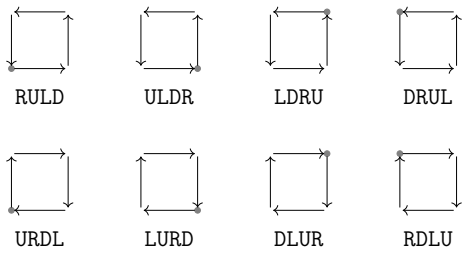
Figures from the paper (8 more)


Reference graph
Works this paper leans on
-
[1]
https://en.wikipedia.org/wiki/FMA_instruction_set, 2024
FMA instruction set. https://en.wikipedia.org/wiki/FMA_instruction_set, 2024
work page 2024
-
[2]
Github code, project “square_sap”.https://github.com/jfromentin/square_sap, 2024
work page 2024
-
[3]
Lempel–Ziv–Markov chain algorithm.https://en.wikipedia.org/wiki/Lempel-Ziv-Markov_ chain_algorithm, 2024. 22
work page 2024
-
[4]
Calculco platform, Université du Littoral Côte d’Opale. https://www-calculco. univ-littoral.fr, 2024
work page 2024
-
[5]
D. Atkinson and F. J. van Steenwijk. Infinite resistive lattices. American Journal of Physics, 67(6):486–492, 1999
work page 1999
-
[6]
W. N. Bailey.Generalized hypergeometric series. Cambridge University Press, 1935
work page 1935
-
[7]
A. R. Conway, I. G. Enting, and A. J. Guttmann. Algebraic techniques for enumerating self- avoiding walks on the square lattice.Journal of Physics A: Mathematical and General, 26(7):1519, apr 1993
work page 1993
-
[8]
J. Cserti. Application of the lattice Green’s function for calculating the resistance of an infinite network of resistors.American Journal of Physics, 68(10):896–906, 2000
work page 2000
Show all 27 references
-
[9]
Cserti, G
J. Cserti, G. Széchenyi, and G. Dávid. Uniform tiling with electrical resistors.Journal of Physics A: Mathematical and Theoretical, 44(21):215201, apr 2011
2011
-
[10]
Duplantier and F
B. Duplantier and F. David. Exact partition functions and correlation functions of multiple Hamiltonian walks on the Manhattan lattice.Journal of Statistical Physics, 51(3):327–434, May 1988
1988
-
[11]
S. Finski. Spanning trees, cycle-rooted spanning forests on discretizations of flat surfaces and analytic torsion. Math. Z., 301(4):3285–3343, 2022
2022
-
[12]
P.-L. Giscard. Counting walks by their last erased self-avoiding polygons using sieves.Discrete Mathematics, 344(4):112305, 2021
2021
-
[13]
R. L. Greenblatt. Discrete and zeta-regularized determinants of the Laplacian on polygonal do- mains with Dirichlet boundary conditions. Journal of Mathematical Physics, 64(4):043301, 04 2023
2023
-
[14]
A. J. Guttmann. Lattice Green’s functions in all dimensions.Journal of Physics A: Mathematical and Theoretical, 43(30):305205, jun 2010
2010
-
[15]
Jensen and A
I. Jensen and A. J. Guttmann. Self-avoiding polygons on the square lattice.Journal of Physics A: Mathematical and General, 32(26):4867, jul 1999
1999
-
[16]
R. Kenyon. The asymptotic determinant of the discrete Laplacian.Acta Mathematica, 185(2):239– 286, 2000
2000
-
[17]
D. J. Klein. Resistance-distance sum rules*.Croatica Chemica Acta, 75:633–649, 2002
2002
-
[18]
D. J. Klein and M. Randić. Resistance distance.Journal of Mathematical Chemistry, 12(1):81–95, Dec 1993
1993
-
[19]
G. F. Lawler. A self-avoiding random walk.Duke Mathematical Journal, 47(3):655–693, 09 1980
1980
-
[20]
G. F. Lawler.Loop-Erased Random Walk, pages 197–217. Birkhäuser Boston, Boston, MA, 1999
1999
-
[21]
G. F. Lawler, O. Schramm, and W. Werner. Conformal invariance of planar loop-erased random walks and uniform spanning trees.The Annals of Probability, 32(1B):939 – 995, 2004
2004
-
[22]
Madras and G
N. Madras and G. Slade. The Self-Avoiding Walk. Modern Birkhäuser Classics. Springer New York, 2012. 23
2012
-
[23]
S. N. Majumdar and D. Dhar. Height correlations in the Abelian sandpile model. Journal of Physics A: Mathematical and General, 24(7):L357–L362, apr 1991
1991
-
[24]
S. S. Manna, D. Dhar, and S. N. Majumdar. Spanning trees in two dimensions.Physical Review A, 46:R4471–R4474, Oct 1992
1992
-
[25]
T. Morita. Use of a recurrence formula in computing the lattice Green function.Journal of Physics A: Mathematical and General, 8(4):478–489, apr 1975
1975
-
[26]
Pozrikidis.An Introduction to Grids, Graphs, and Networks
C. Pozrikidis.An Introduction to Grids, Graphs, and Networks. OUP USA, 2014
2014
-
[27]
O. Schramm. Scaling limits of loop-erased random walks and uniform spanning trees. Israel Journal of Mathematics, 118(1):221–288, Dec 2000. 24
2000
Reviewed May 23, 2026 · model on record in the stance chip above.
Discussion (0). Sign in to comment.