REVIEW 3 major objections 5 minor 46 references
Constraining fermionic condensates
T0 review · 3 major / 5 minor · reviewed 2026-08-11 · deepseek-v4-flash
Pith's one-line read The paper constructs the first constraint effective potential for fermionic order parameters and tests it in the chiral Gross-Neveu model.
desk verdict A genuinely new constrained-path-integral method for fermionic condensates, demonstrated in the chiral Gross-Neveu model; the quadratic-expansion gap on off-constraint configurations needs tightening, but the paper deserves peer review. read the letter →
The pith
A machine-rendered reading of the paper's core claim, the machinery that carries it, and where it could break.
The reading
What carries the argument
The carrying mechanism is the saddle-point, large-volume expansion of the Grassmann-valued delta constraint. Representing the Dirac delta by a Fourier integral over an auxiliary field $\eta$ and expanding the logarithm of the shifted fermion determinant to quadratic order in $\eta/V$ converts the constraint into a Gaussian weight: every bosonic configuration gets the extra factor $\exp[-V(\phi-M)\chi^{-1}(\phi-M)/2]$, where $M$ is the fermion-bilinear observable and $\chi$ its fluctuations, a susceptibility matrix. This turns the constrained path integral into an ordinary path integral over bosonic fields with a modified action, Eq.~(29), which is the object a simulation can sample.
What would settle it
Compute the neglected cubic and higher terms in the auxiliary field on configurations sampled from the unconstrained ensemble of the same theory and check whether their contribution to $Z_\phi$ is suppressed as $V\to\infty$ for $|\phi|<\bar\phi$; if the suppression fails, the approximated path integral in Eq.~(29) would not reproduce the exact constrained distribution.
Extended reading notes
Core claim
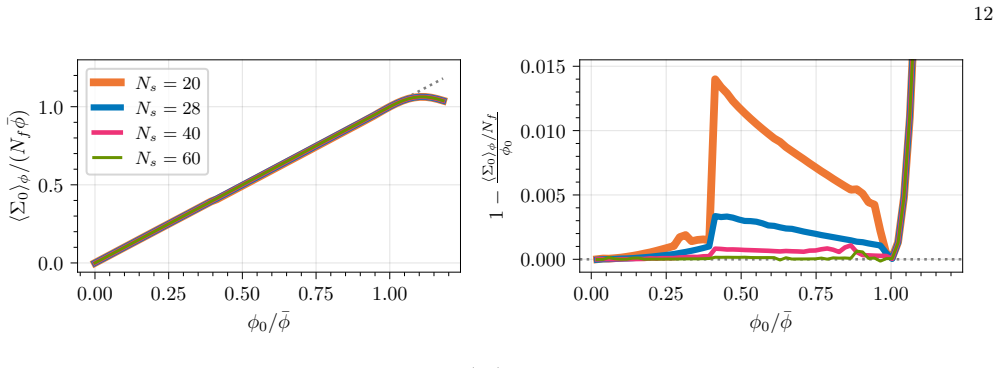
The central claim is that the approximated constrained path integral in Eq.~(29) is a valid finite-volume representation of the exact constrained partition function for fermionic condensates. It is normalized, reproduces the exact moments up to $\mathcal{O}(1/V)$ corrections, and yields $\Omega(\phi) = \Gamma(\phi)$ in the thermodynamic limit, so that the edge of the flat disk in $\Omega$ gives the physically realized condensate. The authors demonstrate this in the chiral Gross-Neveu model in the large-$N_f$ limit, where the constrained condensate tracks the constraint value, the potential flattens inside the disk as the volume grows, and the valley edge extrapolates to the condensate obtained by the standard source method.
Load-bearing premise
The quadratic expansion of the exponent in the auxiliary field must be accurate on every bosonic configuration that dominates the constrained path integral in the disk region, while the paper checks it directly only on the minimizing configurations.
Editorial extensions
If this is right
- In the chiral Gross-Neveu model the edge of the flat disk in the constraint effective potential gives the chiral condensate, replacing the double limit by a single infinite-volume extrapolation.
- The flat region is populated by inhomogeneous, spin-wave-like condensates whose winding behavior changes at a cusp in the finite-volume potential.
- The method applies to any theory with a bilinear fermion action and a real, positive fermion determinant, including QCD.
- The approximated constrained distribution matches the first two moments of the exact constrained distribution exactly and the higher moments up to $\mathcal{O}(1/V)$ corrections.
Reading between the lines
- If Eq.~(29) survives a check on the full ensemble, it could be implemented in QCD simulations using standard determinant and trace estimates, without full diagonalization of the Dirac operator.
- The comparison in Section~IIID suggests the new constraint carries more fluctuation information than binning the observable $M$ as in a density-of-states calculation, so it may resolve finite-volume chiral observables more sharply.
- A direct numerical test would be to compare the exact third moment $\langle(\bar\psi\psi)^3\rangle$ with the third moment of the approximated distribution; agreement to $\mathcal{O}(1/V)$ would confirm the expansion on the full ensemble rather than only on energy-minimizing configurations.
Editorial analysis
A structured set of objections, weighed in public.
Referee Report
Summary. The paper constructs a constraint effective potential for fermionic order parameters. Starting from a Dirac-delta constraint on the fermionic bilinear (Eq. 9), the authors introduce a Fourier representation of the delta, carry out the fermionic integral, and then perform a quadratic expansion of the resulting log-determinant functional u(eta) around eta = 0, justified as a large-volume expansion. This yields the approximate constrained partition function of Eq. (29), a standard path integral over bosonic fields with a Gaussian weight that suppresses configurations for which the observable M differs from the constraint phi. The paper shows that this approximation is normalized, matches the first two moments of the exact constrained distribution up to O(1/V) corrections, and argues that the resulting potential Omega(phi) coincides with the effective potential Gamma(phi) in the thermodynamic limit. The method is tested in the large-N_f chiral Gross-Neveu model, where the constrained condensate follows phi, the potential flattens for |phi| below the symmetry-breaking value, and the edge of the flat disk reproduces the standard value phi-bar. Inhomogeneous, spin-wave-like configurations are shown to dominate inside the disk.
Significance. If valid, the construction is significant: it is the first constraint effective potential for a continuous fermionic symmetry, and it offers a practical alternative to the double extrapolation procedure used to locate spontaneous symmetry breaking, with potential applications to QCD. The paper contains several genuine analytic checks: the approximate measure is normalized, the exactness of the constraint is tested through the constrained condensate, and the moment matching in Section IIIC1 is a nontrivial consistency condition. The numerical demonstration in the large-N_f chiral Gross-Neveu model is clean and uses established methodology. The main weakness is that the central finite-volume validity claim rests on an expansion whose control is demonstrated only on minimizing configurations, not on the full ensemble of bosonic fields that the approximate path integral must describe. The contribution is therefore promising, but the advertised generality is not yet fully supported.
major comments (3)
- [Sec. IIIB, Eqs. (24)-(29)] The paper's central claim is that Eq. (29) is a valid finite-volume representation of the exact constrained path integral, obtained by expanding u(eta) quadratically around eta = 0. For a fixed bosonic configuration, the exact eta-integral in Eq. (24) is controlled by the saddle satisfying <M(eta-bar)> = phi; when M(0) - phi is O(1), eta-bar is O(V), and the discarded O(eta^3/V^3) terms in Eq. (26) contribute O(V) to the exponent, so the quadratic expansion is not controlled for that configuration. The Gaussian weight in Eq. (29) suppresses such configurations only if the exact suppression exponent equals the approximate one at leading order. Section VD checks Re u only on the minimizing configurations of Eq. (53), on which M is close to phi, and the paper itself concedes that this validates the approximation "at the very least for these configurations." Since Eq. (29) is proposed before the bosonic integral is performed, this leaves a load-bearing gap for off-constraint bosonic configurations, and hence for finite-N_f applications such as QCD. Please either provide a uniform large-volume bound on the remainder of the quadratic expansion over the field configurations that contribute to Eq. (29), or test the Gaussian approximation against the exact one-dimensional eta-integral on a sample of non-minimizing rho configurations.
- [Sec. IIIC1 and Eq. (23)] The moment matching in Table I shows that the first two moments of Z_approx^phi/Z agree with the exact distribution up to O(1/V) corrections. This does not by itself control the pointwise convergence of the log-density, i.e. of Omega(phi) = -(1/V) log Z_phi, which is a large-deviation functional. The equality Omega = Gamma in the thermodynamic limit asserted in Eq. (23) requires a large-deviation or relative-entropy statement for the approximated measure, not merely moment convergence. The numerical evidence at large-N_f mitigates this concern for the chiGN test, but the analytic claim in Section III is stronger than what is proved. Please either supply such a bound or explicitly state that the thermodynamic-limit equality is established only under the additional assumption that the Gaussian approximation of the eta-integral is uniform in the bosonic configurations.
- [Secs. IV and V] The numerical demonstration is entirely in the large-N_f limit, where the rho path integral collapses to the global minimizers of Eq. (53). Consequently, the numerical tests do not exercise the full ensemble of bosonic configurations that Eq. (29) must control in a finite-N_f simulation; the off-constraint-configuration error identified above could in principle shift the finite-volume potential and the edge location in Monte Carlo applications. A direct test of the approximation on configurations sampled with the weight of Eq. (29), or a finite-N_f simulation, would address this concern. As the manuscript stands, the claim of general applicability to QCD rests on uniformity of the eta = 0 expansion that is neither proved nor numerically demonstrated on the full configuration ensemble.
minor comments (5)
- [Sec. III, Eq. (13)] The exchange of the eta-integral and the epsilon to 0 limit with the path integral is formal; Appendix A justifies the finite-dimensional Grassmann case, but the main text would benefit from a sentence noting that on a finite lattice the relevant integrals are finite-dimensional and the exchange is permitted.
- [Sec. IIIA, after Eq. (17)] The statement that definiteness of Gamma implies existence of a purely imaginary solution of Eq. (17) is too quick; footnote 2 already indicates non-uniqueness at large |eta|, so the branch selection should be stated as part of the definition of the Legendre transform.
- [Fig. 5] The axes for eta_0 and eta_1 are not labeled with the lattice-scale normalization, and only Re u is shown; since the phase of the integrand (Im u) matters for the Gaussian approximation away from the minimum, a statement about Im u would be useful.
- [Sec. VE, Fig. 7] The continuum extrapolation yields a nonzero value beta = 0.000503 at fixed finite volume; the statement that this deviation vanishes in the infinite-volume limit is an expectation based on Sec. VA, not a demonstrated extrapolation, and should be presented as such.
- [Appendix A and Sec. IIB] The exact constrained partition function is a distribution rather than a positive measure, as Appendix A shows; the probabilistic language in Section IIB should be understood as heuristic, and a short caveat at the first use of "probability density" would prevent confusion.
Circularity Check
No significant circularity: the constrained partition function is derived by a self-contained large-volume expansion, with only minor non-load-bearing self-citations.
full rationale
The central derivation of Eq. (29) starts from the exact constrained path integral Eq. (9), represents the delta constraint via its Fourier form Eq. (12)/Eq. (A4), performs the fermionic integral exactly, and only then expands log det(Q - i\eta\sigma/V) in powers of \eta/V around \eta=0 (Eqs. (26)-(27)). The expansion point is selected by the infinite-volume and \epsilon\to 0 limits for the disk region, not by the target value of the condensate, and the location of the flat-disk edge is obtained by minimizing the effective action Eq. (53), not imposed. The equality \Omega(\phi)=\Gamma(\phi) in the thermodynamic limit is argued via the Legendre-transform/saddle-point route in Eqs. (21)-(23), which does not assume the final condensate value. The numerical consistency check uses \bar\phi from the standard method only as a scale to set units; the ratio of the computed valley position to \bar\phi is a genuine, falsifiable comparison and is not statistically forced by the rescaling. Self-citations to Refs. [8,9] are contextual or supportive (e.g., the bosonic-versus-fermionic constraint comparison in Ref. [9] informs the choice of scheme) and are not load-bearing for the derivation of Eq. (29). The main vulnerability is a correctness gap rather than circularity: the quadratic truncation of u(\eta) is checked in Sec. VD only on the minimizing configurations, with the paper itself conceding that this confirms the approximation 'at the very least for these configurations,' while the representation (29) weights all bosonic configurations. That is an uncontrolled-approximation risk that could shift \Omega(\phi), but it is not an input-output identification, a fitted parameter renamed as a prediction, or a self-citation chain forcing the result.
Assumptions & free parameters
assumptions (5)
- standard math The Fourier representation of the Dirac delta and its formal extension to Grassmann-valued arguments (Appendix A) is well defined and can be interchanged with the fermionic path integral.
- domain assumption The theory is restricted to bilinear fermionic actions with det Q real and positive, so the fermionic path integral is Gaussian and sign-problem free.
- domain assumption The saddle-point approximation for the eta integral becomes exact as V goes to infinity, and Gamma(phi) is convex so the Legendre transform is well defined.
- ad hoc to paper For field configurations in the disk region |phi| < phibar, expanding u(eta) to quadratic order around eta = 0 is a valid large-volume approximation, with chi positive definite.
- domain assumption In the chiral Gross-Neveu test case, the large-Nf limit makes the mean-field (minimization) approximation exact, and the lattice discretization with naive fermions plus a smearing function f(p) correctly represents the continuum model.
Cite this review
Pith. "Pith review of Constraining fermionic condensates." pith.science (2026). https://pith.science/paper/XK3IXAU4
@misc{pith2026241212973,
  author       = {Pith},
  title        = {Pith review of: Constraining fermionic condensates},
  year         = {2026},
  howpublished = {\url{https://pith.science/paper/XK3IXAU4}},
  note         = {Machine review of arXiv:2412.12973}
}
read the original abstract
We study spontaneous symmetry breaking in quantum field theories with fermionic order parameters and construct, for the first time in the literature, the constraint effective potential for it. The Grassmann-valued constraint we encounter is handled using its large-volume expansion, corresponding to a saddle-point approximation. We test the method in the chiral Gross-Neveu model and demonstrate its consistency with the standard approach. The machinery we developed opens up a new avenue to investigate the spontaneous symmetry breaking and restoration in field theories, in particular for the chiral symmetry breaking in the strong interactions.
Figures


Figures from the paper (6 more)


Reference graph
Works this paper leans on
-
[1]
Comparison of the exact and approximated constrained path integral via moments The purpose of this section is to quantify the impact of the approximations made in Section IIIB and to check whether one indeed recovers the exact distributionZϕ/Z from Z approx ϕ /Z in the infinite volume limit. To do so, we consider both objects as probability distributions ...
-
[2]
Exactness of the constraint Another way to gauge the impact of the approximation is to study the exactness of the constraint, i.e., how well the fermionic condensates⟨Σ⟩ϕ satisfy the constraint.6 In an unconstrained path integral, the condensates are obtained by taking derivatives with respect to the specific sources as shown in Eq. (6). Taking this appro...
-
[3]
Derivatives of the constraint potential The derivative of the quantum effective potential con- nects the expectation valueϕa and selected source term ma, see Eq. (8). Similarly, we can explicitly compute the derivative (11) of the constraint potential using the approximated constrained path integral (29), in terms of constrained expectation values, ja = χ...
-
[4]
T. Brauner, Spontaneous Symmetry Breaking and Nambu-Goldstone Bosons in Quantum Many-Body Sys- tems, Symmetry2, 609 (2010), arXiv:1001.5212 [hep-th]
arXiv 2010
-
[5]
Maas, Brout-Englert-Higgs physics: From founda- tions to phenomenology, Prog
A. Maas, Brout-Englert-Higgs physics: From founda- tions to phenomenology, Prog. Part. Nucl. Phys.106, 132 (2019), arXiv:1712.04721 [hep-ph]
arXiv 2019
-
[6]
G. Aarts et al. , Phase Transitions in Particle Physics: ResultsandPerspectivesfromLatticeQuantumChromo- Dynamics, Prog. Part. Nucl. Phys.133, 104070 (2023), arXiv:2301.04382 [hep-lat]
arXiv 2023
-
[7]
Y. Hatta and T. Ikeda, Universality, the QCD critical / tricritical point and the quark number susceptibility, Phys. Rev. D67, 014028 (2003), arXiv:hep-ph/0210284
arXiv 2003
-
[8]
L. Du, A. Sorensen, and M. Stephanov, The QCD phase diagram and Beam Energy Scan physics: a the- ory overview (2024) arXiv:2402.10183 [nucl-th]
arXiv 2024
Show all 46 references
-
[9]
Fukuda and E
R. Fukuda and E. Kyriakopoulos, Derivation of the ef- fective potential, Nucl. Phys. B85, 354
-
[10]
O’Raifeartaigh, A
L. O’Raifeartaigh, A. Wipf, and H. Yoneyama, The Constraint Effective Potential, Nucl. Phys. B271, 653 (1986)
1986
-
[11]
Endrődi, T
G. Endrődi, T. G. Kovács, and G. Markó, Spontaneous Symmetry Breaking via Inhomogeneities and the Dif- ferential Surface Tension, Phys. Rev. Lett.127, 232002 (2021), arXiv:2109.03668 [hep-lat]
2021 arXiv
-
[12]
Endrődi, T
G. Endrődi, T. G. Kovács, G. Markó, and L. Pan- nullo, Flattening of the quantum effective potential in fermionic theories, PoS LATTICE2023, 379 (2024), arXiv:2312.01960 [hep-lat]
2024 arXiv
-
[13]
Azcoiti, V
V. Azcoiti, V. Laliena, and X.-Q. Luo, Spontaneous sym- metry breaking in fermion - gauge systems: A Nonstan- dard approach, Phys. Lett. B354, 111 (1995), arXiv:hep- th/9509091
1995
-
[14]
Luo, Chiral condensate of lattice QCD with mass- less quarks from the probability distribution function method, Phys
X.-Q. Luo, Chiral condensate of lattice QCD with mass- less quarks from the probability distribution function method, Phys. Rev. D 69, 076012 (2004), arXiv:hep- lat/0409032
2004
-
[15]
S. J. Brodsky and R. Shrock, Condensates in Quantum Chromodynamics and the Cosmological Constant, Proc. Nat. Acad. Sci.108, 45 (2011), arXiv:0905.1151 [hep-th]
2011 arXiv
-
[16]
S. J. Brodsky, C. D. Roberts, R. Shrock, and P. C. Tandy, Essence of the vacuum quark condensate, Phys. Rev. C 82, 022201 (2010), arXiv:1005.4610 [nucl-th]
2010 arXiv
-
[17]
S. J. Brodsky, C. D. Roberts, R. Shrock, and P. C. Tandy, Confinement contains condensates, Phys. Rev. C 85, 065202 (2012), arXiv:1202.2376 [nucl-th]
2012 arXiv
-
[18]
Sadzikowski and W
M. Sadzikowski and W. Broniowski, Non-uniform chiral phase in effective chiral quark models, Phys. Lett. B488, 63 (2000), arXiv:hep-ph/0003282
2000 arXiv
-
[19]
Thies and K
M. Thies and K. Urlichs, Revised phase diagram of the Gross-Neveu model, Phys. Rev. D 67, 125015 (2003), arXiv:hep-th/0302092
2003 arXiv
-
[20]
Nakano and T
E. Nakano and T. Tatsumi, Chiral symmetry and density wave in quark matter, Phys. Rev. D71, 114006 (2005), arXiv:hep-ph/0411350
2005 arXiv
-
[21]
Nickel, Inhomogeneous phases in the Nambu-Jona- Lasino and quark-meson model, Phys
D. Nickel, Inhomogeneous phases in the Nambu-Jona- Lasino and quark-meson model, Phys. Rev. D80, 074025 (2009), arXiv:0906.5295
2009 arXiv
-
[22]
Buballa and S
M. Buballa and S. Carignano, Inhomogeneous chiral con- densates, Progress in Particle and Nuclear Physics81, 39 (2015), arXiv:1406.1367 [hep-ph]
2015 arXiv
-
[23]
Brauner and N
T. Brauner and N. Yamamoto, Chiral Soliton Lattice and Charged Pion Condensation in Strong Magnetic Fields, JHEP 04, 132, arXiv:1609.05213 [hep-ph]
-
[24]
O.Akerlund, P.deForcrand,andT.Rindlisbacher,Oscil- lating propagators in heavy-dense QCD, JHEP10, 055, arXiv:1602.02925 [hep-lat]
-
[25]
R. W. Haymaker and J. Perez-Mercader, Convexity of the Effective Potential, Phys. Rev. D27, 1948 (1983)
1983
-
[26]
Alexandre and A
J. Alexandre and A. Tsapalis, Maxwell Construc- tion for Scalar Field Theories with Spontaneous Sym- metry Breaking, Phys. Rev. D 87, 025028 (2013), arXiv:1211.0921 [hep-th]
2013 arXiv
-
[27]
E. J. Weinberg and A.-q. Wu, Understanding complex perturbative effective potentials, Phys. Rev. D36, 2474 (1987)
1987
-
[28]
B. S. DeWitt, Supermanifolds, Cambridge Monographs on Mathematical Physics (Cambridge Univ. Press, Cam- bridge, UK, 2012)
2012
-
[29]
C. M. Bender and S. A. Orszag,Advanced Mathematical Methods for Scientists and Engineers I (Springer, 1999)
1999
-
[30]
Langfeld, Density-of-states, PoS LATTICE2016, 010 (2017), arXiv:1610.09856 [hep-lat]
K. Langfeld, Density-of-states, PoS LATTICE2016, 010 (2017), arXiv:1610.09856 [hep-lat]
2017 arXiv
-
[31]
Lucini, D
B. Lucini, D. Mason, M. Piai, E. Rinaldi, and D. Vadacchino, First-order phase transitions in Yang- Millstheoriesandthedensityofstatemethod,Phys.Rev. D 108, 074517
-
[32]
Endrődi, Z
G. Endrődi, Z. Fodor, S. D. Katz, D. Sexty, K. K. Szabó, and C. Török, Applying constrained simulations for low temperaturelatticeQCDatfinitebaryonchemicalpoten- tial, Phys. Rev. D98, 074508 (2018), arXiv:1807.08326 [hep-lat]
2018 arXiv
-
[33]
Schnetz, M
O. Schnetz, M. Thies, and K. Urlichs, Full Phase Di- agram of the Massive Gross-Neveu Model, Annals of Physics 321, 2604, hep-th/0511206
-
[34]
Basar, G
G. Basar, G. V. Dunne, and M. Thies, Inhomoge- neous Condensates in the Thermodynamics of the Chiral NJL_2 model, Phys. Rev. D79, 105012, 0903.1868
-
[35]
D. J. Gross and A. Neveu, Dynamical symmetry breaking in asymptotically free field theories, Phys. Rev. D10, 3235
-
[36]
Wolff, The phase diagram of the infinite N Gross- Neveu model at finite temperature and chemical poten- tial, Phys
U. Wolff, The phase diagram of the infinite N Gross- Neveu model at finite temperature and chemical poten- tial, Phys. Lett. B157, 303
-
[37]
Hands, M
S. Hands, M. Mesiti, and J. Worthy, Critical behavior in the single flavor Thirring model in 2+1D, Phys. Rev. D 19 102, 094502
-
[38]
J. Lenz, B. Wellegehausen, and A. Wipf, Absence of chi- ral symmetry breaking in Thirring models in 1+2 dimen- sions, Phys. Rev. D100, 054501, 1905.00137
1905 arXiv
-
[39]
Pannullo and M
L. Pannullo and M. Winstel, Absence of inhomoge- neous chiral phases in 2+1-dimensional four-fermion and Yukawa models, Phys. Rev. D108, 036011, 2305.09444
-
[40]
Koenigstein and L
A. Koenigstein and L. Pannullo, Inhomogeneous conden- sation in the Gross-Neveu model in noninteger spatial dimensions $1\leq d <3$. II. Nonzero temperature and chemical potential, Phys. Rev. D109, 056015
-
[41]
Witten, Chiral symmetry, the 1/n expansion, and the SU(N) thirring model, Nucl
E. Witten, Chiral symmetry, the 1/n expansion, and the SU(N) thirring model, Nucl. Phys. B145, 110 (1978)
1978
-
[42]
Ciccone, L
R. Ciccone, L. Di Pietro, and M. Serone, Anomalies and persistent order in the chiral Gross-Neveu model, JHEP 02, 211, arXiv:2312.13756 [hep-th]
-
[43]
J. Lenz, L. Pannullo, M. Wagner, B. Wellegehausen, and A. Wipf, Inhomogeneous phases in the Gross-Neveu model in 1+1 dimensions at finite number of flavors, Phys. Rev. D101, 094512 (2020), arXiv:2004.00295 [hep- lat]
2020 arXiv
-
[44]
Pannullo, M
L. Pannullo, M. Wagner, and M. Winstel, Inhomoge- neous phases in the chirally imbalanced 2+1-dimensional Gross-Neveu model and their absence in the continuum limit, Symmetry14, 265 (2022), 2112.11183
2022 arXiv
-
[45]
Winstel and L
M. Winstel and L. Pannullo, Stability of homoge- neous chiral phases against inhomogeneous perturbations in 2+1 dimensions, PoS LATTICE2022, 195 (2023), arXiv:2211.04414 [hep-ph]
2023 arXiv
-
[46]
Pannullo, M
L. Pannullo, M. Wagner, and M. Winstel, Regularization effects in the Nambu-Jona-Lasinio model: Strong scheme dependence of inhomogeneous phases and persistence of the moat regime, Phys. Rev. D110, 076006
Reviewed August 11, 2026 · model on record in the stance chip above.
Discussion (0). Continue with ORCID to comment.