REVIEW 3 major objections 4 minor 34 references
On the Time-Frequency Localization Characteristics of the Delay-Doppler Plane Orthogonal Pulse
T0 review · 3 major / 4 minor · reviewed 2026-08-11 · deepseek-v4-flash
Pith's one-line read This paper derives closed-form time-frequency localization metrics for the delay-Doppler plane orthogonal pulse, showing that it spreads energy widely in time, frequency, and jointly while still obeying the Gabor limit.
desk verdict Useful closed forms for the DDOP's TF spread, but the frequency dispersion in Theorem 1 is an unspecified essential-bandwidth quantity, not the exact RMS width, and Eq. (16) has a minor misprint. read the letter →
The pith
A machine-rendered reading of the paper's core claim, the machinery that carries it, and where it could break.
The reading
What carries the argument
The carrier of the argument is the concatenation construction $u(t)=\sum_{n=0}^{N-1} a(t-nT-T_a/2)$, together with its frequency-domain counterpart, a train of sinc-shaped tones $\mathrm{sinc}(NTf-mN)$ spaced $1/T$ apart. This structure makes the second-moment integrals separable: the time dispersion of the DDOP is essentially the time dispersion of its rectangular time envelope, while the frequency dispersion is essentially the frequency dispersion of its sub-pulse envelope. A supporting lemma evaluates shifted second-moment integrals of even functions, and the derivation treats the truncated RRC spectrum as essentially the ideal RRC spectrum, so the sinc-train sums can be approximated as integrals for large $M$ and $N$.
What would settle it
Compute $\Delta F$ by numerically integrating (10) with the exact truncated RRC spectrum $A(f)=\tilde{A}(f)\star\mathrm{sinc}(T_a f)$ over a wide band, say $\pm 5M/T$, for small $Q$ and low $\beta$; if the result departs from (26c) by more than the sub-one-percent margin reported for the simulated parameters, then the essential-bandwidth assumption is the point of failure.
Extended reading notes
Core claim
On the paper's own terms, the discovery is that the time-frequency localization of the DDOP is governed by two independent envelopes: the rectangular time window of length $NT$ sets the time dispersion, and the sub-pulse spectrum sets the frequency dispersion. For a DDOP built from $N$ truncated root-raised-cosine sub-pulses with roll-off $\beta$, the resulting metrics are $\Delta T \approx NT/\sqrt{12}$, $\Delta F \approx (M/T)\sqrt{1/12+(\pi^2-8)\beta^2/(4\pi^2)}$, $\Delta A \approx (MN/12)\sqrt{1+3(\pi^2-8)\beta^2/\pi^2}$, and $\kappa \approx (NT^2/M)\sqrt{\pi^2/(\pi^2+3(\pi^2-8)\beta^2)}$. Because both $\Delta T$ and $\Delta F$ are large, the joint area lies orders of magnitude above the Gabor limit, yet the pulse obeys the Heisenberg uncertainty bound and behaves locally like a narrow pulse in small tiles of the time-frequency plane.
Load-bearing premise
The closed forms depend on treating the truncated RRC sub-pulse's spectrum as essentially the untruncated RRC spectrum and on $M$ and $N$ being large enough that the sinc-tone sums behave like integrals; if the small frequency tails carry significant energy or the block sizes are small, the stated $\Delta F$ and $\Delta A$ formulas shift.
Editorial extensions
If this is right
- The DDOP is physically realizable as a prototype pulse: its time-frequency area respects the Gabor limit, so the fine delay-Doppler resolutions of ODDM do not force a pulse that violates the uncertainty principle.
- Compared with TDM and FDM benchmark pulses, the DDOP has a larger joint time-frequency area because it spreads widely in both dimensions instead of being narrow in one; its direction parameter also falls between the TDM and FDM values.
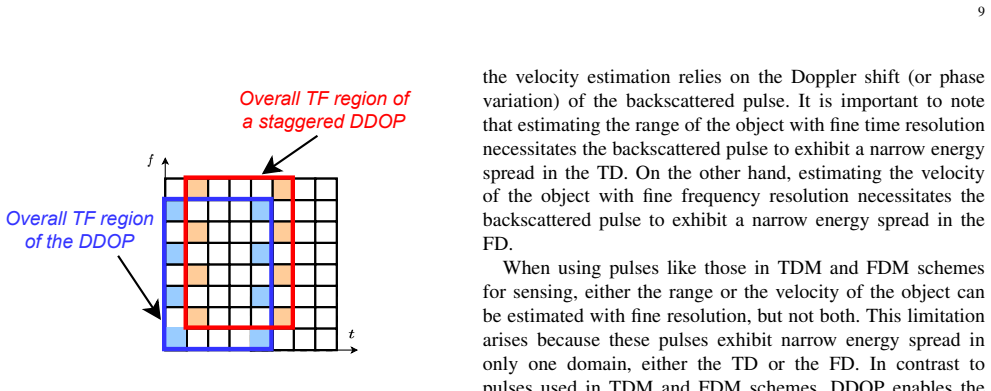
- Locally, each of the roughly $MN$ scattered tiles has a time-frequency area on the order of $1/(4\pi MN)$, so the pulse behaves like a well-localized pulse in small regions of the time-frequency plane.
- For the generalized DDOP with cyclic prefix and suffix, the time dispersion and time-frequency area grow in steps with the sub-pulse duration $T_a$, through the parameter $D=\lceil T_a/T\rceil$.
- Choosing the RRC sub-pulse instead of the better-than-RRC sub-pulse yields a lower frequency dispersion and a lower joint time-frequency area, especially at high roll-off $\beta$.
Reading between the lines
- The envelope shortcut of reading $\Delta T$ from the time envelope and $\Delta F$ from the frequency envelope should extend to any ODDM-like pulse whose sub-pulse is spectrally concentrated, letting future DD-domain waveforms be compared by evaluating only their envelopes.
- The same formulas give a design handle: increasing $N$ or $M$ raises both dispersions and the joint area, so system designers could tune block sizes to trade diversity gain against sensing resolution or out-of-band constraints.
- Because the DDOP is locally narrow and globally spread, it suggests a single-waveform joint communication-and-sensing system in which the same pulse provides data throughput, delay resolution, and Doppler resolution; a direct experiment would measure delay-Doppler ambiguity sidelobes against the formulas in Theorem 1.
- One might test whether a sub-pulse with a more rectangular spectrum than RRC directly lowers $\Delta A$ through the same formula, turning the time-frequency metric into an optimization target.
Signed reviews
Editorial analysis
A structured set of objections, weighed in public.
Referee Report
Summary. The paper derives closed-form approximations for the time-frequency (TF) localization metrics of the delay-Doppler plane orthogonal pulse (DDOP): the TF area ΔA, time dispersion ΔT, frequency dispersion ΔF, and direction parameter κ. The derivation covers the DDOP with truncated root-raised-cosine and better-than-RRC sub-pulses, as well as a generalized DDOP with cyclic prefix/suffix extensions. The paper interprets the resulting large TF area as a consequence of the pulse energy being scattered across approximately MN small TF regions, discusses implications for diversity exploitation and sensing, and validates the analytical formulas numerically.
Significance. If the formulas stand, they give a compact analytical description of the DDOP's energy spread and clarify why the jointly large ΔT and ΔF can coexist with local fine-resolution behavior. The numerical validation is a genuine strength: the closed forms are compared with direct numerical integration for a range of M, N, and β and agree to about 1% for the intended operating region, and no parameter is fitted to the target metrics. The envelope-function relationships in Section V are also useful for extending the results to variants of the DDOP. However, the exact-frequency-dispersion issue described below affects the theorem's statement and must be resolved before the results can be taken at face value.
major comments (3)
- [Section III-A, Eq. (16)] Computing t̄ directly from (11) and (3) gives t̄ = T(N−1)/2 + Ta/2 for a sub-pulse centered at t = 0, not the value T(N−1)+Ta/2 stated in Eq. (16). With the erroneous value, the cancellation of the TTa and Ta² terms that leads from (15b) to (17) does not hold as written. The final approximation ΔT ≈ NT/√12 is still the correct large-N variance of the N pulse positions, so the theorem's conclusion can be repaired, but Eq. (16) and the intervening algebra must be corrected.
- [Section II-B, Eq. (10) and Footnote 7; Theorem 1, Eq. (26c)] Because a(t) in (4) is time-limited and does not vanish at ±Ta/2, the convolution A(f) = A~(f) ⋆ Ta·sinc(Ta f) in (6) decays only as O(1/f). Consequently the exact RMS bandwidth defined in (10) is infinite: f²|A(f)|² has a non-integrable tail. The finite closed form (26c) is obtained only after replacing A(f) by A~(f) (Footnote 5) and adopting an 'essential' bandwidth convention (Footnote 7), and the numerical validation in Section VII integrates only up to ±5M/T. Since the central quantity ΔA in (26a) is the product of ΔT and this ΔF, the theorem needs either an explicit, testable definition of the essential-bandwidth cutoff or a quantitative bound showing that the discarded tail does not affect (26c) over a specified cutoff range.
- [Section III-A, Eqs. (22b)–(23)] The parameter K introduced in (22b) is the number of sinc(NTf) zero-crossings retained, and the term ΔF2² = K/(π²T²N²) is then dropped because it is asserted to be negligible compared with ΔF1². For the truncated RRC sub-pulse, however, the 1/f tail of A(f) contributes a roughly constant density to f²|A(f)|², so the ratio ΔF2²/ΔF1² is not obviously negligible for all large cutoffs. Please quantify this ratio, or fold it into the essential-bandwidth convention requested in the preceding major comment.
minor comments (4)
- [Section V-A] The sentence '∆F1 and ∆F1 are same as ∆F of a(t) and b(t)' should read '∆F1 and ∆F2 are the same as ∆F of a(t) and b(t), respectively.'
- [Section I, last paragraph] The organization paragraph says 'followed by the conclusion in Section VII', but the conclusion is in Section VIII.
- [Section IV-B, Remark 2] 'bellow' should be 'below'.
- [Footnote 5] Footnote 5 states that the truncation sidelobes of A(f) are 'negligibly small'; given the O(1/f) decay, a quantitative statement of how small and over which frequency range would help the reader assess the approximation.
Circularity Check
No circular derivation: the DDOP TF-localization metrics follow from the DDOP's defining sub-pulse and standard Fourier analysis; self-citations provide structural context, not the derived result.
full rationale
The paper's central quantities ΔT, ΔF, ΔA, and κ are computed from the standard RMS definitions (9)–(13) applied to the DDOP constructed in (3) and its Fourier transform (5). The derivation chain is self-contained: ΔT follows from the sub-pulse support condition Ta≪T and the rectangular envelope NT/√12 (Eqs. (15)–(19)); ΔF follows from the sampled comb structure of U(f), the approximation that A(f)≈Ã(f), and the finite-band integral (24). No parameter is fitted to the target metrics, and the numerical validation simulates the DDOP from its definition and compares with the closed forms without optimizing any free parameter. The self-citations [2],[5],[8],[9] supply the DDOP definition, orthogonality statements, and the U(f) representation; the paper also sketches the derivation of U(f) via (29), and the cited prior work does not assert or presuppose the TF-localization theorem. The main caveat is declared rather than concealed: Footnotes 5 and 7 state that truncation sidelobes are ignored and that ΔF is evaluated in an essential-bandwidth sense, and Section VII adopts the same convention by integrating only to ±5M/T. That is an approximation with an explicit cutoff and an unstated tail bound, so it is a correctness/robustness risk rather than a circular reduction; nothing is defined in terms of the claimed result and no fitted input is relabeled as a prediction.
Assumptions & free parameters
free parameters (1)
- K =
intermediate; cancels
assumptions (7)
- standard math The TF localization metrics in (9)-(12) (standard deviation based ΔT, ΔF, ΔA, κ) are the appropriate measures of energy spread.
- standard math Heisenberg/Gabor limit ΔA ≥ 1/(4π) applies to any physical pulse.
- domain assumption The DDOP is constructed as u(t)=Σ_{n=0}^{N-1} a(t-nT-Ta/2) with a truncated square-root-Nyquist sub-pulse and the orthogonality conditions from [2,5,8,9].
- ad hoc to paper Frequency sidelobes of the truncated RRC sub-pulse can be neglected, i.e., A(f)≈Ã(f).
- domain assumption The frequency dispersion can be computed in the 'essential' sense, ignoring very small frequency tails.
- ad hoc to paper A(f) is approximately constant over the significant support of each sinc replica, justifying Eq. (21).
- ad hoc to paper The envelope-function relationships (30)-(31) hold for DDOP variants.
Cite this review
Pith. "Pith review of On the Time-Frequency Localization Characteristics of the Delay-Doppler Plane Orthogonal Pulse." pith.science (2026). https://pith.science/paper/GN2IINSH
@misc{pith2026241213216,
  author       = {Pith},
  title        = {Pith review of: On the Time-Frequency Localization Characteristics of the Delay-Doppler Plane Orthogonal Pulse},
  year         = {2026},
  howpublished = {\url{https://pith.science/paper/GN2IINSH}},
  note         = {Machine review of arXiv:2412.13216}
}
read the original abstract
In this work, we study the time-frequency (TF) localization characteristics of the prototype pulse of orthogonal delay-Doppler (DD) division multiplexing modulation, namely, the DD plane orthogonal pulse (DDOP). The TF localization characteristics examine how concentrated or spread out the energy of a pulse is in the joint TF domain, the time domain (TD), and the frequency domain (FD). We first derive the TF localization metrics of the DDOP, including its TF area, its time and frequency dispersions, and its direction parameter. Based on these results, we demonstrate that the DDOP exhibits a high energy spread in the TD, FD, and the joint TF domain, while adhering to the Heisenberg uncertainty principle. Thereafter, we discuss the potential advantages brought by the energy spread of the DDOP, especially with regard to harnessing both time and frequency diversities and enabling fine-resolution sensing. Subsequently, we examine the relationships between the time and frequency dispersions of the DDOP and those of the envelope functions of DDOP's TD and FD representations, paving the way for simplified determination of the TF localization metrics for more generalized variants of the DDOP and the pulses used in other DD domain modulation schemes. Finally, using numerical results, we validate our analysis and find further insights.
Figures


Figures from the paper (6 more)


Reference graph
Works this paper leans on
- [1]
-
[2]
Orthogonal delay-Doppler division multiplexing modulation,
H. Lin and J. Yuan, “Orthogonal delay-Doppler division multiplexing modulation,” IEEE Trans. Wireless Commun. , vol. 21, no. 12, pp. 11 024–11 037, Dec. 2022
2022
-
[3]
Orthogonal time-frequency space modulation: A promising next-generation waveform,
Z. Wei, W. Yuan, S. Li, J. Yuan, G. Bharatula, R. Hadani, and L. Hanzo, “Orthogonal time-frequency space modulation: A promising next-generation waveform,” IEEE Wireless Commun., vol. 28, no. 4, pp. 136–144, Aug. 2021. 15 0 200 400 600 800 1000 1200 1400 1500 1600 1700 1800 1900 2000 5400 5500 5600 5700 5800 5900 6000 6100 (a) ∆A for general DDOP 0 200 40...
work page 2021
-
[4]
C. Xu, L. Xiang, J. An, C. Dong, S. Sugiura, R. G. Maunder, L.-L. Yang, and L. Hanzo, “OTFS-aided RIS-assisted SAGIN systems outperform their OFDM counterparts in doubly selective high-doppler scenarios,” IEEE Internet of Things J. , vol. 10, no. 1, pp. 682–703, Jan. 2023
work page 2023
-
[5]
Multicarrier modulation on delay-Doppler plane: Achieving orthogonality with fine resolutions,
H. Lin and J. Yuan, “Multicarrier modulation on delay-Doppler plane: Achieving orthogonality with fine resolutions,” in Proc. IEEE Int. Conf. Commun. (ICC), Seoul, Republic of Korea, May 2022, pp. 2417–2422
work page 2022
-
[6]
Orthogonal time frequency space modula- tion,
R. Hadani, S. Rakib, M. Tsatsanis, A. Monk, A. J. Goldsmith, A. F. Molisch, and R. Calderbank, “Orthogonal time frequency space modula- tion,” in Proc. IEEE Wireless Commun. and Networking Conf. (WCNC) , San Francisco, CA, USA, Mar. 2017, pp. 1–6
work page 2017
-
[7]
On the coexistence of OTFS modulation with OFDM-based communication systems,
A. Shafie, J. Yuan, P. Fitzpatrick, T. Sakurai, and Y . Fang, “On the coexistence of OTFS modulation with OFDM-based communication systems,” IEEE Trans. Commun. , vol. 72, no. 11, pp. 6822–6838, June 2024
work page 2024
-
[8]
On delay-Doppler plane orthogonal pulse,
H. Lin and J. Yuan, “On delay-Doppler plane orthogonal pulse,” in Proc. IEEE Global Commun. Conf. (Globecom) , Rio de Janeiro, Brazil, Dec. 2022, pp. 5589–5594
work page 2022
Show all 34 references
-
[9]
Multi-carrier modulation: An evolution from time-frequency domain to delay-Doppler domain,
H. Lin, J. Yuan, W. Yu, J. Wu, and L. Hanzo, “Multi-carrier modulation: An evolution from time-frequency domain to delay-Doppler domain,” arXiv preprint arXiv:2308.01802 , Aug. 2023
2023 arXiv
-
[10]
A survey on multicarrier communi- cations: Prototype filters, lattice structures, and implementation aspects,
A. Sahin, I. Guvenc, and H. Arslan, “A survey on multicarrier communi- cations: Prototype filters, lattice structures, and implementation aspects,” IEEE Commun. Surveys Tuts., vol. 16, no. 3, pp. 1312–1338, 3rd Quart. 2014
2014
-
[11]
A time-frequency well-localized pulse for multiple carrier transmission,
R. Haas and J.-C. Belfiore, “A time-frequency well-localized pulse for multiple carrier transmission,” Wireless personal commun., vol. 5, no. 1, pp. 1–18, July 1997
1997
-
[12]
Theory of communication,
D. Gabor, “Theory of communication,” J. IEEE , vol. 93, no. 26, pp. 429–441, Nov. 1946
1946
-
[13]
Iterative detection for multicarrier trans- mission employing time-frequency concentrated pulses,
T. Hunziker and D. Dahlhaus, “Iterative detection for multicarrier trans- mission employing time-frequency concentrated pulses,” IEEE Trans. Commun., vol. 51, no. 4, pp. 641–651, Apr. 2003
2003
-
[14]
Filter bank multicarrier modu- lation schemes for future mobile communications,
R. Nissel, S. Schwarz, and M. Rupp, “Filter bank multicarrier modu- lation schemes for future mobile communications,” IEEE J. Sel. Areas Commun., vol. 35, no. 8, pp. 1768–1782, Aug. 2017
2017
-
[15]
OFDM versus filter bank multicarrier,
B. Farhang-Boroujeny, “OFDM versus filter bank multicarrier,” IEEE Signal Process. Mag. , vol. 28, no. 3, pp. 92–112, May 2011
2011
-
[16]
Time and frequency localized pulse shape for resolution enhancement in STFT-BOTDR,
L. Luo, B. Li, Y . Yu, X. Xu, K. Soga, and J. Yan, “Time and frequency localized pulse shape for resolution enhancement in STFT-BOTDR,” J. Sensors, vol. 1, Jan. 2016
2016
-
[17]
Pulse shape adaptivity in OFDM/OQAM systems,
J. Du and S. Signell, “Pulse shape adaptivity in OFDM/OQAM systems,” in Proc. Int. Conf. Adv. Infocomm Technol. , July 2008, pp. 1–5
2008
-
[18]
Optimal OFDM design for time-frequency dispersive channels,
T. Strohmer and S. Beaver, “Optimal OFDM design for time-frequency dispersive channels,” IEEE Trans. Commun. , vol. 51, no. 7, pp. 1111– 1122, July 2003
2003
-
[19]
Classic OFDM systems and pulse shaping OFDM/OQAM systems,
J. Du and S. Signell, “Classic OFDM systems and pulse shaping OFDM/OQAM systems,” Information and Communication Technology, KTH - Royal Institute of Technology, Stockholm, Sweden, 2007
2007
-
[20]
Time-frequency localization optimized biorthogonal wavelets,
M. Sharma, R. Kolte, P. Patwardhan, and V . Gadre, “Time-frequency localization optimized biorthogonal wavelets,” in Proc. Int. Conf. Sig. Process. Commun. (SPCOM) , Bangalore, India, July 2010, pp. 1–5
2010
-
[21]
Data transmission by frequency-division mul- tiplexing using the discrete Fourier transform,
S. Weinstein and P. Ebert, “Data transmission by frequency-division mul- tiplexing using the discrete Fourier transform,” IEEE Trans. Commun. Technol., vol. 19, no. 5, pp. 628–634, Oct. 1971
1971
-
[22]
Orthogonal delay-Doppler division multiplexing (ODDM) over general physical channels,
J. Tong, J. Yuan, H. Lin, and J. Xi, “Orthogonal delay-Doppler division multiplexing (ODDM) over general physical channels,” IEEE Trans. Commun., pp. 1–1, June 2024
2024
-
[23]
H. G. Feichtinger and T. Strohmer, Gabor analysis and algorithms: Theory and applications . Birkh ¨auser, Boston, MA, Springer Science & Business Media, 1998. 16 0 0.2 0.4 0.6 0.8 1 18.35 18.4 18.45 18.5 18.55 18.6 18.65 Simulation with BTRRC pulse as sub-pulse Analysis with B...
1998
-
[24]
A better than Nyquist pulse,
N. Beaulieu, C. Tan, and M. Damen, “A better than Nyquist pulse,” IEEE Commun. Lett. , vol. 5, no. 9, pp. 367–368, Sept. 2001
2001
-
[25]
Reduced ICI in OFDM systems using the better than raised-cosine pulse,
P. Tan and N. Beaulieu, “Reduced ICI in OFDM systems using the better than raised-cosine pulse,” IEEE Commun. Lett. , vol. 8, no. 3, pp. 135–137, Mar. 2004
2004
-
[26]
Tse and P
D. Tse and P. Viswanath, Fundamentals of wireless communication . Cambridge university press, 2005
2005
-
[27]
Bandwidth efficiency and capacity estima- tion of a multi-band W-CDMA system with partial spectral overlap,
A. Taghol and H. Aghvami, “Bandwidth efficiency and capacity estima- tion of a multi-band W-CDMA system with partial spectral overlap,” in Proc. IEEE Veh. Technol. Conf. (VTC), vol. 3, Tokyo, Japan, May 2000, pp. 1768–1772
2000
-
[28]
Dahlman, S
E. Dahlman, S. Parkvall, and J. Sk ¨old, 4G: LTE/LTE-advanced for mobile broadband. Academic press, 2013
2013
-
[29]
OFDM numerology design for 5G new radio to support IoT, eMBB, and MBSFN,
A. A. Zaidi, R. Baldemair, V . Moles-Cases, N. He, K. Werner, and A. Cedergren, “OFDM numerology design for 5G new radio to support IoT, eMBB, and MBSFN,”IEEE Commun. Standards Mag., vol. 2, no. 2, pp. 78–83, June 2018
2018
-
[30]
I. S. Gradshteyn and I. M. Ryzhik, Table of Integrals, Series, and Products, 7th ed. San Diego, CA: Academic press, 2007
2007
-
[31]
On the effective- ness of OTFS for joint radar parameter estimation and communication,
L. Gaudio, M. Kobayashi, G. Caire, and G. Colavolpe, “On the effective- ness of OTFS for joint radar parameter estimation and communication,” IEEE Trans. Wireless Commun. , vol. 19, no. 9, pp. 5951–5965, Sept. 2020
2020
-
[32]
Enabling joint communication and radar sensing in mobile networks—a survey,
J. A. Zhang, M. L. Rahman, K. Wu, X. Huang, Y . J. Guo, S. Chen, and J. Yuan, “Enabling joint communication and radar sensing in mobile networks—a survey,” IEEE Commun. Surveys Tuts. , vol. 24, no. 1, pp. 306–345, 1st Quart. 2022
2022
-
[33]
STAR-RIS aided integrated sensing and communication over high mobility scenario,
M. Li, S. Zhang, Y . Ge, Z. Li, F. Gao, and P. Fan, “STAR-RIS aided integrated sensing and communication over high mobility scenario,” March 2024. [Online]. Available: https://arxiv.org/abs/2403.11452
2024 arXiv
-
[34]
Interference can- cellation and iterative detection for orthogonal time frequency space modulation,
P. Raviteja, K. T. Phan, Y . Hong, and E. Viterbo, “Interference can- cellation and iterative detection for orthogonal time frequency space modulation,” IEEE Trans. Wireless Commun., vol. 17, no. 10, pp. 6501– 6515, Oct. 2018
2018
Reviewed August 11, 2026 · model on record in the stance chip above.
Discussion (0). Continue with ORCID to comment.