REVIEW 3 major objections 5 minor 3 cited by
Background characterization of the CONUS+ experimental location
T0 review · 3 major / 5 minor · reviewed 2026-08-11 · deepseek-v4-flash
Pith's one-line read The CONUS+ site is 30 times noisier in neutrons yet 26 times cleaner in high-energy gamma rays, leaving simulated cosmogenic cascade neutrons as the dominant residual background.
desk verdict A careful, honest background budget for CONUS+ whose measured headline numbers look solid, but the dominant reactor-off cosmogenic neutron background in the ROI rests on an unvalidated simulation that could plausibly be checked with the Bonner-sphere data they already took. read the letter →
The pith
A machine-rendered reading of the paper's core claim, the machinery that carries it, and where it could break.
The reading
What carries the argument
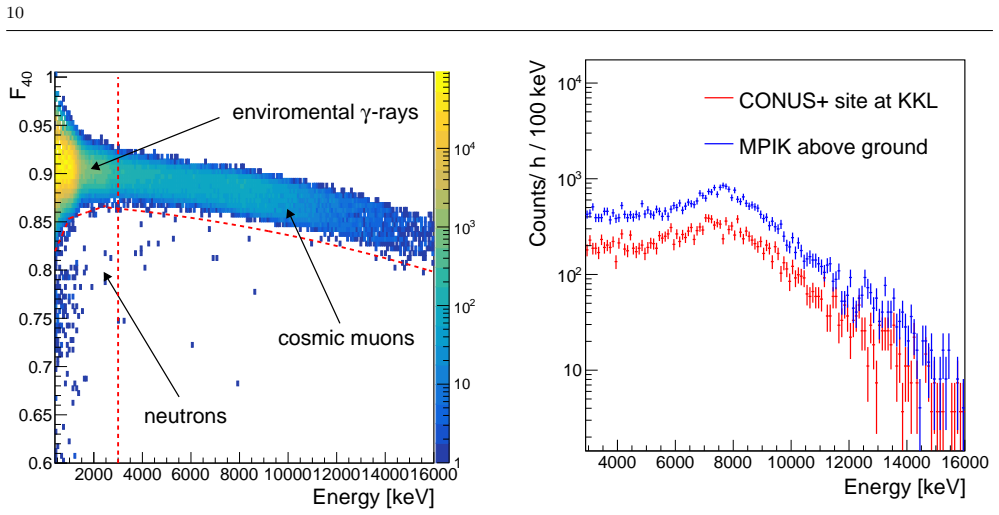
The argument relies on four measurement tools plus one simulation chain. A Bonner sphere spectrometer with 3He-filled proportional counters and polyethylene spheres of different diameters determines the neutron energy spectrum from thermal to hundreds of MeV, with a copper-shell sphere sensitive to cascade neutrons around 100 MeV. A coaxial high-purity germanium detector measures gamma rays up to 11 MeV and identifies neutron-capture lines in the room's concrete and steel, providing a cross-check of the neutron field. A small liquid-scintillator detector measures the muon flux and yields the 7.4 m w.e. overburden. The reactor-off spectrum is produced with a Geant4-based simulation, generating surface cosmogenic neutrons with the spectrum of references [47] and [48] and muons with the spectrum of [23], normalized to the measured muon flux; this simulated spectrum is what makes cascade neutrons the dominant background.
What would settle it
Measure the >20 MeV neutron flux in the room during a reactor-off period with a detector sensitive in that range, or use the shielded CONUS+ detectors to count nuclear-recoil-like events below a few keV and compare the rate with the simulated cascade component; a measured >20 MeV flux that differs significantly from $0.9\pm0.2$ cm$^{-2}$ d$^{-1}$, or a recoil spectrum without the predicted ~100 MeV neutron contribution, would falsify the claim that cascade neutrons dominate the background.
Extended reading notes
Core claim
The central claim is that the CONUS+ location is viable for CEνNS despite a 30-fold higher reactor neutron flux and a muon flux twice that at the previous site, because the reactor-correlated gamma-ray background above 2.7 MeV is suppressed by a factor of 26 and the reactor neutrons contribute negligibly to the low-energy region of interest. The paper reports a maximum thermalized neutron fluence of $(2.3\pm0.1)\times10^4$ neutrons d$^{-1}$ cm$^{-2}$ during reactor operation, a muon flux of $(107\pm3)$ s$^{-1}$ m$^{-2}$ corresponding to 7.4 m w.e., and a simulated reactor-off spectrum in which cascade neutrons above 20 MeV make up over 50% of the rate in the $[0.4,\,1.0]$ keV$_{ee}$ region after selection cuts. It further claims that the reactor-off neutron field cannot be inferred from the previous site: the new room's concrete produces 28Si and 40Ca capture lines, steel lines from 56Fe dominate, and surface contamination carries a different nuclide vector (60Co, 54Mn, 156Eu). The background campaign therefore had to be redone locally, and the CONUS+ shield was modified by removing one lead layer and adding a second muon veto layer.
Load-bearing premise
The load-bearing premise is that the simulated reactor-off neutron spectrum, built from a surface cosmic-neutron spectrum and the measured muon flux, correctly represents the actual neutron field in the room; the paper's own reactor-off measurement was inconclusive and no direct measurement validates the simulation.
Editorial extensions
If this is right
- Reactor-correlated neutrons, despite being 30 times more abundant, contribute less than one order of magnitude of the expected CEνNS signal in the $[0.15,\,1.0]$ keV$_{ee}$ window, so the reactor does not by itself prevent the measurement.
- The 26-fold lower high-energy gamma background justifies a thinner lead shield; removing one lead layer freed space for a second muon veto, which is needed because the muon-induced neutron rate in lead is 2.3 times higher than at the previous site.
- Muon-induced neutrons produced in the reactor building contribute only about 4% of the background in the $[0.4,\,1.0]$ keV$_{ee}$ region, so the main simulated background is the cosmogenic cascade component, not the muon-induced component.
- Background compositions cannot be transferred between reactor sites or even between positions within one room; each future reactor neutrino experiment needs its own on-site characterization campaign.
- The shield and handling protocols developed here—cleaning floors and walls, wrapping components, glove exchange, and assembly under overpressure—keep surface contamination from being a limiting background, based on wipe tests before and after a 5-year operation.
Reading between the lines
- If the simulated reactor-off spectrum is accurate, the next limiting step for CONUS+ will be direct detection and mitigation of >20 MeV cascade neutrons, for instance with a hydrogenous moderator or an active neutron tagger, rather than further lead shielding.
- A direct measurement of the reactor-off neutron spectrum with a longer exposure or a detector specifically sensitive above 20 MeV would test the paper's central residual-background claim; the paper itself states the reactor-off measurement was inconclusive and that future direct measurements are planned.
- The ~100 MeV peak seen in the simulated cosmogenic component suggests that correlated muon-neutron tagging, looking at time and spatial correlations between muon veto hits and candidate nuclear recoils, could validate or reject the cascade-neutron background in the data themselves.
- The lesson that background conditions can vary by an order of magnitude within one room implies that site selection alone is not enough; a full local survey plus ongoing monitoring is required for any shallow-depth reactor neutrino experiment.
Editorial analysis
A structured set of objections, weighed in public.
Referee Report
Summary. The paper reports the background characterization campaign for the CONUS+ experiment at the Leibstadt nuclear power plant (KKL). It describes measurements of the gamma-ray field with the CONRAD HPGe detector, wipe-test surface contamination analyses, a liquid-scintillator muon flux measurement, and Bonner-sphere neutron spectrometry during reactor on and off periods. The main results are a reactor-correlated thermal neutron fluence of (2.3±0.1)×10^4 cm^-2 d^-1, a high-energy gamma-ray rate above 2.7 MeV that is 26 times lower than at the former CONUS site at KBR, a muon flux of (107±3) s^-1 m^-2 corresponding to an average overburden of 7.4 m w.e., and a simulated reactor-off cosmogenic neutron spectrum whose cascade component above 20 MeV is claimed to contribute more than 50% of the background in the [0.4, 1.0] keV_ee region of interest. The paper compares these conditions with the previous CONUS location and discusses shield modifications.
Significance. If the results hold, the paper provides a valuable quantitative comparison of two reactor sites for CEνNS searches and demonstrates that the reactor-correlated neutron background at KKL is not the dominant problem, while the shallow-overburden cosmogenic neutron component is. The strengths of the paper are its use of calibrated instruments with stated uncertainties, the direct comparison of gamma-ray spectra obtained with the same detector at both sites, and the internal consistency of the reported numbers (e.g., the reactor-on Bonner-sphere integrals in Table 4 renormalized by 86.4 GWh d^-1 reproduce the rates in Table 6). The central weakness is that the dominant residual background in the ROI is obtained from an unvalidated simulation rather than from the on-site reactor-off neutron data that were collected.
major comments (3)
- [Sec. 5.2, Table 5, Fig. 15] The claim that cascade neutrons above 20 MeV contribute more than 50% of the CONUS+ background rate in the [0.4, 1.0] keV_ee region rests entirely on a simulated reactor-off neutron spectrum. The paper itself states that the reactor-off Bonner-sphere measurement was 'not conclusive' for spectral unfolding, but five measured count rates were acquired over five days: bare, 3.5-inch, 8-inch, 12-inch, and 8-inch-with-Cu-shell spheres. In particular, the 8-inch Cu-shell sphere has a strongly enhanced response above about 50 MeV (Fig. 9) and is precisely the configuration that should constrain the simulated cascade flux of (0.9±0.2) cm^-2 d^-1 in Table 5. No comparison of the measured sphere count rates with the simulated spectrum is reported. Since the simulated cascade flux is the load-bearing input for the dominant background conclusion and for the projected sensitivity, this comparison should be added; without it, the central claim of Sec. 5.2 is unsupported.
- [Sec. 5.1, Fig. 14] For the reactor-on data, the unfolding model fixes the positions of the evaporation and cascade peaks 'as expected from Monte Carlo simulations (see Sec. 5.2)'. The 'tiny peak at 100 MeV' visible in Fig. 14 is therefore a consequence of this prior, not an independently observed feature. The analysis should quantify how the integrated fast+cascade fluence and the reactor-on conclusions depend on the assumed peak positions, or justify the prior with a direct comparison to data. This is not a fatal issue, but it should be made explicit because the same simulation framework is then used for the reactor-off background claim.
- [Sec. 5.2, Table 5] The simulated reactor-off total neutron flux of (28.2±5.3) cm^-2 d^-1 is compared with the KBR value in Table 6, but no uncertainty is assigned to the building-geometry model or to the muon-induced neutron yields in the simulation. The stated uncertainties in Table 5 appear to be statistical only. Since the cascade component is a small fraction of the total simulated flux yet produces more than half of the ROI background, the systematic uncertainty on this extrapolation should be estimated and reported. The text mentions that 'future direct measurements are planned', which is a welcome statement but does not replace the need for a validation step in the present manuscript.
minor comments (5)
- [Sec. 5.1] The sentence 'The bare counter was removed from the analysis due inconsistency with the other sphere configurations' provides no explanation; given that the bare counter is the most sensitive to thermal neutrons, a brief justification or a quantitative inconsistency estimate should be given.
- [Sec. 5.2] The phrase 'will be refereed as "cascade neutrons"' should read 'referred to as'.
- [Fig. 2 caption] The caption contains the typo 'diamter' for 'diameter'.
- [Sec. 5] In the sentence 'Prior to the neutron fluence detmination with the ERBSS system', 'detmination' should be 'determination'.
- [Sec. 5.2, Table 6] The phrase 'a no negligible component over 20 MeV' should be 'a non-negligible component over 20 MeV'.
Circularity Check
No significant circularity; the reactor-off background is a forward simulation with external inputs, not a circular derivation.
full rationale
The paper's central measurements—muon flux, gamma-ray rates, and Bonner-sphere count rates—are not defined in terms of the conclusions drawn from them. The muon flux is measured with a liquid scintillator detector and converted to overburden using an external reference [35]; the gamma-ray rates are measured with the CONRAD HPGe detector; the reactor-on neutron fluence is unfolded from Bonner-sphere data using published response functions. The reactor-off neutron spectrum, which feeds the claim that cascade neutrons contribute more than 50% of the ROI background, is explicitly a forward simulation: cosmogenic neutrons are generated from the measured surface spectrum of Refs. [47,48], muon-induced neutrons are normalized to the measured muon flux, and both are propagated through the building geometry with Geant4/MaGe. This is model-based extrapolation with external literature inputs, not a quantity defined in terms of the target result. The self-citation to [25] for MaGe validation is a prior, externally falsifiable CONUS background decomposition, not an unverified premise assumed here. The paper openly states that the reactor-off Bonner-sphere measurement was 'not conclusive' and that future direct measurements are planned, which is a validation gap rather than circular reasoning. The only mild concern is that the reactor-on unfolding fixes evaporation and cascade peak locations using the Sec. 5.2 simulations, but this is a stated modeling assumption, not a circular reuse of the paper's conclusions.
Assumptions & free parameters
free parameters (2)
- Wipe-test extraction efficiency =
10%
- Bonner sphere unfolding model peak positions =
Not given; fixed to Monte Carlo expectations
assumptions (4)
- domain assumption The parametrized spectral model used for Bonner sphere unfolding is appropriate for the reactor neutron field at KKL.
- domain assumption The Geant4/MaGe simulation of the reactor-off cosmogenic and muon-induced neutron background faithfully represents the KKL reactor building and the CONUS+ shield.
- domain assumption The ground-level cosmic-ray neutron spectral shape and normalization from Refs. [47,48] apply at the KKL location (366 m a.s.l., cutoff rigidity ~4 GeV).
- domain assumption The muon-induced neutron yield in the reactor building materials is correctly modeled by MaGe/Geant4 using the measured muon flux and a published muon spectrum [23].
Cite this review
Pith. "Pith review of Background characterization of the CONUS+ experimental location." pith.science (2026). https://pith.science/paper/K4CEFB2W
@misc{pith2026241213707,
  author       = {Pith},
  title        = {Pith review of: Background characterization of the CONUS+ experimental location},
  year         = {2026},
  howpublished = {\url{https://pith.science/paper/K4CEFB2W}},
  note         = {Machine review of arXiv:2412.13707}
}
abstract
CONUS+ is an experiment aiming at detecting coherent elastic neutrino-nucleus scattering (CE$\nu$NS) of reactor antineutrinos on germanium nuclei in the fully coherent regime, continuing the CONUS physics program conducted at the Brokdorf nuclear power plant (KBR), Germany. The CONUS+ experiment is installed in the Leibstadt nuclear power plant (KKL), Switzerland, at a distance of 20.7 m from the 3.6 GW reactor core, where the antineutrino flux is $1.5\cdot 10^{13}$~s$^{-1}$cm$^{-2}$. The CE$\nu$NS signature will be measured with four point-contact high-purity low energy threshold germanium (HPGe) detectors. A good understanding of the background is crucial, especially events correlated with the reactor thermal power are troublesome. A large background characterization campaign was conducted during reactor on and off times to find the best location for the CONUS+ setup. On-site measurements revealed a correlated, highly thermalized neutron field with a maximum fluence rate of $(2.3\pm0.1)\cdot 10^{4}$~neutrons~d$^{-1}$cm$^{-2}$ during reactor operation. The $\gamma$-ray background was studied with a HPGe detector without shield. The muon flux was examined using a liquid scintillator detector measuring (107$\pm$3)~muons~s$^{-1}$m$^{-2}$, which corresponds to an average overburden of 7.4~m of water equivalent. The new background conditions in CONUS+ are compared to the previous CONUS ones, showing a 30 times higher flux of neutrons, but a 26 times lower component of reactor thermal power correlated $\gamma$-rays over 2.7 MeV. The lower CONUS+ overburden increases the number of muon-induced neutrons by 2.3 times and the flux of cosmogenic neutrons. Finally, all the measured rates are discussed in the context of the CONUS+ background, together with the CONUS+ modifications performed to reduce the impact of the new background conditions at KKL.
Figures


Figures from the paper (9 more)




Forward citations
Cited by 3 Pith papers
-
Direct observation of coherent elastic antineutrino-nucleus scattering
CONUS+ reports the first 3.7 sigma observation of coherent elastic antineutrino-nucleus scattering at a nuclear reactor, with 395 measured events versus 347 predicted.
-
Testing lepton non-unitarity with the next generation of Germanium-based CE$\nu$NS reactor experiments
A future 100-kg Germanium reactor CEνNS experiment could constrain lepton non-unitarity to 1−α11² ≈ 0.005 and, under low-scale seesaw assumptions, probe new-physics scales up to ~2.5 TeV.
-
Exploring the Standard Model and Beyond from the Evidence of CE$\nu$NS with Reactor Antineutrinos in CONUS+
Fitting the CONUS+ reactor CEνNS event count yields sin²θW = 0.268 ± 0.047, µν < 5.6×10⁻¹⁰ µB, and NSI bounds similar to COHERENT, all consistent with the Standard Model.
Reference graph
Works this paper leans on
-
[1]
D. Z. Freedman. Coherent Neutrino Nucleus Scattering as a Probe of the Weak Neutral Current . Phys. Rev. D, 9:1389–1392, 1974. doi:10.1103/PhysRevD.9.1389
-
[2]
V. B. Kopeliovich and L. L. Frankfurt. Isotopic and chiral structure of neutral current . JETP Lett., 19:145–147, 1974
work page 1974
-
[3]
D. Akimov et al. Observation of Coherent Elastic Neutrino-Nucleus Scattering . Science, 357(6356):1123– 1126, 2017. doi:10.1126/science.aao0990. arXiv:1708. 01294
-
[4]
D. Akimov et al. First Measurement of Coherent Elas- tic Neutrino-Nucleus Scattering on Argon . Phys. Rev. Lett., 126(1):012002, 2021. doi:10.1103/PhysRevLett. 126.012002. arXiv:2003.10630
arXiv 2021
-
[5]
S. Adamski et al. First detection of coherent elastic neutrino-nucleus scattering on germanium . 2024. arXiv: 2406.13806
arXiv 2024
-
[6]
E. Aprile et al. First Indication of Solar B8 Neutrinos via Coherent Elastic Neutrino-Nucleus Scattering with XENONnT. Phys. Rev. Lett., 133(19):191002, 2024. doi: 10.1103/PhysRevLett.133.191002. arXiv:2408.02877
arXiv 2024
- [7]
-
[8]
A. Aguilar-Arevalo. Upgraded CONNIE experiment with Skipper CCDs / CONNIE First results with Skipper- CCDs. PoS, T AUP2023:154, 2024. doi:10.22323/1.441. 0154
Show all 59 references
-
[9]
Ackermann et al
N. Ackermann et al. Final CONUS results on coher- ent elastic neutrino nucleus scattering at the Brokdorf reactor. Phys. Rev. Lett., 133:251802, 2024. doi: 10.1103/PhysRevLett.133.251802
2024 doi
-
[10]
Agnolet et al
G. Agnolet et al. Background Studies for the MINER Coherent Neutrino Scattering Reactor Experiment. Nucl. Instrum. Meth. A, 853:53–60, 2017. doi:10.1016/j.nima. 2017.02.024. arXiv:1609.02066
2017 arXiv
-
[11]
Colaresi, J
J. Colaresi, J. I. Collar, T. W. Hossbach, C. M. Lewis and K. M. Yocum. Measurement of Coherent Elas- tic Neutrino-Nucleus Scattering from Reactor Antineu- trinos. Phys. Rev. Lett., 129(21):211802, 2022. doi: 10.1103/PhysRevLett.129.211802. arXiv:2202.09672
2022 arXiv
-
[12]
J. J. Choi et al. Exploring coherent elastic neutrino- nucleus scattering using reactor electron antineutrinos in the NEON experiment. Eur. Phys. J. C, 83(3):226, 2023. doi:10.1140/epjc/s10052-023-11352-x. arXiv:2204.06318
2023 arXiv
-
[13]
Goupy et al
C. Goupy et al. Exploring coherent elastic neutrino- nucleus scattering of reactor neutrinos with the NU- CLEUS experiment . SciPost Phys. Proc., 12:053,
-
[14]
Alekseev et al
I. Alekseev et al. First results of the νGeN experiment on coherent elastic neutrino-nucleus scattering . Phys. Rev. D, 106(5):L051101, 2022. doi:10.1103/PhysRevD. 106.L051101. arXiv:2205.04305
2022 arXiv
-
[15]
D. Y. Akimov et al. First constraints on the coherent elastic scattering of reactor antineutrinos off xenon nu- clei. 2024. arXiv:2411.18641
2024 arXiv
-
[16]
L. Yang, Y. Liang and Q. Yue. RECODE program for reactor neutrino CEvNS detection with PPC Germanium detector. PoS, T AUP2023:296, 2024. doi:10.22323/1. 441.0296
2024 doi
-
[17]
Cai et al
C. Cai et al. Reactor neutrino liquid xenon coherent elas- tic scattering experiment . Phys. Rev. D, 110(7):072011,
-
[18]
Augier et al
C. Augier et al. First demonstration of 30 eVee ioniza- tion energy resolution with Ricochet germanium cryo- genic bolometers. Eur. Phys. J. C, 84(2):186, 2024. doi: 10.1140/epjc/s10052-024-12433-1. arXiv:2306.00166
2024 arXiv
-
[19]
Karmakar et al
S. Karmakar et al. New Limits on Coherent Neu- trino Nucleus Elastic Scattering Cross Section at the Kuo-Sheng Reactor Neutrino Laboratory . 2024. arXiv: 2411.18812
2024
-
[20]
Ackermann et al
N. Ackermann et al. CONUS+ Experiment . Eur. Phys. J. C, 84(12):1265, 2024. doi:10.1140/epjc/ s10052-024-13551-6. arXiv:2407.11912
2024 arXiv
-
[21]
Thomas and A
D. Thomas and A. Alevra. Bonner sphere spectrome- ters—a critical review . Nucl. Instrum. Methods Phys. Res., 476(1):12–20, 2002. ISSN 0168-9002. doi:https:// doi.org/10.1016/S0168-9002(01)01379-1, int. Workshop on Neutron Field Spectrometry in Science, Technolog y and Radiati...
2002 doi
-
[22]
Hakenm¨ uller et al.Neutron-induced background in the CONUS experiment
J. Hakenm¨ uller et al.Neutron-induced background in the CONUS experiment . Eur. Phys. J. C, 79(8):699, 2019. doi:10.1140/epjc/s10052-019-7160-2. arXiv:1903.09269
2019 arXiv
-
[23]
L. N. Bogdanova, M. G. Gavrilov, V. N. Kornoukhov and A. S. Starostin. Cosmic muon flux at shallow depths un- derground. Phys. Atom. Nucl., 69:1293–1298, 2006. doi: 10.1134/S1063778806080047. arXiv:nucl-ex/0601019
2006 arXiv
-
[24]
P. A. Zyla et al. Review of Particle Physics . PTEP, 2020(8):083C01, 2020. doi:10.1093/ptep/ptaa104
2020 doi
-
[25]
Bonet et al
H. Bonet et al. Full background decomposition of the CONUS experiment . Eur. Phys. J. C, 83(3):195, 2023. doi:10.1140/epjc/s10052-023-11240-4. arXiv:2112.09585
2023 arXiv
-
[26]
Bonet et al
H. Bonet et al. Large-size sub-keV sensitive germanium detectors for the CONUS experiment . Eur. Phys. J. C, 81(3):267, 2021. doi:10.1140/epjc/s10052-021-09038-3. arXiv:2010.11241
2021
-
[27]
Hakenm¨ uller and G
J. Hakenm¨ uller and G. Heusser. CONRAD—A low level germanium test detector for the CONUS exper- iment. Appl. Radiat. Isot., 194:110669, 2023. doi: 10.1016/j.apradiso.2023.110669
2023
-
[28]
Bediako and E
M. Bediako and E. Amankwah. Analysis of Chemical Composition of Portland Cement in Ghana: A Key to Understand the Behavior of Cement . Advances in Ma- terials Science and Engineering, V olume 2015:5 pages,
2015
-
[29]
Non-serial Publications
Database of Prompt Gamma Rays from Slow Neutron Capture for Elemental Analysis. Non-serial Publications. IAEA, Vienna, 2007. ISBN 92-0-101306-X
2007
-
[30]
Budj´ aˇ s, M
D. Budj´ aˇ s, M. Heisel, W. Maneschg and H. Simgen.Op- timisation of the MC-model of a p-type Ge-spectrometer for the purpose of efficiency determination . Appl. Ra- diat. Isot., 67(5):706–710, 2009. ISSN 0969-8043. doi: https://doi.org/10.1016/j.apradiso.2009.01.015
2009 doi
-
[31]
Radiological characterization of shut down nu- clear reactors for decommissioning purposes
IAEA. Radiological characterization of shut down nu- clear reactors for decommissioning purposes. 1998. ISSN 0074-1914, ISBN 92-0-103198-X
1998
-
[32]
J. E. Delmore, D. C. Snyder, T. Tranter and N. R. Mann. Cesium isotope ratios as indicators of nuclear 19 power plant operations . Journal of Environmental Ra- dioactivity, 102(11):1008–1011, 2011. ISSN 0265-931X. doi:https://doi.org/10.1016/j.jenvrad.2011.06.013
2011 doi
-
[33]
Bonhomme, C
A. Bonhomme, C. Buck, B. Gramlich and M. Raab. Safe liquid scintillators for large scale detectors . JINST, 17(11):P11025, 2022. doi:10.1088/1748-0221/17/11/ P11025. arXiv:2205.15046
2022 arXiv
-
[34]
X. Hua-Lin. Oxygen quenching in LAB based liquid scin- tillator and nitrogen bubbling . Chin. Phys. C, 34:571– 575, 2010. doi:10.1088/1674-1137/34/5/011. arXiv: 0904.1329
2010 arXiv
-
[35]
G. Heusser. Cosmic ray-induced background in Ge- spectrometry. Nucl. Instrum. Methods Phys. Res., 83(1):223–228, 1993. ISSN 0168-583X. doi:https://doi. org/10.1016/0168-583X(93)95931-T
1993 doi
-
[36]
Wiegel and A
B. Wiegel and A. Alevra. NEMUS—the PTB Neutron Multisphere Spectrometer: Bonner spheres and more . Nuclear Instruments and Methods in Physics Research Section A: Accelerators, Spectrometers, Detectors and Associated Equipment, 476(1):36–41, 2002. doi:https: //doi.org/10.1016/S...
2002 doi
-
[37]
R. Galeev. Characterization of neutron stray fields for residual activation estimation around high-energy accel- erators using spectrometric and Monte Carlo methods. Thesis, University of Basel, Faculty of Science, 2021
2021
-
[38]
R¨ ottger et al
S. R¨ ottger et al. The PTB neutron reference fields (PIAF)—quasi-monoenergetic neutron reference fields in the energy range from thermal to 200 MeV . AIP Conf. Proc., 1175:375–381, 2009. doi:https://doi.org/10.1063/ 1.3258255
2009
-
[39]
Wiegel, A
B. Wiegel, A. Alevra, M. Matzke, U. Schrewe and J. Wittstock. Spectrometry using the PTB neutron mul- tisphere spectrometer (NEMUS) at flight altitudes and at ground level . Nucl. Instrum. Methods Phys. Res., 476(1):52–57, 2002. ISSN 0168-9002. doi:https://doi. org/10.1016/S01...
2002 doi
-
[40]
Reginatto
M. Reginatto. Overview of spectral unfolding techniques and uncertainty estimation . Radiation Measurements, 45(10):1323–1329, 2010. ISSN 1350-4487. doi:https:// doi.org/10.1016/j.radmeas.2010.06.016
2010 doi
-
[41]
Reginatto, E
M. Reginatto, E. , Hohmann and B. Wiegel. How Accurately Can We Determine Spectra in High-Energy Neutron Fields with Bonner Spheres? Nucl. Tech., 168:328–332, 2009
2009
-
[42]
Reginatto
M. Reginatto. Bayesian approach for quantifying the uncertainty of neutron doses derived from spectromet- ric measurements. Radiat. Prot. Dosimetry, 168:64–69,
-
[43]
M. Plummer. JAGS: A Program for Analysis of Bayesian Graphical Models Using Gibbs Sampling . Pro- ceedings of the 3rd International Workshop on Dis- tributed Statistical Computing, 2003
2003
-
[44]
Compendium of Neutron Spectra and Detector Responses for Radiation Protection Purposes
International Atomic Energy Agency. Compendium of Neutron Spectra and Detector Responses for Radiation Protection Purposes. Supplement to Technical Reports Series No. 318, Vienna, 2001
2001
-
[45]
Goupy, S
C. Goupy, S. Marnieros, B. Mauri, C. Nones and M. Vivier. Prototyping a High Purity Germanium cryo- genic veto system for a bolometric detection experi- ment. Nucl. Instrum. Meth. A, 1064:169383, 2024. doi: 10.1016/j.nima.2024.169383. arXiv:2401.09837
2024
-
[46]
Augier et al
C. Augier et al. Fast neutron background characterization of the future Ricochet experiment at the ILL research nuclear reactor. Eur. Phys. J. C, 83(1):20, 2023. doi: 10.1140/epjc/s10052-022-11150-x. arXiv:2208.01760
2023 arXiv
-
[47]
Goldhagen, J
P. Goldhagen, J. M. Clem and J. W. Wilson. The en- ergy spectrum of cosmic-ray induced neutrons measured on an airplane over a wide range of altitude and lati- tude. Radiation Protection Dosimetry, 110(1-4):387–392,
-
[48]
Gordon et al
M. Gordon et al. Measurement of the flux and energy spectrum of cosmic-ray induced neutrons on the ground . IEEE Transactions on Nuclear Science, 51(6):3427–3434,
-
[49]
Boswell et al
M. Boswell et al. MaGe-a Geant4-based Monte Carlo Application Framework for Low-background Germanium Experiments. IEEE Trans. Nucl. Sci., 58:1212–1220,
-
[50]
Agostinelli et al
S. Agostinelli et al. GEANT4–a simulation toolkit. Nucl. Instrum. Meth. A, 506:250–303, 2003. doi:10.1016/ S0168-9002(03)01368-8
2003
-
[51]
Allison et al
J. Allison et al. Geant4 developments and applications . IEEE Trans. Nucl. Sci., 53:270, 2006. doi:10.1109/TNS. 2006.869826
2006
-
[52]
R. L. Bramblett, R. I. Ewing and T. Bonner. A new type of neutron spectrometer . Nuclear Instruments and Methods, 9(1):1–12, 1960. ISSN 0029-554X. doi:https: //doi.org/10.1016/0029-554X(60)90043-4
1960 doi
-
[54]
doi:10.1109/TNS.2004.839134
2004
- [2004]
-
[2006]
doi:https://10.1093/rpd/ncl096
-
[2011]
arXiv:1011.3827
doi:10.1109/TNS.2011.2144619. arXiv:1011.3827
2011
-
[2015]
doi:10.1155/2015/349401
2015 doi
- [2023]
- [2024]
Reviewed August 11, 2026 · model on record in the stance chip above.
Discussion (0). Continue with ORCID to comment.