REVIEW 3 major objections 5 minor 62 references
Performance envelope of laser wakefield accelerators
T0 review · 3 major / 5 minor · reviewed 2026-08-11 · deepseek-v4-flash
Pith's one-line read Across more than 50 published experiments, total electron beam energy in laser wakefield accelerators grows almost linearly with laser energy, making conversion efficiency nearly constant.
desk verdict Useful empirical scalings for LWFA design, but the 100 GeV projection over-extrapolates and misstates the required density. read the letter →
The pith
A machine-rendered reading of the paper's core claim, the machinery that carries it, and where it could break.
The reading
What carries the argument
The workhorse is a least-squares power-law fit $y = C x^\beta$ applied to log-transformed experimental data, weighted by the number of shots reported in each experiment. The central outcome metric is the total beam energy $E_b = \int E (dQ/dE)\,dE$, approximated as $E_b \simeq E_e Q_b$ for a narrow peak, using the reported centroid energy and charge extracted from each paper. A 95% upper prediction interval on the same fits defines the 'performance envelope.' The dataset spans pulse durations from 8 to 160 fs, laser energies from 26 mJ to 130 J, and densities typically above $10^{17}$ cm$^{-3}$, all at 800 nm or 1 $\mu$m wavelength.
What would settle it
Measure the total beam energy of a single-stage laser wakefield accelerator driven by a ~1 kJ, ~100 fs laser at a density near $10^{17}$ cm$^{-3}$; if the result lies well below the $E_b \simeq 1.7$ J predicted by Eq. (10), or if the conversion efficiency drops by more than a factor of two from the 0.3% seen at few-joule lasers, the near-linear scaling and its 100 GeV extrapolation would be falsified.
Extended reading notes
Core claim
The authors' core discovery is an empirical scaling law for the usable beam energy of a laser wakefield accelerator: $E_b[\mathrm{mJ}] = (3.3 \pm 0.2)(E_\ell[\mathrm{J}])^{0.9 \pm 0.05}$ for average performance, with a 95% upper prediction interval $E_b[\mathrm{mJ}] \simeq (30^{+12}_{-9})(E_\ell[\mathrm{J}])^{1.09 \pm 0.14}$. The near-unity exponent means the efficiency $E_b/E_\ell$ is almost independent of laser energy: $E_b/E_\ell \simeq 0.003\,(E_\ell[\mathrm{J}])^{-0.1}$. The paper argues this supports investment in higher-energy driver lasers, because the plasma can be adapted to the laser without a loss in conversion efficiency. It also finds that electron energy scales as $E_e \propto E_\ell^{0.65}$, closer to a 2/3 power, and that laser pulse energy predicts electron energy more accurately than laser peak power. These scalings are presented as useful engineering guidelines, not as a replacement for models.
Load-bearing premise
The fits are derived from experiments with laser energies up to about 130 J and densities mostly above $10^{17}$ cm$^{-3}$, and the projection to a 100 GeV stage assumes these power laws continue unchanged at 18 kJ, 87 PW, and densities below $10^{17}$ cm$^{-3}$.
Editorial extensions
If this is right
- A 100 GeV LWFA stage is projected to require an 87 PW, 18 kJ laser for average performance, or roughly a 30 PW laser if operating near the upper prediction interval, with electron density below $10^{17}$ cm$^{-3}$.
- A 1 TeV stage would call for an exawatt-scale laser with about 600 kJ of pulse energy.
- Conversion efficiency stays near 0.3% (average) as laser energy grows, so higher-energy drivers do not incur diminishing returns.
- Observed scalings do not reproduce the 'matched' bubble-regime model; laser pulse energy is a better predictor of electron energy than peak power.
- The upper prediction interval suggests well-designed systems can reach about 3% conversion efficiency into the usable beam component.
Reading between the lines
- If the near-linear scaling survives to higher energies, the cost per joule of beam energy will be set mainly by laser construction and repetition-rate costs, making high-average-power laser development the key economic lever.
- The dataset cannot test wavelength scaling because all points are at 800 nm or 1 $\mu$m; a proposed shift to other driver wavelengths remains unvalidated by this dataset.
- The extrapolation to 18 kJ and $n_e<10^{17}$ cm$^{-3}$ is a two-order-of-magnitude leap from the fitted range; a single intermediate test at a few kilojoules would substantially stiffen the claim.
- Because beam energy is defined from the quasi-monoenergetic peak, the scaling likely undercounts total accelerated charge and would change if injection schemes that funnel more charge into the usable peak are developed.
Signed reviews
Editorial analysis
A structured set of objections, weighed in public.
Referee Report
Summary. This manuscript compiles data from more than 50 published laser wakefield accelerator (LWFA) experiments, using an AI-based extraction tool, and fits power-law scalings of electron energy and total beam energy against plasma density, laser power, and laser energy. The principal in-sample result is Eq. (10): the total beam energy scales as E_b [mJ] = (3.3±0.2)(E_l [J])^{0.9±0.05}, implying a conversion efficiency that depends only weakly on laser energy. The paper also derives scalings E_e ∝ n_e^{-0.86}, E_e ∝ P^{0.81}, and E_e ∝ E_l^{0.65}, compares them with literature models, and uses them to project that a 100 GeV LWFA stage would require an 87 PW, 18 kJ laser (or ~30 PW when using the 95% upper prediction interval) at an electron density below 10^17 cm^-3.
Significance. The near-linear scaling of total beam energy with laser energy is a potentially valuable empirical result for prioritizing laser development, and the paper's systematic compilation of heterogeneous experimental data, with explicit uncertainties on the fitted exponents, is a strength. The analysis is transparent about the difficulty of charge definitions and the use of AI extraction, and it validates the extraction on a human-analyzed subset. The 100 GeV projection, however, currently goes beyond what the data can support, because it relies on the simultaneous extrapolation of two univariate fits into a regime (E_l ~ 18 kJ, n_e ~ 4×10^15 cm^-3) far outside the fitted range. The in-sample scaling is the most defensible contribution; the projection needs substantial revision or a strong out-of-sample test.
major comments (3)
- [VI, abstract] The 100 GeV projection combines Eq. (9) (E_e ∝ E_l^{0.65}) with Eq. (7) (E_e ∝ n_e^{-0.86}) to infer E_l ≈ 18 kJ and n_e ≈ 4×10^15 cm^-3. This operating point lies roughly 140× above the maximum fitted laser energy (130 J) and roughly 25× below the typical lower end of the fitted densities, which are mostly ≥10^17 cm^-3. The two power laws are univariate fits and are never validated as a joint model, so nothing in the dataset tests their simultaneous applicability. The abstract's statement that the stage operates 'at electron density <10^17/cm^3' is technically true but misleading, since the required density is about 4×10^15 cm^-3, an order of magnitude below the support of the data. This unvalidated joint extrapolation is the load-bearing step for the abstract's headline projection.
- [V.A, V.C, VI] No multivariate regression is reported. The projection in Section VI assumes that the exponents in Eqs. (7) and (9) combine multiplicatively, but it is not shown that E_l and n_e are independent in the dataset. If higher-energy laser experiments tend to run at lower plasma densities (as the need for self-guiding at lower density and the Texas Petawatt points suggest), the univariate slopes would confound the two dependencies, and the resulting 100 GeV estimate would be biased. The authors should present a joint fit E_e(E_l, n_e) or at least a correlation analysis of the inputs to justify the multiplicative combination.
- [II, V.E] The analysis acknowledges that beam charge is reported inconsistently (charge 'in the peak' versus total charge) and states that this 'likely introduces noise into our analysis.' However, if the reporting convention correlates with laser energy, the near-linear exponent in Eq. (10) would be biased, not merely noisy. Because Eq. (10) is the paper's central result, the authors should demonstrate the robustness of the fitted exponent to the subset of experiments with a clearly defined charge, or otherwise quantify the possible bias. Without this check, the strong conclusion that 'investment in high-power laser technology ... directly transfers to accelerator performance without diminishing returns' (Section V.E) is not fully supported.
minor comments (5)
- [Fig. 2 caption] The caption says the blue line is 'given in Eq. (7),' but the left panel (electron energy vs. laser peak power) corresponds to Eq. (8) and the right panel (electron energy vs. laser pulse energy) corresponds to Eq. (9).
- [IV, V] The paper does not report the number of data points used in each fit; provide N for Eqs. (7)-(12), as the number of points is likely substantially smaller than the 50-plus papers because charge was reported in only 72% of cases (Table I).
- [V.E] The prefactor in Eq. (7) is described as having 'order of magnitude uncertainty,' but the 100 GeV projection in Section VI quotes 87 PW and 18 kJ without propagating this uncertainty; the projection should be given with a range reflecting the prefactor and exponent uncertainties.
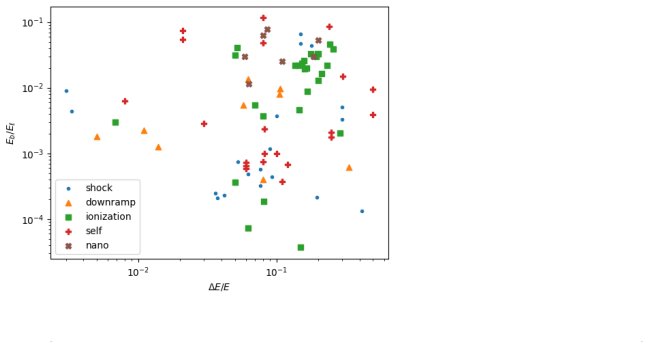
- [Abstract] The abstract contains typographic artifacts such as 'L WF As' (with spaces), which should be cleaned.
- [References] The paper cites Ref. [5] (Tau Systems website) as a general reference for laser technology; if this is intended as a commercial endorsement or as evidence of capability, consider replacing it with a neutral technical reference, or clarify the role of the citation.
Circularity Check
No significant circularity: fitted scalings are empirical inputs and the 100 GeV benchmark is a forward extrapolation, not a fitted target.
full rationale
The central load-bearing result, Eq. (10), is a least-squares power-law fit to more than 50 external published experiments (Refs. [3,4,11-56]); Eqs. (7)-(9) are likewise fits to external data. The 100 GeV benchmark in Section VI is obtained by inserting E_e = 100 GeV into Eq. (8), which gives P approximately 87 PW, and then taking a 210 fs pulse to get E_l approximately 18 kJ; this is a predictive extrapolation, not a quantity used to determine any fit parameter, so it does not reduce to an input by construction. Eq. (11) is the algebraic rearrangement E_b/E_l of Eq. (10), not a separately fitted prediction. The only self-citations are Ref. [4] (one published experimental data point at 10 GeV, 100 J) and Ref. [5] (company URL). Ref. [4] is peer-reviewed, externally falsifiable data, and the paper explicitly says this point "aligns with the trends ... set by experiments on lower-energy lasers," so the self-citation is not load-bearing. No uniqueness theorem or ansatz is imported from the authors' prior work. The paper also discloses its own data limitations, e.g., "only laser wavelengths of 800 nm and 1 µm, meaning we could not check proposed wavelength scalings," and notes the empty top-left region of Fig. 5 for simultaneously narrow-spread and efficient beams; these are validity limitations, not circular steps. The extrapolation to 100 GeV lies far outside the fitted joint range (a correctness and extrapolation risk), but extrapolation risk is not circularity.
Assumptions & free parameters
free parameters (10)
- Power-law exponent for E_e vs n_e =
-0.86 ± 0.09
- Prefactor for E_e vs n_e =
0.83 (order of magnitude uncertainty not written out)
- Power-law exponent for E_e vs P =
0.81 ± 0.06
- Prefactor for E_e vs P =
10 MeV/TW^0.81, ~30% uncertainty
- Power-law exponent for E_e vs E_l =
0.65 ± 0.04
- Prefactor for E_e vs E_l =
170 MeV/J^0.65
- Power-law exponent for E_b vs E_l =
0.9 ± 0.05
- Prefactor for E_b vs E_l =
3.3 ± 0.2 mJ/J^0.9
- Efficiency exponent for E_b/E_l vs E_l =
-0.1
- 95% upper prediction interval exponent and prefactor =
1.09 ± 0.14 and 30 (+12/-9) mJ
assumptions (5)
- domain assumption Published experiments are representative of LWFA performance.
- domain assumption The reported centroid energy and beam charge are commensurable across experiments.
- domain assumption A power-law functional form y = C x^beta is adequate for the scalings.
- domain assumption The beam energy is approximated as E_b = E_e Q_b, neglecting the width correction in Eq. (2).
- ad hoc to paper The power-law fits extrapolate beyond the fitted range.
Cite this review
Pith. "Pith review of Performance envelope of laser wakefield accelerators." pith.science (2026). https://pith.science/paper/JEGKPFQZ
@misc{pith2026241214311,
  author       = {Pith},
  title        = {Pith review of: Performance envelope of laser wakefield accelerators},
  year         = {2026},
  howpublished = {\url{https://pith.science/paper/JEGKPFQZ}},
  note         = {Machine review of arXiv:2412.14311}
}
abstract
Laser wakefield accelerator experiments have made enormous progress over the past $\sim 20$ years, but their promise to revolutionize high-energy particle sources is only beginning to be realized. To make the next step toward engineering LWFAs for different accelerator outcomes, we need more reliable and quantitative models to predict performance. Using the data from $>50$ published experiments, we estimate scalings and the performance envelope. We compare the observed scalings with several models in the literature. We find that the total beam energy (centroid energy times beam charge) scales almost linearly with laser energy, supporting the value of investment in progressively higher energy driver lasers. The dataset includes pulse durations from 8 to 160 fs, but only laser wavelengths of 800 nm and 1 \si{\micro\meter}, meaning we could not check proposed wavelength scalings for alternative laser technologies. As a benchmark next-generation case, the observed scalings suggest that achieving a 100-GeV LWFA stage will require a $\gtrsim 30$ PW laser operating at electron density $<10^{17}/$cm$^3$.
Figures


Figures from the paper (2 more)

Reference graph
Works this paper leans on
-
[41]
A. R. Maier, N. M. Delbos, T. Eichner, L. H¨ ubner, S. Jalas, L. Jeppe, S. W. Jolly, M. Kirchen, V. Leroux, P. Messner, M. Schnepp, M. Trunk, P. A. Walker, C. Werle, and P. Winkler, Physical Review X10, 10.1103/PhysRevX.10.031039 (2020)
-
[1]
S. Asai, A. Ballarino, T. Bose, K. Cranmer, F.-Y. Cyr-Racine, S. Demers, C. Geddes, Y. Gershtein, K. Heeger, B. Heinemann,et al.,Exploring the Quantum Universe: Pathways to Innovation and Discovery in Particle Physics(2024)
work page 2024
- [2]
-
[4]
C. Aniculaesei, T. Ha, S. Yoffe, L. Labun, S. Milton, E. McCary, M. M. Spinks, H. J. Quevedo, O. Z. Labun, R. Sain,et al., Matter and Radiation at Extremes9, 014001 (2024)
work page 2024
-
[5]
Tau Systems Inc., Www.tausystems.com
-
[6]
K. L. Brown and R. V. Servranckx,First- and second-order charged particle optics(1984)
work page 1984
- [7]
-
[8]
W. Lu, M. Tzoufras, C. Joshi, F. Tsung, W. Mori, J. Vieira, R. Fonseca, and L. Silva, Physical Review Special Topics-Accelerators and Beams10, 061301 (2007)
work page 2007
Show all 62 references
-
[9]
Brunetti, R
E. Brunetti, R. N. Campbell, J. Lovell, and D. A. Jaroszynski, Scientific Reports12, 10.1038/s41598-022-10160-9 (2022)
2022 doi
-
[10]
Elicit: The AI Research Assistant, (2024), https://elicit.com, Accessed: 2024-03-24
2024
-
[11]
S. P. Mangles, C. Murphy, Z. Najmudin, A. G. R. Thomas, J. Collier, A. E. Dangor, E. Divall, P. Foster, J. Gallacher, C. Hooker,et al., Nature431, 535 (2004)
2004
-
[12]
Geddes, C
C. Geddes, C. Toth, J. Van Tilborg, E. Esarey, C. Schroeder, D. Bruhwiler, C. Nieter, J. Cary, and W. Leemans, Nature431, 538 (2004)
2004
-
[13]
Faure, Y
J. Faure, Y. Glinec, A. Pukhov, S. Kiselev, S. Gordienko, E. Lefebvre, J.-P. Rousseau, F. Burgy, and V. Malka, Nature431, 541 (2004)
2004
-
[14]
W. P. Leemans, B. Nagler, A. J. Gonsalves, C. T´ oth, K. Nakamura, C. G. Geddes, E. Esarey, 18 C. B. Schroeder, and S. M. Hooker, Nature Physics2, 696 (2006)
2006
-
[16]
Brunetti, R
E. Brunetti, R. P. Shanks, G. G. Manahan, M. R. Islam, B. Ersfeld, M. P. Anania, S. Cipic- cia, R. C. Issac, G. Raj, G. Vieux, G. H. Welsh, S. M. Wiggins, and D. A. Jaroszynski, Physical Review Letters105, 10.1103/PhysRevLett.105.215007 (2010)
2010 doi
-
[17]
Schmid, A
K. Schmid, A. Buck, C. M. Sears, J. M. Mikhailova, R. Tautz, D. Herrmann, M. Geissler, F. Krausz, and L. Veisz, Physical Review Special Topics - Accelerators and Beams13, 10.1103/PhysRevSTAB.13.091301 (2010)
2010 doi
-
[18]
Cipiccia, M
S. Cipiccia, M. R. Islam, B. Ersfeld, R. P. Shanks, E. Brunetti, G. Vieux, X. Yang, R. C. Issac, S. M. Wiggins, G. H. Welsh, M. P. Anania, D. Maneuski, R. Montgomery, G. Smith, M. Hoek, D. J. Hamilton, N. R. Lemos, D. Symes, P. P. Rajeev, V. O. Shea, J. M. Dias, and D. A. Jaro...
2011
-
[19]
Weingartner, S
R. Weingartner, S. Raith, A. Popp, S. Chou, J. Wenz, K. Khrennikov, M. Heigoldt, A. R. Maier, N. Kajumba, M. Fuchs, B. Zeitler, F. Krausz, S. Karsch, and F. Gr¨ uner, Physical Review Special Topics - Accelerators and Beams15, 10.1103/PhysRevSTAB.15.111302 (2012)
2012 doi
-
[20]
Albert, B
F. Albert, B. B. Pollock, J. L. Shaw, K. A. Marsh, J. E. Ralph, Y. H. Chen, D. Alessi, A. Pak, C. E. Clayton, S. H. Glenzer, and C. Joshi, Physical Review Letters111, 10.1103/PhysRevLett.111.235004 (2013)
2013 doi
-
[21]
A. Buck, J. Wenz, J. Xu, K. Khrennikov, K. Schmid, M. Heigoldt, J. M. Mikhailova, M. Geissler, B. Shen, F. Krausz, S. Karsch, and L. Veisz, Physical Review Letters110, 10.1103/PhysRevLett.110.185006 (2013)
2013 doi
-
[22]
H. T. Kim, K. H. Pae, H. J. Cha, I. J. Kim, T. J. Yu, J. H. Sung, S. K. Lee, T. M. Jeong, and J. Lee, Physical Review Letters111, 10.1103/PhysRevLett.111.165002 (2013)
2013 doi
-
[23]
X. Wang, R. Zgadzaj, N. Fazel, Z. Li, S. Yi, X. Zhang, W. Henderson, Y.-Y. Chang, R. Korzekwa, H.-E. Tsai,et al., Nature communications4, 1988 (2013). 19
2013
-
[26]
Mirzaie, S
M. Mirzaie, S. Li, M. Zeng, N. A. Hafz, M. Chen, G. Y. Li, Q. J. Zhu, H. Liao, T. Sokol- lik, F. Liu, Y. Y. Ma, L. M. Chen, Z. M. Sheng, and J. Zhang, Scientific Reports5, 10.1038/srep14659 (2015)
2015 doi
-
[27]
Thaury, E
C. Thaury, E. Guillaume, A. Lifschitz, K. T. Phuoc, M. Hansson, G. Grittani, J. Gautier, J. P. Goddet, A. Tafzi, O. Lundh, and V. Malka, Scientific Reports5, 10.1038/srep16310 (2015)
2015 doi
-
[28]
W. T. Wang, W. T. Li, J. S. Liu, Z. J. Zhang, R. Qi, C. H. Yu, J. Q. Liu, M. Fang, Z. Y. Qin, C. Wang, Y. Xu, F. X. Wu, Y. X. Leng, R. X. Li, and Z. Z. Xu, Physical Review Letters117, 10.1103/PhysRevLett.117.124801 (2016)
2016 doi
-
[29]
J. P. Couperus, R. Pausch, A. K¨ ohler, O. Zarini, J. M. Kr¨ amer, M. Garten, A. Huebl, R. Gebhardt, U. Helbig, S. Bock, K. Zeil, A. Debus, M. Bussmann, U. Schramm, and A. Irman, Nature Communications8, 10.1038/s41467-017-00592-7 (2017)
2017 doi
-
[30]
K. K. Swanson, H. E. Tsai, S. K. Barber, R. Lehe, H. S. Mao, S. Steinke, J. V. Tilborg, K. Nakamura, C. G. Geddes, C. B. Schroeder, E. Esarey, and W. P. Leemans, Physical Review Accelerators and Beams20, 10.1103/PhysRevAccelBeams.20.051301 (2017)
2017 doi
-
[31]
Ekerfelt, M
H. Ekerfelt, M. Hansson, I. G. Gonz´ alez, X. Davoine, and O. Lundh, Scientific Reports7, 10.1038/s41598-017-12560-8 (2017)
2017 doi
-
[32]
Y. Li, D. Li, K. Huang, M. Tao, M. Li, J. Zhao, Y. Ma, X. Guo, J. Wang, M. Chen,et al., Physics of Plasmas24(2017)
2017
-
[33]
Delbos, C
N. Delbos, C. Werle, I. Dornmair, T. Eichner, L. H¨ ubner, S. Jalas, S. W. Jolly, M. Kirchen, V. Leroux, P. Messner, M. Schnepp, M. Trunk, P. A. Walker, P. Winkler, and A. R. Maier, Nuclear Instruments and Methods in Physics Research, Section A: Accelerators, Spectrometers, De...
2018
-
[34]
Irman, J
A. Irman, J. P. Couperus, A. Debus, A. K¨ ohler, J. M. Kr¨ amer, R. Pausch, O. Zarini, and U. Schramm, Plasma Physics and Controlled Fusion60, 10.1088/1361-6587/aaaef1 (2018)
2018 doi
-
[35]
H. E. Tsai, K. K. Swanson, S. K. Barber, R. Lehe, H. S. Mao, D. E. Mittelberger, S. Steinke, K. Nakamura, J. V. Tilborg, C. Schroeder, E. Esarey, C. G. Geddes, and W. Leemans, Physics of Plasmas25, 10.1063/1.5023694 (2018)
2018 doi
-
[36]
Aniculaesei, V
C. Aniculaesei, V. B. Pathak, H. T. Kim, K. H. Oh, B. J. Yoo, E. Brunetti, Y. H. Jang, C. I. Hojbota, J. H. Shin, J. H. Jeon, S. Cho, M. H. Cho, J. H. Sung, S. K. Lee, B. M. Hegelich, and C. H. Nam, Scientific Reports9, 10.1038/s41598-019-47677-5 (2019)
2019 doi
-
[37]
Aniculaesei, V
C. Aniculaesei, V. B. Pathak, K. H. Oh, P. K. Singh, B. R. Lee, C. I. Hojbota, T. G. Pak, E. Brunetti, B. J. Yoo, J. H. Sung,et al., Physical Review Applied12, 044041 (2019)
2019
-
[38]
Gilljohann, H
M. Gilljohann, H. Ding, A. D¨ opp, J. G¨ otzfried, S. Schindler, G. Schilling, S. Corde, A. De- bus, T. Heinemann, B. Hidding,et al., Physical Review X9, 011046 (2019)
2019
-
[39]
Y. Wu, C. Yu, Z. Qin, W. Wang, Z. Zhang, R. Qi, K. Feng, L. Ke, Y. Chen, C. Wang, et al., Applied Sciences9, 2561 (2019)
2019
-
[40]
R. J. Shalloo, S. J. Dann, J. N. Gruse, C. I. Underwood, A. F. Antoine, C. Arran, M. Backhouse, C. D. Baird, M. D. Balcazar, N. Bourgeois, J. A. Cardarelli, P. Hatfield, J. Kang, K. Krushelnick, S. P. Mangles, C. D. Murphy, N. Lu, J. Osterhoff, K. P˜ oder, P. P. Rajeev, C. P. ...
2020 doi
-
[42]
G¨ otzfried, A
J. G¨ otzfried, A. D¨ opp, M. F. Gilljohann, F. M. Foerster, H. Ding, S. Schindler, G. Schilling, A. Buck, L. Veisz, and S. Karsch, Physical Review X10, 10.1103/PhysRevX.10.041015 (2020)
2020 doi
-
[43]
Jalas, M
S. Jalas, M. Kirchen, P. Messner, P. Winkler, L. H¨ ubner, J. Dirkwinkel, M. Schnepp, R. Lehe, and A. R. Maier, Physical review letters126, 104801 (2021)
2021
-
[44]
L. Ke, C. Yu, K. Feng, Z. Qin, K. Jiang, H. Wang, S. Luan, X. Yang, Y. Xu, Y. Leng, 21 et al., Applied Sciences11, 2560 (2021)
2021
-
[45]
L. T. Ke, K. Feng, W. T. Wang, Z. Y. Qin, C. H. Yu, Y. Wu, Y. Chen, R. Qi, Z. J. Zhang, Y. Xu, X. J. Yang, Y. X. Leng, J. S. Liu, R. X. Li, and Z. Z. Xu, Physical Review Letters 126, 10.1103/PhysRevLett.126.214801 (2021)
2021 doi
-
[46]
W. Wang, K. Feng, L. Ke, C. Yu, Y. Xu, R. Qi, Y. Chen, Z. Qin, Z. Zhang, M. Fang, J. Liu, K. Jiang, H. Wang, C. Wang, X. Yang, F. Wu, Y. Leng, J. Liu, R. Li, and Z. Xu, Nature595, 516 (2021)
2021
-
[47]
F. M. Foerster, A. D¨ opp, F. Haberstroh, K. V. Grafenstein, D. Campbell, Y. Y. Chang, S. Corde, J. P. C. Cabadaˇ g, A. Debus, M. F. Gilljohann, A. F. Habib, T. Heinemann, B. Hidding, A. Irman, F. Irshad, A. Knetsch, O. Kononenko, A. M. D. L. Ossa, A. Nutter, R. Pausch, G. Sch...
2022 doi
-
[49]
X. Zhu, B. Li, F. Liu, J. Li, Z. Bi, X. Ge, H. Deng, Z. Zhang, P. Cui, L. Lu, W. Yan, X. Yuan, L. Chen, Q. Cao, Z. Liu, Z. Sheng, M. Chen, and J. Zhang, Physical Review Letters130, 10.1103/PhysRevLett.130.215001 (2023)
2023 doi
-
[50]
T. Pak, M. Rezaei-Pandari, S. B. Kim, G. Lee, D. H. Wi, C. I. Hojbota, M. Mirzaie, H. Kim, J. H. Sung, S. K. Lee, C. Kang, and K. Y. Kim, Light: Science and Applications 12, 10.1038/s41377-022-01068-0 (2023)
2023 doi
-
[51]
J. Liu, H. Lu, H. Lu, H. Zhang, X. Wu, D. Wu, H. Lan, J. Zhang, J. Lv, Q. Ma, Y. Xia, Z. Wang, J. Cai, Y. Zhao, Y. Geng, X. Xu, and X. Yan, Physics of Plasmas 30, 10.1063/5.0161811 (2023)
2023 doi
-
[52]
Z. Lei, Z. Jin, A. Zhidkov, N. Pathak, Y. Mizuta, K. Huang, N. Nakanii, I. Daito, M. Kando, and T. Hosokai, Progress of Theoretical and Experimental Physics2023, 10.1093/ptep/ptad030 (2023)
2023 doi
-
[53]
Rezaei-Pandari, M
M. Rezaei-Pandari, M. Mirzaie, C. I. Hojbota, T. G. Pak, S. B. Kim, G. W. Lee, R. Mas- sudi, A. R. Niknam, S. K. Lee, K. Y. Kim, and C. H. Nam, Physical Review Applied20, 22 10.1103/PhysRevApplied.20.034026 (2023)
2023 doi
-
[54]
C. M. Lazzarini, G. M. Grittani, P. Valenta, I. Zymak, R. Antipenkov, U. Chaulagain, L. V. Goncalves, A. Grenfell, M. Lamaˇ c, S. Lorenz, M. Nevrkla, A. ˇSpaˇ cek, V.ˇSobr, W. Szuba, P. Bakule, G. Korn, and S. V. Bulanov, Physics of Plasmas31, 10.1063/5.0189051 (2024)
2024 doi
-
[55]
I. Nam, M. Kim, M. H. Cho, D. Jang, M. S. Hur, and H. Suk, Physica Scripta99, 10.1088/1402-4896/ad1452 (2024)
2024 doi
-
[56]
J. E. Shrock, E. Rockafellow, B. Miao, M. Le, R. C. Hollinger, S. Wang, A. J. Gonsalves, A. Picksley, J. J. Rocca, and H. M. Milchberg, Physical Review Letters133, 10.1103/Phys- RevLett.133.045002 (2024)
2024 doi
-
[57]
Spillias, K
S. Spillias, K. Ollerhead, M. Andreotta, R. Annand-Jones, F. Boschetti, J. Dug- gan, D. Karcher, C. Paris, R. Shellock, and R. Trebilco, Research Square https://doi.org/10.21203/rs.3.rs-4922498/v1 (2024), preprint
2024 doi
-
[58]
M. C. Downer, R. Zgadzaj, A. Debus, U. Schramm, and M. Kaluza, Reviews of Modern Physics90, 035002 (2018)
2018
-
[59]
C. B. Schroeder, E. Esarey, C. Geddes, C. Benedetti, and W. P. Leemans, Physical Review Special Topics—Accelerators and Beams13, 101301 (2010)
2010
-
[60]
C. W. Siders, T. Galvin, A. Erlandson, A. Bayramian, B. Reagan, E. Sistrunk, T. Spinka, and C. Haefner, Instruments3, 44 (2019)
2019
- [61]
-
[62]
H. Suk, N. Barov, J. B. Rosenzweig, and E. Esarey, Physical review letters86, 1011 (2001)
2001
-
[63]
Tomassini, M
P. Tomassini, M. Galimberti, A. Giulietti, D. Giulietti, L. Gizzi, L. Labate, and F. Pegoraro, Physical Review Special Topics—Accelerators and Beams6, 121301 (2003)
2003
-
[64]
Faure, C
J. Faure, C. Rechatin, A. Norlin, A. Lifschitz, Y. Glinec, and V. Malka, Nature444, 737 (2006)
2006
-
[65]
Kotaki, I
H. Kotaki, I. Daito, M. Kando, Y. Hayashi, J. Ma, L.-M. Chen, T. Z. Esirkepov, Y. Fukuda, T. Homma, A. Pirozhkov,et al., IEEE transactions on plasma science36, 1760 (2008)
2008
-
[66]
Esarey and M
E. Esarey and M. Pilloff, Physics of Plasmas2, 1432 (1995)
1995
-
[67]
Irshad, C
F. Irshad, C. Eberle, F. Foerster, K. v. Grafenstein, F. Haberstroh, E. Travac, N. Weisse, S. Karsch, and A. D¨ opp, Physical Review Letters133, 085001 (2024). 23
2024
Reviewed August 11, 2026 · model on record in the stance chip above.
Discussion (0). Continue with ORCID to comment.