REVIEW 3 major objections 5 minor 111 references
Deep Swift/UVOT Observations of GOODS-N and the Evolution of the Ultraviolet Luminosity Function at 0.2<z<1.2
T0 review · 3 major / 5 minor · reviewed 2026-08-11 · deepseek-v4-flash
Pith's one-line read Deep Swift/UVOT imaging of GOODS-N traces the ultraviolet luminosity function and star formation rate density from z=0.2 to z=1.2, finding the characteristic UV luminosity brightens by about 1.2 magnitudes with no strong trend in UV…
desk verdict New UVOT catalog and LF in GOODS-N, but the faint-end alpha constraints in the lowest bins rest on a point-source completeness assumption the paper's own test weakens. read the letter →
The pith
A machine-rendered reading of the paper's core claim, the machinery that carries it, and where it could break.
The reading
What carries the argument
The load-bearing machinery is the Schechter luminosity function, $\phi(M)\,dM = 0.4\ln(10)\,\phi^*\,[10^{0.4(M^*-M)}]^{\alpha+1}\exp(-10^{0.4(M^*-M)})\,dM$, fitted two ways: a binned Vmax estimator with Fleming completeness curves, and an unbinned maximum-likelihood estimator whose likelihood, derived from Poisson statistics, is integrated over the survey volume with a 50%-completeness luminosity limit. Completeness curves come from injecting Gaussian point sources with the UVOT PSF into the mosaics and re-running the detection pipeline; this is the step that lets the faint end be corrected. For redshift-dependent K-corrections the paper fits a linear function of redshift to per-galaxy corrections, and for the dust-corrected star formation rate density it applies the Meurer IRX-$\beta$ relation to median $\beta$ values per bin.
What would settle it
Re-run the completeness simulation in the 0.2<z<0.4 bin injecting artificial galaxies with Sersic profiles and half-light radii drawn from the Yang et al. catalog instead of PSF Gaussians, then refit the luminosity function; if the 50% completeness magnitude shifts by the roughly 0.8 mag seen in the paper's own 2x-PSF UVM2 test, the reported free-fit alpha of -1.31 would flatten and the local UV luminosity density would drop.
Extended reading notes
Core claim
The paper's central claim is that deep, repeated Swift/UVOT observations can measure the UV luminosity function and its evolution at 0.2<z<1.2 with enough depth to constrain all three Schechter parameters in the lower-redshift bins. Specifically, M* evolves from about -18.0 at z~0.3 to -19.2 at z~1 (with $\alpha$ fixed to GALEX values), in agreement with previous work; with $\alpha$ free, the faint-end slope is approximately -1.31 and -1.40 in the 0.2-0.4 and 0.4-0.6 bins. The observed UV luminosity density grows as (1+z)^{3.04+/-1.38}, and the dust-corrected star formation rate density agrees with prior measurements once the Meurer IRX-$\beta$ correction is applied. The paper also claims that the UV spectral slope $\beta$, measured from the four UVOT bands, is roughly constant in the median, with no significant dependence on redshift or absolute magnitude, because galaxy-to-galaxy scatter dominates any trend.
Load-bearing premise
The completeness corrections treat all detected galaxies as Gaussian point sources with the UVOT PSF width; if many galaxies in the lowest redshift bin are actually extended, the correction overestimates how many faint galaxies are detected, which would bias the faint-end slope and normalization.
Editorial extensions
If this is right
- The UV luminosity density evolves as (1+z)^3 over 0.2<z<1.2, matching the rise seen by GALEX and putting the local star formation rate density anchor on firmer footing.
- Because alpha is now constrained in the two lowest redshift bins rather than fixed, the integrated luminosity density there depends less on an assumed faint-end slope, tightening the local SFRD measurement.
- The absence of a beta-MUV or beta-z trend implies that dust corrections based on a single IRX-beta law applied globally will misestimate individual galaxy SFRs; scatter, not slope, is the dominant uncertainty at z<1.2.
- The catalog of 1011 UV-selected galaxies with UVOT colors and Yang et al. photometric and spectroscopic redshifts provides a reference sample for SED fitting and for comparisons with deeper HST UV imaging.
Reading between the lines
- A direct test the authors leave implicit is to repeat the completeness simulation using Sersic profiles matched to the Yang et al. half-light radii in the lowest redshift bin; their own 2x-PSF test suggests the 50% limit would drop by about 0.8 mag, which would flatten the fitted alpha and lower the local UV luminosity density.
- If dust attenuation is applied per galaxy before fitting the LF, as the paper notes is possible, the effect would land mainly on L* and could flatten alpha because UV-faint galaxies may be heavily obscured, thereby reducing the corrected SFRD normalization.
- The large beta scatter suggests that combining UVOT photometry with the IR data already available in GOODS-N could separate attenuation-curve shape from stellar population age, a step that would connect this low-z sample to the IRX-beta relations used at z~2 and above.
- A combined multi-field analysis using CDF-S, GOODS-N, and COSMOS OM or UVIT data could reduce cosmic variance and decide whether the roughly 0.5 mag discrepancy in M* between UVOT samples is a selection effect or real field-to-field variation.
Editorial analysis
A structured set of objections, weighed in public.
Referee Report
Summary. The paper presents Swift/UVOT observations of GOODS-N in four near-UV filters, a catalog of 1011 extragalactic sources after cross-matching with Yang et al. (2014), UV galaxy number counts, and a Schechter-function analysis of the UV luminosity function in four redshift bins over 0.2<z<1.2. The authors fit the LF with both a Vmax method and an MLE approach, derive star formation rate densities from the fitted LFs, and examine the UV spectral slope beta as a function of redshift and absolute magnitude. The main quantitative claims are that M* brightens by roughly 1.2 mag from z~0.3 to z~1, that the faint-end slope alpha can be constrained in the two lowest redshift bins, and that the derived SFRD evolution is consistent with previous measurements.
Significance. If the quantitative claims hold, the paper provides a useful dataset that sits between the wide, shallow GALEX surveys and the deep, narrow HST fields: four-filter UVOT photometry of GOODS-N with a machine-readable catalog, explicit completeness simulations, and both binned and unbinned LF fitting. The analysis is transparent about many limitations, including the faint-end turn-down, cosmic variance, and the uncertainty in dust corrections. However, the new faint-end slope constraints and the M* evolution claim are conditional on a point-source completeness assumption that the paper's own tests show is questionable at the faint end, and cosmic variance is not included in the quoted uncertainties. These issues need to be addressed before the central evolutionary claims can be considered robust.
major comments (3)
- [§3.1, §3.3.2, Table 3] The point-source assumption used to build the completeness corrections is load-bearing for the new faint-end slope constraints. The paper's own extended-source test in §3.1 shifts the 50% completeness limit by about 0.8 mag in UVM2 at twice the PSF FWHM, and the median Kron radius of real sources (5.5 arcsec) lies between the point-source (4.5 arcsec) and extended-source (7.5 arcsec) values. In the lowest redshift bin, where angular sizes are largest, the text admits that completeness may be overestimated at the faint end. Because the correction factor 1/C enters the Vmax estimator directly and sets Lmin(z) in the MLE, overestimated completeness lowers the corrected faint-end number densities, which flattens alpha and explains the turn-down in the faintest bins of Figure 7. The alpha values quoted for the 0.2<z<0.4 and 0.4<z<0.6 bins in Table 3 are therefore not robust, and the alpha-M* degeneracy means the M* evolution claim could shift as well. Please quantify this systematic by repeating the fits with extended-source completeness curves, or by restricting the sample to magnitudes where the point-source and extended-source completeness agree.
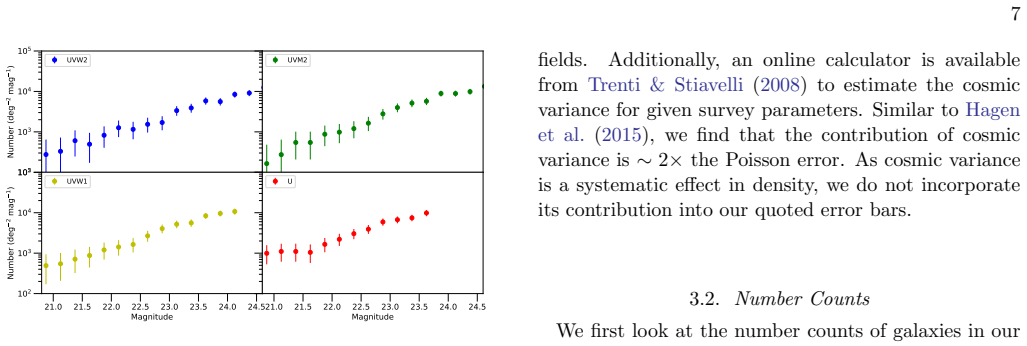
- [§3.1, Table 3, §3.5] Cosmic variance is estimated in §3.1 to be roughly twice the Poisson error, but it is not included in any of the quoted uncertainties. This matters because GOODS-N contains known overdensities at z~0.5 and z~0.9 (§3.2), and because Table 3, Figure 3, and Figure 8 present Poisson or MCMC errors as the final uncertainties. The Schechter parameters and the luminosity-density evolution index n=3.04±1.38 therefore have underestimated error bars. Please add a cosmic-variance term (for example, a density-floor systematic) to the reported uncertainties, or clearly tabulate Poisson and cosmic-variance contributions separately.
- [Table 3, §4.1.2] The evidence for M* evolution in Conclusion 1 is partly derived from fits in the two highest redshift bins where alpha is fixed to the Arnouts et al. (2005) values (Table 3). Because alpha and M* are degenerate in the Schechter function, a different but equally plausible alpha in the 0.6<z<0.8 or 0.8<z<1.2 bins would change M* and could alter the claimed brightening. The free-alpha fits are available only in the two lowest bins, so the evolution claim is conditional on external alpha priors. Please show robustness by marginalizing over alpha with a literature-based prior, fitting alpha freely with upper and lower limits in all bins, or demonstrating that M* shifts by less than the quoted errors over the range of alpha values in the literature.
minor comments (5)
- [§3.2, Table 2] The text and Figure 3 say the number counts are shown down to the 50% completeness limit, but Table 2 includes bins with completeness values as low as 0.246; please clarify which bins enter the LF fitting and whether the sub-50% points are used only for illustration.
- [§3.4] The luminosity-density equation integrates from 0 to infinity, while the text immediately says a lower limit of 0.03 L* is adopted; state explicitly that the tabulated values use the incomplete gamma function with this lower limit.
- [§3.3.2, Figure 5] The linear K-correction fit shown in Figure 5 is described only qualitatively; please provide the fitted slope and intercept so that the MLE calculation is reproducible.
- [§4.3, Abstract] The abstract and Section 4.3 conclude there is no trend between UV attenuation and redshift or absolute magnitude, but the paper measures the UV slope beta and then infers attenuation via the Meurer relation; the wording should distinguish the measured quantity from the inferred attenuation.
- [Table 3, Figure 7] It would help to state explicitly that the full-sample Vmax and MLE alpha values differ by about 0.18 (alpha=-1.086 vs -1.267), and to note in the Figure 7 caption that the shaded region uses only the M* and phi* errors with alpha fixed, not the full covariance.
Circularity Check
No significant circularity: the LF parameters are fitted to observed counts, and the luminosity density/SFRD are explicitly derived from those fits rather than presented as independent predictions.
full rationale
The paper's derivation chain is observational and self-contained. Completeness is measured by injecting artificial point sources and fitting a Fleming curve (Eq. 1); the Vmax estimator (Eq. 3) and the MLE likelihood (Eq. 4) use this independently measured completeness together with the K-correction regression shown in Figure 5. The Schechter parameters are fitted to the observed magnitudes and redshifts, and the luminosity density and SFRD are explicitly post-fit integrals (Section 3.4), not disguised predictions. The paper is transparent about fixing alpha to Arnouts et al. (2005) in some bins and reports free-alpha fits for the two bins where alpha is constrained. The point-source completeness assumption is supported by an external empirical result (Page et al. 2021) and by the paper's own Kron-radius test; the authors also flag the residual risk of overestimated faint-end completeness in the lowest redshift bin (Sections 3.1 and 3.3.2), which is an acknowledged limitation rather than a circular step. No equation reduces to its input by construction, and no load-bearing claim rests on a self-citation chain.
Assumptions & free parameters
free parameters (8)
- Schechter M* (full sample MLE) =
-19.04 ± 0.11 AB mag
- Schechter phi* (full sample MLE) =
3.21 ± 0.48 x 10^-3 Mpc^-3
- Schechter alpha (full sample MLE) =
-1.267 ± 0.071
- M* per redshift bin (fixed-alpha fits) =
-18.00 ± 0.17, -18.81 ± 0.14, -19.37 ± 0.18, -19.23 ± 0.14
- phi* per redshift bin (fixed-alpha fits) =
4.29, 4.23, 2.13, 3.26 x 10^-3 Mpc^-3
- alpha in lowest two bins (free) =
-1.31 ± 0.20 and -1.40 ± 0.23
- Completeness f50 per band =
24.7, 24.66, 24.25, 23.85 AB mag (UVW2, UVM2, UVW1, u)
- K-correction linear fit parameters =
Not tabulated; shown as linear regression in Figure 5
assumptions (7)
- domain assumption Galaxies are point sources with Gaussian profile of FWHM equal to UVOT PSF for completeness simulations
- domain assumption UVM2 apparent magnitude traces rest-frame FUV after K-correction
- standard math The Schechter function describes the UV luminosity function
- domain assumption Photometric redshifts from Yang et al. (2014) are accurate with Qz<1
- domain assumption Meurer et al. (1999) IRX-beta relation applies to these galaxies
- ad hoc to paper Alpha values from Arnouts et al. (2005) are valid for higher redshift bins
- ad hoc to paper Luminosity density integrated down to 0.03 L*
Cite this review
Pith. "Pith review of Deep Swift/UVOT Observations of GOODS-N and the Evolution of the Ultraviolet Luminosity Function at 0.2<z<1.2." pith.science (2026). https://pith.science/paper/ZVYRAEGR
@misc{pith2026241214377,
  author       = {Pith},
  title        = {Pith review of: Deep Swift/UVOT Observations of GOODS-N and the Evolution of the Ultraviolet Luminosity Function at 0.2<z<1.2},
  year         = {2026},
  howpublished = {\url{https://pith.science/paper/ZVYRAEGR}},
  note         = {Machine review of arXiv:2412.14377}
}
abstract
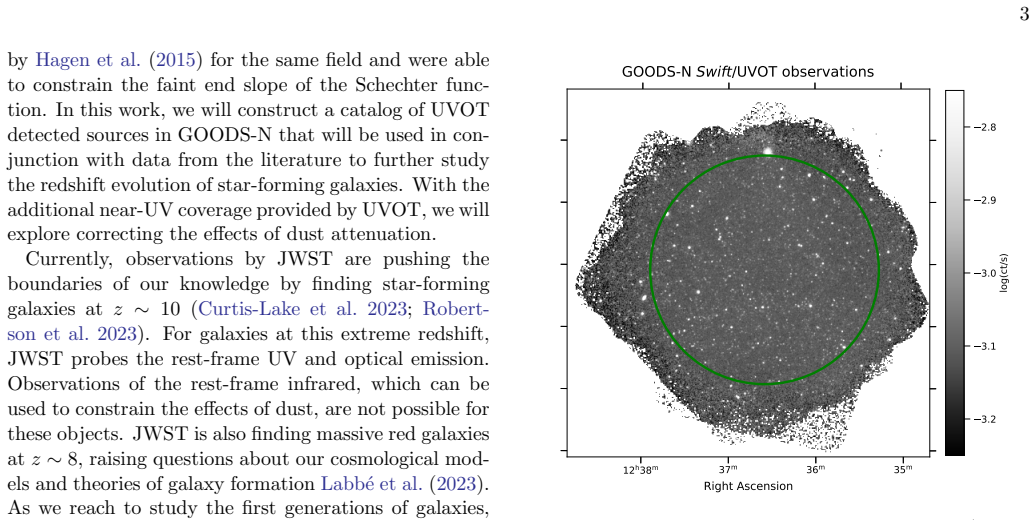
We present Swift Ultraviolet Optical Telescope (UVOT) observations of the deep field GOODS-N in four near-UV filters. A catalog of detected galaxies is reported, which will be used to explore galaxy evolution using ultraviolet emission. Swift/UVOT observations probe galaxies at $z \lesssim 1.5$ and combine a wide field of view with moderate spatial resolution; these data complement the wide-field observations of GALEX and the deep, high angular resolution observations by HST. Using our catalog of detected galaxies, we calculate the UV galaxy number counts as a function of apparent magnitude and compute the UV luminosity function and its evolution with redshift. From the luminosity function fits in various redshift bins, we calculate the star formation rate density as a function of redshift and find evolution consistent with past works. We explore how different assumptions such as dust attenuation corrections can dramatically change how quickly the corrected star formation rate density changes with redshift. At these low redshifts, we find no trend between UV attenuation and redshift or absolute magnitude with significant scatter in the UV spectral slope $\beta$. This dataset will complement the extensive observations of GOODS-N already in the literature.
Figures

Figures from the paper (7 more)


Reference graph
Works this paper leans on
-
[1]
2016, ApJ, 832, 56, doi: 10.3847/0004-637X/832/1/56
Alavi, A., Siana, B., Richard, J., et al. 2016, ApJ, 832, 56, doi: 10.3847/0004-637X/832/1/56
-
[2]
Alexander, D. M., Bauer, F. E., Brandt, W. N., et al. 2003, AJ, 126, 539, doi: 10.1086/376473
doi:10.1086/376473 2003
-
[3]
2015, A&A, 574, A49, doi: 10.1051/0004-6361/201425010
Antonucci, M., Talavera, A., Vagnetti, F., et al. 2015, A&A, 574, A49, doi: 10.1051/0004-6361/201425010
-
[4]
2005, ApJL, 619, L43, doi: 10.1086/426733
Arnouts, S., Schiminovich, D., Ilbert, O., et al. 2005, ApJL, 619, L43, doi: 10.1086/426733
doi:10.1086/426733 2005
-
[5]
Ashby, M. L. N., Willner, S. P., Fazio, G. G., et al. 2013, ApJ, 769, 80, doi: 10.1088/0004-637X/769/1/80 Astropy Collaboration, Robitaille, T. P., Tollerud, E. J., et al. 2013, A&A, 558, A33, doi: 10.1051/0004-6361/201322068 Astropy Collaboration, Price-Whelan, A. M., Sip˝ ocz, B. M., et al. 2018, AJ, 156, 123, doi: 10.3847/1538-3881/aabc4f Astropy Colla...
-
[6]
Barro, G., P´ erez-Gonz´ alez, P. G., Cava, A., et al. 2019, ApJS, 243, 22, doi: 10.3847/1538-4365/ab23f2
-
[7]
Bastian, N., Covey, K. R., & Meyer, M. R. 2010, ARA&A, 48, 339, doi: 10.1146/annurev-astro-082708-101642
-
[8]
2011, ApJ, 739, 98, doi: 10.1088/0004-637X/739/2/98
Lehmer, B., & Gronwall, C. 2011, ApJ, 739, 98, doi: 10.1088/0004-637X/739/2/98
Show all 111 references
-
[9]
J., Calzetti, D., & Chary, R
Battisti, A. J., Calzetti, D., & Chary, R. R. 2017, ApJ, 851, 90, doi: 10.3847/1538-4357/aa9a43
2017 doi
-
[10]
1996, A&AS, 117, 393, doi: 10.1051/aas:1996164
Bertin, E., & Arnouts, S. 1996, A&AS, 117, 393, doi: 10.1051/aas:1996164
1996 doi
- [11]
- [12]
-
[13]
2020, MNRAS, 496, 5341, doi: 10.1093/mnras/staa1928
Bogdanoska, J., & Burgarella, D. 2020, MNRAS, 496, 5341, doi: 10.1093/mnras/staa1928
2020 doi
-
[14]
J., Illingworth, G
Bouwens, R. J., Illingworth, G. D., Franx, M., et al. 2009, ApJ, 705, 936, doi: 10.1088/0004-637X/705/1/936 20
2009 doi
-
[15]
J., Illingworth, G
Bouwens, R. J., Illingworth, G. D., Oesch, P. A., et al. 2014, ApJ, 793, 115, doi: 10.1088/0004-637X/793/2/115
2014 doi
-
[16]
B., van Dokkum, P
Brammer, G. B., van Dokkum, P. G., & Coppi, P. 2008, ApJ, 686, 1503, doi: 10.1086/591786
2008 doi
-
[17]
A., Curran, P
Breeveld, A. A., Curran, P. A., Hoversten, E. A., et al. 2010, MNRAS, 406, 1687, doi: 10.1111/j.1365-2966.2010.16832.x
2010
-
[18]
J., Roming, P
Brown, P. J., Roming, P. W. A., Milne, P., et al. 2010, ApJ, 721, 1608, doi: 10.1088/0004-637X/721/2/1608
2010 doi
- [19]
-
[20]
C., et al
Calzetti, D., Armus, L., Bohlin, R. C., et al. 2000, ApJ, 533, 682, doi: 10.1086/308692
2000 doi
-
[21]
L., & Storchi-Bergmann, T
Calzetti, D., Kinney, A. L., & Storchi-Bergmann, T. 1994, ApJ, 429, 582, doi: 10.1086/174346
1994 doi
-
[22]
L., Hu, E
Capak, P., Cowie, L. L., Hu, E. M., et al. 2004, AJ, 127, 180, doi: 10.1086/380611
2004 doi
-
[23]
M., Scoville, N
Casey, C. M., Scoville, N. Z., Sanders, D. B., et al. 2014, ApJ, 796, 95, doi: 10.1088/0004-637X/796/2/95
2014 doi
-
[24]
Charlot, S., & Fall, S. M. 2000, ApJ, 539, 718, doi: 10.1086/309250
2000 doi
-
[25]
J., et al
Ciardullo, R., Gronwall, C., Adams, J. J., et al. 2013, ApJ, 769, 83, doi: 10.1088/0004-637X/769/1/83
2013 doi
-
[26]
G., Hogg, D
Cohen, J. G., Hogg, D. W., Blandford, R., et al. 2000, ApJ, 538, 29, doi: 10.1086/309096
2000 doi
-
[27]
2013, ARA&A, 51, 393, doi: 10.1146/annurev-astro-082812-141017
Conroy, C. 2013, ARA&A, 51, 393, doi: 10.1146/annurev-astro-082812-141017
2013 doi
-
[28]
2023, Nature Astronomy, doi: 10.1038/s41550-023-01918-w
Curtis-Lake, E., Carniani, S., Cameron, A., et al. 2023, Nature Astronomy, doi: 10.1038/s41550-023-01918-w
2023 doi
-
[29]
2019, MNRAS, 486, 743, doi: 10.1093/mnras/stz805
Decleir, M., De Looze, I., Boquien, M., et al. 2019, MNRAS, 486, 743, doi: 10.1093/mnras/stz805
2019 doi
-
[30]
Eddington, A. S. 1913, MNRAS, 73, 359, doi: 10.1093/mnras/73.5.359
1913 doi
-
[31]
S., et al
Elbaz, D., Dickinson, M., Hwang, H. S., et al. 2011, A&A, 533, A119, doi: 10.1051/0004-6361/201117239
2011 doi
-
[32]
L., Papovich, C., Salmon, B., et al
Finkelstein, S. L., Papovich, C., Salmon, B., et al. 2012, ApJ, 756, 164, doi: 10.1088/0004-637X/756/2/164
2012 doi
-
[33]
Fitzpatrick, E. L. 1999, PASP, 111, 63, doi: 10.1086/316293
1999 doi
-
[34]
Fleming, D. E. B., Harris, W. E., Pritchet, C. J., & Hanes, D. A. 1995, AJ, 109, 1044, doi: 10.1086/117340
1995 doi
-
[35]
2016, The Journal of Open Source Software, 1, 24, doi: 10.21105/joss.00024
Foreman-Mackey, D. 2016, The Journal of Open Source Software, 1, 24, doi: 10.21105/joss.00024
2016 doi
-
[36]
W., Lang, D., & Goodman, J
Foreman-Mackey, D., Hogg, D. W., Lang, D., & Goodman, J. 2013, PASP, 125, 306, doi: 10.1086/670067
2013 doi
-
[37]
2013, ApJS, 206, 10, doi: 10.1088/0067-0049/206/2/10
Galametz, A., Grazian, A., Fontana, A., et al. 2013, ApJS, 206, 10, doi: 10.1088/0067-0049/206/2/10
2013 doi
-
[38]
1986, ApJ, 303, 336, doi: 10.1086/164079
Gehrels, N. 1986, ApJ, 303, 336, doi: 10.1086/164079
1986 doi
-
[39]
2004, ApJ, 611, 1005, doi: 10.1086/422091
Gehrels, N., Chincarini, G., Giommi, P., et al. 2004, ApJ, 611, 1005, doi: 10.1086/422091
2004 doi
-
[40]
C., Koekemoer, A
Giavalisco, M., Ferguson, H. C., Koekemoer, A. M., et al. 2004, ApJL, 600, L93, doi: 10.1086/379232
2004 doi
-
[41]
D., Clayton, G
Gordon, K. D., Clayton, G. C., Misselt, K. A., Landolt, A. U., & Wolff, M. J. 2003, ApJ, 594, 279, doi: 10.1086/376774
2003 doi
-
[42]
A., Kocevski, D
Grogin, N. A., Kocevski, D. D., Faber, S. M., et al. 2011, ApJS, 197, 35, doi: 10.1088/0067-0049/197/2/35
2011 doi
-
[43]
C., Giavalisco, M., et al
Guo, Y., Ferguson, H. C., Giavalisco, M., et al. 2013, ApJS, 207, 24, doi: 10.1088/0067-0049/207/2/24
2013 doi
-
[44]
Hagen, L. M. Z., Hoversten, E. A., Gronwall, C., et al. 2015, ApJ, 808, 178, doi: 10.1088/0004-637X/808/2/178
2015 doi
-
[45]
C., Johnson, B
Hao, C.-N., Kennicutt, R. C., Johnson, B. D., et al. 2011, ApJ, 741, 124, doi: 10.1088/0004-637X/741/2/124
2011 doi
-
[46]
A., Gronwall, C., Vanden Berk, D
Hoversten, E. A., Gronwall, C., Vanden Berk, D. E., et al. 2009, ApJ, 705, 1462, doi: 10.1088/0004-637X/705/2/1462
2009 doi
-
[47]
2019, ApJ, 871, 233, doi: 10.3847/1538-4357/aaf9a7
Hsu, L.-T., Lin, L., Dickinson, M., et al. 2019, ApJ, 871, 233, doi: 10.3847/1538-4357/aaf9a7
2019 doi
-
[48]
D., Magee, D., Oesch, P
Illingworth, G. D., Magee, D., Oesch, P. A., et al. 2013, ApJS, 209, 6, doi: 10.1088/0067-0049/209/1/6
2013 doi
-
[49]
Wang, W. H. 2010, ApJS, 186, 94, doi: 10.1088/0067-0049/186/1/94
2010 doi
-
[50]
1998, ARA&A, 36, 189, doi: 10.1146/annurev.astro.36.1.189
Kennicutt, Robert C., J. 1998, ARA&A, 36, 189, doi: 10.1146/annurev.astro.36.1.189
1998 doi
-
[51]
C., & Evans, N
Kennicutt, R. C., & Evans, N. J. 2012, ARA&A, 50, 531, doi: 10.1146/annurev-astro-081811-125610
2012 doi
-
[52]
M., Faber, S
Koekemoer, A. M., Faber, S. M., Ferguson, H. C., et al. 2011, ApJS, 197, 36, doi: 10.1088/0067-0049/197/2/36
2011 doi
-
[53]
Kong, X., Charlot, S., Brinchmann, J., & Fall, S. M. 2004, MNRAS, 349, 769, doi: 10.1111/j.1365-2966.2004.07556.x
2004
-
[54]
Kron, R. G. 1980, ApJS, 43, 305, doi: 10.1086/190669
1980 doi
-
[55]
K., Hutchings, J., et al
Kumar, A., Ghosh, S. K., Hutchings, J., et al. 2012, in Society of Photo-Optical Instrumentation Engineers (SPIE) Conference Series, Vol. 8443, Space Telescopes and Instrumentation 2012: Ultraviolet to Gamma Ray, ed. T. Takahashi, S. S. Murray, & J.-W. A. den Herder, 84431N, d...
2012 doi
-
[56]
2014, ApJL, 793, L5, doi: 10.1088/2041-8205/793/1/L5 Labb´ e, I., van Dokkum, P., Nelson, E., et al
Kurczynski, P., Gawiser, E., Rafelski, M., et al. 2014, ApJL, 793, L5, doi: 10.1088/2041-8205/793/1/L5 Labb´ e, I., van Dokkum, P., Nelson, E., et al. 2023, Nature, 616, 266, doi: 10.1038/s41586-023-05786-2
2014 doi
-
[57]
D., Conroy, C., et al
Leja, J., Johnson, B. D., Conroy, C., et al. 2019, ApJ, 877, 140, doi: 10.3847/1538-4357/ab1d5a
2019 doi
-
[58]
A., Treu, T., et al
Ly, C., Malkan, M. A., Treu, T., et al. 2009, ApJ, 697, 1410, doi: 10.1088/0004-637X/697/2/1410
2009 doi
-
[59]
2014, ARA&A, 52, 415, doi: 10.1146/annurev-astro-081811-125615 21
Madau, P., & Dickinson, M. 2014, ARA&A, 52, 415, doi: 10.1146/annurev-astro-081811-125615 21
2014 doi
- [60]
-
[61]
O., Breeveld, A., Much, R., et al
Mason, K. O., Breeveld, A., Much, R., et al. 2001, A&A, 365, L36, doi: 10.1051/0004-6361:20000044
2001 doi
-
[62]
Mitchell, N. P. 2015, ApJ, 808, 109, doi: 10.1088/0004-637X/808/2/109
2015 doi
-
[63]
R., Heckman, T
Meurer, G. R., Heckman, T. M., & Calzetti, D. 1999, ApJ, 521, 64, doi: 10.1086/307523
1999 doi
-
[64]
G., Brammer, G
Momcheva, I. G., Brammer, G. B., van Dokkum, P. G., et al. 2016, ApJS, 225, 27, doi: 10.3847/0067-0049/225/2/27
2016 doi
-
[65]
A., & Jansen, R
Mondal, C., Saha, K., Windhorst, R. A., & Jansen, R. A. 2023a, ApJ, 946, 90, doi: 10.3847/1538-4357/acc110
-
[66]
2023b, ApJS, 264, 40, doi: 10.3847/1538-4365/aca7c4
Mondal, C., Saha, K., Bhattacharya, S., et al. 2023b, ApJS, 264, 40, doi: 10.3847/1538-4365/aca7c4
-
[67]
2020, MNRAS, 494, 1894, doi: 10.1093/mnras/staa706
Moutard, T., Sawicki, M., Arnouts, S., et al. 2020, MNRAS, 494, 1894, doi: 10.1093/mnras/staa706
2020 doi
-
[68]
J., Condon, J
Murphy, E. J., Condon, J. J., Schinnerer, E., et al. 2011, ApJ, 737, 67, doi: 10.1088/0004-637X/737/2/67
2011 doi
-
[69]
2018a, ApJ, 869, 70, doi: 10.3847/1538-4357/aaed25
Popping, G. 2018a, ApJ, 869, 70, doi: 10.3847/1538-4357/aaed25
-
[70]
D., et al
Narayanan, D., Dav´ e, R., Johnson, B. D., et al. 2018b, MNRAS, 474, 1718, doi: 10.1093/mnras/stx2860
-
[71]
A., Bouwens, R
Oesch, P. A., Bouwens, R. J., Carollo, C. M., et al. 2010, ApJL, 725, L150, doi: 10.1088/2041-8205/725/2/L150
2010 doi
-
[72]
A., Montes, M., Reddy, N., et al
Oesch, P. A., Montes, M., Reddy, N., et al. 2018, ApJS, 237, 12, doi: 10.3847/1538-4365/aacb30
2018 doi
- [73]
-
[74]
A., Heckman, T
Overzier, R. A., Heckman, T. M., Wang, J., et al. 2011, ApJL, 726, L7, doi: 10.1088/2041-8205/726/1/L7
2011 doi
-
[75]
J., Dwelly, T., McHardy, I., et al
Page, M. J., Dwelly, T., McHardy, I., et al. 2021, MNRAS, 506, 473, doi: 10.1093/mnras/stab1638
2021 doi
-
[76]
S., Breeveld, A
Poole, T. S., Breeveld, A. A., Page, M. J., et al. 2008, MNRAS, 383, 627, doi: 10.1111/j.1365-2966.2007.12563.x
2008
-
[77]
A., Steidel, C
Reddy, N. A., Steidel, C. C., Pettini, M., et al. 2008, ApJS, 175, 48, doi: 10.1086/521105
2008 doi
-
[78]
A., Oesch, P
Reddy, N. A., Oesch, P. A., Bouwens, R. J., et al. 2018, ApJ, 853, 56, doi: 10.3847/1538-4357/aaa3e7
2018 doi
-
[79]
E., Tacchella, S., Johnson, B
Robertson, B. E., Tacchella, S., Johnson, B. D., et al. 2023, Nature Astronomy, doi: 10.1038/s41550-023-01921-1
2023 doi
-
[80]
2023, astropy/reproject: v0.10.0, v0.10.0, Zenodo, doi: 10.5281/zenodo.7584411
Robitaille, T., Ginsburg, A., Mumford, S., et al. 2023, astropy/reproject: v0.10.0, v0.10.0, Zenodo, doi: 10.5281/zenodo.7584411
2023 doi
-
[81]
Roming, P. W. A., Kennedy, T. E., Mason, K. O., et al. 2005, SSRv, 120, 95, doi: 10.1007/s11214-005-5095-4
2005 doi
-
[82]
2019, ApJ, 872, 23, doi: 10.3847/1538-4357/aaf88a
Salim, S., & Boquien, M. 2019, ApJ, 872, 23, doi: 10.3847/1538-4357/aaf88a
2019 doi
-
[83]
Salim, S., Boquien, M., & Lee, J. C. 2018, ApJ, 859, 11, doi: 10.3847/1538-4357/aabf3c
2018 doi
-
[84]
2019, Nature Astronomy, 3, 212, doi: 10.1038/s41550-018-0478-0
Salvato, M., Ilbert, O., & Hoyle, B. 2019, Nature Astronomy, 3, 212, doi: 10.1038/s41550-018-0478-0
2019 doi
-
[85]
1976, ApJ, 203, 297, doi: 10.1086/154079
Schechter, P. 1976, ApJ, 203, 297, doi: 10.1086/154079
1976 doi
-
[86]
2005, ApJL, 619, L47, doi: 10.1086/427077
Schiminovich, D., Ilbert, O., Arnouts, S., et al. 2005, ApJL, 619, L47, doi: 10.1086/427077
2005 doi
-
[87]
F., & Finkbeiner, D
Schlafly, E. F., & Finkbeiner, D. P. 2011, ApJ, 737, 103, doi: 10.1088/0004-637X/737/2/103
2011 doi
-
[88]
J., Finkbeiner, D
Schlegel, D. J., Finkbeiner, D. P., & Davis, M. 1998, ApJ, 500, 525, doi: 10.1086/305772
1998 doi
-
[89]
1968, ApJ, 151, 393, doi: 10.1086/149446
Schmidt, M. 1968, ApJ, 151, 393, doi: 10.1086/149446
1968 doi
-
[90]
J., & Breeveld, A
Sharma, M., Page, M. J., & Breeveld, A. A. 2022a, MNRAS, 511, 4882, doi: 10.1093/mnras/stac356
- [91]
-
[92]
J., Symeonidis, M., & Ferreras, I
Sharma, M., Page, M. J., Symeonidis, M., & Ferreras, I. 2024, MNRAS, 528, 1997, doi: 10.1093/mnras/stae135
2024 doi
-
[93]
2020, ApJ, 899, 117, doi: 10.3847/1538-4357/aba35e
Shivaei, I., Reddy, N., Rieke, G., et al. 2020, ApJ, 899, 117, doi: 10.3847/1538-4357/aba35e
2020 doi
-
[94]
H., Porterfield, B
Siegel, M. H., Porterfield, B. L., Linevsky, J. S., et al. 2014, AJ, 148, 131, doi: 10.1088/0004-6256/148/6/131
2014 doi
-
[95]
E., Whitaker, K
Skelton, R. E., Whitaker, K. E., Momcheva, I. G., et al. 2014, ApJS, 214, 24, doi: 10.1088/0067-0049/214/2/24
2014 doi
-
[96]
W., Yan, L., & Cohen, J
Smail, I., Hogg, D. W., Yan, L., & Cohen, J. G. 1995, ApJL, 449, L105, doi: 10.1086/309647
1995 doi
-
[97]
S., Lee, K., Ferguson, H
Somerville, R. S., Lee, K., Ferguson, H. C., et al. 2004, ApJL, 600, L171, doi: 10.1086/378628
2004 doi
- [98]
-
[99]
T., Yuan, F.-T., Ikeyama, A., Murata, K
Takeuchi, T. T., Yuan, F.-T., Ikeyama, A., Murata, K. L., & Inoue, A. K. 2012, ApJ, 755, 144, doi: 10.1088/0004-637X/755/2/144
2012 doi
-
[100]
N., Subramaniam, A., Girish, V., et al
Tandon, S. N., Subramaniam, A., Girish, V., et al. 2017, AJ, 154, 128, doi: 10.3847/1538-3881/aa8451
2017 doi
-
[101]
I., Siana, B., Brown, T
Teplitz, H. I., Siana, B., Brown, T. M., et al. 2006, AJ, 132, 853, doi: 10.1086/505685
2006 doi
-
[102]
2008, ApJ, 676, 767, doi: 10.1086/528674
Trenti, M., & Stiavelli, M. 2008, ApJ, 676, 767, doi: 10.1086/528674
2008 doi
-
[103]
2011, Ap&SS, 331, 1, doi: 10.1007/s10509-010-0458-z
Walcher, J., Groves, B., Budav´ ari, T., & Dale, D. 2011, Ap&SS, 331, 1, doi: 10.1007/s10509-010-0458-z
2011 doi
-
[104]
2010, ApJS, 187, 251, doi: 10.1088/0067-0049/187/1/251
Ting, H.-C. 2010, ApJS, 187, 251, doi: 10.1088/0067-0049/187/1/251
2010 doi
-
[105]
I., Sun, L., et al
Wang, X., Teplitz, H. I., Sun, L., et al. 2024, Research Notes of the American Astronomical Society, 8, 26, doi: 10.3847/2515-5172/ad1f6f 22
2024 doi
-
[106]
E., Blacker, B., Dickinson, M., et al
Williams, R. E., Blacker, B., Dickinson, M., et al. 1996, AJ, 112, 1335, doi: 10.1086/118105
1996 doi
-
[107]
K., Treyer, M
Wyder, T. K., Treyer, M. A., Milliard, B., et al. 2005, ApJL, 619, L15, doi: 10.1086/424735
2005 doi
-
[108]
K., Donas, J., Arnouts, S., et al
Xu, C. K., Donas, J., Arnouts, S., et al. 2005, ApJL, 619, L11, doi: 10.1086/425252
2005 doi
-
[109]
K., Shupe, D., Buat, V., et al
Xu, C. K., Shupe, D., Buat, V., et al. 2007, ApJS, 173, 432, doi: 10.1086/516641
2007 doi
-
[110]
Q., Luo, B., Brandt, W
Xue, Y. Q., Luo, B., Brandt, W. N., et al. 2016, ApJS, 224, 15, doi: 10.3847/0067-0049/224/2/15
2016 doi
-
[111]
Q., Luo, B., et al
Yang, G., Xue, Y. Q., Luo, B., et al. 2014, ApJS, 215, 27, doi: 10.1088/0067-0049/215/2/27
2014 doi
Reviewed August 11, 2026 · model on record in the stance chip above.
Discussion (0). Continue with ORCID to comment.