REVIEW 3 major objections 7 minor 80 references
Vulnerable Connectivity Caused by Local Communities in Spatial Networks
T0 review · 3 major / 7 minor · reviewed 2026-08-11 · deepseek-v4-flash
Pith's one-line read Spatial networks with strong local communities lose connectivity faster under node removal, because short links between clustered nodes create few fragile inter-community bridges.
desk verdict Plausible and carefully executed empirical study of population-based spatial networks, but the headline causal claim that community structure itself weakens robustness is not fully separated from correlated spatial sparsity and degree effects. read the letter →
The pith
A machine-rendered reading of the paper's core claim, the machinery that carries it, and where it could break.
The reading
What carries the argument
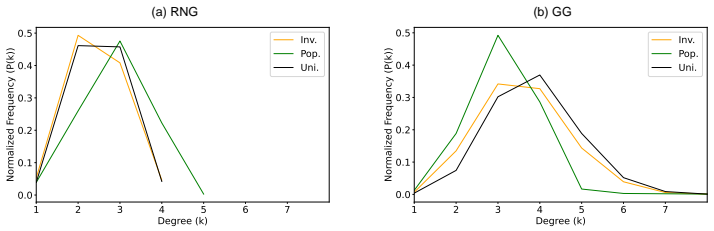
The argument runs on three measures: modularity $Q$ (the fraction of links that fall within detected communities minus the expected fraction under random linking, estimated here with the Louvain method), the robustness index $R$ (area under the curve of the relative size of the largest connected component as nodes are removed), and the critical fraction $q_c$ (removal fraction at which the second largest component peaks). The comparative machinery is the degree-preserving control: original population-based networks, the same nodes relocated to a 2D lattice, and degree-preserving randomized rewiring are compared under identical degree distributions, so differences in robustness are attributed to node placement and community structure rather than degree sequence.
What would settle it
Take any one of the seven city networks, construct the population-based RNG/GG version, and add long-distance links between communities while keeping the degree distribution fixed; if the robustness index $R_{RB}$ does not increase relative to the original, the paper's claimed mitigation mechanism fails. More directly, if a real or synthetic spatial network with strong local communities shows equal or higher robustness under recalculated-betweenness attacks than a matched uniform network with similar degrees, the central claim would be contradicted.
Extended reading notes
Core claim
Using relative neighborhood graphs (RNG) and Gabriel graphs (GG) as planar models of road and communication networks, with node locations taken from the 500m × 500m census mesh of seven Japanese urban areas, the paper reports that networks whose nodes are selected by population concentration (Pop.) or inverse concentration (Inv.) have higher modularity and lower robustness than networks with uniformly random node locations (Uni.), even when the degree distributions are nearly identical. Relocating the same nodes onto a 2D lattice (2DL) while preserving degrees weakens community structure and shifts the fragmentation curves rightward, meaning higher robustness index $R$ and larger critical fraction $q_c$. The authors conclude that local communities arising from short links between spatially concentrated nodes weaken robustness against intentional attacks and random failures, and that long-distance links can mitigate this effect.
Load-bearing premise
The whole conclusion rests on the assumption that planar proximity graphs with short links (RNG and GG) capture the connectivity of real road and communication networks well enough that community structure in these models corresponds to community structure in actual infrastructure.
Editorial extensions
If this is right
- Population-concentrated siting of infrastructure nodes lowers resilience to targeted attacks, because few bridge links connect dense local clusters.
- Under the same degree distribution, uniform node placement is more robust than either extreme population-based placement.
- Degree-preserving random rewiring consistently improves robustness, confirming that the vulnerability is structural, not a degree-sequence artifact.
- Gabriel graphs are generally more robust than relative neighborhood graphs, since the extra short links provide redundant connectivity.
- Adding long-distance inter-community connections is the paper's proposed practical remedy, more feasible than relocating nodes.
Reading between the lines
- Inference: the modularity-robustness relation may hold only while inter-community links remain scarce; a network with strong communities but many redundant bridges could violate the monotone trend.
- Inference: the sparsity index correlation suggests a testable proxy — add long links without increasing modularity, and the robustness gain should come from bridge redundancy, not from reduced clustering alone.
- Inference: in multilayer or interdependent infrastructure, the same local communities could become chokepoints for cascading failures, so the single-layer result is a lower bound on vulnerability; that is outside the paper's scope.
- Inference: the finding can be checked against real outage data, e.g., whether cities with stronger detected community structure in road networks fragment into disconnected components after the same fraction of hub removals.
Editorial analysis
A structured set of objections, weighed in public.
Referee Report
Summary. The paper studies how the spatial concentration of nodes connected by short links (termed local communities) affects the robustness of connectivity in planar spatial networks. It constructs relative neighborhood graphs (RNG) and Gabriel graphs (GG) on node locations drawn from Japanese population data (Pop., Inv., Uni.) and compares them with degree-preserving randomized and 2D-lattice relocated controls. Robustness is measured by the area-under-curve index R and the critical fraction qc under recalculated-betweenness (RB), initial-degree (ID), and random-failure (RF) removals. The main claim is that stronger community structure, measured by modularity Q, weakens robustness, and that long-distance links can mitigate this effect.
Significance. The question addressed is relevant to infrastructure planning, and the study has useful strengths: it uses real demographic data from seven Japanese metropolitan areas, two planar proximity graph models, three network sizes, three removal strategies, and degree-preserving control constructions. The ANOVA results for the RB-attack comparisons are consistent and highly significant for both RNG and GG, giving the paper a solid empirical core. At the same time, the central causal attribution to community structure is not yet isolated from correlated geometric factors, most notably the sparsity index SI and grid-like local structure, and the reported evidence is partly inconsistent across model types (RNG versus GG). Because the conclusion is phrased as a general mechanism rather than as a model-specific association, the manuscript needs additional analysis to support the causal claim.
major comments (3)
- [§3.2, Figs. 5–8 and S13/S14] The load-bearing inference that higher modularity Q leads to lower robustness R_RB is not causally isolated. The original-versus-2DL and original-versus-randomized comparisons simultaneously change the edge-length distribution (hence the sparsity index SI), the spatial point process, and planarity; the 2DL construction explicitly introduces non-planar long links through its second trial. Fig. 7 shows that R_RB decreases with SI, while S14 shows that Q and SI are significantly correlated only in GG (p = 0.0198), not in RNG (p = 0.3315). Moreover, S13 shows that the SI–R_RB correlation is not significant in RNG (p = 0.1486). The observed Q–R relation could therefore be a proxy for SI in GG, while in RNG the claimed monotone relation lacks statistical support. I ask for partial correlations or multivariate regressions of R on Q and SI, or for a spatially constrained rewiring control that preserves edge lengths, to demonstrate that community strength, rather than sparsity or grid-like geometry, is the operative variable.
- [§3.3, Tables 4–5 and S9–S10] The general conclusion that Pop.- and Inv.-based networks are weaker than Uni.-based networks under both intentional attacks and random failures is contradicted by two non-significant ANOVA results in RNG: qcID (p = 0.249) and RRF (p = 0.104). The manuscript attributes these exceptions to higher average degree and to grid-like parts, which is an admission that degree and local lattice geometry, not community strength alone, control the outcome in the RNG model—the model used for road networks. Please either restrict the conclusion to GG and to the metrics that are significant, or add an analysis that controls for average degree and the grid-ratio across all three attack types.
- [§3.2, text near Figs. 7–8 versus S13/S14] The statement that "The Pearson's correlation tests confirm the relation in both RNG and GG with the significance" is contradicted by S14, where the RNG Q–SI correlation has p = 0.3315. Similarly, the claim that "r < 0 for all cases against RB attacks confirmed these monotone decreasing" overstates the evidence, because in S13 the RNG R_RB–SI correlation has p = 0.1486 and is not significant. Please report all p-values accurately and adjust the conclusions and summary statements accordingly.
minor comments (7)
- [Abstract] The sentence "modeling planar infrastructure reveals that the robustness is weakened by strong local communities in spatial networks" is grammatically incomplete and should be reworded, for example as "modeling planar infrastructure, we show that robust connectivity is weakened by strong local communities in spatial networks."
- [Throughout] The term "ANOV A" should be written as "ANOVA" (e.g., in Section 3.2, S8–S10 Tables).
- [§2.2] The phrase "RB has a strong affect on global fragmentation" should read "effect."
- [Fig. 5 caption] The caption states "A monotone decreasing is observed" without reporting any correlation coefficient or significance test; please add the corresponding statistic or cite the table where it is reported.
- [Tables 2 and 3] The "Analytical" rows should explicitly cite the source formula from reference [69] and clarify whether the quoted values apply to RNG, GG, or the Uniform baseline.
- [§2.2 (2DL construction)] Because the 2DL construction permits non-planar second-trial links while the original networks are planar, the control changes planarity as well as community structure; please state this explicitly as a design limitation.
- [Data and code availability] The statement that code is "available from the corresponding author upon request" is not sufficient for reproducibility; please deposit the code in a permanent repository with a versioned DOI.
Circularity Check
No significant circularity: the central Q–R relation is an independent empirical comparison, not a fitted or definitional identity.
full rationale
The paper's derivation chain is self-contained and empirical. It constructs spatial networks by placing nodes according to population, inverse-population, or uniform distributions and connecting them with RNG/GG proximity rules. It then measures modularity Q via Louvain community detection and robustness index R / critical fraction qc via node-removal simulations. These are distinct quantities computed independently from the same network: Q is a structural partition statistic, while R and qc are percolation-style responses to node deletion. The central inference—that stronger communities (higher Q) accompany lower robustness—is supported by direct comparisons among original, degree-preserving randomized, and 2D-lattice relocated networks. None of these controls is constructed from the target quantity; the degree distribution is preserved but community structure is weakened by rewiring or relocation, giving an independent contrast. No parameter is fitted to the robustness outcome, and no prediction is defined in terms of its own input. The one self-citation (ref. 21, by co-author Hayashi) is used only as background noting that spatial constraints can weaken connectivity; the paper explicitly says the reason remained unclear and proceeds with its own analysis, so the citation is not load-bearing. Concerns about confounding between spatial sparsity, degree, and modularity are legitimate scientific validity questions, but confounding is not circularity: the observed Q–R relation is not true by construction. Therefore no circular step meets the evidentiary bar of 'Eq. X = Eq. Y by construction' or 'fitted parameter renamed as prediction.'
Assumptions & free parameters
assumptions (6)
- domain assumption Planar proximity graphs (RNG, GG) approximate real road and communication networks.
- domain assumption Static structural robustness, measured by LCC size after node removal, captures the vulnerability of infrastructure networks.
- domain assumption Rank-based selection of top or bottom population meshes represents realistic extreme node distributions.
- domain assumption Single-layer network abstraction is sufficient to isolate community effects.
- domain assumption Louvain modularity is a valid measure of community strength for comparing these networks.
- domain assumption The 2D lattice relocation preserves degree distributions while removing spatial clustering.
Cite this review
Pith. "Pith review of Vulnerable Connectivity Caused by Local Communities in Spatial Networks." pith.science (2026). https://pith.science/paper/CII74USL
@misc{pith2026241214513,
  author       = {Pith},
  title        = {Pith review of: Vulnerable Connectivity Caused by Local Communities in Spatial Networks},
  year         = {2026},
  howpublished = {\url{https://pith.science/paper/CII74USL}},
  note         = {Machine review of arXiv:2412.14513}
}
read the original abstract
Local communities by concentration of nodes connected with short links are widely observed in spatial networks. However, how such structure affects robustness of connectivity against malicious attacks remains unclear. This study investigates the impact of local communities on the robustness by modeling planar infrastructure reveals that the robustness is weakened by strong local communities in spatial networks. These results highlight the potential of long-distance links in mitigating the negative effects of local community on the robustness.
Figures


Figures from the paper (8 more)




Reference graph
Works this paper leans on
-
[1]
Modularity and community structure in networks
Newman ME. Modularity and community structure in networks. Proceedings of the National Academy of Sciences in USA. 2006;103(23):8577–8582. doi:10.1073/pnas.0601602103
-
[2]
Community structure in social and biological networks
Girvan M, Newman ME. Community structure in social and biological networks. Proceedings of the National Academy of Sciences in USA. 2002;99(12):7821–7826. doi:10.1073/pnas.122653799
-
[3]
The spatial structure of networks
Gastner M, Newman M. The spatial structure of networks. The European Physical Journal B. 2006;2(49):247–252. doi:10.1140/epjb/e2006-00046-8
-
[4]
Guimera R, Mossa S, Turtschi A, Amaral LN. The worldwide air transportation network: Anomalous centrality, community structure, and cities’ global roles. Proceedings of the National Academy of Sciences. 2005;102(22):7794–7799. doi:10.1073/pnas.0407994102
-
[5]
The complex network of global cargo ship movements
Kaluza P, K¨ olzsch A, Gastner MT, Blasius B. The complex network of global cargo ship movements. Journal of the Royal Society Interface. 2010;7(48):1093–1103. doi:10.1098/rsif.2009.0495
-
[6]
Finding and Evaluating Community Structures in Spatial Networks
Wan Y, Tan X, Shu H. Finding and Evaluating Community Structures in Spatial Networks. ISPRS International Journal of Geo-Information. 2023;12(187):1–20. doi:10.3390/ijgi12050187
-
[7]
On community structure in complex networks: challenges and opportunities
Cherifi H, Palla G, Szymanski BK, Lu X. On community structure in complex networks: challenges and opportunities. Applied Network Science. 2019;4(1):117. doi:10.1007/s41109-019-0238-9
-
[8]
A comprehensive review of community detection in graphs
Li J, Lai S, Shuai Z, Tan Y, Jia Y, Yu M, et al. A comprehensive review of community detection in graphs. Neurocomputing. 2024;600:128169. doi:10.1016/j.neucom.2024.128169
arXiv 2024
Show all 80 references
-
[9]
Extracting the hierarchical organization of complex systems
Sales-Pardo M, Guimer` a R, Moreira AA, Amaral LAN. Extracting the hierarchical organization of complex systems. Proceedings of the National Academy of Sciences in USA. 2007;104(39):15224–15229. doi:10.1073/pnas.0703740104
2007 doi
-
[10]
Inference and Phase Transitions in the Detection of Modules in Sparse Networks
Decelle A, Krzakala F, Moore C, Zdeborov´ a L. Inference and Phase Transitions in the Detection of Modules in Sparse Networks. Physical Review Letters. 2011;107(6):065701. doi:10.1103/PhysRevLett.107.065701
2011 doi
-
[11]
Community detection in graphs
Fortunato S. Community detection in graphs. Physics Reports. 2010;486(3):75–174. doi:https://doi.org/10.1016/j.physrep.2009.11.002
2010 doi
-
[12]
Performance of modularity maximization in practical contexts
Good BH, de Montjoye YA, Clauset A. Performance of modularity maximization in practical contexts. Phys Rev E. 2010;81:046106. doi:10.1103/PhysRevE.81.046106
2010 doi
-
[13]
Statistical mechanics of community detection
Reichardt J, Bornholdt S. Statistical mechanics of community detection. Physical Review E. 2006;74(1):016110. doi:10.1103/PhysRevE.74.016110
2006 doi
-
[14]
Rare-event statistics and modular invariance
Nechaev SK, Polovnikov K. Rare-event statistics and modular invariance. Physics-Uspekhi. 2018;61(1):99–104. doi:10.3367/UFNe.2017.01.038106. April 24, 2025 16/67
2018 doi
-
[15]
Spectral redemption in clustering sparse networks
Krzakala F, Moore C, Mossel E, Neeman J, Sly A, Zdeborov´ a L, et al. Spectral redemption in clustering sparse networks. Proceedings of the National Academy of Sciences in USA. 2013;110(52):20935–20940. doi:10.1073/pnas.1312486110
2013 doi
-
[16]
Non-backtracking walks reveal compartments in sparse chromatin interaction networks
Polovnikov K, Gorsky A, Nechaev S, Razin SV, Ulianov SV. Non-backtracking walks reveal compartments in sparse chromatin interaction networks. Scientific Reports. 2020;10(1):1–11. doi:10.1038/s41598-020-68182-0
2020 doi
-
[17]
Communities in C
Onuchin AA, Chernizova A V, Lebedev MA, Polovnikov KE. Communities in C. elegans connectome through the prism of non-backtracking walks. Scientific Reports. 2023;13(1):1–13. doi:10.1038/s41598-023-49503-5
2023 doi
-
[18]
Core–periphery organization of the cryptocurrency market inferred by the modularity operator
Polovnikov K, Kazakov V, Syntulsky S. Core–periphery organization of the cryptocurrency market inferred by the modularity operator. Physica A: Statistical Mechanics and its Applications. 2020;540:123075. doi:10.1016/j.physa.2019.123075
2020
-
[19]
Critical tipping point distinguishing two types of transitions in modular network structures
Shai S, Kenett DY, Kenett YN, Faust M, Dobson S, Havlin S. Critical tipping point distinguishing two types of transitions in modular network structures. Physical Review E. 2015;92(6):062805. doi:10.1103/PhysRevE.92.062805
2015 doi
-
[20]
Modularity affects the robustness of scale-free model and real-world social networks under betweenness and degree-based node attack
Nguyen Q, Vu TV, Dinh HD, Cassi D, Scotognella F, Alfieri R, et al. Modularity affects the robustness of scale-free model and real-world social networks under betweenness and degree-based node attack. Applied Network Science. 2021;6:1–21. doi:10.1007/s41109-021-00426-y
2021 doi
-
[21]
Improvement of the robustness on geographical networks by adding shortcuts
Hayashi Y, Matsukubo J. Improvement of the robustness on geographical networks by adding shortcuts. Physica A: Statistical Mechanics and its Applications. 2007;380:552–562. doi:10.1016/j.physa.2007.02.080
2007 doi
-
[22]
Urban spatial order: Street network orientation, configuration, and entropy
Boeing G. Urban spatial order: Street network orientation, configuration, and entropy. Applied Network Science. 2019;4(1):1–19. doi:10.1007/s41109-019-0189-1
2019 doi
-
[23]
Complex networks: Structure and dynamics
Boccaletti S, Latora V, Moreno Y, Chavez M, Hwang DU. Complex networks: Structure and dynamics. Physics Reports. 2006;424(4-5):175–308. doi:10.1016/j.physrep.2005.10.009
2006 doi
-
[24]
Planarity and street network representation in urban form analysis
Boeing G. Planarity and street network representation in urban form analysis. Environment and Planning B: Urban Analytics and City Science. 2018;doi:10.1177/2399808318802941
2018 doi
-
[25]
The relative neighbourhood graph of a finite planar set
Toussaint GT. The relative neighbourhood graph of a finite planar set. Pattern Recognition. 1980;12(4):261–268. doi:10.1016/0031-3203(80)90066-7
1980 doi
-
[26]
A new statistical approach to geographic variation analysis
Gabriel KR, Sokal RR. A new statistical approach to geographic variation analysis. Systematic Zoology. 1969;18(3):259–278. doi:10.2307/2412323
1969 doi
-
[27]
Spatial Networks: A Complete Introduction: From Graph Theory and Statistical Physics to Real-World Applications
Barthelemy M. Spatial Networks: A Complete Introduction: From Graph Theory and Statistical Physics to Real-World Applications. Cham: Springer; 2022
2022
-
[28]
Bioevaluation of World Transport Networks
Adamatzky A, Adamatzky A. Bioevaluation of World Transport Networks. USA: World Scientific Publishing Co., Inc.; 2012
2012
-
[29]
Resilience and efficiency in transportation networks
Ganin AA, Kitsak M, Marchese D, Keisler JM, Seager TP, Linkov I. Resilience and efficiency in transportation networks. Science Advances. 2017;3(12):e1701079. doi:10.1126/sciadv.1701079. April 24, 2025 17/67
2017 doi
-
[30]
Editorial: Network resilience and robustness: Theory and applications
Dong G, Duan D, Xia Y. Editorial: Network resilience and robustness: Theory and applications. Frontiers in Physics. 2022;10:972037. doi:10.3389/fphy.2022.972037
2022
-
[31]
Catastrophic cascade of failures in interdependent networks
Buldyrev SV, Parshani R, Paul G, Stanley HE, Havlin S. Catastrophic cascade of failures in interdependent networks. Nature. 2010;464(7291):1025–1028. doi:10.1038/nature08932
2010 doi
-
[32]
Structural resilience of spatial networks with inter-links behaving as an external field
Fan J, Dong G, Shekhtman LM, Zhou D, Meng J, Chen X, et al. Structural resilience of spatial networks with inter-links behaving as an external field. New Journal of Physics. 2018;20:093003. doi:10.1088/1367-2630/aadceb
2018 doi
-
[33]
Spatial association network of economic resilience and its influencing factors: evidence from 31 Chinese provinces
Wang H, Ge Q. Spatial association network of economic resilience and its influencing factors: evidence from 31 Chinese provinces. Humanities and Social Sciences Communications. 2023;10(1):290. doi:10.1057/s41599-023-01783-y
2023 doi
-
[34]
Attack vulnerability of complex networks
Holme P, Kim BJ, Yoon CN, Han SK. Attack vulnerability of complex networks. Physical Review E. 2002;65(5):056109. doi:10.1103/PhysRevE.65.056109
2002 doi
-
[35]
Emergence of scaling in random networks
Barab´ asi AL, Albert R. Emergence of scaling in random networks. Science. 1999;286(5439):509–512. doi:10.1126/science.286.5439.509
1999 doi
-
[36]
Error and attack tolerance of complex networks
Albert R, Jeong H, Barab´ asi AL. Error and attack tolerance of complex networks. Nature. 2000;406(6794):378–382. doi:10.1038/35019019
2000 doi
-
[37]
Morphogenesis of Spatial Networks
Barthelemy M. Morphogenesis of Spatial Networks. 1st ed. Lecture Notes in Morphogenesis. Cham: Springer International Publishing; 2018
2018
-
[38]
Navigability of interconnected networks under random failures
De Domenico M, Sol´ e-Ribalta A, Cozzo E, Kivel¨ a M, Moreno Y, Porter MA, et al. Navigability of interconnected networks under random failures. Proceedings of the National Academy of Sciences. 2014;111(23):8351–8356. doi:10.1073/pnas.1318469111
2014 doi
-
[39]
Interdependent Spatially Embedded Networks: Dynamics at Percolation Threshold
Danziger MM, Bashan A, Berezin Y, Havlin S. Interdependent Spatially Embedded Networks: Dynamics at Percolation Threshold. In: 2013 International Conference on Signal-Image Technology & Internet-Based Systems; 2013. p. 619–625
2013
-
[40]
A Study on Analyzing Road Network Patterns using Proximity Graphs
Watanabe D. A Study on Analyzing Road Network Patterns using Proximity Graphs. Journal of the City Planning Institute of Japan. 2005;40.3:133–138. doi:10.11361/journalcpij.40.3.133
2005 doi
-
[41]
A study on analyzing the grid road network patterns using relative neighborhood graph
Watanabe D. A study on analyzing the grid road network patterns using relative neighborhood graph. In: The Ninth International Symposium on Operations Research and Its Applications. Lecture Notes in Operations Research. Beijing, China: World Publishing . . . ; 2010. p. 112–119
2010
-
[42]
Routing with guaranteed delivery in ad hoc wireless networks
Bose P, Morin P, Stojmenovi´ c I, Urrutia J. Routing with guaranteed delivery in ad hoc wireless networks. In: Proceedings of the 3rd International Workshop on Discrete Algorithms and Methods for Mobile Computing and Communications. DIALM ’99. New York, NY, USA: Association fo...
1999
-
[43]
GPSR: greedy perimeter stateless routing for wireless networks
Karp B, Kung HT. GPSR: greedy perimeter stateless routing for wireless networks. In: Proceedings of the 6th Annual International Conference on Mobile Computing and Networking. MobiCom ’00. New York, NY, USA: Association for Computing Machinery; 2000. p. 243–254. April 24, 2025 18/67
2000
-
[44]
Sur la sph` ere vide
Delaunay B. Sur la sph` ere vide. Izvestia Akademii Nauk SSSR, Otdelenie Matematicheskikh i Estestvennykh Nauk. 1934;7:793–800
1934
-
[45]
Nouvelles applications des param` etres continus ` a la th´ eorie des formes quadratiques: premier m´ emoire
Voronoi G. Nouvelles applications des param` etres continus ` a la th´ eorie des formes quadratiques: premier m´ emoire. Sur quelques propri´ et´ es des formes quadratiques positives parfaites. Journal f¨ ur die reine und angewandte Mathematik. 1908;133:97–178
1908
-
[46]
Modeling environmental effects on directionality in wireless networks
Anderson E, Phillips C, Sicker D, Grunwald D. Modeling environmental effects on directionality in wireless networks. In: 2009 7th International Symposium on Modeling and Optimization in Mobile, Ad Hoc, and Wireless Networks; 2009. p. 1–7
2009
-
[47]
Determining best setup sites for cellular towers using fuzzy logic
Singh J, Kaur G, Kaur G. Determining best setup sites for cellular towers using fuzzy logic. In: 2015 International Conference on Futuristic Trends on Computational Analysis and Knowledge Management (ABLAZE). IEEE; 2015. p. 256–260
2015
-
[48]
Optimization of base station location in 3G networks using fuzzy clustering and mesh adaptive direct search
Onim A, Kihato P, Musyoki S. Optimization of base station location in 3G networks using fuzzy clustering and mesh adaptive direct search. In: Proceedings of sustainable research and innovation conference; 2014. p. 30–35
2014
-
[49]
Population density, Census 2021; 2021
Office for National Statistics. Population density, Census 2021; 2021. Available from: https://www.ons.gov.uk/census/maps/choropleth/population/ population-density/population-density/ persons-per-square-kilometre
2021
-
[50]
Notes on the Poisson point process
Keeler HP. Notes on the Poisson point process. Weierstrass Inst, Berlin, Germany, Technical Report. 2016
2016
-
[51]
Introduction to Solid State Physics
Kittel C, McEuen P. Introduction to Solid State Physics. 8th ed. Hoboken, NJ: John Wiley & Sons; 2018
2018
-
[52]
A Set of Measures of Centrality Based on Betweenness
Freeman LC. A Set of Measures of Centrality Based on Betweenness. Sociometry. 1977;40(1):35–41. doi:10.2307/3033543
1977 doi
-
[53]
Assessing the resilience of complex ecological spatial networks using a cascading failure model
Xiang Q, Yu H, Huang H, Li F, Ju L, Hu W, et al. Assessing the resilience of complex ecological spatial networks using a cascading failure model. Journal of Cleaner Production. 2024;434:140014. doi:https://doi.org/10.1016/j.jclepro.2023.140014
2024
-
[54]
Li D. 4. In: L¨ u J, Yu X, Chen G, Yu W, editors. Resilience of Spatial Networks. Berlin, Heidelberg: Springer Berlin Heidelberg; 2016. p. 79–106
2016
-
[55]
Localized attacks on spatially embedded networks with dependencies
Berezin Y, Bashan A, Danziger MM, Li D, Havlin S. Localized attacks on spatially embedded networks with dependencies. Scientific Reports. 2015;5:8934. doi:10.1038/srep08934
2015 doi
-
[56]
2010 Census of Japan; 2010
Statistics Bureau of Japan. 2010 Census of Japan; 2010. https://www.stat.go.jp/english/data/kokusei/2010/summary.html
2010
-
[57]
Finding and evaluating community structure in networks
Newman MEJ, Girvan M. Finding and evaluating community structure in networks. Physical Review E. 2004;69(2):026113. doi:10.1103/PhysRevE.69.026113
2004 doi
-
[58]
Fast unfolding of communities in large networks
Blondel VD, Guillaume JL, Lambiotte R, Lefebvre E. Fast unfolding of communities in large networks. Journal of Statistical Mechanics: Theory and Experiment. 2008;2008(10):P10008. doi:10.1088/1742-5468/2008/10/P10008. April 24, 2025 19/67
2008 doi
-
[59]
Detecting hierarchical genome folding with network modularity
Norton HK, Emerson DJ, Huang H, Kim J, Titus KR, Gu S, et al. Detecting hierarchical genome folding with network modularity. Nature Methods. 2018;15(2):119–122. doi:10.1038/nmeth.4560
2018 doi
-
[60]
On Modularity Clustering
Brandes U, Delling D, Gaertler M, Gorke R, Hoefer M, Nikoloski Z, et al. On Modularity Clustering. IEEE Transactions on Knowledge and Data Engineering. 2008;20(2):172–188. doi:10.1109/TKDE.2007.190689
2008
-
[61]
Mitigation of malicious attacks on networks
Schneider CM, Moreira AA, Andrade Jr JS, Havlin S, Herrmann HJ. Mitigation of malicious attacks on networks. Proceedings of the National Academy of Sciences in USA. 2011;108(10):3838–3841. doi:10.1073/pnas.1009440108
2011 doi
-
[62]
Network robustness and fragility: Percolation on random graphs
Callaway DS, Newman ME, Strogatz SH, Watts DJ. Network robustness and fragility: Percolation on random graphs. Physical Review Letters. 2000;85(25):5468. doi:10.1103/PhysRevLett.85.5468
-
[63]
Sparsity measure of a network graph: Gini index
Goswami S, Murthy CA, Das AK. Sparsity measure of a network graph: Gini index. Information Sciences. 2018;462:16–39. doi:10.1016/j.ins.2018.05.044
2018 doi
-
[64]
Sparsity of weighted networks: Measures and applications
Goswami S, Das AK, Nandy SC. Sparsity of weighted networks: Measures and applications. Information Sciences. 2021;577:557–578. doi:10.1016/j.ins.2021.06.090
2021 doi
-
[65]
Optimal design of spatial distribution networks
Gastner MT, Newman MEJ. Optimal design of spatial distribution networks. Phys Rev E. 2006;74:016117. doi:10.1103/PhysRevE.74.016117
2006 doi
-
[66]
IBM SPSS Statistics; 2024
IBM Corporation. IBM SPSS Statistics; 2024. Available from: https://www.ibm.com/jp-ja/products/spss-statistics
2024
-
[67]
Statistical Methods for Research Workers
Fisher RA. Statistical Methods for Research Workers. Oliver and Boyd; 1925
1925
-
[68]
One-way ANOV A using SPSS Statistics; 2015
Laerd Statistics. One-way ANOV A using SPSS Statistics; 2015. Available from: https://statistics.laerd.com/spss-tutorials/ one-way-anova-using-spss-statistics.php
2015
-
[69]
Fragmentation properties of two-dimensional proximity graphs considering random failures and targeted attacks
Norrenbrock C, Melchert O, Hartmann AK. Fragmentation properties of two-dimensional proximity graphs considering random failures and targeted attacks. Physical Review E. 2016;94(6):062125. doi:10.1103/PhysRevE.94.062125
2016 doi
-
[70]
Introduction To Percolation Theory: Second Edition
Stauffer D, Aharony A. Introduction To Percolation Theory: Second Edition. 2nd ed. London: Taylor & Francis; 1992
1992
-
[71]
Identifying optimal targets of network attack by belief propagation
Mugisha S, Zhou HJ. Identifying optimal targets of network attack by belief propagation. Phys Rev E. 2016;94:012305. doi:10.1103/PhysRevE.94.012305
2016 doi
-
[72]
Influence maximization in complex networks through optimal percolation
Morone F, Makse H. Influence maximization in complex networks through optimal percolation. Nature. 2015;524:65–68. doi:10.1038/nature14604
2015 doi
-
[73]
Review on modeling and simulation of interdependent critical infrastructure systems
Ouyang M. Review on modeling and simulation of interdependent critical infrastructure systems. Reliability Engineering & System Safety. 2014;121:43–60. doi:https://doi.org/10.1016/j.ress.2013.06.040
2014 doi
-
[74]
Generic metrics and quantitative approaches for system resilience as a function of time
Henry D, Emmanuel Ramirez-Marquez J. Generic metrics and quantitative approaches for system resilience as a function of time. Reliability Engineering & System Safety. 2012;99:114–122. doi:https://doi.org/10.1016/j.ress.2011.09.002
2012 doi
-
[75]
A Framework to Quantitatively Assess and Enhance the Seismic Resilience of Communities
Bruneau M, Chang SE, Eguchi RT, Lee GC, O’Rourke TD, Reinhorn AM, et al. A Framework to Quantitatively Assess and Enhance the Seismic Resilience of Communities. Earthquake Spectra. 2003;19(4):733–752. doi:10.1193/1.1623497. April 24, 2025 20/67
2003 doi
-
[76]
Modeling the multi-layer nature of the European Air Transport Network: Resilience and passengers re-scheduling under random failures
Cardillo A, Zanin M, G´ omez-Garde˜ nes J, Romance M, Papo D, del Pozo F, et al. Modeling the multi-layer nature of the European Air Transport Network: Resilience and passengers re-scheduling under random failures. The European Physical Journal Special Topics. 2013;215(1):23–3...
2013 doi
-
[77]
Two distinct percolation transitions in interdependent networks
Danziger MM, Bonamassa I, Boccaletti S, Havlin S. Two distinct percolation transitions in interdependent networks. EPL (Europhysics Letters). 2016;115(3):36002. doi:10.1209/0295-5075/115/36002
2016 doi
-
[78]
Regional Mesh Statistics: First Regional Division, 2010 Population Census (World Geodetic System)
Danziger MM, Bashan A, Havlin S. Interdependent resistor networks with process-based dependency. New Journal of Physics. 2015;17(4):043046. doi:10.1088/1367-2630/17/4/043046. April 24, 2025 21/67 Supporting Information S1 Fig fukuokadescend 1024 community 2in1.pdf : Visualizat...
2015 doi
-
[79]
Yingzhou MOU (Corresponding author) Japan Advanced Institute of Science and Technology, Nomi-city, Ishikawa 923-1292, Japan E-mail: mouyingzhou@outlook.com
-
[80]
Illustration of connection constraints for (a) RNG and (b) GG
Yukio HAYASHI Japan Advanced Institute of Science and Technology, Nomi-city, Ishikawa 923-1292, Japan E-mail: yhayashi@jaist.ac.jp April 24, 2025 28/67 0.0 0.2 0.4 0.6 0.8 1.0 0.1 0.2 0.3 0.4 0.5 0.6 0.7 0.8 0.9 (a) 0.0 0.2 0.4 0.6 0.8 1.0 0.1 0.2 0.3 0.4 0.5 0.6 0.7 0.8 0.9 (...
2025
Reviewed August 11, 2026 · model on record in the stance chip above.
Discussion (0). Continue with ORCID to comment.