REVIEW 2 major objections 5 minor 33 references
Bounded cohomology of groups acting on trees with almost prescribed local actions
T0 review · 2 major / 5 minor · reviewed 2026-08-11 · deepseek-v4-flash
Pith's one-line read The paper proves that, for groups acting on a regular tree with almost prescribed local actions, bounded acyclicity is equivalent to the larger local permutation group being 2-transitive, and that otherwise the second bounded cohomology…
desk verdict A new and useful dichotomy for bounded cohomology of Le Boudec groups, with two small, fixable gaps that a referee should catch. read the letter →
The pith
A machine-rendered reading of the paper's core claim, the machinery that carries it, and where it could break.
The reading
What carries the argument
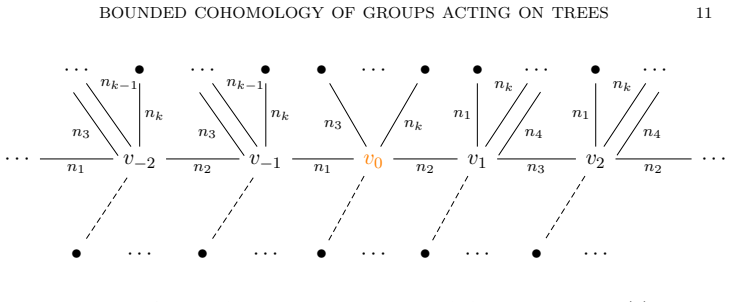
The load-bearing mechanism is a single geodesic line L inside the regular tree. In the 2-transitive case one constructs L from the cycles of a nontrivial permutation in F so that the stabilizer of L contains a translation of length two and a flip, making it act transitively on geometric edges; because the action is amenable, the dual of the aligned complex (the subcomplex spanned by tuples lying on geodesics) lets one replace the bounded cohomology of G by that of the amenable stabilizer of L, forcing all positive-degree groups to vanish. In the opposite case the decisive objects are median quasimorphisms: for a fixed oriented segment s, the map counting the number of G-translates of s along the geodesic from v to gv, homogenized, is a continuous quasimorphism, and non-2-transitivity guarantees that infinitely many of these are linearly independent in $H^{2}$_cb.
What would settle it
Take d=3, F={id}, and F'=Sym({1,2,3}), so F' is 2-transitive; compute whether G({id},F') admits an unbounded continuous homogeneous quasimorphism. If one exists, part (1) of Theorem 1 is false in that allowed case; if none exists, the vanishing likely still holds and the proof needs a separate argument for trivial F.
Extended reading notes
Core claim
On the paper's own terms, the central discovery is that the symmetry of the local permutation group completely controls bounded cohomology in this family. If F' is 2-transitive, G(F,F') admits an amenable action on the d-regular tree with a distinguished geodesic line L such that every finite segment can be moved into L and the set-wise stabilizer of L acts transitively on the geometric edges of L; a general criterion then identifies the bounded cohomology of G(F,F') with that of the stabilizer of L, which is an extension of amenable groups and hence has vanishing bounded cohomology. If F' is not 2-transitive, the same action is minimal and fixes no boundary point, but it also fails to be transitive on length-two segments starting at a fixed vertex, so a trichotomy theorem for actions on trees yields infinitely many linearly independent classes in $H^{2}$_cb, represented by homogenized median quasimorphisms. Together the two cases give an 'if and only if' description of bounded acyclicity for these groups.
Load-bearing premise
For the vanishing statement the proof assumes the smaller group F contains a permutation with a cycle of length at least two; if F is the trivial group, the construction of the line with edge-transitive stabilizer is not carried out, so the theorem as stated is not established in that case.
Editorial extensions
If this is right
- For any d >= 3 and any 2-transitive F' with F < F', the group G(F,F') is a non-amenable boundedly acyclic locally compact group; when F acts freely, every finitely generated direct product subgroup of G(F,F') is finite, so this is acyclicity without the usual direct-product structure.
- The dichotomy classifies bounded acyclicity in the whole family: G(F,F') is boundedly acyclic if and only if F' is 2-transitive on {1,...,d}.
- In the non-2-transitive case, the infinite dimensionality of H^2_cb is witnessed by infinitely many independent homogenized median quasimorphisms, so the failure is already visible in degree two.
- The general criterion applies to any amenable, inversion-free action on a locally finite regular tree admitting such a line, giving a new sufficient condition for bounded acyclicity beyond the specific family studied here.
Reading between the lines
- A natural quantitative next step is to measure how large the infinite-dimensional H^2_cb is, for instance by making explicit the defects of the median quasimorphisms and asking whether the independent classes survive in a normed quotient with controlled geometry.
- Because the vanishing mechanism is a single edge-transitive line in an amenable action, one can look for the same pattern in other locally compact groups acting on trees, such as groups with prescribed local actions where the smaller local group is transitive but not free, as new candidates for bounded acyclicity.
- The role of the hypothesis that F' preserves the orbits of F is not explored in the paper; testing whether the dichotomy persists when this condition is dropped would clarify which part of the structure is essential.
Editorial analysis
A structured set of objections, weighed in public.
Referee Report
Summary. This paper studies the continuous bounded cohomology (with real coefficients) of Le Boudec's locally compact groups G(F,F') acting on the d-regular tree with almost prescribed local actions, where F<F'<Sym(Ω) and F' preserves the orbits of F. Theorem 1 states a dichotomy: if F' is 2-transitive then G(F,F') is boundedly acyclic; otherwise the second continuous bounded cohomology space is infinite-dimensional. The proof of the vanishing part is based on a new criterion, Theorem 2, for bounded acyclicity of a locally compact group acting amenably and without inversions on a locally finite regular tree, provided some line L satisfies a segment-intersection property and its stabilizer acts edge-transitively; the proof uses Bucher-Monod's aligned chain complex. The non-vanishing part uses a theorem of Iozzi-Pagliantini-Sisto on median quasimorphisms. The paper also records a lemma on direct-product subgroups when F acts freely.
Significance. If the results are correct, Theorem 1 provides a sharp and clean dichotomy for a prominent family of non-discrete locally compact groups, adding new examples of non-amenable boundedly acyclic groups and of groups with infinite-dimensional H^2_cb. The aligned-complex criterion in Theorem 2 is of independent interest, and the amenability assumption is well suited to groups that cannot act properly on a tree. The proofs are largely self-contained, with external results used as black boxes; the treatment of continuity of homogenized median quasimorphisms in Remark 3.5 is a useful detail. The main gap I found is in the proof of Theorem 2 at degree n=0, which is fixable and does not appear to affect the main theorem.
major comments (2)
- [Section 5, proof of Theorem 2, Claim] The surjectivity part of the Claim is not proved for n = 0. The argument chooses y as the first vertex after x0 in the segment [x0,xn], which is impossible when x0 = xn; hence no h ∈ H is produced that aligns a single vertex gx0 with g'x0. Since the Claim asserts an isomorphism for every n ≥ 0 and the subsequent identification H^n_cb(G) ≅ H^n_cb(H) uses the cochain isomorphism, this is a gap in the proof of Theorem 2. In the application to G+ this gap can be closed because G+ preserves the bipartition of T and the stabilizer H of L then has the two bipartition classes of L as its vertex orbits, so images of a fixed vertex x under elements of G+ that land in L always lie in a single H-orbit; I suggest the authors either add this argument or reformulate the proof via a mapping-cone/LES argument that only needs isomorphisms in positive degrees and the automatic vanishing of H^1_cb.
- [Section 2, Definition 2.2; Section 5, proof of Theorem 1(1)] The phrase 'F' preserves the orbits of F' is not defined in the paper. The proof of Theorem 1(1) uses it to conclude that F contains a cycle of length at least 2 (hence F is nontrivial), and the proof of Theorem 1(2) uses it to conclude that if F is not transitive then F' is not transitive. Both implications require that every element of F' fixes each F-orbit setwise, not merely that the set of F-orbits is permuted by F'. If only the latter were meant, F={id} would be allowed with 2-transitive F' and the proof of part (1) would fail. Please state the intended meaning explicitly in Section 2 and, if necessary, add a short justification of the nontrivial-cycle step.
minor comments (5)
- [Section 4, Definition 4.1] The equivalence relation on alternating chains is described 'for all σ ∈ Sym(Ω)', but the symmetric group should act on the coordinates of the (n+1)-tuple, not on Ω = {1,...,d}.
- [Section 5, proof of Theorem 2] The sentence 'Since y is adjacent to x0 and G acts without inversions, the case hgx0 = g'y cannot happen' gives an inaccurate reason; the real obstruction is that this endpoint swap would place h(gxn) on the wrong side of the line L, so h(gxn)=g'xn would be impossible. Please rephrase.
- [Section 5, proof of Theorem 1(1)] In the construction of the translation t, the sentence 'The transitivity of F grants that there exists a permutation in F which sends w to its prescribed image' should be phrased precisely: a permutation in F sends the color of the edge from w to L to the color of the prescribed image edge.
- [Section 5, proof of Theorem 1(1)] The assertion that each segment can be sent into L by an element of even displacement length is stated without proof; please expand it by noting that vertex-transitivity and transitivity on segments allow the initial vertex to be mapped to a vertex of L at even distance.
- [Theorem 2 statement] The notation 'Td' suggests a regular tree of degree d, but the statement does not specify the degree; please state explicitly that d ≥ 2 or simply say 'a locally finite regular tree'.
Circularity Check
No circularity: the vanishing and non-vanishing proofs rest on independent external theorems, with no fitted inputs or self-citation chain; the F={id} issue is a proof gap, not circularity.
full rationale
The derivation chain is self-contained with respect to circularity. The vanishing result (Theorem 1(1)) is obtained by applying Theorem 2, whose proof uses Monod's resolution computing bounded cohomology from amenable regular G-spaces, and the Bucher–Monod aligned complex; these are external results used as tools, not restatements of the theorem. The non-vanishing result (Theorem 1(2)) invokes Iozzi–Pagliantini–Sisto's quasimorphism criterion (external) and rules out its first two alternatives from the permutation-group hypotheses. The construction of the line L in Section 5 is explicit from F and F' and is not fitted to the conclusion. There is no fitted parameter renamed as a prediction and no load-bearing self-citation. A separate correctness concern is that the proof of Theorem 1(1) assumes a nontrivial permutation in F when it chooses τ with a cycle length at least 2; if F={id}, which is not excluded by the hypotheses (the singleton partition is invariant under any F'), no such τ exists, so that case appears unhandled. This is a proof gap, not a circular step, and therefore does not raise the circularity score.
Assumptions & free parameters
assumptions (4)
- ad hoc to paper F contains a nontrivial permutation, i.e. a cycle of length at least 2.
- standard math The aligned cochain complex computes bounded cohomology for amenable actions on trees.
- domain assumption Point stabilizers in G(F,F') are amenable.
- standard math U(id) is isomorphic to the free product of d copies of Z/2.
Cite this review
Pith. "Pith review of Bounded cohomology of groups acting on trees with almost prescribed local actions." pith.science (2026). https://pith.science/paper/IMTIZERU
@misc{pith2026241215463,
  author       = {Pith},
  title        = {Pith review of: Bounded cohomology of groups acting on trees with almost prescribed local actions},
  year         = {2026},
  howpublished = {\url{https://pith.science/paper/IMTIZERU}},
  note         = {Machine review of arXiv:2412.15463}
}
abstract
We prove the vanishing of bounded cohomology of the groups acting on trees with almost prescribed local actions $G(F, F')$, where $F<F'$ are finite permutation groups such that $F'$ is 2-transitive. By contrast, when $F'$ is not 2-transitive, we prove that the second bounded cohomology with real coefficients of the groups $G(F, F')$ is infinite dimensional.
Figures

Reference graph
Works this paper leans on
-
[1]
P. Abramenko and K. Brown. Buildings: T heory and A pplications . Springer New York, NY, 2008
work page 2008
-
[2]
S. Amontova and M. Bucher. Trivial cup products in bounded cohomology of the free groups via aligned chains. Forum Math. , 34(4):933--943, 2022
work page 2022
-
[3]
B. Bekka and P. de la Harpe. Groups with simple reduced C^* -algebra. Expo. Math. , 18(3):215--230, 2000
work page 2000
-
[4]
M. Bestvina and K. Fujiwara. Bounded cohomology of subgroups of mapping class groups . Geom. T op. , 6(1):69 -- 89, 2002
work page 2002
-
[5]
M. Burger and S. Mozes. Groups acting on trees : from local to global structure. Publ. Math. de l'IHÉS , 92:113--150, 2000
work page 2000
-
[6]
M. Bucher and N. Monod. The bounded cohomology of SL _ 2 over local fields and S -integers. Int. Math. Res. Not. , 2019(6):1601--1611, 2017
work page 2019
-
[7]
M. Bucher and N. Monod. The cup product of B rooks quasimorphisms. Forum Math. , 30(5), 2017
work page 2017
-
[8]
J. Button. Groups acting faithfully on trees and properly on products of trees, 2019. ar X iv/1910.04614
work page Pith review arXiv 2019
Show all 33 references
-
[9]
Calegari
D. Calegari. scl , volume 20 of MSJ Mem. Mathematical Society of Japan, Tokyo, 2009
2009
-
[10]
Caprace and K
PE. Caprace and K. Fujiwara. Rank-one isometries of buildings and quasi-morphisms of K ac– M oody groups. Geom. Funct. Anal. , 19:1296–1319, 10
-
[11]
Campagnolo, F
C. Campagnolo, F. Fournier-Facio, Y. Lodha, and M. Moraschini. An algebraic criterion for the vanishing of bounded cohomology, 2024. ar X iv/2311.16259
2024 arXiv
-
[12]
Campagnolo, F
C. Campagnolo, F. Fournier-Facio, Y. Lodha, and M. Moraschini. Displacement techniques in bounded cohomology. to appear in manuscripta math., 2024. ar X iv/2401.08857
2024 arXiv
-
[13]
D. B. A. Epstein and K. Fujiwara. The second bounded cohomology of word-hyperbolic groups. Topology , 36(6):1275--1289, 1997
1997
-
[14]
Fournier-Facio
F. Fournier-Facio. Infinite sums of B rooks quasimorphisms and cup products in bounded cohomology, 2020. ar X iv, 2002.10323
2020 arXiv
-
[15]
Fournier-Facio, C
F. Fournier-Facio, C. L \"o h, and M. Moraschini. Bounded cohomology and binate groups. J. Aus. Math. Soc. , 115:204--239, 2023
2023
-
[16]
Fournier-Facio, N
F. Fournier-Facio, N. Monod, S. Nariman, and A. Kupers. The bounded cohomology of transformation groups of E uclidean spaces and discs, 2024. ar X iv/2405.20395
2024 arXiv
-
[17]
Frigerio
R. Frigerio. Bounded cohomology of discrete groups , volume 227 of Mathematical Surveys and Monographs . American Mathematical Society, Providence, RI, 2017
2017
-
[18]
Fujiwara
K. Fujiwara. The second bounded cohomology of a group acting on a G romov-hyperbolic space. Proc. London Math. Soc. , 76(1):70–94, 1998
1998
-
[19]
Fujiwara
K. Fujiwara. The second bounded cohomology of an amalgamated free product of groups. Trans. Am. Math. Soc. , 352(3):1113--1129, 2000
2000
-
[20]
Garrido, Y
A. Garrido, Y. Glasner, and S. Tornier. Automorphism groups of trees: generalities and prescribed local actions , page 92–116. London Math. Soc. Lecture Note Ser. Cambridge University Press, 2018
2018
-
[21]
F. Hofmann. Quasimorphisms and bounded cohomology. Master Thesis, October 2024
2024
-
[22]
Iozzi, C
A. Iozzi, C. Pagliantini, and A. Sisto. Characterising actions on trees yielding non-trivial quasimorphisms. Ann. Math. Qu \'e . , 45:185--202, 2020
2020
-
[23]
B.E. Johnson. Cohomology in B anach algebras. Mem. of the Am. Math. Soc. , 1972
1972
-
[24]
Le Boudec
A. Le Boudec. Groups acting on trees with almost prescribed local action. Comment. Math. Helv. , 91:253--293, 2015
2015
-
[25]
Le Boudec
A. Le Boudec. C^* -simplicity and the amenable radical. Invent. Math. , 209:159--174, 2016
2016
-
[26]
D. Marasco. Trivial M assey product in bounded cohomology, 2022. ar X iv/2209.00560
2022 arXiv
-
[27]
Matsumoto and S
S. Matsumoto and S. Morita. Bounded cohomology of certain groups of homeomorphisms. Proc. Am. Math. Soc. , 94(3):539--544, 1985
1985
-
[28]
N. Monod. Continuous Bounded Cohomology of Locally Compact Groups . Springer Berlin Heidelberg, 2001
2001
-
[29]
N. Monod. Lamplighters and the bounded cohomology of T hompson’s group. Geom. Funct. Anal. , 32(3):662–675, 2022
2022
-
[30]
N. Monod. Flatmates and the bounded cohomology of algebraic groups, 2024. ar X iv/2407.01709
2024
-
[31]
J. T. Moore. A brief introduction to amenable equivalence relations. Trends in Set Theory , 2018
2018
-
[32]
D. J. S. Robinson. A Course in the Theory of Groups . Springer New York, 1996
1996
-
[33]
J. Tits. Buildings of S pherical T ype and F inite BN - P airs . Springer Berlin, Heidelberg, 1974
1974
Reviewed August 11, 2026 · model on record in the stance chip above.
Discussion (0). Continue with ORCID to comment.