REVIEW 4 major objections 5 minor 30 references
Random Batch Method with Momentum Correction
T0 review · 4 major / 5 minor · reviewed 2026-08-11 · deepseek-v4-flash
Pith's one-line read This paper claims that adding a momentum-like correction to the Random Batch Method yields a provably smaller error bound than the original method, with the same O(N) cost, and numerically cuts the error roughly in half for particle…
desk verdict The momentum idea is cheap and the numerics on singular kernels show real gains, but the main theorem bounds a position-averaging recurrence that is not the force-averaging algorithm actually implemented, and the 'mathematically proven smaller error' claim does not follow from the displayed bound. read the letter →
The pith
A machine-rendered reading of the paper's core claim, the machinery that carries it, and where it could break.
The reading
What carries the argument
The load-bearing object is the momentum-corrected interaction kernel $K_{\mathrm{cor}}(X_i-X_j) = \beta K_{t-1}(X_i-X_j) + (1-\beta) K_t(X_i-X_j)$, equivalently the exponential-weighted averaging of RBM iterates $\tilde{u}_n^p = \beta^n u_0^p + (1-\beta)\sum_{i=1}^n \beta^{n-i}u_i^p$. The proof of Theorem 3.2 expands this average, keeps only the final two history terms, bounds the rest as $O(\beta^2)$, and uses Proposition 2.1 (the RBM error bound from [1]) plus Proposition 3.1 (adjacent-step error $O(\tau)$) on the surviving terms. The hyperparameter $\beta$ controls correction strength: larger $\beta$ damps the RBM baseline error more strongly but adds the momentum-error term $\beta(1-\beta)\tau$.
What would settle it
One concrete check would be to evaluate the discarded tail directly: for a small system, compute $u_i^p$ from RBM for $i=0,\dots,n$ and compare $(1-\beta)\sum_{i=0}^{n-2}\beta^{n-i}\|u_i^p - E\| + \beta^n\|u_0^p - E\|$ against the claimed $O(\beta^2)$ term in Theorem 3.2 with, say, $\beta=0.1$, $\tau=10^{-4}$, and large $n$. If the tail is not bounded by a constant times $\beta^2$ (with constants set by Propositions 2.1 and 3.1), the leading $(1-\beta^2)$ factor is unsupported. A numerical companion test is to run RBM and RBM-M on kernel K6 from Table 3 at $\tau=0.001$ and $\beta=0.1$ and see whether the error ratio matches $(1-\beta^2)$ or instead reflects an unrelated improvement.
Extended reading notes
Core claim
On the paper's own terms, the discovery is that a momentum-like correction to the random batch force produces a strictly smaller leading error term without changing the algorithm's complexity. Writing $u_i^p$ for the RBM solution at step i and $\tilde{u}_i^p$ for the RBM-M solution, the correction is $\tilde{u}_i^p = \beta \tilde{u}_{i-1}^p + (1-\beta) u_i^p$, equivalently an exponential-weighted average of all past RBM iterates. Theorem 3.2 states that under the same convexity and smoothness assumptions used for RBM, $\lVert E - \tilde{u}_n^p \rVert \le C(1-\beta^2)\sqrt{\tau/(p-1)+\tau^2} + C\beta(1-\beta)\tau + O(\beta^2)$, leading the authors to write: 'We have mathematically proven that the error of the RBM-M is smaller than that of the RBM.' The paper also proves an asymptotic-unbiasedness result for the corrected estimator (Theorem 3.4), a variance reduction relative to RBM (Theorem 3.5), and a rescaled relative-entropy bound of order $C_1\tau^2 + C_2/N$ between the RBM-M joint distribution and the reference solution (Theorem 3.7).
Load-bearing premise
The load-bearing premise is that, inside the norm in the proof of Theorem 3.2, all but the last two terms of the exponential-weighted history can be discarded with only $O(\beta^2)$ error; that discarding step is what produces the $(1-\beta^2)$ factor, and it requires the earlier RBM iterates to stay uniformly close to the true solution.
Editorial extensions
If this is right
- Under the theorem's ideal smooth-kernel conditions, the leading term of the RBM-M error bound is smaller than RBM's by the factor $(1-\beta^2)$, so in the $\tau\to 0$ limit the method is claimed to be more accurate rather than merely comparable.
- RBM-M keeps the O(N) per-step complexity of RBM, since the extra computation is only two multiplications and one addition per interaction.
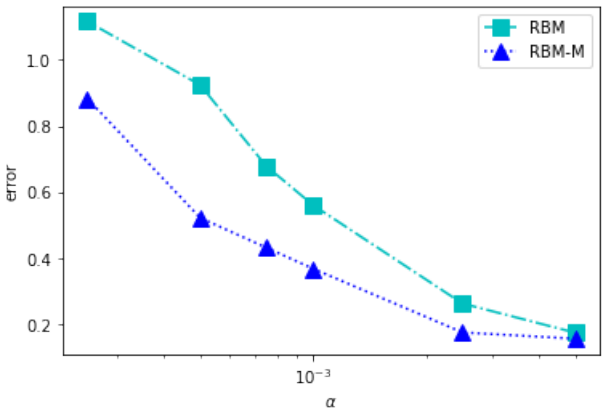
- The hyperparameter $\beta$ provides a tunable trade-off: the numerical tables show small $\beta$ (about 0.01) best for smoother systems and larger $\beta$ (about 0.1) best for more singular systems, with RBM-M errors falling to roughly 43-59% of RBM's error in the singular cases.
- The corrected batch estimator is asymptotically unbiased as $\tau,\beta\to 0$, and for small $\tau$ and $\beta$ its variance is below RBM's by roughly the factor $(1-\beta)^2/(1-\beta^2)$, which the paper interprets as making RBM-M statistically more stable.
- The rescaled relative entropy between the RBM-M joint distribution and the reference solution is bounded by $C_1\tau^2 + C_2/N$, giving a mean-field-style guarantee alongside the trajectory error bound.
Reading between the lines
- The theorem is proven only for bounded Lipschitz kernels, the regime where plain RBM already works; the claimed advantage for singular kernels rests on the heuristic that the momentum term smooths the batch estimator plus the numerical tables. A rigorous singular-kernel version would need an RBM error bound that grows with the kernel's singularity, which the current proof does not supply.
- Balancing the two terms in Theorem 3.2 (damping $(1-\beta^2)\sqrt{\tau}$ against momentum cost $\beta(1-\beta)\tau$) suggests an optimal $\beta$ of order $\sqrt{\tau}$ in the smooth regime, which would make the improvement over RBM of order $\tau$; this is a testable prediction the paper does not state.
- The momentum update is mathematically identical to exponential smoothing of the batch force estimator, so the variance reduction in Theorem 3.5 should carry over to other stochastic approximation schemes, suggesting a general principle: smoothing a high-variance, heavy-tailed batch estimator helps most when the estimator's distribution has large outliers, exactly the singular-kernel case.
- Because the correction reuses only past forces, it can be combined with other fast summation ideas that also approximate the all-to-all force; the momentum correction is orthogonal to how the batch force is computed.
Editorial analysis
A structured set of objections, weighed in public.
Referee Report
Summary. The paper proposes a momentum-correction variant of the Random Batch Method (RBM-M) for interacting particle systems, claiming to reduce error relative to the standard RBM when interaction kernels have large singularities. The method regularizes singular kernels and introduces a momentum parameter beta, and the paper presents theoretical error bounds, a variance analysis, and numerical experiments. The central theoretical claim is Theorem 3.2, which asserts an error bound of the form C(1-beta^2) sqrt(tau/(p-1)+tau^2) + C beta(1-beta) tau + O(beta^2), supposedly proving that the error of RBM-M is smaller than that of RBM. The paper also presents unbiasedness and variance results (Theorems 3.4 and 3.5) and a relative-entropy estimate (Theorem 3.7).
Significance. If established, the result would be a useful contribution: an O(N) method with improved accuracy for singular interaction kernels, backed by an explicit error bound and variance reduction. The paper correctly identifies a real limitation of the standard RBM for nonsmooth kernels, and the regularized-kernel idea is reasonable. However, the proof of the central theorem does not analyze the algorithm that is actually implemented, the key truncation step in the proof is unjustified, and the variance theorem rests on a false independence assumption. These issues undermine the paper's main claim, so the significance cannot be credited from the evidence presented.
major comments (4)
- [Section 3.1, proof of Theorem 3.2 (Eq. (3.4))] The proof truncates the expansion of \tilde{u}_n^p to its last two terms, discarding all earlier terms as O(beta^2). This truncation is not justified: the discarded terms are (1-beta) sum_{i=1}^{n-2} beta^{n-i} u_i^p, and although each coefficient beta^{n-i} with n-i >= 2 is O(beta^2) as beta -> 0, the number of terms grows as n = T/tau, and the RBM solutions u_i^p are not shown to be uniformly bounded in i and tau. Consequently, the sum of discarded terms need not be O(beta^2), and the factor (1-beta^2) in the final bound, which arises solely from this truncation, is not supported.
- [Section 2.3 and Section 3.1 (Algorithm 1 vs. Eqs. (3.1)-(3.2))] The method analyzed in Theorem 3.2 is not the method presented in Algorithm 1. Section 2.3 defines RBM-M by solving, over each batch interval, the SDE with interaction kernel K_cor(X_i - X_j) = beta K_{t-1}(X_i - X_j) + (1-beta) K_t(X_i - X_j), whereas Section 3.1 (Eqs. (3.1)-(3.2)) analyzes the recurrence \tilde{u}_i^p = beta \tilde{u}_{i-1}^p + (1-beta) u_i^p, i.e., a convex combination of previously computed RBM solutions. These two processes differ already for a scalar linear problem: with p=N, V=0, sigma=0, K(x)=-x, tau=0.1, beta=0.5, the recurrence gives \tilde{u}_1 = 0.95 x_0, while the Algorithm 1 Euler step gives x_1 = (1 - tau beta)/(1 + tau(1-beta)) x_0 = 0.9048 x_0. Therefore Theorem 3.2 does not provide an error bound for the algorithm that is implemented and tested in Section 4.
- [Section 3.2, Theorem 3.5 (Eq. (3.18))] The proof explicitly assumes that K(x_i^{t1} - x_j^{t1}) and K(x_i^{t2} - x_j^{t2}) are independent for t1 != t2 because the regroupings at different times are independent. This assumption is false for the particle system (1.1): the positions themselves are strongly dependent over time through the shared drift, interaction, and Brownian paths, so the kernel evaluations at different times are correlated. Only the random batch partitions are independent. The variance decomposition in the proof is therefore invalid, and the claimed variance reduction factor (1-beta)^2/(1-beta^2) is not established.
- [Section 3.1, Eq. (3.4) and Section 4.2] Even if the truncation step were valid, Eq. (3.4) does not imply that the RBM-M error is smaller than the RBM error. The displayed bound contains an additional positive term C beta(1-beta) tau + O(beta^2) that is not present in the RBM bound (Proposition 2.1). For typical parameters used in Section 4 (tau=0.001, p=360, beta=0.1), the RBM-M bound is actually larger than the RBM bound unless the O(beta^2) term is negative or the first-term reduction dominates; the paper gives no condition under which the extra term is dominated by the factor (1-beta^2). Thus the sentence 'We have mathematically proven that the error of the RBM-M is smaller than that of the RBM' does not follow from the displayed inequality.
minor comments (5)
- [Throughout] The manuscript contains numerous typographical errors and inconsistent notation (e.g., 'Lipshitz', 'Tayler', 'satisfies', and the mixing of \tilde{\rho} with \tilde{\varrho} in Section 3.3); a careful proofreading pass is needed.
- [Section 2.3, Algorithm 1] The line 'K(X_i - X_j)=0 when time=0' is ambiguous; it presumably initializes the momentum buffer, but the algorithm does not specify how K_{t-1} is stored or updated for each particle pair across time steps.
- [Section 2.2 and Section 4] The regularization parameter delta in Eq. (2.1) is never reported for the numerical experiments in Section 4, and no code is provided; this makes the numerical results difficult to reproduce and prevents verification that the experiments satisfy the smoothness assumptions of the theorems.
- [Section 4.3, Figure 6 and Table 4] The text states that each point in Figure 6 is the average of 10 repeated calculations, but error bars or standard deviations are not shown, and Table 4 reports only single-run errors; adding measures of variability would make the comparison between RBM and RBM-M more convincing.
- [Section 4.3] The sentence 'When the function is flatter, we use a smaller beta, and when the function is more steep, we use a larger beta (the final difference has decreased because the singularity of the function is too large, and a larger beta should be selected)' is confusing and appears to contradict the previous prescription; it should be rewritten for clarity.
Circularity Check
The central 'mathematical proof' that RBM-M has smaller error is a property of the weighted-average definition (3.1)-(3.2), not of Algorithm 1's K_cor dynamics; the advertised (1-beta^2) factor is manufactured by that definition and the O(beta^2) truncation.
-
self definitional
[Section 3.1, Eqs. (3.1)-(3.2) and proof of Theorem 3.2, Eq. (3.4)]
"Second, let us review the algorithmic process of RBM-M: \tilde u_p^0 = u_p^0, \tilde u_p^i = \beta \tilde u_p^{i-1} + (1-\beta) u_p^i (i \ge 1). ... Substitute the definition of \tilde u_p^n: \|E - \tilde u_p^n\| \le \|E - (\beta^n u_p^0 + (1-\beta)\sum_{i=1}^n \beta^{n-i} u_p^i)\|. \beta is vary small so that the high-order terms of \beta can be almost ignored: \|(1-\beta^2)E - (1-\beta)\beta u_{p1}^{n-1} - (1-\beta) u_{p2}^n\| + O(\beta^2)."
The theorem's object \tilde u_p^n is defined in (3.1)-(3.2) as an exponential weighted average of RBM solutions u_p^i, not as the K_cor-driven SDE trajectory of Algorithm 1. The proof then substitutes this definition and discards all terms with i <= n-2 as O(beta^2), which is exactly what creates the advertised factor (1-beta^2) in front of the RBM error bound taken from Proposition 2.1. The untruncated weights sum to 1, so the full convex combination would merely reproduce the RBM error bound; the improvement is therefore an algebraic artifact of the chosen definition and truncation.
full rationale
The paper contains no load-bearing self-citation chain: the central error bound uses the external RBM estimate of Jin-Li-Liu (reference [1]), and the entropy estimates in Section 3.3 borrow from [28]-[30], none of which are authored by the present authors. The numerical experiments are independent benchmark computations, not fitted predictions. The significant circularity is in the theoretical claim itself. Theorem 3.2 is stated as the error bound of Algorithm 1, but the proof's object is the recurrence (3.2), which defines the RBM-M solution as a convex combination of RBM solutions u_p^i. The factor (1-beta^2) and the 'smaller than RBM' conclusion are consequences of this weighted-average definition plus the O(beta^2) truncation of the exponential sum; they do not follow from the K_cor-averaged interaction force in Eq. (2.2). For a scalar linear test with V=0, sigma=0, K(x)=-x, Algorithm 1's Euler step already differs from (3.2), so the theorem bounds an auxiliary method, not the method tested in Section 4. This is a self-definitional reduction of the paper's main theoretical prediction, warranting a score of 6. The remaining statistical and entropy results, whatever their correctness, are not circular in the same way.
Assumptions & free parameters
free parameters (3)
- beta (momentum weight) =
0.01 to 0.12 (chosen per experiment)
- p (particles per batch) =
360
- delta (regularization parameter) =
unspecified
assumptions (4)
- domain assumption Strong convexity of V and bounded, Lipschitz K with bounded second derivatives (Prop 2.1 from [1])
- ad hoc to paper Kernel evaluations at different times are independent (Theorem 3.5)
- ad hoc to paper The O(beta^2) truncation in the proof of Theorem 3.2 is valid
- standard math Standard stochastic analysis framework (Fokker-Planck, Liouville equation, Log-Sobolev inequality) from [28,29]
Cite this review
Pith. "Pith review of Random Batch Method with Momentum Correction." pith.science (2026). https://pith.science/paper/ZRUS2OHC
@misc{pith2026241215581,
  author       = {Pith},
  title        = {Pith review of: Random Batch Method with Momentum Correction},
  year         = {2026},
  howpublished = {\url{https://pith.science/paper/ZRUS2OHC}},
  note         = {Machine review of arXiv:2412.15581}
}
read the original abstract
The Random Batch Method (RBM) is an effective technique to reduce the computational complexity when solving certain stochastic differential problems (SDEs) involving interacting particles. It can transform the computational complexity from O(N^2) to O(N), where N represents the number of particles. However, the traditional RBM can only be effectively applied to interacting particle systems with relatively smooth kernel functions to achieve satisfactory results. To address the issue of non-convergence of the RBM in particle interaction systems with significant singularities, we propose some enhanced methods to make the modified algorithm more applicable. The idea for improvement primarily revolves around a momentum-like correction, and we refer to the enhanced algorithm as the Random Batch Method with Momentum Correction ( RBM-M). We provide a theoretical proof to control the error of the algorithm, which ensures that under ideal conditions it has a smaller error than the original algorithm. Finally, numerical experiments have demonstrated the effectiveness of the RBM-M algorithm.
Figures


Figures from the paper (4 more)



Reference graph
Works this paper leans on
- [1]
-
[2]
Z. Wang, J. Xin, Z. Zhang, Deepparticle: Learning invariant measure by a deep neural network minimizing wasserstein distance on data generated from an interacting particle method, Journal of Computational Physics 464 (2022) 111309.doi:https://doi.org/10.1016/ j.jcp.2022.111309
arXiv 2022
-
[3]
B. Perthame, Pde models for chemotactic movements: Parabolic, hyperbolic and kinetic, Applications of Mathematics 49 (2004) 539–564
work page 2004
-
[4]
L. Greengard, V. Rokhlin, A fast algorithm for particle simulations, Journal of Computational Physics 73 (2) (1987) 325–348.doi:https: //doi.org/10.1016/0021-9991(87)90140-9
-
[5]
J. S. Bagla, Treepm: A code for cosmological n-body simulations, Journal of Astrophysics and Astronomy 23 (1999) 185–196
work page 1999
-
[6]
Y. Yao, J. Capecelatro, An accurate particle-mesh method for simulating charged particles in wall-bounded flows, Powder Technology 387 (2021) 239–250. doi:https://doi.org/10.1016/j.powtec.2021.04.012. Zhao et al.:Preprint submitted to Elsevier Page 24 of 25
-
[7]
Ruder, An overview of gradient descent optimization algorithms, ArXiv abs/1609.04747 (2016)
S. Ruder, An overview of gradient descent optimization algorithms, ArXiv abs/1609.04747 (2016)
arXiv 2016
-
[8]
J.Lin,C.Song,K.He,L.Wang,J.E.Hopcroft,Nesterovacceleratedgradientandscaleinvarianceforimprovingtransferabilityofadversarial examples, ArXiv abs/1908.06281 (2019)
arXiv 2019
Show all 30 references
-
[9]
Chaintron, A
L.-P. Chaintron, A. Diez, Propagation of chaos: A review of models, methods and applications. i. models and methods, Kinetic and Related Models (2022)
2022
-
[10]
CLIFFORD, A
P. CLIFFORD, A. SUDBURY, A model for spatial conflict, Biometrika 60 (3) (1973) 581–588.doi:10.1093/biomet/60.3.581
1973 doi
-
[11]
J. M. Swart, A course in interacting particle systems, arXiv: Probability (2017)
2017
-
[12]
Ferreiro-Castilla, A
A. Ferreiro-Castilla, A. E. Kyprianou, R. Scheichl, An euler-poisson scheme for lévy driven sdes, arXiv: Probability (2013)
2013
-
[13]
J. Hong, C. Huang, X. Wang, Strong convergence rate of runge–kutta methods and simplified step-$n$ euler schemes for sdes driven by fractional brownian motions, arXiv: Numerical Analysis (2017)
2017
-
[14]
Z. Wang, J. X. Xin, Z. Zhang, Deepparticle: learning invariant measure by a deep neural network minimizing wasserstein distance on data generated from an interacting particle method, J. Comput. Phys. 464 (2021) 111309
2021
-
[15]
Z. Wang, J. X. Xin, Z. Zhang, A deepparticle method for learning and generating aggregation patterns in multi-dimensional keller-segel chemotaxis systems, ArXiv abs/2209.00109 (2022)
2022 arXiv
-
[16]
S. Jin, L. Li, Random batch methods for classical and quantum interacting particle systems and statistical samplings, ArXiv abs/2104.04337 (2021)
2021 arXiv
-
[17]
J.Liu,L.Wang,Z.jiangZhou,Positivity-preservingandasymptoticpreservingmethodfor2dkeller-segalequations,Math.Comput.87(2016) 1165–1189
2016
-
[18]
M.Eisterer,Thesignificanceofsolutionsoftheinversebiot–savartprobleminthicksuperconductors,SuperconductorScienceandTechnology 18 (2004) S58 – S62
2004
-
[19]
X. Chen, Z. S. Wu, M. Hong, Understanding gradient clipping in private sgd: A geometric perspective, ArXiv abs/2006.15429 (2020)
2020 arXiv
-
[20]
L. Kong, M. Tao, Quantitative convergences of lie group momentum optimizers, ArXiv abs/2405.20390 (2024)
2024 arXiv
-
[21]
D. P. Kingma, J. Ba, Adam: A method for stochastic optimization, CoRR abs/1412.6980 (2014)
2014 arXiv
-
[22]
D.Xu,S.Zhang,H.Zhang,D.P.Mandic,Convergenceofthermspropdeeplearningmethodwithpenaltyfornonconvexoptimization,Neural Networks 139 (2021) 17–23.doi:https://doi.org/10.1016/j.neunet.2021.02.011
2021 doi
-
[23]
J. A. Carrillo, Y. Huang, S. Martin, Explicit flock solutions for quasi-morse potentials, European Journal of Applied Mathematics 25 (2013) 553 – 578
2013
-
[24]
Degond, M
P. Degond, M. Engel, Coagulation–fragmentation model for animal group-size statistics, Journal of Nonlinear Science 27 (2015) 379–424
2015
-
[25]
Vicsek, A
T. Vicsek, A. Czirók, E. Ben-Jacob, I. Cohen, O. Sochet, Novel type of phase transition in a system of self-driven particles., Physical review letters 75 6 (1995) 1226–1229
1995
-
[26]
J. A. Carrillo, S. Lisini, E. Mainini, Uniqueness for keller-segel-type chemotaxis models, Discrete and Continuous Dynamical Systems 34 (2012) 1319–1338
2012
-
[27]
Motsch, E
S. Motsch, E. Tadmor, Heterophilious dynamics enhances consensus, SIAM Rev. 56 (2013) 577–621
2013
-
[28]
Huang, S
Z. Huang, S. Jin, L. Li, Mean field error estimate of the random batch method for large interacting particle system, ArXiv abs/2403.08336 (2024)
2024 arXiv
-
[29]
L. Li, Y. Wang, A sharp uniform-in-time error estimate for stochastic gradient langevin dynamics, ArXiv abs/2207.09304 (2022)
2022 arXiv
-
[30]
S. Jin, L. Li, On the mean field limit of the random batch method for interacting particle systems, Science China Mathematics 65 (2020) 169 – 202. Zhao et al.:Preprint submitted to Elsevier Page 25 of 25
2020
Reviewed August 11, 2026 · model on record in the stance chip above.
Discussion (0). Continue with ORCID to comment.