REVIEW 2 major objections 4 minor 30 references
Cohomological lifting of multi-toric graphs
T0 review · 2 major / 4 minor · reviewed 2026-08-11 · deepseek-v4-flash
Pith's one-line read For circle bundles over symplectic $SU(3)$-manifolds, compact edges of the base multi-moment graph lift to $G_2$ multi-moment graph edges, with endpoint differences given by intersection products $[\omega]\cap[E]$ and $[F]\cap[E]$; in the…
desk verdict Core lifting formulas and loop-closure criterion are correct; fix the sign typo in Example 5.1. read the letter →
The pith
A machine-rendered reading of the paper's core claim, the machinery that carries it, and where it could break.
The reading
What carries the argument
The load-bearing object is the multi-moment graph: for a closed $G_2$-structure with a $T^3$-action, the image under the multi-moment map $\nu: M \to \Lambda^2 \mathrm{Lie}(T^3)^* \cong \mathbb{R}^3$ of the points with non-trivial stabiliser, an embedded trivalent graph whose edges are straight lines with rational tangents and whose vertices satisfy a zero-tension condition. On the six-dimensional base, the analogous graph is defined from the symplectic moment map $\mu$ of the $T^2$-action on the symplectic $SU(3)$-structure. The lifting mechanism is the relation between the $G_2$ three-form and the $SU(3)$ data of the base, together with the Hamiltonian condition $d\lambda_i = -F(X_i,\cdot)$ on the circle bundle's curvature; combining these, formulas (3.7)–(3.10) express endpoint differences as the intersection products $[\omega]\cap[E]$ and $[F]\cap[E]$, with $E$ the surface generated by the edge and the complementary circle action.
What would settle it
Using the star-triangulated hexagon example with integer coefficients for which $[\omega]\cup[F] \neq 0$, compute $\nu_3(q_7) - \nu_3(q_1)$ from (4.5) and (4.6); Theorem 4.3 predicts a non-zero value, so a result of zero—or any edge whose endpoint difference contradicts (3.7)–(3.10)—would falsify the central claim.
Extended reading notes
Core claim
The paper's central claim is that the compact part of the $G_2$ multi-moment graph of a circle bundle $M \to B$ is determined, edge by edge, by cohomological data of the base. If $B$ carries a symplectic $SU(3)$-structure with an effective multi-Hamiltonian $T^2$-action, and the curvature $F$ of the circle bundle satisfies the Hamiltonian condition (3.2), then each compact edge $e$ of the base graph, whose stabiliser is generated by $X = r_1 X_1 + r_2 X_2$, lifts to a corresponding edge of the $G_2$ graph. Writing $E$ for the surface swept out by the edge under the complementary circle action, the endpoint differences are given by $\mu(c) - \mu(b) = [\omega]\cap[E](-r_2,r_1)$, $\lambda(c) - \lambda(b) = -[F]\cap[E](-r_2,r_1)$, and $\nu_3(c) - \nu_3(b) = t(r_1\lambda_1 + r_2\lambda_2)$ with $t = [\omega]\cap[E]$. In the toric Calabi-Yau case, Theorem 4.3 states that the lifted polygon closes if and only if $[\omega]\cup[F]=0$.
Load-bearing premise
The lifting only works if the circle bundle's curvature $F$ is Hamiltonian for the torus action: functions $\lambda_1, \lambda_2$ must exist with $d\lambda_i = -F(X_i,\cdot)$, and if they do not exist there is no lifted three-torus action and no $G_2$ multi-moment graph to compute.
Editorial extensions
If this is right
- For any compact edge of the base multi-moment graph, the lifted $G_2$ edge's direction and length are computed directly from $[\omega]\cap[E]$ and $[F]\cap[E]$, with no differential equations to solve.
- A loop in the base graph lifts to a closed loop in the $G_2$ graph exactly when $[\omega]\cup[F]=0$ on the corresponding cycle; in the toric Calabi-Yau setting the paper proves this equivalence as Theorem 4.3.
- The cohomological condition $[\omega]\cup[F]=0$ used in known circle-bundle constructions of complete non-compact $G_2$-manifolds is not an artefact of the adiabatic-limit method, but is forced by the graph geometry itself.
- The additive constants in $\lambda$ and $\nu$ correspond to affine changes of the graph, so lifted graphs can be computed relative to an arbitrary basepoint, as the paper's examples do.
- In the examples (the $M_{m,n}$ spaces, the star-triangulated hexagon, and the second resolution of the conifold quotient), the formulas produce the full compact part of the $G_2$ graph, including non-planar configurations when $[\omega]\cup[F]\neq 0$.
Reading between the lines
- The same formulas should apply to any multi-Hamiltonian $T^2$-action on a symplectic $SU(3)$-manifold with a curvature satisfying (3.2), so the lifting procedure is not restricted to toric or Calabi-Yau bases.
- Graph closure could serve as a necessary cohomological test for the existence of torsion-free $G_2$-structures in this circle-bundle class: a base whose lifted graph fails to close cannot admit the corresponding $G_2$ metric.
- The non-planar examples suggest that varying $[F]$ moves vertices of the lifted graph in the third coordinate, giving a way to engineer $G_2$ multi-moment graphs with prescribed three-dimensional shapes.
- The expectation expressed in Remark 5.3, that versal deformations of toric singularities produce graphs whose components lie in distinct parallel affine planes, is a testable consequence of the same lifting picture.
Editorial analysis
A structured set of objections, weighed in public.
Referee Report
Summary. The paper studies seven-dimensional manifolds with closed G2-structures obtained as circle bundles over six-dimensional symplectic SU(3)-manifolds carrying a two-torus symmetry. Under a multi-Hamiltonian hypothesis, the authors derive cohomological formulas for how the compact part of the base multi-moment graph lifts to the G2 multi-moment graph: along an edge with stabilizer generated by X = r1X1+r2X2, the moment-map differences are given by equations (3.7)-(3.10), involving the classes [omega], [F], and the homology class of the corresponding surface [E]. In the toric Calabi-Yau case, the paper specializes to a fan computation and proves in Theorem 4.3 that the lifted polygon closes exactly when [omega] union [F] = 0, matching a condition appearing in the Foscolo-Haskins-Nordström construction. The paper closes with three explicit examples illustrating the lifting procedure.
Significance. The main formulas provide a practical, cohomological method for computing the compact part of G2 multi-moment graphs without solving for the metric or the connection. This is a useful tool for the growing literature on circle-bundle constructions of G2-manifolds from Calabi-Yau three-folds, and the identification of the Fenchel-type closing condition with the cohomological condition [omega] union [F] = 0 is a clean and convincing result. The derivation of Section 3 is explicit and checkable, and the fan computation in Section 4 is concrete and parameter-free in the sense that the lift is determined directly by the classes [omega] and [F]. The paper does not provide machine-checked proofs or code, but the hand derivations are sufficiently detailed to be verified independently. The main caveat is that one of the illustrative examples contains sign inconsistencies that need to be corrected; these do not appear to affect the central theorems.
major comments (2)
- [Section 4.2, Theorem 4.3] The example as printed is algebraically inconsistent. With [F] = m[omega+] - n[omega-] and the stated [omega] = k(m[omega+] + n[omega-]), one computes [omega] union [F] = +/-2kmn [omega+ union omega-], which is nonzero for kmn != 0; hence the stated implication '[omega] union [F] = 0 implies [omega] = k(m[omega+] + n[omega-])' is false. The correct consequence would be [omega] = k(m[omega+] - n[omega-]), or else the sign of the n-term in [F] must be changed. Moreover, the subsequent values lambda(B) = n(0,1) and nu3(D) = -kmn are consistent with equations (3.8) and (3.10) only if s_AB = -n and the orientation of E_AB is chosen accordingly; the printed value s_AB = n gives lambda(B) = -n(0,1) and then nu3(D) = +kmn. This is an illustrative example rather than a step in the proof of Theorem 4.3, but it should be repaired so that it actually demonstrates the formulas.
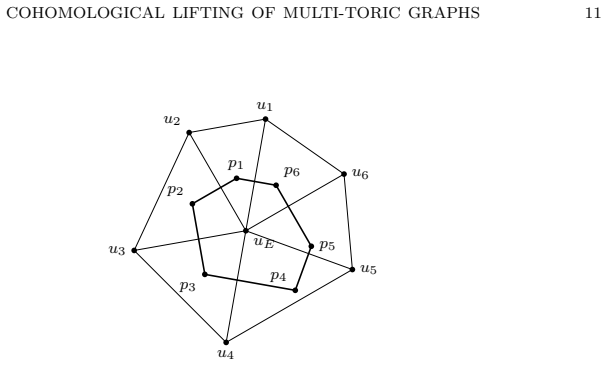
- [Section 4.2, Theorem 4.3] The proof computes nu3(q_{m+1}) - nu3(q_1) for the loop around a single interior ray E and shows that it equals ([omega] union [F]).E. To justify the global 'if and only if [omega] union [F] = 0', the paper should state explicitly that the classes E = A_j cap E, as E runs over interior rays and A_j over adjacent boundary rays, generate H_2(B;Z) in the present toric setting; otherwise the conclusion is only established for the particular loop under consideration. This generation statement is standard for smooth toric varieties obtained by triangulating a polygon, but it is not written down and is needed for the theorem as stated.
minor comments (4)
- [Section 5, Example 5.1] The fixed point D is printed as (q+,p+); it should be (q+,q-) to match the later use of E_BD as {p+} x CP(1)-? Actually E_BD is described as CP(1)+ x {q-}, so its endpoints are B = (p+,q-) and D = (q+,q-).
- [Section 5, Example 5.2] The printed value lambda(q6) = (-f1+f2, -f1-f2) is inconsistent with equation (4.6) applied to the edge from q5 to q6; using t6 = w1 and u6-uE = (-1,0) gives lambda(q6) = (-f1+f2, f1-f2). The second component does not affect the printed value of nu3(q6), but it should be corrected.
- [Section 3] The standing hypothesis that the functions lambda_i solving (3.2) exist globally should be stated explicitly before equations (3.7)-(3.10) are used, even though it is introduced as a necessary and sufficient condition just above. In the toric Calabi-Yau setting this is guaranteed by b1(B) = 0, but the main formulas of Section 3 apply only under this Hamiltonian assumption on F.
- [Throughout] There are several typographical errors: the abstract reads 'may obtained' instead of 'may be obtained', equation (2.1) has 'permuations' instead of 'permutations', and the introduction contains 'sympletic' instead of 'symplectic'. These should be corrected in a final pass.
Circularity Check
No significant circularity: the lifting formulas (3.7)–(3.10) and Theorem 4.3 are derived from defining equations and standard geometric identities, not from the statements they purport to prove.
full rationale
The paper's central claims are not circular. Equations (3.7)–(3.10) are obtained by applying the defining identities dμ_i = ω(X_i, ·) and dλ_i = −F(X_i, ·), the integration identities (3.3)–(3.6), and the expanded expression for dν_3; no target statement is used as an input. In particular, the factor t is identified as [ω] ∩ [E] by comparing the first two components of the edge vector, and then (3.10) determines the ν_3 change. Theorem 4.3 is proved by computing the total ν_3 change around a loop as Σ t_j(f_j − f_E) and then showing, using toric intersection identities (4.2)–(4.3), that this equals ([ω] ∪ [F]) · E; the Foscolo–Haskins–Nordström condition is a conclusion, not an assumption. Prior work by the authors [22–25] and [27] is invoked for published facts (existence and local structure of multi-moment graphs, invariant connection condition), and these facts do not contain the lifting formulas or the closure criterion. The existence premise (3.2) is an input hypothesis; if it fails, the theorem simply does not apply, and in the toric Calabi–Yau case its solvability is argued independently from b1(B) = 0 and integral periods. The arithmetic typo in Example 5.1 is localized and does not infect the derivation. No fitted parameter is relabeled as a prediction.
Assumptions & free parameters
assumptions (5)
- domain assumption The T^2-action on B lifts to an effective T^3-action on the circle bundle M with a T^2-invariant connection of curvature F, equivalent to the existence of functions λ_i with dλ_i = -F(X_i,·).
- domain assumption For a multi-Hamiltonian closed G2-structure with T^3 action, each non-trivial stabilizer is a connected subtorus of dimension at most two, and the image of the fixed-point set is a trivalent graph with zero-tension vertices.
- domain assumption The base SU(3)-structure is symplectic with dω=0 and admits a global multi-moment map μ; in the toric section, B is a smooth toric Calabi-Yau manifold with b1(B)=0 and a good fan.
- standard math Standard toric geometry facts: the Picard group of a smooth toric variety is generated by toric divisors subject to the linear relations (4.1), and triple intersection numbers satisfy the quadrilateral relations (4.3).
- domain assumption The Foscolo-Haskins-Nordström existence theorem and Cavalleri's T^2-invariance result provide the actual G2 metrics used in the examples.
Cite this review
Pith. "Pith review of Cohomological lifting of multi-toric graphs." pith.science (2026). https://pith.science/paper/NP3TX2JN
@misc{pith2026241215769,
  author       = {Pith},
  title        = {Pith review of: Cohomological lifting of multi-toric graphs},
  year         = {2026},
  howpublished = {\url{https://pith.science/paper/NP3TX2JN}},
  note         = {Machine review of arXiv:2412.15769}
}
abstract
We study $G_{2}$-manifolds obtained from circle bundles over symplectic $SU(3)$-manifolds with $T^{2}$-symmetry. When the geometry is multi-Hamiltonian, we show how the compact part of the resulting multi-moment graph for the $G_{2}$-structure may obtained cohomologically from the base. The lifting procedure is illustrated in the context of toric geometry.
Figures

Figures from the paper (3 more)


Reference graph
Works this paper leans on
-
[1]
B. S. Acharya, L. Foscolo, M. Najjar, and E. E. Svanes, New G2-conifolds in M -theory and their field theory interpretation , J. High Energy Phys. (2021), no. 5, 32 pp
work page 2021
-
[2]
O. Aharony, A. Hanany, and B. Kol, Webs of (p, q) 5 -branes, five dimensional field theories and grid diagrams , J. High Energy Phys. 1998 (1998), no. 1, 51 pp
work page 1998
-
[3]
Altmann, The versal deformation of an isolated toric Gorenstein sing ularity, In- vent
K. Altmann, The versal deformation of an isolated toric Gorenstein sing ularity, In- vent. Math. 128 (1997), no. 3, 443–479
work page 1997
-
[4]
V. Apostolov and S. Salamon, K¨ ahler reduction of metrics with holonomy G2, Comm. Math. Phys. 246 (2004), no. 1, 43–61
work page 2004
-
[5]
V. Bouchard, Lectures on complex geometry, Calabi-Yau manifolds and tor ic geome- try, preprint arXiv: hep-th/0702063, 2007
arXiv 2007
-
[6]
R. L. Bryant, Metrics with exceptional holonomy , Ann. of Math. 126 (1987), 525–576
work page 1987
-
[7]
R. L. Bryant and S. M. Salamon, On the construction of some complete metrics with exceptional holonomy , Duke Math. J. 58 (1989), 829–850
work page 1989
-
[8]
N. Cavalleri, Complete non-compact Spin(7)-manifolds from T 2-bundles over AC Calabi-Yau manifolds , preprint arXiv: 2407.19486 [math.DG] , 2024
arXiv 2024
Show all 30 references
-
[9]
K. Cho, A. Futaki, and H. Ono, Uniqueness and examples of compact toric Sasaki- Einstein metrics , Comm. Math. Phys. 277 (2008), no. 2, 439–458
2008
-
[10]
Cleyton and A
R. Cleyton and A. F. Swann, Cohomogeneity-one G2-structures, J. Geom. Phys. 44 (2002), no. 2–3, 202–220
2002
-
[11]
R. J. Conlon and H.-J. Hein, Classification of asymptotically conical Calabi-Yau man- ifolds, Duke Math. J. 173 (2024), no. 5, 947–1015
2024
-
[12]
Conti and A
D. Conti and A. Tomassini, Special symplectic six-manifolds , Q. J. Math. 58 (2007), no. 3, 297–311
2007
-
[13]
D. A. Cox, J. B. Little, and H. K. Schenck, Toric varieties , Graduate Studies in Mathematics, vol. 124, American Mathematical Society, Pro vidence, RI, 2011
2011
-
[14]
K. Dixon, Toric ALC G2 manifolds, online talk Simons Collabo- ration on Special Holonomy in Geometry, Analysis, and Physi cs, https://sites.duke.edu/scshgap/kael-dixon-lectures/ , 2020
2020
-
[15]
Foscolo, M
L. Foscolo, M. Haskins, and J. Nordstr¨ om, Complete non-compact G2–manifolds from asymptotically conical Calabi–Yau 3-folds, Duke Math. J. 170 (2021), no. 15, 3323– 3416
2021
-
[16]
, Infinitely many new families of complete cohomogeneity one G2-manifolds: G2 analogues of the Taub-NUT and Eguchi-Hanson spaces , J. Eur. Math. Soc. (JEMS) 23 (2021), no. 7, 2153–2220
2021
-
[17]
Futaki, H
A. Futaki, H. Ono, and G. Wang, Transverse K¨ ahler geometry of Sasaki manifolds and toric Sasaki-Einstein manifolds , J. Differential Geom. 83 (2009), no. 3, 585–635
2009
-
[18]
G. W. Gibbons and S. W. Hawking, Gravitational multi-instantons , Phys. Lett. B78 (1978), 430–432. 18 KAEL DIXON, THOMAS BRUUN MADSEN, AND ANDREW SW ANN
1978
-
[19]
R. K. Lashof, J. P. May, and G. B. Segal, Equivariant bundles with Abelian structural group, Proceedings of the Northwestern Homotopy Theory Conferen ce (Evanston, Ill., 1982), Contemp. Math., vol. 19, Amer. Math. Soc., 1983, pp. 1 67–176
1982
-
[20]
Li, C.-C
J. Li, C.-C. M. Liu, K. Liu, and J. Zhou, A mathematical theory of the topological vertex, Geom. Topol. 13 (2009), no. 1, 527–621
2009
-
[21]
Li, SYZ geometry for Calabi-Yau 3-folds: Taub-NUT and Ooguri-Vafa type met- rics, Mem
Y. Li, SYZ geometry for Calabi-Yau 3-folds: Taub-NUT and Ooguri-Vafa type met- rics, Mem. Amer. Math. Soc. 292 (2023), no. 1453, 126 pp
2023
-
[22]
T. B. Madsen and A. F. Swann, Multi-moment maps , Adv. Math. 229 (2012), 2287– 2309. [23] , Closed forms and multi-moment maps , Geom. Dedicata 165 (2013), no. 1, 25–52
2012
-
[24]
, Toric geometry of G2-manifolds, Geom. Topol. 23 (2019), no. 7, 3459–3500
2019
-
[25]
, Multi-toric geometries with larger compact symmetry , preprint arXiv: 2407.03693 [math.DG] , 2024
2024 arXiv
-
[26]
Martelli and J
D. Martelli and J. Sparks, Toric geometry, Sasaki-Einstein manifolds and a new infinite class of AdS/CFT duals , Comm. Math. Phys. 262 (2006), no. 1, 51–89
2006
-
[27]
A. F. Swann, Twisting Hermitian and hypercomplex geometries , Duke Math. J. 155 (2010), no. 2, 403–431
2010
-
[28]
van Coevering, Ricci-flat K¨ ahler metrics on crepant resolutions of K¨ ahler cones , Math
C. van Coevering, Ricci-flat K¨ ahler metrics on crepant resolutions of K¨ ahler cones , Math. Ann. 347 (2010), no. 3, 581–611
2010
-
[29]
, Examples of asymptotically conical Ricci-flat K¨ ahler manifolds, Math. Z. 267 (2011), no. 1-2, 465–496
2011
-
[30]
Xie and S.-T
D. Xie and S.-T. Yau, Three dimensional canonical singularity and five dimension al N = 1 SCFT, J. High Energy Phys. (2017), no. 6, 33 pp
2017
-
[31]
Yeats, A combinatorial perspective on quantum field theory , Springer Briefs in Mathematical Physics, vol
K. Yeats, A combinatorial perspective on quantum field theory , Springer Briefs in Mathematical Physics, vol. 15, Springer, Cham, 2017. Email address : kael.dix@gmail.com School of Computing and Engineering, University of West Lon don, St. Mary’s Road, Ealing, London W5 5RF, Un...
2017
Reviewed August 11, 2026 · model on record in the stance chip above.
Discussion (0). Continue with ORCID to comment.