REVIEW 4 major objections 5 minor 110 references
Predicting human cooperation: sensitizing drift-diffusion model to interaction and external stimuli
T0 review · 4 major / 5 minor · reviewed 2026-08-11 · deepseek-v4-flash
Pith's one-line read A drift-diffusion model whose parameters are updated from the previous round's social interactions can forecast next-round cooperation and defection response-time distributions, expected cooperation rates, and final earnings on unseen data.
desk verdict A genuinely predictive DDM for MIPD cooperation, with one-step-ahead validation; the multi-step policy simulations outrun the validation and need re-scoping. read the letter →
The pith
A machine-rendered reading of the paper's core claim, the machinery that carries it, and where it could break.
The reading
What carries the argument
The load-bearing object is the augmented predictive drift-diffusion model: a classic DDM of evidence accumulation $dx = \nu\,di + \xi(i)$, with bias $z$, barrier height $a$, drift $\nu$, and non-decision time $t_0$, in which each parameter at round $t$ is an affine function of a regressor vector built from round $t-1$ (Eqs.~12--13). The regressors include the normalized previous response time, the previous decision, the normalized number of cooperating neighbors, the Relative Allocation measure of the focal player's payoff split between self and others, windowed averages of self- and other-allocations over a five-round memory, and round and experience counters. These regressors convert social interaction history into the four cognitive parameters, and Bayesian regression supplies posterior distributions for the coefficient vectors. The same machinery both predicts on held-out human data and, when simulated forward in stochastic realizations, generates behavior in altered conditions.
What would settle it
Run a fresh MIPD experiment with the same protocol but a changed payoff matrix (e.g., increasing R by 2) or a hard response-time cap (e.g., 4 seconds), and compare the observed per-round cooperation rates and response-time distributions with the model's predictions using the originally fitted coefficients; systematic divergence (e.g., per-round $R^2$ dropping below 0.5 for several consecutive rounds) would disprove the transferability claim.
Extended reading notes
Core claim
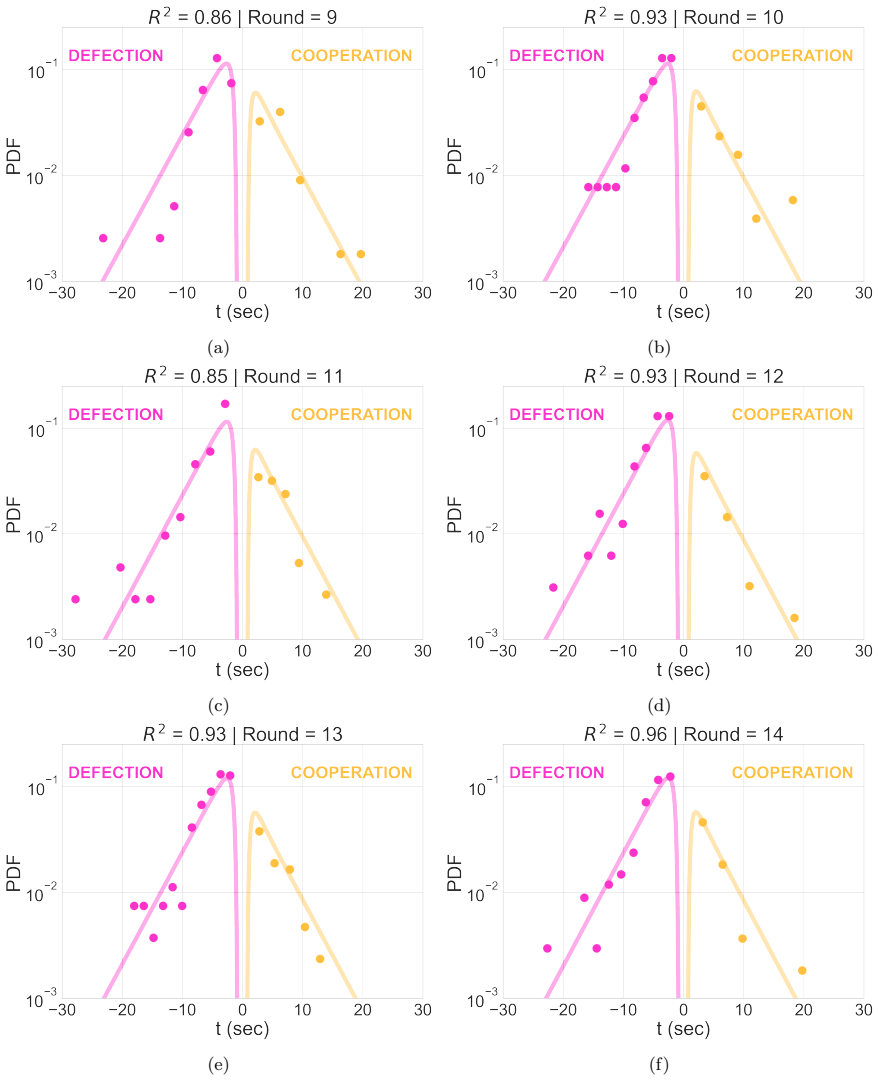
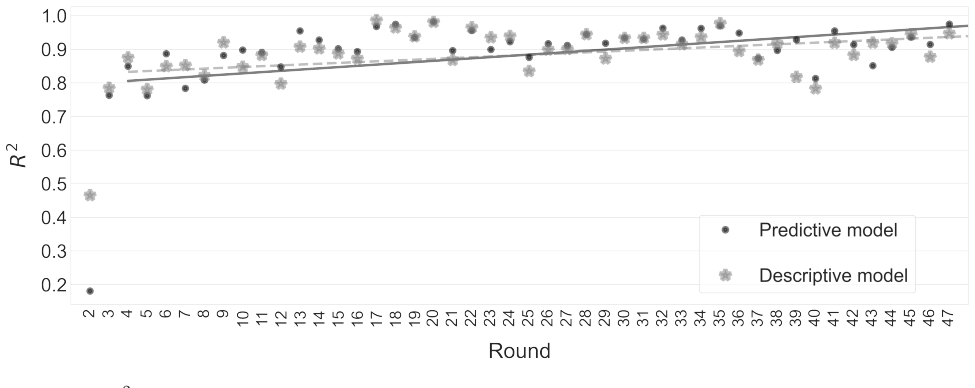
On the paper's own terms, the central discovery is that the DDM parameters at round $t$ can be predicted one step ahead from an affine combination of lagged interaction regressors (Eq.~13), with coefficients learned via Bayesian regression on a training phase (Experiment 1). On the unseen test phase (Experiment 2), these predicted parameters, when fed into the first-passage-time formulas for the DDM, reproduce the empirical response-time probability density functions for both cooperation and defection at every round, with $R^2$ exceeding 0.75 in all rounds and a distance of 0.04 (p-value 0.99) between predicted and empirical final-earnings distributions. Because the area under the cooperation response-time PDF equals the expected cooperation rate, the model thereby forecasts the population's evolving propensity to cooperate. The same fitted model, simulated forward, yields qualitative predictions consistent with established findings: cooperation decays over rounds, reshuffling co-players produces a temporary restart effect, both rewards and punishments raise expected cooperation, and time pressure increases intuitive cooperation.
Load-bearing premise
The paper assumes that the affine mapping from previous-round interaction features to the next round's DDM parameters, learned from one experiment with a fixed payoff matrix and no time limits, remains valid without retraining when the payoff matrix is changed, when response times are truncated, and when groups are reshuffled.
Editorial extensions
If this is right
- One-step-ahead forecasting: given the previous round's choices, payoffs, and response times, the model predicts the next round's cooperation and defection response-time distributions, hence the expected cooperation rate, without any fitting to the test phase.
- The final-earnings distribution across the population is reproduced (distance 0.04 on the test set), meaning the model captures not just average behavior but the heterogeneous accumulation of payoffs.
- Simulated interventions behave as the human literature suggests: punishing defection increases expected cooperation slightly more than rewarding cooperation, team reshuffling triggers a transient rise in cooperation, and time pressure boosts cooperation toward levels consistent with the Social Heuristic Hypothesis.
- The fitted coefficients are interpretable as cognitive tendencies: drift and caution decline with experience, and the starting bias tracks the balance between self- and other-oriented payoffs, giving a neuro-cognitive reading of why cooperation decays.
Reading between the lines
- Editorial inference: the scenario simulations are extrapolations, not validations; the coefficients were fit under one payoff matrix and no time pressure, so the predicted responses to modified payoffs and time caps should be treated as hypotheses to test in new experiments rather than as measured facts.
- Editorial inference: if the affine regressor mapping is stable across populations, the same method could be applied to other repeated social dilemmas with response-time data, such as public-goods games or commons dilemmas, by redefining the interaction regressors.
- Editorial inference: the one-step-ahead structure opens the door to online policy design: a planner could read the current cooperation state from recent behavior and adjust time limits, payoffs, or group composition before the next round to steer the population toward cooperation.
- Editorial inference: because the parameters, not just choices, are forecastable, response times may carry information about the upcoming decision that choices alone do not; a testable extension would compare choice-only versus choice-plus-response-time predictors of next-round decisions.
Signed reviews
Editorial analysis
A structured set of objections, weighed in public.
Referee Report
Summary. The paper enriches the drift-diffusion model of binary decisions with round-dependent parameters that are affine functions of interaction regressors from the previous round of a multiplayer iterated prisoner's dilemma. The coefficients are estimated by Bayesian regression (HDDM) on 47 rounds of Experiment 1 with 169 participants, then applied to 58 rounds of Experiment 2, a reshuffled-network phase with the same participants. The authors report R² above 0.75 for the per-round response-time PDFs for both cooperation and defection, and a Kolmogorov–Smirnov distance of 0.04 (p=0.99) for the final earnings distribution. They then simulate three intervention scenarios (co-player cooperation levels and reshuffling; payoff-matrix rewards and punishments; time pressure), finding that the model reproduces known qualitative effects. The central claim is that previous-round interaction data are sufficient to predict the DDM parameters, and hence the response-time distributions and expected cooperation rate, on a phase not used for fitting.
Significance. The paper's contribution is a step from descriptive DDM fits to a predictive, cognitively interpretable model of social decisions, and the target quantities (full RT distributions per round) are more informative than choice probabilities alone. Strengths include a genuine out-of-phase test of the fitted coefficients (they are not refit on Experiment 2), the use of theoretical DDM first-passage formulas that give parameter-free density predictions, and scenario results that are concrete and falsifiable. The validation metric R²>0.75 at every round is non-trivial. However, the significance is capped by three limitations: the test phase involves the same subjects, the validation conditions on observed previous-round regressors, and the reported PDFs are evaluated at averaged parameters. These do not invalidate the one-step-ahead claim, but they mean the paper's stronger forecasting claims need revision.
major comments (4)
- [Materials and Methods, 'Using the model to predict and to simulate'] Eq. (14) aggregates the per-subject predicted parameters by averaging before evaluating the DDM densities in Eq. (3). The empirical densities are mixtures over subjects, and the map (ν,a,z) ↦ P_D/P_C is nonlinear, so the density at the average parameter vector is not the average density. Consequently the R² values in Fig. 2 and the PDF comparisons in Fig. 1 validate an 'average subject' rather than the population's response-time distribution. The same issue applies to the expected cooperation rate, since C_C(ν,a,z) in Eq. (7) is nonlinear. Please recompute the predicted PDFs by averaging the per-subject predicted densities (or by simulating each subject's choices) and report both the aggregate and per-subject-averaged statistics.
- [Results, test-set validation (Figs. 1–3)] For every t=2..58 of the test phase, the regressors in Eq. (12) are computed from the actual observed actions, payoffs, and response times of round t−1 of the same 169 participants who played Experiment 2; moreover the same participants provided the Experiment 1 training data. The reported R² and KS values therefore certify a one-step-ahead conditional predictive distribution, not the multi-step forecasts that Scenarios 1–3 require, where regressors are self-generated and errors can compound. The phrase 'unseen test dataset' should be qualified in the abstract and results: the test phase is new only in network configuration, not in participants. Please add a validation that initializes from round-1 observations only and simulates forward, or revise the central claim to one-step-ahead forecasting and explicitly mark the scenario simulations as extrapolations without direct validation.
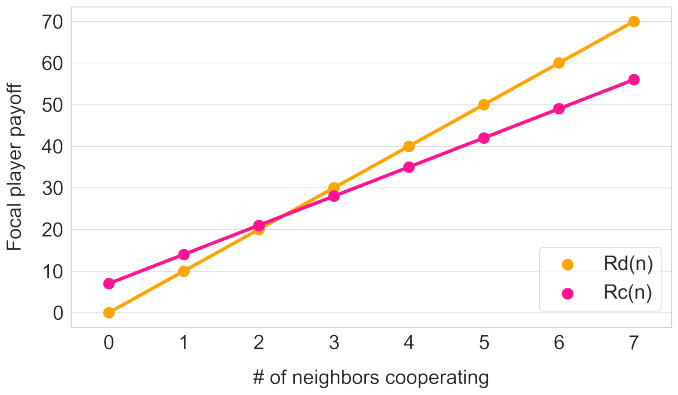
- [Results, Scenario 2 and Scenario 3] The simulations in Scenario 2 (Fig. 7) and Scenario 3 (Fig. 8) use coefficients from Table 2 that were estimated on data with the original payoff matrix (R=7, S=0, T=10, P=0) and no response-time cap. Because the regressors a_self, a_others, and RA are defined directly from payoff values, the affine mapping in Eq. (13) is plausibly payoff-dependent; the truncation at T_max also changes the error distribution in ways the fitted drift-diffusion parameters were never calibrated against. No external human data or robustness check supports these transfers. Please add sensitivity analyses (e.g., refitting with perturbed coefficients, or testing on altered-payoff experiments if available) or clearly present Scenarios 2–3 as model-based hypotheses conditional on the transferability assumption.
- [Results, final earnings distribution (Fig. 3)] The text states that the final-earnings distribution is obtained by 'simulating the behavior of our model on the same data many times' but does not specify whether the simulated regressors come from observed test-phase rounds or are generated by the model. If the former, the KS=0.04 inherits the one-step-ahead conditioning of comment 2; if the latter, it is a full forward simulation that would partially address comment 2. Please specify the protocol, and report the KS for both modes.
minor comments (5)
- [Model fitting and obtained parameters, Table 2] The text says a is 'inversely proportional' to a_self and z is 'directly proportional' to a_o, but the reported standard deviations (0.130688 and 0.023936) mean the credible intervals include zero; these directional statements should be softened or replaced with posterior intervals.
- [Abstract and Results] The phrase 'unseen test dataset' should be rephrased as 'a later experimental phase with the same participants' to avoid implying new subjects.
- [General] Typos: 'drown' should be 'drawn' (Model fitting section); 'decribed' should be 'described' and 'taylored' should be 'tailored' (Using the model to predict and to simulate section); 'Pioneer’s research' should be 'Pioneering research' (Scenario 3).
- [Regressors, memory window] The memory window M=5 is a global assumption that affects all experience-based regressors; please add a sentence in the Discussion acknowledging the lack of sensitivity analysis, or report M∈{1,3,7} results in the Supplementary Information.
- [Data and code availability] The manuscript does not state whether model-fitting code, posterior traces, and preprocessed regressors are available; please add a data/code availability statement.
Circularity Check
No circular derivation: round-t RT PDFs are predicted from coefficients fit on Experiment 1 and evaluated on held-out Experiment 2 data; only non-load-bearing self-citations and a one-step-ahead conditioning caveat are present.
full rationale
The central validation is not circular. The regression coefficients (Pa, Pnu, Pz, Pt0) are fitted only on Experiment 1 ('we let our model use the regressors computed from data in Experiment 1 (training dataset) to estimate the parameter vectors...'), and the model then predicts round-t DDM parameters for Experiment 2 using Eq. 13 from lagged regressors x_{t-1}. The predicted parameters are inserted into the theoretical first-passage PDFs (Eq. 3) and compared with empirical round-t response-time PDFs and final earnings from the held-out phase; the R2 and Kolmogorov-Smirnov statistics are therefore evaluated against data not used in fitting. No fitted value of the target round enters the regressor vector, so the prediction is not a restatement of the fit. The affine form in Eq. 13 is a modeling choice, not a result derived from the target quantities. The self-citations ([68] and [109]) supply the Relative Allocation metric, the descriptive baseline, and the rationality ratio; these are prior published definitions and are not invoked as uniqueness theorems or as proof that the affine regressors are forced, so they are not load-bearing. The only substantive caveat is claim scope: the test-phase validation is one-step-ahead conditional on the actual observed round t-1 regressors from the same Experiment 2 phase, so it does not directly certify long, fully compounding multi-round simulations. That is a correctness/scope concern, not circularity.
Assumptions & free parameters
free parameters (7)
- Pa (threshold a regressor weights) =
pa1=5.51, pa2=-0.42, pa3=-0.53, pa4=-0.09, pa5=-0.53, pa6=4.72
- Pν (drift ν regressor weights) =
pν1=0.137, pν2=-0.136, pν3=-0.087
- Pz (bias z regressor weights) =
pz1=-0.056, pz2=0.034, pz3=0.568
- Pt0 (non-decision time regressor weights) =
pt01=1.33, pt02=-0.065, pt03=0.91, pt04=0.055
- Memory window M =
5
- Initial DDM parameters for simulations =
estimated from first round of Experiment 2
- RT normalization maxExp1(RT) =
maximum response time in training data
assumptions (5)
- standard math Standard Feller and Fürth first-passage-time formulas for the DDM (Eqs. 6 and 7) give the response-time densities and expected cooperation rate.
- domain assumption All participants are copies of an average subject; no subject-specific random effects in the predictive model.
- ad hoc to paper The DDM parameters at round t are affine functions of the chosen regressors (Eq. 10).
- ad hoc to paper Coefficients fitted on Experiment 1 transfer to Experiment 2 and to modified payoff matrices, reshuffled groups, and time truncation.
- ad hoc to paper All individuals share the same memory window M=5, weighting the last five rounds equally.
Cite this review
Pith. "Pith review of Predicting human cooperation: sensitizing drift-diffusion model to interaction and external stimuli." pith.science (2026). https://pith.science/paper/UHGIQKOY
@misc{pith2026241216121,
  author       = {Pith},
  title        = {Pith review of: Predicting human cooperation: sensitizing drift-diffusion model to interaction and external stimuli},
  year         = {2026},
  howpublished = {\url{https://pith.science/paper/UHGIQKOY}},
  note         = {Machine review of arXiv:2412.16121}
}
read the original abstract
As humans perceive and actively engage with the world, we adjust our decisions in response to shifting group dynamics and are influenced by social interactions. This study aims to identify which aspects of interaction affect cooperation-defection choices. Specifically, we investigate human cooperation within the Prisoner's Dilemma game, using the Drift-Diffusion Model to describe the decision-making process. We introduce a novel Bayesian model for the evolution of the model's parameters based on the nature of interactions experienced with other players. This approach enables us to predict the evolution of the population's expected cooperation rate. We successfully validate our model using an unseen test dataset and apply it to explore three strategic scenarios: co-player manipulation, use of rewards and punishments, and time pressure. These results support the potential of our model as a foundational tool for developing and testing strategies aimed at enhancing cooperation, ultimately contributing to societal welfare.
Figures


Figures from the paper (20 more)







Reference graph
Works this paper leans on
-
[1]
Thinking and deciding
Jonathan Baron. Thinking and deciding . Cambridge University Press, 2023
2023
-
[2]
Understanding complexity in the human brain
Danielle S Bassett and Michael S Gazzaniga. Understanding complexity in the human brain. Trends in cognitive sciences, 15(5):200–209, 2011
2011
-
[3]
A spatiotemporal complexity architecture of human brain activity
Stephan Krohn, Nina von Schwanenflug, Leonhard Waschke, Amy Romanello, Martin Gell, Douglas D Garrett, and Carsten Finke. A spatiotemporal complexity architecture of human brain activity. Science Advances, 9(5):eabq3851, 2023
2023
-
[4]
Toward a synthesis of cognitive biases: how noisy information processing can bias human decision making
Martin Hilbert. Toward a synthesis of cognitive biases: how noisy information processing can bias human decision making. Psychological bulletin, 138(2):211, 2012
2012
-
[5]
Cognitive biases
Johan E Korteling and Alexander Toet. Cognitive biases. Encyclopedia of behavioral neuroscience, 2020
2020
-
[6]
Affect, emotion, and decision making
Jennifer M George and Erik Dane. Affect, emotion, and decision making. Organizational Behavior and Human Decision Processes, 136:47–55, 2016
2016
-
[7]
Quantification of emotions in decision making
Vyacheslav I Yukalov. Quantification of emotions in decision making. Soft Computing , 26(5):2419–2436, 2022
2022
-
[8]
Decision-making processes in social contexts
Elizabeth Bruch and Fred Feinberg. Decision-making processes in social contexts. Annual review of sociology, 43(1):207–227, 2017
2017
Show all 110 references
-
[9]
Extraneous factors in judicial decisions
Shai Danziger, Jonathan Levav, and Liora Avnaim-Pesso. Extraneous factors in judicial decisions. Pro- ceedings of the National Academy of Sciences , 108(17):6889–6892, 2011
2011
-
[10]
Cognitive dissonance
Eddie Harmon-Jones and Judson Mills. Cognitive dissonance. Progress on a pivotal theory in social psychology. Washington, DC: American Psychological Association , 1999
1999
-
[11]
Thinking fast and slow
Daniel Kahneman. Thinking fast and slow. Farrar, Strauss and Giroux, 2011
2011
-
[12]
Individual differences in decision-making
Ingmar HA Franken and Peter Muris. Individual differences in decision-making. Personality and Individual Differences, 39(5):991–998, 2005
2005
-
[13]
The decision making individual differences inventory and guidelines for the study of individual differences in judgment and decision-making research
Kirstin C Appelt, Kerry F Milch, Michel JJ Handgraaf, and Elke U Weber. The decision making individual differences inventory and guidelines for the study of individual differences in judgment and decision-making research. Judgment and Decision making , 6(3):252–262, 2011
2011
-
[14]
The theory of decision making
Ward Edwards. The theory of decision making. Psychological bulletin, 51(4):380, 1954
1954
-
[15]
Jonathan St.B.T. Evans. Dual-process theories of reasoning: Contemporary issues and developmental applications. Developmental Review, 31(2):86–102, 2011
2011
-
[16]
Representativeness revisited: Attribute substitution in intuitive judgment
Daniel Kahneman, Shane Frederick, et al. Representativeness revisited: Attribute substitution in intuitive judgment. Heuristics and biases: The psychology of intuitive judgment , 49(49-81):74, 2002
2002
-
[17]
Decision-making under risk: Integrating perspectives from biology, economics, and psychology
Sandeep Mishra. Decision-making under risk: Integrating perspectives from biology, economics, and psychology. Personality and Social Psychology Review , 18(3):280–307, 2014
2014
-
[18]
The cognitive neuroscience of human decision making: a review and conceptual frame- work
Lesley K Fellows. The cognitive neuroscience of human decision making: a review and conceptual frame- work. Behavioral and cognitive neuroscience reviews , 3(3):159–172, 2004
2004
-
[19]
Decision neuroscience and consumer decision making
Carolyn Yoon, Richard Gonzalez, Antoine Bechara, Gregory S Berns, Alain A Dagher, Laurette Dub´ e, Scott A Huettel, Joseph W Kable, Israel Liberzon, Hilke Plassmann, et al. Decision neuroscience and consumer decision making. Marketing letters , 23:473–485, 2012
2012
-
[20]
Heuristics and biases: The science of decision-making
Steve Dale. Heuristics and biases: The science of decision-making. Business Information Review, 32(2):93– 99, 2015. 21
2015
-
[21]
Theories of decision- making in economics and behavioural science
American Economic Association, Royal Economic Society, and Herbert A Simon. Theories of decision- making in economics and behavioural science . Springer, 1966
1966
-
[22]
Vaccine hesitancy: an overview
Eve Dub´ e, Caroline Laberge, Maryse Guay, Paul Bramadat, R´ eal Roy, and Julie A Bettinger. Vaccine hesitancy: an overview. Human vaccines & immunotherapeutics , 9(8):1763–1773, 2013
2013
-
[23]
Qualitative analysis of mothers’ decision-making about vaccines for infants: the importance of trust
Andrea L Benin, Daryl J Wisler-Scher, Eve Colson, Eugene D Shapiro, and Eric S Holmboe. Qualitative analysis of mothers’ decision-making about vaccines for infants: the importance of trust. Pediatrics, 117(5):1532–1541, 2006
2006
-
[24]
The social psychology of decision making
Icek Ajzen. The social psychology of decision making. Social psychology: Handbook of basic principles , pages 297–325, 1996
1996
-
[25]
Social groups in action and interaction
Charles Stangor. Social groups in action and interaction . Routledge, 2015
2015
-
[26]
Social rank and social cooperation: Impact of social comparison processes on cooperative decision-making
Xu Gong and Alan G Sanfey. Social rank and social cooperation: Impact of social comparison processes on cooperative decision-making. PLoS One, 12(4):e0175472, 2017
2017
-
[27]
Human cooperation
David G Rand and Martin A Nowak. Human cooperation. Trends in cognitive sciences , 17(8):413–425, 2013
2013
-
[28]
Competition, volume 26
Paul A Keddy. Competition, volume 26. Springer Science & Business Media, 2012
2012
-
[29]
Strategic use of preference confirmation in group decision making: The role of competition and dissent
Claudia Toma, Ingrid Gilles, and Fabrizio Butera. Strategic use of preference confirmation in group decision making: The role of competition and dissent. British Journal of Social Psychology , 52(1):44–63, 2013
2013
-
[30]
The psychology of competition: A social comparison perspective
Stephen M Garcia, Avishalom Tor, and Tyrone M Schiff. The psychology of competition: A social comparison perspective. Perspectives on psychological science, 8(6):634–650, 2013
2013
-
[31]
Altruism in humans
C Daniel Batson. Altruism in humans . Oxford University Press, 2010
2010
-
[32]
Neurocomputational models of altruistic decision-making and social motives: Advances, pitfalls, and future directions
Anita Tusche and Lisa M Bas. Neurocomputational models of altruistic decision-making and social motives: Advances, pitfalls, and future directions. Wiley Interdisciplinary Reviews: Cognitive Science , 12(6):e1571, 2021
2021
-
[33]
Direct reciprocity among humans
Charlotte SL Rossetti and Christian Hilbe. Direct reciprocity among humans. Ethology, 130(4):e13407, 2024
2024
-
[34]
Measuring and making decisions for social reciprocity
Antonio Solanas, David Leiva, Vicenta Sierra, and Llu ´ ıs Salafranca. Measuring and making decisions for social reciprocity. Behavior research methods, 41(3):742–754, 2009
2009
-
[35]
Reciprocity outperforms conformity to promote cooperation
Angelo Romano and Daniel Balliet. Reciprocity outperforms conformity to promote cooperation. Psy- chological Science, 28(10):1490–1502, 2017
2017
-
[36]
Regimes of expectations: an active inference model of social conformity and human decision making.Frontiers in psychology, 10:679, 2019
Axel Constant, Maxwell JD Ramstead, Samuel PL Veissi` ere, and Karl Friston. Regimes of expectations: an active inference model of social conformity and human decision making.Frontiers in psychology, 10:679, 2019
2019
-
[37]
Influence of agent type and task ambiguity on conformity in social decision making
Nicholas Hertz and Eva Wiese. Influence of agent type and task ambiguity on conformity in social decision making. In Proceedings of the human factors and ergonomics society annual meeting , volume 60, pages 313–317. SAGE Publications Sage CA: Los Angeles, CA, 2016
2016
-
[38]
Natural conflict resolution
Filippo Aureli, Frans De Waal, et al. Natural conflict resolution. University of California Press Berkeley, 2000
2000
-
[39]
Has conflict resolution grown up? toward a developmental model of decision making and conflict resolution
Hossain B Danesh and Roshan Danesh. Has conflict resolution grown up? toward a developmental model of decision making and conflict resolution. International Journal of Peace Studies , pages 59–76, 2002
2002
-
[40]
Interactive problem-solving: A social-psychological approach to conflict resolution
Herbert C Kelman. Interactive problem-solving: A social-psychological approach to conflict resolution. In Conflict: Readings in management and resolution , pages 199–215. Springer, 1990. 22
1990
-
[41]
The neuroscience of intergroup relations: An integrative review
Mina Cikara and Jay J Van Bavel. The neuroscience of intergroup relations: An integrative review. Perspectives on Psychological Science, 9(3):245–274, 2014
2014
-
[42]
How social cognition can inform social decision making
Victoria Lee and Lasana Harris. How social cognition can inform social decision making. Frontiers in neuroscience, 7:259, 12 2013
2013
-
[43]
The neuroscience of social decision-making
James K Rilling and Alan G Sanfey. The neuroscience of social decision-making. Annual review of psychology, 62:23–48, 2011
2011
-
[44]
Social decision-making: insights from game theory and neuroscience
Alan G Sanfey. Social decision-making: insights from game theory and neuroscience. Science, 318(5850):598–602, 2007
2007
-
[45]
Solving the puzzle of human cooperation
Robert Boyd and Peter J Richerson. Solving the puzzle of human cooperation. Evolution and culture , pages 105–132, 2006
2006
-
[46]
Peace through cooperation or peace through strength? how to achieve peace in the very intractable conflict society
Young-Mi Kwon and Juhwa Park. Peace through cooperation or peace through strength? how to achieve peace in the very intractable conflict society. Historical Social Research/Historische Sozialforschung, 44(4 (170):269–292, 2019
2019
-
[47]
From conflict to cooperation? environmental cooper- ation as a tool for peace-building
Achim Maas, Alexander Carius, and Anja Wittich. From conflict to cooperation? environmental cooper- ation as a tool for peace-building. In Environmental security, pages 102–120. Routledge, 2013
2013
-
[48]
Mutual aid: When does resource scarcity favour group cooperation? Ecological Complexity, 40:100790, 2019
Etienne Delay and Cyril Piou. Mutual aid: When does resource scarcity favour group cooperation? Ecological Complexity, 40:100790, 2019
2019
-
[49]
Trust and cooperation: Social capital and community resource management
Jetske Bouma, Erwin Bulte, and Daan Van Soest. Trust and cooperation: Social capital and community resource management. Journal of environmental economics and management , 56(2):155–166, 2008
2008
-
[50]
Industrial cooperation and its influence on sustainable economic growth
Alena V Fomina, Oksana N Berduygina, and Alexander A Shatsky. Industrial cooperation and its influence on sustainable economic growth. Entrepreneurship and Sustainability Issues , 5(3):467–479, 2018
2018
-
[51]
Relationship between regional cooperation and political stability and prosperity
Anna Louise Strachan. Relationship between regional cooperation and political stability and prosperity. K4D Helpdesk Report. Brighton, UK: Institute of Development Studies , 2018
2018
-
[52]
Culture and the evolution of human cooperation
Robert Boyd and Peter J Richerson. Culture and the evolution of human cooperation. Philosophical Transactions of the Royal Society B: Biological Sciences , 364(1533):3281–3288, 2009
2009
-
[53]
Cooperation and the use of technology
David W Johnson and Roger T Johnson. Cooperation and the use of technology. In Handbook of research on educational communications and technology , pages 777–803. Routledge, 2013
2013
-
[54]
Cooperation in modern society
Mark Van Vugt, Mark Snyder, Tom R Tyler, and Anders Biel. Cooperation in modern society. Promoting the welfare of communities, states and organizations: Routledge , 2000
2000
-
[55]
Prevalence of health misinformation on social media: systematic review
Victor Suarez-Lledo and Javier Alvarez-Galvez. Prevalence of health misinformation on social media: systematic review. Journal of medical Internet research , 23(1):e17187, 2021
2021
-
[56]
Public health and online misinformation: challenges and recommendations
Briony Swire-Thompson, David Lazer, et al. Public health and online misinformation: challenges and recommendations. Annu Rev Public Health , 41(1):433–451, 2020
2020
-
[57]
Iterated n-player prisoner’s dilemma games
John W Carroll. Iterated n-player prisoner’s dilemma games. Philosophical Studies: An International Journal for Philosophy in the Analytic Tradition , 53(3):411–415, 1988
1988
-
[58]
Information and strategy in iterated prisoner’s dilemma
Kaushik Basu. Information and strategy in iterated prisoner’s dilemma. Theory and Decision , 8(3):293, 1977
1977
-
[59]
Game theory and neural basis of social decision making
Daeyeol Lee. Game theory and neural basis of social decision making. Nature neuroscience, 11(4):404–409, 2008
2008
-
[60]
Cooperation, fast and slow: Meta-analytic evidence for a theory of social heuristics and self-interested deliberation
David G Rand. Cooperation, fast and slow: Meta-analytic evidence for a theory of social heuristics and self-interested deliberation. Psychological science, 27(9):1192–1206, 2016
2016
-
[61]
Cooperation in rats playing the iterated prisoner’s dilemma game
Ruth I Wood, Jessica Y Kim, and Grace R Li. Cooperation in rats playing the iterated prisoner’s dilemma game. Animal behaviour, 114:27–35, 2016. 23
2016
-
[62]
Risk consideration and cooperation in the iterated prisoner’s dilemma
Weijun Zeng, Minqiang Li, Fuzan Chen, and Guofang Nan. Risk consideration and cooperation in the iterated prisoner’s dilemma. Soft Computing , 20:567–587, 2016
2016
-
[63]
Changing the intensity of interaction based on individual behavior in the iterated prisoner’s dilemma game
Jiaqi Li, Chunyan Zhang, Qinglin Sun, Zengqiang Chen, and Jianlei Zhang. Changing the intensity of interaction based on individual behavior in the iterated prisoner’s dilemma game. IEEE Transactions on Evolutionary Computation , 21(4):506–517, 2016
2016
-
[64]
Resolving the iterated prisoner’s dilemma: theory and reality
Nichola J Raihani and Redouan Bshary. Resolving the iterated prisoner’s dilemma: theory and reality. Journal of Evolutionary Biology , 24(8):1628–1639, 2011
2011
-
[65]
Evolution of cooperative behavior in the iterated prisoner’s dilemma under random pairing in game playing
Hisao Ishibuchi and Naoki Namikawa. Evolution of cooperative behavior in the iterated prisoner’s dilemma under random pairing in game playing. In 2005 IEEE Congress on Evolutionary Computation , volume 3, pages 2637–2644. IEEE, 2005
2005
-
[66]
Diffusion decision model: Current issues and history
Roger Ratcliff, Philip L Smith, Scott D Brown, and Gail McKoon. Diffusion decision model: Current issues and history. Trends in cognitive sciences, 20(4):260–281, 2016
2016
-
[67]
A theory of memory retrieval
Roger Ratcliff. A theory of memory retrieval. Psychological review, 85(2):59, 1978
1978
-
[68]
A quantitative description of the transition between intuitive altruism and rational deliberation in iterated prisoner’s dilemma experiments
Riccardo Gallotti and Jelena Gruji´ c. A quantitative description of the transition between intuitive altruism and rational deliberation in iterated prisoner’s dilemma experiments. Scientific reports, 9(1):17046, 2019
2019
-
[69]
A neurocomputational model of altruistic choice and its implications
Cendri A Hutcherson, Benjamin Bushong, and Antonio Rangel. A neurocomputational model of altruistic choice and its implications. Neuron, 87(2):451–462, 2015
2015
-
[70]
A common mechanism underlying food choice and social decisions
Ian Krajbich, Todd Hare, Bj¨ orn Bartling, Yosuke Morishima, and Ernst Fehr. A common mechanism underlying food choice and social decisions. PLoS computational biology, 11(10):e1004371, 2015
2015
-
[71]
Response time modelling reveals evidence for multiple, distinct sources of moral decision caution
Milan Andrejevi´ c, Joshua P White, Daniel Feuerriegel, Simon Laham, and Stefan Bode. Response time modelling reveals evidence for multiple, distinct sources of moral decision caution. Cognition, 223:105026, 2022
2022
-
[72]
The physics of opti- mal decision making: a formal analysis of models of performance in two-alternative forced-choice tasks
Rafal Bogacz, Eric Brown, Jeff Moehlis, Philip Holmes, and Jonathan D Cohen. The physics of opti- mal decision making: a formal analysis of models of performance in two-alternative forced-choice tasks. Psychological review, 113(4):700, 2006
2006
-
[73]
The diffusion decision model: theory and data for two-choice decision tasks
Roger Ratcliff and Gail McKoon. The diffusion decision model: theory and data for two-choice decision tasks. Neural computation, 20(4):873–922, 2008
2008
-
[74]
Applied regression: An introduction , volume 22
Colin Lewis-Beck and Michael Lewis-Beck. Applied regression: An introduction , volume 22. Sage publi- cations, 2015
2015
-
[75]
Social experiments in the mesoscale: Humans playing a spatial prisoner’s dilemma
Jelena Gruji´ c, Constanza Fosco, Lourdes Araujo, Jos´ e A Cuesta, and Angel S´ anchez. Social experiments in the mesoscale: Humans playing a spatial prisoner’s dilemma. PloS one , 5(11):e13749, 2010
2010
-
[76]
Dynamic social networks promote coopera- tion in experiments with humans
David G Rand, Samuel Arbesman, and Nicholas A Christakis. Dynamic social networks promote coopera- tion in experiments with humans. Proceedings of the National Academy of Sciences, 108(48):19193–19198, 2011
2011
-
[77]
Human strategy updating in evolutionary games
Arne Traulsen, Dirk Semmann, Ralf D Sommerfeld, Hans-J¨ urgen Krambeck, and Manfred Milinski. Human strategy updating in evolutionary games. Proceedings of the National Academy of Sciences , 107(7):2962–2966, 2010
2010
-
[78]
Resilient cooperators stabilize long-run cooperation in the finitely repeated prisoner’s dilemma
Andrew Mao, Lili Dworkin, Siddharth Suri, and Duncan J Watts. Resilient cooperators stabilize long-run cooperation in the finitely repeated prisoner’s dilemma. Nature communications, 8(1):13800, 2017
2017
-
[79]
Reward, punishment, and cooperation: a meta-analysis
Daniel Balliet, Laetitia B Mulder, and Paul AM Van Lange. Reward, punishment, and cooperation: a meta-analysis. Psychological bulletin, 137(4):594, 2011
2011
-
[80]
Cooperation and decision time
Anthony M Evans and David G Rand. Cooperation and decision time. Current opinion in psychology , 26:67–71, 2019. 24
2019
-
[81]
Social heuristics shape intuitive cooperation
David G Rand, Alexander Peysakhovich, Gordon T Kraft-Todd, George E Newman, Owen Wurzbacher, Martin A Nowak, and Joshua D Greene. Social heuristics shape intuitive cooperation. Nature communi- cations, 5(1):3677, 2014
2014
-
[82]
Intuition, deliberation, and the evolution of cooperation
Adam Bear and David G Rand. Intuition, deliberation, and the evolution of cooperation. Proceedings of the National Academy of Sciences , 113(4):936–941, 2016
2016
-
[83]
Spontaneous giving and calculated greed
David G Rand, Joshua D Greene, and Martin A Nowak. Spontaneous giving and calculated greed. Nature, 489(7416):427–430, 2012
2012
-
[84]
Deliberation erodes cooperative behavior—even towards competitive out-groups, even when using a control condition, and even when eliminating selection bias
Jim AC Everett, Zach Ingbretsen, Fiery Cushman, and Mina Cikara. Deliberation erodes cooperative behavior—even towards competitive out-groups, even when using a control condition, and even when eliminating selection bias. Journal of Experimental Social Psychology , 73:76–81, 2017
2017
-
[85]
Predicting human cooperation
John J Nay and Yevgeniy Vorobeychik. Predicting human cooperation. PloS one , 11(5):e0155656, 2016
2016
-
[86]
Cooperation in the finitely repeated prisoner’s dilemma
Matthew Embrey, Guillaume R Fr´ echette, and Sevgi Yuksel. Cooperation in the finitely repeated prisoner’s dilemma. The Quarterly Journal of Economics , 133(1):509–551, 2018
2018
-
[87]
Predicting human cooperation in the prisoner’s dilemma using case-based decision theory
Todd Guilfoos and Andreas Duus Pape. Predicting human cooperation in the prisoner’s dilemma using case-based decision theory. Theory and Decision , 80:1–32, 2016
2016
-
[88]
Split q learning: reinforcement learning with two-stream rewards
Baihan Lin, Djallel Bouneffouf, and Guillermo Cecchi. Split q learning: reinforcement learning with two-stream rewards. arXiv preprint arXiv:1906.12350 , 2019
1906 arXiv
-
[89]
A story of two streams: Reinforcement learning models from human behavior and neuropsychiatry
Baihan Lin, Guillermo Cecchi, Djallel Bouneffouf, Jenna Reinen, and Irina Rish. A story of two streams: Reinforcement learning models from human behavior and neuropsychiatry. arXiv preprint arXiv:1906.11286, 2019
1906 arXiv
-
[90]
Unified models of human behavioral agents in bandits, contextual bandits and rl
Baihan Lin, Guillermo Cecchi, Djallel Bouneffouf, Jenna Reinen, and Irina Rish. Unified models of human behavioral agents in bandits, contextual bandits and rl. arXiv preprint arXiv:2005.04544 , 2020
2005 arXiv
-
[91]
Models of human behavioral agents in bandits, contextual bandits and rl
Baihan Lin, Guillermo Cecchi, Djallel Bouneffouf, Jenna Reinen, and Irina Rish. Models of human behavioral agents in bandits, contextual bandits and rl. In Human Brain and Artificial Intelligence: Second International Workshop, HBAI 2020, Held in Conjunction with IJCAI-PRICAI ...
2020
-
[92]
Online learning in iterated prisoner’s dilemma to mimic human behavior
Baihan Lin, Djallel Bouneffouf, and Guillermo Cecchi. Online learning in iterated prisoner’s dilemma to mimic human behavior. In Pacific rim international conference on artificial intelligence , pages 134–147. Springer, 2022
2022
-
[93]
Sequential sampling models in cognitive neuroscience: Advantages, applications, and extensions
Birte U Forstmann, Roger Ratcliff, and E-J Wagenmakers. Sequential sampling models in cognitive neuroscience: Advantages, applications, and extensions. Annual review of psychology , 67:641–666, 2016
2016
-
[94]
The mechanistic foundation of weber’s law
Jose L Pardo-Vazquez, Juan R Casti˜ neiras-de Saa, Mafalda Valente, Iris Dami˜ ao, Tiago Costa, M Inˆ es Vicente, Andr´ e G Mendon¸ ca, Zachary F Mainen, and Alfonso Renart. The mechanistic foundation of weber’s law. Nature neuroscience, 22(9):1493–1502, 2019
2019
-
[95]
Predicting human decision making in psychological tasks with recurrent neural networks
Baihan Lin, Djallel Bouneffouf, and Guillermo Cecchi. Predicting human decision making in psychological tasks with recurrent neural networks. PloS one , 17(5):e0267907, 2022
2022
-
[96]
Scaffolding cooperation in human groups with deep reinforcement learning
Kevin R McKee, Andrea Tacchetti, Michiel A Bakker, Jan Balaguer, Lucy Campbell-Gillingham, Richard Everett, and Matthew Botvinick. Scaffolding cooperation in human groups with deep reinforcement learning. Nature Human Behaviour , pages 1–10, 2023
2023
-
[97]
Analyzing complex strategic interactions in multi-agent systems
William E Walsh, Rajarshi Das, Gerald Tesauro, and Jeffrey O Kephart. Analyzing complex strategic interactions in multi-agent systems. In AAAI-02 Workshop on Game-Theoretic and Decision-Theoretic Agents, pages 109–118, 2002
2002
-
[98]
Methods for empirical game-theoretic analysis
Michael P Wellman. Methods for empirical game-theoretic analysis. In AAAI, volume 980, pages 1552– 1556, 2006. 25
2006
-
[99]
Multi-agent rein- forcement learning in sequential social dilemmas
Joel Z Leibo, Vinicius Zambaldi, Marc Lanctot, Janusz Marecki, and Thore Graepel. Multi-agent rein- forcement learning in sequential social dilemmas. arXiv preprint arXiv:1702.03037 , 2017
2017 arXiv
-
[100]
Inequity aversion improves cooperation in intertemporal social dilemmas
Edward Hughes, Joel Z Leibo, Matthew Phillips, Karl Tuyls, Edgar Due˜ nez-Guzman, Antonio Garc ´ ıa Casta˜ neda, Iain Dunning, Tina Zhu, Kevin McKee, Raphael Koster, et al. Inequity aversion improves cooperation in intertemporal social dilemmas. Advances in neural information ...
2018
-
[101]
Hockey helmets, concealed weapons, and daylight saving: A study of binary choices with externalities
Thomas C Schelling. Hockey helmets, concealed weapons, and daylight saving: A study of binary choices with externalities. Journal of Conflict resolution , 17(3):381–428, 1973
1973
-
[102]
A multi-agent reinforcement learning model of common-pool resource appropriation
Julien Perolat, Joel Z Leibo, Vinicius Zambaldi, Charles Beattie, Karl Tuyls, and Thore Graepel. A multi-agent reinforcement learning model of common-pool resource appropriation. Advances in neural information processing systems, 30, 2017
2017
-
[103]
A note on modeling accumulation of information when the rate of accumulation changes over time
Roger Ratcliff. A note on modeling accumulation of information when the rate of accumulation changes over time. Journal of Mathematical Psychology , 1980
1980
-
[104]
Modeling response times for two-choice decisions
Roger Ratcliff and Jeffrey N Rouder. Modeling response times for two-choice decisions. Psychological science, 9(5):347–356, 1998
1998
-
[105]
Optimal decision making in heterogeneous and biased environments
Rani Moran. Optimal decision making in heterogeneous and biased environments. Psychonomic bulletin & review, 22:38–53, 2015
2015
-
[106]
Optimal strategies for seeking information: Models for statistics, choice reaction times, and human information processing
Ward Edwards. Optimal strategies for seeking information: Models for statistics, choice reaction times, and human information processing. Journal of Mathematical Psychology , 2(2):312–329, 1965
1965
-
[107]
Connectionist and diffusion models of reaction time
Roger Ratcliff, Trisha Van Zandt, and Gail McKoon. Connectionist and diffusion models of reaction time. Psychological review, 106(2):261, 1999
1999
-
[108]
An introduction to probability theory and its applications , volume 81
William Feller. An introduction to probability theory and its applications , volume 81. John Wiley & Sons, 1991
1991
-
[109]
Fast deliberation is related to unconditional behaviour in iterated prisoners’ dilemma experiments
Eladio Montero-Porras, Tom Lenaerts, Riccardo Gallotti, and Jelena Grujic. Fast deliberation is related to unconditional behaviour in iterated prisoners’ dilemma experiments. Scientific Reports, 12(1):20287, 2022
2022
-
[110]
Hddm: Hierarchical bayesian estimation of the drift-diffusion model in python
Thomas V Wiecki, Imri Sofer, and Michael J Frank. Hddm: Hierarchical bayesian estimation of the drift-diffusion model in python. Frontiers in neuroinformatics, page 14, 2013. 26 Supplementary Information Rationality regimes over time Figure 1: Rationality values attained on th...
2013
Reviewed August 11, 2026 · model on record in the stance chip above.
Discussion (0). Continue with ORCID to comment.