REVIEW 3 major objections 6 minor 129 references
A central tidal disruption event candidate in high redshift quasar SDSS J000118.70+003314.0
T0 review · 3 major / 6 minor · reviewed 2026-08-11 · deepseek-v4-flash
Pith's one-line read The nine-year $ugriz$ light curves of quasar SDSS J0001 can be modeled as a main-sequence star of about 1.9 solar masses being tidally disrupted by a black hole of about $6.5\times10^7$ solar masses, making it the highest-redshift optical…
desk verdict A plausible but unproven high-z TDE candidate in a quasar; the headline 0.009% probability is not meaningful as stated. read the letter →
The pith
A machine-rendered reading of the paper's core claim, the machinery that carries it, and where it could break.
The reading
What carries the argument
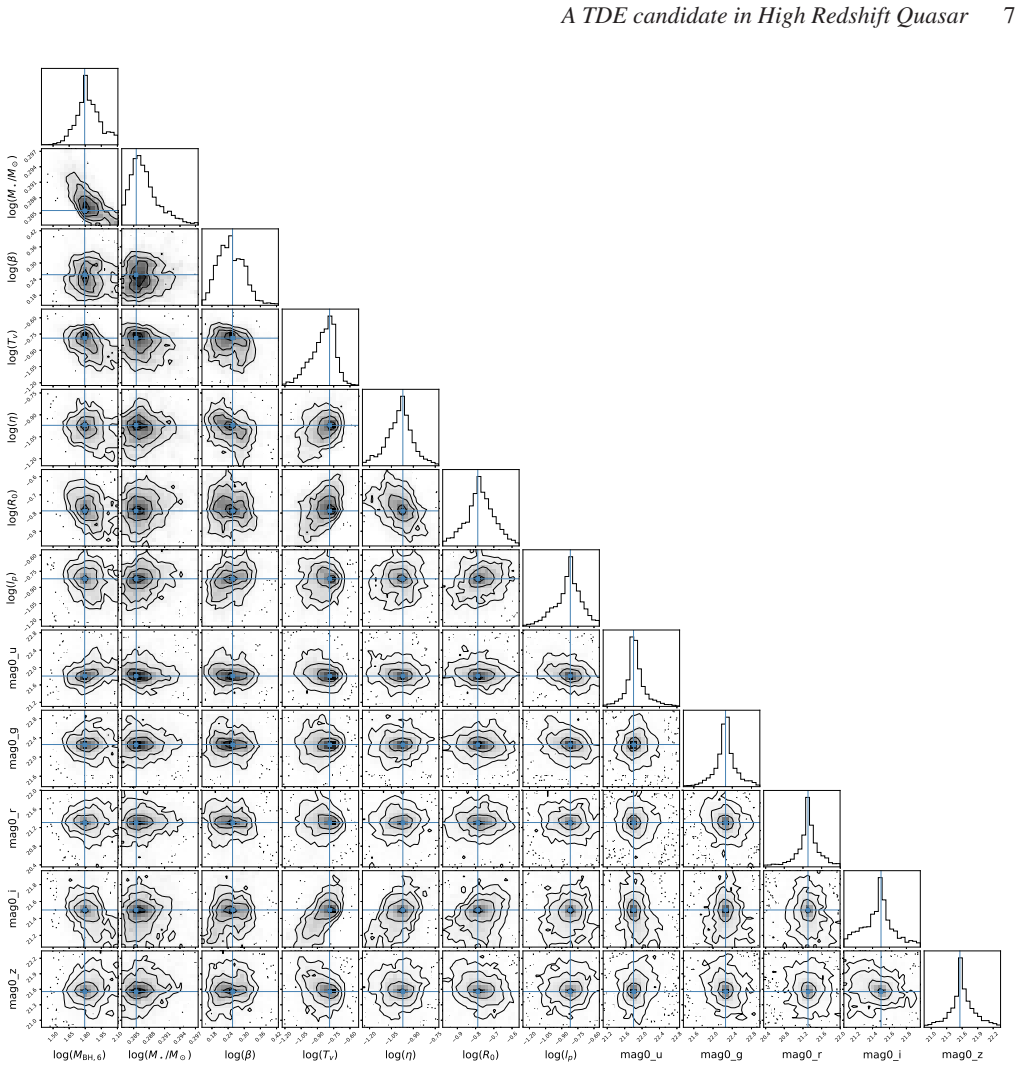
The argument runs on the standard tidal-disruption fallback model in which a star is shredded at the tidal radius, the debris returns to the black hole on a spread of binding energies, and the resulting accretion rate is convolved with a viscous delay to produce a blackbody-photosphere light curve. The paper uses hydrodynamically computed fallback-rate templates, scales them to arbitrary black-hole and stellar masses through the known scaling relations, and adopts a main-sequence mass-radius relation, then fits the model to all five SDSS bands with MCMC. A second machine, the damped random walk (CAR) stochastic process, generates $10^5$ mock light curves with the quasar's measured variance and correlation time; counting how many of those mocks can also be fitted by the TDE model yields the claimed 0.009 per cent probability that the flare is intrinsic AGN variability.
What would settle it
A decisive observation would be continued photometric and spectroscopic monitoring of SDSS J0001 over the next several years. A tidal disruption event should fade smoothly toward the pre-flare level and not re-flare on timescales of years, while the damped random-walk model predicts continuing stochastic variability; the first clear re-brightening or erratic upturn would contradict the TDE interpretation. In addition, a spectrum taken after the flare has faded could check whether the Mg II line width and shift follow the ordinary quasar virial relation, which the debris scenario predicts they should not.
Extended reading notes
Core claim
On the paper's own terms, the long-term variability of SDSS J0001 is a tidal disruption event rather than a coincidence of AGN activity. The observed $ugriz$ light curves are well fitted by the standard viscous-delayed fallback model, yielding a disrupted main-sequence star of mass $1.905^{+0.023}_{-0.009}\,M_\odot$ and a central black hole of mass $6.5^{+3.5}_{-2.6}\times10^7\,M_\odot$, with about $0.78\,M_\odot$ accreted and $1.12\,M_\odot$ ejected. The flare's peak luminosity and photosphere temperature are moderate compared with known optical TDEs, and its unusually long observed timescale follows from a large impact parameter, a relatively massive black hole, and redshift time dilation. The virial black-hole mass from the broad Mg II line is about 7.5 times larger than the TDE fit, which the paper attributes to non-virial motions of TDE debris contributing to the broad-line emission. Finally, mock light curves generated with the damped random walk (CAR) process and fitted with the TDE model give a probability of about 0.009 per cent that the observed flare is intrinsic quasar variability.
Load-bearing premise
The load-bearing premise is that the 0.009 per cent probability computed from mock light curves for this single object, without accounting for the 7253 visually inspected light curves or for fitting the CAR parameters to the same data, is a valid measure of the chance that the flare is intrinsic quasar variability rather than a TDE.
Editorial extensions
If this is right
- SDSS J0001 becomes the highest-redshift optical TDE candidate found in a broad-line quasar at $z=1.404$, extending TDE searches beyond quiescent galaxies.
- The $7.5\times$ gap between the TDE-fitted black-hole mass and the Mg II virial mass implies that broad emission lines in TDE-hosting AGN may contain non-virial debris components, so virial masses in such objects can be biased.
- The long observed timescale of the flare follows from the combination of a high impact parameter, a large black-hole mass, and time dilation, so similar long flares at high redshift need not require exotic physics.
- The low mock-light-curve probability supports the interpretation that some apparent quasar flares are central TDEs rather than stochastic accretion variability.
Reading between the lines
- Applying the paper's TDE-template fit to the other 19 visually selected flare candidates from the same Stripe82 parent sample would reveal whether the highest-redshift case is a one-off or the bright end of a population.
- If the TDE interpretation is right, the same archival method should find more such flares in high-redshift quasars, and the fraction of AGN variability attributable to TDEs could be measured from the parent sample.
- The non-virial broad-line interpretation could be tested by high-resolution follow-up spectroscopy: TDE debris should produce velocity-offset or time-variable line profiles tied to the continuum decay, whereas a normal broad-line region would not.
Editorial analysis
A structured set of objections, weighed in public.
Referee Report
Summary. SDSS J000118.70+003314.0 (SDSS J0001) is a z=1.404 quasar with a broad Mg II line. It was one of 20 flare-shaped candidates found by visual inspection of the light curves of 7253 z>1 Stripe82 quasars, and is analyzed here because it has the highest redshift among them. The paper fits its nine-year ugriz photometry (about 60 epochs per band from Stripe82 plus PHOTOOBJALL) with the publicly available MOSFIT/TDEFIT tidal disruption event model and reports a best fit with a main-sequence star of about 1.9 M_sun and a black hole of 6.5x10^7 M_sun, at reduced chi^2/dof of about 4.5. The authors then test the null hypothesis of intrinsic AGN variability by fitting a damped random walk (CAR) model with JAVELIN to the g-band light curve (tau about 470 days), generating 10^5 mock light curves, and counting how many the TDE model fits as well as the data; 9 of 10^5 pass, giving the quoted 0.009% probability. Alternative explanations (dust extinction, microlensing, accretion) are discussed and argued to be disfavored. The paper concludes that SDSS J0001 is a high-redshift TDE candidate in an AGN, supporting the view that some AGN variability is produced by tidal disruption events.
Significance. If confirmed, this would be one of the very few TDE candidates hosted by a broad-line quasar at z>1 and would add empirical support to the idea that central stellar disruptions contribute to AGN variability. The manuscript has genuine strengths: the TDE modeling is not ad hoc, since it uses published MOSFIT/TDEFIT hydrodynamical templates and standard scaling relations; the flare characterization is multi-pronged (Gaussian-rise/exponential-decay fit, Weibull shape parameters, g-r color evolution); the DRW/CAR test is a serious attempt to quantify the intrinsic-variability null rather than asserting it; and each alternative scenario receives a concrete physical argument. The analysis is transparent and reproducible in structure: the light-curve sources, the SQL query, the fitting codes (kmpfit, emcee, JAVELIN), and the template interpolations (Appendix B) are all described. These strengths make the candidate worth keeping in the literature, provided the statistical significance issues described in the major comments are resolved.
major comments (3)
- [Section 5.3; Abstract] The quoted probability p about 0.009% is a per-object false-positive rate and does not account for the way SDSS J0001 was selected. Section 2 reports a visual inspection of the light curves of 7253 z>1 Stripe82 quasars, from which 20 flare-shaped candidates were chosen, with SDSS J0001 analyzed as the highest-redshift example. Section 5.3 then simulates 10^5 mock DRW light curves for this single object and finds 9 that pass the TDE-fit criterion. If the per-object rate is about 9x10^-5, the parent sample of 7253 quasars yields about 0.65 expected false positives, and the authors' own alternative calculation with tau uniformly drawn from [50,5000] days (0.144%) yields about 10 expected false positives. The observation is therefore fully consistent with the null of intrinsic DRW variability once the search is taken into account. I recommend that the authors either analyze all 20 selected candidates with the same machinery, apply an explicit trial correction, or clearly state that 0.009% is a per-object conditional rate and refrain from presenting it in the Abstract as the probability that the event results from intrinsic variability of quasars.
- [Section 5.3; Eq. (10)] The DRW/CAR null simulations are calibrated on the very light curve under test. The parameters tau about 470+260-178 days and sigma are fitted with JAVELIN to the same g-band light curve that is hypothesized to contain the TDE (Section 5.3, Figure 9), and the mock light curves are then generated from these data-derived parameters using the variance (0.07 mag^2) of that same light curve. If the flare is real, the fitted CAR process is contaminated by the signal; if the flare is an extreme DRW fluctuation, the object was selected from 7253 quasars precisely because of that fluctuation. In neither case is the simulation an independent null, and the resulting 0.009% is a conditional probability given the fitted parameters, not the probability that the event is intrinsic variability as the Abstract states. Depending on the direction of the bias, this could either over- or under-state the significance. I recommend re-running the simulation with population-level priors on (tau, sigma), or with parameters fitted only to the pre- and post-flare portions of the light curve, and reporting how the resulting probability changes.
- [Section 4; Table 1] The fit quality does not support the Abstract's statement that the light curves can be described by the conventional TDE model. Section 4 reports reduced chi^2/dof of about 4.5; with roughly 300 photometric points (Section 2 states about 60 per band in five bands) and 13 free parameters (Table 1), this corresponds to chi^2 of about 1300 for about 287 degrees of freedom and is a formally poor fit. The MCMC parameter uncertainties in Table 1 (e.g., log(M_star/M_sun)=0.28 with very small asymmetric errors) are therefore underestimated, because no rescaling for chi^2/dof>1 is applied. Please quantify the likely sources of excess scatter (underestimated photometric errors, correlated systematics, model deficiencies), rescale the uncertainties accordingly, and justify the chi^2/dof<4.5 acceptance threshold used for the mock light curves in Section 5.3 in light of this assessment.
minor comments (6)
- [Section 2] The claim that SDSS J0001 is the highest-redshift optical TDE candidate known in AGN is internally inconsistent with the Introduction, which lists SDSS J120414.37+351800.5 at z about 2.359 as a TDE candidate in a N-rich quasar; please qualify the statement (e.g., among candidates with well-sampled multi-band light curves) or correct it.
- [Section 5.2] The spectrum was taken near the flare peak, so the continuum luminosity entering the Shen et al. (2011) virial Mg II estimator is likely flare-boosted; part of the factor-7.5 discrepancy between the virial and TDE black-hole masses may therefore arise from the virial estimator itself, a possibility not discussed alongside the proposed non-virial dynamics of TDE debris.
- [Section 5.4] The dust-extinction test in the left panel of Figure 11 derives E(B-V) from binned i-band mean magnitudes under the assumption that all i-band variability is extinction; the test would be biased if the i-band contains intrinsic variability, and the binning and interpolation choices are not described in detail.
- [Section 5.4; Figure 11] No fit statistics are reported for the 1S2L microlensing model; a chi^2 value or a residual plot is needed to support the claim that microlensing is disfavored by the achromaticity argument.
- [Eq. (10)] Equation (10) is not written as a proper stochastic differential equation: the drift term is missing the dt factor and the noise term notation is ambiguous; please correct the expression so that the CAR process is unambiguously defined.
- [Section 2] The comparison with the Weibull parameters of simulated lensing flares in Graham et al. (2017) is purely qualitative; a figure or table showing the location of SDSS J0001 relative to the simulated 1S1L and lensing distributions would make the argument against lensing quantitative.
Circularity Check
The 0.009% intrinsic-variability probability is computed from CAR/DRW parameters fitted to the same g-band light curve under test, making the key significance claim partially circular; the MOSFIT TDE fit itself is external and non-circular.
-
fitted input called prediction
[Section 5.3 (Eqs. 10-11, Fig. 9) and Abstract's 0.009% claim]
"the left panel of Figure 9 shows the best fit ... to the photometric SDSS g-band light curve with the JAVELIN code. ... We have ln(τ/days) ∼ 6.15 ... (τ∼ 470 ... days) ... The CAR process parameter τ is randomly selected from 470-178 to 470+260 ... and the parameter σ∗ is determined by σ∼0.07. ... Finally, we found 9 light curves that can be well described by the theoretical TDE model. Therefore, the probability is about 0.009%."
The reported probability that SDSS J0001's long-term variability is intrinsic AGN variability is not an independent null test. JAVELIN fits the CAR/DRW parameters (τ∼470 days, σ) to the same g-band light curve that is hypothesized to contain a TDE flare; the mock light curves are then generated from those data-derived parameters, with variance σ=0.07 taken from that same light curve, and the acceptance threshold χ2/dof<4.5 is set by the observed TDE fit. The null distribution is therefore calibrated on the signal being tested: the 0.009% is the rate at which the fitted CAR process, contaminated by the flare, reproduces a TDE-like curve, not the probability that the observed variability arises from intrinsic AGN activity.
full rationale
The TDE model fit itself is not circular: the ugriz light curves are compared with external MOSFIT/TDEFIT templates (Guillochon et al. 2014; Mockler et al. 2019) with free physical parameters, and the reported stellar and black-hole masses come from that fit. The main circularity is concentrated in Section 5.3, where the quantitative claim that excludes intrinsic quasar variability is produced by fitting the CAR/DRW null model to the same g-band light curve under study and then simulating from those fitted parameters, including the light curve's own variance. This makes the 0.009% probability a fitted-input prediction rather than an independent significance estimate. The per-object value is also quoted after visual selection from 7253 Stripe82 quasars without a trials correction, so it cannot be read as an experiment-wide false-alarm rate; that is a statistical validity issue rather than circularity. The self-citations to Zhang et al. (2019) and Zhang (2021, 2022) for non-virial BLR dynamics are present but not the load-bearing derivation of the TDE candidate, which rests on the external MOSFIT fit. Overall, the central TDE identification has independent content, but the headline probability is partially circular.
Assumptions & free parameters
free parameters (11)
- Black hole mass M_BH =
log10(M_BH/Msun)=1.81, about 6.5e7 Msun
- Disrupted star mass M_star =
log10(M_star/Msun)=0.28, about 1.905 Msun
- Impact parameter beta =
log10(beta)=0.25, beta=1.77
- Viscous time T_v =
log10(T_v/yr)=-0.84
- Energy conversion efficiency eta =
log10(eta)=-0.98, eta about 0.105
- Photosphere radius normalization R0 =
log10(R0)=-0.77
- Photosphere luminosity power-law index l_p =
log10(l_p)=-0.82
- Host galaxy magnitude offsets mag0_u/g/r/i/z =
21.61, 22.25, 21.85, 21.47, 21.31 mag
- DRW/CAR timescale tau =
about 470 days, ln(tau)=6.15
- DRW/CAR amplitude sigma =
ln(sigma)=-1.38
- Phenomenological shape parameters =
Gaussian-exponential log(sigma)=2.99, log(tau)=3.46; Weibull log(a)=0.016, log(b)=0.016
assumptions (7)
- domain assumption MOSFIT/TDEFIT fallback-rate templates from Guillochon et al. (2014) and Mockler et al. (2019) are valid for this event after linear interpolation in beta and T_v.
- domain assumption The radiating region is a single blackbody photosphere with radius depending on luminosity as a power law (Equations 6 and 7).
- domain assumption The host galaxy contributes constant flux in each band, represented by five free magnitudes.
- domain assumption Intrinsic AGN variability is adequately described by a DRW/CAR process, and JAVELIN recovers tau for this cadence.
- domain assumption The disrupted star follows the main-sequence mass-radius relation from Tout et al. (1996).
- domain assumption A single partial disruption with polytropic index gamma=4/3 describes the fallback.
- standard math Cosmological parameters H0=70 km/s/Mpc, Omega_m=0.3, Omega_Lambda=0.7.
invented entities (1)
-
Non-virial Mg II emitting clouds from TDE debris
Cite this review
Pith. "Pith review of A central tidal disruption event candidate in high redshift quasar SDSS J000118.70+003314.0." pith.science (2026). https://pith.science/paper/EY32DPIV
@misc{pith2026241217046,
  author       = {Pith},
  title        = {Pith review of: A central tidal disruption event candidate in high redshift quasar SDSS J000118.70+003314.0},
  year         = {2026},
  howpublished = {\url{https://pith.science/paper/EY32DPIV}},
  note         = {Machine review of arXiv:2412.17046}
}
abstract
We report a high-redshift ($z=1.404$) tidal disruption event (TDE) candidate in SDSS J000118.70+003314.0 (SDSS J0001), which is a quasar with apparent broad Mg~{\sc ii} emission line. The long-term variability in its nine-year photometric $ugriz$-band light curves, obtained from the SDSS Stripe82 and the PHOTOOBJALL databases, can be described by the conventional TDE model. Our results suggest that the TDE is a main-sequence star with mass of $1.905_{-0.009}^{+0.023}{\rm M_\odot}$ tidally disrupted by a black hole (BH) with mass {$6.5_{-2.6}^{+3.5}\times10^7{\rm M_\odot}$}. The BH mass is about 7.5 times smaller than the virial BH mass derived from the broad Mg~{\sc ii} emission line, which can be explained by non-virial dynamic properties of broad emission lines from TDEs debris. Furthermore, we examine the probability that the event results from intrinsic variability of quasars, which is about $0.009\%$, through applications of the DRW/CAR process. Alternative explanations for the event are also discussed, such as the scenarios of dust obscurations, microlensing and accretion. Our results provide clues to support that TDEs could be detectable in broad line quasars as well as in quiescent galaxies, and to indicate the variability of some active galactic nuclei may be partly attributed to central TDEs.
Figures


Figures from the paper (8 more)



Reference graph
Works this paper leans on
-
[1]
Ahumada R., et al., 2020, @doi [ ] 10.3847/1538-4365/ab929e , https://ui.adsabs.harvard.edu/abs/2020ApJS..249....3A 249, 3
-
[2]
Almeida A., et al., 2023, @doi [ ] 10.3847/1538-4365/acda98 , https://ui.adsabs.harvard.edu/abs/2023ApJS..267...44A 267, 44
-
[3]
Anderson M. M., et al., 2020, @doi [ ] 10.3847/1538-4357/abb94b , https://ui.adsabs.harvard.edu/abs/2020ApJ...903..116A 903, 116
-
[4]
Andrae R., Kim D. W., Bailer-Jones C. A. L., 2013, @doi [ ] 10.1051/0004-6361/201321335 , https://ui.adsabs.harvard.edu/abs/2013A&A...554A.137A 554, A137
-
[5]
Andreoni I., et al., 2022, @doi [ ] 10.1038/s41586-022-05465-8 , https://ui.adsabs.harvard.edu/abs/2022Natur.612..430A 612, 430
-
[6]
Arcavi I., et al., 2014, @doi [ ] 10.1088/0004-637X/793/1/38 , https://ui.adsabs.harvard.edu/abs/2014ApJ...793...38A 793, 38
-
[7]
Bade N., Komossa S., Dahlem M., 1996, , https://ui.adsabs.harvard.edu/abs/1996A&A...309L..35B 309, L35
1996
-
[8]
Bellm E. C., et al., 2019, @doi [ ] 10.1088/1538-3873/aaecbe , https://ui.adsabs.harvard.edu/abs/2019PASP..131a8002B 131, 018002
Show all 129 references
-
[9]
K., et al., 2017, @doi [ ] 10.3847/1538-4357/aa77f7 , https://ui.adsabs.harvard.edu/abs/2017ApJ...843..106B 843, 106
Blanchard P. K., et al., 2017, @doi [ ] 10.3847/1538-4357/aa77f7 , https://ui.adsabs.harvard.edu/abs/2017ApJ...843..106B 843, 106
2017 doi
-
[10]
R., et al., 2017, @doi [ ] 10.3847/1538-3881/aa7567 , https://ui.adsabs.harvard.edu/abs/2017AJ....154...28B 154, 28
Blanton M. R., et al., 2017, @doi [ ] 10.3847/1538-3881/aa7567 , https://ui.adsabs.harvard.edu/abs/2017AJ....154...28B 154, 28
2017 doi
-
[11]
S., et al., 2011, @doi [Science] 10.1126/science.1207150 , https://ui.adsabs.harvard.edu/abs/2011Sci...333..203B 333, 203
Bloom J. S., et al., 2011, @doi [Science] 10.1126/science.1207150 , https://ui.adsabs.harvard.edu/abs/2011Sci...333..203B 333, 203
2011 doi
-
[13]
C., Levan A
Brown G. C., Levan A. J., Stanway E. R., Tanvir N. R., Cenko S. B., Berger E., Chornock R., Cucchiaria A., 2015, @doi [ ] 10.1093/mnras/stv1520 , https://ui.adsabs.harvard.edu/abs/2015MNRAS.452.4297B 452, 4297
2015 doi
-
[14]
S., Shappee B
Brown J. S., Shappee B. J., Holoien T. W. S., Stanek K. Z., Kochanek C. S., Prieto J. L., 2016, @doi [ ] 10.1093/mnras/stw1928 , https://ui.adsabs.harvard.edu/abs/2016MNRAS.462.3993B 462, 3993
2016 doi
-
[15]
S., et al., 2018, @doi [ ] 10.1093/mnras/stx2372 , https://ui.adsabs.harvard.edu/abs/2018MNRAS.473.1130B 473, 1130
Brown J. S., et al., 2018, @doi [ ] 10.1093/mnras/stx2372 , https://ui.adsabs.harvard.edu/abs/2018MNRAS.473.1130B 473, 1130
2018 doi
-
[16]
N., et al., 2011, @doi [ ] 10.1038/nature10374 , https://ui.adsabs.harvard.edu/abs/2011Natur.476..421B 476, 421
Burrows D. N., et al., 2011, @doi [ ] 10.1038/nature10374 , https://ui.adsabs.harvard.edu/abs/2011Natur.476..421B 476, 421
2011 doi
-
[17]
A., Moretti A., 2015, @doi [ ] 10.1051/0004-6361/201525965 , https://ui.adsabs.harvard.edu/abs/2015A&A...581A..17C 581, A17
Campana S., Mainetti D., Colpi M., Lodato G., D'Avanzo P., Evans P. A., Moretti A., 2015, @doi [ ] 10.1051/0004-6361/201525965 , https://ui.adsabs.harvard.edu/abs/2015A&A...581A..17C 581, A17
2015 doi
-
[18]
Cappelluti N., et al., 2009, @doi [ ] 10.1051/0004-6361/200811479 , https://ui.adsabs.harvard.edu/abs/2009A&A...495L...9C 495, L9
2009 doi
-
[19]
P., 1983, , https://ui.adsabs.harvard.edu/abs/1983A&A...121...97C 121, 97
Carter B., Luminet J. P., 1983, , https://ui.adsabs.harvard.edu/abs/1983A&A...121...97C 121, 97
1983
-
[20]
B., et al., 2012, @doi [ ] 10.1088/0004-637X/753/1/77 , https://ui.adsabs.harvard.edu/abs/2012ApJ...753...77C 753, 77
Cenko S. B., et al., 2012, @doi [ ] 10.1088/0004-637X/753/1/77 , https://ui.adsabs.harvard.edu/abs/2012ApJ...753...77C 753, 77
2012 doi
-
[21]
B., et al., 2016, @doi [ ] 10.3847/2041-8205/818/2/L32 , https://ui.adsabs.harvard.edu/abs/2016ApJ...818L..32C 818, L32
Cenko S. B., et al., 2016, @doi [ ] 10.3847/2041-8205/818/2/L32 , https://ui.adsabs.harvard.edu/abs/2016ApJ...818L..32C 818, L32
2016 doi
-
[22]
C., 2007, in American Astronomical Society Meeting Abstracts
Chambers K. C., 2007, in American Astronomical Society Meeting Abstracts. p. 142.06
2007
-
[23]
Chornock R., et al., 2014, @doi [ ] 10.1088/0004-637X/780/1/44 , https://ui.adsabs.harvard.edu/abs/2014ApJ...780...44C 780, 44
2014 doi
-
[24]
Cikota A., Leloudas G., Bulla M., Dai L., Maund J., Andreoni I., 2023, @doi [ ] 10.3847/2041-8213/acaf67 , https://ui.adsabs.harvard.edu/abs/2023ApJ...943L..18C 943, L18
2023 doi
-
[25]
De Colle F., Lu W., 2020, @doi [ ] 10.1016/j.newar.2020.101538 , https://ui.adsabs.harvard.edu/abs/2020NewAR..8901538D 89, 101538
2020
-
[26]
J., Miller M
Dittmann A. J., Miller M. C., 2020, @doi [ ] 10.1093/mnras/staa463 , https://ui.adsabs.harvard.edu/abs/2020MNRAS.493.3732D 493, 3732
2020 doi
-
[27]
L., Brandt W
Donley J. L., Brandt W. N., Eracleous M., Boller T., 2002, @doi [ ] 10.1086/342280 , https://ui.adsabs.harvard.edu/abs/2002AJ....124.1308D 124, 1308
2002 doi
-
[28]
J., et al., 2009, @doi [ ] 10.1088/0004-637X/696/1/870 , https://ui.adsabs.harvard.edu/abs/2009ApJ...696..870D 696, 870
Drake A. J., et al., 2009, @doi [ ] 10.1088/0004-637X/696/1/870 , https://ui.adsabs.harvard.edu/abs/2009ApJ...696..870D 696, 870
2009 doi
-
[29]
J., et al., 2011, @doi [ ] 10.1088/0004-637X/735/2/106 , https://ui.adsabs.harvard.edu/abs/2011ApJ...735..106D 735, 106
Drake A. J., et al., 2011, @doi [ ] 10.1088/0004-637X/735/2/106 , https://ui.adsabs.harvard.edu/abs/2011ApJ...735..106D 735, 106
2011 doi
-
[30]
Elvis M., et al., 1994, @doi [ ] 10.1086/192093 , https://ui.adsabs.harvard.edu/abs/1994ApJS...95....1E 95, 1
1994 doi
-
[31]
D., Freyberg M
Esquej P., Saxton R. D., Freyberg M. J., Read A. M., Altieri B., Sanchez-Portal M., Hasinger G., 2007, @doi [ ] 10.1051/0004-6361:20066072 , https://ui.adsabs.harvard.edu/abs/2007A&A...462L..49E 462, L49
2007 doi
-
[32]
Esquej P., et al., 2008, @doi [ ] 10.1051/0004-6361:200810110 , https://ui.adsabs.harvard.edu/abs/2008A&A...489..543E 489, 543
2008 doi
-
[33]
L., 1999, @doi [ ] 10.1086/316293 , https://ui.adsabs.harvard.edu/abs/1999PASP..111...63F 111, 63
Fitzpatrick E. L., 1999, @doi [ ] 10.1086/316293 , https://ui.adsabs.harvard.edu/abs/1999PASP..111...63F 111, 63
1999 doi
-
[34]
W., Lang D., Goodman J., 2013, @doi [ ] 10.1086/670067 , https://ui.adsabs.harvard.edu/abs/2013PASP..125..306F 125, 306
Foreman-Mackey D., Hogg D. W., Lang D., Goodman J., 2013, @doi [ ] 10.1086/670067 , https://ui.adsabs.harvard.edu/abs/2013PASP..125..306F 125, 306
2013 doi
-
[35]
A., et al., 2008, @doi [ ] 10.1088/0004-6256/135/1/338 , https://ui.adsabs.harvard.edu/abs/2008AJ....135..338F 135, 338
Frieman J. A., et al., 2008, @doi [ ] 10.1088/0004-6256/135/1/338 , https://ui.adsabs.harvard.edu/abs/2008AJ....135..338F 135, 338
2008 doi
-
[36]
Gezari S., 2021, @doi [ ] 10.1146/annurev-astro-111720-030029 , https://ui.adsabs.harvard.edu/abs/2021ARA&A..59...21G 59, 21
2021 doi
-
[37]
Gezari S., et al., 2008, @doi [ ] 10.1086/529008 , https://ui.adsabs.harvard.edu/abs/2008ApJ...676..944G 676, 944
2008 doi
-
[38]
Gezari S., et al., 2012, @doi [ ] 10.1038/nature10990 , https://ui.adsabs.harvard.edu/abs/2012Natur.485..217G 485, 217
2012 doi
-
[39]
J., Djorgovski S
Graham M. J., Djorgovski S. G., Drake A. J., Stern D., Mahabal A. A., Glikman E., Larson S., Christensen E., 2017, @doi [ ] 10.1093/mnras/stx1456 , https://ui.adsabs.harvard.edu/abs/2017MNRAS.470.4112G 470, 4112
2017 doi
- [40]
-
[41]
Gromadzki M., et al., 2019, @doi [ ] 10.1051/0004-6361/201833682 , https://ui.adsabs.harvard.edu/abs/2019A&A...622L...2G 622, L2
2019 doi
- [42]
-
[43]
Guillochon J., Ramirez-Ruiz E., 2013, @doi [ ] 10.1088/0004-637X/767/1/25 , https://ui.adsabs.harvard.edu/abs/2013ApJ...767...25G 767, 25
2013 doi
-
[44]
Guillochon J., Manukian H., Ramirez-Ruiz E., 2014, @doi [ ] 10.1088/0004-637X/783/1/23 , https://ui.adsabs.harvard.edu/abs/2014ApJ...783...23G 783, 23
2014 doi
-
[45]
A., Mockler B., Narayan G., Mandel K
Guillochon J., Nicholl M., Villar V. A., Mockler B., Narayan G., Mandel K. S., Berger E., Williams P. K. G., 2017, MOSFiT: Modular Open-Source Fitter for Transients , Astrophysics Source Code Library, record ascl:1710.006 ( @eprint ascl 1710.006 )
2017
-
[46]
A., Mockler B., Narayan G., Mandel K
Guillochon J., Nicholl M., Villar V. A., Mockler B., Narayan G., Mandel K. S., Berger E., Williams P. K. G., 2018, @doi [ ] 10.3847/1538-4365/aab761 , https://ui.adsabs.harvard.edu/abs/2018ApJS..236....6G 236, 6
2018 doi
-
[47]
Hammerstein E., et al., 2023, @doi [ ] 10.3847/1538-4357/aca283 , https://ui.adsabs.harvard.edu/abs/2023ApJ...942....9H 942, 9
2023 doi
-
[48]
T., et al., 2023, @doi [ ] 10.1093/mnras/stac3659 , https://ui.adsabs.harvard.edu/abs/2023MNRAS.519.2035H 519, 2035
Hinkle J. T., et al., 2023, @doi [ ] 10.1093/mnras/stac3659 , https://ui.adsabs.harvard.edu/abs/2023MNRAS.519.2035H 519, 2035
2023 doi
-
[49]
Holoien T. W. S., et al., 2014, @doi [ ] 10.1093/mnras/stu1922 , https://ui.adsabs.harvard.edu/abs/2014MNRAS.445.3263H 445, 3263
2014 doi
-
[50]
Holoien T. W. S., et al., 2016, @doi [ ] 10.1093/mnras/stv2486 , https://ui.adsabs.harvard.edu/abs/2016MNRAS.455.2918H 455, 2918
2016 doi
-
[51]
Holoien T. W. S., et al., 2019, @doi [ ] 10.3847/1538-4357/ab2ae1 , https://ui.adsabs.harvard.edu/abs/2019ApJ...880..120H 880, 120
2019 doi
-
[52]
Hung T., et al., 2017, @doi [ ] 10.3847/1538-4357/aa7337 , https://ui.adsabs.harvard.edu/abs/2017ApJ...842...29H 842, 29
2017 doi
-
[53]
Hung T., et al., 2019, @doi [ ] 10.3847/1538-4357/ab24de , https://ui.adsabs.harvard.edu/abs/2019ApJ...879..119H 879, 119
2019 doi
-
[54]
Hung T., et al., 2020, @doi [ ] 10.3847/1538-4357/abb606 , https://ui.adsabs.harvard.edu/abs/2020ApJ...903...31H 903, 31
2020 doi
-
[55]
B., Novikov I
Ivanov P. B., Novikov I. D., 2001, @doi [ ] 10.1086/319050 , https://ui.adsabs.harvard.edu/abs/2001ApJ...549..467I 549, 467
2001 doi
-
[56]
Kajava J. J. E., Giustini M., Saxton R. D., Miniutti G., 2020, @doi [ ] 10.1051/0004-6361/202038165 , https://ui.adsabs.harvard.edu/abs/2020A&A...639A.100K 639, A100
2020 doi
-
[57]
C., Bechtold J., Siemiginowska A., 2009, @doi [ ] 10.1088/0004-637X/698/1/895 , https://ui.adsabs.harvard.edu/abs/2009ApJ...698..895K 698, 895
Kelly B. C., Bechtold J., Siemiginowska A., 2009, @doi [ ] 10.1088/0004-637X/698/1/895 , https://ui.adsabs.harvard.edu/abs/2009ApJ...698..895K 698, 895
2009 doi
-
[58]
Kesden M., 2012, @doi [ ] 10.1103/PhysRevD.85.024037 , https://ui.adsabs.harvard.edu/abs/2012PhRvD..85b4037K 85, 024037
2012 doi
-
[59]
S., M \'e sz \'a ros P., 2004, @doi [ ] 10.1086/424684 , https://ui.adsabs.harvard.edu/abs/2004ApJ...615..855K 615, 855
Kobayashi S., Laguna P., Phinney E. S., M \'e sz \'a ros P., 2004, @doi [ ] 10.1086/424684 , https://ui.adsabs.harvard.edu/abs/2004ApJ...615..855K 615, 855
2004 doi
-
[60]
S., 1994, @doi [ ] 10.1086/173745 , https://ui.adsabs.harvard.edu/abs/1994ApJ...422..508K 422, 508
Kochanek C. S., 1994, @doi [ ] 10.1086/173745 , https://ui.adsabs.harvard.edu/abs/1994ApJ...422..508K 422, 508
1994 doi
- [61]
- [62]
-
[63]
Komossa S., et al., 2008, @doi [ ] 10.1086/588281 , https://ui.adsabs.harvard.edu/abs/2008ApJ...678L..13K 678, L13
2008 doi
-
[64]
C., Martel H., eds, American Institute of Physics Conference Series Vol
Kormendy J., Gebhardt K., 2001, in Wheeler J. C., Martel H., eds, American Institute of Physics Conference Series Vol. 586, 20th Texas Symposium on relativistic astrophysics. pp 363--381 ( @eprint arXiv astro-ph/0105230 ), @doi 10.1063/1.1419581
2001 arXiv
-
[65]
C., 2013, @doi [ ] 10.1146/annurev-astro-082708-101811 , https://ui.adsabs.harvard.edu/abs/2013ARA&A..51..511K 51, 511
Kormendy J., Ho L. C., 2013, @doi [ ] 10.1146/annurev-astro-082708-101811 , https://ui.adsabs.harvard.edu/abs/2013ARA&A..51..511K 51, 511
2013 doi
-
[66]
Koz owski S., 2017, @doi [ ] 10.1051/0004-6361/201629890 , https://ui.adsabs.harvard.edu/abs/2017A&A...597A.128K 597, A128
2017 doi
-
[67]
Koz owski S., et al., 2010, @doi [ ] 10.1088/0004-637X/708/2/927 , https://ui.adsabs.harvard.edu/abs/2010ApJ...708..927K 708, 927
2010 doi
-
[68]
R., Klein R
Krumholz M. R., Klein R. I., McKee C. F., Offner S. S. R., Cunningham A. J., 2009, @doi [Science] 10.1126/science.1165857 , https://ui.adsabs.harvard.edu/abs/2009Sci...323..754K 323, 754
2009 doi
-
[69]
M., et al., 2015, @doi [ ] 10.1088/0004-637X/800/2/144 , https://ui.adsabs.harvard.edu/abs/2015ApJ...800..144L 800, 144
LaMassa S. M., et al., 2015, @doi [ ] 10.1088/0004-637X/800/2/144 , https://ui.adsabs.harvard.edu/abs/2015ApJ...800..144L 800, 144
2015 doi
-
[70]
M., et al., 2009, @doi [ ] 10.1086/648598 , https://ui.adsabs.harvard.edu/abs/2009PASP..121.1395L 121, 1395
Law N. M., et al., 2009, @doi [ ] 10.1086/648598 , https://ui.adsabs.harvard.edu/abs/2009PASP..121.1395L 121, 1395
2009 doi
-
[71]
Lawrence A., et al., 2016, @doi [ ] 10.1093/mnras/stw1963 , https://ui.adsabs.harvard.edu/abs/2016MNRAS.463..296L 463, 296
2016 doi
-
[72]
Leloudas G., et al., 2016, @doi [Nature Astronomy] 10.1038/s41550-016-0002 , https://ui.adsabs.harvard.edu/abs/2016NatAs...1E...2L 1, 0002
2016 doi
-
[73]
J., et al., 2011, @doi [Science] 10.1126/science.1207143 , https://ui.adsabs.harvard.edu/abs/2011Sci...333..199L 333, 199
Levan A. J., et al., 2011, @doi [Science] 10.1126/science.1207143 , https://ui.adsabs.harvard.edu/abs/2011Sci...333..199L 333, 199
2011 doi
-
[74]
Lin D., et al., 2015, @doi [ ] 10.1088/0004-637X/811/1/43 , https://ui.adsabs.harvard.edu/abs/2015ApJ...811...43L 811, 43
2015 doi
-
[75]
Liu X., Dittmann A., Shen Y., Jiang L., 2018, @doi [ ] 10.3847/1538-4357/aabb04 , https://ui.adsabs.harvard.edu/abs/2018ApJ...859....8L 859, 8
2018 doi
-
[76]
Liu Z., Li D., Liu H.-Y., Lu Y., Yuan W., Dou L., Shen R.-F., 2020, @doi [ ] 10.3847/1538-4357/ab880f , https://ui.adsabs.harvard.edu/abs/2020ApJ...894...93L 894, 93
2020 doi
-
[77]
M., 2011, @doi [ ] 10.1111/j.1365-2966.2010.17448.x , https://ui.adsabs.harvard.edu/abs/2011MNRAS.410..359L 410, 359
Lodato G., Rossi E. M., 2011, @doi [ ] 10.1111/j.1365-2966.2010.17448.x , https://ui.adsabs.harvard.edu/abs/2011MNRAS.410..359L 410, 359
2011
-
[78]
R., Pringle J
Lodato G., King A. R., Pringle J. E., 2009, @doi [ ] 10.1111/j.1365-2966.2008.14049.x , https://ui.adsabs.harvard.edu/abs/2009MNRAS.392..332L 392, 332
2009
-
[79]
L., et al., 2010, @doi [ ] 10.1088/0004-637X/721/2/1014 , https://ui.adsabs.harvard.edu/abs/2010ApJ...721.1014M 721, 1014
MacLeod C. L., et al., 2010, @doi [ ] 10.1088/0004-637X/721/2/1014 , https://ui.adsabs.harvard.edu/abs/2010ApJ...721.1014M 721, 1014
2010 doi
-
[80]
L., et al., 2012, @doi [ ] 10.1088/0004-637X/753/2/106 , https://ui.adsabs.harvard.edu/abs/2012ApJ...753..106M 753, 106
MacLeod C. L., et al., 2012, @doi [ ] 10.1088/0004-637X/753/2/106 , https://ui.adsabs.harvard.edu/abs/2012ApJ...753..106M 753, 106
2012 doi
-
[81]
L., et al., 2016, @doi [ ] 10.1093/mnras/stv2997 , https://ui.adsabs.harvard.edu/abs/2016MNRAS.457..389M 457, 389
MacLeod C. L., et al., 2016, @doi [ ] 10.1093/mnras/stv2997 , https://ui.adsabs.harvard.edu/abs/2016MNRAS.457..389M 457, 389
2016 doi
-
[82]
P., Lin D., Irwin J
Maksym W. P., Lin D., Irwin J. A., 2014, @doi [ ] 10.1088/2041-8205/792/2/L29 , https://ui.adsabs.harvard.edu/abs/2014ApJ...792L..29M 792, L29
2014 doi
- [83]
-
[84]
D., 2023, @doi [ ] 10.1093/mnras/stad1182 , https://ui.adsabs.harvard.edu/abs/2023MNRAS.522.4028M 522, 4028
Matsumoto T., Metzger B. D., 2023, @doi [ ] 10.1093/mnras/stad1182 , https://ui.adsabs.harvard.edu/abs/2023MNRAS.522.4028M 522, 4028
2023 doi
-
[85]
Merloni A., et al., 2015, @doi [ ] 10.1093/mnras/stv1095 , https://ui.adsabs.harvard.edu/abs/2015MNRAS.452...69M 452, 69
2015 doi
-
[86]
Mockler B., Guillochon J., Ramirez-Ruiz E., 2019, @doi [ ] 10.3847/1538-4357/ab010f , https://ui.adsabs.harvard.edu/abs/2019ApJ...872..151M 872, 151
2019 doi
-
[87]
A., Katz J
Nolthenius R. A., Katz J. I., 1982, @doi [ ] 10.1086/160511 , https://ui.adsabs.harvard.edu/abs/1982ApJ...263..377N 263, 377
1982 doi
-
[88]
R., et al., 2023, @doi [Nature Astronomy] 10.1038/s41550-022-01820-x , https://ui.adsabs.harvard.edu/abs/2023NatAs...7...88P 7, 88
Pasham D. R., et al., 2023, @doi [Nature Astronomy] 10.1038/s41550-022-01820-x , https://ui.adsabs.harvard.edu/abs/2023NatAs...7...88P 7, 88
2023 doi
-
[89]
S., 1989
Phinney E. S., 1989. p. 543
1989
-
[90]
J., 1988, @doi [ ] 10.1038/333523a0 , https://ui.adsabs.harvard.edu/abs/1988Natur.333..523R 333, 523
Rees M. J., 1988, @doi [ ] 10.1038/333523a0 , https://ui.adsabs.harvard.edu/abs/1988Natur.333..523R 333, 523
1988 doi
-
[91]
Ren W., Wang J., Cai Z., Hu X., 2024, @doi [ ] 10.3847/1538-4357/ad17cb , https://ui.adsabs.harvard.edu/abs/2024ApJ...963....7R 963, 7
2024 doi
-
[92]
Rhodes L., et al., 2023, @doi [ ] 10.1093/mnras/stad344 , https://ui.adsabs.harvard.edu/abs/2023MNRAS.521..389R 521, 389
2023 doi
-
[93]
R., 2009, @doi [ ] 10.1088/0004-637X/695/1/404 , https://ui.adsabs.harvard.edu/abs/2009ApJ...695..404R 695, 404
Rosswog S., Ramirez-Ruiz E., Hix W. R., 2009, @doi [ ] 10.1088/0004-637X/695/1/404 , https://ui.adsabs.harvard.edu/abs/2009ApJ...695..404R 695, 404
2009 doi
-
[94]
Rumbaugh N., et al., 2018, @doi [ ] 10.3847/1538-4357/aaa9b6 , https://ui.adsabs.harvard.edu/abs/2018ApJ...854..160R 854, 160
2018 doi
-
[95]
Ryu T., Krolik J., Piran T., 2020, @doi [ ] 10.3847/1538-4357/abbf4d , https://ui.adsabs.harvard.edu/abs/2020ApJ...904...73R 904, 73
2020 doi
-
[96]
D., Read A
Saxton R. D., Read A. M., Komossa S., Lira P., Alexander K. D., Wieringa M. H., 2017, @doi [ ] 10.1051/0004-6361/201629015 , https://ui.adsabs.harvard.edu/abs/2017A&A...598A..29S 598, A29
2017 doi
-
[97]
G., 2021, Correction to: X-Ray Properties of TDEs , Space Science Reviews, Volume 217, Issue 1, article id.18 ( @eprint arXiv 2103.15442 ), @doi 10.1007/s11214-020-00759-7
Saxton R., Komossa S., Auchettl K., Jonker P. G., 2021, Correction to: X-Ray Properties of TDEs , Space Science Reviews, Volume 217, Issue 1, article id.18 ( @eprint arXiv 2103.15442 ), @doi 10.1007/s11214-020-00759-7
2021 arXiv
-
[98]
Sazonov S., et al., 2021, @doi [ ] 10.1093/mnras/stab2843 , https://ui.adsabs.harvard.edu/abs/2021MNRAS.508.3820S 508, 3820
2021 doi
-
[99]
J., et al., 2014, @doi [ ] 10.1088/0004-637X/788/1/48 , https://ui.adsabs.harvard.edu/abs/2014ApJ...788...48S 788, 48
Shappee B. J., et al., 2014, @doi [ ] 10.1088/0004-637X/788/1/48 , https://ui.adsabs.harvard.edu/abs/2014ApJ...788...48S 788, 48
2014 doi
-
[100]
Shen Y., et al., 2011, @doi [ ] 10.1088/0067-0049/194/2/45 , https://ui.adsabs.harvard.edu/abs/2011ApJS..194...45S 194, 45
2011 doi
-
[101]
Sheng X., Ross N., Nicholl M., 2022, @doi [ ] 10.1093/mnras/stac803 , https://ui.adsabs.harvard.edu/abs/2022MNRAS.512.5580S 512, 5580
2022 doi
-
[102]
W., Wang S
Shu X. W., Wang S. S., Dou L. M., Jiang N., Wang J. X., Wang T. G., 2018, @doi [ ] 10.3847/2041-8213/aaba17 , https://ui.adsabs.harvard.edu/abs/2018ApJ...857L..16S 857, L16
2018 doi
-
[103]
C., Metzger B
Stone N. C., Metzger B. D., 2016, @doi [ ] 10.1093/mnras/stv2281 , https://ui.adsabs.harvard.edu/abs/2016MNRAS.455..859S 455, 859
2016 doi
-
[104]
C., Kesden M., Cheng R
Stone N. C., Kesden M., Cheng R. M., van Velzen S., 2019, @doi [General Relativity and Gravitation] 10.1007/s10714-019-2510-9 , https://ui.adsabs.harvard.edu/abs/2019GReGr..51...30S 51, 30
2019 doi
-
[105]
R., et al., 2022, GRB Coordinates Network, https://ui.adsabs.harvard.edu/abs/2022GCN.31602....1T 31602, 1
Tanvir N. R., et al., 2022, GRB Coordinates Network, https://ui.adsabs.harvard.edu/abs/2022GCN.31602....1T 31602, 1
2022
-
[106]
L., et al., 2018, @doi [ ] 10.1088/1538-3873/aabadf , https://ui.adsabs.harvard.edu/abs/2018PASP..130f4505T 130, 064505
Tonry J. L., et al., 2018, @doi [ ] 10.1088/1538-3873/aabadf , https://ui.adsabs.harvard.edu/abs/2018PASP..130f4505T 130, 064505
2018 doi
-
[107]
A., Pols O
Tout C. A., Pols O. R., Eggleton P. P., Han Z., 1996, @doi [ ] 10.1093/mnras/281.1.257 , https://ui.adsabs.harvard.edu/abs/1996MNRAS.281..257T 281, 257
1996 doi
-
[108]
Trakhtenbrot B., et al., 2019a, @doi [Nature Astronomy] 10.1038/s41550-018-0661-3 , https://ui.adsabs.harvard.edu/abs/2019NatAs...3..242T 3, 242
-
[109]
Trakhtenbrot B., et al., 2019b, @doi [ ] 10.3847/1538-4357/ab39e4 , https://ui.adsabs.harvard.edu/abs/2019ApJ...883...94T 883, 94
- [110]
-
[111]
Wang X.-Y., Liu R.-Y., 2016, @doi [ ] 10.1103/PhysRevD.93.083005 , https://ui.adsabs.harvard.edu/abs/2016PhRvD..93h3005W 93, 083005
2016 doi
-
[112]
Wevers T., et al., 2019, @doi [ ] 10.1093/mnras/stz1976 , https://ui.adsabs.harvard.edu/abs/2019MNRAS.488.4816W 488, 4816
2019 doi
- [113]
-
[114]
Wyrzykowski ., et al., 2017, @doi [ ] 10.1093/mnrasl/slw213 , https://ui.adsabs.harvard.edu/abs/2017MNRAS.465L.114W 465, L114
2017 doi
-
[115]
Yan Z., Xie F.-G., 2018, @doi [ ] 10.1093/mnras/stx3259 , https://ui.adsabs.harvard.edu/abs/2018MNRAS.475.1190Y 475, 1190
2018 doi
-
[116]
Yang C.-W., Wang T.-G., Ferland G., Yuan W., Zhou H.-Y., Jiang P., 2013, @doi [ ] 10.1088/0004-637X/774/1/46 , https://ui.adsabs.harvard.edu/abs/2013ApJ...774...46Y 774, 46
2013 doi
-
[117]
J., Dou L., Zhou H., Jiang N., Sheng Z., 2017, @doi [ ] 10.3847/1538-4357/aa8598 , https://ui.adsabs.harvard.edu/abs/2017ApJ...846..150Y 846, 150
Yang C., Wang T., Ferland G. J., Dou L., Zhou H., Jiang N., Sheng Z., 2017, @doi [ ] 10.3847/1538-4357/aa8598 , https://ui.adsabs.harvard.edu/abs/2017ApJ...846..150Y 846, 150
2017 doi
-
[118]
Yao Y., et al., 2023, @doi [ ] 10.3847/2041-8213/acf216 , https://ui.adsabs.harvard.edu/abs/2023ApJ...955L...6Y 955, L6
2023 doi
-
[119]
R., Gezari S., Guolo M., Cenko S
Yao Y., Lu W., Harrison F., Kulkarni S. R., Gezari S., Guolo M., Cenko S. B., Ho A. Y. Q., 2024, @doi [ ] 10.3847/1538-4357/ad2b6b , https://ui.adsabs.harvard.edu/abs/2024ApJ...965...39Y 965, 39
2024 doi
-
[120]
Zhang X.-G., 2021, @doi [ ] 10.1093/mnrasl/slaa184 , https://ui.adsabs.harvard.edu/abs/2021MNRAS.500L..57Z 500, L57
2021 doi
-
[121]
Zhang X.-G., 2022, @doi [ ] 10.1093/mnrasl/slac092 , https://ui.adsabs.harvard.edu/abs/2022MNRAS.516L..66Z 516, L66
2022 doi
-
[122]
arXiv:2310.07095
Zhang X., 2023, arXiv e-prints, https://ui.adsabs.harvard.edu/abs/2023arXiv231007095X p. arXiv:2310.07095
2023 arXiv
-
[123]
Zhang X.-G., Bao M., Yuan Q., 2019, @doi [ ] 10.1093/mnrasl/slz151 , https://ui.adsabs.harvard.edu/abs/2019MNRAS.490L..81Z 490, L81
2019 doi
-
[124]
Zhang X., YingFei Z., PeiZhen C., BaoHan W., Yi-Li L., HaiChao Y., 2021, @doi [ ] 10.3847/1538-4357/ac23c8 , https://ui.adsabs.harvard.edu/abs/2021ApJ...922..248X 922, 248
2021 doi
-
[125]
J., et al., 2022, @doi [ ] 10.1051/0004-6361/202142253 , https://ui.adsabs.harvard.edu/abs/2022A&A...660A.119Z 660, A119
Zhang W. J., et al., 2022, @doi [ ] 10.1051/0004-6361/202142253 , https://ui.adsabs.harvard.edu/abs/2022A&A...660A.119Z 660, A119
2022 doi
-
[126]
S., Koz owski S., Udalski A., 2013, @doi [ ] 10.1088/0004-637X/765/2/106 , https://ui.adsabs.harvard.edu/abs/2013ApJ...765..106Z 765, 106
Zu Y., Kochanek C. S., Koz owski S., Udalski A., 2013, @doi [ ] 10.1088/0004-637X/765/2/106 , https://ui.adsabs.harvard.edu/abs/2013ApJ...765..106Z 765, 106
2013 doi
-
[127]
S., Koz owski S., Peterson B
Zu Y., Kochanek C. S., Koz owski S., Peterson B. M., 2016, @doi [ ] 10.3847/0004-637X/819/2/122 , https://ui.adsabs.harvard.edu/abs/2016ApJ...819..122Z 819, 122
2016 doi
-
[128]
van Velzen S., et al., 2011, @doi [ ] 10.1088/0004-637X/741/2/73 , https://ui.adsabs.harvard.edu/abs/2011ApJ...741...73V 741, 73
2011 doi
-
[129]
van Velzen S., et al., 2019, @doi [ ] 10.3847/1538-4357/aafe0c , https://ui.adsabs.harvard.edu/abs/2019ApJ...872..198V 872, 198
2019 doi
-
[130]
van Velzen S., et al., 2021, @doi [ ] 10.3847/1538-4357/abc258 , https://ui.adsabs.harvard.edu/abs/2021ApJ...908....4V 908, 4
2021 doi
Reviewed August 11, 2026 · model on record in the stance chip above.
Discussion (0). Continue with ORCID to comment.