REVIEW 3 major objections 7 minor 2 cited by
Stochastic Gravitational Wave Background from Chiral Superconducting Cosmic Strings
T0 review · 3 major / 7 minor · reviewed 2026-08-11 · deepseek-v4-flash
Pith's one-line read This paper argues that vector radiation emitted by superconducting cosmic string loops must be included in stochastic gravitational wave background predictions, and that moderate coupling with large current can reconcile the spectrum with…
desk verdict A genuinely new SGWB computation for chiral superconducting strings, with a solid analytic core; the suppression result is robust, but the NANOGrav compatibility claim rests on an unevolved constant-current assumption that the paper's own loop equations contradict. read the letter →
The pith
A machine-rendered reading of the paper's core claim, the machinery that carries it, and where it could break.
The reading
What carries the argument
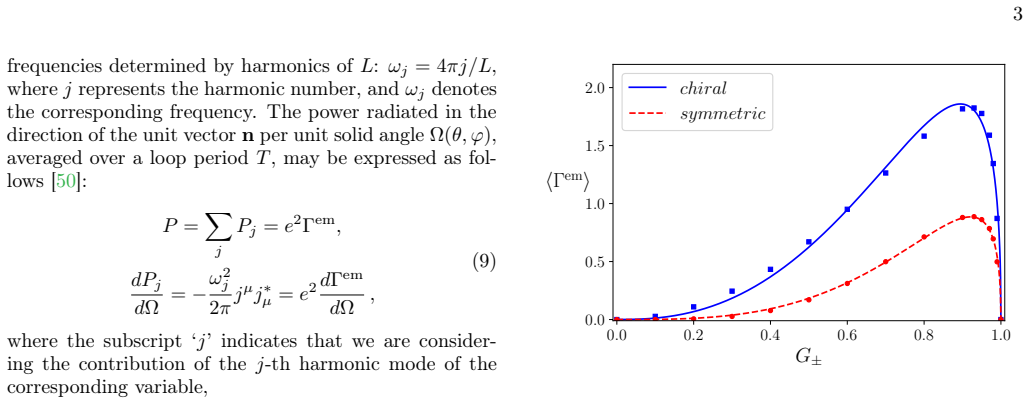
The load-bearing objects are the vector radiation emission efficiency $\Gamma_{\rm em}$, the Charge-Velocity-dependent One-Scale (CVOS) model of the string network, and the loop decay equations. The efficiency is approximated by the phenomenological fit $\langle\Gamma_{\rm em}\rangle = \Gamma_0^{\rm em}|F'_\pm| (1 - |F'_\pm|)^D$, with parameters fitted to Burden loops (smooth loops with quasi-cusps) and Garfinkle-Vachaspati loops (four-segment kinky loops). The CVOS model supplies the characteristic length, RMS velocity, charge amplitude, and current for the long-string network, and the decay equations $\dot\ell = -G\mu_0\Gamma_{\rm gr}(Y) - \tilde e^2\Gamma_{\rm em}(Y)$ and $\dot Y = (Y/\ell)[G\mu_0\Gamma_{\rm gr}(Y) + \tilde e^2\Gamma_{\rm em}(Y) - A(Y)]$ connect the microscopic current to the macroscopic charge amplitude. Together these determine the loop number density $n(\ell,t)$ and the spectral density $\Omega_{\rm gw}(f)$.
What would settle it
A numerical simulation of current-carrying cosmic string loops that measures the charge leakage rate as a function of loop length would settle the main assumption: if the current decays to zero before gravitational radiation dominates the loop's lifetime, the NANOGrav-compatible peak predicted here disappears, while if vortons form instead, the high-frequency plateau is suppressed.
Extended reading notes
Core claim
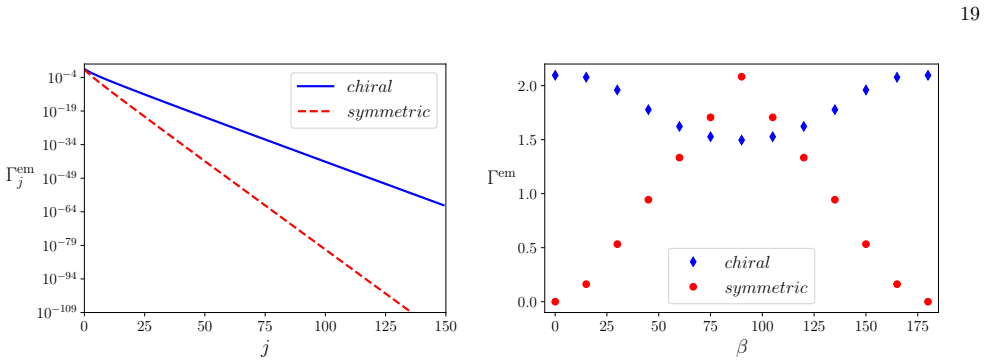
The paper's central claim is that a complete prediction of the stochastic gravitational wave background from chiral superconducting cosmic strings has to include vector radiation, and that including it produces two distinct regimes. When the coupling $\tilde e$ between the string current and the vector field is strong, vector emission dominates loop decay and the gravitational wave amplitude is suppressed, in the large-loop regime as $\Omega_{\rm gw}^{\rm plateau} \propto \tilde e^{-3}$; strings coupled to ordinary electromagnetism would then be nearly invisible to gravitational wave detectors. When the coupling is moderate, vector radiation is a subdominant but non-negligible decay channel, and the current-induced increase of the loop oscillation period raises the plateau by a factor $1/S(Y)$. In that intermediate limit, with radiation-era current amplitude close to unity, the spectrum can be shifted into the NANOGrav 15 yr region for tension $G\mu_0 \sim 2\times 10^{-10}$ while remaining below LIGO-Virgo-KAGRA upper limits. The emission itself is characterized by a phenomenological efficiency that peaks at moderate current and falls at high current, with kink loops producing a power-law spectrum and quasi-cusp loops an exponentially suppressed one.
Load-bearing premise
The paper assumes that a loop is born with the same current as the long-string network and keeps that current fixed while it shrinks, so charge leakage toward zero current and vorton formation toward maximal current are both ignored; if either process dominates, the computed spectrum's amplitude and shape change.
Editorial extensions
If this is right
- Strong vector coupling ($\tilde e^2 > G\mu_0$) makes vector radiation the dominant decay channel, so the gravitational wave amplitude is suppressed and superconducting strings can evade existing gravitational wave bounds.
- Moderate coupling with radiation-era current amplitude near $Y_{\rm rd} \sim 0.9$ can shift the stochastic gravitational wave background into the NANOGrav 15 yr region while keeping tension at values consistent with LIGO-Virgo-KAGRA constraints.
- Once vector radiation dominates, the spectrum peak stops moving to higher frequencies as tension is lowered, reducing future space-based detector sensitivity compared with currentless strings.
- High-frequency vector emission from kinks follows a power law $j^{-2}$, so kinks rather than quasi-cusps dominate the high-frequency vector radiation from current-carrying loops.
- The low-frequency peak shifts toward higher frequencies as current grows, providing a spectral signature that distinguishes superconducting strings from ordinary Nambu-Goto strings.
Reading between the lines
- If charge leakage or vorton formation dominates loop evolution, the constant-current assumption breaks and the NANOGrav-compatible window shown in the paper would close or move; the result is only as robust as that assumption.
- The same vector-emission machinery applies to hidden-sector or dark-photon currents, in which case electromagnetic constraints disappear and the stochastic background becomes a direct probe of dark-sector superconductivity.
- A clean observational discriminator is the relation between peak frequency and tension: vector-dominated models tie the peak to $\tilde e$ rather than $G\mu_0$, a trend that future detectors could test across several decades in frequency.
Editorial analysis
A structured set of objections, weighed in public.
Referee Report
Summary. This paper presents a first computation of the stochastic gravitational wave background (SGWB) from chiral superconducting cosmic strings that includes vector radiation emitted by loops. The authors derive the vector emission spectra for Burden (quasi-cusp) and Garfinkle-Vachaspati (kink) loop solutions, fit the total emission efficiency with the two-parameter form of Eq. (12), and tabulate the fit constants in Table I. They then use the CVOS network model, with the one-parameter approximation for the radiation-era current amplitude Yrd given in Eq. (18), to compute loop production, and generalize the loop decay equations to include gravitational and vector emission together with charge leakage (Eqs. (34)-(36)). The resulting SGWB is studied as a function of Gmu0, the carrier charge e-tilde, and Yrd: strong vector coupling suppresses the spectrum (Figs. 6-9), while large currents can shift and enhance it (Figs. 10-13). Finally, the spectra are confronted with NANOGrav, LVK, A+, and LISA data (Fig. 14), and the paper argues that large currents may help reconcile the SGWB with pulsar timing array observations.
Significance. If the central relations hold, this is a significant contribution: vector radiation would become a mandatory ingredient in SGWB predictions for superconducting strings, and the suppression mechanism would relax gravitational-wave bounds on such models. The analytic work is careful and largely self-contained: the emission spectra in Appendices A and B are derived explicitly, the fit of Eq. (12) is tested on two distinct loop families in both chiral and symmetric configurations, the loop equations (34) are solved and illustrated in Figs. 4-5, and the reduced CVOS approximation is validated against the full system in Figs. 3, 7, and 10. The paper is also candid about uncalibrated ingredients, including the loop production parameters alpha and Ffuzz, the leakage function A(Y), and the lack of dedicated simulations for superconducting networks. The main quantitative conclusions, however, rest on an assumption about loop-current evolution that is not checked against the paper's own loop equations, and the abstract's NANOGrav claim is stronger than the evidence presented in Section VII supports.
major comments (3)
- [Sec. VI and Sec. V.B (Eqs. (34), (36); Figs. 4, 5, 11, 14)] The SGWB computation in Section VI assumes that each loop is born with the network current Yrd and keeps that current constant while it decays (Eqs. (40)-(49)). This is not the generic behavior of the loop evolution equations derived in Section V.B: Eq. (34b) drives Y toward the attractor Y* defined by Eq. (36), which is independent of the initial current, or toward Y -> 1 (vorton formation, Fig. 4) when leakage is negligible, or toward Y -> 0 when leakage dominates. Figures 4 and 5 of the paper itself show loops evolving away from their initial currents. The scans over Yrd in Figs. 10-14 (up to Yrd = 0.85 and 0.999) never check the self-consistency condition Yrd = Y*, i.e., A(Yrd) = Gmu0 Gamma_gr(Yrd) + e-tilde^2 Gamma_em(Yrd); the two conditions invoked in Section VI ('current equals the network current at birth' and 'current remains constant') coincide only when this fine-tuned balance holds. The high-current region used for the NANOGrav comparison is exactly the region in which the neglected dynamics are most important, since Gamma_gr and Gamma_em both vanish as Y -> 1. The amplitude, shape, and PTA compatibility of the spectra are therefore not yet established; this should be resolved either by integrating Eqs. (34) for the scanned parameters or by explicitly restricting to and characterizing the Y = Y* parameter subspace, and the abstract should be made conditional on that analysis.
- [Sec. VII and Fig. 14] The demonstration of NANOGrav compatibility in Fig. 14 is weaker than the abstract's 'may help reconcile' wording suggests, and the paper's own text contains the relevant concessions. The specific realization highlighted in the right panel has e-tilde = 0, so the vector-radiation mechanism that is the paper's main new ingredient plays no role in that particular curve; and the text states that models remaining within 1 sigma of the NANOGrav data 'seems to be inconsistent with the LVK O3 constraints and may also violate CMB constraints.' These admissions should be reflected in the abstract and in the framing of Fig. 14; as it stands, a reader could reasonably conclude that a viable vector-emitting superconducting string model is demonstrated to fit the PTA data, which is not what the paper shows.
- [Sec. III, Eq. (12) and Table I; Sec. VI] The central quantitative relation of the paper, Eq. (12), is presented as a best fit, but no uncertainties on Gamma_em0 and D, no residuals, and no goodness-of-fit statistic are reported. The SGWB computations fix Gamma_em0 = 9 and D = 1, whereas Table I reports Gamma_em0 = 8.6 and D = 1.1-1.2 for the chiral cases; the spread across the four rows of Table I presumably brackets a systematic uncertainty that is never quantified or propagated. Since the quantitative conclusions of Section VII (the strong suppression of the plateau, the e-tilde^-3 scaling region, and the detectability statements) depend on the total vector efficiency, the fit statistics should be reported and their impact on the spectra in Figs. 6-14 assessed. The qualitative picture (suppression at large coupling, peak of the efficiency around |F'| roughly 0.4, kink dominance at high harmonics) is robust and should be stated as such.
minor comments (7)
- [Sec. V.A] The sentence 'assume that the critical current for loops is the same as for long strings Ycr = Ycr' appears to contain a typo; the loop and network critical currents should be denoted by different symbols (e.g., Ycr,ell and Ycr).
- [Fig. 13 caption] The caption of Fig. 13 is incomplete: 'dashed lines for different values of Y.' ends without the closing parenthesis, and the sentence is cut off.
- [Sec. III] The derivation assumes F'+ and F'- are constant along the loop; the paper does not discuss how a non-uniform current profile would modify Eq. (12), which is relevant given the claim that this relation may hold 'for any type of current-carrying loops.'
- [Sec. VI.A] The statement that taking n* approximately 10^4 harmonics 'is sufficient in both cases' is not supported by any convergence check or quantitative error estimate.
- [Sec. V.B] The symbol Y is used for both the network current amplitude and the loop current amplitude, distinguished only by a parenthetical remark; given that the equality of these two quantities is the paper's central working assumption, a distinct notation for the loop current (e.g., Y_ell) would improve clarity.
- [Sec. VII] The caveat that the models within 1 sigma of NANOGrav appear inconsistent with the LVK O3 bounds and may violate CMB constraints is important enough to be shown directly in Fig. 14 rather than appearing only in the text.
- [Abstract] The phrase 'in this intermediate limit' in the abstract refers to moderate coupling, but this is never defined in the abstract itself; a brief clarification would help the reader.
Circularity Check
No significant circularity: the vector emission efficiency is computed from loop solutions independently of the SGWB outcome, and the NANOGrav overlay is an explicitly conditional parameter-space demonstration rather than a prediction forced by construction.
full rationale
The paper's central new input, the vector radiation efficiency, is computed from explicit Burden and Garfinkle–Vachaspati loop solutions through the radiation integrals in Eqs. (9) and (11), independently of any SGWB outcome. Equation (12) is a phenomenological fit to those computed efficiencies, but using a fitted interpolation of an independently computed quantity is not circular; it is not a fit to the SGWB or to pulsar-timing data. The loop-evolution system in Eqs. (34)–(36) is likewise derived from energy balance, and Section VI's constant-current assumption is an explicit modeling choice ('we will assume that the current on the loops remains constant... and coincides with the current of the long string network at the moment of creation') with a clear caveat that vorton formation was not studied. That is a robustness limitation, not a self-referential derivation. The claimed NANOGrav compatibility is presented conditionally: the paper says the spectrum 'can, in principle, be brought into agreement' and notes that models within 1σ of NANOGrav seem inconsistent with LVK O3 and may violate CMB constraints. Choosing values of Gµ0, e-tilde, and Yrd that land inside the NANOGrav posterior is parameter-space exploration, not a fitted quantity renamed as a prediction. Self-citations to the CVOS model [28–30] and to the earlier GW efficiency result [47] provide stated-assumption derivations from prior work; they are load-bearing inputs but not an unverified uniqueness claim or an ansatz whose only support is the present paper. No step in the paper reduces, by construction, to its own input.
Assumptions & free parameters
free parameters (7)
- Gamma_em0 and D (vector radiation efficiency fit parameters) =
4.9/1.6, 10.5/1.8, 8.6/1.1, 8.6/1.2 depending on loop/current type
- Yrd (radiation-era current amplitude) =
scanned from 0 to 0.999
- e-tilde (charge of current carriers) =
scanned from 1e-4 to 1
- G mu0 (string tension) =
scanned from 2e-11 to 2e-9 in Fig. 14
- alpha (loop size at formation) =
0.34 (fiducial)
- Ffuzz (loop fuzziness) =
0.1 (fiducial)
- Aconst and Ycr (charge leakage parameters) =
Aconst = 1e-3; Ycr = 0.5, 0.6, 0.7, 0.85, 0.999 in examples
assumptions (7)
- domain assumption The chiral limit (kappa to 0) and transonic condition (L(kappa) = sqrt(1-kappa)) are representative of generic superconducting strings.
- domain assumption The CVOS linear equation of state F(K) = 1 - K/2 describes the network thermodynamics.
- domain assumption Loops are born with the long-string network current and keep it constant while decaying.
- ad hoc to paper The charge leakage function A(Y) for loops has the same form as for long strings.
- ad hoc to paper The one-parameter approximation for Y(x) in Eq. (18) reproduces the full CVOS evolution.
- domain assumption The period-frequency relation Eq. (37), derived for kinky loops, applies to all current-carrying loops.
- domain assumption Loop production parameters alpha and Ffuzz measured in Nambu-Goto simulations apply to superconducting string networks.
Cite this review
Pith. "Pith review of Stochastic Gravitational Wave Background from Chiral Superconducting Cosmic Strings." pith.science (2026). https://pith.science/paper/ZP5QEPSK
@misc{pith2026241217154,
  author       = {Pith},
  title        = {Pith review of: Stochastic Gravitational Wave Background from Chiral Superconducting Cosmic Strings},
  year         = {2026},
  howpublished = {\url{https://pith.science/paper/ZP5QEPSK}},
  note         = {Machine review of arXiv:2412.17154}
}
read the original abstract
We investigate the emission of vector radiation by superconducting cosmic string loops, deriving general relations to characterize the vector radiation emission efficiency, and study its impact on the evolution of loops. Building on these results, we compute the stochastic gravitational wave background generated by a chiral superconducting cosmic string network. Our analysis reveals that strong coupling between superconducting cosmic strings and the vector field may lead to a substantial suppression of the gravitational wave signal, while moderate coupling may still produce a detectable signal. We demonstrate that, in this intermediate limit, the presence of superconductivity in cosmic strings may help reconcile their gravitational wave spectrum with pulsar timing array data for large enough values of current.
Figures


Figures from the paper (14 more)




Forward citations
Cited by 2 Pith papers
-
Gravitational Waves from Superconducting Cosmic Strings
Lattice simulations show the gravitational-wave spectrum from superconducting cosmic strings develops a coupling-dependent suppression at high frequencies, distinguishing them from ordinary Abelian–Higgs strings.
-
Cosmic string gravitational wave backgrounds at LISA: I. Signal survey, template reconstruction, and model comparison
As provided, the manuscript body (random lasing) does not correspond to the abstract (cosmic string gravitational wave backgrounds at LISA), leaving the abstract's quantitative claims unsupported by any accessible text.
Reference graph
Works this paper leans on
-
[1]
A 9, 1387 (1976)
T.W.B.Kibble,Topologyofcosmicdomainsandstrings, J.Phys. A 9, 1387 (1976)
1976
-
[2]
M. B. Hindmarsh and T. W. B. Kibble, Cosmic strings, Rept.Prog.Phys. 58, 477 (1995), arXiv:hep-ph/9411342 [astro-ph.CO]
arXiv 1995
-
[3]
Vilenkin and E
A. Vilenkin and E. P. S. Shellard,Cosmic Strings and Other Topological Defects (Cambridge University Press, 2000)
2000
-
[4]
R. Jeannerot, J. Rocher, and M. Sakellariadou, How generic is cosmic string formation in susy guts, Phys.Rev.D 68, 103514 (2003), arXiv:hep-ph/0308134 [hep-th]
arXiv 2003
-
[5]
P. Bhattacharjee, N. Sahu, and U. A. Yajnik,b − l cos- mic strings and baryogenesis, Phys. Rev. D70, 083534 (2004), arXiv:hep-ph/0406054v3 [hep-ph]
arXiv 2004
-
[6]
Bosonic structure of realistic SO(10) SUSY cosmic strings
E. Allys, Bosonic structure of realistic so(10) supersym- metric cosmic strings, Phys.Rev. D93, 105021 (2016), arXiv:arXiv:1512.02029 [astro-ph.CO]
work page Pith review arXiv 2016
-
[7]
S. Sarangi and S.-H. H. Tye, Cosmic string production towards the end of brane inflation, Phys.Lett.B536, 185 (2002), arXiv:hep-th/0204074 [hep-th]
arXiv 2002
-
[8]
J. A. Dror, T. Hiramatsu, K. Kohri, H. Murayama, and G. White, Testing the Seesaw Mechanism and Leptoge- nesis with Gravitational Waves, Phys. Rev. Lett.124, 041804 (2020), arXiv:1908.03227 [hep-ph]
arXiv 2020
Show all 98 references
-
[9]
Hindmarsh, S
M. Hindmarsh, S. Stuckey, and N. Bevis, Abelian Higgs Cosmic Strings: Small Scale Structure and Loops, Phys. Rev. D79, 123504 (2009), arXiv:0812.1929 [hep-th]
2009 arXiv
-
[10]
Hindmarsh, J
M. Hindmarsh, J. Lizarraga, J. Urrestilla, D. Daverio, and M. Kunz, Scaling from gauge and scalar radiation in Abelian Higgs string networks, Phys.Rev.D96, 023525 (2017), arXiv:1703.06696 [hep-ph]
2017 arXiv
-
[11]
J. R. C. C. C. Correia and C. J. A. P. Martins, Ex- tending and calibrating the velocity dependent one- scale model for cosmic strings with one thousand field theory simulations, Phys. Rev. D 100, 103517 (2019), arXiv:1911.03163 [astro-ph.CO]
2019 arXiv
-
[12]
J. R. C. C. C. Correia and C. J. A. P. Martins, High res- olution calibration of the cosmic strings velocity depen- dent one-scale model, Phys. Rev. D104, 063511 (2021), arXiv:2108.07513 [astro-ph.CO]
2021 arXiv
-
[13]
C. J. A. P. Martins and E. P. S. Shellard, Fractal proper- ties and small-scale structure of cosmic string networks, Phys. Rev.D73, 043515 (2006), arXiv:astro-ph/0511792 [astro-ph]
2006 arXiv
-
[14]
Ringeval, M
C. Ringeval, M. Sakellariadou, and F. Bouchet, Cosmo- logical evolution of cosmic string loops, JCAP02, 023, arXiv:astro-ph/0511646
-
[15]
J. J. Blanco-Pillado, K. D. Olum, and B. Shlaer, Large parallel cosmic string simulations: New re- sults on loop production, Phys.Rev. D, 083514 (2011), arXiv:arXiv:1101.5173 [astro-ph.CO]
2011 arXiv
-
[16]
R. L. Davis and E. P. S. Shellard, Cosmic vortons, Nucl. Phys. B323, 209 (1989)
1989
-
[17]
Peter, Influence of the electric coupling strength in current carrying cosmic strings, Phys
P. Peter, Influence of the electric coupling strength in current carrying cosmic strings, Phys. Rev. D46, 3335 (1992)
1992
-
[18]
Davis and P
A.-C. Davis and P. Peter, Cosmic strings are current carrying, Phys. Lett. B 358, 197 (1995), arXiv:hep- ph/9506433
1995
-
[19]
Binétruy, G
P. Binétruy, G. Dvali, R. Kallosh, and A. V. Proeyen, Fayet–iliopoulos terms in supergravity and cosmol- ogy, Classical and Quantum Gravity 21, 3137 (2004), arXiv:hep-th/0402046v1 [hep-th]
2004 arXiv
-
[20]
Allys, Bosonic condensates in realistic supersym- metric gut cosmic strings, JCAP 1604 (04), 009, arXiv:arXiv:1505.07888 [astro-ph.CO]
E. Allys, Bosonic condensates in realistic supersym- metric gut cosmic strings, JCAP 1604 (04), 009, arXiv:arXiv:1505.07888 [astro-ph.CO]
-
[21]
Y. Abe, Y. Hamada, and K. Yoshioka, Electroweak ax- ion string and superconductivity, Journal of High Energy Physics 2021, 172 (2021), arXiv:2010.02834 [hep-ph]
2021 arXiv
-
[22]
Fukuda, A
H. Fukuda, A. V. Manohar, H. Murayama, and O. Telem, Axion strings are superconducting, Journal of High En- ergy Physics2021, 52 (2021), arXiv:2010.02763 [hep-ph]
2021 arXiv
-
[23]
R. A. Battye, S. J. Cotterill, and J. A. Pearson, A de- tailed study of the stability of vortons, JHEP04, 005, arXiv:2112.08066 [hep-ph]
-
[24]
Hiramatsu, M
T. Hiramatsu, M. Lilley, and D. Yamauchi, Dynamical simulations of colliding superconducting strings, JCAP 22 06, 030, arXiv:2312.16091 [hep-ph]
-
[25]
Fujikura, S
K. Fujikura, S. Li, and M. Yamaguchi, Interactions be- tween several types of cosmic strings, JHEP 12, 115, arXiv:2309.05515 [hep-ph]
-
[26]
J. R. C. C. C. Correia, C. J. A. P. Martins, and F. C. N. Q. Pimenta, Evolution of current-carrying string networks, Phys. Lett. B 855, 138788 (2024), arXiv:2406.03931 [hep-ph]
2024 arXiv
-
[27]
Battye and S
R. Battye and S. Cotterill, Superconducting strings in the two-Higgs doublet model, (2024), arXiv:2410.03300 [hep-ph]
2024 arXiv
-
[28]
C. J. A. P. Martins, P. Peter, I. Y. Rybak, and E. P. S. Shellard,Generalizedvelocity-dependentone-scalemodel for current-carrying strings, Phys. Rev. D103, 043538 (2021), arXiv:2011.09700v1 [astro-ph.CO]
2021 arXiv
-
[29]
C. J. A. P. Martins, P. Peter, I. Y. Rybak, and E. P. S. Shellard, Charge-velocity-dependent one-scale linear model, Phys. Rev. D 104, 103506 (2021), arXiv::2108.03147v2 [astro-ph.CO]
2021 arXiv
-
[30]
I. Y. Rybak, C. J. A. P. Martins, P. Peter, and E. P. S. Shellard, Cosmological evolution of witten superconduct- ing string networks, Phys. Rev. D107, 123514 (2023), arXiv:arXiv:2304.00053 [asto-ph.CO]
2023 arXiv
-
[31]
Lizarraga, J
J. Lizarraga, J. Urrestilla, D. Daverio, M. Hind- marsh, and M. Kunz, New CMB constraints for Abelian Higgs cosmic strings, JCAP 1610 (10), 042, arXiv:1609.03386v3 [astro-ph.CO]
-
[32]
Lazanu and E
A. Lazanu and E. P. S. Shellard, Constraints on the nambu-goto cosmic string contribution to the cmb power spectrum in light of new temperature and polarisation data, JCAP 2015 (02), 024, arXiv:1410.5046v3 [astro- ph.CO]
2015 arXiv
-
[33]
Charnock, A
T. Charnock, A. Avgoustidis, E. Copeland, and M. A., Cmb constraints on cosmic strings and superstrings, Phys.Rev. D93, 123503 (2016), arXiv:1603.01275 [astro- ph.CO]
2016 arXiv
-
[34]
Auclair, J
P. Auclair, J. J. Blanco-Pillado, D. G. Figueroa, A. C. Jenkins, M. Lewicki, M. Sakellariadou, S. Sanidas, L. Sousa, D. A. Steer, J. M. Wachter, and S. Kuroyanagi, Probing the gravitational wave background from cosmic strings with lisa, Journal of Cosmology and Astroparticle P...
2020 arXiv
-
[35]
Afzalet al
A. Afzalet al. (NANOGrav), The NANOGrav 15 yr Data Set: Search for Signals from New Physics, Astrophys. J. Lett. 951, L11 (2023), arXiv:2306.16219 [astro-ph.HE]
2023 arXiv
-
[36]
M. V. Sazhin, O. S. Khovanskaya, M. Capaccioli, G. Longo, M. Paolillo, G. Covone, N. A. Grogin, and E. J. Schreier, Gravitational lensing by cosmic strings: what we learn from the CSL-1 case, Monthly Notices of the Royal Astronomical Society 376, 1731 (2007), arXiv:0611744v2 [...
2007
-
[37]
O. S. Sazhina, D. Scognamiglio, M. V. Sazhin, and M. Capaccioli, Optical analysis of a CMB cosmic string candidate, Monthly Notices of the Royal Astronomi- cal Society 485, 1876 (2019), arXiv:1902.08156v1 [astro- ph.CO]
2019 arXiv
-
[38]
H. Jiao, R. Brandenberger, and A. Refregier, Early struc- ture formation from cosmic string loops in light of early JWST observations, Phys. Rev. D108, 043510 (2023), arXiv:2304.06429 [astro-ph.CO]
2023 arXiv
-
[39]
H. Jiao, R. Brandenberger, and A. Refregier, N- body simulation of early structure formation from cos- mic string loops, Phys. Rev. D 109, 123524 (2024), arXiv:2402.06235 [astro-ph.CO]
2024 arXiv
-
[40]
Imtiaz, R
B. Imtiaz, R. Shi, and Y.-F. Cai, Updated constraints on superconducting cosmic strings from the astronomy of fast radio bursts, Eur. Phys. J. C 80, 500 (2020), arXiv:2001.11149 [astro-ph.HE]
2020 arXiv
-
[41]
R.Brandenberger, B.Cyr,andR.Shi,ConstraintsonSu- perconductingCosmicStringsfromtheGlobal 21-cmSig- nal before Reionization, JCAP09, 009, arXiv:1902.08282 [astro-ph.CO]
1902 arXiv
-
[42]
B. Cyr, J. Chluba, and S. K. Acharya, Cosmic string solution to the radio synchrotron background, Phys. Rev. D 109, L121301 (2024), arXiv:2308.03512 [astro-ph.CO]
2024 arXiv
-
[43]
J. M. Hyde, A. J. Long, and T. Vachaspati, Dark Strings and their Couplings to the Standard Model, Phys. Rev. D 89, 065031 (2014), arXiv:1312.4573 [hep-ph]
2014 arXiv
-
[44]
A. J. Long, J. M. Hyde, and T. Vachaspati, Cosmic Strings in Hidden Sectors: 1. Radiation of Standard Model Particles, JCAP 09, 030, arXiv:1405.7679 [hep- ph]
-
[45]
A. J. Long and T. Vachaspati, Cosmic Strings in Hidden Sectors: 2. Cosmological and Astrophysical Signatures, JCAP 12, 040, arXiv:1409.6979 [hep-ph]
-
[46]
Auclair, S
P. Auclair, S. Blasi, V. Brdar, and K. Schmitz, Gravita- tional waves from current-carrying cosmic strings, JCAP 04, 009, arXiv:2207.03510 [astro-ph.CO]
-
[47]
Rybak and L
I. Rybak and L. Sousa, Emission of gravitational waves by superconducting cosmic strings, Journal of Cosmology and Astroparticle Physics 2022 (11), 024, arXiv:2209.01068 [gr-qc]
2022 arXiv
-
[48]
Witten, Superconducting Strings, Nucl
E. Witten, Superconducting Strings, Nucl. Phys.B249, 557 (1985)
1985
-
[49]
Peter, Superconducting cosmic string: Equation of state for space - like and time - like current in the neutral limit, Phys
P. Peter, Superconducting cosmic string: Equation of state for space - like and time - like current in the neutral limit, Phys. Rev.D45, 1091 (1992)
1992
-
[50]
Vilenkin and T
A. Vilenkin and T. Vachaspati, Electromagnetic radi- ation from superconducting cosmic strings, Phys. Rev. Lett. 58, 1041 (1987)
1987
-
[51]
Martins and E
C. Martins and E. Shellard, Vorton formation, Phys.Rev. D, 7155 (1998), arXiv:hep-ph/9804378 [astro-ph.CO]
1998 arXiv
-
[52]
Carter, Brane dynamics for treatment of cosmic strings and vortons, 2nd Mexican School on Gravitation andMathematicalPhysics (1997),arXiv:hep-th/9705172 [hep-th]
B. Carter, Brane dynamics for treatment of cosmic strings and vortons, 2nd Mexican School on Gravitation andMathematicalPhysics (1997),arXiv:hep-th/9705172 [hep-th]
1997 arXiv
-
[53]
Carter and P
B. Carter and P. Peter, Dynamics and integrability prop- erty of the chiral string model, Phys. Lett. B 466, 41 (1999), arXiv:hep-th/9905025
1999 arXiv
-
[54]
J. J. Blanco-Pillado, K. D. Olum, and A. Vilenkin, Dy- namics of superconducting strings with chiral currents, Phys.Rev.D 63,103513(2001),arXiv:astro-ph/0004410
2001 arXiv
-
[55]
A. C. Davis, T. W. B. Kibble, M. Pickles, and D. A. Steer, Dynamics and properties of chiral cosmic strings in Minkowski space, Phys. Rev. D 62, 083516 (2000), arXiv:astro-ph/0005514
2000 arXiv
-
[56]
I. Y. Rybak, A. Avgoustidis, and C. J. A. P. Martins, Col- lisions of cosmic strings with chiral currents, Phys. Rev. D 98, 063519 (2018), arXiv:1809.04033 [astro-ph.CO]
2018 arXiv
-
[57]
Carter, Integrable equation of state for noisy cosmic string, Phys
B. Carter, Integrable equation of state for noisy cosmic string, Phys. Rev. D41, 3869 (1990)
1990
-
[58]
I. Y. Rybak, Revisiting Y junctions for strings with cur- rents: Transonic elastic case, Phys. Rev. D102, 083516 (2020), arXiv:2001.07262 [astro-ph.CO]
2020 arXiv
-
[59]
Carter, Brane dynamics for treatment of cosmic strings and vortons, in 2nd Mexican School on Grav- itation and Mathematical Physics (1997) arXiv:hep- th/9705172
B. Carter, Brane dynamics for treatment of cosmic strings and vortons, in 2nd Mexican School on Grav- itation and Mathematical Physics (1997) arXiv:hep- th/9705172. 23
1997
-
[60]
Burden, Gravitational radiation from a particular classofcosmicstrings,PhysicsLettersB 164,277(1985)
C. Burden, Gravitational radiation from a particular classofcosmicstrings,PhysicsLettersB 164,277(1985)
1985
-
[61]
Garfinkle and T
D. Garfinkle and T. Vachaspati, Radiation from kinky, cuspless cosmic loops, Phys. Rev. D36, 2229 (1987)
1987
-
[62]
S. A. Sanidas, R. A. Battye, and B. W. Stappers, Con- straints on cosmic string tension imposed by the limit on the stochastic gravitational wave background from the European Pulsar Timing Array, Phys. Rev. D85, 122003 (2012), arXiv:1201.2419 [astro-ph.CO]
2012 arXiv
-
[63]
Kuroyanagi, K
S. Kuroyanagi, K. Miyamoto, T. Sekiguchi, K. Taka- hashi, and J. Silk, Forecast constraints on cosmic string parameters from gravitational wave direct de- tection experiments, Phys. Rev. D 86, 023503 (2012), arXiv:1202.3032 [astro-ph.CO]
2012 arXiv
-
[65]
C. J. A. P. Martins and E. P. S. Shellard, Quanti- tative string evolution, Phys. Rev. D54, 2535 (1996), arXiv:hep-ph/9602271 [hep-ph]
1996 arXiv
-
[66]
Aghanim et al
N. Aghanim et al. (Planck), Planck 2018 results. VI. Cosmological parameters, Astron. Astrophys. 641, A6 (2020), [Erratum: Astron.Astrophys. 652, C4 (2021)], arXiv:1807.06209 [astro-ph.CO]
2020 arXiv
-
[67]
C. J. A. P. Martins and E. P. S. Shellard, Extending the velocity dependent one scale string evolution model, Phys. Rev. D65, 043514 (2002), arXiv:hep-ph/0003298 [hep-ph]
2002 arXiv
-
[68]
I. Y. Rybak, C. J. A. P. Martins, P. Peter, and E. P. S. Shellard, Cosmic microwave background signa- tures from current-carrying cosmic strings, Phys. Rev. D 110, 023534 (2024), arXiv:2403.16332 [astro-ph.CO]
2024 arXiv
-
[69]
I. Yu. Rybak, A. Avgoustidis, and C. J. A. P. Mar- tins, Semianalytic calculation of cosmic microwave background anisotropies from wiggly and supercon- ducting cosmic strings, Phys. Rev. D96, 103535 (2017), [Erratum: Phys. Rev.D100,no.4,049901(2019)], arXiv:1709.01839 [astro-ph.CO]
2017 arXiv
-
[70]
S. M. Barr and A. M. Matheson, Weak Resistance in Superconducting Cosmic Strings, Phys. Rev. D36, 2905 (1987)
1987
-
[71]
Barr and A
S. Barr and A. Matheson, Limiting currents in fermionic superconducting strings, Physics Letters B 198, 146 (1987)
1987
-
[72]
Perkins, L
W. Perkins, L. Perivolaropoulos, A.-C. Davis, R. Bran- denberger, and A. Matheson, Scattering of fermions from a cosmic string, Nuclear Physics B353, 237 (1991)
1991
-
[73]
Gangui, P
A. Gangui, P. Peter, and C. Boehm, Could electromag- netic corrections solve the vorton excess problem?, Phys. Rev. D 57, 2580 (1998), arXiv:hep-ph/9705204
1998 arXiv
-
[74]
J. J. Blanco-Pillado, K. D. Olum, and A. Vilenkin, Quan- tum tunneling of superconducting string currents, Phys. Rev. D 66, 023506 (2002), arXiv:hep-ph/0202116
2002 arXiv
-
[75]
Lemperiere and E
Y. Lemperiere and E. Shellard, On the behaviour and stability of superconducting currents, Nuclear Physics B 649, 511 (2003), arXiv:hep-ph/0207199 [hep.ph]
2003 arXiv
-
[76]
M. Ibe, S. Kobayashi, Y. Nakayama, and S. Shirai, On stability of fermionic superconducting current in cosmic string, Journal of High Energy Physics2021, 217 (2021), arXiv:2102.05412 [hep.ph]
2021 arXiv
-
[77]
Y. Abe, Y. Hamada, K. Saji, and K. Yoshioka, Quan- tum current dissipation in superconducting strings and vortons, Journal of High Energy Physics2023, 4 (2023), arXiv:arXiv:2209.03223 [hep-ph]
2023 arXiv
-
[78]
Martin and P
X. Martin and P. Peter, Current carrying string loop mo- tion: Limitsontheclassicaldescriptionandshocks,Phys. Rev. D 61, 043510 (2000)
2000
-
[79]
Cordero-Cid, X
A. Cordero-Cid, X. Martin, and P. Peter, Current car- rying cosmic string loops 3-D simulation: Towards a re- duction of the vorton excess problem, Phys. Rev. D65, 083522 (2002), arXiv:hep-ph/0201097
2002 arXiv
-
[80]
R. A. Battye and S. J. Cotterill, Stable Cosmic Vortons in Bosonic Field Theory, Phys. Rev. Lett.127, 241601 (2021), arXiv:2111.07822 [hep-ph]
2021 arXiv
-
[81]
R. A. Battye and S. J. Cotterill, Pinching instabilities in superconducting cosmic strings, Phys. Rev. D 107, 063534 (2023), arXiv:2212.06491 [hep-ph]
2023 arXiv
-
[82]
Auclair, P
P. Auclair, P. Peter, C. Ringeval, and D. Steer, Irre- duciblecosmicproductionofrelicvortons,JCAP 03,098, arXiv:2010.04620 [astro-ph.CO]
2010 arXiv
-
[83]
Mukovnikov and L
S. Mukovnikov and L. Sousa, Ultrahigh frequency gravi- tational waves from cosmic strings with friction, Phys. Rev. D 110, 063516 (2024), arXiv:2404.13213 [astro- ph.CO]
2024 arXiv
-
[84]
J. J. Blanco-Pillado and K. D. Olum, Stochastic gravitational wave background from smoothed cos- mic string loops, Phys. Rev. D 96, 104046 (2017), arXiv:1709.02693v2 [astro-ph.CO]
2017 arXiv
-
[85]
Sousa, P
L. Sousa, P. P. Avelino, and G. S. F. Guedes, Full ana- lyticalapproximationtothestochasticgravitationalwave background generated by cosmic string networks, Phys. Rev. D 101, 103508 (2020), arXiv:2002.01079 [astro- ph.CO]
2020 arXiv
-
[86]
J. J. Blanco-Pillado, Y. Cui, S. Kuroyanagi, M. Lewicki, G. Nardini, M. Pieroni, I. Y. Rybak, L. Sousa, and J. M. Wachter (LISA Cosmology Working Group), Grav- itational waves from cosmic strings in LISA: recon- struction pipeline and physics interpretation, (2024), arXiv:2405...
2024 arXiv
-
[87]
M.HindmarshandJ.Kume,Multi-messengerconstraints on Abelian-Higgs cosmic string networks, JCAP04, 045, arXiv:2210.06178 [astro-ph.CO]
-
[88]
Sousa and P
L. Sousa and P. P. Avelino, Stochastic gravitational wave background generated by cosmic string networks: The small-loop regime, Phys. Rev. D 89, 083503 (2014), arXiv:1403.2621 [astro-ph.CO]
2014 arXiv
-
[89]
Sousa and P
L. Sousa and P. P. Avelino, Probing cosmic super- stringswithgravitationalwaves,Phys.Rev.D 94,063529 (2016), arXiv:1606.05585 [astro-ph.CO]
2016 arXiv
-
[90]
Agazie et al
G. Agazie et al. (NANOGrav), The NANOGrav 15 yr Data Set: Evidence for a Gravitational-wave Background, Astrophys. J. Lett. 951, L8 (2023), arXiv:2306.16213 [astro-ph.HE]
2023 arXiv
-
[91]
Abbott et al
R. Abbott et al. (KAGRA, Virgo, LIGO Scientific), Upper limits on the isotropic gravitational-wave back- ground from Advanced LIGO and Advanced Virgo’s third observing run, Phys. Rev. D104, 022004 (2021), arXiv:2101.12130 [gr-qc]
2021
-
[92]
Agazie et al
G. Agazie et al. (NANOGrav), The NANOGrav 15 yr Data Set: Detector Characterization and Noise Budget, Astrophys. J. Lett. 951, L10 (2023), arXiv:2306.16218 [astro-ph.HE]
2023 arXiv
-
[93]
Afzal, Q
A. Afzal, Q. Shafi, and A. Tiwari, Gravitational wave emission from metastable current-carrying strings in E6, Phys.Lett.B 850,138516(2024),arXiv:2311.05564[hep- ph]. 24
2024 arXiv
-
[94]
Amsterdamski, Evolution of Superconducting Cosmic Loops, Phys
P. Amsterdamski, Evolution of Superconducting Cosmic Loops, Phys. Rev. D39, 1524 (1989)
1989
-
[95]
J. M. Wachter and K. D. Olum, Electromagnetic backre- action from currents on a straight string, Phys. Rev. D 90, 023510 (2014), arXiv:1405.2097 [astro-ph.CO]
2014 arXiv
-
[96]
Babichev and V
E. Babichev and V. Dokuchaev, Oscillation damping of chiral string loops, Phys. Rev. D 66, 025007 (2002), arXiv:hep-ph/0204304 [hep-ph]
2002 arXiv
-
[97]
Garfinkle and T
D. Garfinkle and T. Vachaspati, Fields due to kinky, cus- pless, cosmic loops, Phys. Rev. D37, 257 (1988)
1988
-
[98]
Copeland, D
E. Copeland, D. Haws, M. Hindmarsh, and N. Turok, Dynamics of and radiation from superconducting strings and springs, Nuclear Physics B306, 908 (1988)
1988
-
[99]
Blanco-Pillado and K
J. Blanco-Pillado and K. D. Olum, Electromagnetic radi- ation from superconducting string cusps, Nuclear Physics B 599, 435 (2001), arXiv:astro-ph/0008297 [asto-ph]
2001 arXiv
Reviewed August 11, 2026 · model on record in the stance chip above.
Discussion (0). Continue with ORCID to comment.