REVIEW 3 major objections 3 minor 3 cited by
Tuning the order of a deconfined quantum critical point
T0 review · 3 major / 3 minor · reviewed 2026-08-11 · deepseek-v4-flash
Pith's one-line read A symmetry-preserving term turns a quantum critical point first-order
desk verdict A concrete fermionic realization of a tuning parameter that drives the DQCP strongly first order; the observation is solid, though the 'tuning a DQCP' framing leans on a baseline that isn't re-established here. read the letter →
The pith
A machine-rendered reading of the paper's core claim, the machinery that carries it, and where it could break.
The reading
What carries the argument
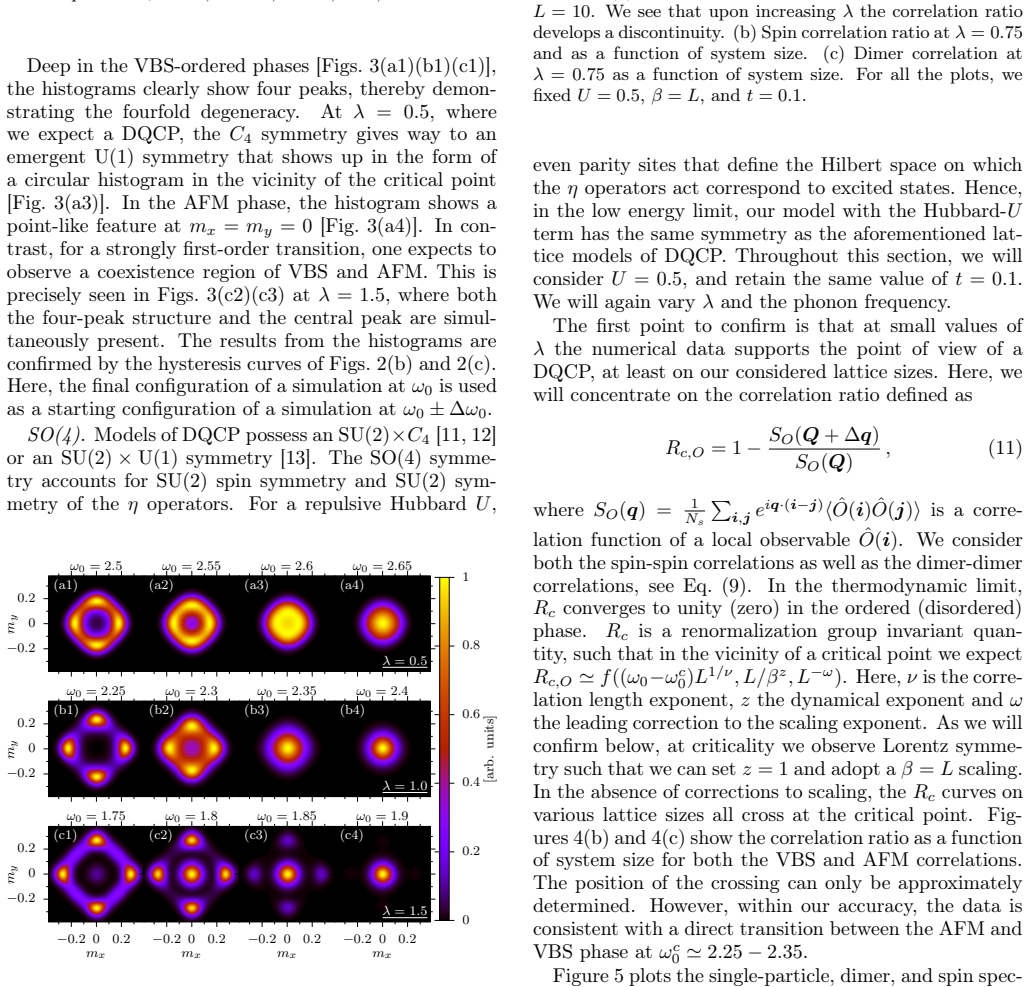
The load-bearing object is the lattice Hamiltonian of Eq. (1): a Su-Schrieffer-Heeger model with phonon-assisted hopping, a square-hopping term −λ $K_b^{2}$ that for small hopping t maps to −4λ(S_i·S_j + η_i·η_j) and thereby favors antiferromagnetism (and η-pairing), and a Hubbard U term that reduces the O(4) symmetry (exposed by writing the fermions as four Majorana components) to SO(4). The tuning of λ (and U) changes the critical phonon frequency ω0 at which the VBS-to-AFM transition occurs. The diagnostics that carry the argument are the derivative ∂F/∂ω0 (which develops a step), histograms of the VBS order parameters mx and my (which show a four-peak pattern in the VBS phase, a circular emergent-U(1) distribution at the λ=0.5 DQCP, and coexisting four-peak plus central peak at large λ), and hysteresis loops. The interpretive mechanism is that the DQCP has emergent Lorentz invariance, so increasing the imaginary-time range of the retarded phonon-mediated interaction is equivalent to increasing its real-space range, which drives the transition strongly first order; the paper connects this to the Peierls instability of the emergent compact U(1) gauge theory and to SO(5) multicriticality.
What would settle it
At λ=0.5, U=0, run order-parameter histograms and correlation-length measurements on system sizes larger than L=14 (for example L=20–24, with β=L scaled accordingly). If the histogram shows coexisting VBS four-peak and AFM central-peak structures, and the correlation-length exponent at the transition falls outside the conformal bootstrap bound for a single relevant operator, then the baseline transition was already first-order, undermining the paper's central interpretation.
Extended reading notes
Core claim
On the paper's own terms, the central discovery is that the order of the deconfined quantum critical point in the assisted-hopping Su-Schrieffer-Heeger model can be tuned from a continuous (or weakly first-order) transition into a strongly first-order one by increasing λ or adding a Hubbard U, and this holds for both the O(4)-symmetric U=0 case and the SO(4)/SU(2)-symmetric finite-U case. As λ grows, the critical phonon frequency decreases, and the transition acquires a discontinuity in the derivative of the free energy with respect to ω0, a coexistence of VBS four-peak structure and AFM central peak in the histogram of the VBS order parameter, and hysteresis upon sweeping ω0 up and down. The tuning parameter preserves the full symmetry of the Hamiltonian, so the change in order is not a symmetry-breaking effect. The paper interprets this as consistent with three scenarios: a Peierls instability of the emergent compact U(1) gauge theory, annihilation of complex fixed points producing a slow RG flow, or an SO(5) multicritical point.
Load-bearing premise
The load-bearing premise is that the λ=0.5, U=0 transition is a genuine deconfined quantum critical point (or at least weakly first-order); if that baseline were already strongly first-order at accessible sizes, the observation would reduce to 'strengthening a first-order transition' rather than tuning a DQCP.
Editorial extensions
If this is right
- If the claim is right, the DQCP is not a single isolated critical point but carries a symmetry-preserving tuning parameter (the effective interaction range) that controls whether the transition is continuous or strongly first order.
- The critical phonon frequency becomes a practical control knob: lowering it by reinforcing the AFM phase with λ or U pushes the transition toward strong first order on numerically accessible lattice sizes.
- The same tuning behavior appears for both O(4) and SO(4)/SU(2)×C4 realizations, so the result is not an artifact of the larger symmetry group.
- The observation that a small change in interaction range strongly alters criticality is a signature of the special nature of DQC, consistent with complex fixed points, fixed-point annihilation, or an SO(5) multicritical point rather than an ordinary critical point.
- Longer-ranged interactions in other DQCP models (e.g. J-Qn-type models) should also produce first-order transitions, matching the authors' comparison.
Reading between the lines
- We infer that a monopole-free realization of DQC, one without the compact U(1) gauge-field monopoles that drive the Peierls instability, should not show this tuning-to-first-order effect; testing this would discriminate the Peierls mechanism from the complex-fixed-point and multicritical scenarios.
- We infer that the same tuning mechanism could be realized experimentally in quantum simulators by engineering phonon-mediated (retarded) interactions of variable range in Hubbard-type lattices, where the critical phonon frequency could be read off from spectral or thermodynamic signatures.
- We infer that the existence of this symmetry-preserving knob offers a practical route to settle the correlation-length-exponent puzzle: tuning λ toward the small-λ DQCP and measuring the exponent on large lattices could reveal whether the apparent DQCP is a true critical point or a slow RG flow near a complex fixed point.
- We infer that the paper's mechanism predicts that any DQCP with an emergent compact U(1) gauge field will become first-order when the interaction range is extended, regardless of microscopic details, so the effect should be visible in other fermion and boson models with retarded interactions.
Signed reviews
Editorial analysis
A structured set of objections, weighed in public.
Referee Report
Summary. The paper studies a two-dimensional Su-Schrieffer-Heeger model in the assisted-hopping limit, with electron-phonon coupling, a square-hopping term λ, and optional Hubbard U. The authors report that increasing λ (or adding U) lowers the critical phonon frequency of the VBS-to-AFM transition and changes the transition from a DQCP (or weakly first-order transition) into a strongly first-order transition. Evidence includes a developing step in the free-energy derivative, hysteresis loops, coexistence in VBS order-parameter histograms, and discontinuities in correlation ratios. The paper argues that this provides a symmetry-preserving tuning parameter for DQCP, and discusses interpretations in terms of a Peierls instability of the emergent U(1) gauge theory, a complex fixed point, or SO(5) multicriticality.
Significance. If the central claim holds, the paper offers a concrete, symmetry-preserving parameter that tunes the order of a deconfined quantum critical point, which is directly relevant to the ongoing debate about whether DQCPs are truly continuous or weakly first-order. The study uses multiple observables (free-energy derivative, histograms, hysteresis, correlation ratios) that consistently show strong first-order behavior at larger λ, and the SO(4) case extends the result to the symmetry class of standard DQCP models. A notable strength is that Eq. (2) is an exact operator identity with no fitted constant, and the numerical method is based on the publicly available ALF code. However, the significance is conditional on the assumption that the λ=0.5, U=0 baseline is a genuine DQCP; the in-paper evidence for that baseline is limited to small system sizes, and the introduction itself allows that it may be 'continuous or weakly first order'. The interpretation sections are appropriately cautious, but the central claim would be weakened if the baseline were already weakly first-order.
major comments (3)
- [O(4) results, Figs. 2 and 3] The premise that λ tunes the order of a DQCP rests on the baseline transition at λ=0.5, U=0 being a genuine deconfined quantum critical point. The paper cites Ref. [14] for this baseline, but the in-paper evidence is limited to hysteresis at L=8 (Fig. 2b) and histograms at L=14 (Fig. 3a1–a4). The circular histogram at ω0=2.6 is also consistent with a weakly first-order transition whose correlation length exceeds L, and the introduction itself states the transition may be 'continuous or weakly first order'. Since the entire 'tuning' narrative depends on this starting point, please provide a more direct finite-size scaling analysis of the baseline (e.g., correlation-ratio crossings for the spin and dimer order parameters at λ=0.5, U=0 for L ≥ 16), or explicitly state that the conclusion is conditional on the DQCP interpretation of Ref. [14] and discuss how the results should be interpreted in the weakly-first-order scenario.
- [Fig. 3(c2,c3) and Fig. 2(c)] The coexistence histograms and hysteresis loops that establish the strong first-order character are shown at single system sizes: L=14 for histograms and L=8 for hysteresis. To distinguish a genuinely strong first-order transition from a finite-size rounding of a weak first-order transition, the coexistence region should persist and the hysteresis width should grow with system size. Please provide L-scaling of the histograms (e.g., L=10, 12, 14, 16) and of the free-energy derivative step, and if possible a Binder cumulant or interface-tension estimate. Without this, the claim that the transition is 'strongly first order' is not quantitatively supported.
- [Fig. 4(a), SO(4) results] The discontinuity in the spin correlation ratio Rc,S at L=10 is presented as evidence of first-order behavior upon increasing λ, but a jump at a single system size is also expected for a continuous transition when plotted versus a tuning parameter, because the correlation ratio changes rapidly in the critical region. To demonstrate that this is a developing discontinuity rather than a finite-size effect, please show Rc,S versus ω0 for multiple system sizes at a representative large λ (e.g., λ=1.5). The supplemental histograms and free-energy derivative support the first-order interpretation, but the main-text claim based on Fig. 4(a) alone is not conclusive.
minor comments (3)
- [Eq. (2) and surrounding text] The sentence introducing Eq. (2) is garbled: 'since forb = ⟨i, j⟩' appears to be a typographical error; it should read 'since for b = ⟨i, j⟩'. Please also ensure the equation and the preceding equality are typeset correctly.
- [Fig. 2 caption and text] The hysteresis curves in Figs. 2(b) and 2(c) lack error bars, and the sweep protocol (e.g., the number of equilibration sweeps, the increment Δω0, and the direction of the sweep) is not fully described. Adding this information would improve reproducibility.
- [Notation and Eq. (8)] The notation for the phonon mass and coupling is inconsistent: the Hamiltonian in Eq. (1) uses M and g, while Eq. (8) uses m and g with m = 1, and the text defines λe−ph = g^2/2. Please unify the symbols to avoid ambiguity.
Circularity Check
No significant circularity: the first-order transition at larger λ is a direct QMC observation; Eq. (2) is an exact identity and no fitted parameter is relabeled as a prediction.
full rationale
The paper's central claim is empirical: increasing λ (or adding a Hubbard U) strengthens the VBS–AFM transition into a strongly first-order one. The derivation chain is: model Eq. (1); Eq. (2) is an exact operator identity used only to motivate that larger λ favors AFM and lowers the critical frequency; QMC observables — ∂F/∂ω0, hysteresis curves, order-parameter histograms, and correlation ratios — directly show the change in the nature of the transition. No parameter is fitted to the target quantity and then called a prediction. The λ=0.5, U=0 baseline is taken from prior work Ref. [14] by two of the present authors, but the paper also shows in-panel evidence (circular histogram, Fig. 3(a3)) and, more importantly, the new first-order result at λ=1.0–1.5 does not use Ref. [14] as an input: the coexistence histograms and hysteresis curves are new data. Even if that baseline were later found to be weakly first-order, the observation that increasing λ produces a strongly first-order transition would remain independent. The theoretical interpretations (Peierls instability, complex CFT, SO(5) multicriticality) are presented as possible readings, not as inputs from which the numerics are derived. Self-citations to the ALF implementation and to the prior Su-Schrieffer-Heeger study are tool/context references, not load-bearing reductions. No equation in the paper equates a prediction with its input by construction, so no circular step is present.
Assumptions & free parameters
free parameters (4)
- square-hopping coupling lambda =
0.5, 0.75, 1.0, 1.1, 1.2, 1.3, 1.4, 1.5 (varied)
- Hubbard U =
0.5 t (chosen)
- electron-phonon coupling lambda_e-ph =
2 (unit setting)
- direct hopping t =
0.1 (chosen)
assumptions (4)
- domain assumption The model at U=0 has O(4) symmetry; the Hubbard term reduces it to SO(4)
- domain assumption At t=0.1 the model is in the pi-flux regime with emergent Dirac fermions
- domain assumption Lorentz invariance at the critical point implies z=1 and allows beta=L scaling
- standard math The auxiliary-field QMC simulations are free of a sign problem and ergodic
Cite this review
Pith. "Pith review of Tuning the order of a deconfined quantum critical point." pith.science (2026). https://pith.science/paper/AU3DGLRN
@misc{pith2026241217215,
  author       = {Pith},
  title        = {Pith review of: Tuning the order of a deconfined quantum critical point},
  year         = {2026},
  howpublished = {\url{https://pith.science/paper/AU3DGLRN}},
  note         = {Machine review of arXiv:2412.17215}
}
abstract
We consider a Su-Schrieffer-Heeger model in the assisted hopping limit, where direct electron hopping is subdominant. At fixed electron-phonon coupling and in the absence of Coulomb interactions, the model shows a deconfined quantum critical point (DQCP) between a $(\pi,0)$ valence bond solid in the adiabatic limit and a quantum antiferromagnetic (AFM) phase at high phonon frequencies. Here, we show that by adding terms to the model that reinforce the AFM phase, thereby lowering the critical phonon frequency, the quantum phase transition becomes strongly first order. Our results do not depend on the symmetry of the model. In fact, adding a Hubbard-$U$ term to the model lowers the O(4) symmetry of the model to SU(2) such that the DQCP we observe has the same symmetries as other models that account for similar quantum phase transitions.
Figures


Figures from the paper (1 more)

Forward citations
Cited by 3 Pith papers
-
Phase transitions on the dark side of the Gross-Neveu model: Spontaneous $\textrm{O}(4N)$ symmetry breaking at repulsive coupling
Spontaneous O(4N) symmetry breaking is confirmed in the repulsive Gross-Neveu model via sign-problem-free quantum Monte Carlo, with a weakly first-order transition at N=2.
-
Imaginary-time correlations in time-sliced stochastic series expansion
Time-sliced SSE with boundary-based operators and loop crossings yields unbiased off-diagonal imaginary-time correlators, benchmarked on Ising and XXZ chains.
-
Lectures on insulating and conducting quantum spin liquids
The notes argue that the FL* state — small pockets plus a quantized spin-liquid anomaly — resolves the ADMR pocket and v_F >> v_Delta problems that defeated holon-metal and plain fermionic-parton theories of the cuprates.
Reference graph
Works this paper leans on
-
[21]
Z. H. Liu, M. Vojta, F. F. Assaad, and L. Janssen, Criti- cal properties of metallic and deconfined quantum phase transitions in dirac systems, Phys. Rev. B110, 125123 (2024)
work page 2024
-
[14]
C. Wang, A. Nahum, M. A. Metlitski, C. Xu, and T. Senthil, Deconfined quantum critical points: Symme- tries and dualities, Phys. Rev. X7, 031051 (2017)
2017
-
[1]
6 2 2 . 4 2 . 8 3 . 2 (a)
-
[2]
5 2 . 6 2 . 7 2 . 8 2 . 9 (b) λ = 0. 5
-
[3]
6 1 . 7 1 . 8 1 . 9 2 (c) λ = 1. 5 1 Nb ∂F ∂ω 0 ω 0 λ = 0. 5
-
[4]
5 1 Nb ∂F ∂ω 0 ω 0→ ← 1 Nb ∂F ∂ω 0 ω 0 FIG. 2. (a) Normalized free-energy derivative with respect to ω0. (b) and (c) Hysteresis curve for free-energy derivative with respect toω0. Here, t = 0.1, U = 0, and β = L = 8. Deep in the VBS-ordered phases [Figs. 3(a1)(b1)(c1)], the histograms clearly show four peaks, thereby demon- strating the fourfold degenerac...
-
[5]
2 − 0. 2 0 0 . 2 − 0. 2 0 0 . 2 − 0. 2 0 0 . 2 − 0. 2 0 0 . 2 my (a1) ω 0 = 2. 5 (a2) ω 0 = 2. 55 (a3) ω 0 = 2. 6 (a4) λ = 0. 5 ω 0 = 2. 65 my (b1) ω 0 = 2. 25 (b2) ω 0 = 2. 3 (b3) ω 0 = 2. 35 0
-
[6]
8 1 [arb. units] (b4) λ = 1. 0 ω 0 = 2. 4 my mx (c1) ω 0 = 1. 75 mx (c2) ω 0 = 1. 8 mx (c3) ω 0 = 1. 85 mx (c4) λ = 1. 5 ω 0 = 1. 9 FIG. 3. Histogram of the VBS order parametermx and my for different λ and ω0 at t = 0.1, U = 0and β = L = 14. 1 .01 .52 .02 .50 .20 .30 .40 .50 .60 .70 .8R c , S λ = 0.75 λ = 0.90 λ = 1.00 λ = 1.10 λ = 1.20 λ = 1.30 λ = 1.40 ...
Show all 54 references
-
[7]
4 − 0. 4 − 0. 2 0 0 . 2 0 . 4 − 0. 4 − 0. 2 0 0 . 2 0 . 4 − 0. 4 − 0. 2 0 0 . 2 0 . 4 ω k (a1) ω 0 = 2. 1 k (a2) ω 0 = 2. 26 k 0. 001
-
[8]
5 ω q (b1) q (b2) q 0
1 1(a3) ω 0 = 2. 5 ω q (b1) q (b2) q 0. 01
-
[9]
1 1 10 (b3) ω q (0, 0) (0, 0) (c1) q (0, 0) (0, 0) (c2) q 0. 01
-
[10]
1 1 10 (0, 0) (0, 0) (c3) my mx (d1) mx (d2) mx 0
-
[11]
unit] (d3) FIG
5 1 [arb. unit] (d3) FIG. 5. (a1)-(a3) Single-particle spectral function A(k, ω), (b1)-(b3) dynamical VBS structure factorSD(q, ω), (c1)-(c3) dynamical spin structure factorSS(q, ω), and (d1)-(d3) his- togram of the VBS order parametermx and my for different ω0 and t = 0.1, λ ...
-
[12]
Senthil, L
T. Senthil, L. Balents, S. Sachdev, A. Vishwanath, and M. P. A. Fisher, Quantum criticality beyond the landau- ginzburg-wilson paradigm, Phys. Rev. B 70, 144407 (2004)
2004
-
[13]
Senthil, A
T. Senthil, A. Vishwanath, L. Balents, S. Sachdev, and M. P. A. Fisher, Deconfined quantum critical points, Sci- ence 303, 1490 (2004)
2004
-
[15]
Tanaka and X
A. Tanaka and X. Hu, Many-body spin berry phases emerging from theπ-flux state: Competition between an- tiferromagnetism and the valence-bond-solid state, Phys. Rev. Lett. 95, 036402 (2005)
2005
-
[16]
Abanov and P
A. Abanov and P. Wiegmann, Theta-terms in nonlinear sigma-models, Nuclear Physics B570, 685 (2000)
2000
-
[17]
Senthil and M
T. Senthil and M. P. A. Fisher, Competing orders, non- linear sigma models, and topological terms in quantum magnets, Phys. Rev. B74, 064405 (2006)
2006
-
[18]
S. Ryu, C. Mudry, C.-Y. Hou, and C. Chamon, Masses in graphenelike two-dimensional electronic systems: Topo- logical defects in order parameters and their fractional exchange statistics, Phys. Rev. B80, 205319 (2009)
2009
-
[19]
Levin and T
M. Levin and T. Senthil, Deconfined quantum critical- ity and néel order via dimer disorder, Phys. Rev. B70, 220403 (2004)
2004
-
[20]
Z. H. Liu, M. Vojta, F. F. Assaad, and L. Janssen, Metal- lic and deconfined quantum criticality in dirac systems, Phys. Rev. Lett.128, 087201 (2022)
2022
-
[22]
A. W. Sandvik, Evidence for deconfined quantum criti- cality in a two-dimensional heisenberg model with four- spin interactions, Phys. Rev. Lett.98, 227202 (2007)
2007
-
[23]
Nahum, J
A. Nahum, J. T. Chalker, P. Serna, M. Ortuño, and A. M. Somoza, Deconfined quantum criticality, scaling violations, and classical loop models, Phys. Rev. X 5, 041048 (2015)
2015
-
[24]
Y. Liu, Z. Wang, T. Sato, M. Hohenadler, C. Wang, W. Guo, and F. F. Assaad, Superconductivity from the condensation of topological defects in a quantum spin- Hall insulator, Nature Communications10, 2658 (2019)
2019
-
[25]
A. Götz, M. Hohenadler, and F. F. Assaad, Phases and exotic phase transitions of a two-dimensional su- schrieffer-heeger model, Phys. Rev. B 109, 195154 (2024)
2024
-
[26]
Nahum, P
A. Nahum, P. Serna, J. T. Chalker, M. Ortuño, and A. M. Somoza, Emergent so(5) symmetry at the néel to valence-bond-solid transition, Phys. Rev. Lett. 115, 267203 (2015)
2015
-
[27]
T. Sato, Z. Wang, Y. Liu, D. Hou, M. Hohenadler, W. Guo, and F. F. Assaad, Simulation of fermionic and bosonic critical points with emergent so(5) symmetry, Phys. Rev. B108, L121111 (2023)
2023
-
[28]
Nakayama and T
Y. Nakayama and T. Ohtsuki, Necessary condition for emergent symmetry from the conformal bootstrap, Phys. Rev. Lett. 117, 131601 (2016)
2016
-
[29]
Ma and C
R. Ma and C. Wang, Theory of deconfined pseudocriti- cality, Phys. Rev. B102, 020407 (2020)
2020
-
[30]
Nahum, Note on wess-zumino-witten models and qua- siuniversality in 2 + 1dimensions, Phys
A. Nahum, Note on wess-zumino-witten models and qua- siuniversality in 2 + 1dimensions, Phys. Rev. B 102, 201116 (2020)
2020
-
[31]
S.M.ChesterandN.Su,Bootstrappingdeconfinedquan- tum tricriticality, Phys. Rev. Lett.132, 111601 (2024)
2024
-
[32]
Takahashi, H
J. Takahashi, H. Shao, B. Zhao, W. Guo, and A. W. Sandvik, So(5) multicriticality in two- dimensional quantum magnets, arXiv:2405.06607 (2024), arXiv:2405.06607 [cond-mat.str-el]
2024 arXiv
-
[33]
W. P. Su, J. R. Schrieffer, and A. J. Heeger, Soliton ex- citations in polyacetylene, Phys. Rev. B22, 2099 (1980)
1980
-
[34]
U. F. P. Seifert, J. Willsher, M. Drescher, F. Pollmann, and J. Knolle, Spin-peierls instability of the u(1) dirac spin liquid, Nature Communications15, 7110 (2024)
2024
-
[35]
Hofmeier, J
D. Hofmeier, J. Willsher, U. F. P. Seifert, and J. Knolle, Spin-peierls instability of deconfined quantum critical points, Phys. Rev. B110, 125130 (2024). 6
2024
-
[36]
Z. Wang, M. P. Zaletel, R. S. K. Mong, and F. F. As- saad, Phases of the (2 + 1) Dimensional SO(5) Nonlinear Sigma Model with Topological Term, Phys. Rev. Lett. 126, 045701 (2021)
2021
-
[37]
Karakuzu, K
S. Karakuzu, K. Seki, and S. Sorella, Solution of the sign problem for the half-filled hubbard-holstein model, Phys. Rev. B 98, 201108 (2018)
2018
-
[38]
Bercx, F
M. Bercx, F. Goth, J. S. Hofmann, and F. F. Assaad, The ALF (Algorithms for Lattice Fermions) project re- lease 1.0. Documentation for the auxiliary field quantum Monte Carlo code, SciPost Phys.3, 013 (2017)
2017
-
[39]
Huffman, Z
F.F.Assaad, M.Bercx, F.Goth, A.Götz, J.S.Hofmann, E. Huffman, Z. Liu, F. P. Toldin, J. S. E. Portela, and J. Schwab, The ALF (Algorithms for Lattice Fermions) project release 2.0. Documentation for the auxiliary-field quantum Monte Carlo code, SciPost Phys. Codebases , 1 (2022)
2022
-
[40]
Blankenbecler, D
R. Blankenbecler, D. J. Scalapino, and R. L. Sugar, Monte carlo calculations of coupled boson-fermion sys- tems., Phys. Rev. D24, 2278 (1981)
1981
-
[41]
White, D
S. White, D. Scalapino, R. Sugar, E. Loh, J. Gubernatis, and R. Scalettar, Numerical study of the two-dimensional hubbard model, Phys. Rev. B40, 506 (1989)
1989
-
[42]
Assaad and H
F. Assaad and H. Evertz, World-line and determinantal quantum monte carlo methods for spins, phonons and electrons, inComputational Many-Particle Physics, Lec- ture Notes in Physics, Vol. 739, edited by H. Fehske, R. Schneider, and A. Weiße (Springer, Berlin Heidelberg,
-
[43]
[14], we symmetrized the histograms by ex- ploiting the C4 symmetry of the model and the arbi- trariness of the minus sign in the definition of the order parameter in Eq
As in Ref. [14], we symmetrized the histograms by ex- ploiting the C4 symmetry of the model and the arbi- trariness of the minus sign in the definition of the order parameter in Eq. (9)
-
[44]
K. S. D. Beach, Identifying the maximum entropy method as a special limit of stochastic analytic con- tinuation, arXiv e-prints , cond-mat/0403055 (2004), arXiv:cond-mat/0403055 [cond-mat.str-el]
2004 arXiv
-
[45]
Sandvik, Stochastic method for analytic continuation of quantum monte carlo data, Phys
A. Sandvik, Stochastic method for analytic continuation of quantum monte carlo data, Phys. Rev. B57, 10287 (1998)
1998
-
[46]
Shao and A
H. Shao and A. W. Sandvik, Progress on stochastic ana- lytic continuation of quantum monte carlo data, Physics Reports 1003, 1 (2023), progress on stochastic analytic continuation of quantum Monte Carlo data
2023
-
[47]
F. F. Assaad and T. Grover, Simple fermionic model of deconfined phases and phase transitions, Phys. Rev. X6, 041049 (2016)
2016
-
[48]
Nandkishore, M
R. Nandkishore, M. A. Metlitski, and T. Senthil, Orthog- onal metals: The simplest non-fermi liquids, Phys. Rev. B 86, 045128 (2012)
2012
-
[49]
Hohenadler and F
M. Hohenadler and F. F. Assaad, Fractionalized Metal in a Falicov-Kimball Model, Phys. Rev. Lett.121, 086601 (2018)
2018
-
[50]
Hohenadler and F
M. Hohenadler and F. F. Assaad, Orthogonal metal in the Hubbard model with liberated slave spins, Phys. Rev. B 100, 125133 (2019)
2019
-
[51]
Meng, Monte Carlo Study of Lattice Compact Quan- tum Electrodynamics with Fermionic Matter: The Par- ent State of Quantum Phases, Phys
X.Y.Xu, Y.Qi, L.Zhang, F.F.Assaad, C.Xu,andZ.Y. Meng, Monte Carlo Study of Lattice Compact Quan- tum Electrodynamics with Fermionic Matter: The Par- ent State of Quantum Phases, Phys. Rev. X9, 021022 (2019)
2019
-
[52]
H. Shao, W. Guo, and A. W. Sandvik, Quantum critical- ity with two length scales, Science352, 213 (2016). 7 1 .01 .52 .02 .50.300 .350 .400 .45N b /s8706 ω 0 1 /s8706 F λ = 0.75 λ = 1.20 λ = 0.90 λ = 1.30 λ = 1.00 λ = 1.40 λ = 1.10 λ = 1.50ω 0 ( a)U /t = 0.5 1 /s8706 F Nb /s87...
2016
-
[53]
3 − 0. 3 0 0 . 3 − 0. 3 0 0 . 3 − 0. 3 0 0 . 3 − 0. 3 0 0 . 3 my (a1) ω 0 = 2. 1 (a2) ω 0 = 2. 24 (a3) ω 0 = 2. 26 (a4) λ = 0. 75 ω 0 = 2. 4 my (b1) ω 0 = 1. 8 (b2) ω 0 = 2. 0 (b3) ω 0 = 2. 05 0
-
[54]
units] (b4) λ = 1
8 1 [arb. units] (b4) λ = 1. 0 ω 0 = 2. 1 my mx (c1) ω 0 = 1. 2 mx (c2) ω 0 = 1. 3 mx (c3) ω 0 = 1. 35 mx (c4) λ = 1. 5 ω 0 = 1. 45 FIG. S2. Histogram of the VBS order parametermx and my for different λ and ω0 at t = 0.1, U = 0.5, β = L = 10. Supplemental Material for: Tuning ...
Reviewed August 11, 2026 · model on record in the stance chip above.
Discussion (0). Continue with ORCID to comment.