REVIEW 3 major objections 5 minor 72 references
The Cosmological Population of Gamma-Ray Bursts from the Disks of Active Galactic Nuclei
T0 review · 3 major / 5 minor · reviewed 2026-08-11 · deepseek-v4-flash
Pith's one-line read Gamma-ray bursts from AGN disks are mostly invisible: at most a few percent are detectable if their light diffuses, and the survivors are low-redshift, outer-disk events around very massive black holes.
desk verdict First population synthesis of AGN-disk GRBs with useful predictions, but the undiffused 40–50% detection fraction is an on-axis conditional number that needs a beaming correction before the paper's central comparison holds. read the letter →
The pith
A machine-rendered reading of the paper's core claim, the machinery that carries it, and where it could break.
The reading
What carries the argument
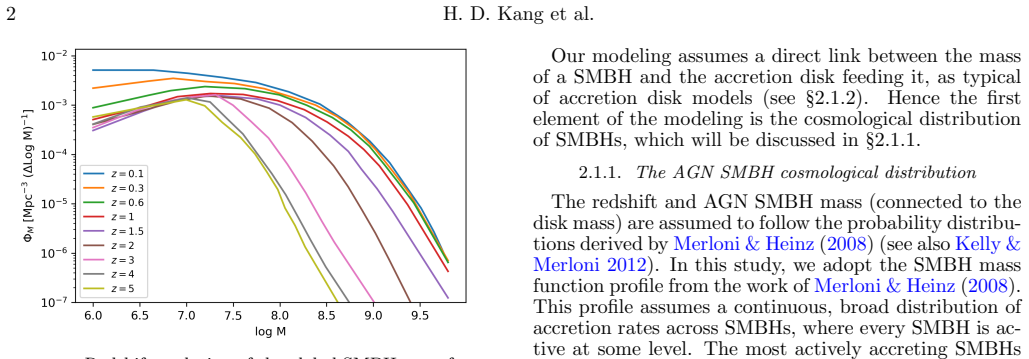
The machinery is a Monte Carlo population synthesis whose pivotal quantity is the Thomson optical depth $\tau(R_{\rm em},R_{\rm GRB})$ from the burst location to the disk surface. Host AGNs are drawn from a supermassive black hole mass function; disk density and scale height come from the two disk models; each GRB is placed at a radius weighted by disk surface density; the prompt emission is computed with the high-density GRB prescription, in which the external shock forms before internal shocks when $n>6\times10^{6}\,E_{52}\Gamma_{\infty,2}^{-8}\Delta t_{-3}\,\mathrm{cm^{-3}}$; and the afterglow is computed with a Monte Carlo synchrotron model including self-absorption. The emission radius is the external shock radius $R_{\rm ES}=\max(R_{\rm ES}^{\rm thin},R_{\rm ES}^{\rm thick})$, and the dichotomy between scenarios is set by $\tau$: for $\tau\lesssim1$ radiation escapes undiffused, while for $\tau\gtrsim1$ it emerges on the diffusion timescale $t_{\rm diff}\simeq[H(R)-R_{\rm em}]\tau/c$ with the reduced luminosity $L_{\rm diff}\sim L_0(t_0/t_{\rm diff})(\Omega/4\pi)$.
What would settle it
Find and localize AGN-disk GRB candidates in a large sample: the model predicts detectable events overwhelmingly at low redshift (z<1-ish), around SMBHs with M>$10^{7}$.5 solar masses, and from outer disk radii, so a well-localized burst at high redshift or in a low-mass AGN - or with a bright radio afterglow, which self-absorption should suppress - would contradict the central prediction.
Extended reading notes
Core claim
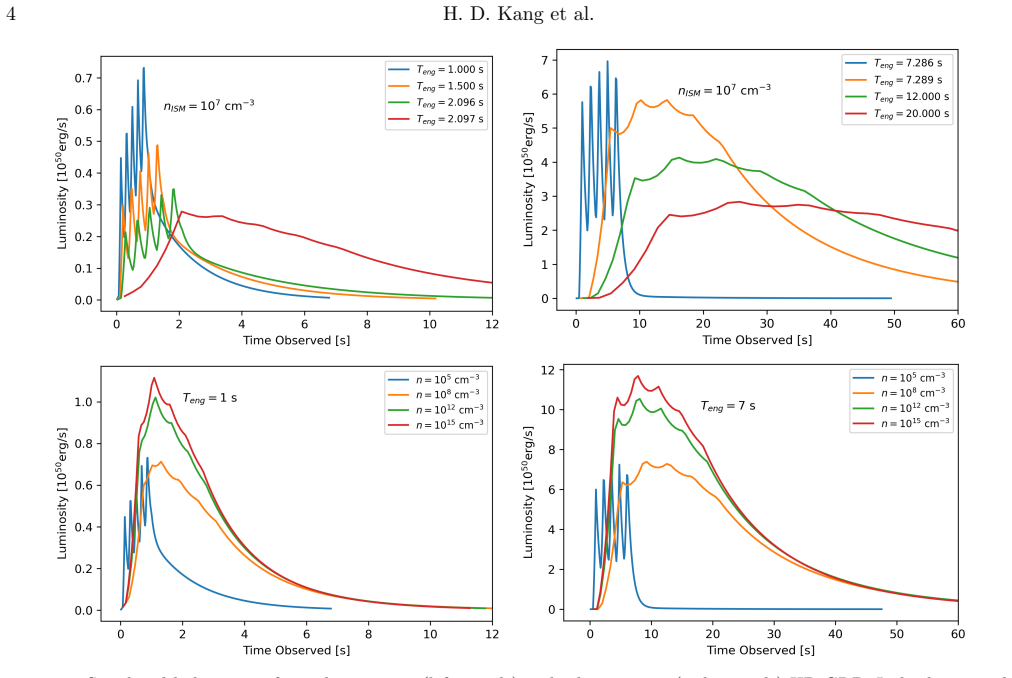
In the paper's own terms, the central result is a selection function: the AGN disk itself decides which GRBs are visible. When the burst radiation must diffuse through the disk (the fully diffused scenario), the expected detectable fraction is at most a few percent - below one percent in the SG disk model and 2-3 percent in the TQM model for prompt gamma-rays - and the survivors are concentrated at low redshift, at outer radii $R\sim [10^6,10^7]R_g$, and around supermassive black holes with $M\gtrsim 10^{7.5}M_\odot$. When radiation escapes through a low-opacity funnel (the undiffused scenario), the detection probability is 38-53 percent depending on burst type and disk model, with a noticeable additional contribution from intermediate disk radii around lower-mass black holes. In both scenarios radio afterglows are essentially invisible because synchrotron self-absorption suppresses low frequencies, while the most promising channels are prompt gamma-rays in the undiffused case and X-ray afterglows in the diffused case. The duration $T_{90}$ is stretched in the dense environment, so short GRBs can appear as long bursts and long bursts as very long ones.
Load-bearing premise
The load-bearing assumption is that the number of GRB progenitors in a disk is proportional to the disk mass and to the local surface density, so bursts are placed exactly where the disk is heaviest; if migration traps or other formation channels concentrate progenitors elsewhere, the predicted detectable fractions and the mass/radius distribution of detections change materially.
Editorial extensions
If this is right
- A fully diffused AGN-disk GRB population would be a rare source class: prompt gamma-ray detection probabilities are below 1-3 percent, so detections should be uncommon even if AGN disks produce a sizable burst rate.
- If the undiffused funnel scenario operates, roughly 40-50 percent of AGN-disk GRBs would be detectable in prompt gamma-rays, making the population accessible to current instruments.
- Radio afterglows from AGN-disk GRBs are predicted to be effectively undetectable with VLA-class sensitivity, so a detected radio counterpart would be difficult to reconcile with the standard self-absorption picture.
- Observed durations are stretched in dense disks: short GRBs would be misclassified as long and long GRBs as very long, so AGN-disk GRBs should be searched for among long and ultra-long bursts with AGN host associations.
- The marked differences between the SG and TQM disk predictions mean that even a few detected AGN-disk GRBs could discriminate between competing AGN disk structures.
Reading between the lines
- The same opacity filter implies that any electromagnetic counterpart to a gravitational-wave merger inside an AGN disk would be strongly biased toward low redshift, massive SMBHs, and outer disk radii; a systematic search along those lines may be more fruitful than an all-sky blind search.
- If the undiffused case is the one realized in nature, current Fermi-era data should already contain a measurable AGN-disk GRB population, and the observed rate could be inverted to place upper limits on the star-formation and merger rates inside AGN disks.
- The predicted near-invisibility of radio afterglows is a sharp testable corollary for wide-field radio facilities; detecting such an afterglow would force the disk models or the self-absorption treatment to be revised.
- The duration-stretching effect suggests that some GRBs currently classified as long with no supernova and an AGN host may be AGN-disk bursts, a classification that follow-up X-ray and optical observations can test.
Editorial analysis
A structured set of objections, weighed in public.
Referee Report
Summary. The paper constructs a Monte Carlo population synthesis of long and short GRBs occurring in the disks of AGNs, combining a cosmological SMBH mass function, two disk models (Sirko-Goodman and Thompson-Quataert-Murray, implemented via pAGN), and high-density GRB emission models for the prompt and afterglow phases. It considers two extreme propagation scenarios: 'undiffused', in which the jet escapes through a low-opacity funnel, and 'diffused', in which radiation is Thomson-scattered and absorbed by the disk. The output is a set of detection probabilities in gamma-ray, X-ray, optical, and radio bands against representative instrument thresholds (Fermi, Chandra, HST, VLA), together with distributions of peak luminosity, afterglow flux, source location in the SMBH mass-radius plane, and T90 stretching. The central qualitative findings are that diffused bursts are observable in only a few percent of cases, preferentially from low redshifts, high SMBH masses, and outer disk radii, while undiffused bursts have much higher on-axis detection probabilities (~40-50%); the T90 distributions are stretched so that short GRBs appear long and long GRBs appear very long.
Significance. If the orientation issue identified below is addressed, the paper would provide a useful first end-to-end population model for AGN-disk GRBs, with falsifiable trends (T90 stretching, mass/radius/redshift selection, and band-dependent detectability) that can be tested with current and future facilities. The work is a forward model that does not fit to its own target predictions, and it makes helpful use of publicly available pAGN disk profiles and of previously published high-density emission calculations. The decision to present probability distributions rather than absolute rates is appropriate given the large uncertainty in the normalization of the AGN stellar population, and the explicit two-scenario treatment (undiffused vs. diffused) frames the problem usefully. The qualitative distinction between a rare, outer-disk, high-mass, low-redshift detectable population in the diffused case and a more accessible population in the undiffused case is physically plausible and worth communicating, pending the quantitative corrections discussed below.
major comments (3)
- [Sec. 3.1(v), Eqs. (9)-(11), Figs. 9, 14, 15] The undiffused detection fractions quoted in the abstract (∼40-50%) are on-axis conditional probabilities, not population-averaged detection probabilities. The Monte Carlo fixes the viewing angle to θobs = 0 for every realization, and Eq. (10), L_att = L0 exp(-τ), contains no solid-angle factor, so these events are only seen if the jet happens to point at the observer. Averaging over a random orientation of the disk/jet axis with the top-hat jet half-opening angle of 5° assumed in Sec. 2.2.2 reduces the undiffused per-event probability by (1 - cos 5°) ≈ 3.8×10^-3, i.e., from ≈40-50% to ≈0.2%. The diffused channel, by contrast, already contains the Ω/4π factor in Eq. (9). The paper therefore does not currently provide a consistent population-normalized comparison of the two scenarios; the undiffused numbers should be relabeled as conditional or, preferably, the simulation should be rerun with θobs drawn from an isotropic distribution.
- [Sec. 3.1(iii), Figs. 9-15] The assumed radial and mass distributions of progenitors, P(R) ∝ Σ(R) and P(M) ∝ MΦ(M,z), are load-bearing for the quantitative fractions in Figs. 9-15. The paper explicitly calls this a zeroth-order approximation and notes that migration traps could alter the radial distribution, but it does not explore the sensitivity of the reported percentages to plausible alternatives. A simple test (e.g., a uniform-in-log-radius prior or a migration-trap-concentrated prior) or an analytic scaling of the detection fraction with the prior would be needed to know whether the 'few percent' and '40-50%' numbers are robust. Without it, these numbers are predictions for one specific stellar-distribution model, not for the AGN-disk GRB population as a whole.
- [Secs. 2.2.1 and 3.2, Fig. 3, Figs. 9-15] The prompt-emission calculations fix Eiso = 10^53 erg for LGRBs and 10^51 erg for SGRBs, with Γ∞ = 100, for every realization. Observed GRB isotropic energies span several orders of magnitude, and the detection fraction is a strong function of the distance at which this fixed luminosity falls below the detector threshold. The quoted quantitative probabilities are therefore conditional on a single representative engine. Sampling Eiso from an observed distribution, or at least showing how the detection fractions vary with Eiso, would make the population predictions meaningful.
minor comments (5)
- [Fig. 7 caption] The caption reads 'LGBRs' but should read 'LGRBs'.
- [Sec. 3.1(v)] The phrase 'massive star collap' should be 'massive star collapse'.
- [Eq. (2)] The notation 'Δt−3' is ambiguous; it should be written as Δt_{-3} with a definition, e.g., Δt_{-3} = Δt / 10^{-3} s.
- [Sec. 3.2 and Fig. 16] The text refers to observed T90 distributions but does not state whether the cosmological (1+z) time dilation has been applied to the simulated durations; a clarification or correction is needed.
- [Fig. 1 caption] The caption says 'mass profile' but the quantity plotted is a mass function; the wording should be corrected.
Circularity Check
No significant circularity: the paper is an explicit forward Monte Carlo model built on independently published inputs; no target quantity is a fitted parameter rewritten as a prediction.
full rationale
The paper's central outputs—detectable fractions and the mass/radius/redshift distributions of detectable AGN-disk GRBs—are generated by a Monte Carlo forward model (Sec. 3.1) from externally specified ingredients: the Merloni & Heinz (2008) SMBH mass function, the SG and TQM disk models implemented in pAGN, the HD-GRB prompt-emission code of Lazzati et al. (2022), and the afterglow code of Wang et al. (2022). These inputs are not fitted to, nor defined in terms of, the paper's target detection probabilities. The authors explicitly label P(R) ∝ Sigma(R) and P(M) ∝ M Phi(M,z) as zeroth-order assumptions, and they explicitly note that the high-SMBH-mass dominance of the detectable fraction is 'an immediate corollary of the assumption of the number of GRB transients being proportional to the disk mass'—an admission, not a disguised fit. The T90 duration distribution is taken from an observed catalog (Bhat et al. 2016) as an assumed intrinsic engine-duration distribution, with the stated subdominance rationale; the predicted observable T90 stretching is then computed, not fitted. Self-citations to Perna et al. (2021a), Lazzati et al. (2022), and Wang et al. (2022) provide the emission and photosphere machinery as prior, code-based calculations; they do not presuppose the present population conclusions. The theta_obs = 0 choice and the absence of an Omega/4pi beaming factor in Eq. (10) mean the quoted 40-50% undiffused detection fractions are on-axis conditional numbers rather than per-event, randomly oriented detection probabilities; that is a normalization/interpretation caveat (a correctness risk), but it is not a circular reduction of a prediction to an input. No step in the derivation chain is equivalent to its inputs by construction.
Assumptions & free parameters
free parameters (5)
- SG disk parameters =
alpha=0.01, eps_s=0.1, l_E=0.5
- TQM disk parameters =
eps_T=0.001, m=0.2, xi=1
- GRB engine parameters =
Eiso=1e53 erg (LGRB), 1e51 erg (SGRB), Gamma_inf=100
- Fermi T90 log-normal fit parameters =
Short: A=36.87, mu=-0.17, sigma=0.48; Long: A=151.71, mu=1.43, sigma=0.48
- Afterglow jet opening angle =
5 degrees
assumptions (6)
- domain assumption The SMBH mass function of Merloni and Heinz (2008) describes the cosmological population of AGN disks for redshifts 0 to 5.
- domain assumption SG and TQM disk models, as implemented in pAGN, give representative density and scale height profiles for AGN disks.
- ad hoc to paper The number of GRB progenitors in a disk is proportional to disk mass, and their radial distribution is proportional to local surface density.
- ad hoc to paper All GRB progenitors lie in the disk mid-plane and all jets are aligned with the disk angular momentum and observed face-on.
- domain assumption The intrinsic engine duration distribution of AGN-disk GRBs equals the observed low-density T90 distribution.
- standard math The fireball external shock radius and the diffusion timescale formulas from Sari and Piran (1995), Sari et al. (1998), and related work apply in the dense AGN disk regime.
Cite this review
Pith. "Pith review of The Cosmological Population of Gamma-Ray Bursts from the Disks of Active Galactic Nuclei." pith.science (2026). https://pith.science/paper/6K25OPTP
@misc{pith2026241217714,
  author       = {Pith},
  title        = {Pith review of: The Cosmological Population of Gamma-Ray Bursts from the Disks of Active Galactic Nuclei},
  year         = {2026},
  howpublished = {\url{https://pith.science/paper/6K25OPTP}},
  note         = {Machine review of arXiv:2412.17714}
}
abstract
With the discovery of gravitational waves (GWs), Active Galactic Nuclei (AGN) disks have emerged as an interesting environment for hosting a fraction of their sources. AGN disks are conducive to forming both long and short Gamma-Ray Bursts (GRBs), and their anticipated cosmological occurrence within these disks has potential to serve as an independent tool for probing and calibrating the population of stars and compact objects within them, and their contribution to the GW-detected population. In this study, we employ Monte Carlo methods in conjunction with models for GRB electromagnetic emission in extremely dense media to simulate the cosmological occurrence of both long and short GRBs within AGN disks, while also estimating their detectability across a range of wavelengths, from gamma-rays to radio. We investigate two extreme scenarios: ``undiffused", in which the radiation escapes without significant scattering (i.e. if the progenitor has excavated a funnel within the disk), and ``diffused", in which the radiation is propagated through the high-density medium, potentially scattered and absorbed. In the diffused case, we find that the majority of detectable GRBs, which are at most a few percent of the total, are likely to originate from lower redshifts, and from the outermost regions of large supermassive black hole (SMBH) masses, $\gtrsim 10^{7.5} \rm M_{\odot}$. In the undiffused case, which has a GRB detection probability $\sim 40-50\%$, we expect a similar trend, but with a considerable contribution from the intermediate regions of lower SMBH masses. Detectable emission is generally expected to be dominant in prompt $\gamma$-rays if diffusion is not dominant, and X-ray afterglow if diffusion is important; however, the nature of the dominant observable signal highly depends on the specific AGN disk model, hence making GRBs in AGN disks also potential probes of the disk structures.
Figures

Figures from the paper (13 more)


Reference graph
Works this paper leans on
-
[1]
Abbott, B. P., Abbott, R., Abbott, T. D., et al. 2020, ApJ, 892, L3, doi: 10.3847/2041-8213/ab75f5
-
[2]
Abbott, R., Abbott, T. D., Abraham, S., et al. 2020, Phys. Rev. Lett., 125, 101102, doi: 10.1103/PhysRevLett.125.101102
-
[3]
Artymowicz, P., Lin, D. N. C., & Wampler, E. J. 1993, ApJ, 409, 592, doi: 10.1086/172690
doi:10.1086/172690 1993
-
[4]
1993, ApJ, 413, 281, doi: 10.1086/172995
Band, D., Matteson, J., Ford, L., et al. 1993, ApJ, 413, 281, doi: 10.1086/172995
doi:10.1086/172995 1993
-
[5]
M., Mac Low, M.-M., McKernan, B., & Ford, K
Bellovary, J. M., Mac Low, M.-M., McKernan, B., & Ford, K. E. S. 2016, ApJ, 819, L17, doi: 10.3847/2041-8205/819/2/L17
-
[6]
Bhat, P. N., Meegan, C. A., von Kienlin, A., et al. 2016, The Astrophysical Journal Supplement Series, 223, 28, doi: 10.3847/0067-0049/223/2/28
-
[7]
Callister, T. A., Haster, C.-J., Ng, K. K. Y., Vitale, S., & Farr, W. M. 2021, ApJ, 922, L5, doi: 10.3847/2041-8213/ac2ccc
-
[8]
Cantiello, M., Jermyn, A. S., & Lin, D. N. C. 2021, ApJ, 910, 94, doi: 10.3847/1538-4357/abdf4f
Show all 72 references
-
[9]
Chen, Y.-X., Jiang, Y.-F., Goodman, J., & Lin, D. N. C. 2024, ApJ, 974, 106, doi: 10.3847/1538-4357/ad6dd4
2024 doi
-
[10]
Chen, Y.-X., Jiang, Y.-F., Goodman, J., & Ostriker, E. C. 2023, ApJ, 948, 120, doi: 10.3847/1538-4357/acc023
2023 doi
-
[11]
Chen, Y.-X., & Lin, D. N. C. 2023, MNRAS, 522, 319, doi: 10.1093/mnras/stad992
2023 doi
-
[12]
J., Jermyn, A
Dittmann, A. J., Jermyn, A. S., & Cantiello, M. 2023, ApJ, 946, 56, doi: 10.3847/1538-4357/acacf2
2023 doi
- [13]
- [14]
-
[15]
S., Caban, F., et al
Fabj, G., Nasim, S. S., Caban, F., et al. 2020, MNRAS, 499, 2608, doi: 10.1093/mnras/staa3004
2020 doi
-
[16]
E., Madras, C
Fenimore, E. E., Madras, C. D., & Nayakshin, S. 1996, ApJ, 473, 998, doi: 10.1086/178210
1996 doi
-
[17]
Fong, W., Berger, E., Margutti, R., & Zauderer, B. A. 2015, ApJ, 815, 102, doi: 10.1088/0004-637X/815/2/102
2015 doi
-
[18]
A., Bonnerot, C., & Gerosa, D
Gangardt, D., Trani, A. A., Bonnerot, C., & Gerosa, D. 2024, Monthly Notices of the Royal Astronomical Society, 530, 3689–3705, doi: 10.1093/mnras/stae1117
2024 doi
-
[19]
L., et al
Gendre, B., Stratta, G., Atteia, J. L., et al. 2013, The Astrophysical Journal, 766, 30, doi: 10.1088/0004-637X/766/1/30
2013 doi
-
[20]
Gilbaum, S., & Stone, N. C. 2022, ApJ, 928, 191, doi: 10.3847/1538-4357/ac4ded
2022 doi
-
[22]
2002, The Astrophysical Journal, 568, 820, doi: 10.1086/339985
Granot, J., & Sari, R. 2002, The Astrophysical Journal, 568, 820, doi: 10.1086/339985
2002 doi
-
[23]
Grishin, E., Bobrick, A., Hirai, R., Mandel, I., & Perets, H. B. 2021, arXiv e-prints, arXiv:2105.09953. https://arxiv.org/abs/2105.09953 18 H. D. Kang et al
2021 arXiv
-
[24]
Grishin, E., Gilbaum, S., & Stone, N. C. 2024, MNRAS, 530, 2114, doi: 10.1093/mnras/stae828
2024 doi
-
[25]
T., Soszy´ nski, I., Gladders, M
Holland, S. T., Soszy´ nski, I., Gladders, M. D., et al. 2002, The Astronomical Journal, 124, 639–645, doi: 10.1086/341388
2002 doi
-
[26]
S., Dittmann, A
Jermyn, A. S., Dittmann, A. J., Cantiello, M., & Perna, R. 2021, ApJ, 914, 105, doi: 10.3847/1538-4357/abfb67
2021 doi
-
[27]
C., & Merloni, A
Kelly, B. C., & Merloni, A. 2012, Advances in Astronomy, 2012, 970858, doi: 10.1155/2012/970858
2012 doi
-
[28]
2015, Annual Review of Astronomy and Astrophysics, 53, 115, doi: 10.1146/annurev-astro-082214-122316
King, A., & Pounds, K. 2015, Annual Review of Astronomy and Astrophysics, 53, 115, doi: 10.1146/annurev-astro-082214-122316
2015 doi
-
[29]
Krongold, Y., & Prochaska, J. X. 2013, The Astrophysical Journal, 774, 115, doi: 10.1088/0004-637x/774/2/115
2013 doi
-
[30]
P., & Levan, A
Lazzati, D., Perna, R., Gompertz, B. P., & Levan, A. J. 2023, ApJ, 950, L20, doi: 10.3847/2041-8213/acd18c
2023 doi
-
[31]
2022, ApJ, 938, L18, doi: 10.3847/2041-8213/ac98ad
Lazzati, D., Soares, G., & Perna, R. 2022, ApJ, 938, L18, doi: 10.3847/2041-8213/ac98ad
2022 doi
-
[32]
J., Malesani, D
Levan, A. J., Malesani, D. B., Gompertz, B. P., et al. 2023, Nature Astronomy, 7, 976, doi: 10.1038/s41550-023-01998-8
2023 doi
-
[33]
M., Li, H., Lai, D., & Li, S
Li, J., Dempsey, A. M., Li, H., Lai, D., & Li, S. 2023, ApJ, 944, L42, doi: 10.3847/2041-8213/acb934
2023 doi
-
[34]
2024, ApJ, 969, 37, doi: 10.3847/1538-4357/ad463a
Liu, J.-R., Wang, Y.-L., & Wang, J.-M. 2024, ApJ, 969, 37, doi: 10.3847/1538-4357/ad463a
2024 doi
-
[35]
McKernan, B., Ford, K. E. S., Callister, T., et al. 2022, MNRAS, 514, 3886, doi: 10.1093/mnras/stac1570
2022 doi
-
[36]
2008, MNRAS, 388, 1011, doi: 10.1111/j.1365-2966.2008.13472.x M´ esz´ aros, P., & Rees, M
Merloni, A., & Heinz, S. 2008, MNRAS, 388, 1011, doi: 10.1111/j.1365-2966.2008.13472.x M´ esz´ aros, P., & Rees, M. J. 1997, ApJ, 476, 232, doi: 10.1086/303625
2008
-
[37]
D., Giannios, D., & Mimica, P
Metzger, B. D., Giannios, D., & Mimica, P. 2012, Monthly Notices of the Royal Astronomical Society, 420, 3528, doi: 10.1111/j.1365-2966.2011.20247.x
2012
-
[38]
L., et al
Muccino, M., Ruffini, R., Bianco, C. L., et al. 2013, The Astrophysical Journal, 772, 62, doi: 10.1088/0004-637x/772/1/62
2013 doi
-
[39]
2021, ApJ, 923, 173, doi: 10.3847/1538-4357/ac249c
Pan, Z., & Yang, H. 2021, ApJ, 923, 173, doi: 10.3847/1538-4357/ac249c
2021 doi
-
[40]
2000, ApJ, 544, L17, doi: 10.1086/317301
Panaitescu, A., & M´ esz´ aros, P. 2000, ApJ, 544, L17, doi: 10.1086/317301
2000 doi
-
[41]
2002, ApJ, 580, 261, doi: 10.1086/343081
Perna, R., & Lazzati, D. 2002, ApJ, 580, 261, doi: 10.1086/343081
2002 doi
-
[42]
2021a, ApJ, 906, L7, doi: 10.3847/2041-8213/abd319
Perna, R., Lazzati, D., & Cantiello, M. 2021a, ApJ, 906, L7, doi: 10.3847/2041-8213/abd319
-
[43]
2003, ApJ, 585, 775, doi: 10.1086/346109
Perna, R., Lazzati, D., & Fiore, F. 2003, ApJ, 585, 775, doi: 10.1086/346109
2003 doi
-
[44]
2021b, ApJ, 915, 10, doi: 10.3847/1538-4357/abfdb4
Perna, R., Tagawa, H., Haiman, Z., & Bartos, I. 2021b, ApJ, 915, 10, doi: 10.3847/1538-4357/abfdb4
-
[45]
2004, Reviews of Modern Physics, 76, 1143, doi: 10.1103/RevModPhys.76.1143
Piran, T. 2004, Reviews of Modern Physics, 76, 1143, doi: 10.1103/RevModPhys.76.1143
2004 doi
-
[46]
Proga, D., & Kallman, T. R. 2004, The Astrophysical Journal, 616, 688, doi: 10.1086/424913
2004 doi
-
[47]
2023, MNRAS, 521, 4233, doi: 10.1093/mnras/stad816
Ray, M., Lazzati, D., & Perna, R. 2023, MNRAS, 521, 4233, doi: 10.1093/mnras/stad816
2023 doi
- [48]
-
[49]
2022, ApJ, 940, L44, doi: 10.3847/2041-8213/aca025
Ren, J., Chen, K., Wang, Y., & Dai, Z.-G. 2022, ApJ, 940, L44, doi: 10.3847/2041-8213/aca025
2022 doi
-
[50]
2023, MNRAS, 524, 2770, doi: 10.1093/mnras/stad1926
Rowan, C., Boekholt, T., Kocsis, B., & Haiman, Z. 2023, MNRAS, 524, 2770, doi: 10.1093/mnras/stad1926
2023 doi
-
[51]
J., et al
Samsing, J., Bartos, I., D’Orazio, D. J., et al. 2022, Nature, 603, 237, doi: 10.1038/s41586-021-04333-1
2022 doi
-
[52]
1995, ApJ, 455, L143, doi: 10.1086/309835
Sari, R., & Piran, T. 1995, ApJ, 455, L143, doi: 10.1086/309835
1995 doi
-
[53]
Sari, R., Piran, T., & Halpern, J. P. 1999, ApJ, 519, L17, doi: 10.1086/312109
1999 doi
-
[54]
1998, ApJ, 497, L17, doi: 10.1086/311269
Sari, R., Piran, T., & Narayan, R. 1998, ApJ, 497, L17, doi: 10.1086/311269
1998 doi
-
[55]
Scalo, J., & Wheeler, J. C. 2001, The Astrophysical Journal, 562, 664–669, doi: 10.1086/323858
2001 doi
-
[56]
I., & Sunyaev, R
Shakura, N. I., & Sunyaev, R. A. 1973, A&A, 500, 33
1973
-
[57]
2003, MNRAS, 341, 501, doi: 10.1046/j.1365-8711.2003.06431.x
Sirko, E., & Goodman, J. 2003, MNRAS, 341, 501, doi: 10.1046/j.1365-8711.2003.06431.x
2003
- [58]
-
[59]
2020, ApJ, 898, 25, doi: 10.3847/1538-4357/ab9b8c
Tagawa, H., Haiman, Z., & Kocsis, B. 2020, ApJ, 898, 25, doi: 10.3847/1538-4357/ab9b8c
2020 doi
-
[60]
S., Haiman, Z., Perna, R., & Bartos, I
Tagawa, H., Kimura, S. S., Haiman, Z., Perna, R., & Bartos, I. 2023a, ApJ, 950, 13, doi: 10.3847/1538-4357/acc4bb —. 2023b, ApJ, 946, L3, doi: 10.3847/2041-8213/acc103
-
[61]
2013, Publications of the Astronomical Society of Japan, 65, doi: 10.1093/pasj/65.4.88
Takeuchi, S., Ohsuga, K., & Mineshige, S. 2013, Publications of the Astronomical Society of Japan, 65, doi: 10.1093/pasj/65.4.88
2013 doi
-
[62]
A., Quataert, E., & Murray, N
Thompson, T. A., Quataert, E., & Murray, N. 2005, ApJ, 630, 167, doi: 10.1086/431923
2005 doi
-
[63]
Wang, Y., Zhu, Z., & Lin, D. N. C. 2024, MNRAS, 528, 4958, doi: 10.1093/mnras/stae321
2024 doi
-
[64]
2022, MNRAS, 516, 5935, doi: 10.1093/mnras/stac1968
Wang, Y.-H., Lazzati, D., & Perna, R. 2022, MNRAS, 516, 5935, doi: 10.1093/mnras/stac1968
2022 doi
-
[65]
2021, ApJ, 923, L23, doi: 10.3847/2041-8213/ac400a
Wang, Y.-H., McKernan, B., Ford, S., et al. 2021, ApJ, 923, L23, doi: 10.3847/2041-8213/ac400a
2021 doi
-
[66]
Waxman, E., & Draine, B. T. 2000, ApJ, 537, 796, doi: 10.1086/309053
2000 doi
-
[67]
2016, ApJ, 824, L17, doi: 10.3847/2041-8205/824/2/L17
Xie, C., Fang, T., Wang, J., Liu, T., & Jiang, X. 2016, ApJ, 824, L17, doi: 10.3847/2041-8205/824/2/L17
2016 doi
-
[68]
2022, ApJ, 933, L28, doi: 10.3847/2041-8213/ac7c0b
Yang, Y., Bartos, I., Fragione, G., et al. 2022, ApJ, 933, L28, doi: 10.3847/2041-8213/ac7c0b
2022 doi
-
[69]
2024a, ApJ, 976, 63, doi: 10.3847/1538-4357/ad8139
Zhang, H.-H., Zhu, J.-P., & Yu, Y.-W. 2024a, ApJ, 976, 63, doi: 10.3847/1538-4357/ad8139
-
[70]
Zhang, S.-R., Yuan, Y.-F., Wang, J.-M., & Ho, L. C. 2024b, MNRAS, 532, 1330, doi: 10.1093/mnras/stae1546
-
[71]
E., & Heger, A
Zhang, W., Woosley, S. E., & Heger, A. 2004, ApJ, 608, 365, doi: 10.1086/386300
2004 doi
-
[72]
2021a, ApJ, 914, L19, doi: 10.3847/2041-8213/abff5a
Zhu, J.-P., Yang, Y.-P., Zhang, B., et al. 2021a, ApJ, 914, L19, doi: 10.3847/2041-8213/abff5a
-
[73]
2021b, ApJ, 906, L11, doi: 10.3847/2041-8213/abd412 This paper was built using the Open Journal of As- trophysics LATEX template
Zhu, J.-P., Zhang, B., Yu, Y.-W., & Gao, H. 2021b, ApJ, 906, L11, doi: 10.3847/2041-8213/abd412 This paper was built using the Open Journal of As- trophysics LATEX template. The OJA is a journal which provides fast and easy peer review for new papers in the astro-ph section of...
Reviewed August 11, 2026 · model on record in the stance chip above.
Discussion (0). Continue with ORCID to comment.